Chapter 5. Evidence Standards, Causality, and Artifact Control in RNA Biology
Scope Note
RNA biology is built from measurements that are powerful but indirect. An RNA molecule may be extracted, fragmented, copied, amplified, enriched, crosslinked, chemically modified, imaged, folded in vitro, inferred from reads, or predicted by a model before a scientist writes a biological conclusion about it. This chapter teaches how to match the strength of a conclusion to the evidence that actually supports it. It defines observation, inference, hypothesis, mechanism, causality, artifact, perturbation, rescue, epistasis, compensation, biochemical reconstitution, orthogonal evidence, negative evidence, and evidence grading. These terms are used throughout later chapters when the book distinguishes a measured RNA species from an inferred transcript, a binding signal from a regulatory mechanism, a perturbation phenotype from direct causality, or a predicted RNA structure from an observed structure.
The chapter is not a substitute for detailed methods chapters. Later chapters explain RNA modification mapping, structure probing, CLIP-family interaction assays, Ribo-seq, spatial transcriptomics, long-read sequencing, single-cell RNA-seq, direct RNA sequencing, perturbation screens, clinical RNA diagnostics, and computational modeling in method-specific depth. Here the goal is more general: to give the reader a disciplined way to ask, for every RNA claim, “What was measured, what was inferred, what alternatives remain, and what controls would change the confidence level?”
The central principle is that the evidence standard is set by the claim, not by the prestige, complexity, or novelty of the method. A high-quality RNA-seq experiment can strongly support an abundance claim while weakly supporting a direct-regulation claim. A convincing CLIP peak can support association near a recovered RNA segment while failing to prove functional regulation. A genetic perturbation can show dependence on a locus or factor while leaving open whether the effect is direct, indirect, compensated, toxic, or off-target. Strong RNA biology usually comes from convergent evidence: multiple methods with different biases support the same narrow claim, and the claim is stated with its conditions and limits.
Executive Summary
Evidence standards are the rules that connect data to claims. In RNA biology, a single experimental result often supports several possible statements at different strengths. Detection of an RNA fragment by sequencing supports the claim that a sequence-compatible molecule was recovered from a sample under a defined protocol. It does not automatically establish the full transcript model, the mature isoform, the cellular location, the molecule’s function, or its mechanism of action. Enrichment of an RNA after immunoprecipitation supports association with the enrichment procedure and, with appropriate controls, association with a protein or modification. It does not automatically prove direct binding, site-specific regulation, or causal consequence. A phenotype after perturbing an RNA, enzyme, or regulatory element supports dependence on the perturbed system, but the dependence may be direct, indirect, redundant, compensated, or artifactual.
The most useful vocabulary distinction is between observation, inference, hypothesis, mechanism, and artifact. An observation is a measurement-level statement: what the assay detected in a defined sample after defined processing. An inference is a reasoned interpretation that connects observations to a broader biological object or process. A hypothesis is a proposed explanation that should generate testable predictions. A mechanism is a causal account that names molecular actors, order of events, states, reactions or interactions, and biological consequences. An artifact is a result produced, distorted, or exaggerated by sample handling, assay design, analysis, or reporting rather than by the biological process under study.
Causality usually requires perturbation, but perturbation alone is not enough. A convincing causal argument normally combines a specific perturbation, a relevant readout, an appropriate time scale, dose or stoichiometry information when possible, rescue or complementation, orthogonal methods, and a mechanism-consistent result. Rescue experiments are especially important for RNA genes and RNA elements because deleting DNA may alter promoters, enhancers, chromatin, transcription, overlapping transcripts, or neighboring genes independent of the RNA product. For RNA modifications, perturbing a writer, eraser, or reader enzyme may affect many RNAs at once. For condensates, changing a low-complexity protein or RNA may alter phase behavior, stress responses, transcription, RNA processing, and cell state together.
Biochemical reconstitution is powerful because it tests whether defined purified components can perform a proposed reaction or interaction. Reconstitution can distinguish direct molecular sufficiency from cellular correlation. It can show that an RNA-binding protein binds a sequence or structure, an editing enzyme modifies a defined duplex, a nuclease cleaves a substrate, or a ribonucleoprotein complex performs a reaction. Reconstitution also simplifies the cell. Salt, magnesium, molecular crowding, RNA length, modification state, protein stoichiometry, compartmentalization, competing ligands, and omitted cofactors can change the result. An in vitro binding constant does not automatically predict regulation in a cell, and a cellular association does not automatically prove direct physical binding.
Sequencing, imaging, structural biology, and computation answer complementary questions. RNA-seq can quantify abundance and isoform evidence, but reproducibility depends on sample handling, RNA integrity, depletion or enrichment, library construction, sequencing design, alignment, quantification, normalization, batch handling, and reporting. Imaging can reveal localization, dynamics, and heterogeneity, but colocalization is not mechanism. Structural methods can define molecular arrangements, but a static structure may not describe all cellular states. Computational methods can integrate evidence and generate predictions, but predictions inherit input data, assumptions, training sets, and benchmark limitations.
Three RNA topics require especially careful causal language. Noncoding RNA function claims require evidence beyond transcript detection or annotation, because noncoding transcripts may be functional molecules, transcriptional byproducts, unstable intermediates, regulatory-element markers, or assay artifacts. RNA modification mechanisms require separate evidence for site existence, stoichiometry, writer or eraser dependence, reader recognition, and functional consequence. RNA condensate claims should distinguish in vitro phase behavior, cellular colocalization, endogenous material properties, perturbation effects, and causal biological mechanism.
The practical rule is to name the claim type before judging the evidence. “This lncRNA is expressed,” “this lncRNA binds a protein,” “this lncRNA changes chromatin,” and “this lncRNA causes a phenotype through that chromatin change” are different claims. They require different controls, perturbations, and levels of support. The same discipline applies to every RNA class, method, disease association, and therapeutic mechanism.
Concept Inventory
- Observation: a measurement-level statement describing what an assay detected under defined conditions. In RNA biology, observation claims should include the molecule class, sample, assay, and processing step when those details affect interpretation. “Poly(A)-selected RNA-seq recovered reads from a transcript” is an observation. “The transcript is functional” is not an observation.
- Inference: a reasoned interpretation that connects observations to a broader biological object, process, or model. A transcript model inferred from junction-spanning reads is stronger than a model inferred from a single internal read. A base-pairing model supported by compensatory mutations is stronger than a structure predicted only from sequence. Inference is not guesswork, but it should remain distinguishable from direct measurement.
- Hypothesis: a proposed explanation that should generate tests. “This lncRNA recruits a chromatin regulator to a locus” is a hypothesis when the evidence consists of expression, localization, and perturbation. The hypothesis becomes stronger when the RNA region, protein partner, recruitment step, genomic target, and phenotype are tested separately.
- Mechanism: a causal account that names molecular actors, molecular states, order of events, reactions or interactions, and consequences. A pathway diagram is not automatically a mechanism. A mechanism for RNA decay, for example, would specify how a poly(A) tail is shortened, how decapping occurs, which exonuclease degrades the body of the RNA, how the pathway is recruited, and how the process changes RNA abundance.
- Artifact: a result produced, distorted, or exaggerated by the measurement system rather than by the biological process under study. Artifact does not imply carelessness or fraud. It means the result may reflect extraction, labeling, enrichment, reverse transcription, amplification, mapping, normalization, antibody specificity, crosslinking chemistry, image processing, or analysis rather than the biological state.
- Causality: a relationship in which changing one biological object, state, reaction, or interaction is responsible for a defined effect under a defined condition. Causality can be direct, indirect, necessary, sufficient, redundant, context-dependent, or condition-limited. A causal statement should identify the cause, effect, system, condition, time scale, and evidence.
- Genetic perturbation: deliberate alteration of DNA, RNA, or regulatory machinery to test dependence of a phenotype, molecular state, or pathway on a component. RNA knockdown, CRISPR interference, locus deletion, splice-site mutation, motif mutation, base editing, writer-enzyme knockout, and antisense oligonucleotide treatment are all perturbations, but they have different interpretation hazards.
- Rescue: restoration of a phenotype or molecular state by reintroducing or replacing the perturbed component. Rescue is strongest when the rescued molecule matches the endogenous dose, isoform, localization, timing, molecular form, and regulatory context. Mutant rescue can test whether a specific RNA sequence, structure, modification site, catalytic residue, or binding surface is required.
- Epistasis: the interpretation of how two or more perturbations interact. Epistasis can suggest pathway order, redundancy, shared function, or independence. The conclusion depends on the measurement scale and the expected effect of independent perturbations.
- Compensation: biological adjustment that masks, redirects, or changes the effect of a perturbation. A stable knockout can induce paralogs, alter pathway activity, change cell state, or select for adapted cells. Acute perturbations can reduce long-term adaptation but introduce their own timing, toxicity, or delivery artifacts.
- Biochemical reconstitution: reconstruction of a molecular reaction or interaction from purified or minimally controlled components. It tests direct sufficiency under chosen conditions, not automatically cellular necessity.
- Binding assay: measures association, specificity, affinity, kinetics, or stoichiometry between molecules. Enrichment is not the same as direct binding. A pulldown signal, a CLIP peak, and a purified binding constant support related but distinct claims.
- Orthogonal evidence: evidence from methods with different biases that converges on the same claim. Two assays that depend on the same antibody are not fully orthogonal. Sequencing plus imaging, genetics plus rescue, or cellular perturbation plus purified reconstitution can be more informative than repeated use of one assay family.
- Negative evidence: evidence that a proposed RNA, interaction, modification, structure, or mechanism was not detected or did not produce an expected effect under conditions where detection or effect should have been possible. Negative evidence is weak when sensitivity, power, condition, or controls are inadequate.
- Evidence grade: a claim-specific label describing how strongly available evidence supports a statement. The same paper may strongly support a measurement claim and weakly support a mechanistic claim.
What to Know Before Reading This Chapter
The reader should know that RNA is both a chemical molecule and a biological information carrier. RNA can be copied from DNA, processed, folded, modified, transported, translated, degraded, packaged, or secreted. RNA can also act as a structural component, catalytic molecule, guide, scaffold, regulator, substrate, ligand, or therapeutic agent. Because RNA can participate in so many processes, the same observed change can have many explanations.
The reader should also know that RNA measurements usually transform the molecule before it is detected. Standard RNA-seq often converts RNA into complementary DNA, amplifies fragments, sequences them, and maps reads to a genome or transcriptome. Imaging labels RNAs with probes, tags, or reporters. CLIP-family methods crosslink RNA-protein contacts, digest unprotected RNA, immunoprecipitate a protein, and sequence recovered fragments. Structure-probing methods chemically or enzymatically mark conformational features and infer structure from reactivity patterns. Each transformation can introduce bias.
Two running examples will help. First, consider a long noncoding RNA, or lncRNA. A lncRNA is a transcript that is not primarily interpreted as a protein-coding mRNA. Detecting a lncRNA by RNA-seq shows expression under a protocol. Depleting the lncRNA and observing a phenotype suggests functional involvement. Restoring the RNA and recovering the phenotype strengthens causality. Showing that a defined RNA region binds a defined protein, that the interaction is needed in cells, and that purified components reconstitute the effect strengthens mechanism.
Second, consider an RNA modification such as N6-methyladenosine, commonly abbreviated m6A. A sequencing enrichment peak may suggest that an RNA region contains m6A. Direct detection or orthogonal chemistry strengthens the site-existence claim. Writer, eraser, reader, stoichiometry, site mutation, and rescue experiments are needed before claiming that a specific m6A site causes a specific change in splicing, export, translation, localization, or decay.
The most important warning is simple: do not let the method name become the conclusion. “CLIP-seq” does not automatically mean direct regulatory binding. “RNA velocity” does not automatically mean observed cell fate. “Phase separation” does not automatically mean a cellular mechanism. “Differential expression” does not automatically mean causal regulation. The evidence standard is set by the biological claim.
5.1. Claim types: mechanism, observation, inference, hypothesis, and artifact
A claim type states what kind of scientific sentence is being made. Claim types matter because RNA biology often uses the same noun in weak and strong claims. “XIST RNA is detected,” “XIST RNA coats the inactive X chromosome,” “XIST RNA binds chromatin-associated proteins,” and “XIST RNA is required for X-chromosome inactivation through defined RNA-protein interactions” are not interchangeable. They differ in measurement, interpretation, and causal force.
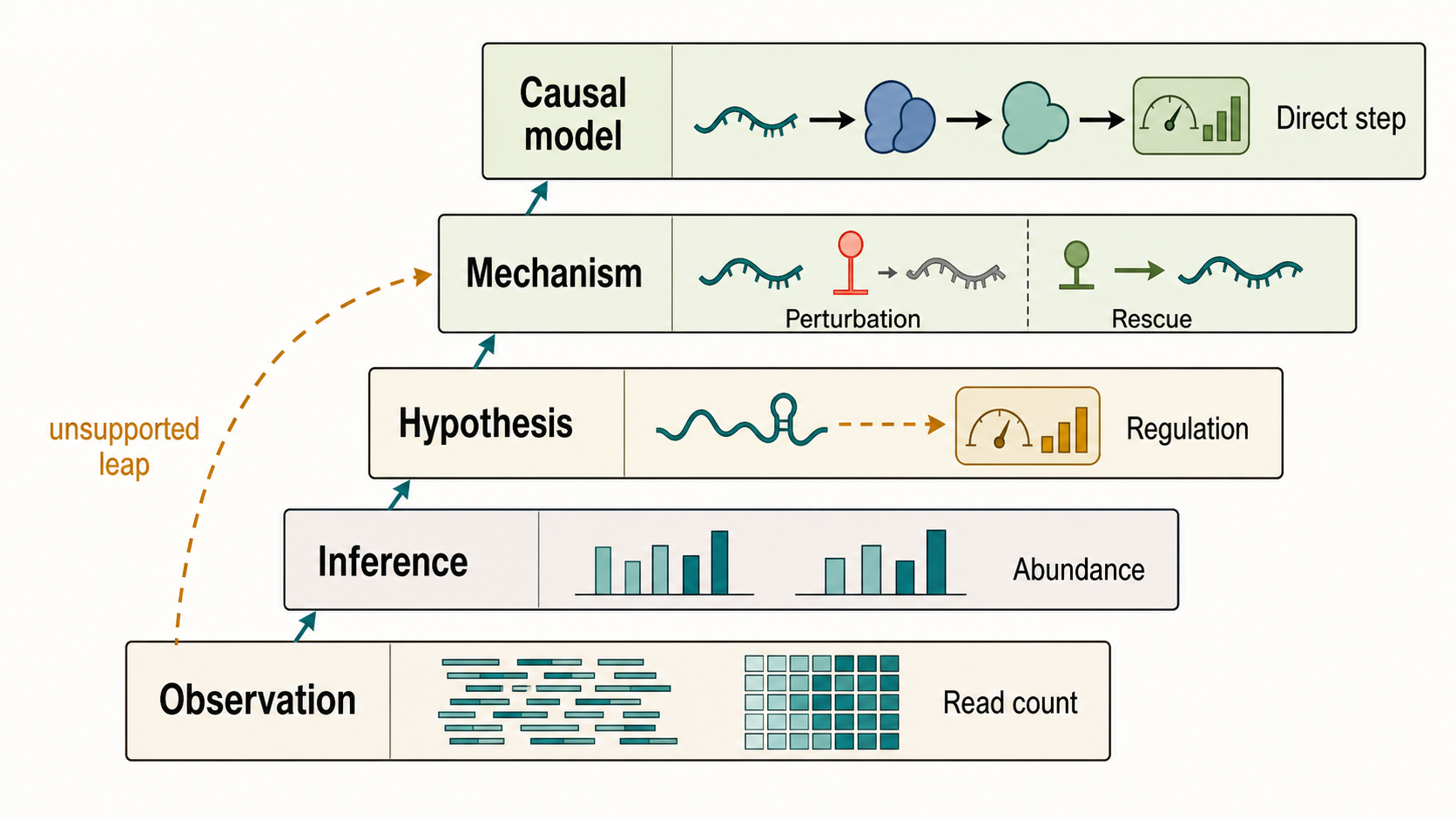
Figure 5.1. Claim-Type Ladder for RNA Biology. A statement in RNA biology can be positioned at one of five levels of interpretive strength—observation, inference, hypothesis, mechanism, and causal model—depending on what the evidence directly supports. Using a long noncoding RNA or m6A modification as a running example, the figure traces how a raw RNA-seq read count becomes an inferred transcript abundance, then a testable regulation hypothesis, then a perturbation-and-rescue result, and finally a molecularly reconstituted or structurally supported mechanism. Positioning each claim at its correct level prevents the common error of treating detection as proof of function or enrichment as proof of direct binding.
Table 5.1. RNA Evidence Claims and Minimal Support. Minimal and strong evidence requirements for twelve common RNA biology claim types, with the most frequent overclaim, a representative artifact risk, and related chapters.
| Claim type | Minimal support | Strong support | Common overclaim | Typical artifact | Related chapters |
|---|---|---|---|---|---|
| Existence | Reads or signal detected under a defined protocol | Orthogonal assay confirms; detection replicated across independent samples | “Transcript is functional” inferred from detection alone | Background reads, PCR contamination | Chapter 18, Chapter 122, Chapter 125 |
| Abundance | Quantified reads in replicated samples with appropriate controls | Multiple quantification methods agree; spike-in normalization applied | “Gene is activated” stated without separating transcription, stability, or cell composition | Library-composition bias, RNA degradation during extraction | Chapter 122, Chapter 125, Chapter 139 |
| Isoform | Junction-spanning reads or long reads covering the isoform | Long-read or targeted validation per isoform; error model applied | Assigning a full isoform model from short internal reads only | Multi-mapping, short-read truncation artifacts | Chapter 18, Chapter 128, Chapter 141 |
| Localization | Signal detected in a compartment by imaging or subcellular fractionation | Single-molecule imaging or orthogonal fractionation method agrees | “RNA functions in that compartment” from localization alone | Fixation artifacts, probe bleed-through, fractionation cross-contamination | Chapter 74, Chapter 106, Chapter 130 |
| Binding | Enrichment in pulldown or CLIP peak over appropriate controls | In vitro binding constant measured plus cellular CLIP with controls | “Direct regulation” inferred from enrichment | Antibody cross-reactivity, nonspecific recovery, indirect complex membership | Chapter 56, Chapter 133, Chapter 138 |
| Structure | Probing-reactivity pattern or sequence covariation supports base pairs | Compensatory mutations restore pairing and function; high-resolution structure agrees | “Structure is known” stated from a minimum-free-energy prediction | Chemical-conversion bias, conformation selection during sample prep | Chapter 4, Chapter 59, Chapter 131 |
| Modification | Antibody-enrichment peak or chemical signature at a site | Orthogonal detection method agrees; site mutation eliminates signal; stoichiometry measured | “Modification regulates the RNA” inferred from enrichment peak alone | Antibody bias, incomplete chemical conversion, RT stops at unmodified sites | Chapter 46, Chapter 132 |
| Decay | Reduced steady-state abundance after metabolic labeling or actinomycin chase | Measured half-life in multiple conditions; transcription rate measured separately | “RNA is unstable” inferred from low steady-state abundance | Transcription rate changes confound decay-rate estimates | Chapter 32, Chapter 35, Chapter 38 |
| Translation | Ribosome footprints over a coding sequence | Polysome association confirmed; protein output quantified independently | “Protein level reflects translation efficiency” without measuring translation directly | Ribosome-pausing artifacts, footprint-mapping bias at ends | Chapter 66-Chapter 71, Chapter 135 |
| Function | Perturbation phenotype with target-engagement evidence | Rescue and mutant-rescue support specificity; orthogonal perturbation agrees | “Transcript is functional” inferred from annotation or conservation | Off-target effects, indirect network responses, compensation | Chapter 5, Chapter 91, Chapter 136 |
| Disease association | Statistical correlation in a patient cohort with adjustment for confounders | Replicated in an independent cohort; cell-composition effects ruled out | “Causal disease driver” inferred from association | Cell-composition changes, medication effects, batch confounding | Chapter 139, Chapter 121, Chapter 146 |
| Therapeutic mechanism | Target engagement confirmed in relevant tissue | Pharmacodynamic readout linked to clinical outcome; off-target activity assessed | “Efficacy proves the proposed mechanism” from clinical response alone | Delivery variation, immune activation, off-target activity | Chapter 149-Chapter 162 |
An observation is closest to the assay output. Examples include “reads mapped to this locus,” “fluorescence signal appeared in the nucleus,” “immunoprecipitation enriched this RNA,” “a chemical probe produced mutations at this nucleotide,” or “a purified enzyme converted this substrate in vitro.” Good observation claims state the assay, sample, processing step, and condition. An observation should not silently absorb interpretation. A sequencing read is not automatically a mature transcript. A fluorescence spot is not automatically a functional granule. A recovered crosslinked fragment is not automatically a regulatory binding site.
An inference connects observations to a broader concept. If reads span exon-exon junctions, the inferred transcript model is stronger than a model inferred from isolated reads. If a structure-probing pattern changes when a ligand binds, the inference may be that the RNA changes conformation. If two genes are co-expressed in a cell type, the inference may be that they belong to a shared program. Inferences can be strong, especially when multiple independent observations converge, but they should remain labeled as inferences when the direct biological object has not been observed.
A hypothesis is a proposed explanation that should produce testable predictions. For example, “this bacterial small RNA represses translation by pairing with the ribosome-binding site of a target mRNA” is a hypothesis until the pairing region, target-site dependence, protein cofactors, and translational output are tested. The hypothesis predicts that disrupting the pairing should weaken repression and that compensatory mutations restoring pairing should restore repression. The hypothesis also predicts a timing relationship: target binding should occur before or during the translational effect.
A mechanism is stronger than a hypothesis because a mechanism describes causal steps. A mechanism should name the actors, substrates, interactions, order, and outcome. For miRNA-mediated repression in animals, a mechanistic account may include a mature miRNA loaded into Argonaute, base pairing between the miRNA seed region and a target site in the mRNA, recruitment of effector complexes, changes in translation and deadenylation, and eventual mRNA decay. Each step has its own evidence standard. A predicted target site alone is not the mechanism.
An artifact is a measurement-derived distortion. RNA artifacts are common because RNA can degrade, fold, crosslink inefficiently, prime reverse transcription unevenly, amplify unevenly, map ambiguously, and become enriched by nonspecific binding. Some artifacts are biological handling artifacts, such as stress responses triggered during cell dissociation. Some are chemical artifacts, such as incomplete conversion or reagent side reactions. Some are computational artifacts, such as multi-mapping reads assigned to the wrong locus. Some are interpretive artifacts, such as treating a database annotation as proof of function.
Artifact control begins by asking what false-positive and false-negative results the method tends to produce. A false positive is a signal that appears although the biological object or effect is not present as claimed. A false negative is failure to detect a real object or effect. RNA biology has both. A low-abundance nonpolyadenylated RNA may be missed by poly(A)-selected RNA-seq. A repeated transcript may be falsely assigned to a paralogous locus. A nonspecific antibody may enrich RNAs that do not carry the intended modification. A crosslinking method may recover only contacts favored by the chemistry rather than all contacts in the cell.
The boundary between observation and inference is not a weakness in science; it is the place where reasoning enters. Good scientific writing makes that boundary visible. A sentence such as “RNA-seq detected increased reads over the locus, consistent with increased transcript abundance under these conditions” is more accurate than “the gene was activated” when promoter activity, RNA stability, isoform usage, and cell-composition changes have not been separated.
Scientific Caution: Strong Data Can Support a Narrow Claim
Strong data do not automatically support broad claims. A deeply sequenced, well-replicated RNA-seq study can strongly support differential abundance while saying little about direct regulation. A high-resolution structure can strongly support one conformation under one condition while saying less about alternative cellular states. A computational model can rank plausible regulators while still requiring experimental validation. The claim should be narrowed until it fits the evidence.
5.2. Genetic perturbation, rescue, epistasis, and compensation
Genetic perturbation means deliberately changing a biological system and observing the consequence. In RNA biology, perturbations include deleting a locus, mutating a promoter, disrupting a splice site, changing an RNA-binding motif, knocking down a transcript with small interfering RNA or antisense oligonucleotides, blocking transcription with CRISPR interference, activating a locus with CRISPR activation, editing a nucleotide, removing a modification enzyme, changing codons, or altering a noncoding RNA domain. Perturbation is central to causality because it asks whether changing one part changes another.
Table 5.2. Perturbation Designs in RNA Biology. Properties and interpretation limits of eleven perturbation strategies used to establish causality in RNA biology.
| Perturbation type | What is changed | Strong use | Main artifact or ambiguity | Best rescue or orthogonal control | Example downstream chapters |
|---|---|---|---|---|---|
| Locus deletion | Genomic DNA permanently removed | Tests whether the locus is necessary for a phenotype | May remove enhancers, noncoding RNAs, promoters, or overlapping transcripts beyond the intended target | Transgene or ectopic RNA rescue to separate DNA-locus and RNA-product effects | Chapter 91, Chapter 136 |
| CRISPRi | Transcription silenced at target locus | Tests transcription and RNA product together without removing DNA | May alter local chromatin independently of the RNA product | Rescue with ectopic RNA expression from a separate locus | Chapter 91, Chapter 136 |
| CRISPRa | Transcription activated at target locus | Tests gain-of-function from increased RNA output | Chromatin remodeling near the target may act independently of the RNA product | Titrate induced expression to near-endogenous level | Chapter 91, Chapter 136 |
| siRNA | Cytoplasmic RNA targeted for RISC-mediated degradation | Acute knockdown with rapid onset; readily reversible | Off-target seed-match effects; ineffective against nuclear or structured RNA | siRNA-resistant rescue construct; independent siRNA with distinct seed | Chapter 87, Chapter 136, Chapter 151 |
| ASO | RNA targeted via RNase H cleavage or steric block | Effective for nuclear and cytoplasmic targets; useful for structured regions | Sequence-independent immune activation; incomplete knockdown at some targets | Mismatch-control ASO; target-site mutation rescue | Chapter 150 |
| Splice-switching oligo | Splice-site choice altered by steric blocking | Tests function of a specific isoform or exon | Can sterically block snRNP access nonspecifically at high concentration | Isoform-specific rescue construct | Chapter 28, Chapter 150 |
| Base editing | Single nucleotide changed without double-strand break | Tests the role of a specific residue or modification site precisely | Bystander edits at nearby cytosines or adenosines | Revert the edit with a second base editor; test all bystander edits separately | Chapter 50, Chapter 154 |
| Writer/reader knockout | Modification enzyme or its reader protein removed | Tests pathway dependence on an enzyme or recognition factor | Pleiotropic effects across many RNA substrates; compensatory pathway induction | Catalytically dead enzyme rescue to separate catalytic from structural roles | Chapter 46-Chapter 52 |
| Motif mutation | Sequence element in the RNA or its regulatory DNA altered | Tests whether the element is required for binding or activity | Adjacent sequence context or secondary structure may also change | Compensatory mutation restoring structure or binding affinity | Chapter 4, Chapter 53, Chapter 56 |
| Compensatory mutation | Pairing partner mutated to restore an RNA-RNA or RNA-protein interaction | Tests whether a structural or interaction requirement is responsible | Second mutation may have an independent effect on folding or binding | Double-mutant phenotype compared with both single mutants and wild type | Chapter 4 |
| Enzyme-dead rescue | Catalytically inactive enzyme introduced after knockdown of endogenous enzyme | Separates catalytic activity from scaffolding, assembly, or structural roles | Inactive enzyme may act as a dominant negative at endogenous targets | Wild-type rescue run in strict parallel under identical conditions | Chapter 46-Chapter 52 |
Perturbation claims have several layers. The first layer is target engagement: did the perturbation actually change the intended DNA, RNA, protein, or molecular activity? For RNA knockdown, target engagement means the intended RNA isoform or region was reduced in the relevant cells and compartment. For CRISPR interference, target engagement means transcription at the intended locus was blocked without assuming that every downstream change is direct. For a writer-enzyme knockout, target engagement means the relevant enzyme activity or modification sites changed, not merely that the gene was edited.
The second layer is phenotype or molecular effect. A phenotype can be growth, morphology, localization, differentiation, stress response, viral replication, translation efficiency, RNA abundance, splicing pattern, decay rate, protein output, or clinical response. The readout should be close enough to the proposed mechanism to be interpretable. A global growth defect after perturbing an RNA-processing factor may be real, but it may be too distant to identify the direct RNA target or catalytic step.
The third layer is specificity. A perturbation phenotype supports dependence on the perturbed component, but it does not by itself distinguish direct mechanism from indirect network response, off-target effect, toxicity, or compensation. If an siRNA changes hundreds of transcripts, the intended target may not be the cause. If a CRISPR deletion removes a promoter, enhancer, splice site, noncoding RNA, and overlapping transcript, the phenotype cannot be assigned to one feature without additional experiments. If an RNA-binding protein is overexpressed, nonphysiological concentration can create interactions that do not occur endogenously.
Rescue is the most common way to strengthen a perturbation claim. In rescue, the investigator restores the removed or altered component and asks whether the phenotype returns toward normal. Rescue is stronger when the rescued molecule matches endogenous expression, isoform, sequence, modification state, timing, and localization. A plasmid that overexpresses an RNA in the wrong compartment may not test the endogenous mechanism. A rescue construct resistant to an siRNA can support target specificity, but only if the construct itself does not create nonphysiological effects.
Mutant rescue is more informative than wild-type rescue alone. Suppose a lncRNA depletion causes a chromatin phenotype. Wild-type RNA rescue shows that supplying the RNA can restore the phenotype. A mutant lacking a protein-binding region can test whether that region is required. A compensatory structure-restoring mutant can test whether a base-paired domain matters. For enzymes, catalytically active and catalytically inactive rescue constructs can separate catalytic activity from scaffolding or structural roles. For RNA modifications, a site-mutant rescue can test whether a specific nucleotide is required for the phenotype.
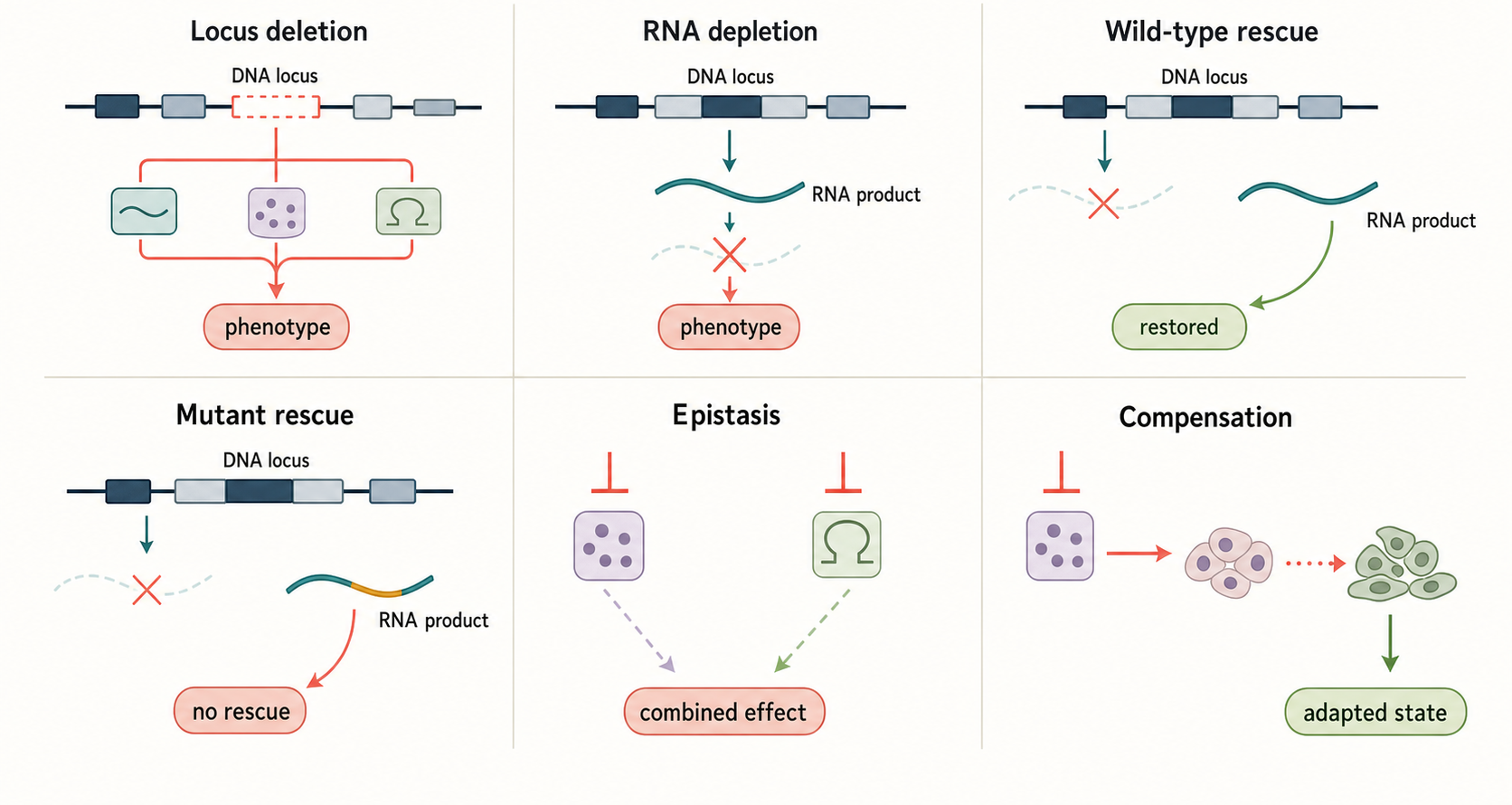
Figure 5.2. Perturbation, Rescue, Epistasis, and Compensation. Perturbation evidence in RNA biology gains causal force when specificity and rescue accompany the perturbation. The figure contrasts locus deletion and RNA depletion, showing how each can affect features beyond the intended target; wild-type rescue demonstrates that supplying the RNA can restore the phenotype, and mutant rescue tests whether a specific sequence, structure, or modification site is required. Epistasis panels show how the combined perturbation of two factors can suggest pathway relationships, and a compensation panel illustrates how long-term genetic adaptation can obscure a direct effect.
Epistasis uses combinations of perturbations to infer pathway relationships. If perturbing A and B together gives no stronger effect than perturbing A alone, A and B may act in the same pathway, or one perturbation may already saturate the readout. If the double perturbation is stronger than either single perturbation, A and B may act partly independently or redundantly. In RNA biology, epistasis logic appears when combining miRNA and target-site mutations, writer and reader perturbations, deadenylase and decapping mutations, RNA structure-disrupting and structure-restoring mutations, or RNA-binding protein and RNA motif perturbations.
Epistasis must be interpreted quantitatively. The expected effect of independent perturbations depends on whether the readout is additive, multiplicative, thresholded, or nonlinear. For example, two modest reductions in translation may appear epistatic if the assay saturates or if the measured phenotype is cell survival rather than translation itself. Therefore, epistasis is strongest when the measurement scale, baseline model, and uncertainty are stated.
Compensation can hide or redirect causality. A chronic knockout can induce a paralog, alter RNA decay, remodel chromatin, select for adapted cells, or shift cell composition. Acute depletion can reduce long-term compensation but may introduce delivery stress or incomplete knockdown. Single-cell perturbation readouts can reveal heterogeneous responses, but they also add dissociation, capture, doublet, and batch artifacts. Perturbation resources and predictive perturbation models are useful for exploring response landscapes, but predicted network responses remain hypotheses until connected to molecular evidence.
Scientific Caution: Causality Can Be Direct or Indirect
The sentence “perturbing X changed Y” is not the same as “X directly regulates Y.” Perturbing an RNA-binding protein can change Y because the protein directly binds Y RNA, because the protein changes a transcription factor, because the perturbation induces stress, or because the cell population changes. Stronger causal language requires specificity, time order, rescue, dose or stoichiometry when possible, and independent evidence for the proposed molecular step.
5.3. Biochemical reconstitution, binding, kinetics, and enzyme assays
Biochemical reconstitution rebuilds a proposed molecular event with defined components. A minimal reaction may contain a purified RNA, purified protein, buffer, salts, magnesium, nucleotide triphosphates, ligand, cofactor, and a readout for binding, cleavage, extension, ligation, editing, modification, folding, or assembly. Reconstitution is powerful because it asks whether the components are sufficient for the event without the complexity of a whole cell.
Direct sufficiency is not the same as cellular necessity. If purified ADAR enzyme edits an RNA duplex in vitro, the result supports the enzyme’s capacity to edit that substrate under defined conditions. Cellular necessity requires evidence that the enzyme is needed for editing of the endogenous site in cells. Physiological relevance requires evidence that the site, stoichiometry, cellular compartment, RNA structure, competing proteins, and biological consequence match the cellular system. This separation protects the reader from two common errors: dismissing reconstitution because it is artificial, and overextending reconstitution beyond its conditions.
Binding assays measure association between molecules. They may ask whether a protein binds an RNA, whether a small molecule binds an RNA pocket, whether an RNA binds another RNA, or whether a ribonucleoprotein complex assembles. Binding assays can measure equilibrium affinity, association rate, dissociation rate, specificity, competition, cooperativity, and stoichiometry. A complete binding claim should state the RNA sequence and length, protein construct, modification state, folding conditions, temperature, ion conditions, competitor molecules, and data model when these details affect interpretation.
Different binding assays support different claims. Electrophoretic mobility shift assays can show shifted complexes but may not define stoichiometry. Fluorescence anisotropy can quantify binding but may depend on label position. Surface plasmon resonance can measure association and dissociation but can be affected by surface immobilization. Isothermal titration calorimetry can measure thermodynamics but requires high concentration and clean components. Pulldown assays can detect association but can include indirect complexes. CLIP-family methods can localize protein-associated RNA regions in cells but are shaped by crosslinking chemistry, nuclease digestion, antibody recovery, and mapping.
Kinetic assays measure change over time. Kinetics are essential for RNA biology because many processes compete. Nascent RNA folds while it is being transcribed. Splice sites are chosen while transcription, RNA-binding proteins, chromatin state, and RNA structure change. Ribosomes move codon by codon, and translation can compete with RNA decay. RNA-binding proteins can exchange rapidly even when an endpoint assay suggests stable occupancy. In-cell kinetic measurements have shown that RNA-protein interactions can be dynamic and context-dependent.
Enzyme assays require explicit definition of substrate, enzyme, product, and time. RNA-related enzymes include polymerases, helicases, nucleases, ligases, capping enzymes, decapping enzymes, poly(A) polymerases, deadenylases, editing enzymes, modification enzymes, aminoacyl-tRNA synthetases, ribozymes, and CRISPR-associated nucleases. For each enzyme, the assay should state whether the substrate is natural or synthetic, whether the RNA has the relevant ends or modifications, whether cofactors are present, whether the enzyme is saturating, whether the reaction is single-turnover or multiple-turnover, and how the product identity was verified.
Biochemical results can be misleading when components are incomplete or nonphysiological. Short RNAs may lack structural domains. Unmodified RNAs may fold differently from cellular RNAs. Recombinant proteins may lack post-translational modifications or partner proteins. High concentrations can create weak interactions that are irrelevant in cells. Low-salt conditions can exaggerate electrostatic RNA binding. Purified components can miss inhibitory factors, chaperones, compartment boundaries, phase behavior, or competing RNAs. These limitations do not weaken biochemistry as a field; they define the conditions under which the biochemical claim is true.
The strongest mechanistic arguments combine cellular and biochemical evidence. A cellular perturbation can show that a factor is needed. A rescue can show specificity. A binding assay can show direct association. A kinetic or enzyme assay can show how fast or how efficiently the reaction occurs. A structural model can explain specificity. Together these data can support a mechanism that no single layer could establish alone. Integrated biochemical and computational approaches are increasingly used to decode RNA-processing rules, but each layer must retain its own claim boundary.
5.4. Structural, imaging, sequencing, and computational evidence
Structural evidence describes molecular shape, contacts, and arrangement. RNA structure can be described at several levels: secondary structure, tertiary contacts, quaternary assemblies, ribonucleoprotein architecture, and dynamic ensembles. A minimum-free-energy prediction, a covariance-supported base-pairing model, a chemical-probing-supported model, a cryo-EM map of a ribonucleoprotein, and an in-cell structure-function model are different evidence objects. They should not be collapsed into the phrase “the structure is known.”
Structure claims often require multiple evidence types. Sequence covariation can support conserved base pairing when compensatory changes preserve pairing across evolution. Chemical probing can report local nucleotide flexibility or accessibility under defined conditions. Crosslinking can indicate proximity. Mutational profiling can connect structure to function. High-resolution structural biology can place atoms or domains, but sample preparation and conformational selection can favor one state. Chapter 4 explains RNA structural principles; later methods chapters address structure-probing and structural-biology techniques in detail.
Imaging evidence describes where molecules are and how signals change in space and time. RNA fluorescence in situ hybridization, single-molecule FISH, live-cell tagging, proximity imaging, expansion microscopy, and spatial transcriptomics can reveal localization, abundance heterogeneity, transport, nuclear organization, compartment association, and cell-to-cell differences. Imaging is indispensable for localized RNAs and nuclear or cytoplasmic RNA bodies. However, colocalization is not mechanism. Two signals can overlap because the molecules share a compartment, because resolution is limited, because probes bleed through channels, because segmentation is imperfect, or because one signal is much more abundant. Chapter 123 develops targeted RNA detection, molecule counting, calibration, and live-tracking artifacts; Chapter 130 treats transcriptome-scale single-cell and spatial platforms.
Sequencing evidence is abundant and method-shaped. RNA-seq measures molecules that survive extraction, selection or depletion, fragmentation, reverse transcription, amplification, sequencing, and mapping. Each step changes the set of molecules represented in the final count table. Poly(A) selection enriches many mRNAs but misses many nonpolyadenylated RNAs. Ribosomal RNA depletion can introduce depletion-specific biases. Short reads can struggle with isoforms and repeats. Long reads can improve isoform resolution but have their own error profiles and throughput limits. Direct RNA sequencing can preserve some native RNA features but requires careful interpretation of signal-level and modification claims.
Reproducible RNA-seq interpretation requires method metadata. Sample handling, RNA integrity, extraction method, depletion or selection strategy, library construction, strandedness, read length, depth, alignment strategy, transcript annotation, normalization, covariate model, batch structure, and filtering can affect results. Reporting limits can make published RNA-seq difficult to reproduce even when the experiment itself was competently performed. A claim about differential abundance should therefore be tied to the protocol and analysis, not stated as if it were independent of measurement.
Single-cell RNA-seq adds cell-level resolution and cell-level artifacts. It can reveal cell types, states, trajectories, co-expression modules, perturbation responses, and rare populations. It can also be distorted by dissociation stress, dropout, ambient RNA, doublets, mitochondrial RNA content, cell-cycle effects, batch effects, normalization choices, clustering parameters, and annotation uncertainty. Co-expression inference can identify cell-type-specific associations, but co-expression is not direct regulation without perturbation and mechanistic evidence.
Trajectory inference and RNA velocity illustrate the distinction between model and observation. These approaches use snapshots of single-cell transcriptomes, often including spliced and unspliced RNA information, to infer likely developmental or response directions. The output can be valuable, especially when it agrees with time-course, lineage, imaging, or perturbation data. But a trajectory is a model of relationships among sampled cells, not direct observation of each cell’s future. A velocity arrow should be read as an inference with assumptions about kinetics, sampling, and cell-state continuity.
Cell-free RNA requires another level of caution. RNA detected in plasma or other extracellular fluids can come from many tissues and cell types, from vesicles or protein complexes, from platelets or blood cells, from dying cells, or from sample handling. Computational inference of cell type of origin is useful, but it is an inference from reference signatures, model assumptions, and measured fragments, not direct observation of release from a particular tissue.
Computational evidence includes alignment, quantification, differential-expression analysis, network inference, motif discovery, structure prediction, molecular simulation, machine learning, variant interpretation, and clinical classifiers. Computation is not merely a weak substitute for experiment. Many RNA datasets cannot be interpreted without statistical and computational models. The rule is that computational claims should state their inputs, assumptions, training data, benchmarks, uncertainty, and failure modes. A prediction becomes biological evidence only when connected to observations or experiments appropriate to the claim.
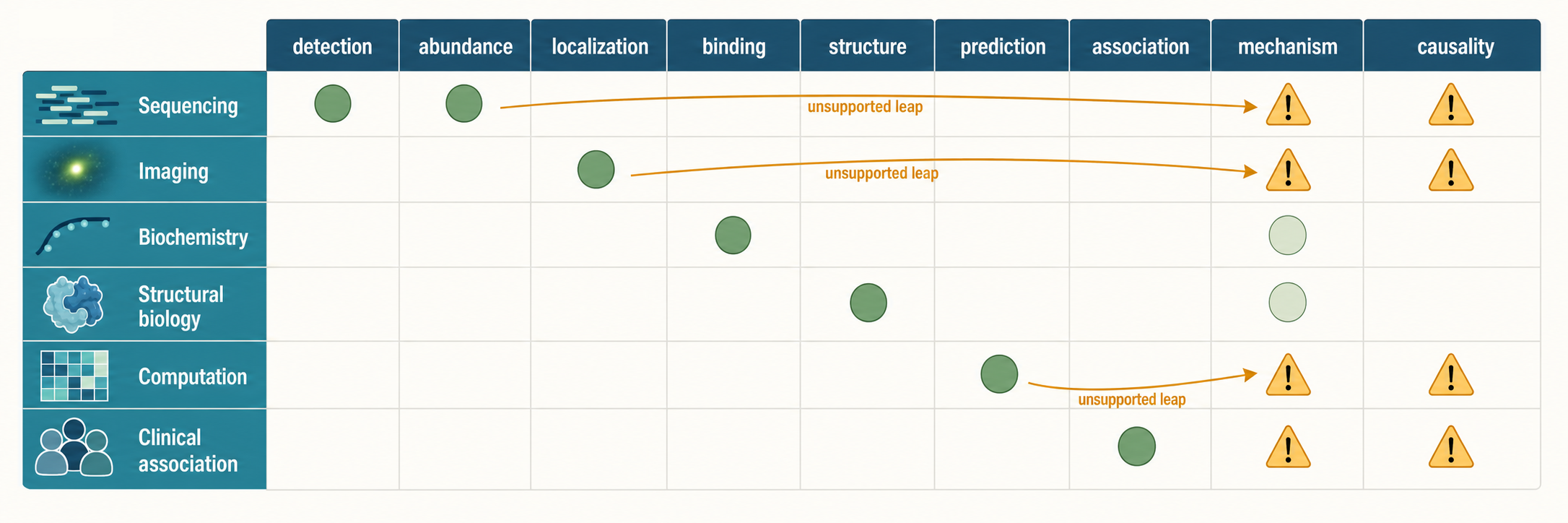
Figure 5.3. Method-to-Claim Matrix. Different RNA methods support different kinds of claims, and moving from one claim type to another requires additional evidence. The figure maps six method families—sequencing, imaging, biochemistry, structural biology, computation, and clinical association—onto the claims they directly support, and highlights common unsupported leaps such as inferring direct regulation from differential expression, mechanism from colocalization, or cellular binding from in vitro affinity. The matrix helps readers identify which additional experiments would close a specific evidential gap.
Table 5.3. Method Outputs Versus Biological Interpretations. Direct outputs, common inferences, unsupported interpretive leaps, and the validations needed to close the gap for fourteen RNA biology methods.
| Method family | Direct output | Common inference | Unsupported leap | Needed validation |
|---|---|---|---|---|
| RNA-seq | Read counts per locus per sample | Differential transcript abundance between conditions | Direct causal regulation inferred from abundance change | Perturbation and rescue; normalize for cell composition; report full metadata |
| Long-read RNA-seq | Full-length read coverage per isoform | Isoform structure and relative usage | Definitive quantification of all isoforms from one protocol | Targeted isoform validation; error-model calibration per platform |
| Direct RNA sequencing | Native RNA signal without cDNA conversion | Unbiased abundance and native modification signals | Modification identity assigned from signal-level change alone | Orthogonal chemical detection; known-modification controls as calibrators |
| CLIP-seq | Crosslinked RNA fragments co-immunoprecipitated with protein | Protein-RNA contact regions in cells | Direct regulatory binding site inferred from peak location | In vitro binding assay; mutant rescue at peak site; orthogonal method |
| RIP | RNA co-purified with protein under native conditions | Protein-associated RNA population | Direct physical binding inferred without crosslinking | CLIP confirmation; purified biochemical binding assay |
| Structure probing | Per-nucleotide reactivity under probing conditions | Local nucleotide flexibility and base-pairing status | Complete structure determined from one probing experiment | Sequence covariation; compensatory mutations; high-resolution structure |
| Ribo-seq | Ribosome-protected footprints across transcriptome | Translated regions and codon-level occupancy | Protein output inferred directly from footprint density | Protein quantification; polysome fractionation; reporter assay |
| FISH | Fluorescence puncta per cell | Subcellular RNA localization and copy number | Mechanism inferred from localization pattern or spot count | Functional perturbation; orthogonal probe or smFISH confirmation |
| Live imaging | Fluorescence signal dynamics over time | RNA or condensate movement and exchange kinetics | Mechanism inferred from colocalization or apparent dynamics | FRAP; single-molecule tracking; perturbation of putative drivers |
| Cryo-EM | Electron-density map of a frozen specimen | Molecular conformation and complex architecture | All cellular states described from a single structural snapshot | Solution probing; ensemble methods; functional mutagenesis |
| NMR | Solution-state atom-resolution structure or dynamics | Flexible or structured RNA regions under defined solution conditions | Cellular RNA structure inferred directly from solution NMR | Chemical probing in cells; sequence covariation; functional tests |
| Biochemical binding | Affinity, rate constants, or stoichiometry measured in vitro | Direct molecular interaction under defined conditions | Cellular regulation inferred from in vitro binding affinity | Cellular perturbation; CLIP or RIP; mutant rescue |
| Enzyme kinetics | Reaction rate, Km, and kcat under defined substrate conditions | Catalytic mechanism and substrate preference | In vivo reaction rate equated directly with in vitro kinetics | Cellular substrate verification; orthogonal activity assay in cells |
| Perturb-seq | Transcriptome-wide response to each genetic perturbation | Perturbation-response networks and pathway membership | Direct molecular mechanism inferred from co-expression response | Targeted mechanistic follow-up; rescue; biochemical interaction assay |
Scientific Caution: Prediction Is Not Observation, but It Is Not Useless
Predicted structures, predicted targets, predicted cell trajectories, and predicted perturbation responses are hypotheses or model outputs. They can be excellent guides for experiment design and can become part of a strong argument when independently tested. The error is not using predictions; the error is describing predictions as if they were direct observations.
Box 5.1. Common Overinterpretations
- Differential expression is not direct regulation. Abundance differences reflect measurement under a protocol and model; direct regulation requires evidence for the regulatory molecule, target, timing, and mechanism.
- Enrichment is not direct binding. Pulldown or CLIP enrichment can reflect direct binding, indirect complex membership, antibody bias, or nonspecific recovery; direct binding requires biochemical, structural, or orthogonal cellular evidence.
- Colocalization is not mechanism. Spatial overlap at assay resolution can result from shared compartment, limited resolution, probe bleed-through, or segmentation error; mechanism requires causal tests and defined molecular steps.
- Predicted structure is not observed structure. A minimum-free-energy prediction is a model output; it becomes evidence when supported by probing, covariation, compensatory mutations, or high-resolution structure.
- Perturbation is not necessarily direct causality. A perturbation effect can be indirect, compensated, toxic, or off-target; direct causality requires specificity controls, target engagement, and mechanism-consistent evidence.
- Disease association is not molecular mechanism. A statistical association can reflect cause, consequence, compensation, cell-composition change, or medication effect; mechanism requires molecular and causal evidence.
5.5. Causality standards for ncRNAs, modifications, and condensates
Noncoding RNA function is one of the most important evidence challenges in RNA biology. Noncoding means that the RNA is not primarily interpreted as a protein-coding transcript. It does not mean that the RNA has a proven molecular function. A noncoding transcript can be a functional RNA, transcriptional byproduct, unstable intermediate, regulatory-element marker, promoter-associated transcript, enhancer-associated transcript, repeat-derived transcript, degradation product, annotation artifact, or condition-specific molecule. Therefore, detection and annotation are only the beginning of a function claim.
A lncRNA function claim should separate the DNA locus, the act of transcription, the RNA molecule, the RNA sequence, the RNA structure, and RNA-bound proteins. A locus deletion can disrupt enhancers, promoters, chromatin boundaries, overlapping transcripts, and local transcription. CRISPR interference can block transcription without removing DNA, but it may also alter chromatin near the targeted promoter. RNA knockdown can reduce the mature RNA product, but it may not affect co-transcriptional functions, and it may introduce off-target or innate immune effects. Transgene rescue can test RNA-product function, but rescue from an ectopic locus may fail to reproduce cis-regulatory context.
The evidence ladder for a lncRNA mechanism therefore begins with expression and molecular form. Is the RNA full-length, spliced, capped, polyadenylated, unstable, nuclear, cytoplasmic, chromatin-associated, or cell-type-specific? The next level is perturbation with target engagement. Does changing the RNA, locus, or transcription alter a relevant phenotype? The next level is specificity and rescue. Can wild-type RNA restore the phenotype? Do sequence, structure, localization, or protein-binding mutants fail to rescue? The next level is mechanism. Which molecules bind? Which genomic or RNA targets change? Which causal step links the RNA to the phenotype?
RNA modifications require a different but equally explicit ladder. A modification mechanism claim should not begin with function. It should begin with site existence: is the modified nucleotide present at the proposed site? The next question is stoichiometry: what fraction of RNA molecules carry the modification under the condition? Then comes enzyme dependence: which writer, eraser, or processing pathway changes the site? Then comes reader or effector recognition: which protein or structural change detects the modification? Only after these steps can the claim move to functional consequence: how does the modification change splicing, export, translation, localization, decay, structure, immune sensing, or disease state.
Modification mapping is artifact-prone because many assays depend on enrichment, chemical conversion, reverse transcription signatures, or signal-level interpretation. Antibodies can have sequence bias or cross-reactivity. Chemical reactions can be incomplete or context-dependent. Reverse transcriptases can stop or misincorporate for reasons unrelated to the intended modification. Writer knockouts can change RNA expression, cell state, and indirect pathways. A site-specific mechanism is strongest when orthogonal detection, site mutation, stoichiometry, enzyme dependence, reader binding, and functional rescue converge. Chapter 46 develops modification-specific detection limits and artifact controls.
Condensate claims require careful language because “condensate” can refer to physical behavior, microscopic appearance, molecular composition, or proposed biological mechanism. Biomolecular condensates are cellular assemblies enriched for specific molecules and often described in terms of phase separation, multivalent interactions, material properties, and dynamic exchange. RNA can help nucleate condensates, tune viscosity, buffer proteins, specify clients, dissolve assemblies, or alter reaction kinetics. The fact that an RNA or protein forms droplets in vitro does not prove that the same phase transition controls a cellular process.
An evidence ladder for RNA-linked condensates separates in vitro phase behavior, cellular localization, endogenous concentration, dynamics, perturbation, material properties, and mechanism. In vitro droplet formation can show that components have phase-transition capacity under defined conditions. Cellular colocalization can show that an RNA and protein occupy overlapping regions. Endogenous tagging and concentration estimates can test whether the cellular system reaches relevant regimes. Fluorescence recovery, single-particle tracking, or perturbation can test dynamics. Mutations can test sequence or domain requirements. A causal mechanism requires linking condensate behavior to a defined RNA-processing, transcriptional, translational, stress-response, or disease output.
The shared problem in ncRNA, modification, and condensate fields is that attractive category names can outrun evidence. “lncRNA regulator,” “epitranscriptomic mark,” and “RNA condensate” are useful terms, but they can make detection or association sound mechanistic. A careful claim states what has been shown: expression, localization, enrichment, direct binding, modification, perturbation, rescue, reconstitution, structural support, clinical association, or causal pathway.
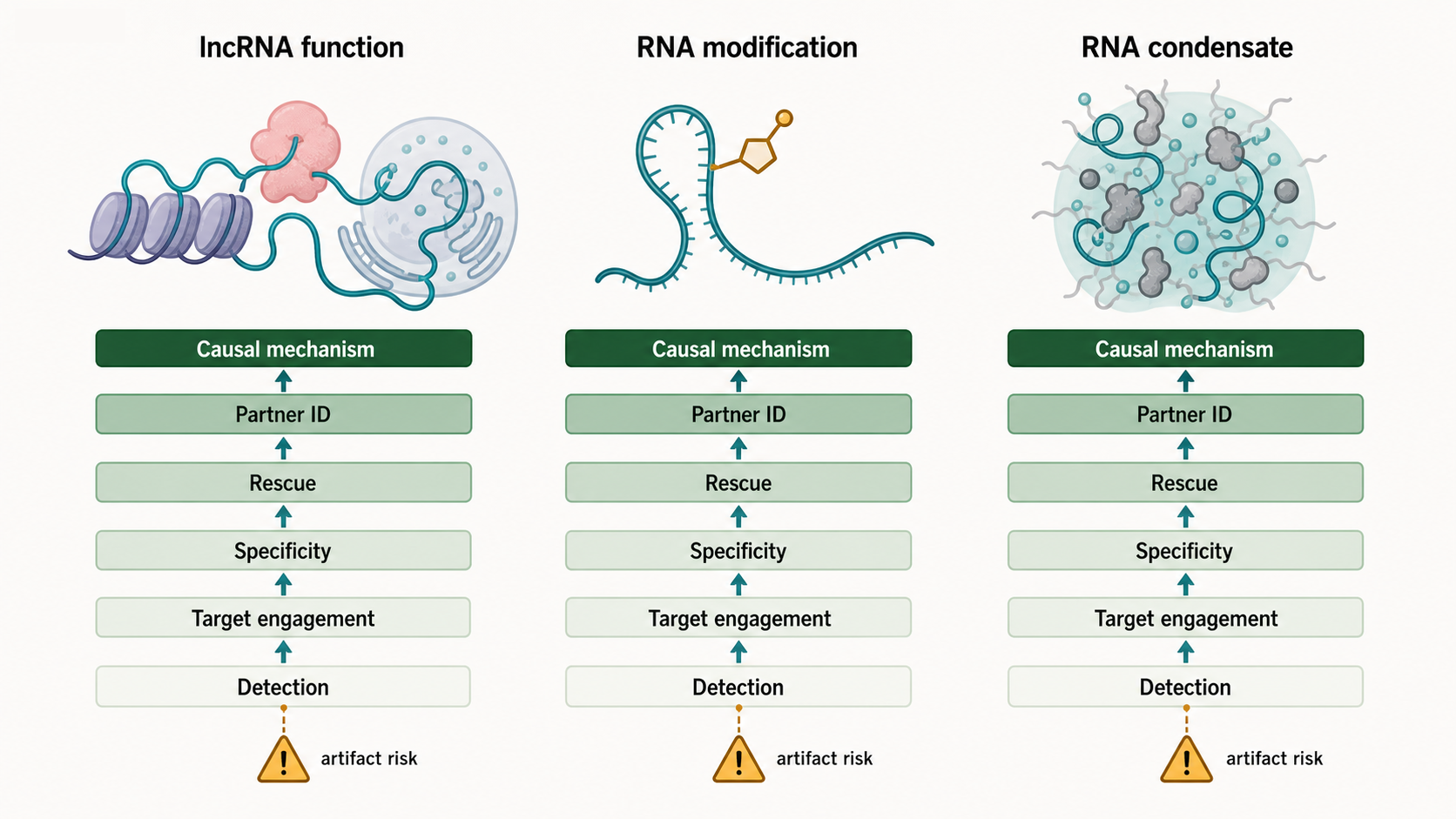
Figure 5.4. Evidence Ladders for Three Difficult RNA Claim Classes. Three RNA biology fields—long noncoding RNA function, RNA modification mechanism, and RNA condensate mechanism—each require an explicit evidence ladder that separates detection from mechanism. The figure presents each ladder as a series of steps: expression and molecular form, perturbation with target engagement, specificity and rescue, partner or effector identification, and finally causal mechanism. Comparing the three ladders shows that while the starting detection step differs by field, all three require perturbation, rescue, and mechanistic evidence before a causal claim can be made.
Scientific Caution: Category Names Are Not Evidence Grades
Calling a transcript a lncRNA does not prove function. Calling a nucleotide a modification site does not prove regulation. Calling a structure a condensate does not prove phase-separation mechanism. Category names help organize biology, but evidence grades must be assigned to specific claims.
5.6. Reproducibility, negative evidence, obsolete models, and evidence grading
Reproducibility is the ability of a result or conclusion to withstand repetition, reanalysis, or independent testing. In RNA biology, reproducibility has several layers. Technical reproducibility asks whether the same sample and protocol give similar results. Biological reproducibility asks whether independent samples under the same biological condition show the same pattern. Analytical reproducibility asks whether the same data and code produce the same result. Conceptual reproducibility asks whether different methods support the same conclusion.
RNA-seq illustrates why these layers matter. A differential-expression result may depend on RNA integrity, extraction method, depletion or selection, library kit, sequencing depth, read length, strandedness, alignment, transcript annotation, normalization, batch correction, covariate modeling, and filtering. If these details are incomplete, another laboratory may not be able to reproduce the analysis even if the biological conclusion is correct. The same principle applies to CLIP-seq peak calling, structure-probing normalization, modification-site detection, spatial transcriptomics segmentation, and single-cell clustering.
Negative evidence is not simply absence of signal. A negative result is informative only when the experiment had adequate sensitivity, power, condition match, and controls to detect the proposed object or effect. Failure to detect a nonpolyadenylated RNA in a poly(A)-selected library is weak negative evidence. Failure to observe a phenotype after incomplete knockdown is weak negative evidence. Failure of a purified protein to bind an RNA under conditions where the positive-control RNA binds can be stronger negative evidence. Failure of a mutant rescue to restore a phenotype can be very informative if wild-type rescue succeeds.
Negative evidence can support mechanism by excluding alternatives. If disrupting an RNA structure causes a phenotype and compensatory mutations restore both structure and phenotype, the result argues against a simple sequence-only model. If catalytically inactive enzyme rescue fails while catalytically active rescue succeeds, the result supports catalytic dependence. If an antibody-enrichment peak disappears after spike-in normalization or orthogonal detection fails, the result can identify an artifact. Negative evidence helps science when the assay is capable of detecting the expected positive result.
Box 5.2. Negative Evidence That Actually Helps
- Failed rescue by a binding-site mutant, when wild-type RNA rescues, argues that the binding surface is required for the phenotype.
- No rescue by a catalytically dead enzyme, when catalytically active enzyme rescues, supports the conclusion that enzymatic activity rather than protein scaffolding is responsible.
- Absence of a modification signal by an orthogonal detection method, when the primary antibody-based method gave a peak, identifies the primary result as likely artifactual.
- Loss of signal after spike-in normalization or batch correction indicates that the initial signal reflected a technical rather than biological difference.
- No direct binding in a purified biochemical assay despite cellular co-immunoprecipitation suggests the cellular interaction is indirect, mediated by a bridging factor or complex.
Obsolete models should be marked rather than silently erased. RNA biology contains many cases in which plausible interpretations changed. Some transcripts first dismissed as noise later gained defined functions. Some annotated noncoding RNAs were later reinterpreted as unstable byproducts or regulatory-element markers. Some modification maps were revised after stronger controls. Some condensate models were narrowed when endogenous concentration, dynamics, and perturbation data became available. A mature field records why models changed so that later readers do not inherit outdated certainty.
Evidence grading makes claim boundaries reusable. An evidence grade should be assigned to a specific claim, not to a whole paper or topic. The same study may strongly support “this RNA abundance changes under condition X” and weakly support “this RNA directly causes phenotype Y.” A practical ladder includes: observed, replicated, orthogonally supported, perturbation-supported, rescue-supported, mechanism-consistent, structurally supported, biochemically reconstituted, context-limited, disputed, obsolete, and artifact-prone.
Box 5.3. Evidence Grade Vocabulary
- Observed: the object or effect was directly detected by an appropriate assay under stated conditions.
- Replicated: the observation has been reproduced in independent samples, laboratories, or experimental instances.
- Orthogonally supported: convergent evidence from methods with different biases supports the same claim.
- Perturbation-supported: a deliberate change in the proposed causal factor altered the expected readout with target-engagement evidence.
- Rescue-supported: reintroducing or replacing the perturbed component restored the phenotype or molecular state.
- Mechanistically supported: causal steps, molecular actors, and their order have been identified with direct evidence.
- Reconstituted: purified or defined components reproduce the proposed reaction or interaction in a controlled system.
- Context-limited: the claim has been established only under specific conditions, cell types, organisms, or developmental stages.
- Disputed: independent experiments or analyses have reached conflicting conclusions, and the discrepancy has not been resolved.
- Obsolete: the claim has been superseded by stronger evidence or corrected methods and should not be treated as current consensus.
- Artifact-prone: the claim rests on an assay or analysis step known to produce frequent false positives or false negatives of the relevant type.
Not every claim needs the highest grade. A transcript-existence claim does not require biochemical reconstitution. A disease-biomarker claim does not require a molecular mechanism if the claim is limited to predictive association. A therapeutic-mechanism claim, however, should distinguish delivery, target engagement, pharmacodynamic effect, clinical outcome, and safety. A causal mechanism claim usually requires perturbation, rescue or specificity controls, timing, and direct evidence for the proposed molecular step.
Scientific Caution: Reproducibility Is Not the Same as Truth
A reproducible artifact can recur across experiments that share the same bias. A true biological effect can fail to reproduce if the condition, cell type, developmental stage, organism, RNA isoform, or assay sensitivity differs. Reproducibility should be interpreted together with scope, method, and mechanism.
Biological Contexts Across RNA Systems
Evidence standards change with biological context. In bacteria, small regulatory RNAs often act through base pairing with target mRNAs and through RNA chaperones such as Hfq or ProQ. A strong claim may combine target prediction, compensatory mutations, RNA chaperone dependence, translation or decay readouts, and time-resolved perturbation. In eukaryotic nuclei, lncRNAs may act near their transcription sites, through chromatin-associated proteins, or through RNA processing. A strong claim must distinguish RNA-product function from DNA-locus or transcription-dependent effects.
In viruses, RNA genomes, antigenomes, subgenomic RNAs, replication intermediates, and structured untranslated regions can be difficult to distinguish by assay. Strand-specificity, replication state, encapsidation, and host response all affect interpretation. A signal for viral negative-strand RNA, for example, may be a replication marker in one context but a method-specific target requiring stringent strand controls in another. Viral RNA evidence standards therefore emphasize strand specificity, replication competence, protein association, and time course.
In development and cell differentiation, transcriptomic changes may reflect cell fate, cell-cycle state, stress, sampling, or changing cell proportions. Single-cell methods help separate populations, but they do not remove the need for lineage, imaging, perturbation, and temporal evidence. In disease biology, an RNA association with disease can indicate cause, consequence, compensation, cell-composition change, medication effect, or biomarker status. Clinical association should therefore be separated from molecular mechanism.
In therapeutics, the evidence ladder begins with the modality and target. An antisense oligonucleotide, small interfering RNA, messenger RNA vaccine, guide RNA, RNA-editing approach, or RNA-targeting small molecule each has distinct evidence needs. Delivery, biodistribution, target engagement, pharmacodynamics, efficacy, durability, immune activation, off-target effects, and safety are separate claims. A reduction in target RNA abundance is not the same as clinical benefit. A clinical response is not automatically proof of the proposed molecular mechanism.
Technology, Computational, and Clinical Links
High-throughput RNA technologies are discovery engines. They can identify unexpected transcripts, isoforms, editing sites, modifications, structures, interactions, cell states, regulatory programs, disease associations, and therapeutic responses. Their strength is breadth. Their weakness is that breadth often comes with indirect measurement, complex processing, and multiple-testing burdens. Discovery methods should be celebrated for discovery while being paired with validation for mechanism.
Computational models are increasingly central to RNA biology. Models infer transcript abundance, splice isoforms, cell type of origin, regulatory networks, RNA velocity, RNA structure, RNA-protein binding, RNA-small-molecule interactions, codon effects, perturbation responses, and clinical classifiers. A model’s biological meaning depends on its training data, features, objective function, benchmarks, uncertainty estimates, and failure modes. A model trained on one cell type, organism, assay, or annotation system may not transfer to another. The correct standard is not “computational versus experimental” but “what exact claim does the model support, and how was it validated?”
Clinical RNA evidence requires extra separation of claims because patient-facing consequences depend on reproducibility and actionability. A diagnostic RNA signature can be useful even when mechanism is unknown, but the claim should be framed as predictive or classificatory. A therapeutic target claim requires stronger causal and mechanistic evidence. A safety claim requires attention to dose, delivery, immune recognition, tissue distribution, persistence, and off-target activity. RNA diagnostics and RNA therapeutics therefore use the same evidence vocabulary as basic RNA biology, but the cost of overclaiming is higher.
Recent Consensus
RNA-biology claims should state what was measured, what was inferred, and what remains hypothetical. The literature increasingly recognizes that high-throughput evidence is method-shaped and that method metadata are essential for reproducibility.
Causal claims usually require perturbation plus specificity controls and, when feasible, rescue. Perturbation can support dependence, but direct mechanism requires additional evidence about target engagement, timing, specificity, and molecular steps.
Biochemical reconstitution is strong evidence for direct molecular sufficiency under defined conditions, but it does not automatically establish cellular necessity or physiological relevance.
Sequencing, imaging, structural biology, and computation answer different questions. The strongest arguments usually combine methods with different biases rather than treating any single method as definitive.
Noncoding RNA, RNA-modification, and condensate fields require especially careful separation of detection, association, perturbation, rescue, and mechanism.
Negative evidence, failed rescue, and obsolete models are scientifically useful when the assay was capable of detecting the expected result and when the claim is scoped to the tested condition; claim-level evidence grades should follow the exact claim being made rather than the general topic label.
Open Questions, Controversies, Deprecated Models, and Common Misconceptions
Open questions:
- How can researchers standardize evidence grades across RNA fields without flattening method-specific expertise? A structure-probing claim, a clinical biomarker claim, a condensate claim, and an RNA-editing claim do not use the same assays, yet all benefit from explicit separation of detection, association, perturbation, rescue, and mechanism.
- How many RNA functions are missed because common assays favor stable, abundant, polyadenylated, easily mapped, or easily extracted molecules? Negative evidence from one assay can be misleading when the assay systematically misses a class of RNA.
- What determines how high-throughput perturbation maps should distinguish direct RNA mechanisms from indirect network responses? Large perturbation atlases and predictive models are valuable, but they can produce confident-looking networks whose edges do not correspond to direct molecular interactions.
- Which condensate mechanisms will remain after endogenous concentration, dynamics, material-property, and perturbation standards mature? The field has moved from simple droplet observation toward more stringent cellular mechanism claims, but standards continue to evolve.
Common misconceptions:
- “Differential expression is direct regulation.” Differential expression shows abundance difference under a protocol and model. Direct regulation requires evidence for the regulatory molecule, target, timing, specificity, and mechanism.
- “Enrichment is direct binding.” Enrichment can reflect direct binding, indirect complex membership, antibody bias, nonspecific recovery, or background. Direct binding needs appropriate biochemical, structural, mutational, or orthogonal cellular evidence.
- “Colocalization is mechanism.” Colocalization shows spatial overlap or proximity at assay resolution. Mechanism requires causal tests and molecular steps.
- “Predicted structure is observed structure.” Prediction is a model output. It becomes stronger when supported by probing, covariation, compensatory mutation, high-resolution structure, or functional tests.
- “Perturbation proves direct causality.” Perturbation can be indirect, compensated, toxic, or off-target. Direct causality requires specificity and mechanism-consistent evidence.
- “No phenotype means no function.” Absence of detected phenotype depends on assay power, condition, redundancy, compensation, developmental stage, cell type, and readout.