Chapter 82. CRISPR-Cas RNAs, Adaptive Immunity, Anti-CRISPR Biology, and Guide RNA Mechanisms
Scope Note
This chapter explains CRISPR-Cas systems as RNA-guided adaptive immune systems of bacteria and archaea, with emphasis on the CRISPR RNAs that record prior genetic encounters and guide interference complexes. The chapter follows the life cycle from spacer acquisition to crRNA biogenesis and target destruction; compares class 1 multi-subunit systems with class 2 single-effector systems; explains tracrRNA, engineered guide RNAs, genome editing, and diagnostics; and treats anti-CRISPR proteins, RNA anti-CRISPRs, phage countermeasures, specificity, evolution, and biotechnology caveats. Archaeal CRISPR diversity is introduced only where needed for mechanism and is treated more fully in Chapter 83.
Executive Summary
Clustered regularly interspaced short palindromic repeats, abbreviated CRISPRs, are genomic memory arrays in many bacteria and archaea. Each array contains short repeats separated by spacers. A spacer is usually derived from a previous encounter with a phage, plasmid, transposon, or other mobile genetic element. When the array is transcribed, the long precursor CRISPR RNA is processed into individual CRISPR RNAs, or crRNAs. Each crRNA contains a guide segment from one spacer and repeat-derived handle sequences that are recognized by CRISPR-associated, or Cas, proteins. The guide segment base-pairs with a matching target sequence, while the Cas machinery interrogates additional marks such as a protospacer adjacent motif (PAM), target transcript status, or flanking sequence to distinguish invader nucleic acid from the host’s own CRISPR array.
CRISPR-Cas immunity is often described in three stages. Adaptation is the acquisition of a new spacer from foreign nucleic acid and its insertion into the CRISPR array. Expression and maturation produce crRNAs from the array transcript. Interference uses the crRNA-loaded effector complex to recognize and destroy complementary target DNA or RNA. This three-stage vocabulary is useful, but real systems connect the stages. Failed or partial interference can stimulate primed adaptation, new spacers are often inserted leader-proximally so that the newest memory is transcribed first, and selection continuously edits the spacer repertoire as phages escape or environments change.
CRISPR-Cas systems fall into two broad classes. Class 1 systems use multi-subunit effector complexes. Type I systems use Cascade-like complexes to bind target DNA and recruit the Cas3 nuclease-helicase for processive DNA degradation. Type III systems use Csm or Cmr complexes to bind transcripts and can connect RNA recognition to DNA cleavage, RNA cleavage, and second-messenger signaling. Class 2 systems use a single large effector protein. Cas9, Cas12, and Cas13 illustrate three different guide architectures and target chemistries. Cas9 uses a crRNA paired with a trans-activating crRNA, or tracrRNA, or an engineered single-guide RNA; it recognizes DNA targets with a PAM and cuts the two DNA strands with HNH and RuvC nuclease domains. Cas12 effectors use crRNAs without a tracrRNA in many systems, often process their own pre-crRNAs, recognize DNA targets with distinct PAM requirements, and can show target-triggered collateral single-stranded DNA cleavage. Cas13 effectors target RNA using HEPN ribonuclease domains and can show target-triggered collateral RNA cleavage.
Guide RNA mechanisms are central to both natural immunity and biotechnology. A guide is not just a matching sequence. The guide has a length, a seed region, a scaffold, chemical ends, structural constraints, and a host context. Base pairing near the seed often contributes disproportionately to target recognition, but specificity also depends on PAM or protospacer flanking site recognition, R-loop propagation, target chromatin or RNA accessibility, guide abundance, effector concentration, repair pathways, and cellular stress. Engineered systems exploit this guide logic for genome editing, base editing, prime editing, transcriptional regulation, RNA knockdown, RNA editing, imaging, pooled screens, and diagnostics. The same logic produces failure modes: off-target cleavage, bystander editing, collateral nuclease activity, guide misfolding, delivery limits, immune recognition, and unintended selection.
Phages and other mobile elements counter CRISPR-Cas immunity. Anti-CRISPR proteins can block DNA binding, prevent crRNA loading, mimic nucleic acid substrates, inhibit nuclease domains, obstruct conformational activation, or recruit regulatory proteins that tune anti-CRISPR expression. RNA anti-CRISPRs expand this concept by using RNA structures or crRNA-like mimicry to interfere with CRISPR effectors, especially RNA-targeting systems. Phages can also escape by mutating protospacers or PAMs, modifying or hiding DNA, forming replication compartments, encoding suppressors, overwhelming host immunity through high multiplicity, or exploiting host regulation. CRISPR-Cas biology is therefore not a one-sided defense system but an evolutionary contest among genomic memory, guide specificity, mobile-element diversity, and counter-defense.
Concept Inventory
- CRISPR array: A genomic locus containing repeated DNA sequences separated by spacer sequences. The repeats provide processing and protein-binding information; the spacers provide sequence memory of prior genetic encounters.
- Spacer: A segment inside a CRISPR array that was acquired from a protospacer, usually from mobile genetic element DNA or RNA-derived DNA. A spacer becomes the guide portion of a crRNA after array transcription and processing.
- Protospacer: The sequence in the invader or target nucleic acid that corresponds to a spacer. A protospacer is outside the CRISPR array; a spacer is inside the array.
- PAM: A protospacer adjacent motif. A PAM is a short sequence next to a DNA protospacer that many DNA-targeting CRISPR systems require for target recognition and self-nonself discrimination.
- PFS: A protospacer flanking site. A PFS is a flanking-sequence feature used by some RNA-targeting or noncanonical systems; its importance is system-specific and should not be assumed for all Cas13 enzymes.
- Pre-crRNA: A long precursor CRISPR RNA transcribed from the CRISPR array before maturation into individual crRNAs.
- crRNA: A mature CRISPR RNA containing spacer-derived guide sequence plus repeat-derived handle sequence. The crRNA directs a Cas effector to a complementary target.
- tracrRNA: A trans-activating crRNA used by type II Cas9 systems. It base-pairs with repeat-derived crRNA sequence and helps recruit RNase III and Cas9 for crRNA maturation and interference.
- Single-guide RNA: An engineered fusion of crRNA and tracrRNA used with Cas9. It preserves the guide segment and the structural scaffold needed for Cas9 binding.
- Cascade: CRISPR-associated complex for antiviral defense. Cascade is a class 1 type I multi-subunit effector complex that binds crRNA and target DNA, then recruits Cas3 for target degradation.
- Cas9: A class 2 type II DNA-targeting effector that uses crRNA:tracrRNA or single-guide RNA and cleaves target DNA with HNH and RuvC nuclease domains.
- Cas12: A class 2 type V DNA-targeting family. Cas12a and related enzymes often use a single crRNA, can process pre-crRNAs, cleave target DNA with a RuvC-like nuclease domain, and may display collateral single-stranded DNA cleavage after activation.
- Cas13: A class 2 type VI RNA-targeting family. Cas13 enzymes use crRNAs to recognize RNA targets and use HEPN ribonuclease domains for target and collateral RNA cleavage.
- Anti-CRISPR: A phage, plasmid, or mobile-element factor that inhibits a CRISPR-Cas system. Most characterized anti-CRISPRs are proteins, but RNA anti-CRISPRs are now recognized.
- Collateral cleavage: Target-triggered nonspecific cleavage of bystander nucleic acids by an activated CRISPR effector. Collateral cleavage is useful in diagnostics but can be toxic or confounding in cells.
- Prime-editing guide RNA: A pegRNA that contains a Cas9 guide segment plus a primer-binding site and reverse-transcription template used by prime editors.
What to Know Before Reading This Chapter
Readers should know that base pairing lets an RNA guide find a complementary DNA or RNA sequence, but base pairing is only part of CRISPR specificity. A short guide sequence would match many places by chance if a Cas protein accepted every partial duplex. Cas proteins therefore combine guide-target pairing with protein recognition of additional features. DNA-targeting systems commonly inspect a PAM, distort a short region of DNA, nucleate pairing in a seed region, and then allow the RNA-DNA hybrid, called an R-loop, to extend if enough complementarity is present. RNA-targeting systems inspect RNA accessibility and system-specific flanking or structural features rather than DNA duplex geometry.
Readers should also separate “adaptive immunity” in bacteria and archaea from the antibody- and T-cell-based adaptive immunity of animals. The shared word “adaptive” means that prior exposure changes future defense. In CRISPR-Cas immunity, the molecular memory is a spacer inserted into a genomic array. The cell and its descendants can then transcribe that memory as crRNA. The memory is heritable and sequence-specific, but it is not organized by lymphocytes, clonal expansion, or immunoglobulin genes.
Finally, the chapter treats CRISPR-Cas as an RNA biology topic, not only as a genome editing technology. The guide RNA is the informational core of recognition. The repeat-derived handle is a protein-binding and processing element. tracrRNA is a small RNA partner that helped make Cas9 programmable. Engineered guides work because they preserve natural RNA-protein recognition while changing the target-matching segment. Many biotechnology failures are guide failures: guide sequence, scaffold, chemical end, target context, and effector state all matter.
Core Mechanisms and Molecular Players
82.1. CRISPR arrays, spacer acquisition, crRNA biogenesis, and interference
A CRISPR array is a genetic archive written in alternating repeat and spacer units. The repeats are similar within an array, while the spacers differ. The repeats are not passive punctuation. Repeat sequences form RNA structures or protein-recognition elements that allow processing enzymes and effector complexes to generate correctly framed crRNAs. The spacers are the variable memory units. A spacer sequence usually derives from a protospacer, meaning a sequence in a phage genome, plasmid, or other mobile genetic element that previously entered the cell lineage. When the CRISPR array is transcribed, the spacer becomes the guide portion of a crRNA.
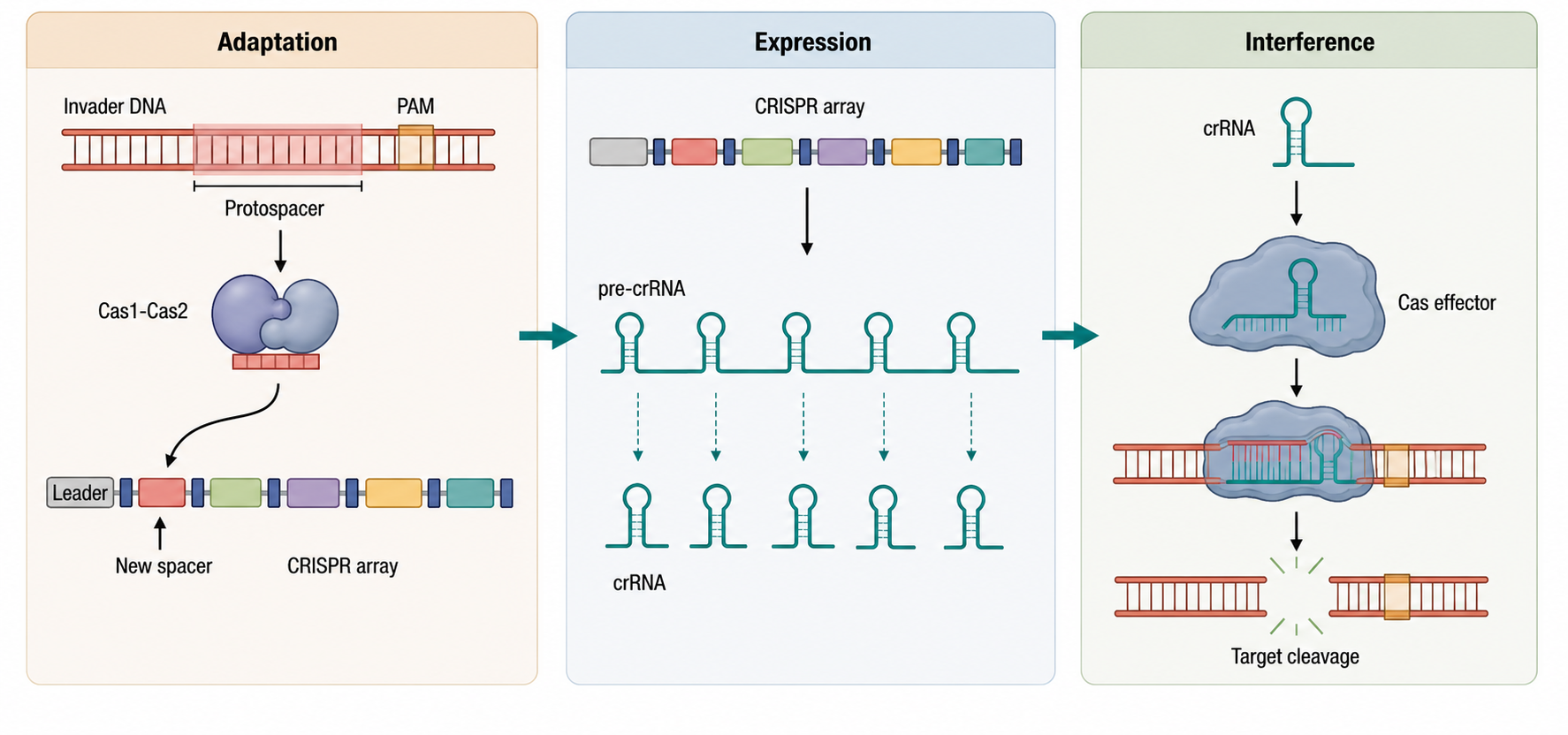
Figure 82.1. CRISPR Adaptation-Expression-Interference Cycle. “CRISPR-Cas immunity links a genomic memory array to RNA-guided target destruction. Cas1-Cas2 adaptation inserts a new spacer near the leader end of the array. Array transcription produces pre-crRNA, which is processed into mature crRNAs. A crRNA-loaded effector recognizes a matching protospacer in foreign nucleic acid, often using a PAM or other target-context cue, and triggers DNA or RNA destruction.”
Spacer acquisition, also called adaptation, is the stage that turns foreign nucleic acid into heritable immunity. The most conserved adaptation machinery contains Cas1 and Cas2. Cas1 is an integrase-like protein, and Cas2 forms a structural platform in many systems. Together, Cas1-Cas2 captures a short segment of foreign nucleic acid, processes or positions it as a prespacer, and integrates it into the CRISPR array. Integration usually occurs near the leader end of the array, so the newest spacers are added in a polarized order. This leader-proximal insertion pattern is useful for immunity because the newest spacers often match recently encountered threats and because array transcription from the leader side gives those spacers prominent access to expression.
The cell must avoid acquiring spacers that target its own chromosome. DNA-targeting systems solve part of this problem by preferring protospacers associated with a PAM. A PAM is present next to the foreign protospacer, but it is not copied into the CRISPR array when the spacer is acquired. Later, during interference, the effector recognizes the PAM next to the target. The host CRISPR array lacks the PAM next to the spacer, so the effector usually ignores the array itself. This is not the only self-nonself mechanism. Target availability, DNA repair, transcription, chromatin-like bacterial proteins, methylation, and regulatory timing can all affect acquisition and interference. Nevertheless, PAM-dependent discrimination is the clearest teaching example because it connects adaptation to later target recognition.
Adaptation can be naive or primed. Naive adaptation acquires a spacer without help from a pre-existing partially matching spacer. Primed adaptation occurs when an existing spacer recognizes an invader imperfectly or inefficiently, often because the phage has mutated the PAM or protospacer. Partial recognition recruits or stimulates adaptation machinery so that new spacers are acquired from the same invader. Priming is an elegant evolutionary answer to phage escape. A mutation that weakens interference can paradoxically make the invader a better source of new spacers, refreshing the host’s immune memory.
Expression begins when the array is transcribed into a long pre-crRNA. In many type I and type III systems, a Cas6-family endoribonuclease recognizes repeat-derived RNA structures and cuts within or near repeats, producing crRNAs with repeat-derived handles. In some type I systems, the processing enzyme remains associated with the mature crRNA-effector complex; in others, processing and effector assembly are more separable. In type II Cas9 systems, crRNA biogenesis uses a tracrRNA that base-pairs with the repeat-derived portion of the pre-crRNA. The duplex is cleaved by RNase III in the presence of Cas9, then trimmed to a mature guide. In many type V Cas12 systems, the effector itself can process pre-crRNA, making multiplex arrays especially natural for Cas12a engineering. These routes differ, but all solve the same problem: a long array transcript must be cut into guide units that preserve both target information and protein-binding handles.
Interference is the stage in which a crRNA-loaded effector finds and disables the target. Interference requires more than full complementarity. A DNA-targeting complex must sample many DNA sequences rapidly, reject most of them, open or distort candidate DNA, test the PAM, nucleate guide pairing, and activate cleavage only when the target passes enough checkpoints. An RNA-targeting complex faces a different search problem: the target may be folded, bound by proteins, modified, translated, degraded, or present only transiently. In both cases, guide-target pairing is necessary but not sufficient for robust specificity.
The original demonstration that small CRISPR RNAs guide antiviral defense was a turning point because it converted CRISPR arrays from genomic curiosities into RNA-guided immune systems (Brouns et al. 2008). That insight also clarified why CRISPR belongs in an RNA textbook. CRISPR immunity depends on RNAs that are transcribed from genomic memory, processed with precise ends, assembled into ribonucleoprotein complexes, and used to identify nucleic acid targets by base pairing.
82.2. Class 1 and class 2 Cas systems and RNA-guided targeting
CRISPR-Cas systems are classified by effector architecture as well as by protein phylogeny. The broadest division is between class 1 and class 2. Class 1 systems use multi-subunit effector complexes. Class 2 systems use a single large effector protein. This distinction is practical for teaching because it predicts how the guide RNA is held, how target recognition changes protein conformation, and how cleavage is executed. It is not a complete evolutionary history, because CRISPR systems exchange modules, lose genes, acquire mobile-element relatives, and diversify rapidly.
Table 82.1. Class 1 and Class 2 Effector Comparison. “Representative CRISPR-Cas systems differ in effector architecture, guide RNA format, target molecule, recognition checkpoint, nuclease output, collateral activity, and common biotechnology use.”
| System type | Effector architecture | Guide RNA architecture | Target nucleic acid | Recognition checkpoint | Catalytic output | Collateral activity | Application caveat |
|---|---|---|---|---|---|---|---|
| Type I, class 1 | Multi-subunit Cascade surveillance complex plus recruited Cas3 nuclease-helicase. | Mature crRNA displayed along Cascade, with spacer-derived guide and repeat-derived handle. | DNA protospacer. | PAM recognition followed by seed pairing and R-loop propagation. | Cascade binds the target and recruits Cas3 for processive DNA degradation. | Not the main defining output; damage is primarily target-directed DNA degradation. | Useful for large deletions or degradation-based engineering, but Cas3 recruitment and degradation extent must be controlled. |
| Type III, class 1 | Multi-subunit Csm or Cmr complex with auxiliary signaling modules in many systems. | crRNA loaded into the complex, commonly used to recognize target transcripts. | RNA target, often linked to transcribed DNA context. | Transcript pairing and system-specific discrimination between target RNA and self-derived RNA. | Target RNA cleavage, and in many systems DNA cleavage or cyclic nucleotide signaling that activates accessory ribonucleases. | Auxiliary RNase activation can broaden the antiviral response beyond the initial target. | Overview claims need subtype-specific validation because type III outputs vary widely. |
| Type II Cas9, class 2 | Single large Cas9 effector with HNH and RuvC nuclease domains. | Natural crRNA:tracrRNA duplex or engineered sgRNA scaffold. | DNA protospacer. | PAM recognition, local DNA opening, seed pairing, and R-loop formation. | HNH and RuvC domains cleave opposite DNA strands, or nuclease-dead variants bind without cutting. | No diagnostic-style collateral cleavage is expected for canonical Cas9 action. | Guide scaffold, PAM, ortholog choice, repair pathway, and exposure time shape editing outcome. |
| Type V Cas12a, class 2 | Single Cas12a effector with RuvC-like nuclease activity and intrinsic crRNA-processing capacity. | Single crRNA; arrays can be processed by the effector in many systems. | DNA protospacer and activated single-stranded DNA reporter substrates in diagnostics. | PAM recognition plus seed-dependent DNA targeting. | Staggered DNA cleavage after target recognition. | Target activation can trigger collateral single-stranded DNA cleavage. | Collateral activity supports diagnostics but differs across Cas12 enzymes and can complicate cellular interpretation. |
| Type VI Cas13, class 2 | Single RNA-targeting Cas13 effector with HEPN ribonuclease domains. | Cas13 crRNA with guide segment and Cas13-compatible handle. | RNA target. | RNA accessibility, guide-target pairing, and system-specific flanking or structural features. | Target RNA cleavage by activated HEPN domains. | Activated Cas13 can cleave bystander RNAs. | RNA knockdown and diagnostics require controls for collateral cleavage, stress responses, target accessibility, and guide dosage. |
Type I systems are the best-known class 1 DNA-targeting systems. A mature crRNA is loaded into Cascade, a multi-protein complex that displays the guide along a protein backbone. Cascade scans DNA for a PAM and begins pairing between the crRNA guide and the protospacer. If pairing extends productively, the target DNA strand is displaced and an R-loop forms. Cascade itself is primarily a recognition complex. After stable target binding, Cascade recruits Cas3, a nuclease-helicase that unwinds and degrades target DNA processively. This separation between recognition and destruction is a core feature of type I immunity. It also makes type I systems useful for large deletions and genome engineering strategies that exploit processive DNA degradation, although those applications require careful control.
Type III systems are class 1 systems with a different logic. Type III Csm and Cmr complexes bind crRNAs and often target RNA transcripts. In many type III systems, base pairing with an actively transcribed target RNA activates cleavage of the RNA target and can also trigger DNA cleavage or second-messenger signaling. Some type III complexes synthesize cyclic oligoadenylates that activate auxiliary ribonucleases such as Csm6-family enzymes, expanding an initial recognition event into a broader antiviral response. Type III systems therefore connect RNA recognition to a multilayer defense output. They also teach a boundary case: not every CRISPR target is DNA, and not every CRISPR immune response is a single cut at a single site.
Cas9, Cas12, and Cas13 are class 2 examples. Cas9 is the type II effector that made genome editing widely programmable. Natural Cas9 targeting uses two RNAs: the crRNA supplies the guide sequence, and the tracrRNA supplies a structural partner and scaffold. The two RNAs can be fused into a single-guide RNA, as shown in the landmark programmable Cas9 study by Jinek et al. (2012). Cas9 recognizes a PAM, forms an R-loop, positions the guide-target duplex, and cleaves the two DNA strands using two nuclease domains. The HNH domain cleaves the DNA strand complementary to the guide RNA, and the RuvC domain cleaves the non-complementary strand.
Cas12 effectors, historically including Cpf1 for Cas12a, use a different guide architecture and cleavage chemistry. Cas12a uses a crRNA without tracrRNA in many systems, recognizes a PAM that is often T-rich for commonly used enzymes, and creates staggered DNA ends rather than the blunt ends associated with many Cas9 cleavage events. Cas12a can process its own crRNA array, which supports multiplex editing and reflects a natural biogenesis route. Structural and biochemical work on Cas12a shows how guide RNA processing and seed-dependent DNA targeting are linked within the same effector (Swarts et al. 2017). After target activation, Cas12 family enzymes can also cleave single-stranded DNA nonspecifically, a property that has been harnessed for diagnostics.
Cas13 effectors are type VI RNA-targeting systems. A Cas13 crRNA guides the effector to a complementary RNA target. Target binding activates higher eukaryotes and prokaryotes nucleotide-binding, or HEPN, ribonuclease domains, which cleave the target and can also cleave bystander RNAs. This collateral RNA cleavage can suppress infection by damaging phage transcripts, but it can also impose cellular costs. Cas13 systems are therefore especially dependent on regulation, target context, and interpretation of collateral effects. Recent structural reviews frame Cas13 as an RNA-centric CRISPR family whose diversity is useful for RNA detection, RNA knockdown, and programmable RNA manipulation while retaining important toxicity and specificity caveats (Yang and Patel 2024).
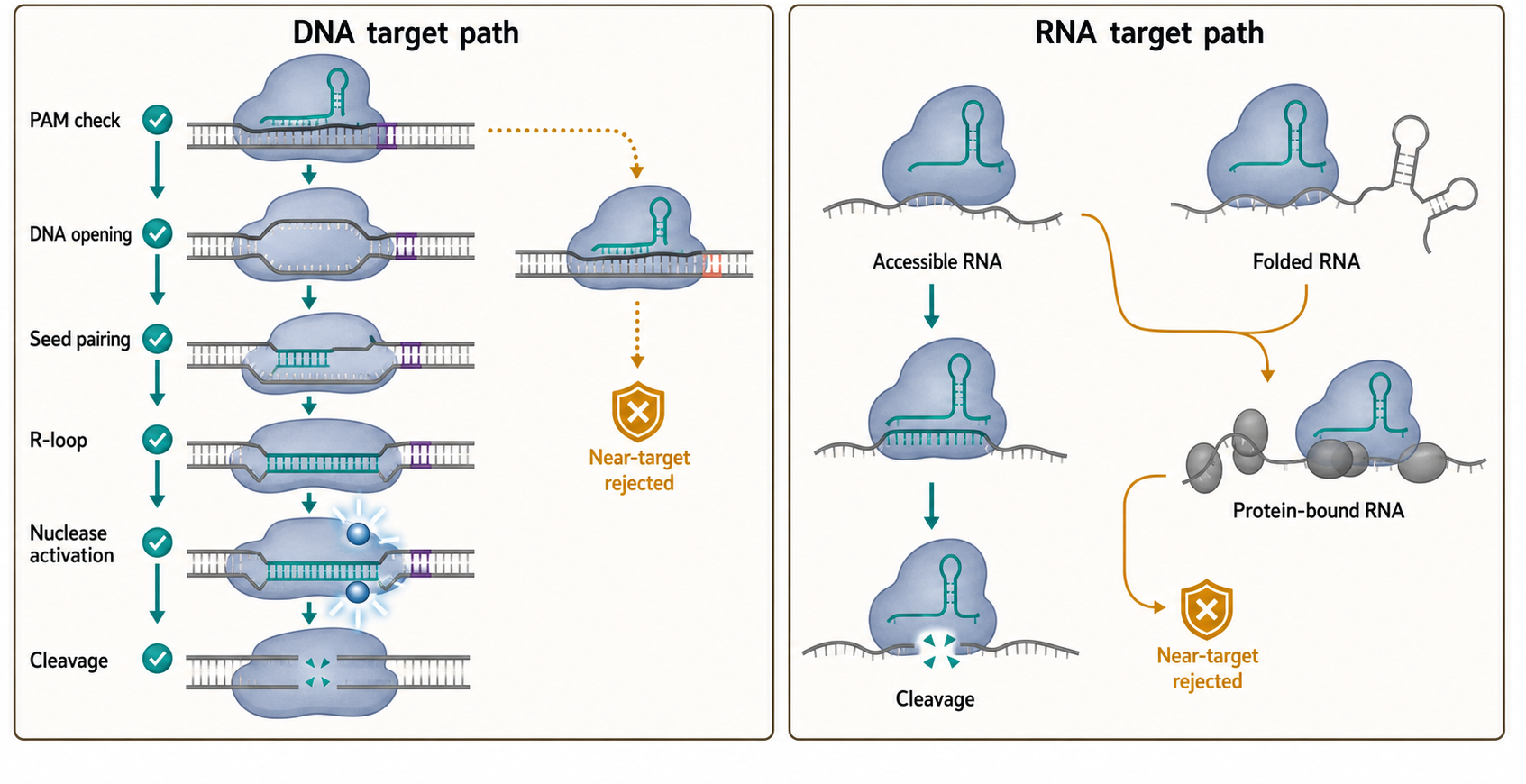
Figure 82.2. Guide-Target Interrogation and Seed/PAM Logic. “DNA-targeting CRISPR effectors combine PAM recognition, local DNA opening, seed pairing, R-loop propagation, and nuclease activation. RNA-targeting effectors face a different search problem because target RNAs can be folded, protein-bound, modified, translated, or transient. The seed region is an operational concept, not a universal fixed interval.”
Specificity is commonly taught through the seed region. The seed is the part of a guide, often near the PAM-proximal end for DNA-targeting systems, where mismatches are least tolerated during initial target interrogation. The seed is not a magic fixed length that applies to every system. Its apparent boundaries depend on the effector, guide length, target sequence, PAM strength, assay, temperature, magnesium concentration, chromatin or nucleoid context, and whether the measured output is binding, cleavage, repair, cell survival, or diagnostic signal. A mismatch that blocks cleavage in one assay can still permit binding, nicking, or transcriptional repression in another. This distinction is crucial when translating natural specificity into engineered use.
82.3. tracrRNA, guide RNAs, engineered genome editors, and diagnostics
The tracrRNA is a small RNA partner in type II Cas9 systems. Its name, trans-activating crRNA, reflects two functions. First, it base-pairs with repeat-derived sequence in the pre-crRNA and helps recruit RNase III for maturation. Second, it forms a structural scaffold recognized by Cas9. The guide portion of the crRNA is interchangeable within limits, but the tracrRNA-derived scaffold is not arbitrary. Stems, loops, bulges, and terminal structures in the guide RNA determine whether Cas9 binds, folds into an active surveillance complex, and reaches the conformations needed for cleavage.
The engineered single-guide RNA simplified Cas9 use by fusing crRNA and tracrRNA into one RNA molecule. This fusion preserved the target-matching segment and the essential scaffold elements. The engineering insight was simple in concept but powerful: if the protein needs a guide segment plus a structural RNA partner, those parts can be joined by a linker so that the user changes only the guide sequence. Jinek et al. (2012) established this dual-RNA and single-guide programmability in vitro and created the molecular basis for many later genome editing systems.
Engineered guide RNAs are designed under constraints. The guide must match the intended target near an acceptable PAM. It should avoid high-risk near matches elsewhere in the genome or transcriptome. It must have a length and GC content compatible with effector loading and target interrogation. It should avoid internal structures that sequester the guide or disrupt the scaffold. If delivered as synthetic RNA, it may need chemical modifications to resist nucleases, reduce innate immune activation, and improve editing in primary cells. Hendel et al. (2015) showed that chemical modification of guide RNAs can improve editing in human primary cells, illustrating that guide performance includes RNA chemistry, not only target sequence.
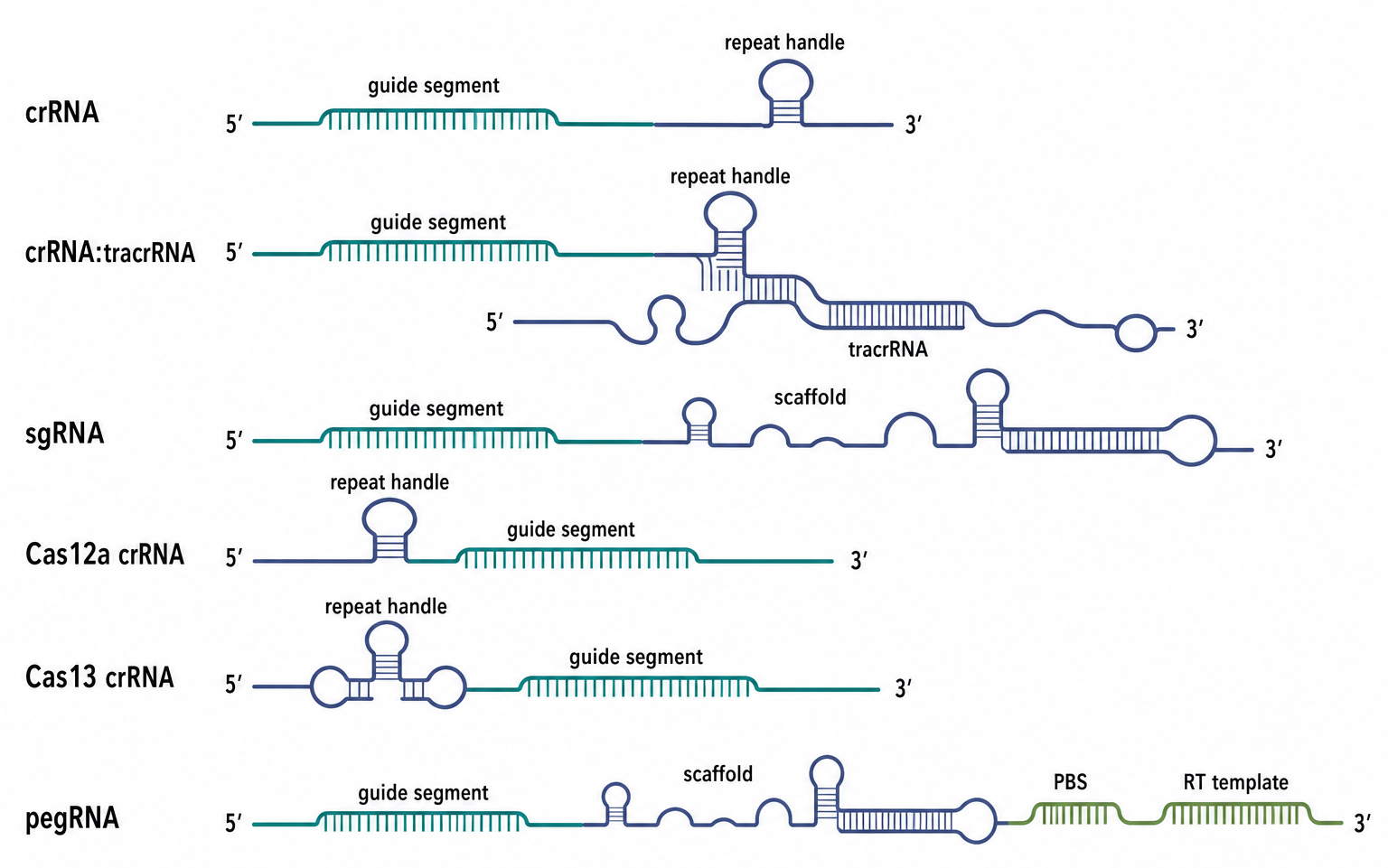
Figure 82.3. Natural and Engineered Guide RNA Architectures. “Guide RNAs combine interchangeable target-recognition segments with noninterchangeable structural and processing elements. Natural crRNAs include spacer-derived guide and repeat-derived handles. Cas9 uses crRNA with tracrRNA or an engineered sgRNA. Cas12 and Cas13 guides use different handles. pegRNAs add a primer-binding site and reverse-transcription template for prime editing.”
Genome editors extend the natural guide concept. A nuclease-active Cas9 can make a double-strand break that the cell repairs by end joining or homology-directed repair. A nuclease-dead Cas9 can bind DNA without cutting and can recruit transcriptional regulators, chromatin modifiers, base editors, or imaging tags. Base editors couple a guide-directed Cas protein to a deaminase, producing local base conversion without a double-strand break. Prime editors couple a Cas9 nickase to a reverse transcriptase and use a prime-editing guide RNA, or pegRNA. The pegRNA contains the ordinary guide segment plus a primer-binding site and a reverse-transcription template. Reviews and structural work on prime editing emphasize that pegRNA function depends on both Cas9 targeting and reverse-transcription geometry (Chen and Liu 2023; Shuto et al. 2024).
Cas12a guide engineering differs because the natural crRNA is shorter and the effector can process arrays. This allows one transcript to encode multiple crRNAs, a useful feature for multiplex editing or regulation. Cas12 diagnostics exploit a target-triggered collateral single-stranded DNA cleavage activity. A guide directs Cas12 to a target DNA or, after amplification or conversion, a diagnostic sequence. Once activated, Cas12 cleaves labeled reporter oligonucleotides, generating a signal. Photocontrol and other guide-control strategies can reduce background or time activation in diagnostic workflows (Hu et al. 2022).
Cas13 diagnostics use a similar transduction principle with RNA. A crRNA directs Cas13 to a target RNA, and activated Cas13 cleaves labeled RNA reporters. The collateral activity is not just a nuisance; it is the signal amplifier. The same property means that cellular Cas13 use must be interpreted with care. Knockdown of a target RNA may be accompanied by bystander RNA cleavage, stress responses, growth defects, or selection against cells with high effector activity. A clean Cas13 experiment therefore needs guide controls, inactive or mismatch controls, RNA abundance measurements, cell-state controls, and, when possible, orthogonal validation.
PAM-flexible and engineered Cas variants expand targetable sequence space, but they also change specificity landscapes. An enzyme that accepts more PAMs can reach more genomic sites. It may also increase the number of near-targets that pass early recognition. Engineered FnCas9 variants illustrate how PAM flexibility and precision can be optimized for editing and diagnostics, but each variant must be benchmarked in the intended application rather than assumed to inherit the exact specificity profile of its parent enzyme (Acharya et al. 2024). Guide design and enzyme engineering are therefore coupled problems.
82.4. Anti-CRISPR proteins, RNA anti-CRISPRs, and phage countermeasures
CRISPR-Cas immunity creates strong selection on phages, plasmids, and other mobile elements. A mobile element that cannot escape guide recognition is degraded. A mobile element that mutates the PAM, mutates the protospacer, hides the target, or inhibits the effector can replicate. Anti-CRISPRs are counter-defense factors that inhibit CRISPR-Cas systems. Most characterized anti-CRISPRs are proteins encoded by phages or mobile genetic elements, but RNA anti-CRISPRs show that nucleic acid mimics can also be counter-defense molecules.
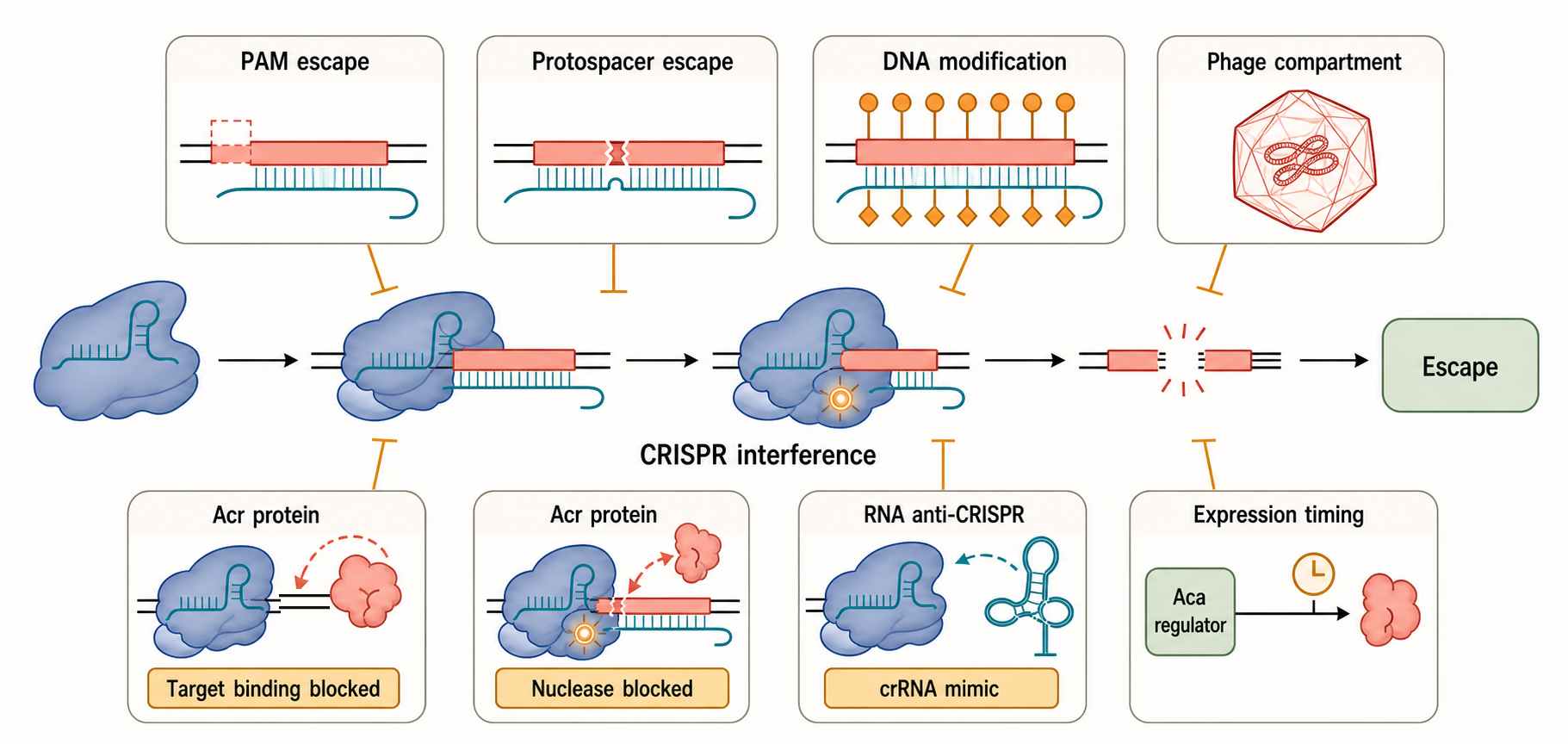
Figure 82.4. Anti-CRISPR Mechanisms and Phage Escape Routes. “Phages and mobile elements evade CRISPR-Cas immunity by mutating PAMs or protospacers, modifying or hiding target DNA, expressing anti-CRISPR proteins, producing RNA anti-CRISPRs, and regulating inhibitor expression. Anti-CRISPR proteins can block target binding, mimic nucleic acid substrates, inhibit nuclease activation, or alter surveillance-complex assembly. RNA anti-CRISPRs can act as structured decoys or crRNA-like mimics.”
Anti-CRISPR proteins use diverse mechanisms because CRISPR-Cas interference has many vulnerable steps. Some anti-CRISPR proteins prevent the effector from binding DNA by occupying a PAM-recognition surface or guide-target binding region. Some mimic DNA or RNA substrates so that the effector binds an inhibitor instead of the real target. Some lock the effector in an inactive conformation after target binding. Some inhibit nuclease active sites. Some destabilize or prevent assembly of the surveillance complex. Some regulate anti-CRISPR gene expression through associated anti-CRISPR-associated proteins, often abbreviated Aca proteins. Anti-CRISPR families are diverse and often system-specific, so the name “anti-CRISPR” describes function rather than a single fold or mechanism (Liu et al. 2020).
RNA anti-CRISPRs extend the concept of molecular mimicry. Phages can produce RNAs that resemble crRNA structures or otherwise bind CRISPR effectors in ways that prevent immune function. Camara-Wilpert et al. (2023) reported bacteriophages that suppress CRISPR-Cas immunity using RNA-based anti-CRISPRs. Hayes et al. (2025) described RNA-mediated CRISPR-Cas13 inhibition through crRNA structural mimicry. These examples are especially important for RNA biology because they show that a guide RNA fold can become both an immune specificity molecule and an inhibitory decoy. A mimic does not need to encode a protein to alter the immune state of the cell.
Some anti-CRISPR systems are regulated by proteins that bind both RNA and DNA. Birkholz et al. (2024) describe phage anti-CRISPR control by an RNA- and DNA-binding helix-turn-helix protein. Such regulation matters because anti-CRISPR expression must be timed. If the phage expresses too little inhibitor, CRISPR interference can destroy the phage genome. If the phage expresses an inhibitor at the wrong time or level, it may burden the phage or reveal itself to host counter-counter-defense systems. Anti-CRISPR biology is therefore not only an inhibitor catalog; it is gene regulation under intense selection.
Phage escape is broader than anti-CRISPRs. A single nucleotide change in a PAM can be enough to prevent target recognition in many systems. A mutation in the seed region can weaken guide pairing. Deletions, recombination, DNA modification, anti-restriction systems, replication compartments, high-speed replication, and high multiplicity of infection can all change the outcome of infection. Some jumbo phages build proteinaceous compartments that physically separate phage DNA from host nucleases. Some mobile elements may carry multiple counter-defense genes, so CRISPR inhibition is part of a larger anti-defense arsenal.
The existence of anti-CRISPRs also constrains biotechnology. Anti-CRISPR proteins can be useful off-switches for genome editing, allowing temporal control of Cas activity. They can reduce off-target exposure by limiting the time an editor remains active. They can be built into circuits that restrict editing to a condition or cell type. But they also complicate environmental and clinical uses because naturally occurring inhibitors may reduce editing or diagnostic performance in microbial communities. Anti-CRISPRs should be treated as both natural phage countermeasures and programmable regulatory parts.
Box 82.1. Do Not Overgeneralize Anti-CRISPR Action
“An anti-CRISPR claim should specify the inhibitor molecule, source element, target CRISPR type, inhibited step, expression timing, and assay readout. Activity against one Cas ortholog or subtype does not imply activity against all CRISPR-Cas systems.”
82.5. Evolution, specificity, and biotechnology of CRISPR RNAs
CRISPR-Cas systems evolve rapidly because they sit at the interface between heritable host defense and mobile genetic element pressure. The array changes as new spacers are acquired and old spacers are deleted or drift into irrelevance. Cas genes are gained, lost, rearranged, and replaced. Anti-CRISPRs appear in phages and mobile elements. Some CRISPR loci become inactive, and some spacers target chromosomal sequences, creating risks and sometimes regulatory opportunities. CRISPR immunity is therefore dynamic at both the sequence level and the system-architecture level.
Evolutionary links between CRISPR effectors and mobile-element nucleases are especially important. TnpB and IscB are transposon-associated RNA-guided nucleases related to Cas12 and Cas9-like systems. Fanzor is a eukaryotic programmable RNA-guided endonuclease related to this broader family (Saito et al. 2023). Bridge RNAs direct programmable recombination between target and donor DNA in IS110-family systems, expanding the landscape of guide-RNA-directed genome manipulation beyond canonical CRISPR cleavage (Durrant et al. 2024). These discoveries do not mean all RNA-guided nucleases are CRISPR immune systems. They mean that mobile elements and CRISPR systems share an evolutionary toolkit of RNA-guided recognition, nuclease recruitment, and genome remodeling.
Specificity has three layers. The first layer is molecular recognition by the effector: PAM or flanking sequence, seed pairing, guide-target duplex geometry, scaffold recognition, and nuclease activation. The second layer is cellular context: target copy number, chromatin or nucleoid state, transcription, replication, RNA folding, RNA-binding proteins, repair pathway availability, and effector abundance. The third layer is population selection: cells with toxic self-targeting or high collateral damage may die or be depleted, while phages with escape mutations may expand. A guide can appear highly specific in a short biochemical assay and less specific after days of cellular selection, or the reverse can happen if off-target products are poorly repaired or selected against.
Biotechnology uses CRISPR RNAs because the targeting rule is programmable. Change the guide sequence, preserve the scaffold, supply a compatible effector, and the complex can be redirected. This statement is true enough to explain the field and incomplete enough to cause mistakes. The scaffold may tolerate some changes and not others. The target may be inaccessible. The cell may repair the break in an unwanted way. The guide may have near matches. The effector may stay active too long. A diagnostic sample may contain inhibitors. An RNA-targeting system may trigger collateral cleavage. A delivery vehicle may stimulate immunity. A microbial strain may encode an anti-CRISPR. Programmability reduces the cost of retargeting, but it does not remove the need for mechanism-specific validation.
Table 82.2. Evidence and Validation Ladder for CRISPR RNA Mechanisms. “CRISPR mechanism claims become stronger as genomic prediction is connected to mature crRNA detection, biochemical reconstitution, structural models, cellular interference, specificity profiling, and application-specific validation.”
| Evidence tier | Typical method | What it supports | What it does not prove | Common artifact or caveat |
|---|---|---|---|---|
| Genomic prediction | Repeat-spacer annotation, nearby cas gene classification, spacer-protospacer matching. | A locus may encode a CRISPR-Cas system and may have sampled related mobile-element sequences. | Current immunity, mature crRNA production, or active interference. | Old spacer matches, inactive cas loci, incomplete assemblies, and unsampled environmental targets can mislead interpretation. |
| Mature crRNA detection | Northern blot, primer extension, small-RNA sequencing, or in vitro processing assay. | Array transcripts are processed into guide-sized RNAs with plausible repeat-derived handles. | Effector loading, target cleavage, or immune protection. | Total pre-crRNA transcription can be mistaken for mature guide production. |
| Biochemical reconstitution | Purified Cas proteins with synthetic or transcribed guide RNA and defined DNA or RNA targets. | Binding, cleavage chemistry, PAM or PFS dependence, mismatch effects, product ends, and collateral activity under controlled conditions. | Cellular specificity, repair outcome, infection protection, or long-term toxicity. | High protein or guide concentration and naked target substrates can exaggerate activity. |
| Structural biology | Cryo-electron microscopy, crystallography, or related structural analysis of guide-effector-target states. | Guide scaffold placement, R-loop geometry, nuclease-domain positioning, Cas12 processing architecture, Cas13 activation, or anti-CRISPR blockade. | Full target-search kinetics, mismatch rejection pathways, guide exchange, or cellular repair outcomes. | Static structures capture selected states and may miss transient intermediates. |
| Cellular interference | Phage challenge, plasmid loss, target depletion, spacer or cas deletion, and complementation. | Spacer-, target-, and cas-dependent immune function in a biological context. | The exact molecular step responsible for resistance without supporting mechanism assays. | Other defense systems, receptor changes, growth state, or selection can mimic or mask CRISPR effects. |
| Specificity profiling | Mismatch libraries, off-target sequencing, guide screens, target-variant libraries, or diagnostic cross-reactivity panels. | Which near-targets, PAMs, guide positions, or target contexts are tolerated in a defined assay. | Transferability to all cell types, orthologs, delivery formats, or exposure times. | Scores are readout-specific and can be reshaped by repair, chromatin, RNA structure, toxicity, or selection. |
| Anti-CRISPR testing | Phage survival assays, inhibitor expression, direct binding, cleavage inhibition, structural analysis, or expression-regulation assays. | Whether a protein or RNA inhibitor blocks a specific CRISPR-Cas step or system. | Broad inhibition across unrelated Cas types or natural relevance in every host. | Anti-CRISPRs are often system-specific, dosage-sensitive, and timing-dependent. |
| Application validation | Editing outcome analysis, diagnostic limit-of-detection testing, multiplex guide abundance measurement, delivery assessment, and orthogonal readout confirmation. | Performance of the chosen guide-effector format in the intended genome-editing, RNA-targeting, diagnostic, or multiplex workflow. | General mechanism or safety in untested biological settings. | Delivery, immune sensing, sample inhibitors, guide competition, collateral cleavage, and repair pathway differences can dominate the result. |
Multiplex CRISPR applications highlight the importance of RNA processing and guide dosage. Natural arrays encode many spacers in one transcript. Engineered arrays can similarly express multiple crRNAs, especially for Cas12a systems that process their own crRNAs. Multiplex genome editing, microbial strain engineering, pooled perturbation screens, and combinatorial regulation depend on how guides are expressed, processed, loaded, and competed. A guide that works alone may fail in a pool because it is expressed at a lower level, processed inefficiently, competes poorly for the effector, or creates a growth disadvantage. Multiplex systems therefore require measurements of individual guide abundance and output, not only final phenotype.
Recent structural and evolutionary studies continue to refine the relationship among natural Cas enzymes, engineered editors, and ancestral RNA-guided systems. Nagahata et al. (2026) is treated here only as broad evolutionary-structural context because it is a very recent reference. The conservative conclusion is already strong without overreaching: CRISPR-Cas effectors are part of a broader evolutionary landscape of RNA-guided nucleases and recombinases, and biotechnology increasingly mines that landscape for smaller, more flexible, or differently specific tools.
Experimental Foundations and Evidence
CRISPR evidence begins with comparative genomics. Arrays are recognized by repeat-spacer organization. Spacers can be matched to phage, plasmid, prophage, or environmental sequences. Cas genes near arrays suggest system type. Comparative analysis can infer likely function, but it cannot prove activity. A spacer match may be old, the target phage may no longer exist, the Cas locus may be inactive, or the array may be transcribed but not processed productively. Genomic evidence is strongest when paired with expression, processing, and interference assays.
Phage challenge experiments test immune function. A bacterial strain with a spacer matching a phage protospacer can be challenged with that phage. Loss of infection, phage escape mutants, new spacer acquisition, and dependence on cas genes support CRISPR immunity. Such assays must account for other defense systems. Restriction-modification, abortive infection, defense islands, toxin-antitoxin systems, surface receptor variation, and growth state can all affect phage sensitivity. A CRISPR claim is strongest when deleting the spacer or cas gene changes resistance and restoring the system restores resistance.
RNA processing assays establish crRNA biogenesis. Northern blots, primer extension, RNA sequencing, and in vitro processing can show that a pre-crRNA is cut into repeat-spacer units. Mutations in repeats, tracrRNA, Cas6, RNase III, or effector processing domains can connect RNA structure to mature crRNA formation. These assays also reveal a common artifact: total array transcription is not the same as mature guide production. A highly transcribed array may fail if repeats are not processed correctly or if mature crRNAs are unstable.
Biochemical reconstitution tests mechanism. Purified Cas proteins and synthetic or transcribed guide RNAs can be combined with target DNA or RNA. Such assays measure binding, cleavage, PAM dependence, mismatch tolerance, product ends, and collateral activity. Reconstitution is powerful because it reduces cellular complexity, but it can exaggerate activity if protein and guide concentrations are high, if targets are naked rather than chromatinized or protein-bound, or if the assay lacks cellular inhibitors. A cleavage reaction in a tube is evidence for catalytic capacity, not a complete description of cellular specificity.
Structural biology explains how guide RNAs and targets are held. Cryo-electron microscopy and crystallography have shown guide RNA scaffolds, R-loop formation, nuclease-domain positions, Cas12a processing architecture, and Cas13 activation states. Structures reveal why PAMs matter, how seed pairing nucleates recognition, and how anti-CRISPRs block conformational transitions. A structure is still a snapshot. Target search, mismatched intermediates, guide exchange, collateral activation, and repair outcomes require kinetic and cellular data.
High-throughput guide screens measure many guides at once. In genome editing, guide libraries can reveal which genes affect a phenotype. In guide-design research, libraries with systematic mismatches or target variants measure rules of specificity. In diagnostics, libraries can optimize guide sensitivity, background, and robustness. These approaches produce useful maps, but they are assay-specific. A guide score from one cell type, Cas variant, repair pathway, chromatin state, or readout does not transfer automatically.
Biological Contexts Across Organisms and Mobile Elements
CRISPR-Cas systems are common in bacteria and archaea, but distribution is patchy. Some lineages carry many arrays and cas genes; others carry none. Even within a species, strains can differ sharply because CRISPR loci are gained, lost, silenced, or reshaped by horizontal gene transfer. The patchiness makes biological sense. CRISPR immunity blocks mobile elements, but mobile elements can also bring beneficial genes such as antibiotic resistance, virulence factors, metabolic traits, or symbiosis functions. A lineage that benefits from frequent horizontal gene transfer may lose or suppress CRISPR defense, while a lineage under strong phage pressure may maintain active systems.
In bacteria, CRISPR-Cas immunity interacts with other defense and regulatory networks. Surface receptor mutation can prevent phage entry before CRISPR is needed. Restriction enzymes can cut invading DNA before a crRNA-guided complex finds it. Abortive infection can kill the infected cell to protect the population. Small RNAs and stress responses can alter cas gene expression. Biofilm state, growth rate, and nutrient availability can change phage exposure. The CRISPR locus is therefore one defense layer among many, not a universal immune solution.
In archaea, CRISPR-Cas systems are especially diverse and often prominent, with many type I and type III systems. Archaeal transcription, RNA processing, and cellular biology differ from bacterial systems, so archaeal CRISPRs provide important comparisons for guide maturation and effector assembly. This chapter uses archaeal examples only as comparative context. Chapter 83 treats archaeal small RNAs, archaeal CRISPR diversity, and archaeal regulatory logic in more detail.
Phages and plasmids are not passive targets. They are evolving populations. A phage population may contain pre-existing PAM or protospacer variants before encountering a host. Selection enriches escape mutants. Anti-CRISPR genes can spread among mobile elements. Recombination can replace targeted regions. A spacer that gives strong defense today may become obsolete after phage evolution. Conversely, a phage escape mutation may reduce phage fitness, making immunity effective even when escape is possible.
Self-targeting is an important boundary case. If a spacer matches the host chromosome and the effector is active, the result can be lethal or mutagenic. Some self-targeting spacers are tolerated because the cas system is inactive, the target lacks a PAM, the target is mutated, the guide is poorly expressed, or anti-CRISPR regulation suppresses activity. In a few contexts, CRISPR-associated targeting may influence genome evolution or regulation, but such claims require careful evidence because toxic self-targeting creates strong selection for loss or suppression.
Technology, Computational, Clinical, and Engineering Links
CRISPR biotechnology rests on natural RNA-guided targeting, but each application asks for a different version of the natural system. Genome editing needs efficient target modification with acceptable off-target risk. CRISPR interference and activation need stable binding with minimal cleavage. Base editing needs a residence time and editing window that position a deaminase over the intended base. Prime editing needs guide-directed nicking, primer binding, reverse transcription, flap resolution, and repair. Diagnostics need low background, high sensitivity, and sample compatibility. RNA targeting needs target knockdown or detection without intolerable collateral RNA damage.
Computational guide design starts with sequence search. The simplest task is to find targets next to compatible PAMs or suitable RNA-accessible regions and then remove guides with close matches elsewhere. More advanced models estimate mismatch tolerance, chromatin accessibility, RNA structure, guide folding, editing windows, repair outcomes, expression level, and toxicity. These models depend on training data. A model trained on one Cas9 ortholog, cell line, delivery method, or readout may perform poorly elsewhere. Computational guide design should be treated as prioritization, not as proof of specificity.
Genome editing in cells adds repair biology. A Cas nuclease can cut a target exactly as designed, but the final product is created by the cell. Nonhomologous end joining, microhomology-mediated end joining, homology-directed repair, base excision repair, mismatch repair, reverse-transcription intermediates, and DNA damage responses all affect outcomes. The same guide can yield different indels or editing frequencies in different cell types. Guide RNA mechanism therefore connects to DNA repair and cell-state biology.
Clinical and environmental applications add delivery, exposure, and safety. A guide and effector must reach the right cells or organisms, persist long enough to act, avoid excessive immune stimulation, and stop before off-target damage accumulates. Synthetic guide RNAs can be chemically modified, as in primary-cell editing work, but modifications may alter loading, activity, or recognition. Viral vectors, lipid nanoparticles, electroporation, ribonucleoprotein delivery, and bacterial conjugation each impose different constraints. Anti-CRISPR off-switches, split editors, inducible expression, transient ribonucleoprotein delivery, and guide half-life tuning are ways to narrow the active window.
Diagnostics illustrate a different engineering tradeoff. Collateral cleavage by Cas12 or Cas13 is undesirable in many cellular contexts but valuable for signal amplification in a test tube. The diagnostic guide must distinguish the intended pathogen, variant, or allele from near neighbors. The assay must tolerate sample inhibitors, amplification bias, contamination risk, temperature variation, and reporter background. A positive collateral-cleavage signal proves that the effector was activated under assay conditions; it does not by itself identify whether amplification artifacts or near-match targets contributed.
Box 82.2. Guide RNA Design Caveats
“Guide design requires more than target complementarity. A guide must preserve scaffold integrity, satisfy PAM or PFS rules when relevant, avoid high-risk near-targets, remain accessible and stable, load into the chosen effector, fit the delivery chemistry, and be interpreted in the context of repair, collateral cleavage, and selection.”
Recent Consensus
Current consensus treats CRISPR-Cas systems as diverse RNA-guided immune systems rather than a single mechanism. The shared core is crRNA-guided recognition, but adaptation machinery, crRNA maturation, effector architecture, target type, nuclease chemistry, and immune outputs vary greatly. Class 1 and class 2 systems are both important; class 2 systems dominate many biotechnological applications because a single protein is easier to deliver and engineer, while class 1 systems remain central to natural immunity and increasingly useful for large-scale genome manipulation.
A second consensus is that guide RNA design must include scaffold, chemistry, expression, target context, and effector state. A guide sequence cannot be evaluated only by perfect complementarity to the intended target. PAM strength, seed mismatches, guide folding, off-target landscape, target accessibility, repair biology, and time of exposure all shape outcome. This principle applies to natural spacers, synthetic sgRNAs, Cas12 crRNAs, Cas13 crRNAs, pegRNAs, and diagnostic guides.
A third consensus is that anti-CRISPR biology is mechanistically diverse and biologically important. Anti-CRISPRs are not rare curiosities. They are part of the same evolutionary conflict that created CRISPR diversity. Protein anti-CRISPRs and RNA anti-CRISPRs demonstrate that mobile elements can inhibit immunity at many points, including guide loading, target recognition, nuclease activation, and transcriptional control of inhibitor expression.
A fourth consensus is that CRISPR-related RNA-guided systems extend beyond canonical immune loci. Fanzor, TnpB/IscB-like nucleases, and bridge RNA systems show that programmable RNA-guided DNA manipulation is a broader biological theme. The conservative interpretation is not that these systems are all CRISPR. The important point is that RNA-guided recognition has repeatedly been coupled to enzymes that cut, nick, transpose, recombine, or regulate nucleic acids.
Open Questions, Controversies, Deprecated Models, and Common Misconceptions
Open questions:
- What determines how cells balance immunity against access to beneficial mobile DNA? CRISPR-Cas defense can prevent lethal phage infection, but it can also block plasmids, islands, and other elements that might carry useful genes. Lineages differ in whether CRISPR is active, inactive, absent, or regulated by environmental conditions. Explaining this distribution requires ecology, phage pressure, horizontal gene transfer, and defense-system interactions, not only molecular mechanism.
- The full diversity of RNA anti-CRISPRs and non-protein counter-defense? Protein anti-CRISPR discovery accelerated because small phage open reading frames could be screened genetically. RNA anti-CRISPRs are harder to find because they may be short, structured, conditionally expressed, poorly conserved at primary sequence, or embedded in regulatory regions. The recent reports of RNA-based anti-CRISPRs suggest that many counter-defense RNAs may remain hidden.
- How can researchers predict specificity across biological scales? Biochemical mismatch maps are valuable, but cellular outcomes also depend on repair, chromatin, transcription, RNA folding, dosage, immune sensing, and selection. For therapeutic and ecological applications, the relevant endpoint includes rare off-target, bystander, repair, or escape events that become important only after many cells or organisms are exposed.
Common misconceptions:
- “CRISPR is a bacterial version of animal adaptive immunity.” CRISPR is adaptive in the sense of acquired, heritable, sequence-specific memory, but its molecules and population logic are different from lymphocyte-based immunity.
- “The spacer is the foreign DNA still present in the cell.” A spacer is a copied memory inside the host CRISPR array. The protospacer is the corresponding sequence in the invader or target.
- “A perfect guide match guarantees cleavage.” Cleavage also requires the right effector, guide scaffold, PAM or target context, target accessibility, active nuclease conformation, and compatible cellular conditions.
- “Cas9, Cas12, and Cas13 are interchangeable editors.” Cas9 and Cas12 mainly target DNA with different guide architectures and cleavage properties; Cas13 targets RNA and can produce collateral RNA cleavage.
- “Collateral cleavage is always an artifact.” Collateral cleavage can be a natural immune output and a useful diagnostic amplifier. It becomes a problem when it is mistaken for target-specific knockdown or editing in cells.
- “Anti-CRISPR means one kind of inhibitor.” Anti-CRISPRs include unrelated proteins and RNAs that inhibit different steps of different CRISPR-Cas systems.