Chapter 93. Functional Evidence for Enhancer, Promoter-Associated, Antisense, and Readthrough RNAs
Scope Note
This chapter asks when an enhancer RNA, promoter-associated RNA, natural antisense RNA, or readthrough RNA product has a causal regulatory function. Its primary subject is functional evidence: candidate RNA-product mechanisms, perturbation and rescue logic, and the evidence needed to distinguish an RNA-molecule effect from an effect of the underlying DNA element, the act of transcription, or an incidental by-product. The architecture that produces these RNAs is introduced only as needed for causal interpretation and is treated in depth in Chapter 15; nuclear recognition and disposal are treated in Chapter 31.
Executive Summary
Enhancer RNAs, promoter-associated RNAs, antisense RNAs, and readthrough RNAs are genomic-origin classes, not mechanistic classes. Detecting one establishes that transcription occurred and, with suitable end mapping, where the RNA came from. Detection does not establish that the RNA molecule regulates another gene. For every class, at least four causal layers may explain an association: the DNA element may act independently of its transcript; transcription through the locus may change chromatin or interfere with another polymerase; the RNA product may act through sequence, structure, modification, localization, or binding; or the RNA may be an incidental product of an active or imperfectly bounded transcriptional region.
Plausible RNA-product mechanisms differ among loci. An enhancer RNA may stabilize a local coactivator interaction; a promoter-associated RNA may bind a transcription factor, chromatin regulator, or RNA-processing factor near its site of synthesis; a natural antisense RNA may pair with a sense RNA or recruit a protein through a defined domain; and a readthrough RNA may retain or redistribute RNA-binding proteins, form a hybrid, or contribute sequence that alters processing of an extended product. Each mechanism demands evidence that is specific to the RNA product rather than to coincident transcription.
The most persuasive studies triangulate causality. They verify the RNA species, perturb DNA, transcription, and RNA layers separately, measure immediate molecular outputs before secondary cell-state changes dominate, and perform a rescue that matches the proposed mechanism. A transcript that correlates with enhancer activity may be a useful biomarker, a causal RNA effector, a consequence of enhancer opening, or different combinations in different contexts. Functional and by-product interpretations are therefore conclusions supported by defined evidence, not labels inferred from abundance, stability, genomic location, or annotation alone.
Concept Inventory
- Enhancer RNA (eRNA): an RNA transcribed from an enhancer, usually by RNA polymerase II, often short-lived, nonpolyadenylated or weakly processed, and bidirectional. The term describes origin, not proven function.
- Promoter-associated RNA: a transcript initiated at or near a promoter but not necessarily part of the mature sense mRNA. This category includes upstream antisense RNAs, promoter upstream transcripts, short promoter-proximal RNAs, and divergent promoter products.
- Natural antisense transcript (NAT): an endogenous transcript produced from the strand opposite another annotated transcript, with partial or complete overlap in genomic coordinates. NATs can be protein-coding or noncoding, stable or unstable, cis-acting or trans-acting.
- RNA-product mechanism: a causal mechanism that requires a property of the RNA molecule—such as its sequence, structure, modification, localization, concentration, or protein-binding surface—rather than merely its synthesis.
- Transcription-dependent effect: a regulatory consequence of initiation or polymerase passage that does not require persistence of the RNA product.
- DNA-element effect: a consequence of regulatory sequences, factor-binding sites, spacing, or chromatin architecture at the locus that remains distinct from transcription and RNA-product effects.
- Transcriptional interference: a change in expression caused by one transcription unit affecting another through polymerase passage, promoter occlusion, elongation collision, chromatin changes, termination effects, or altered RNA processing.
- Readthrough transcript: an RNA produced when polymerase continues beyond a normal termination zone. Readthrough can be transient, stress-induced, caused by defective termination, or associated with disease and boundary failure.
- Pervasive transcription: transcription initiation and elongation outside canonical annotated genes. The phrase includes biologically regulated noncoding transcription and unstable transcripts that are normally contained by termination and nuclear RNA decay.
What to Know Before Reading This Chapter
RNA polymerase II transcription is not restricted to a one-promoter-one-mRNA model. Enhancers and promoters can produce nearby noncoding RNAs, opposite-strand transcription can overlap another gene, and polymerase can extend beyond an annotated 3′ end. Those production routes are summarized here only to define the candidate molecule. The organization of initiation sites, termination regions, and transcription boundaries belongs to Chapter 15, while the pathways that recognize and remove unstable nuclear products belong to Chapter 31.
The core experimental distinction is between observing synthesis and testing molecule function. Standard RNA-seq emphasizes accumulated RNA, whereas GRO-seq, PRO-seq, NET-seq, TT-seq, and capped-RNA profiling emphasize engaged polymerase, new RNA, or initiation. Neither observation alone identifies the causal layer. Removing a regulatory DNA element, blocking transcription, degrading the RNA after synthesis, mutating an RNA motif, and restoring the RNA in cis or in trans answer different questions and can yield different phenotypes.
Running examples in this chapter include signal-induced enhancers that produce eRNAs, divergent promoters that generate upstream antisense transcripts, antisense transcription that represses or alters a sense gene, and termination failure that creates readthrough into downstream loci. These examples show why the same molecular observation can have several interpretations. A short unstable RNA near a regulatory element might be causal, might be a marker of open chromatin, might help recruit a regulator only in a particular cell state, or might be a by-product that matters only when surveillance fails.
93.1. Enhancer RNAs: candidate mechanisms and functional evidence
An enhancer RNA (eRNA) is defined by origin at an enhancer, not by a common sequence or proven function. Many active enhancers show bidirectional nascent transcription and yield short, weakly processed RNAs, whereas some enhancer-associated loci produce longer or more stable RNAs. The detailed production architecture belongs to Chapter 15, and the fate of unstable products belongs to Chapter 31. Here, the relevant starting fact is narrower: enhancer transcription and nearby gene activation often covary, so experiments must determine whether the enhancer DNA, the transcription event, the RNA molecule, or a shared upstream activator explains that covariance. Lam et al. (2014), Darrow and Chadwick (2013), and Field and Adelman (2020) anchor this interpretive framework.
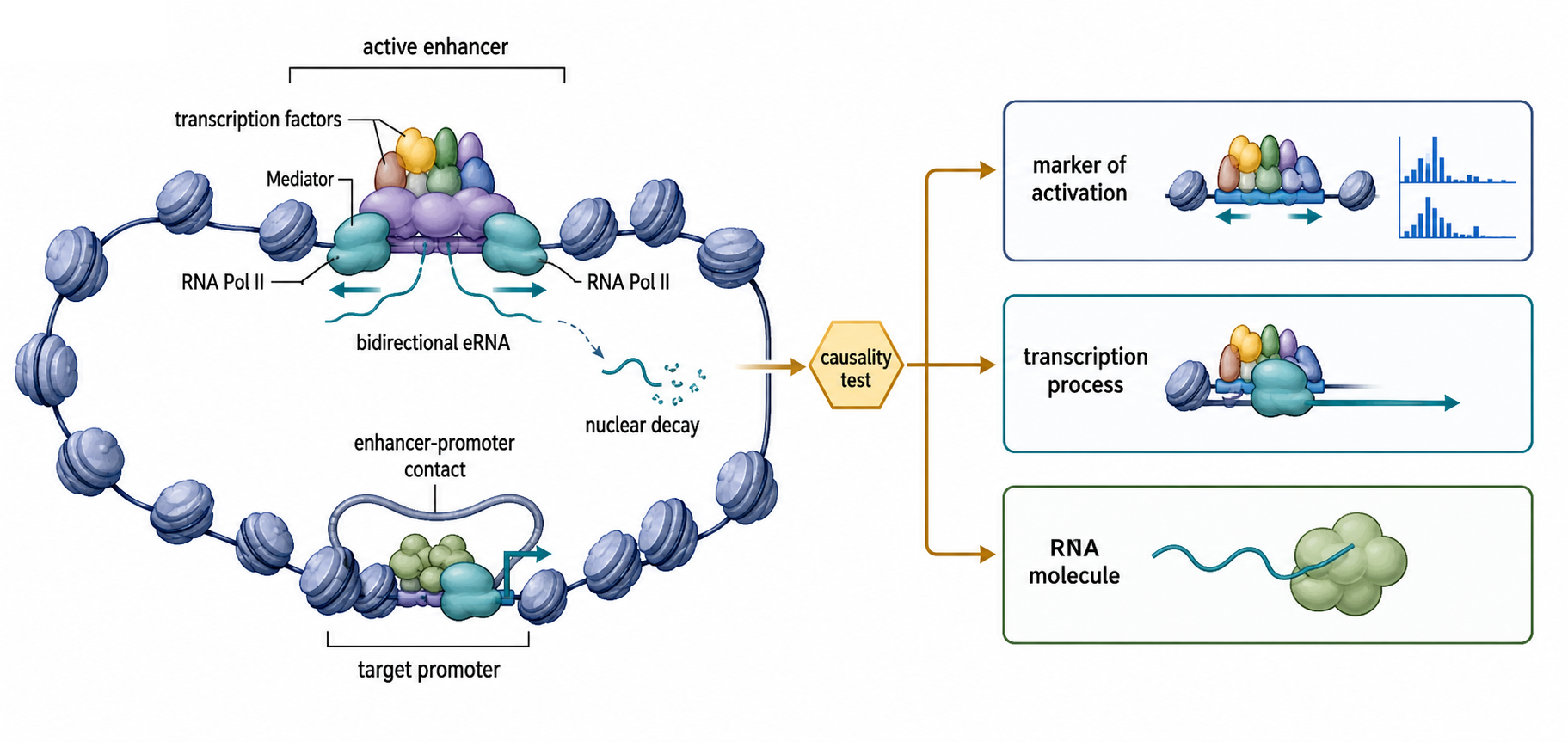
Figure 93.1. Separating enhancer DNA, transcription, and enhancer RNA-product mechanisms. The same association between enhancer transcription and target-gene output can arise through distinct causal paths. A useful experiment changes one layer while measuring the others rather than treating enhancer deletion, transcription blocking, and RNA depletion as interchangeable.
The null model treats eRNA synthesis as a readout of enhancer activation. A transcription factor or signaling pathway can independently cause enhancer accessibility, eRNA synthesis, enhancer-promoter contact, and target-gene induction. Under that model, eRNA abundance is a useful state marker but removing the accumulated RNA should not reduce target output once effects on transcription and the enhancer DNA are excluded. Time ordering strengthens association—for example, eRNA appearing before target mRNA—but does not by itself rule out a shared upstream cause.
The transcription-process model assigns function to polymerase initiation or passage. Transcription can change local nucleosome occupancy, topology, factor residence, or enhancer-promoter communication even when the RNA is dispensable. A transcription-blocking perturbation can support this model only if it preserves the relevant enhancer DNA and if the phenotype is not reproduced by selective post-transcriptional RNA depletion. Conversely, a cleavage or terminator insertion that shortens the transcription path may reveal which portion of polymerase passage is required, but the inserted sequence must be controlled because it can itself alter chromatin or factor recruitment.
The RNA-product model requires a molecular property of the eRNA. Candidate properties include a protein-binding sequence, a secondary structure, a chemical modification, a local concentration threshold, or retention near the enhancer. Some eRNAs have been proposed to affect Mediator or other coactivators, chromatin regulators, and transcriptional assemblies. Lee et al. (2021) connected m6A-modified eRNAs to condensate formation and gene activation, while Henninger et al. (2021) showed that RNA can feed back on transcriptional condensates. These results establish plausible RNA-dependent mechanisms in particular systems, not a universal condensate function for all eRNAs.
The strongest product-level experiment first verifies the eRNA species and then uses at least one perturbation that acts after synthesis. RNA depletion, RNA-targeting nucleases, catalytic antisense reagents, or disruption of a defined binding motif can be informative, but each requires controls for altered transcription, premature termination, and off-target effects. A rescue should match the proposed mechanism: an RNA claimed to act in trans may be restored from another locus, whereas an RNA claimed to act through high local concentration or cotranscriptional loading may require cis restoration or tethering. Failure of ectopic rescue does not refute a cis-localized RNA mechanism, and successful overexpression rescue can be misleading if nonphysiological RNA concentration recruits promiscuous partners.
Enhancer activity models are not mutually exclusive. A given enhancer can be functional as DNA, require transcription through part of the locus, and also use a particular RNA-protein interaction under one stimulus. Allele-specific designs are especially useful because the unedited allele provides an internal control and cis effects should remain linked to the perturbed chromosome. Panigrahi et al. (2023) and Hunt and Mannervik (2024) illustrate why enhancer-promoter interdependence and developmental context must be considered before assigning the phenotype to an eRNA molecule.
Box 93.1. Causality questions for an enhancer RNA claim
Render-ready content:
- Which RNA species and isoform were observed, and was transcription distinguished from accumulated RNA?
- Which layer was perturbed: enhancer DNA, transcription initiation or passage, RNA abundance, RNA motif, modification, localization, or binding partner?
- Were local nascent transcription and enhancer chromatin measured after RNA perturbation?
- Did the rescue reproduce the proposed cis or trans mechanism at a physiological level?
- Which alternative—DNA-element activity, act of transcription, shared activation, or incidental product—remains compatible with the data?
93.2. Promoter-associated RNAs: candidate mechanisms and functional evidence
Promoter-associated RNA is an origin label covering upstream antisense RNAs, promoter upstream transcripts, and other short or long RNAs initiated close to a promoter. Their production reflects bidirectional initiation and early transcriptional decisions described in Chapter 15. Their frequent instability reflects surveillance described in Chapter 31. Neither proximity to a promoter nor rapid turnover proves a regulatory role. The causal question is whether a particular RNA product contributes information or molecular activity beyond the promoter DNA and the act of local transcription.
Candidate product mechanisms include binding a transcription factor or chromatin regulator near the promoter, competing for an RNA-binding protein, forming a short duplex with a nascent sense transcript, influencing RNA processing, or stabilizing a local regulatory assembly. These mechanisms predict different dependencies. A binding mechanism predicts loss of function after mutation of the relevant RNA motif without loss of transcription. A duplex mechanism predicts strand and complementarity requirements. A local scaffold mechanism predicts sensitivity to RNA localization or tethering and may resist rescue from a distant locus. Yang (2022) reviews evidence that some promoter antisense RNAs extend beyond being passive products, while emphasizing locus-specific interpretation.
Box 93.2. Naming promoter-associated RNAs without overclaiming
Render-ready content:
A promoter-associated RNA name should report what the assay establishes: initiation position and direction, transcript ends, processing, localization, and stability. PROMPT, upstream antisense RNA, divergent transcript, and promoter-proximal RNA are useful labels but are not functional conclusions. A product-level claim additionally requires an RNA feature that is necessary for a proximal output while neighboring promoter DNA and transcription are controlled.
Promoter-associated RNAs are unusually difficult to perturb cleanly because their genes overlap the regulatory neighborhood being measured. Deleting the RNA promoter can remove transcription-factor sites or change spacing. CRISPR interference can spread repressive chromatin into the nearby sense promoter. Inserting a terminator can change local sequence and polymerase traffic. Antisense oligonucleotides can lower RNA abundance but may also induce cotranscriptional cleavage and premature termination. A credible study therefore measures sense initiation, nascent transcription on both strands, local chromatin, and RNA abundance after each perturbation rather than assuming that a reagent acts on only one layer.
A promoter-associated RNA product is most convincing when two independent post-synthesis perturbations agree, local transcription remains substantially intact, and a mechanistically appropriate rescue restores the phenotype. If RNA depletion changes the sense gene but promoter mutation or transcription blocking produces a different effect, that divergence can be informative rather than contradictory: the locus may combine a DNA-element effect, a transcription-dependent effect, and an RNA-product effect. If only promoter deletion changes expression, the conservative conclusion is that the promoter region or its transcription matters; the RNA product has not yet been isolated as causal.
R-loops illustrate the need for precise layer assignment. An RNA made near a promoter may contribute to an RNA-DNA hybrid, but perturbing the locus can also change topology or polymerase behavior independently of the mature RNA. RNase H sensitivity, strand-aware hybrid mapping, a sequence requirement, and separation from transcription-rate changes are needed before assigning the consequence to a promoter-associated RNA product. Method-specific biases and the broader biology of R-loops are treated in Chapter 97.
93.3. Natural antisense RNAs: regulatory claims and causal tests
Natural antisense RNAs are defined by opposite-strand overlap, not by one mechanism. A natural antisense transcript may overlap a promoter, gene body, splice region, untranslated region, or termination zone, and it may be stable or detectable mainly as nascent RNA. Overlap geometry helps generate hypotheses but does not establish regulation. A head-to-head arrangement raises promoter-level alternatives; a tail-to-tail arrangement raises processing and termination alternatives; convergent transcription raises polymerase and topological alternatives; and extensive RNA complementarity raises a possible duplex mechanism.
The first causal branch does not require an antisense RNA product. Antisense initiation or polymerase passage can occlude a sense promoter, alter chromatin, change topology, or interfere with a converging polymerase. These are transcription-dependent effects even though an antisense RNA is necessarily synthesized. A terminator inserted downstream of antisense initiation, combined with preserved antisense promoter activity, can help localize the required transcription path. Direct polymerase measurements and immediate chromatin readouts are needed because a later decrease in sense RNA could be secondary to altered cell state.
The second branch requires the antisense RNA molecule. Complementarity can allow an antisense RNA to mask a splice or polyadenylation signal, alter RNA structure, create a duplex recognized by editing or decay machinery, or change the availability of a sense RNA to proteins. Non-complementary domains can bind chromatin or RNA-binding proteins. Product-level claims should identify the relevant domain and establish whether the interaction occurs at physiological abundance. A biochemical interaction becomes causal evidence only when disrupting the interaction also changes the predicted regulatory output.
Antisense-associated effects can be repressive, activating, permissive, or undetectable. An antisense transcription event may repress through promoter occlusion but activate by displacing a repressor or maintaining local accessibility. An RNA duplex may reduce a sense transcript in one system but stabilize or alter its processing in another. Noe Gonzalez et al. (2021) provide a framework for polymerase stalling and elongation problems, while Yang (2022) focuses on promoter antisense RNAs. The general conclusion is deliberately modest: orientation and overlap constrain possible mechanisms but do not determine the direction or existence of regulation.
An important experimental trap is confusing antisense RNA knockdown with antisense transcription perturbation. Antisense oligonucleotides, RNA interference, RNA-targeting nucleases, CRISPR interference, promoter deletion, and terminator insertion perturb different molecular layers. Lee and Mendell (2020) showed that antisense-mediated transcript knockdown can trigger premature transcription termination. A reagent intended to remove RNA can therefore change polymerase behavior at the locus. A clean causality series compares post-synthesis RNA depletion with transcription blocking, quantifies nascent transcription after both, and attempts rescue by a form of the RNA that cannot restore the original transcription event.
Rescue logic depends on the claim. Recovery after ectopic RNA expression supports a diffusible product mechanism, provided expression level and localization are physiological. Failure of ectopic rescue is inconclusive for a cis-retained RNA; allele-specific tethering or insertion of a rescue cassette near the native locus may be more appropriate. Mutational rescue is stronger than full-length overexpression when it shows that a defined complementary segment or protein-binding motif is necessary and sufficient. Conversely, restoration of antisense transcription with a sequence-scrambled RNA favors a process mechanism over a sequence-specific product mechanism.
Low abundance is not evidence against function, because fast turnover can keep a locally acting antisense RNA scarce. High abundance is not evidence for function, because stability and function are separable. Cordiner et al. (2023) illustrates how temporal cotranscriptional RNA-protein mapping can capture interactions missed by steady-state assays. The method must follow the causal question: nascent assays for polymerase behavior, strand-specific and end-resolved assays for RNA identity, interaction assays for candidate partners, and controlled perturbation plus rescue for mechanism.
93.4. Readthrough RNAs: regulatory consequences and causal evidence
Readthrough RNA extends from an upstream transcription unit beyond its usual termination region. The molecular architecture of termination failure and boundary production is owned by Chapter 15. For functional interpretation, the essential observation is continuity: downstream RNA must be shown to depend on transcription from the upstream locus rather than an independent downstream promoter. Nascent signal spanning the boundary, end-resolved long molecules, dependence on the upstream promoter, and restoration after correcting termination provide complementary evidence.
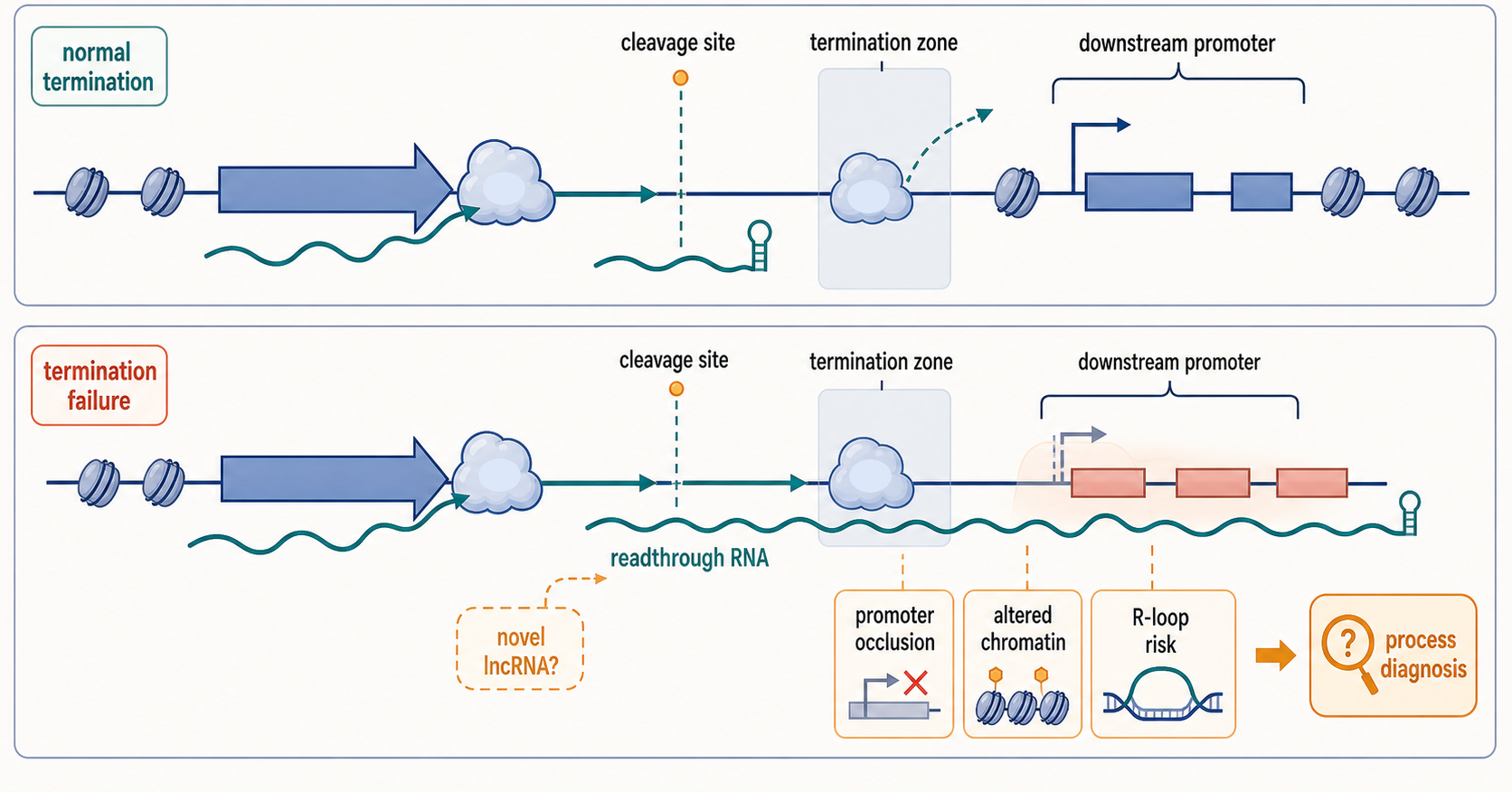
Figure 93.3. Causal diagnosis of readthrough-associated regulation. Continuous nascent transcription and upstream dependence distinguish readthrough from independent initiation. If termination repair rescues downstream initiation but selective depletion of the extended RNA does not, the evidence favors transcriptional interference rather than a regulatory RNA-product mechanism.
Readthrough can accompany a regulated stress response, produce an alternative 3′ extension, or arise from defective termination. Its regulatory consequence can likewise reside at different layers. Polymerase passage into a downstream promoter can cause transcriptional interference without any function for the extended RNA. The RNA product can alter processing, remain chromatin-associated, bind proteins across a new sequence interval, or contribute to a hybrid. Alternatively, neither polymerase passage nor RNA accumulation may have a measurable effect under the tested condition.
Several observations support a transcription-dependent consequence. A downstream promoter loses initiation when readthrough rises; strengthening the upstream termination region restores that promoter; and selective removal of the accumulated extended RNA does not restore initiation. Allele-specific coupling strengthens the inference because the effect should remain on the chromosome carrying the readthrough event. Chromatin changes or polymerase occupancy across the invaded promoter can provide a mechanistic intermediate. These results support interference by transcription, not a regulatory readthrough RNA product.
An RNA-product claim needs different evidence. Post-synthesis depletion of the extended RNA should change the proposed output without repairing upstream termination or eliminating polymerase passage. A candidate product mechanism might require a newly included RNA domain, a splice junction created within the extension, local retention, or binding to a defined RNA-binding protein. Rescue must reproduce the relevant extended RNA feature without recreating boundary-crossing transcription. If only correction of termination rescues the phenotype, the evidence supports a production or transcription-path defect rather than an independent regulatory role for the readthrough RNA molecule.
Readthrough also shows why transcript annotation must include process information. A downstream RNA-seq signal can represent an independent transcript, enhancer RNA, promoter-associated RNA, read-in product from an upstream gene, or processing intermediate. Nascent directionality, splice junctions, 5′ caps, 3′ ends, continuous long reads, and upstream-dependence tests can separate these possibilities. Without that information, a readthrough product can be misannotated as a novel long noncoding RNA and then assigned a function that actually belongs to the upstream transcription event.
Box 93.3. Readthrough or independent transcript?
Render-ready content:
Evidence for readthrough includes continuous same-strand nascent signal from the upstream gene, boundary-spanning long molecules, loss of downstream signal when the upstream promoter is silenced, and reduction after termination repair. Evidence for independent initiation includes a discrete capped 5′ start, promoter chromatin, persistence when the upstream gene is silenced, and an independent stimulus response. Both processes can coexist. After identity is established, compare termination repair with post-synthesis depletion and RNA-feature mutation to distinguish polymerase-path consequences from extended-RNA mechanisms.
Regulated and pathological readthrough should not be conflated. A stress-associated extension can be reproducible and adaptive, reproducible but harmful, or simply tolerated. A mutation in a termination or processing factor can create downstream signals at many genes, making secondary effects likely. Time-resolved experiments help separate an immediate local consequence from later changes in stress signaling or cell identity. Noe Gonzalez et al. (2021) anchors polymerase stalling and elongation stress, while Villa and Porrua (2023) frames pervasive transcription as a controlled risk.
93.5. Evidence thresholds for distinguishing RNA function from transcriptional by-products
Pervasive transcription forces a discipline of evidence. The presence of a transcript is not enough to infer function, and the absence of a stable transcript is not enough to infer nonfunction. Accessible regulatory regions can produce RNA without that molecule becoming a selected effector. At the same time, an unstable RNA can act locally before disposal. The useful question is not whether the transcript is “real,” because reproducible transcription is real as a biochemical event. The question is which molecular layer has a reproducible consequence in a defined biological context.
Table 93.2. Evidence thresholds for assigning RNA-product function. Claims should remain at the level of the evidence, and rescue should match the proposed mechanism.
| Evidence level | Supported conclusion | What remains unresolved | Next discriminating test |
|---|---|---|---|
| Reproducible detection | A defined RNA species or transcription event exists in the tested context. | Function, causal layer, and mature-product stability. | Confirm strand, ends, continuity, and localization with an orthogonal assay. |
| Association and time order | The signal tracks or precedes a regulatory output. | Shared upstream cause and necessity. | Perturb DNA, transcription, and RNA layers separately. |
| DNA or transcription perturbation | The locus or act of transcription contributes to the output. | Whether the RNA molecule is required. | Apply a post-synthesis RNA perturbation while measuring nascent transcription. |
| Post-synthesis RNA perturbation | RNA abundance contributes if local transcription remains intact. | Off-target effects and the required RNA property. | Repeat with an orthogonal reagent and mutate a candidate RNA feature. |
| Mechanism-matched rescue | A restored RNA property can restore the output. | Generality across loci or contexts. | Test necessity of the interaction and replicate across relevant states. |
| Proximal mechanism | A required RNA feature connects to a direct molecular readout. | Scope beyond the tested system. | Test allele, dose, time, state, and negative-locus boundaries. |
A useful evidence ladder begins with detection and ends with mechanism. Detection means that the RNA species or transcription event is reproducibly observed with strand specificity, end information, and appropriate negative controls. Association means that it covaries with enhancer output, promoter state, sense-gene expression, downstream interference, or a stimulus. Layer-specific perturbation means that changing the DNA element, transcription event, RNA molecule, or candidate partner changes an immediate output in a way predicted by the hypothesis. Rescue means that a defined replacement restores the output. Mechanism identifies the causal step and its necessary molecular features.
The ladder is most useful when the claim stays at the level of the evidence. If an enhancer RNA appears in PRO-seq after stimulation and a nearby gene rises, the supported claim is that enhancer transcription accompanies the response. If blocking enhancer transcription reduces target induction while selective post-synthesis RNA depletion does not, a transcription-dependent or DNA-coupled effect is more plausible than a persistent RNA-product mechanism. If a defined RNA domain binds a coactivator, motif disruption reduces target expression without reducing transcription, and motif-restored RNA rescues the phenotype, an RNA-product mechanism becomes substantially more credible.
The strongest designs separate four entities: the DNA element, the transcription process, the RNA molecule, and the genomic neighborhood. Deleting an enhancer removes factor motifs and spatial architecture as well as eRNA synthesis. CRISPR interference can block transcription but spread chromatin repression. A terminator can shorten polymerase passage but introduce new sequence features. Antisense-mediated depletion can remove RNA while also causing cotranscriptional cleavage or termination. Ectopic RNA expression can test a diffusible product but cannot recreate a cis transcription event. No single perturbation is definitive, so agreement among mechanistically different interventions is more valuable than repetition of one reagent class.
A practical minimum for a strong RNA-product claim includes five elements. First, the relevant RNA isoform and its cellular location are defined. Second, RNA abundance is altered after or independently of synthesis while local DNA and nascent transcription are measured. Third, the phenotype appears promptly and at an output proximal to the proposed mechanism. Fourth, a rescue restores the necessary sequence, structure, modification, localization, or binding property at a physiological level. Fifth, alternative DNA-element and transcription-dependent explanations are tested rather than dismissed. Not every study can satisfy all five, but missing elements should lower the certainty of the claim.
The by-product category is also contextual. An RNA can lack detectable function under one condition yet acquire a consequence when stress changes its concentration, localization, or available partners. A transcript can be deleterious without being an evolved regulatory molecule, and a locus can be functional because transcription modifies chromatin even if the RNA product is incidental. Villa and Porrua (2023) emphasize the risk-control framing, while Wu et al. (2024) connects RNA tailing with safeguards against products of pervasive transcription. “By-product” should therefore mean that RNA-product function has not been demonstrated in the stated context, not that the RNA is low-abundance, unstable, nonpolyadenylated, or absent from a reference annotation.
Cross-System and Biological Contexts
In mammalian cells, enhancer and promoter-associated transcripts are especially prominent in stimulus-responsive regulation. Hormone signaling, immune activation, differentiation, and oncogenic transcription programs can produce waves of eRNAs that track enhancer activation. Super-enhancer regions can generate many local transcription products, but the term super-enhancer should not be used as a shortcut for function. Ormsbee Golden et al. (2024) illustrates how transcription factors can alter the coactivator landscape of a super-enhancer and promoter region; such work is informative because it connects enhancer transcription to specific regulatory architecture rather than treating all high-output enhancer clusters as equivalent.
In Drosophila and other developmental systems, enhancer-promoter specificity is central. Enhancers must activate the correct promoter at the correct developmental stage and tissue. eRNA production can accompany enhancer activity, but enhancer-promoter communication depends on transcription factor grammar, promoter compatibility, chromatin topology, and insulation. Hunt and Mannervik (2024) provide a developmental review anchor. These systems are useful because genetics and imaging can connect regulatory DNA, nascent transcription, and organismal patterning.
In yeast, pervasive and antisense transcription provide powerful genetic systems for separating promoter sequence, polymerase passage, chromatin effects, and RNA-product effects. These examples are not simply smaller versions of mammalian enhancer biology because regulatory architecture differs. Experiments that replace an antisense sequence while retaining transcription, reposition a terminator, or compare cis and trans rescue nevertheless illustrate causal logic that transfers across systems. The production architecture is treated in Chapter 15, and decay-coupled containment in Chapter 31.
In disease and therapeutic contexts, these distinctions become more important rather than less. Cancer genomes can alter enhancers, promoters, chromatin boundaries, and RNA-processing factors, producing abnormal enhancer, antisense, and readthrough signals. A disease association can therefore reflect a driver RNA, an altered DNA element, transcriptional interference, or a biomarker of dysregulated transcription. Therapeutic antisense oligonucleotides can intentionally degrade RNA or alter splicing, but they can also affect transcriptional termination or nearby processing. Mechanistic claims require direct evidence in the relevant disease model rather than extrapolation from abundance correlations.
Boundary failures are especially easy to misread in disease datasets because neighboring transcription units can become coupled. A mutation in a cleavage or termination factor may create downstream signal that looks like a new lncRNA, enhancer activation, or fusion-like transcript. A chromatin-boundary lesion may let an upstream gene invade a tumor suppressor neighborhood without producing a stable RNA that is easy to annotate. Conversely, a disease-associated eRNA can be a marker of an altered enhancer state rather than the effector that drives the phenotype. Clinical interpretation therefore needs the same process-level evidence as basic mechanism: directionality, 5′ and 3′ end information, upstream-dependence tests, allele or clone specificity, and perturbation of the proposed causal layer.
Experimental foundations and evidence
The experimental foundation of this field is method-dependent. Capped-RNA methods detect initiation products and can map enhancer or promoter start sites. Nascent elongation methods such as GRO-seq and PRO-seq map engaged polymerase with strand information. NET-seq-related approaches capture polymerase-associated nascent RNA at high resolution. TT-seq and related metabolic labeling methods estimate newly synthesized RNA and can reveal readthrough after stress or termination perturbation. Standard poly(A)+ RNA-seq is useful for stable processed transcripts but underestimates unstable eRNAs, PROMPTs, and many cryptic RNAs.
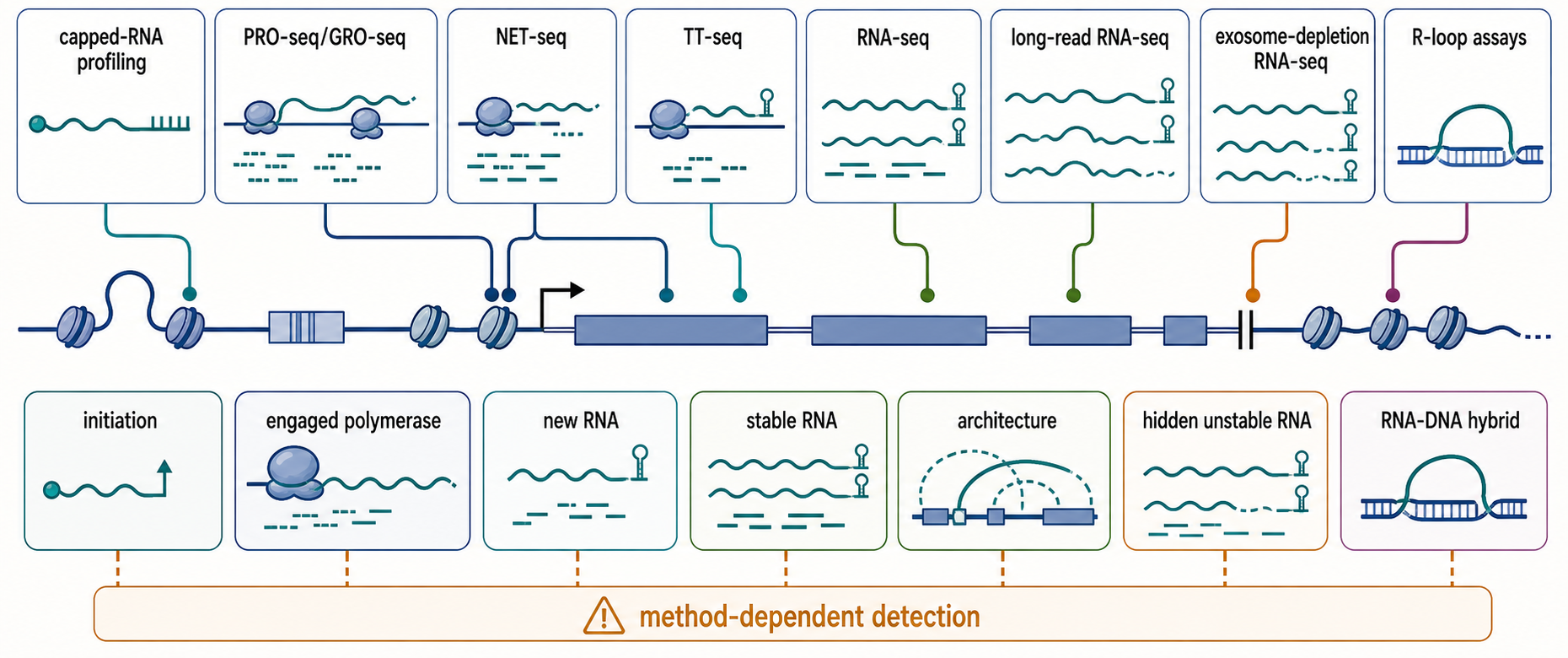
Figure 93.4. Assay and perturbation map for regulatory RNA claims. Detection methods differ in whether they report initiation, engaged polymerase, newly synthesized RNA, accumulated RNA, or transcript architecture. Perturbations differ in whether they alter DNA, transcription, RNA abundance, or a defined RNA property.
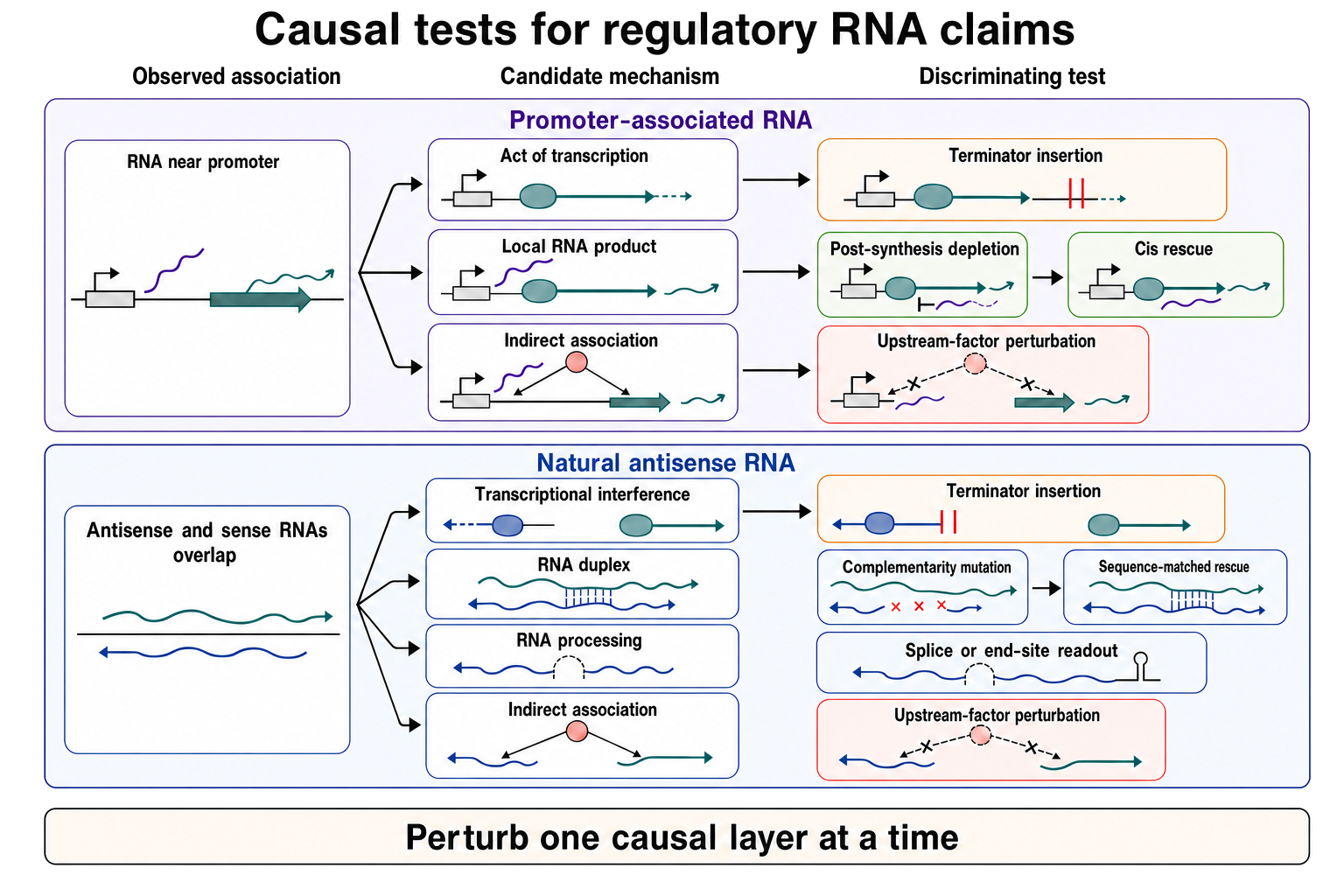
Figure 93.5. Causal tests for promoter-associated and natural antisense RNA mechanisms. An observed promoter-associated or antisense RNA correlation supports several causal models. Transcription-path perturbations, post-synthesis depletion, sequence-specific mutation, proximal processing readouts, and mechanism-matched rescue distinguish the act of transcription from a local RNA product, an RNA duplex, a processing mechanism, or a shared upstream cause.
Each method has failure modes. Capped-RNA enrichment can favor stable capped products and depends on cap chemistry. Nascent RNA methods can detect polymerase activity without proving that a mature RNA exists. Exosome depletion can reveal hidden transcripts but also changes nuclear RNA metabolism globally. Strand-specificity failures can create false antisense signals. Long-read RNA sequencing can connect distant exons and readthrough structures, but low-abundance unstable transcripts and chromatin-associated nascent RNA remain challenging. R-loop methods differ in whether they detect DNA-RNA hybrids directly, require RNase H controls, or preserve strand and genomic resolution.
Perturbation evidence is layered. CRISPR deletion tests a DNA interval but removes binding sites and chromatin information. CRISPR interference can block initiation while preserving sequence but may spread repressive chromatin. Terminator insertion can test the need for elongation through a region but introduces new regulatory features. RNA degradation tests the molecule most directly when nascent transcription remains unchanged, yet antisense oligonucleotides and RNA interference can alter processing, localization, or transcription. RNA tethering and rescue test sufficiency, but ectopic expression can miss cis localization and overexpression can create nonphysiological interactions.
The strongest studies use orthogonal detection and perturbation. For an eRNA, evidence might include enhancer transcription by PRO-seq, loss of target-gene induction when enhancer transcription is blocked, no equivalent loss when the same RNA is degraded after transcription, and rescue by restoring the enhancer transcription event. For a NAT, evidence might include strand-specific overlap, transcription-dependent chromatin changes at the sense promoter, polymerase collision signatures, and separation of RNA molecule versus transcription effects. For readthrough, evidence might include impaired 3′-end processing, upstream-gene-dependent downstream signal, restoration after termination-factor rescue, and exclusion of an independent downstream promoter.
Recent Consensus
Recent consensus can be stated in five points. First, enhancer, promoter-associated, antisense, and readthrough labels specify genomic origin or transcriptional relationship, not regulatory mechanism. Second, instability does not prove irrelevance, but correlation with a regulatory state does not prove RNA-product function. Third, functional analysis must separate the DNA element, transcription process, RNA molecule, and genomic neighborhood. Fourth, post-synthesis perturbation, measurement of nascent transcription, and mechanism-matched rescue provide stronger product-level evidence than deletion or transcription blocking alone. Fifth, conclusions are often locus- and context-specific rather than universal properties of an RNA class.
Consensus is weak for a universal eRNA mechanism. Some eRNAs appear to participate in coactivator recruitment, local RNA-protein interactions, or transcriptional assembly behavior, whereas many others may primarily mark enhancer activation. Promoter-associated RNAs likewise include both plausible regulators and by-products of promoter activity. For antisense loci, overlap alone does not establish regulation or distinguish RNA pairing from transcriptional interference. For readthrough, continuity from the upstream transcription unit must be established before either regulatory consequence or independent RNA-product function is inferred.
Open Questions, Controversies, Deprecated Models, and Common Misconceptions
Open questions:
- Is eRNA sequence specificity common or exceptional? Some eRNA molecules have sequence- or modification-dependent interactions, but many enhancer transcription events may depend more on transcription through the locus than on RNA sequence.
- How broadly RNA-mediated condensate models apply? RNA can alter transcriptional condensates, but condensate language can become vague if it is not connected to measurable concentration, material properties, residence times, or transcriptional output.
- What determines how cells balance the evolutionary benefits of regulatory transcription with the genome-stability risks of R-loops, polymerase collision, and cryptic initiation?
- Which combination of cis rescue, RNA tethering, and post-synthesis depletion most reliably detects highly local RNA-product functions without perturbing transcription?
Common misconceptions:
- “If an eRNA is correlated with enhancer activity, the eRNA activates the enhancer.” Correlation may reflect shared upstream activation by transcription factors and chromatin opening. A causal claim needs perturbation of the RNA or transcription event.
- “Low abundance means noise.” Low abundance can result from rapid decay, nuclear retention, cell-type specificity, or transient induction. Functional RNA can be low abundance, and nonfunctional RNA can be abundant.
- “Antisense transcription always represses the sense gene.” Antisense transcription can repress, activate, poise, or have no measurable effect, depending on position, elongation, processing, chromatin context, and surveillance.
- “Deleting a noncoding RNA locus tests the RNA molecule.” A deletion simultaneously changes DNA sequence, factor binding, chromatin, transcription, and RNA production unless the design explicitly preserves those layers.
- “Ectopic rescue is the definitive test of an RNA function.” Ectopic rescue is appropriate for a diffusible product, but a cis-retained or cotranscriptionally assembled RNA may require local rescue; overexpression can also create artificial interactions.
Deprecated or weakened claims:
- Deprecated simplification: “The genome is mostly silent except for genes.” This model was useful before high-resolution nascent RNA mapping but no longer describes polymerase II behavior. A better model is that initiation is widespread, while productive elongation, processing, export, translation, and stability are strongly selected and regulated.