Chapter 81. Small RNA Sponges, Decoys, Toxin-Antitoxin RNAs, and Bacterial RNA Network Motifs
Scope Note
Small RNAs do not act only as linear on-off switches for single messenger RNAs. In bacterial cells they participate in competitive, stoichiometric, and feedback-rich networks in which one RNA can sequester another RNA, a leader region can act as a regulatory landing pad, an antisense transcript can remodel translation or decay, and a toxin-antitoxin locus can convert RNA pairing into a physiological decision. This chapter examines bacterial RNA sponges and target mimics, RNA-linked toxin-antitoxin systems, overlapping transcription, stress-associated RNA network motifs, and quantitative or synthetic approaches for rewiring bacterial RNA regulation. The emphasis is on mechanisms, evidence, and caveats rather than on naming every known small RNA.
Executive Summary
Bacterial small RNAs often regulate gene expression by base pairing with mRNAs. A standard example is a trans-encoded sRNA that uses a short seed region to expose or occlude a ribosome binding site, recruit RNase E-dependent decay, or alter translation. Chapter 80 introduced that core logic. This chapter adds a second layer: the same base-pairing chemistry can make regulatory RNAs regulate each other. A sponge or decoy RNA contains binding sites that titrate an sRNA, RNA-binding protein, or regulatory complex away from its usual targets. If the sponge is abundant, stable, and accessible, it can reduce the free concentration of the regulator. If the sponge is degraded together with the regulator, it can also reshape regulator turnover. These effects are stoichiometric, so copy number, binding affinity, chaperone availability, and degradation rate matter as much as the presence of a complementary sequence.
Target mimicry is a related principle in which one RNA resembles a normal target closely enough to bind a regulator but differs in the outcome of binding. A mimic may bind an sRNA without being productively repressed, bind CsrA/RsmA-like proteins without encoding the regulated output, or present a leader structure that absorbs regulatory capacity. The term “sponge” is often used broadly, but mechanisms differ. A true stoichiometric sponge consumes or retains regulator molecules. A catalytic decoy can accelerate regulator degradation and then be recycled or produced again. A target mimic can behave as a false target, a sink, a competitive substrate, or an insulated binding platform. Distinguishing these cases requires quantitative evidence, not only sequence complementarity.
RNA-linked toxin-antitoxin systems illustrate how small RNAs can control cell physiology through compact genetic modules. In type I toxin-antitoxin systems, a stable or conditionally stable toxin mRNA encodes a small toxic peptide or protein, and an antisense RNA antitoxin represses toxin expression by pairing with the toxin transcript. Pairing can block translation, expose cleavage sites, alter RNA structure, or promote degradation. Other RNA-linked toxin-antitoxin systems use RNA antitoxins that bind toxin proteins or RNA pairs associated with CRISPR-Cas modules. These systems are attractive explanations for stress survival, persistence, plasmid maintenance, and bacterial competition, but evidence must be interpreted carefully because toxin overexpression can create nonphysiological growth arrest.
mRNA leaders and overlapping transcription expand the regulatory surface of bacterial genomes. A 5′ leader can host a ribosome binding site, a terminator, a riboswitch-like structural element, an sRNA target site, or an RNA-binding-protein motif. Antisense transcription can overlap coding regions, leaders, or untranslated regions, creating opportunities for transcriptional collision, RNA duplex formation, RNase III cleavage, translational interference, or apparent regulation caused by annotation artifacts. Network buffering emerges when these elements dampen fluctuations, delay responses, or create thresholds. In bacterial RNA networks, buffering is often not a single motif but a composite behavior produced by coupled transcription, RNA stability, translation, and degradation.
Stress, persistence, biofilms, and antibiotic tolerance are major biological contexts for these motifs. Bacterial populations under stress are heterogeneous: cells differ in growth rate, metabolic state, toxin-antitoxin activation, envelope stress, and biofilm position. RNA regulators contribute to these states, but they rarely act alone. A small RNA that changes antibiotic survival in an overexpression strain is not automatically a natural persistence determinant. Stronger evidence combines native expression measurements, loss-of-function and rescue genetics, direct target validation, time-resolved stress assays, and single-cell or spatial readouts.
Quantitative models help separate plausible network stories from mechanisms that are possible only at unrealistic concentrations. Models of small RNA regulation commonly track transcription rates, RNA association and dissociation, chaperone binding, translation initiation, RNase-mediated degradation, and dilution by growth. Stoichiometric titration can create thresholds and noise filtering; coupled degradation can create ultrasensitive target responses; shared chaperones can couple otherwise unrelated RNAs. Synthetic rewiring uses these principles to build tunable riboregulators, target mimics, kill switches, feedback loops, and programmable RNA circuits. The same design principles expose the main caveats: expression burden, off-target pairing, changes in RNA decay, and artifacts introduced by plasmid copy number or nonnative promoters.
Concept Inventory
Small regulatory RNA, or sRNA, refers here to a bacterial RNA, usually tens to a few hundred nucleotides long, that regulates another molecule without serving primarily as a translated messenger. Many bacterial sRNAs act by base pairing with mRNAs, often with help from the RNA chaperone Hfq or from alternative RNA-binding proteins such as ProQ. Some sRNAs are trans-encoded, meaning that their gene is located away from their target and the pairing is partial. Others are cis-encoded antisense RNAs, meaning that their transcription unit overlaps the target locus and can form extensive complementarity.
- RNA sponge: an RNA that reduces the availability of a regulatory RNA or RNA-binding protein by binding it. The defining feature is sequestration or titration, not the name of the locus. Sponge activity depends on abundance, affinity, structure, cellular location, and whether binding causes co-degradation. A decoy RNA is a broader term for an RNA that attracts a regulator away from its productive target or normal reaction. A target mimic is a decoy that resembles a natural target sufficiently to bind the regulator but changes the regulatory outcome.
- Stoichiometric regulation: that the number of regulator molecules and the number of binding sites are comparable enough that binding changes the free concentration of the regulator. This is different from a catalytic enzyme-like interaction in which one regulator molecule acts on many targets without being consumed. Many RNA-RNA regulatory events fall between these extremes because base-pairing complexes can be degraded together, recycled, or stabilized by chaperones.
- Type I toxin-antitoxin system: a toxin gene and an antisense RNA antitoxin. The toxin usually encodes a small hydrophobic peptide or compact protein whose expression is harmful under some conditions. The RNA antitoxin prevents toxin production by pairing with the toxin mRNA. The common boundary case is that “toxin” does not always mean the locus normally kills the cell; at physiological levels, many toxins slow growth, alter membranes, modulate translation, or contribute to reversible stress states.
- mRNA leader: the region between a transcription start site and the start codon of a coding sequence. Leaders can contain ribosome binding sites, small upstream open reading frames, RNA structures, ligand-binding aptamers, RNase sites, and sRNA pairing sites. An overlapping transcript is an RNA whose transcription unit overlaps another gene or RNA on the same or opposite strand. Overlap can be functional, neutral, or artifactual depending on transcription, processing, and annotation.
- Bacterial RNA network motif: a recurring regulatory pattern built from RNA production, RNA pairing, RNA-binding proteins, translation, and RNA decay. Examples include negative feedback through an sRNA, feed-forward regulation in which a transcription factor and sRNA converge on the same target, reciprocal sequestration between RNAs, toxin-antitoxin buffering, and shared-chaperone competition.
What to Know Before Reading This Chapter
Readers should be familiar with bacterial transcription, translation initiation, and RNA decay. Translation initiation in many bacteria depends on pairing between the Shine-Dalgarno sequence in an mRNA and the 3′ end of 16S ribosomal RNA. A small RNA that hides or exposes this region can change protein synthesis without changing the DNA sequence. RNases such as RNase E and RNase III contribute to bacterial RNA turnover; RNase E often participates in decay of single-stranded regions and ribonucleoprotein complexes, whereas RNase III cleaves double-stranded RNA. The exact enzyme logic varies among bacterial species.
The chapter also assumes the reader has encountered Hfq and ProQ as RNA chaperones. Hfq is an Sm-like hexameric protein that helps many enterobacterial sRNAs find and pair with targets. ProQ binds structured RNAs and supports a different subset of regulatory interactions. CsrA and RsmA are RNA-binding proteins that control translation and stability by binding GGA-rich motifs, often in mRNA leaders. RNAs with repeated CsrA/RsmA binding motifs can titrate these proteins and therefore behave as protein sponges.
Two cautions are essential. First, a predicted base pair is not a demonstrated regulatory interaction. A true regulatory claim needs evidence that the two RNAs are present in the same cell state, interact at relevant concentrations, and produce a measurable effect on translation, stability, or physiology. Second, an RNA that affects survival during stress is not automatically a persistence determinant. Persistence is a phenotypic state in which a subpopulation survives antibiotic exposure without heritable resistance. Demonstrating persistence requires population and single-cell logic, not only a growth defect or a change in minimum inhibitory concentration.
Core Mechanisms and Molecular Players
81.1. RNA sponges, target mimicry, and small RNA sequestration
An RNA sponge is easiest to understand as a binding-site reservoir. Suppose an sRNA represses several mRNAs by pairing with a short seed sequence near their ribosome binding sites. If another RNA is expressed with a similar accessible site, the sRNA can bind that RNA instead. The free sRNA concentration falls, and normal targets are less repressed. This description is simple, but it hides the central mechanistic question: after binding the sponge, what happens to the regulator and to the sponge? If both RNAs are degraded, the sponge reduces the total regulator pool. If the complex is stable, the sponge stores the regulator and may release it later. If the sponge is rapidly transcribed and decayed, it can function as a dynamic sink. If the bound regulator remains able to pair with additional targets, the molecule is not a simple sponge.
The bacterial literature uses several overlapping terms. “Sponge” emphasizes sequestration. “Decoy” emphasizes diversion away from the usual target. “Target mimic” emphasizes resemblance to a natural target. “Competing RNA” emphasizes mass action among multiple targets. In practice, the same RNA may fit more than one term. A 3′ untranslated region generated by mRNA processing may bind an sRNA after the coding region has been translated. A leader RNA may mimic a target site while belonging to an mRNA that is itself regulated. A Csr/Rsm antagonist RNA may carry many GGA motifs and titrate CsrA or RsmA proteins rather than an sRNA. The common lesson is that RNA networks include binding sites that do not map neatly onto protein-coding genes.
Stoichiometry is the defining quantitative feature of a sponge. If a cell contains 20 molecules of an sRNA and a decoy with 200 accessible binding sites, the decoy can in principle absorb most of the sRNA. If the cell contains 2,000 molecules of the sRNA and only 20 decoy sites, the same sequence may have little effect unless binding triggers rapid regulator degradation. Because bacterial cells are small, changes of tens or hundreds of molecules per cell can matter. Transcriptional bursts, growth-rate changes, and RNase activity can shift these ratios within minutes. A sponge therefore cannot be identified solely from complementarity; abundance and kinetic measurements are part of the mechanism.
The outcome also depends on chaperones. Hfq can bring sRNAs and targets together, stabilize some sRNAs, and alter the competition among targets. A sponge that binds an Hfq-dependent sRNA may also occupy Hfq surfaces, compete with other Hfq substrates, or change the lifetime of the sRNA-Hfq complex. ProQ-associated RNAs raise similar issues for structured RNAs. Csr/Rsm systems make the stoichiometric logic especially explicit because multiple RNA binding motifs can titrate a finite pool of CsrA/RsmA proteins. This protein-centered sponge mechanism differs from direct sRNA-sponge pairing, but both systems convert RNA copy number into regulator availability.
Target mimicry is especially useful when a regulatory RNA recognizes a short seed. A mimic can contain a seed-complementary region but lack the downstream features that normally cause repression. It can be transcribed under conditions in which the original target should be derepressed, allowing the cell to reset the network after a stress pulse. In enterobacterial sRNA networks, several examples have been described in which an RNA produced from a leader, 3′ region, or processed transcript binds an sRNA and changes the response of other targets. The listed bibliography for this chapter does not include every direct primary paper for these examples, so they should be treated here as mechanistic examples requiring chapter-specific citation expansion. The general principle is supported by bacterial sRNA consensus reviews and by the broader recognition that bacterial metabolism and stress physiology are densely connected to sRNA regulation (Wassarman et al. 1999; Papenfort and Storz 2024).
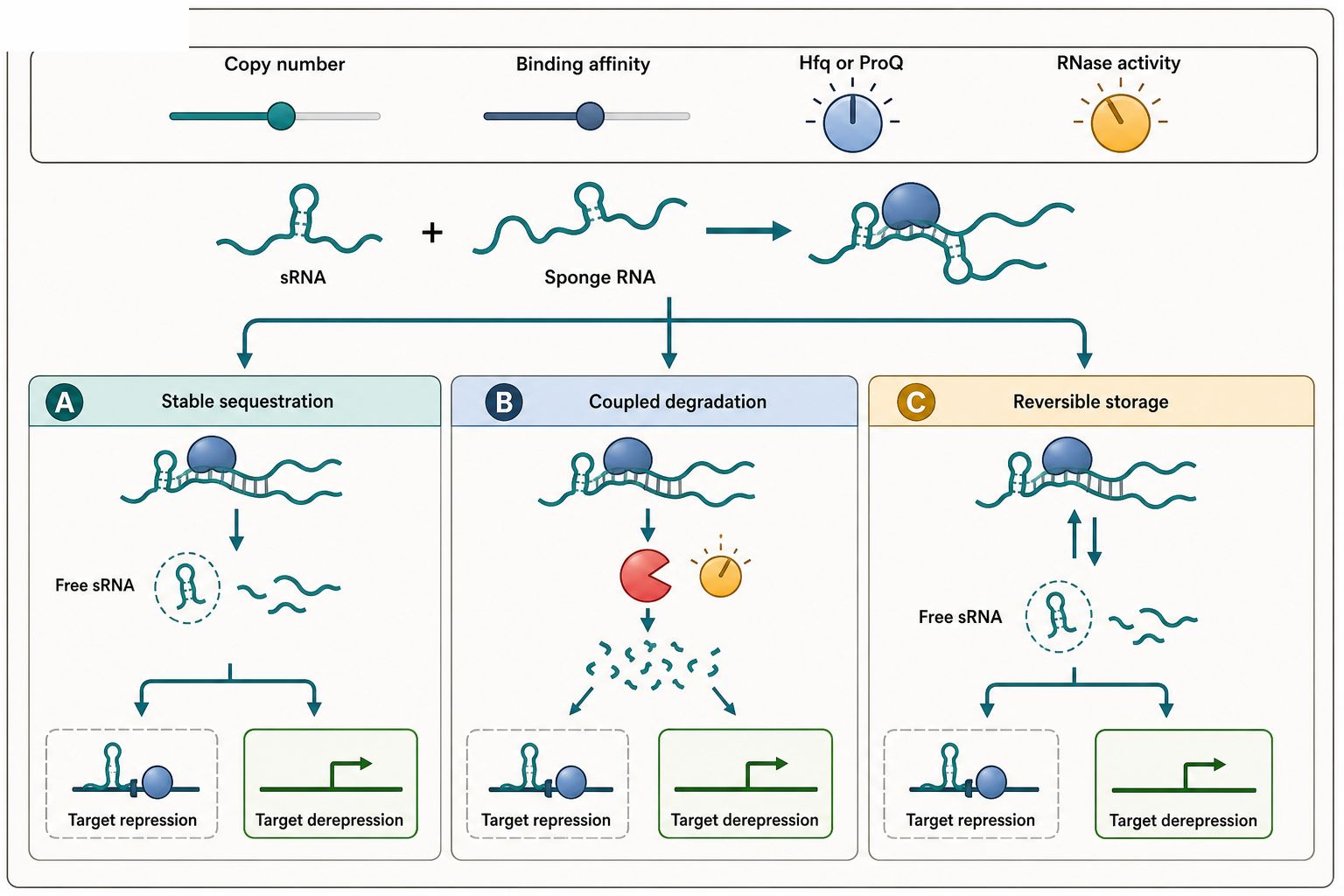
Figure 81.1. Stoichiometric Fates of a Bacterial sRNA Sponge. A bacterial small RNA can be diverted by a decoy or sponge through three different fates. In stable sequestration, the sponge retains the sRNA and reduces free regulator concentration. In coupled degradation, the sponge and sRNA are degraded together, lowering total regulator abundance. In reversible storage, the sponge temporarily stores the sRNA and may release it when conditions change. The figure should annotate how sponge copy number, binding affinity, Hfq or ProQ availability, and RNase activity change the regulatory output.
The strongest evidence for sponge activity combines several tests. First, the decoy RNA should be expressed at the relevant time and location. Second, the predicted binding site should be accessible and conserved or experimentally important. Third, mutating the site should disrupt regulation, and compensatory mutation in the sRNA should restore it when direct pairing is claimed. Fourth, altering the decoy should change free regulator activity on independent targets. Fifth, the experiment should distinguish direct sequestration from indirect transcriptional or growth effects. RNA coimmunoprecipitation, RIL-seq, CLASH-style methods, and RNA interactome mapping can identify candidate contacts, but candidate contacts still require functional validation.
Several artifacts recur. Plasmid overexpression can make weak interactions appear strong by flooding the cell with binding sites. Reporter fusions can remove leader structures or processing signals that normally determine accessibility. Transcript annotations can misassign a processed fragment to a new gene or miss a 3′ UTR-derived sponge. Deleting a sponge locus can also delete promoter, terminator, or coding information for another transcript. A rigorous study therefore uses native expression whenever possible, clean point mutations, rescue constructs, and multiple readouts.
81.2. Type I and RNA-linked toxin-antitoxin systems
A toxin-antitoxin system is a genetic module in which a harmful toxin is held in check by a more labile antitoxin. In protein-antitoxin systems, the antitoxin is a protein. In type I toxin-antitoxin systems, the antitoxin is an RNA. The toxin mRNA usually encodes a small peptide or compact protein, frequently with hydrophobic character that can perturb membranes, although toxin mechanisms are diverse. The antitoxin RNA is complementary to the toxin transcript and represses toxin expression by forming an RNA duplex.
The causal sequence is important. The toxin gene is transcribed, producing a toxin mRNA with a leader, coding region, and sometimes stabilizing structure. The antitoxin RNA is transcribed from the opposite strand or nearby locus. The antitoxin pairs with the toxin mRNA through an initial contact region, often followed by extension of the duplex. Pairing can occlude the ribosome binding site, remodel a structure needed for translation, expose a cleavage site, or recruit double-strand-specific decay. When the antitoxin is abundant and pairing is fast, toxin translation remains low. When antitoxin synthesis falls, antitoxin decay accelerates, or toxin mRNA persists longer than the antitoxin, toxin production can increase.
Classic type I systems such as hok/sok, tisB/IstR, fst/RNAII, and bsrG/SR4 have been used to teach the principle that RNA stability differences can create a delayed toxic output. In a plasmid maintenance setting, loss of the plasmid stops synthesis of both toxin and antitoxin, but the antitoxin decays faster. Toxin mRNA that remains can be translated in plasmid-free progeny, reducing their fitness. In chromosomal stress-response settings, the logic is more subtle. The toxin may slow growth, alter membrane potential, inhibit translation, or shift metabolism. The antitoxin controls when that potentially dangerous activity is allowed.
RNA-linked toxin-antitoxin biology extends beyond the narrow type I category. Some systems use structured RNA antitoxins that bind toxin proteins rather than toxin mRNAs. Other systems connect RNA-guided immune modules to toxin-antitoxin logic, including CRISPR-associated toxin-antitoxin RNA pairs in which RNA regulation helps safeguard immune functions. Primary studies in the listed bibliography support the existence of RNA toxin-antitoxin pairs associated with CRISPR-Cas systems and more recent links between RNA toxin-antitoxin ancestry and RNA-targeting CRISPR systems (Li et al. 2021; Zilberzwige-Tal et al. 2025). These systems should not be collapsed into type I toxin-antitoxin systems; they share RNA-centered control but differ in molecular architecture.
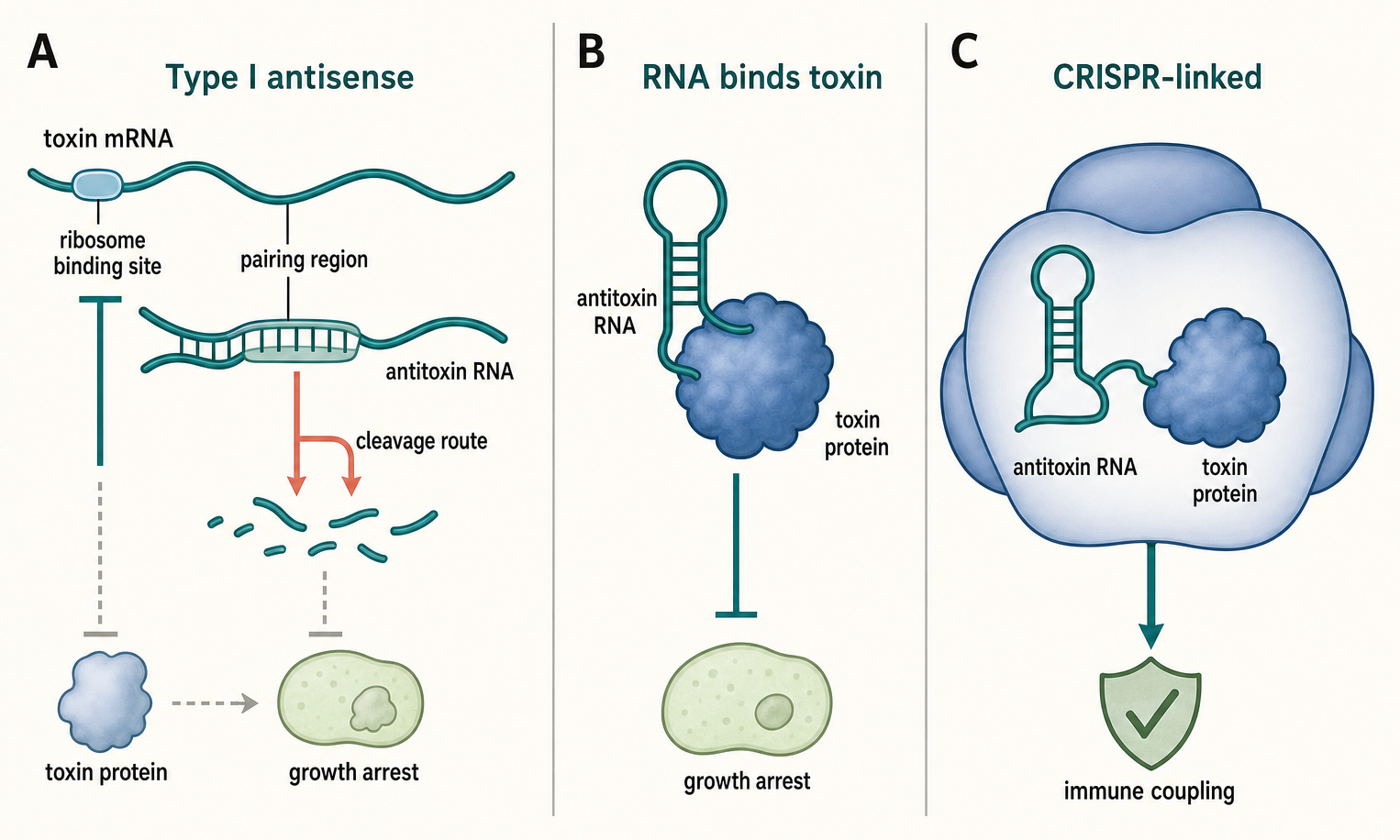
Figure 81.2. RNA Control Points in Toxin-Antitoxin Modules. RNA-linked toxin-antitoxin systems use several architectures. In type I systems, an antisense RNA pairs with toxin mRNA and blocks translation or promotes decay. In protein-binding RNA antitoxin systems, structured RNA binds the toxin protein or toxin complex. In CRISPR-associated RNA toxin-antitoxin architectures, RNA modules are coupled to immune-system function. The figure should mark toxin transcript, antitoxin RNA, pairing region, ribosome binding site, cleavage route, and physiological output.
RNA structure can decide whether a toxin mRNA is translated. A leader may fold so that the ribosome binding site is hidden, exposed, or conditionally available. An antitoxin may nucleate pairing at a loop, single-stranded tail, or anti-Shine-Dalgarno region and then drive structural rearrangement. A toxin transcript can also be processed into more active or more stable forms. Because these mechanisms occur at the RNA level, a silent mutation can change toxicity by altering structure or pairing without changing the peptide sequence. A recent listed Nucleic Acids Research paper on an RNA structural switch controlling bacterial toxin translation appears directly relevant to this point, but the chapter should treat it as needing expert metadata review because the automated reference file may contain noisy entries (Eleftheraki et al. 2026).
Evidence for type I toxin-antitoxin regulation comes from several layers. Northern blotting or RNA sequencing can show toxin and antitoxin expression and stability. Reporter fusions and toeprinting can test translation control. Compensatory mutations can demonstrate direct RNA pairing. RNase mutants can reveal whether duplex formation triggers degradation. Toxicity assays can show whether toxin expression changes growth or survival, but toxicity assays are not sufficient by themselves. A toxin expressed from a strong plasmid promoter may damage cells in ways unrelated to the native locus. Physiological interpretation requires native-locus perturbation, single-copy complementation, stress-relevant induction, and comparison with natural expression levels.
The persistence literature illustrates the problem. Many toxin-antitoxin systems can slow growth when overexpressed, and slow-growing cells can survive some antibiotics better because many antibiotics kill most efficiently during active growth. This does not prove that a given toxin-antitoxin system naturally creates persister cells during infection, biofilm growth, or antibiotic treatment. Strong claims require showing that the native toxin-antitoxin module is activated in the relevant subpopulation, that removing or repairing the module changes survival without simply changing growth rate, and that the effect is reproducible across conditions. Reviews of RNA-regulated toxin-antitoxin systems in pathogens emphasize both the mechanistic richness and the need for careful physiological interpretation (Sarpong and Murphy 2021).
81.3. mRNA leaders, overlapping transcription, and network buffering
An mRNA leader is not a passive spacer. It is the first RNA segment encountered by a ribosome, a ribonuclease, a regulatory protein, or an sRNA before the coding sequence is translated. The leader can determine whether a ribosome binding site is single-stranded, whether a terminator forms, whether a ligand-binding aptamer changes structure, and whether an sRNA can bind. Because leaders are transcribed before coding regions, they can also act before a full mRNA exists. In bacteria, where transcription and translation are coupled, a leader can make a regulatory decision while RNA polymerase is still transcribing the downstream gene.
Leader regions are common sites for sRNA binding. A repressive sRNA may pair near the Shine-Dalgarno sequence and block ribosome loading. An activating sRNA may disrupt an inhibitory hairpin and expose the ribosome binding site. A leader may also contain binding sites for CsrA/RsmA proteins, riboswitch aptamers, RNA thermometers, or attenuation structures. These motifs can combine. For example, an mRNA leader might bind a metabolite, change its secondary structure, and thereby expose an sRNA target site only under a particular nutritional condition. The resulting network is not simply “sRNA regulates mRNA”; it is a conditional RNA logic element.
Overlapping transcription adds more possibilities. A transcript from the opposite strand can overlap a 5′ leader, coding sequence, or 3′ region. If the overlap is extensive, the two RNAs can form a duplex that is recognized by RNase III or that blocks translation. If transcription occurs at the same time from opposite directions, RNA polymerases may collide or transcription may alter local DNA topology. If the overlap is only apparent because of incomplete annotation, a predicted antisense regulator may disappear after transcription start sites and processing sites are mapped accurately. These alternatives have different mechanisms but can produce similar RNA-seq patterns, so annotation and functional tests are inseparable.
Network buffering means that the system dampens, delays, or bounds a response. RNA motifs can buffer in several ways. A sponge can prevent a transient sRNA pulse from repressing targets until the sponge sites are saturated. A leader hairpin can require a threshold amount of an activating sRNA before translation begins. Coupled degradation of an sRNA and target can reduce noise by removing both molecules after interaction. An antisense RNA can provide negative feedback if toxin transcription also increases antitoxin production. Shared Hfq or ProQ availability can create indirect buffering because a highly expressed RNA can change the activity of other RNAs that use the same chaperone.
Table 81.1. Distinguishing Leader, Antisense, Sponge, and Transcription-Overlap Effects. Similar RNA-seq patterns can arise from different mechanisms. This table compares mRNA leader regulation, direct antisense RNA pairing, sponge or decoy action, and transcriptional interference. For each mechanism, list the physical molecule, expected molecular signature, strongest direct test, and common artifact.
| Mechanism | Physical RNA feature | Main output | Strongest validation | Common artifact |
|---|---|---|---|---|
| mRNA leader platform | 5′ untranslated region containing a ribosome binding site, hairpin, attenuator, protein motif, or sRNA target site. | Gates translation, termination, RNA stability, or target-site accessibility before or during coding-sequence transcription. | Transcription-start and RNA-end mapping plus leader-preserving reporter, ribosome-profiling, toeprinting, or compensatory structure mutations. | Reporter fusions truncate the leader or change coding-region context, making an artificial accessibility state look native. |
| Direct cis-antisense pairing | Opposite-strand RNA overlapping a leader, coding sequence, or 3′ region with enough complementarity to form a duplex. | Blocks ribosome loading, remodels RNA structure, recruits RNase III-like cleavage, or changes mRNA stability. | Strand-specific transcript mapping, interaction capture or biochemical pairing, disruptive and compensatory mutations, and cleavage-site tests. | Anticorrelated RNA-seq signal is mistaken for direct pairing despite shared regulation, mapping ambiguity, or growth-state differences. |
| Sponge, decoy, or target mimic | Independent RNA, processed UTR fragment, or repeated binding-site RNA that binds an sRNA or RNA-binding protein without the usual productive output. | Lowers free regulator activity, derepresses competing targets, accelerates regulator turnover, or temporarily stores a regulator. | Native-copy expression tests, binding-site point mutations, regulator-rescue experiments, and effects on independent validated targets. | Plasmid overexpression or whole-locus deletion creates titration, burden, promoter, terminator, or neighboring-gene effects that are not native sponge biology. |
| Processed 3′ UTR regulatory fragment | Stable RNA fragment released from an mRNA after processing or decay of the coding transcript. | Acts as a small RNA, decoy, or target mimic even though genome annotation places it inside a protein-coding locus. | Size-resolved northern blotting or RNA-end mapping, fragment-specific mutation or repair, and separation of coding-gene versus fragment effects. | The fragment is dismissed as passive mRNA decay product or, conversely, assigned function without showing independent abundance and output. |
| Transcriptional interference or overlap | Convergent, divergent, or tandem transcription units that overlap at promoters, terminators, coding regions, or untranslated regions. | Alters initiation, elongation, local topology, polymerase traffic, or apparent RNA abundance without requiring a stable RNA-RNA duplex. | Promoter and terminator perturbations that preserve RNA-pairing sequences, nascent-transcript mapping, and tests separating transcription from RNA product effects. | Genomic overlap alone is treated as proof of antisense regulation or physical duplex formation. |
A useful example class is the 3′ UTR-derived sRNA or decoy. In bacteria, processing of an mRNA can leave behind a stable 3′ fragment. That fragment may base-pair with targets independently of the coding region or bind an existing sRNA. From a genome annotation viewpoint, it may look like part of a protein-coding mRNA. From a regulatory viewpoint, it behaves like a small RNA. This boundary case matters for network modeling because deleting the coding gene, the promoter, or the processed fragment can have different consequences.
Experimental methods have improved the ability to resolve these cases. Differential RNA sequencing and related approaches map transcription start sites. Termination mapping and RNA-end sequencing identify transcript boundaries. RIL-seq and CLASH-style approaches capture RNA-RNA interactions associated with RNA chaperones. Reporter assays test the output of a leader or overlap. Structure probing can identify whether a leader site is accessible. Mutational rescue remains central: if an antisense interaction is direct, disrupting one side of the predicted pair and restoring function with a compensatory mutation is much stronger evidence than observing a correlation in expression. The bacterial RNA interactome study in hypervirulent Klebsiella pneumoniae illustrates how interaction mapping can reveal virulence-associated sRNAs, but candidate interactions still need individual mechanistic testing (Wu et al. 2024).
Network buffering is often inferred too quickly. A negative correlation between an antisense RNA and an mRNA can reflect direct duplex-mediated decay, transcriptional interference, shared regulation by a transcription factor, different growth states, or mapping bias. A leader mutation can change transcription, translation, RNA stability, and protein function indirectly if it alters coding sequence context or mRNA folding. To claim buffering, one should show dynamic behavior: altered response thresholds, reduced noise, delayed induction, faster recovery, or stabilized output across perturbations. Time courses, single-cell measurements, and calibrated reporters are more informative than one endpoint RNA-seq comparison.
81.4. Stress, persistence, biofilms, and antibiotic tolerance
Bacterial RNA networks are most visible when the cell must choose among growth, repair, movement, virulence, and survival. Stress responses change transcription globally, but RNA regulators add post-transcriptional timing. An sRNA can rapidly repress outer-membrane proteins during envelope stress. A leader can alter translation during nutrient limitation. A toxin-antitoxin RNA pair can connect DNA damage, membrane stress, or metabolic stress to growth arrest. A sponge can terminate an sRNA response once a stress has passed or prevent low-level stress noise from triggering a full response.
Persistence, antibiotic tolerance, and resistance should be distinguished. Antibiotic resistance is heritable growth at drug concentrations that inhibit susceptible cells, often measured by minimum inhibitory concentration. Antibiotic tolerance is survival of transient drug exposure without necessarily changing the minimum inhibitory concentration. Persistence is a form of tolerance in which a subpopulation survives, often because its physiological state makes killing inefficient. RNA regulators can contribute to tolerance or persistence by changing growth rate, metabolism, envelope composition, efflux, stress repair, or toxin-antitoxin activity. A survival effect is therefore biologically important but mechanistically ambiguous until the pathway is resolved.
Toxin-antitoxin systems are often discussed in persistence because toxins can slow growth. Type I toxins that affect membranes or translation could, in principle, place cells into states less vulnerable to antibiotics that require active cell-wall synthesis, translation, DNA replication, or energy-dependent uptake. However, the strongest interpretation is condition-specific. A toxin-antitoxin locus may promote survival under one antibiotic and have no effect under another. The same locus may be important in a biofilm but not in planktonic culture. A toxin that increases survival by stopping growth may also reduce competitive fitness after stress. These tradeoffs are central to understanding why toxin-antitoxin systems persist in genomes.
Biofilms create spatial and physiological heterogeneity. Cells near the surface of a biofilm can experience different oxygen, nutrient, pH, waste, immune, and antibiotic conditions than cells deep inside the matrix. RNA networks can respond to these microenvironments through stress sRNAs, quorum-related regulators, exopolysaccharide control, and toxin-antitoxin modules. Bacterial single-cell RNA sequencing and biofilm transcriptomics are beginning to resolve this heterogeneity, but bacterial cells are small and have low RNA content, so detection biases are serious. Recent single-cell bacterial transcriptomic studies in antibiotic-treated populations and biofilms provide important method evidence for heterogeneous states (Ma et al. 2023; Korshoj and Kielian 2024; McNulty et al. 2023).
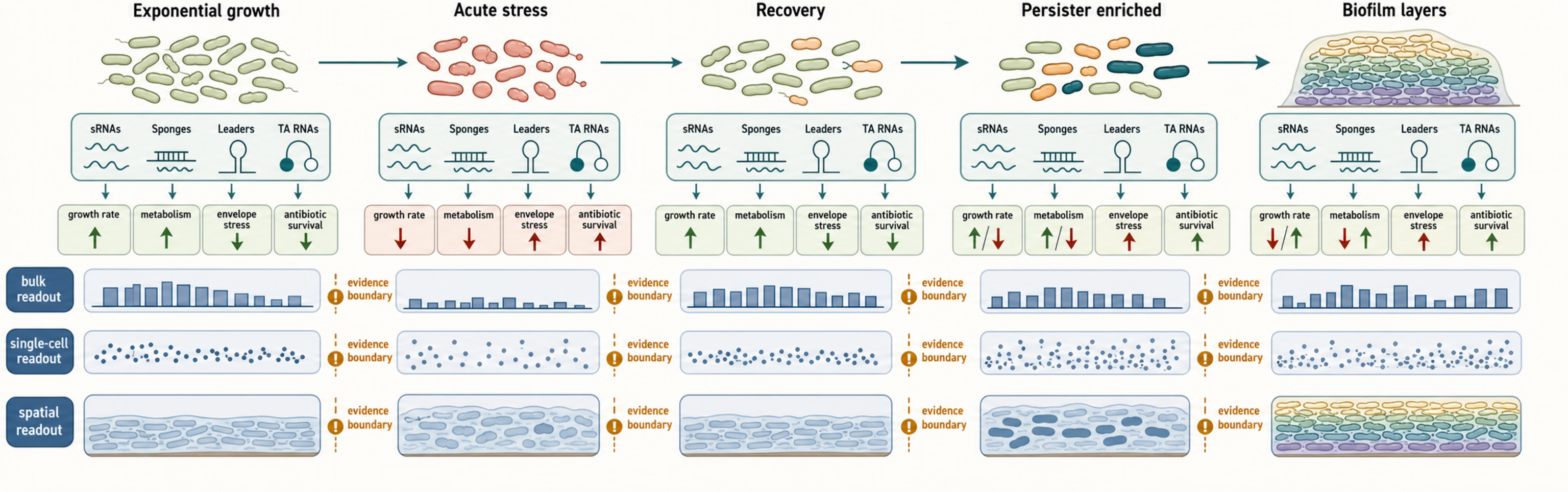
Figure 81.3. RNA Network States Across Stress, Persistence, and Biofilms. Bacterial RNA network outputs differ across exponential growth, acute stress, recovery, persister-enriched subpopulations, and biofilm layers. Small RNAs, sponges, leaders, and toxin-antitoxin RNAs can alter growth rate, metabolism, envelope stress, and antibiotic survival. The figure should distinguish bulk measurements, single-cell measurements, and spatial biofilm readouts.
The evidence ladder for stress and tolerance claims should be explicit. A weak claim is that an RNA changes abundance during antibiotic exposure. A stronger claim is that deleting or repairing the RNA locus changes survival under native expression conditions. Stronger still is a mechanism showing direct targets, RNA pairing, and physiological output. The strongest claims connect single-cell state, native RNA-network activity, antibiotic killing dynamics, and rescue by precise mutations. Many published studies stop in the middle of this ladder. That is not a failure; it means the correct conclusion is “associated with tolerance under tested conditions” rather than “is the persistence switch.”
Stress networks also expose sponge and decoy logic. A stress-induced sRNA may need to be turned off quickly when nutrients return. A decoy produced during recovery can accelerate this reset. Conversely, a preexisting sponge can prevent accidental activation until stress signals are strong enough to overcome sequestration. In a biofilm, different layers may express different balances of sRNA and sponge, creating spatially distinct regulatory thresholds. These hypotheses are plausible, but they should be tested with native reporters and spatial or single-cell assays rather than inferred from bulk average RNA abundance alone.
81.5. Quantitative models and synthetic rewiring of bacterial RNA networks
Quantitative modeling begins with a simple question: which molecular numbers must be true for the proposed RNA mechanism to work? For a trans-encoded sRNA repressing an mRNA, a minimal model tracks sRNA transcription, mRNA transcription, sRNA-mRNA association, complex dissociation, translation initiation, RNA decay, complex decay, and dilution by growth. For a sponge, the model adds decoy transcription, decoy binding sites, and the fate of sponge-regulator complexes. For a toxin-antitoxin module, the model tracks toxin mRNA, antitoxin RNA, pairing, toxin translation, toxicity, and feedback from growth inhibition to dilution and transcription.
These models reveal why stoichiometric titration can create thresholds. If the amount of sponge is below the amount of sRNA, most sponge sites are filled and some free sRNA remains to repress targets. If sponge production increases above the sRNA pool, free sRNA can collapse sharply, derepressing many targets at once. Coupled degradation can sharpen or soften this transition depending on whether the sRNA is degraded with the sponge. Chaperones add another layer: if Hfq is limiting, a sponge can alter not only its cognate sRNA but also other Hfq-dependent sRNAs through competition. This effect is sometimes called retroactivity, meaning that adding a downstream binding module changes the behavior of the upstream regulator.
Noise matters because bacterial cells often contain low copy numbers of regulatory RNAs. A small transcriptional burst can produce a few molecules that have large effects if the network is near a threshold. Sponges and leaders can filter these bursts by requiring sustained production before output changes. Conversely, toxin-antitoxin systems can amplify small differences if antitoxin decay allows toxin translation in only a subset of cells. Models are useful not because they produce a single correct diagram, but because they force each claim to specify parameters that can be measured: RNA copy number, half-life, association rate, translation rate, and fitness effect.
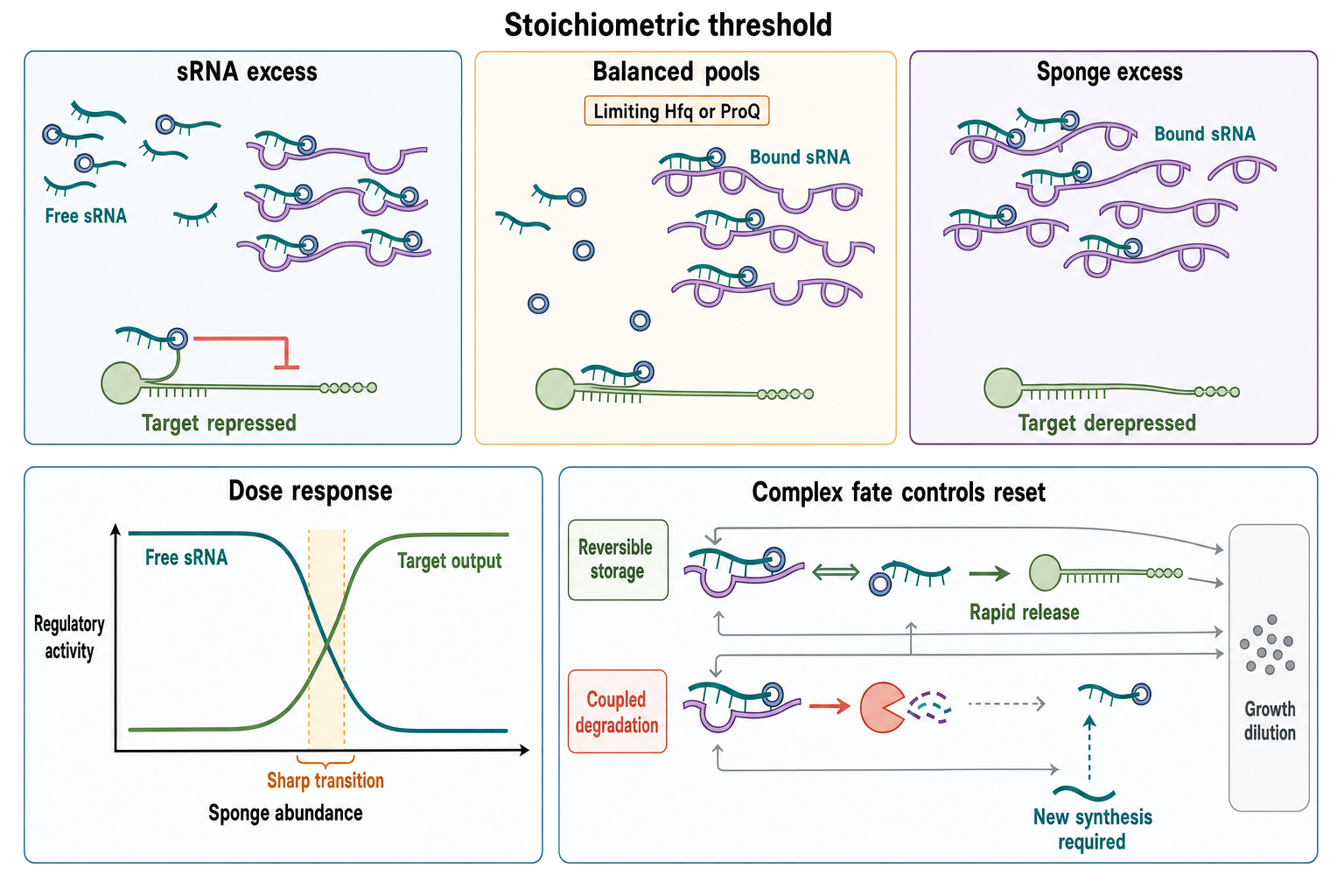
Figure 81.4. Quantitative threshold behavior in sponge, target, and chaperone competition. As sponge abundance approaches and then exceeds the available sRNA pool, free regulatory sRNA can collapse and target output can rise sharply. Limiting Hfq or ProQ shifts the active pool and couples one RNA route to competing clients. Reversible storage preserves bound sRNA for rapid release, whereas coupled degradation destroys the complex and makes recovery depend on new synthesis; growth dilution removes every molecular pool without being an RNase reaction.
Synthetic rewiring uses natural RNA principles to build new regulation. A designer can change the seed sequence of an sRNA so that it targets a new mRNA leader, insert a target mimic to tune the free sRNA pool, place a CsrA/RsmA binding cassette upstream of a gene, or wire a toxin-antitoxin module into a containment circuit. Engineered riboregulators can place translation under the control of a trans-acting RNA. Synthetic decoys can buffer noise or impose thresholds. Toxin-antitoxin modules can create kill switches or growth-control devices, though safety and evolutionary stability are major concerns.
Table 81.2. Modeling Variables for Bacterial RNA Circuits. Quantitative models of RNA circuits require explicit parameters. This table lists variables for sRNA-target regulation, sponge or decoy titration, mRNA leader gating, and toxin-antitoxin RNA modules. Variables include synthesis rate, decay rate, association and dissociation rates, translation initiation, chaperone occupancy, growth dilution, and fitness cost.
| Circuit type | Essential variables | Output behavior | Measurements needed | Common modeling trap |
|---|---|---|---|---|
| Trans-encoded sRNA-target circuit | sRNA and mRNA synthesis rates, association and dissociation rates, translation initiation, RNase-mediated decay, complex decay, Hfq or ProQ occupancy, and growth dilution. | Graded or threshold-like repression or activation depending on target abundance, pairing kinetics, and complex fate. | Native RNA copy number, half-life, reporter output, ribosome loading, chaperone dependence, and pairing-site rescue. | Treating predicted complementarity as regulation while ignoring RNA abundance, chaperone limitation, and decay coupling. |
| Sponge or decoy titration | Decoy synthesis and decay, number of accessible binding sites, regulator abundance, binding affinity, complex stability, coupled degradation, and release rate. | Sequestration, regulator depletion, reversible storage, delayed reset after stress, or sharp derepression when decoy sites exceed regulator molecules. | Time-resolved decoy and regulator levels, free-regulator activity on independent targets, native-locus binding-site mutants, and copy-number calibration. | Modeling the decoy as an unlimited sink or using plasmid-level expression that overwhelms native stoichiometry. |
| Csr/Rsm protein-sponge circuit | CsrA/RsmA pool size, motif number and affinity, antagonist RNA expression, target leader occupancy, protein turnover, and competing target load. | Redistribution of a finite RNA-binding protein pool across antagonist RNAs and mRNA leaders, often affecting metabolism, motility, biofilm, or virulence outputs. | Protein occupancy assays, motif-mutant antagonist RNAs, target translation readouts, and species-specific network mapping. | Assuming every repeated GGA-rich RNA has the same regulatory output across bacteria or that protein titration equals direct sRNA pairing. |
| mRNA leader gate | Promoter output, folding alternatives, ribosome binding-site exposure, ligand or protein binding, sRNA access, transcription-translation timing, and RNase sites. | Conditional translation, attenuation, activation, or decay, often with thresholds imposed by RNA structure and cotranscriptional timing. | Leader-preserving reporters, structure probing, toeprinting or ribosome profiling, RNA-end mapping, and mutations that separate structure from coding changes. | Removing the leader from its native transcript context and then interpreting reporter behavior as the original leader mechanism. |
| Type I or RNA-linked toxin-antitoxin module | Toxin mRNA synthesis and stability, antitoxin RNA synthesis and decay, pairing path, toxin translation, toxicity, stress input, growth feedback, and dilution. | Repression under antitoxin-rich conditions, delayed toxin expression after antitoxin loss, growth arrest, survival shift, or plasmid-maintenance-like selection. | Native-locus expression, antitoxin and toxin half-lives, pairing-site compensation, toxin translation readout, killing kinetics, and rescue at physiological expression. | Inferring natural persistence from toxin overexpression or from growth inhibition without a population survival model. |
| Synthetic rewired RNA circuit | Promoter strength, plasmid or chromosomal copy number, designed pairing affinity, off-target sites, burden, chaperone demand, escape mutation rate, and fitness cost. | Tunable thresholds, noise buffering, kill-switch behavior, target retargeting, or synthetic feedback that may differ from native physiology. | Dose-response curves, single-copy reconstruction, off-target profiling, growth burden, stability over passages, and comparison with native-expression regimes. | Treating a high-copy engineered circuit as evidence for the behavior of an endogenous bacterial RNA network. |
Natural evolution also rewires RNA networks. A new promoter can express an existing RNA fragment under a new condition. A mutation can create or destroy a seed match in an mRNA leader. A duplication can increase the number of protein-binding motifs in a Csr/Rsm antagonist RNA. A mobile element can bring an antisense transcript or toxin-antitoxin module into a new genomic context. Comparative and experimental work on recurrent rewiring of RNA regulatory networks supports the idea that RNA networks can change rapidly while preserving recognizable circuit logic (Wilinski et al. 2017). This evolutionary flexibility helps explain why related bacteria can have similar stress outputs but different RNA wiring.
The synthetic literature is valuable but should be translated cautiously into physiology. A circuit that works from a high-copy plasmid under an inducible promoter may not behave like a chromosomal RNA network. Non-native expression can overload Hfq, change growth rate, and create off-target pairing. A toxin-based kill switch can select for disabling mutations. A decoy that is useful as an engineering control may be too burdensome or too unstable in natural conditions. A listed paper on programmable T7-based synthetic transcription factors is relevant to synthetic regulatory rewiring at a broad level, but it is not a direct substitute for bacterial sRNA synthetic-network literature (Hussey and McMillen 2018). The current reference set needs additional expert-selected reviews and primary studies for this subsection.
Experimental Foundations and Evidence
The chapter’s mechanisms are unified by a simple evidentiary problem: RNA molecules are short, flexible, and often multifunctional. A transcript can be an mRNA, a regulatory RNA, a processed fragment, and an antisense partner in different contexts. Therefore, the best experiments separate presence, interaction, mechanism, and physiological consequence.
Presence is measured by RNA abundance, boundaries, and stability. Northern blotting remains valuable because it shows transcript size and processing. RNA sequencing provides breadth but can blur processed fragments, overlapping transcripts, and low-abundance RNAs. Transcription start-site mapping, terminator mapping, and RNA-end sequencing help define the physical molecule. RNA half-life experiments show whether a proposed antitoxin is more labile than a toxin mRNA or whether a sponge changes regulator stability.
Interaction is measured by proximity and pairing. Hfq or ProQ coimmunoprecipitation can enrich associated RNAs but does not prove direct base pairing. RIL-seq and CLASH-style ligation can capture chaperone-associated RNA-RNA pairs, providing stronger candidate interactions. Structure probing can show whether pairing regions are accessible. Direct biochemical assays can measure binding affinity, but in vitro affinity may differ from in vivo regulation if chaperones, RNases, and translation are absent.
Mechanism is tested by perturbation. Point mutations in predicted pairing regions are more informative than whole-locus deletions because they preserve neighboring promoters, terminators, and coding information. Compensatory mutations are especially strong evidence for direct RNA-RNA interaction. Reporter fusions can isolate a leader or target site, but they must preserve the relevant RNA context. Ribosome profiling or toeprinting can distinguish translation control from RNA stability control. RNase mutants or cleavage mapping can identify decay pathways.
Physiological consequence is the final layer. A growth phenotype, biofilm phenotype, virulence phenotype, or antibiotic survival phenotype is meaningful only when connected back to native RNA mechanism. Complementation should avoid overexpression artifacts. Survival assays should distinguish tolerance, persistence, and resistance. Single-cell methods can reveal heterogeneous states that bulk RNA sequencing averages away. The recent rise of bacterial single-cell RNA sequencing is particularly relevant for antibiotic tolerance and biofilm studies, but sparse detection requires cautious interpretation (Ma et al. 2023; Korshoj and Kielian 2024; McNulty et al. 2023).
Biological Contexts Across Bacteria
Enterobacteria provide many of the best-studied examples because their Hfq-dependent sRNA networks, stress responses, and toxin-antitoxin loci are genetically tractable. In Escherichia coli and Salmonella, sRNAs connect envelope stress, iron homeostasis, sugar metabolism, motility, virulence, and stationary phase. These systems are not universal templates for all bacteria. Some bacteria lack canonical Hfq-dependent networks or use different RNA chaperones. Gram-positive bacteria often use different RNA decay machinery and toxin-antitoxin architectures. Pathogens can integrate RNA regulation with host-associated cues such as nutrient limitation, immune stress, capsule production, and intracellular survival.
Csr/Rsm systems are widespread but vary in wiring. The core principle is that CsrA or RsmA family proteins bind RNA motifs to regulate translation and stability. Antagonist RNAs with repeated binding motifs titrate the proteins. In some organisms this network controls carbon metabolism, motility, biofilm formation, and virulence. The repeated-motif architecture makes these RNAs natural examples of protein sponges, but target identity and physiological output depend on species-specific regulators and environmental conditions.
Type I toxin-antitoxin systems also vary. Some are plasmid-associated maintenance systems. Others are chromosomal and stress-linked. Some toxins are membrane peptides, whereas others affect translation or other cellular processes. Antitoxin RNAs differ in stability, structure, and pairing path. Generalizing from one toxin-antitoxin family to all bacterial systems is unsafe. The correct unit of interpretation is usually the locus, organism, and condition.
Biofilms and infection models add ecological complexity. In a host, bacteria experience immune factors, nutrient gradients, antibiotics, and competing microbes. RNA regulators that appear dispensable in rich laboratory medium may matter in these settings. Conversely, a strong laboratory phenotype may disappear in a host if the relevant stress is absent or if redundant regulators compensate. The Klebsiella RNA interactome study cited in the reference set is a useful reminder that virulence-associated RNA networks can differ between pathogens and model enterobacteria (Wu et al. 2024).
Technology, Computational, and Engineering Links
RNA network motifs are useful in biotechnology because they are compact and programmable. A short pairing region can be redesigned more easily than a protein interface. An RNA leader can be placed upstream of a coding sequence to regulate translation. A synthetic target mimic can tune the dose of an endogenous or engineered sRNA. A toxin-antitoxin pair can be used in selection, plasmid maintenance, or containment, although escape mutants and unintended toxicity must be expected. Csr/Rsm binding-site arrays can, in principle, titrate protein regulators, but they may also perturb native targets.
Computational prediction helps prioritize interactions but cannot replace experiments. Base-pairing algorithms can find potential sRNA-target or antitoxin-toxin contacts. Comparative genomics can identify conserved antisense arrangements or repeated binding motifs. Kinetic models can predict threshold behavior and guide dose selection. Machine-learning approaches may eventually improve bacterial RNA interaction prediction, but training data are biased toward well-studied organisms and experimentally detectable interactions. For this chapter, the listed bibliography includes broad RNA-targeting and machine-learning references that are not directly focused on bacterial sRNA sponges; those should not be used as primary support for bacterial mechanisms without additional curation.
Synthetic rewiring also provides a testbed for natural hypotheses. If a model predicts that adding a sponge should shift a threshold, a synthetic decoy can test the prediction. If a leader structure is proposed to gate translation, redesigned leaders can test which structural elements matter. If a toxin-antitoxin module is thought to generate bistability, controlled expression can test whether physiological parameter ranges are sufficient. The most informative synthetic experiments are not merely demonstrations that a circuit can be built; they measure how design parameters map to molecular mechanism.
Recent Consensus
The current consensus is that bacterial RNA networks are richer than one-sRNA-one-target diagrams. Many regulatory RNAs have multiple targets, many mRNA leaders are regulatory platforms, and RNAs can regulate regulators through sequestration, mimicry, or coupled degradation. RNA chaperones and RNases are not background helpers; they shape specificity, timing, and network output. Reviews of bacterial small RNAs and metabolism emphasize that sRNAs are embedded in core physiology rather than acting only as peripheral stress switches (Papenfort and Storz 2024).
There is also broad agreement that RNA-linked toxin-antitoxin systems are mechanistically diverse. Type I systems use antisense RNA antitoxins to control toxin mRNAs, but RNA antitoxin logic appears in other architectures as well. The field increasingly treats toxin-antitoxin modules as condition-dependent physiological regulators rather than universal cell-death devices. Claims about persistence and antibiotic tolerance require careful native-locus evidence.
For bacterial stress and biofilm states, consensus is moving toward heterogeneity. Bulk cultures contain subpopulations with different transcriptional and physiological states. Single-cell bacterial transcriptomic methods are beginning to measure this heterogeneity directly, but the methods are technically difficult and sparse. The correct interpretation is therefore neither dismissal nor overconfidence: single-cell data are powerful when integrated with genetics and mechanism, but they are not automatically complete maps of every RNA regulator.
Open Questions, Controversies, Deprecated Models, and Common Misconceptions
Open questions:
- How many bacterial RNAs annotated as UTR fragments, antisense transcripts, or low-abundance transcriptional products are functional sponges or decoys? Deep sequencing reveals many transcripts, but function is harder to establish. Some fragments may be decay intermediates. Some may act only under conditions not yet tested. Some may affect regulation through transcription rather than RNA pairing. The field needs more native-locus perturbation and quantitative copy-number measurements.
- What are the physiological functions of toxin-antitoxin systems under native conditions? Many toxin-antitoxin systems are real regulatory modules, but the natural conditions that activate each locus are often uncertain. Persistence, biofilm tolerance, plasmid maintenance, phage defense, immune-system coupling, and stress buffering are all plausible for different systems. Treating all toxin-antitoxin loci as persistence modules is a common overgeneralization.
- How much network behavior arises from shared RNA-binding proteins? Hfq, ProQ, CsrA/RsmA proteins, and RNases have finite capacity. A highly expressed RNA can change network behavior by competing for these factors, even without direct base pairing to every affected target. This makes regulatory maps context-dependent. A target that appears direct in one condition may be indirectly affected in another.
Common misconceptions:
- “Any RNA complementary to an sRNA is a sponge.” Complementarity is only a starting point. A sponge must be expressed, accessible, abundant enough, and functionally able to change regulator availability or output.
- “Toxin-antitoxin activation means bacterial death.” Many toxins cause reversible growth inhibition or condition-specific stress phenotypes at native levels. Death can occur with overexpression, but overexpression does not define the natural function.
- “Antibiotic tolerance is the same as resistance.” Tolerance and persistence concern survival during exposure, whereas resistance concerns growth at inhibitory concentrations. RNA networks can affect one without affecting the other.
- “RNA-seq correlation proves antisense regulation.” Correlation can arise from shared transcriptional control, RNA stability differences, growth-state changes, mapping ambiguity, or direct base pairing. Mechanistic experiments are required.