Chapter 51. Guide RNA-Directed, Organellar, and Insertion-Deletion Editing Systems
Scope Note
RNA editing is not one mechanism. Chapter 50 treats animal deaminase-centered editing. This chapter owns guide-RNA-directed kinetoplastid insertion-deletion editing, plant organellar C-to-U and U-to-C editing, and other lineage-specific assemblies that make informationally complete RNAs. Chapter 47 compares the underlying deamination, recognition, cofactor, and complex-assembly principles with other modification enzymes; this chapter retains the biological pathways, guide systems, and organellar consequences.
Executive Summary
Kinetoplastid uridine insertion-deletion editing is one of the most elaborate RNA maturation systems known. Many mitochondrial transcripts in trypanosomatid protists are transcribed from maxicircle DNA in forms that cannot encode functional proteins until uridines have been inserted or deleted at many positions. Small guide RNAs, many encoded on mitochondrial minicircles, base-pair with pre-edited or partially edited mRNAs and specify where the edited mRNA should contain uridines. The catalytic work is performed by multisubunit ribonucleoprotein assemblies that cut the mRNA, add or remove uridines, and ligate the RNA. The reaction proceeds through successive editing blocks, often from the 3′ region toward the 5′ region, because newly edited sequence can create the anchor needed by the next guide RNA. The system is therefore both a biochemical machine and an information-transfer process.
Plant organellar editing has a different logic. In plant mitochondria and chloroplasts, most editing events are single-nucleotide conversions, especially cytidine-to-uridine changes in mRNAs. Many edits restore evolutionarily conserved codons in respiratory-chain or photosynthetic proteins. In several lineages, especially among hornworts, lycophytes, ferns, and some seed plants, uridine-to-cytidine editing also occurs. Site recognition is usually directed by nuclear-encoded RNA-binding proteins, especially pentatricopeptide repeat (PPR) proteins, that bind sequence upstream of an editable cytidine or uridine. Many plant editing factors include or recruit DYW-domain proteins with cytidine deaminase-like catalytic features, and accessory proteins such as MORF/RIP factors help assemble active editing complexes. Editing is therefore a nuclear-organellar coordination system: nuclear genes encode specificity factors that act on organellar transcripts.
The chapter’s major comparison is between templated and factor-specified editing. In kinetoplastids, guide RNAs provide explicit sequence information through base-pairing; the final edited sequence is read from a guide RNA-mRNA pairing register. In plant organelles, specificity factors usually recognize a local RNA sequence and position a chemical conversion at a nearby base; the missing information is encoded in nuclear protein sequence, not in a complementary RNA guide. Both strategies must solve the same problems: substrate recognition, catalytic control, order of reactions, avoidance of destructive intermediates, and verification by translation or organellar function. Both systems also create measurement problems, because partially edited molecules, low-abundance intermediates, organellar genome variation, RNA degradation, and mapping ambiguity can make an apparent edit difficult to interpret.
These natural systems teach cautious lessons for engineered editing. Natural guide RNAs show that guide-target complementarity can direct complex RNA remodeling, but they also show that productive editing depends on an associated protein machine, reaction order, RNA accessibility, and quality control. Plant PPR systems show that modular RNA recognition can be built from protein repeat arrays, but they also show that specificity usually depends on accessory proteins, local RNA context, organellar localization, and evolutionary tuning. Modern programmable ADAR recruitment, prime-editing guide RNAs, and small-RNA-enhanced editing platforms are not direct descendants of kinetoplastid or plant organellar editing, but they face analogous design constraints: guide architecture, bystander risk, off-target substrates, delivery, stoichiometry, and readout validity.
Concept Inventory
- Guide RNA: an RNA molecule that helps specify the target or product of another nucleic-acid reaction. In this chapter, the most literal guide RNAs are kinetoplastid mitochondrial guide RNAs. A kinetoplastid guide RNA base-pairs with a mitochondrial mRNA and encodes, through the pattern of pairing and mismatches, the uridines that must be inserted or deleted. The term guide RNA is also used in CRISPR biology and engineered editing, but those systems differ in protein partners, target chemistry, and biological context. A guide RNA should therefore always be defined by system and mechanism rather than by name alone.
- Kinetoplastids: flagellated protists that include medically important parasites such as Trypanosoma brucei, Trypanosoma cruzi, and Leishmania species. Their single mitochondrion contains a kinetoplast, a dense network of mitochondrial DNA. Kinetoplast DNA includes maxicircles, which encode many mitochondrial genes, and minicircles, which encode many guide RNAs. A cryptogene is a gene whose primary transcript cannot be translated into a functional protein until RNA editing creates an open reading frame. In kinetoplastids, some cryptogene transcripts require dozens to hundreds of uridine insertion or deletion events before they become functional mRNAs.
- Uridine insertion-deletion editing: an RNA editing process in which uridines are inserted into or removed from an RNA molecule. The edited positions are not random. In kinetoplastids, a guide RNA pairs with the mRNA around an editing site. If the pre-edited mRNA lacks uridines needed to pair with the guide RNA, a terminal uridylyltransferase adds uridines after endonucleolytic cleavage. If the pre-edited mRNA contains extra uridines relative to the guide RNA, an exonuclease removes them. RNA ligase then rejoins the mRNA fragments. The editosome or RNA editing catalytic complex is the multiprotein assembly that carries out these catalytic steps.
- Plant organellar RNA editing: mostly a base-conversion process in mitochondria and chloroplasts. Cytidine-to-uridine editing changes C to U in RNA and is abundant in many land-plant organellar transcripts. Uridine-to-cytidine editing changes U to C and occurs in selected plant lineages and some non-plant systems. These are RNA changes, not changes to organellar DNA. A PPR protein is a pentatricopeptide repeat protein, built from repeated RNA-binding motifs that often recognize RNA bases in a modular fashion. A DYW domain is a plant organellar editing-associated domain with cytidine deaminase-like features; many DYW-domain proteins are candidate or demonstrated catalytic components for C-to-U editing. MORF/RIP proteins are accessory factors that assist some plant organellar editing reactions.
- Editing factor: a molecule required for editing at one or more sites. The phrase can refer to a specificity factor that recognizes an RNA target, a catalytic factor that performs chemistry, an accessory factor that stabilizes a complex, or a maturation factor that links editing to splicing, cleavage, translation, or RNA stability. This distinction matters because loss of an editing factor can reduce an edited RNA product without proving that the factor is the catalytic enzyme. A factor may act indirectly by stabilizing a transcript, recruiting another protein, altering RNA structure, or changing organellar physiology.
What to Know Before Reading This Chapter
The reader should bring four ideas from earlier chapters. First, organelles retain genomes and gene-expression systems with bacterial ancestry, but organellar transcripts are heavily shaped by nuclear-encoded proteins. A mitochondrial or chloroplast RNA is therefore often the product of two genomes: the organellar genome provides the transcript, while the nuclear genome provides polymerases, RNA-binding proteins, processing enzymes, aminoacyl-tRNA synthetases, ribosomal proteins, and editing factors. Chapter 17 gives the broader map of organellar RNA genes, and Chapter 22 covers organellar transcription machinery.
Second, base-pairing can transmit sequence information. A guide RNA can specify a product by pairing with a target RNA, but base-pairing alone is not enough to make editing happen. The cell must supply enzymes that cut, add, delete, deaminate, or ligate RNA, and the guide-target duplex must be accessible in an RNP environment. Third, an editing site is usually measured as a fraction of RNA molecules edited at that position. Mixed edited and unedited reads may represent partial editing in each cell, cell-type differences, developmental state, environmental regulation, RNA turnover, or contamination by immature intermediates. Fourth, organellar systems often violate assumptions learned from nuclear mRNA biology. Polycistronic transcription, trans-splicing, extensive RNA maturation, nonstandard genetic codes, and high-copy organellar genomes can make “the transcript” a heterogeneous family rather than a single molecule.
51.1. Kinetoplastid guide RNAs and insertion-deletion editing
Kinetoplastid uridine insertion-deletion editing is easiest to understand as a repair of informationally incomplete mitochondrial transcripts. Many kinetoplastid mitochondrial genes are encoded on maxicircle DNA in a form that is not directly translatable. A primary transcript may contain frameshifts, missing codon information, or extra uridines relative to the conserved protein sequence. After editing, the RNA can contain an open reading frame that encodes a mitochondrial respiratory-chain protein. In bloodstream and insect-stage trypanosomes, the biological importance of a given edited transcript can vary with mitochondrial metabolism, but the underlying principle is stable: gene expression requires post-transcriptional reconstruction of the mRNA.
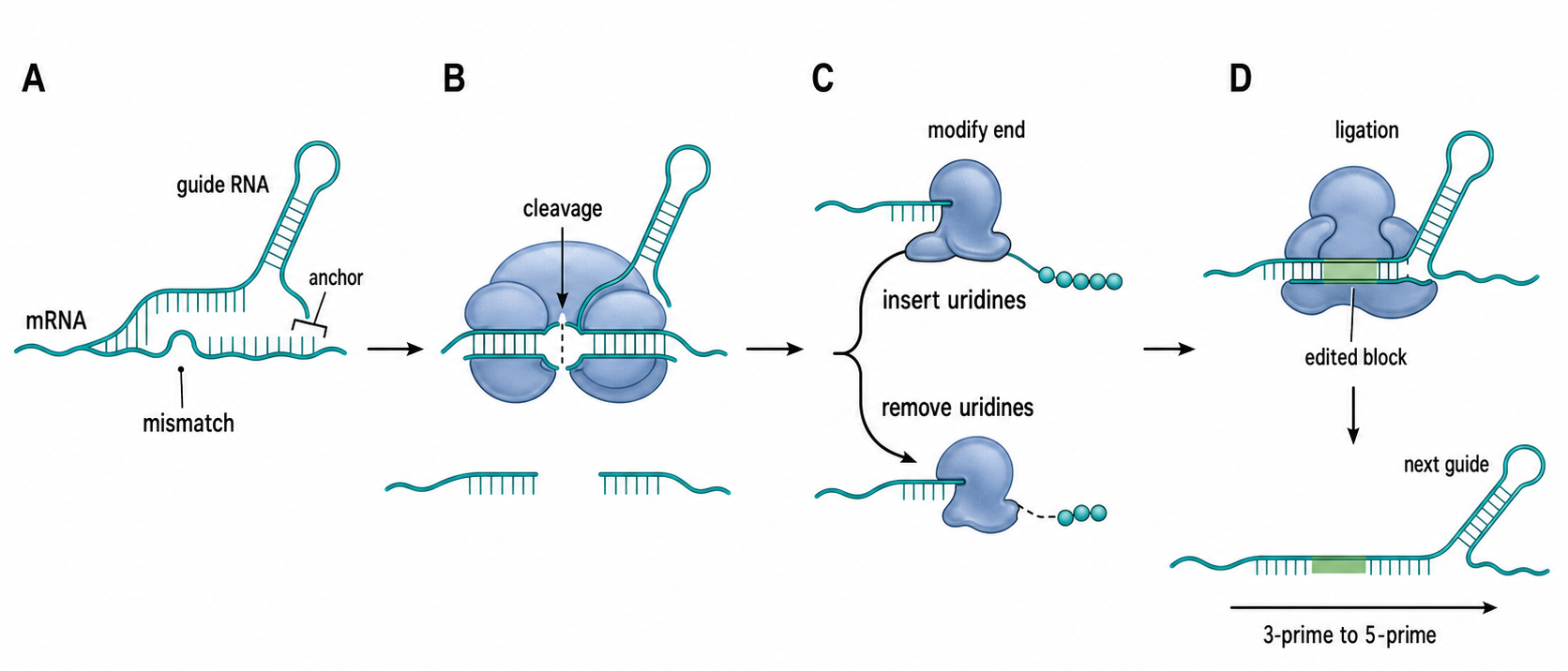
Figure 51.1. Kinetoplastid Guide RNA-Directed U-Indel Editing Cycle. Kinetoplastid guide RNAs pair with mitochondrial mRNAs to specify the position and number of uridines that must be inserted or deleted. Editing proceeds through a cut-modify-ligate cycle distinct from base deamination: an endoribonuclease cleaves the mRNA at a mismatch-defined site, a terminal uridylyltransferase or exonuclease modifies the 3′ end of the upstream fragment, and RNA ligase rejoins the halves. Newly edited sequence can create the anchor region needed by the next guide RNA, so editing typically advances in blocks from the 3′ toward the 5′ end of the transcript.
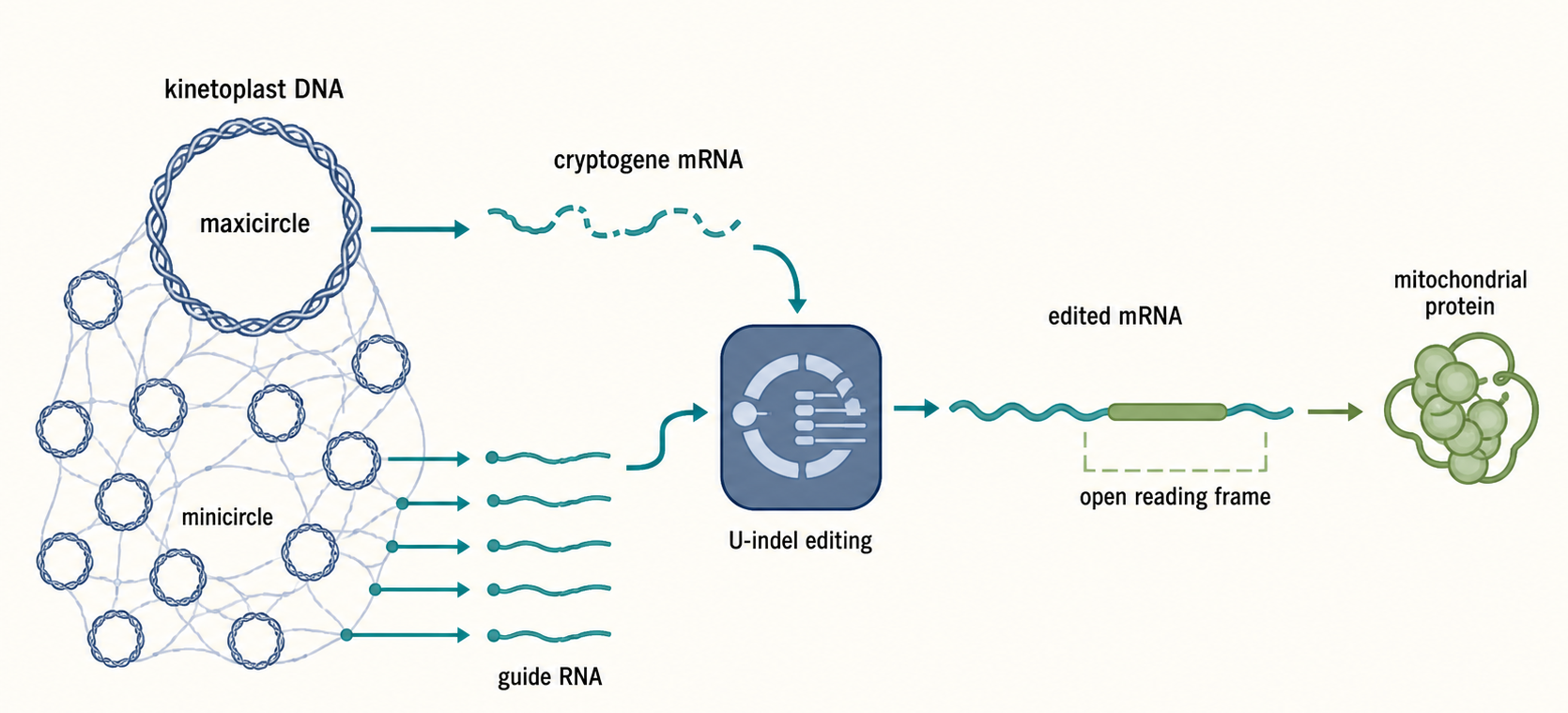
Figure 51.2. Kinetoplast DNA as a Split Information System. In kinetoplastids, kinetoplast DNA consists of maxicircles that encode mitochondrial transcripts and minicircles that encode many guide RNAs. Maxicircle cryptogene transcripts cannot be translated until guide RNA-directed uridine insertion or deletion reconstructs a functional open reading frame. The minicircle-encoded guide RNA repertoire therefore functions as part of the mitochondrial genetic system, supplying trans-acting sequence information that is essential for decoding maxicircle genes.
Table 51.1. Natural Organellar Editing Systems Compared. Comparison of five major RNA editing systems by organism, chemistry, specificity module, catalytic machinery, functional consequence, and key interpretive caveat.
| System | Typical organism or organelle | Molecular change | Specificity module | Catalytic or processing module | Product consequence | Major caveat |
|---|---|---|---|---|---|---|
| Kinetoplastid U-indel editing | Trypanosoma, Leishmania mitochondria | U insertion and deletion in mRNA | Minicircle-encoded guide RNA | Editosome (RECC): endonuclease, TUTase, exonuclease, RNA ligase | Creates translatable open reading frames in cryptogene mRNAs | Partially edited intermediates complicate transcript sequencing and editing-order inference |
| Plant mitochondrial C-to-U editing | Angiosperm and gymnosperm mitochondria | C-to-U conversion in mRNA | Nuclear-encoded PPR protein | DYW-domain protein (fused or recruited); MORF/RIP cofactors | Restores conserved amino acids in respiratory-chain proteins | Loss of editing factor may reduce transcript stability rather than editing fraction alone |
| Plant chloroplast C-to-U editing | Land-plant chloroplasts | C-to-U conversion in mRNA | PPR protein with or recruiting DYW domain | DYW cytidine deaminase-like domain | Restores conserved codons in photosynthetic gene products | Fewer sites than mitochondria; functional importance varies by site and lineage |
| Plant U-to-C editing | Hornwort, lycophyte, fern organelles | U-to-C conversion in mRNA | Recognition factors not definitively identified | Catalytic enzyme not definitively assigned | Corrects codons in organellar mRNAs; lineage-specific repertoire | Catalytic mechanism and required factors remain poorly characterized |
| Noncanonical protist mitochondrial editing | Diverse non-kinetoplastid protist mitochondria | Various (substitution, insertion, or base change depending on lineage) | Varies; guide RNAs or protein factors depending on system | Often uncharacterized | Varies; can enable translation of unusual mitochondrial gene products | Few systems are mechanistically resolved; secondary literature is sparse |
Table 51.2. Evidence Standards for Editing Claims. Minimum and stronger evidence requirements, common artifacts, and useful controls for six categories of RNA editing claim.
| Claim type | Minimum evidence | Stronger evidence | Common artifact | Useful control |
|---|---|---|---|---|
| Edited site exists | cDNA sequencing showing a base change at a defined position | Multiple independent clones or high-throughput RNA-seq with adequate read depth | Reverse transcriptase error; DNA-level polymorphism at the site | Genomic DNA sequencing at the same position to distinguish RNA change from DNA variant |
| Guide RNA specifies a kinetoplastid edit | Guide RNA identified with complementarity to the editing site | Guide RNA perturbation alters editing; guide-target pairing conserved across species | Coincidental complementarity; misprimed cDNA generating apparent guide match | Depletion or mutation of guide RNA followed by transcript sequencing |
| Plant PPR factor specifies a site | Loss-of-function mutant shows reduced editing at a target site | RNA binding by PPR protein demonstrated in vitro; site-specific editing loss confirmed | Reduced transcript accumulation rather than reduced editing fraction per molecule | Separate quantification of transcript level and per-molecule editing fraction |
| Editing affects protein function | Unedited codon changes an amino acid in a conserved protein region | Protein mass spectrometry or biochemical assay confirms the edited residue is incorporated | Inference from codon change without protein or physiological evidence | Compare organellar complex assembly or catalytic activity in editing-deficient vs. wild type |
| Editing changes under stress | Editing fraction differs between control and stress conditions | Tissue-matched, developmental stage-controlled comparison with expression-level normalization | Altered transcript abundance or cell-type composition rather than regulated editing machinery | Normalize editing fraction to transcript abundance; use comparable tissue or cell populations |
| Engineered guide improves editing | Increased editing fraction at target site with guide vs. non-targeting control | Bystander and off-target sites quantified; protein or phenotype consequence demonstrated | Selective survival of edited RNA; guide-independent basal editing; sequencing error | Non-targeting guide control; direct sequencing of neighboring editable positions |
The guide RNA supplies local sequence information. A typical kinetoplastid guide RNA has an anchor region that pairs with an already edited or pre-edited region of the mRNA, an informational region whose pairing pattern specifies the uridines to be inserted or deleted, and often a 3′ oligo(U) tail. The anchor region matters because it gives the editing complex a starting register. Once the guide RNA is paired, mismatches between the guide and the mRNA indicate where the mRNA must change. If the guide contains purines that cannot pair because the mRNA lacks enough uridines, uridines are inserted. If the mRNA has excess uridines that prevent proper guide pairing, uridines are deleted. The edited mRNA therefore becomes more complementary to the guide RNA.
The catalytic cycle has a causal sequence. First, a guide RNA-mRNA duplex forms around an editing site. Second, an endoribonuclease cleaves the mRNA at or near the mismatch-defined site. Third, the 3′ end of the upstream mRNA fragment is modified. In insertion editing, a terminal uridylyltransferase adds one or more uridines. In deletion editing, a U-specific exonuclease removes extra uridines. Fourth, RNA ligase rejoins the upstream and downstream fragments. Fifth, the edited region can become the anchor for another guide RNA or for another editing event. This cut-modify-ligate cycle is a major contrast with deaminase editing, where a base is chemically changed without breaking the phosphodiester backbone.
Editing often proceeds in blocks. A fully edited region near the 3′ side of the transcript can create the sequence needed for the next guide RNA to bind slightly upstream. This dependency explains why partially edited intermediates accumulate and why a transcript can show a gradient of editing states rather than a binary unedited-versus-edited pattern. It also explains why disruption of one guide RNA, one editing factor, or one upstream editing block can have cascading effects. The final product is not produced by one large simultaneous rewrite; it is produced by many local reactions whose order is constrained by guide availability, RNA structure, and RNP assembly.
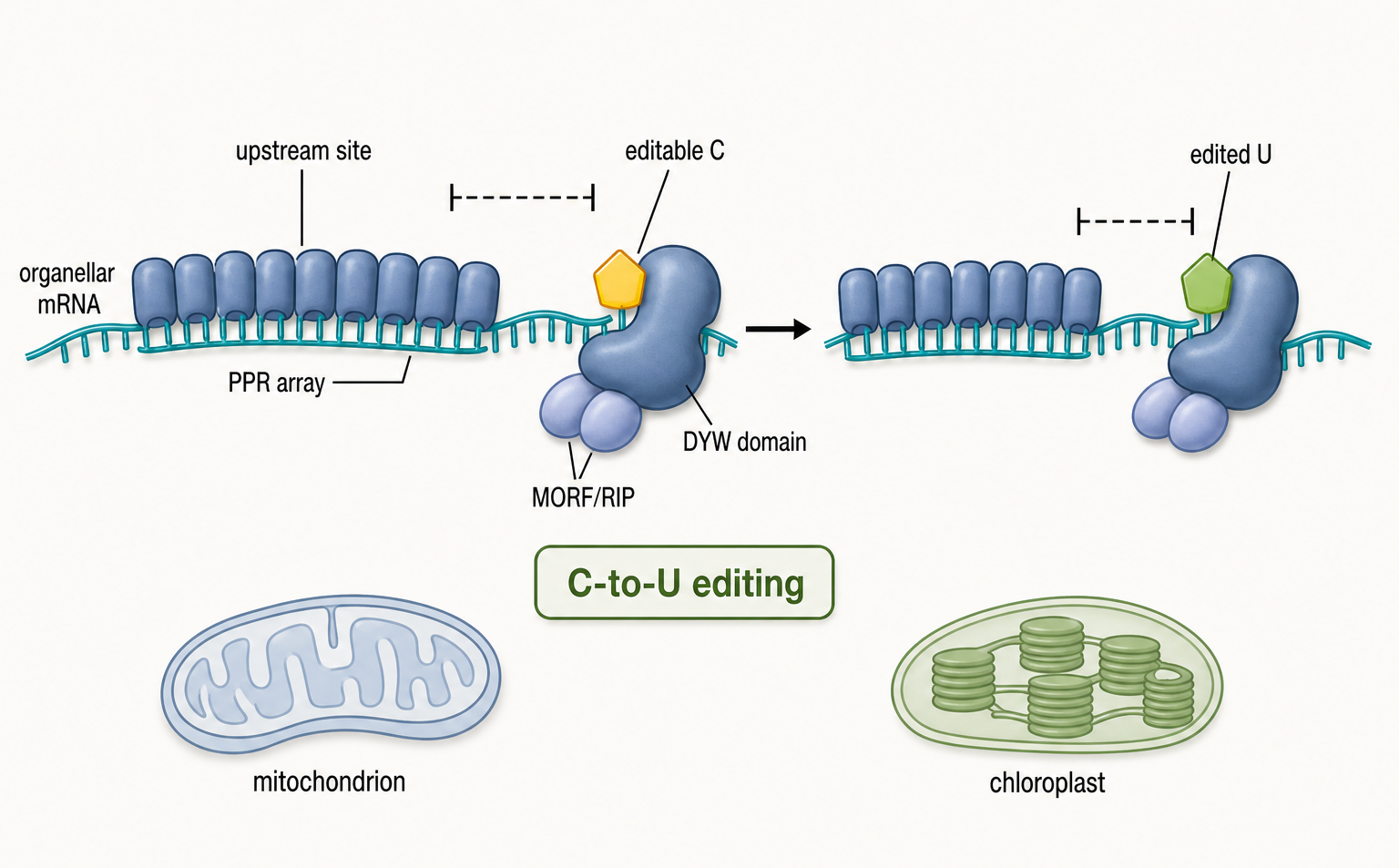
Figure 51.3. Plant Organellar C-to-U Editing by PPR/DYW Factors. Many plant organellar C-to-U editing sites are specified by nuclear-encoded pentatricopeptide repeat (PPR) proteins that bind upstream of the editable cytidine and position editing activity at a defined distance. A DYW domain—either fused to the recognition PPR protein or recruited as a separate polypeptide—provides cytidine deaminase-like catalytic chemistry. Accessory proteins such as MORF/RIP factors stabilize editing complexes and are required at subsets of sites in both mitochondria and chloroplasts.
The protein machinery is modular. The RNA editing catalytic complex, often discussed with editosome or RECC terminology, contains endonucleases, terminal uridylyltransferases, exonucleases, RNA ligases, structural proteins, and interaction factors. Additional assemblies, including RNA editing substrate-binding and regulatory complexes, organize guide RNAs, mRNAs, and editing intermediates. RESC factors, including transcript-specific components such as RESC13 and RESC14 in recent work, help explain why editing cannot be reduced to a minimal catalytic core. Some factors affect many transcripts, whereas others affect particular mRNAs or editing stages.
Minicircles create a genomic layer of specificity. Kinetoplast DNA minicircles encode many guide RNAs, and different kinetoplastid lineages organize minicircle classes and guide RNA repertoires differently. A parasite’s guide RNA complement determines which maxicircle transcripts can be productively edited. The minicircle network is therefore not junk mitochondrial DNA; it is an archive of trans-acting RNA information needed to read the maxicircle genes. Comparative studies of minicircle organization in species such as Trypanosoma lewisi show that guide RNA repertoires and kinetoplast DNA organization can evolve substantially while retaining the requirement for edited mitochondrial gene expression.
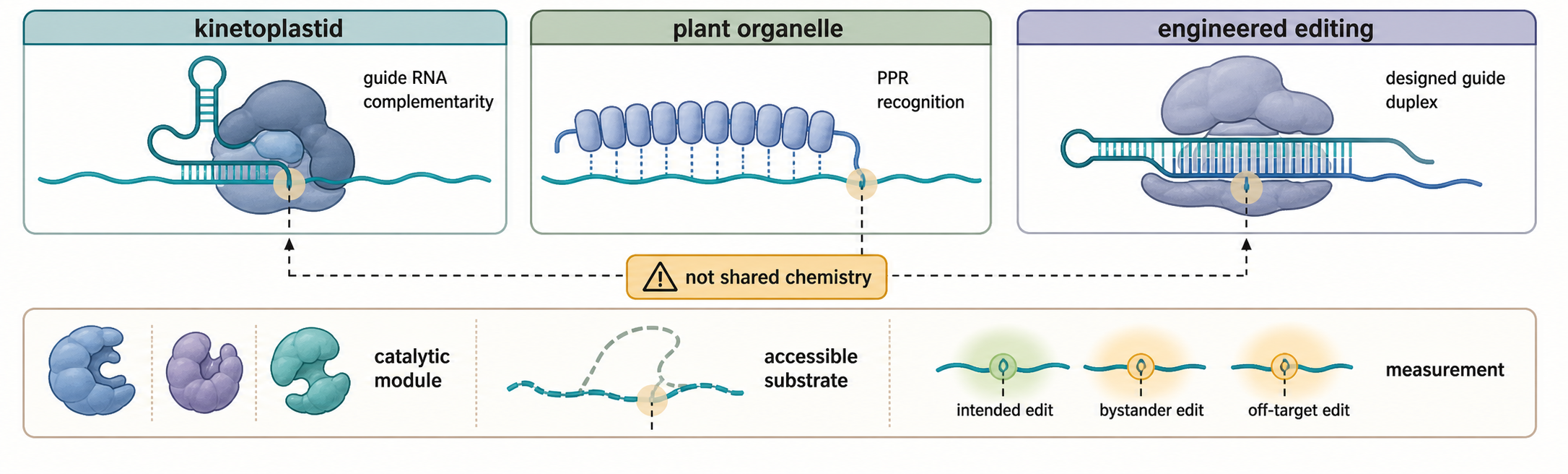
Figure 51.4. Specificity Strategies Across Editing Systems. Natural and engineered RNA editing systems diverge in their specificity modules—guide RNA complementarity in kinetoplastids, PPR repeat-array recognition in plant organelles, and designed guide RNA duplexes in ADAR recruitment or prime editing—but share a common requirement for a compatible catalytic module, an accessible substrate architecture, and measurement strategies that capture intended edits alongside bystander and off-target events. Understanding these three requirements in natural systems informs the design of programmable RNA editing tools.
The evidence basis for kinetoplastid editing is unusually rich because the edits are large and mechanistically diagnostic. Sequencing of edited and unedited mitochondrial transcripts reveals precise U insertion and deletion patterns. Guide RNAs can be matched to edited regions by complementarity. Biochemical assays with mitochondrial extracts or defined complexes support cut-add/delete-ligate reaction models. Genetic perturbation of editing proteins or guide RNA biogenesis factors changes editing patterns and affects parasite mitochondrial gene expression. High-throughput sequencing has sharpened the field by revealing populations of partially edited intermediates, alternative editing paths, and conserved fundamentals across species.
Artifact control is essential. A partially edited read may be a true intermediate, an abortive product, a degradation fragment, a misprimed cDNA, or a mapping artifact if the reference set is incomplete. Uridine-rich sequences are prone to alignment ambiguity, and guide RNA annotation depends on knowing the minicircle repertoire. Assays based on engineered ribozyme reporters or high-throughput screening can capture editing-like U insertion or deletion activity, but reporter substrates are simplified compared with mitochondrial RNPs and should not be treated as complete reconstructions of the in vivo pathway. A strong claim about editing order or guide usage should combine transcript reads, guide RNA evidence, perturbation, and awareness of alternative alignments.
51.2. Plant organellar C-to-U and U-to-C editing systems
Plant organellar RNA editing is most often a single-base correction system. In land-plant mitochondria and chloroplasts, many transcripts are synthesized with cytidines at positions where the functional protein requires uridines. C-to-U editing changes those cytidines in RNA, often restoring conserved codons in proteins of oxidative phosphorylation or photosynthesis. A chloroplast edit might restore a codon in a photosystem or NADH dehydrogenase subunit; a mitochondrial edit might restore a conserved amino acid in a cytochrome c biogenesis, complex I, or ATP synthase component. The edit does not change the organellar genome; it changes the RNA population available for translation.
The main specificity logic uses nuclear-encoded RNA-binding proteins. Many plant editing sites depend on a PPR protein that binds upstream of the editable base. PPR proteins contain arrays of repeats, and amino acids in each repeat help determine which RNA base is recognized. The resulting recognition code is not perfectly mechanical, but it is sufficiently modular that PPR proteins can be thought of as programmable RNA-binding scaffolds evolved by the plant nuclear genome. A PPR specificity factor positions an editing activity near a selected cytidine, usually with a characteristic spacing between the binding site and the edited base. This differs from kinetoplastid guide RNA editing because the missing information is not written in a guide RNA; it is encoded in the amino-acid sequence of a protein repeat array.
The catalytic component of C-to-U editing is linked to DYW-domain proteins. A DYW domain contains motifs consistent with cytidine deamination chemistry, including zinc-coordinating residues in many cases, and genetic evidence ties many DYW-containing PPR proteins to specific editing sites. Some PPR proteins combine target recognition and a DYW domain in one polypeptide. In other cases, a target-binding PPR protein lacks a catalytic DYW domain and must recruit a separate DYW protein or editing complex. Accessory factors, including MORF/RIP proteins and other organellar RNA maturation factors, can be required for efficient editing at subsets of sites.
Plant U-to-C editing is less widespread than C-to-U editing, but it is biologically important because it demonstrates that organellar editing is not a single universal chemical reaction. U-to-C editing occurs in several plant lineages, with especially extensive editing in some hornworts, lycophytes, and ferns, and with lineage-specific patterns in seed plants. The enzyme chemistry and factor requirements for U-to-C editing remain less settled than the C-to-U DYW model. Some sites may involve distinct enzyme families or still-unresolved catalytic mechanisms. A careful textbook statement should therefore separate the established existence and phylogenetic distribution of U-to-C editing from stronger claims about universal mechanism(chapter1047.md)-U-to-C-MECHANISM].
Editing is integrated with organellar transcript maturation. Plant organellar RNAs often undergo cleavage, splicing, trimming, stabilization, polyadenylation-linked decay, and translation regulation. Editing can occur before or after some of these steps depending on transcript and site. Some edits create start codons or restore residues needed for protein assembly; others may influence RNA stability, splicing, or translation. Conversely, RNA processing state can influence whether an editing factor can bind. This coupling means that loss of an editing factor can have downstream consequences beyond a single base. An unedited codon may reduce protein function, but the same perturbation may also alter transcript accumulation or organellar stress signaling.
Stress and development add another layer. Plant editing levels can vary with tissue type, developmental stage, environmental stress, and organellar physiological state. Stress-responsive changes in C-to-U editing have been reported and reviewed, but interpretation requires caution. A change in apparent editing percentage may reflect regulation of editing machinery, altered transcript abundance, shifts in organellar copy number, tissue composition, developmental timing, or selective degradation of unedited transcripts. Therefore a stress-editing claim should report the transcript, site, tissue, developmental stage, organelle, editing fraction, expression controls, and whether protein or physiological effects were measured.
The evidence basis for plant editing combines genetics, comparative genomics, organellar transcript sequencing, biochemical inference, and increasingly engineered reconstitution. Site-specific loss of editing in mutants identifies required factors. Cross-species comparisons show that many edits restore conserved amino acids, supporting functional interpretation. RNA-seq and targeted cDNA sequencing quantify editing at many sites, while direct protein evidence can confirm that edited codons are translated into expected amino acids. Recent work showing that plant organellar C-to-U editing factors can function in the plant cytosol is important because it partially uncouples editing chemistry from organellar context and supports engineering of plant editing factors, but cytosolic activity does not prove that all organellar cofactors or site rules are dispensable.
51.3. RNA editing in mitochondria, chloroplasts, and protists
Mitochondria and chloroplasts are recurring sites of unusual RNA editing because their gene-expression systems are evolutionarily constrained and biochemically specialized. Organellar genomes tend to be small, lineage-specific, and embedded in a cellular environment where many required factors are imported from the nucleus. An organelle can tolerate a genomic sequence that is not directly coding-competent if a reliable post-transcriptional process restores the RNA. Over evolutionary time, this creates a distributed genetic system: part of the information is in organellar DNA, part is in nuclear-encoded editing factors, and part is in guide RNAs or RNA-binding codes.
Kinetoplastid mitochondria represent the guide RNA-directed extreme. Plant mitochondria represent the protein specificity-factor extreme. Chloroplasts provide a related but distinct plant organellar context, with fewer editing sites than many plant mitochondria but strong functional consequences for photosynthetic gene products. Protists add further diversity. Some protist mitochondria display editing modes that do not match the canonical kinetoplastid U-indel model or the familiar plant C-to-U model. Novel mitochondrial editing modes have been described in nonstandard systems, but many remain less mechanistically resolved than kinetoplastid and land-plant cases(chapter1047.md)-PROTIST-DIRECT-REVIEWS].
The biological reason editing persists differs by lineage. In kinetoplastids, extensive editing is essential for generating many readable mitochondrial mRNAs and may be tied to kinetoplast DNA architecture and life-cycle regulation. In plants, editing often restores conserved protein sequences after genomic C-to-T or T-to-C patterns have not fixed at the DNA level. In some algae and protists, editing may compensate for unusual organellar genome evolution, relaxed DNA-level constraints, or lineage-specific RNA maturation pathways. These explanations are not mutually exclusive, and none should be treated as a universal law for organelles.
Boundary cases are common. Not all mitochondrial transcripts in kinetoplastids are extensively edited; some are never edited, some are minimally edited, and others are pan-edited across long regions. Not all plants have the same number or type of organellar editing sites; editing repertoires differ among angiosperms, gymnosperms, ferns, mosses, hornworts, and algae. Not every C-to-U event changes a protein sequence; edits can occur in untranslated regions, tRNAs, rRNAs, or sites with unclear functional consequences, depending on lineage and annotation. Some apparent edits disappear when organellar genome assemblies improve or when nuclear mitochondrial DNA segments are excluded from analysis.
Mitochondrial and chloroplast editing also links to organellar quality control. Edited, unedited, partially edited, and misedited RNAs can differ in stability and translation competence. Organellar ribosomes may preferentially translate mature transcripts, while defective transcripts may be degraded by organellar ribonucleases or surveillance pathways. Because organelles contain many genome copies and many RNA copies, editing efficiency should be interpreted as a population property. A 70 percent edited site means that the RNA pool is mixed; whether that is sufficient depends on protein complex assembly, turnover, and the physiological demand for the encoded protein.
The cross-chapter handoff is to organellar gene expression rather than to editing alone. Chapter 17 covers organellar genome architecture, Chapter 22 covers organellar polymerases, and later chapters on RNA decay and translation cover how organellar mRNAs are stabilized and read. Editing is one layer in this pipeline. Treating editing as an isolated oddity misses its real role: it is a transcript-maturation step that interacts with transcription, processing, RNP assembly, translation, protein complex assembly, and organellar signaling.
51.4. Editing complexes, specificity factors, and evolutionary diversity
Every editing system must solve the specificity problem. The cell must distinguish an editable site from many chemically similar nucleotides. Kinetoplastids solve much of the specificity problem by guide RNA complementarity and by ordered RNP assembly. Plant organelles solve much of it through sequence-specific RNA-binding proteins, especially PPR proteins, and associated catalytic or accessory factors. Engineered systems often solve it through designed guide RNAs, protein fusions, or synthetic scaffolds. These strategies differ in molecules, but they all convert recognition energy into a local editing reaction.
The kinetoplastid editing complex is not a passive enzyme that waits for a perfect substrate. It coordinates RNA binding, cleavage, U addition or removal, and ligation while remaining compatible with multiple guide RNAs and transcript states. Holo-editosome models emphasize dynamic assemblies with subcomplex variants rather than one invariant particle. This dynamic view explains transcript specificity and developmental regulation better than a static list of proteins. It also explains why in vitro reconstitution of one editing step does not automatically reproduce full editing of a pan-edited transcript.
Plant editing complexes are also modular rather than one-size-fits-all. One PPR protein may be required for one site or a small group of sites, while shared factors affect broader subsets. A DYW domain may provide catalytic chemistry in one context, while an accessory DYW protein may act with a recognition PPR protein in another. MORF/RIP factors can bridge proteins, stabilize RNA-bound complexes, or alter activity. Recent work on plant editing factors functioning outside their usual organelle supports the idea that recognition and catalysis can be partially portable, but portability is constrained by localization signals, substrate structure, expression level, and cofactor availability.
Evolutionary diversity is not random clutter. Editing systems evolve under pressures from organellar genome mutation, nuclear suppressor evolution, protein-sequence conservation, life-cycle metabolism, and selfish or mobile DNA dynamics. In plants, the gain or loss of editing sites can be coupled to changes in PPR gene families. If a genomic mutation changes a codon away from a conserved amino acid but a nuclear editing factor restores the RNA, the plant lineage may tolerate the genomic state. If a later DNA mutation makes the edit unnecessary, the editing factor or site may decay. Gymnosperm mitochondrial editing evolution illustrates how editing site repertoires can shift across lineages.
Kinetoplastid guide RNA systems raise a different evolutionary question: why maintain a split information system with maxicircle cryptogenes and minicircle guide RNAs? Proposed answers include historical contingency, kinetoplast DNA network evolution, regulatory flexibility, and coevolution of guide repertoires with maxicircle genes. None is a complete explanation by itself. What is clear is that once a transcript depends on many guide RNAs, loss of guide RNA information can be as damaging as mutation of a protein-coding gene. The guide RNA repertoire becomes part of the functional mitochondrial genome even when guide RNAs are encoded separately from the edited mRNA.
Specificity failures create biological and interpretive hazards. A mispositioned kinetoplastid guide RNA could create a nonproductive editing intermediate. A plant editing factor with relaxed specificity could edit a paralogous site or a nearby cytidine. An engineered editing factor borrowed from a natural system could act on endogenous organellar or nuclear RNAs if localization and binding are not controlled. Natural systems limit such failures through compartmentalization, cofactor dependence, expression patterns, RNA structure, and quality control. Engineered systems must replace evolutionary tuning with design, screening, and measurement.
The strongest evolutionary comparisons avoid ranking systems from primitive to advanced. Kinetoplastid U-indel editing is not a primitive version of CRISPR, and plant PPR editing is not simply a natural base editor waiting to be transferred. Each system is an adaptation to a particular genome architecture and cellular compartment. Comparative biology is useful because it reveals recurring design constraints, not because one system is a direct prototype for all others.
51.5. Comparative lessons for engineered editing systems
Natural guide RNA-directed editing teaches that guide design is inseparable from machinery design. A kinetoplastid guide RNA can specify an edited product only because the mitochondrion contains enzymes that cleave, add or remove uridines, and ligate RNA. In programmable ADAR recruitment, an engineered guide can specify a target adenosine only if ADAR is present, localized, and able to engage the guide-target duplex. In prime editing, a prime-editing guide RNA encodes a primer-binding site and reverse-transcription template, but editing efficiency depends on nicking, reverse transcription, flap resolution, DNA repair, and cellular context. A guide is therefore a targeting and information element, not a complete editor.
Natural systems also teach that local sequence context is not a nuisance variable. Kinetoplastid editing depends on guide-mRNA register, anchor strength, neighboring edited blocks, and RNA-protein assemblies. Plant editing depends on upstream recognition sequence, spacing to the edited base, RNA structure, and cofactors. ADAR guide mimic designs exploit the fact that endogenous ADAR substrates have architectures that can be imitated to improve editing. Prime editing improvements using endogenous small RNA-binding proteins similarly show that guide stability and RNP architecture can be as important as nominal complementarity.
The bystander problem has natural analogs. In plant organelles, a PPR factor must edit the intended cytidine without converting every nearby cytidine. In ADAR-guided editing, a guide-target duplex can present multiple editable adenosines. In kinetoplastids, an editing block must add or remove the correct number of uridines; an overextended product may fail to pair with the next guide. The engineering lesson is that editing windows, reaction processivity, and product selection must be measured directly. Reporting only the intended edit can hide nearby edits or product mixtures that determine biological outcome.
Compartmentalization is a design principle. Kinetoplastid U-indel editing occurs in mitochondria with a specialized guide RNA and protein repertoire. Plant organellar editing factors are imported into mitochondria or chloroplasts and act in organellar RNP environments. Therapeutic RNA editing usually aims at nuclear or cytosolic transcripts, and delivery vehicles must reach the correct tissue and subcellular compartment. A factor that edits efficiently in a plant chloroplast or a parasite mitochondrion is not automatically useful in human cytosol. Conversely, cytosolic reconstitution of plant editing activity is exciting because it tests which components are portable, but it also shows how much context must be deliberately rebuilt.
Measurement standards should be borrowed from natural editing biology. A mature engineered-editing claim should distinguish substrate abundance, editing fraction, product identity, bystander edits, off-target edits, RNA stability, protein consequence, and cellular response. Kinetoplastid researchers learned to interpret populations of intermediates, not only final edited products. Plant organellar researchers learned to separate editing defects from transcript accumulation and organelle stress. Therapeutic editing researchers should make the same separations: an increased edited read fraction can reflect better chemistry, altered RNA decay, selective survival of edited molecules, or changes in cell composition.
The most realistic engineering opportunities may come from modular recognition rather than wholesale transfer. PPR repeat arrays are attractive because their RNA-recognition code can in principle be redesigned. Guide RNAs are attractive because they are easier to synthesize and retarget than proteins. Endogenous ADAR recruitment is attractive because it avoids delivering a deaminase protein. Prime-editing guide design is attractive because a short RNA can encode both targeting and templating information. Each approach inherits a different liability: PPR engineering requires protein delivery and code accuracy, guide RNA editing requires off-target control and endogenous enzyme availability, and prime editing requires DNA repair compatibility and genomic safety assessment.
The final lesson is humility about portability. Natural editing systems are highly evolved RNP ecosystems. They can inspire engineered editing, but they should not be flattened into slogans such as “guide RNAs can edit anything” or “PPR proteins are programmable base editors.” The useful abstraction is narrower and stronger: accurate editing requires a specificity module, a catalytic module, a compatible substrate architecture, control over reaction order or editing window, and a measurement system that captures intended products and unintended products.
Box 51.1. Do Not Overgeneralize the Word “Guide”
The word “guide” appears across very different editing and gene-targeting systems and does not imply shared ancestry, protein partners, or chemistry.
- Kinetoplastid guide RNAs pair with mitochondrial mRNAs and encode, through their mismatches, the uridines to be inserted or deleted; they work inside a mitochondrial cut-modify-ligate complex.
- CRISPR guide RNAs direct Cas endonucleases to DNA or RNA targets by Watson-Crick complementarity; the downstream reaction is cleavage, not base modification.
- ADAR-recruiting guide RNAs form a duplex over a target adenosine in cytosolic or nuclear mRNA and present it to endogenous ADAR; the reaction is hydrolytic deamination of adenosine to inosine.
- Prime-editing guide RNAs contain a primer-binding site and a reverse-transcription template that encode a desired DNA sequence change; the downstream reaction involves nicking, reverse transcription, flap resolution, and DNA repair.
- In all cases, “guide” means a targeting or information-transfer element within a particular molecular machine; the machines, chemistries, and biological contexts are distinct.
Box 51.2. Partial Editing: Intermediate, Error, or Artifact?
A sequencing read that shows partial editing at a site can have several origins with different biological meanings.
- True pathway intermediate: in kinetoplastid editing, partially edited transcripts are expected because editing proceeds block by block from 3′ to 5′; finding a partially edited molecule does not mean editing failed.
- Abortive product: the editing machinery may have engaged and then dissociated, leaving an incomplete and potentially unstable product.
- Degradation fragment: a fully edited mRNA may have been cleaved, and only an edited fragment was captured.
- Sequencing artifact: reverse transcriptase errors, template switching, or adapter mispriming can generate apparent editing at positions that are not genuinely edited.
- Mapping artifact: uridine-rich sequences can align to multiple positions in an incompletely annotated organellar genome; an apparent edit may reflect misalignment rather than chemistry.
- Interpretation requires combining transcript context, guide RNA evidence, read depth, perturbation data, and awareness of alternative alignments before concluding that a partially edited species is a true biological intermediate.
Recent Consensus
There is strong consensus that kinetoplastid U-indel editing is guide RNA-directed and proceeds through cleavage, uridine insertion or deletion, and ligation by multisubunit mitochondrial RNP complexes. Modern sequencing has added detail about intermediates, alternative products, and species variation, but it has not overturned the core guide-directed model.
There is strong consensus that plant organellar C-to-U editing depends heavily on nuclear-encoded specificity factors, especially PPR proteins, and that DYW-domain proteins are central to many C-to-U editing reactions. The precise composition of active complexes differs by site, organelle, and lineage, and accessory proteins remain important for explaining efficiency and specificity.
There is broader consensus that organellar editing systems are evolutionary mosaics rather than variants of one universal pathway. Mitochondria, chloroplasts, and protists use different combinations of guide RNAs, RNA-binding proteins, catalytic domains, and RNA maturation pathways. Comparative study is valuable because it reveals design principles for RNA recognition and editing, but direct extrapolation from one lineage to another is risky.
Open Questions, Controversies, Deprecated Models, and Common Misconceptions
Open questions:
- The mechanism of plant U-to-C editing remains less settled than the mechanism of many C-to-U events. The existence of U-to-C editing in particular lineages is established, but the catalytic proteins, reaction chemistry, and relationship to C-to-U machinery require careful site- and lineage-specific treatment(chapter1047.md)-U-to-C-MECHANISM].
Controversies:
- The evolution of kinetoplastid pan-editing remains incompletely explained. The field can describe guide RNAs, maxicircle cryptogenes, minicircle repertoires, and editing complexes in mechanistic detail, but why such an elaborate split information system was retained is still debated. Historical contingency, DNA network architecture, and regulatory features may all contribute.
Common misconceptions:
- “Guide RNA-directed editing and CRISPR guide RNA targeting are the same kind of process.” They are not. Kinetoplastid guide RNAs guide an RNA reconstruction reaction in mitochondria; CRISPR guide RNAs guide Cas proteins to nucleic-acid targets; ADAR recruitment guides create RNA duplexes for deamination; prime-editing guide RNAs template DNA synthesis. The shared word guide means targeting or information transfer, not shared ancestry or identical chemistry.
- “Every organellar C-to-U change is adaptive or protein-restoring.” Many edits clearly restore conserved codons, but some sites have unclear function, low editing fractions, lineage-specific occurrence, or uncertain annotation. A claim of function should be supported by conservation, factor dependence, protein consequence, physiology, or experimental perturbation rather than by the presence of an edit alone.