Chapter 31. Nuclear Surveillance and Disposal of Cryptic and Pervasive RNA Products
Scope Note
This chapter explains how eukaryotic nuclei recognize, contain, process, retain, and destroy RNA molecules that should not become stable exported ribonucleoprotein particles. The central examples are nuclear exosome cofactors, cryptic unstable transcripts, promoter-associated RNAs, pervasive transcription products, and quality-control decisions during pre-mRNA, ribosomal RNA, transfer RNA, small nuclear RNA, and long noncoding RNA biogenesis. Chapter 15 owns the promoter, enhancer, antisense, readthrough, termination-site, and transcription-unit architecture that produces these RNAs. Chapter 93 owns evidence for regulatory function of the RNA products. This chapter owns their surveillance fate and the consequences when disposal fails.
Executive Summary
Nuclear RNA surveillance is the set of recognition, retention, processing, and degradation reactions that prevents inappropriate RNA molecules from accumulating in the nucleus or entering productive export pathways. The best-studied effector is the nuclear RNA exosome, a multi-subunit 3′ to 5′ ribonuclease machine that can trim normal precursors and degrade aberrant or short-lived transcripts. The exosome itself does not identify every substrate alone. Targeting cofactors, including helicases, RNA-binding proteins, terminal nucleotidyltransferases, adaptor complexes, and transcription-associated factors, help decide whether an RNA is matured, held, remodeled, or destroyed. Reviews of the nuclear exosome and pervasive transcription emphasize this dual role: the same decay system both enforces RNA quality and shapes the observable transcriptome by eliminating many products of transcription that are made but not meant to persist (Ogami and Suzuki 2021; Villa and Porrua 2023).
A major lesson of modern transcriptomics is that eukaryotic genomes are transcribed more broadly than protein-coding annotation once suggested. Pervasive transcription means that RNA polymerases initiate, elongate, pause, terminate, or read through at many sites outside canonical stable transcript models. Some products are regulatory or become precursors to functional noncoding RNAs. Many are short, unstable, promoter-proximal, antisense, intragenic, intergenic, repeat-derived, or prematurely terminated RNAs that are rapidly degraded. The word “cryptic” should therefore be used carefully. A cryptic RNA is hidden under normal conditions because surveillance removes it or because conventional assays miss it; cryptic does not automatically mean nonfunctional, and functional claims require evidence beyond detection after exosome depletion.
Surveillance is most intelligible as a kinetic competition. Nascent RNAs acquire protective features such as a 5′ cap, spliceosome engagement, productive 3′ end processing, export adaptors, stable RNP proteins, or specialized maturation factors. RNAs that fail to acquire these features, expose unprotected 3′ ends, terminate prematurely, remain improperly assembled, or form persistent aberrant RNPs become substrates for nuclear decay pathways. Tailing enzymes can either stabilize some RNAs or mark others for degradation, depending on organism, tail chemistry, RNP context, and associated cofactors. Recent work on RNA 3′ end tailing after pervasive transcription termination reinforces that terminal nucleotide addition is part of nuclear containment rather than a simple synonym for poly(A)-mediated stability (Wu et al. 2024).
Quality control is not limited to messenger RNA. Pre-ribosomal RNAs, pre-transfer RNAs, small nuclear RNAs, small nucleolar RNAs, and long noncoding RNAs all pass through nuclear maturation pathways where incomplete processing can trigger retention or decay. In these pathways the distinction between processing and degradation is not absolute: controlled trimming can create mature ends, whereas extended digestion can eliminate the same precursor class if assembly or modification fails. This explains why perturbing exosome cofactors can cause both accumulation of aberrant RNAs and defects in the abundance of normal stable RNPs.
Surveillance defects matter because excess or mislocalized nuclear RNA can perturb chromatin, transcription, DNA replication, innate immunity, and cell state. The evidence is strongest for direct molecular phenotypes such as accumulation of exosome-sensitive RNAs, altered polymerase occupancy, R-loop-associated genome stress, and disrupted stable RNA maturation. Developmental, aging, stress, and disease links are increasingly reported, but causal chains vary in strength. For example, MYCN-linked recruitment of the nuclear exosome to RNA polymerase II connects an oncogenic transcription factor to exosome targeting and transcription-replication conflict control in specific cancer-relevant settings (Papadopoulos et al. 2022; Papadopoulos et al. 2024). Broader disease associations should not be overgeneralized unless supported by mechanism, rescue, and context-specific evidence.
Concept Inventory
- Nuclear RNA surveillance: the nuclear quality-control network that evaluates RNA molecules while they are being transcribed, processed, assembled into RNPs, retained, exported, or degraded. The term includes degradation, but it is broader than degradation because retention, remodeling, terminal trimming, and delayed maturation can also be surveillance outcomes.
- RNA exosome: a conserved multi-subunit 3′ to 5′ RNA-processing and RNA-degradation complex. Eukaryotic nuclei use the exosome for both maturation, such as precise trimming of stable RNA precursors, and disposal, such as degradation of unstable pervasive transcripts. Chapter 32 treats exosome structure, catalytic subunits, and comparison with other ribonucleases in more detail.
- Exosome targeting cofactors: proteins or protein complexes that recruit, activate, position, or feed RNA substrates into the exosome. Examples include nuclear helicase-containing assemblies, RNA-binding adaptors, poly(A)-adding or oligo(A)-adding enzymes, and transcription-associated factors. The human nuclear exosome targeting complex, abbreviated NEXT, is a major metazoan example, and structural work has clarified how NEXT can bind RNA and physically connect surveillance factors to the exosome (Puno and Lima 2022).
- Cryptic unstable transcripts: RNAs that are difficult to observe at steady state because surveillance rapidly degrades them. In budding yeast, CUT commonly labels short products whose accumulation becomes apparent when nuclear exosome activity is compromised. Instability describes fate; functional interpretation belongs to Chapter 93.
- Promoter-associated RNAs: products synthesized near promoters that can include divergent, upstream, abortive, or promoter-proximal RNAs. PROMPT is a mammalian label for one unstable upstream class. Production architecture belongs to Chapter 15; this chapter asks how these products are recognized and removed.
- Pervasive transcription products: RNAs made outside the narrow set of stable annotated outputs. Their production is treated in Chapter 15; their containment and disposal are treated here.
- Containment systems: the combined mechanisms that keep pervasive transcripts from disrupting gene expression or genome integrity. Containment can occur by preventing initiation, promoting early termination, rapidly degrading RNA, packaging RNA into non-exported RNPs, suppressing R-loop persistence, or coupling transcription to chromatin and DNA repair pathways. Containment is therefore an active regulatory architecture, not merely a cleanup crew.
What to Know Before Reading This Chapter
This chapter assumes the reader knows that eukaryotic nuclei contain several RNA polymerases. RNA polymerase II synthesizes mRNAs and many noncoding RNAs, RNA polymerase I synthesizes the large precursor rRNA in the nucleolus, and RNA polymerase III synthesizes tRNAs and several other small RNAs. Chapter 21 introduces these polymerases, and Chapter 24 explains initiation, pausing, elongation, and termination. The surveillance systems in this chapter operate on the RNA products of those polymerases and are often physically or kinetically linked to transcription.
The second prerequisite is the concept of an RNP, or ribonucleoprotein particle. A newly made RNA is not a naked polymer floating freely in the nucleoplasm. It is coated, folded, modified, spliced, cleaved, tailed, and inspected by proteins. Chapter 25 and Chapter 30 describe the assembly of productive messenger RNPs. Here the emphasis is the opposite decision: what happens when an RNA does not acquire the right protective marks or RNP partners.
The third prerequisite is the distinction between RNA abundance and RNA production. Steady-state RNA-seq mostly measures what remains after synthesis, processing, export, and decay. Nascent RNA methods, chromatin-associated RNA sequencing, exosome depletion, metabolic labeling, single-molecule imaging, and perturbation experiments reveal that many RNAs are made but rapidly removed. The conclusion that an RNA exists should therefore be separated from the conclusion that the RNA is stable, exported, translated, regulatory, or biologically important.
31.1. Nuclear exosome cofactors and substrate classes
The nuclear RNA exosome is best understood as a processing and degradation machine that needs instructions. The core exosome contains a channel-like scaffold and catalytic activities that act from RNA 3′ ends. A substrate must be presented in a compatible geometry, often after proteins remodel the RNP or expose a single-stranded tail. Because a nucleus contains many RNAs that should not be degraded, exosome access is heavily shaped by cofactors. A mature mRNA with a cap-binding complex, splice-associated proteins, a productive 3′ end, and export adaptors is less available to the nuclear exosome than a prematurely terminated transcript with an exposed 3′ end and no protective RNP architecture.
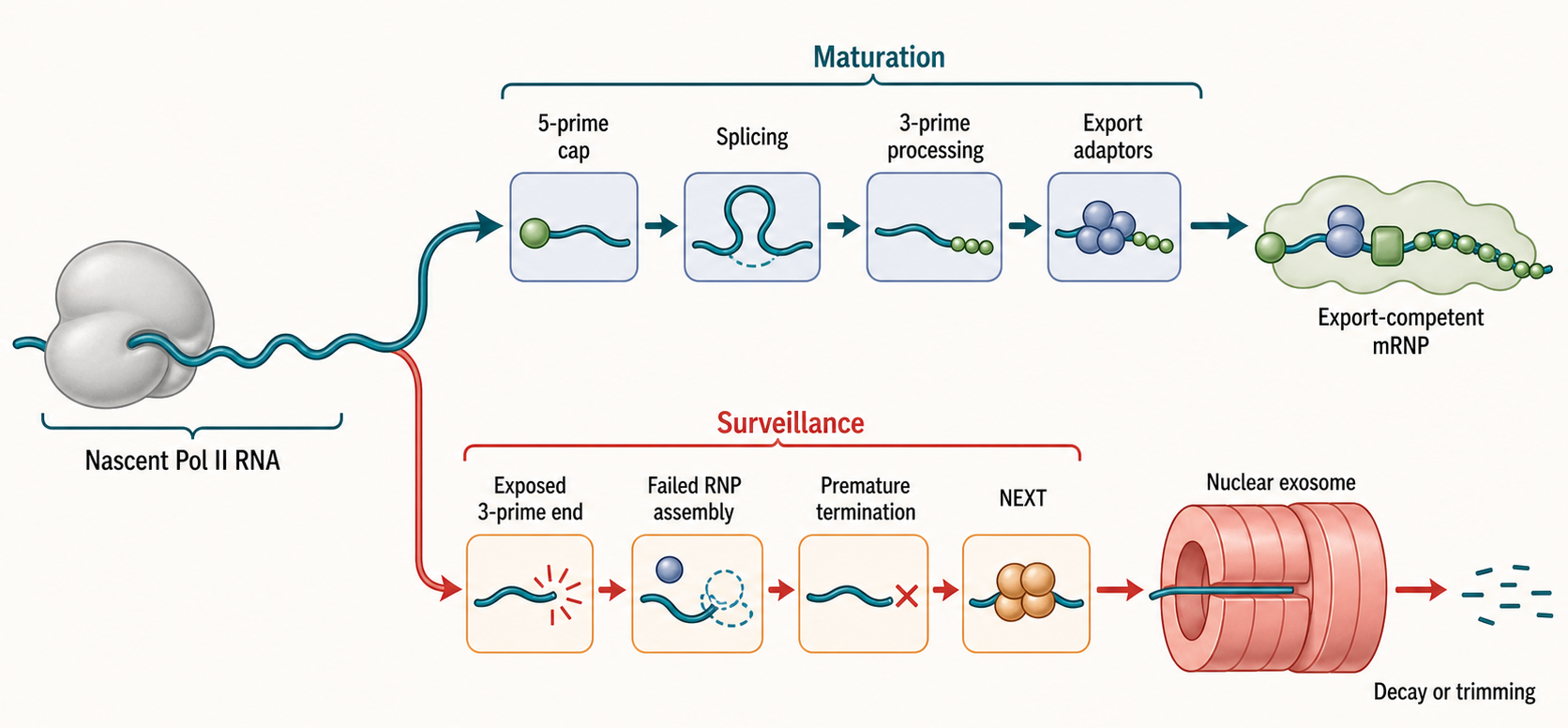
Figure 31.1. Kinetic Competition Between Maturation and Nuclear Exosome Targeting. A nascent RNA polymerase II transcript can mature into an export-competent mRNP or become a nuclear surveillance substrate. Productive maturation requires a 5′ cap, cap-binding complex engagement, spliceosome recruitment, correct 3′ end processing, and export adaptor loading. Surveillance is favored when transcription terminates prematurely, 3′ ends remain exposed and unprotected, RNP assembly fails, splicing is aberrant, or exosome targeting cofactors such as the NEXT complex are recruited. The outcome is a kinetic competition rather than a single terminal checkpoint.
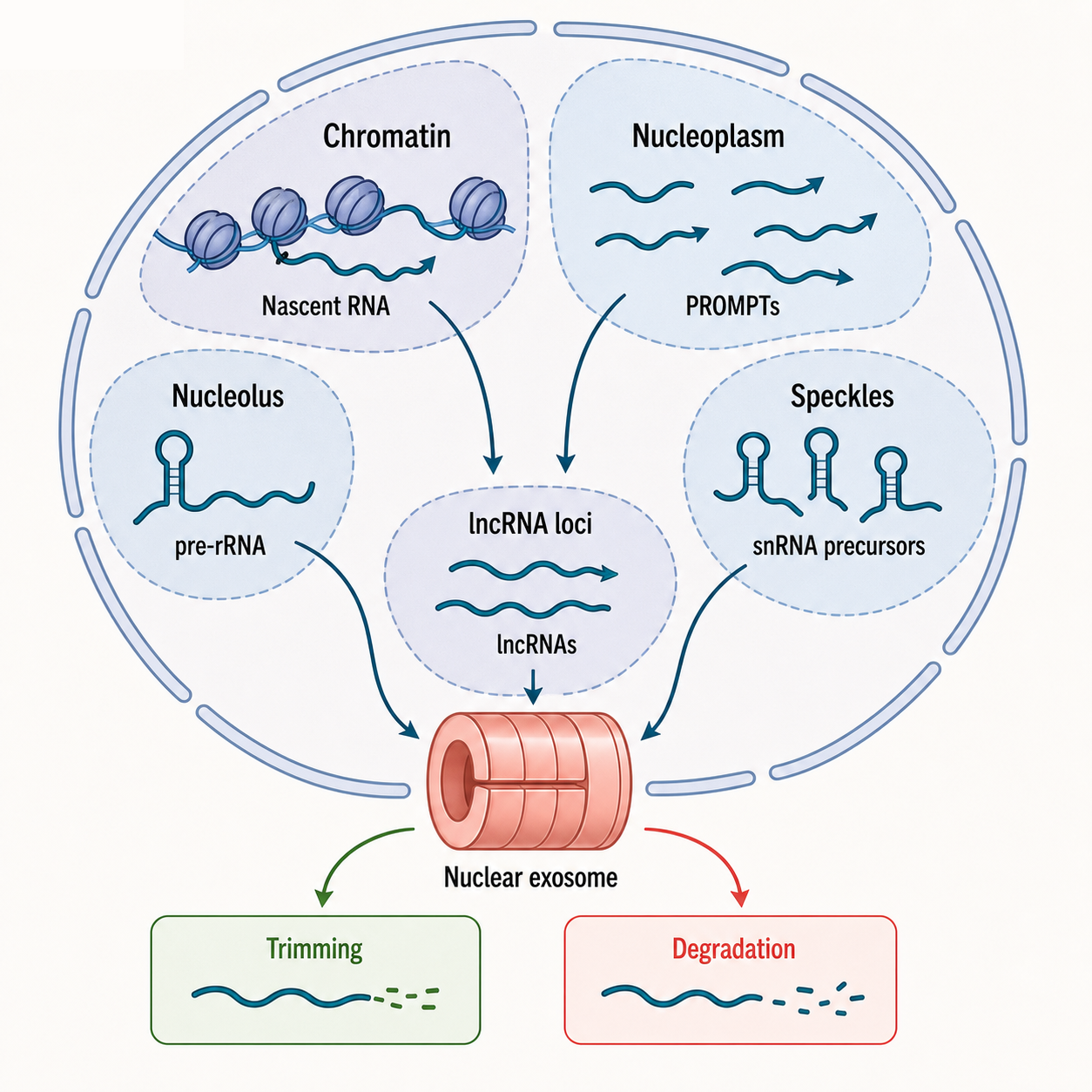
Figure 31.3. Nuclear Exosome Substrate Classes by Subnuclear Context. Nuclear exosome substrates arise in multiple compartments: chromatin-associated nascent RNA, nucleoplasmic promoter-associated transcripts, nucleolar pre-rRNA intermediates, snRNA and snoRNA precursors, and selected lncRNAs. The same exosome-centered machinery can trim normal precursors to generate mature ends or degrade aberrant RNAs depending on cofactor composition, RNP assembly state, and subnuclear location of the substrate.
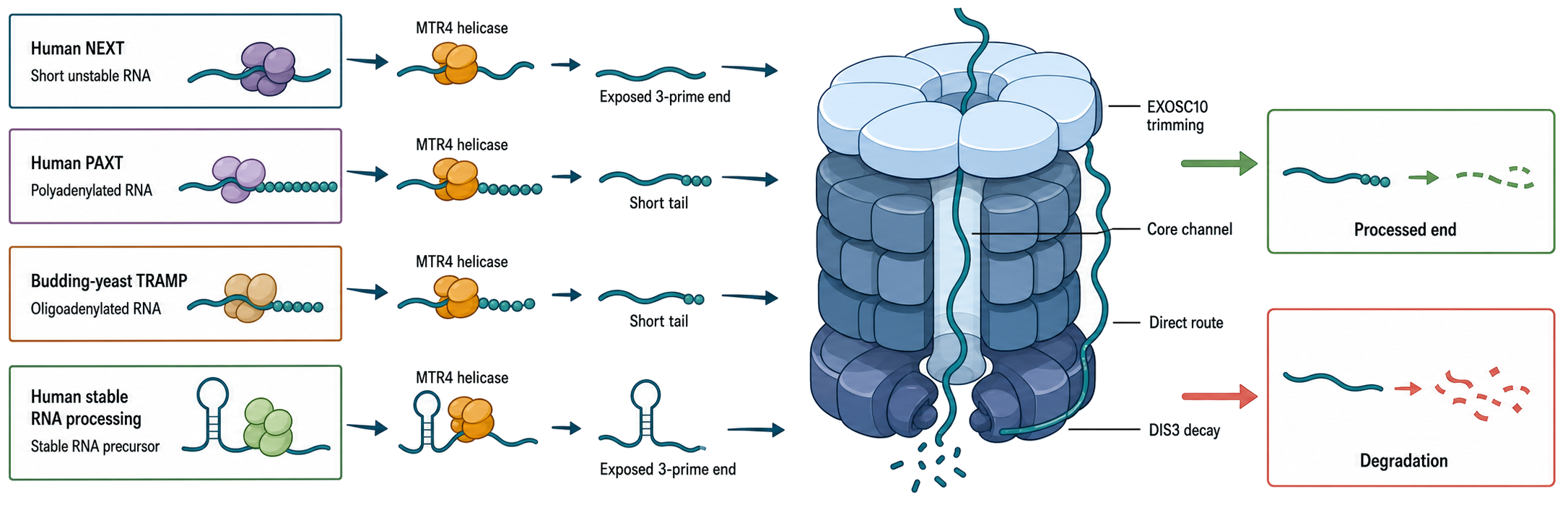
Figure 31.5. Nuclear Exosome Architecture and Cofactor-Directed Substrate Routing. The nuclear exosome is a conserved channel-like scaffold whose catalytic routes are selected by substrate geometry and cofactors rather than by RNA class alone. Separate, organism-qualified entry branches should compare human NEXT and PAXT, budding-yeast TRAMP, and human stable-RNA processing; they should show how MTR4-family helicase activity, short tail addition, or an already accessible 3′ end presents RNA to the core channel or a direct-access route. The central machine should distinguish EXOSC10-mediated trimming from DIS3-mediated processive decay and show that a stable precursor can leave with a processed end while an unstable or aberrant RNA can be degraded.
Table 31.1. RNA Classes and Nuclear Quality-Control Logic. Summary of how different RNA classes are normally matured, what triggers their surveillance or retention, which factors act on them, and what assay and interpretive caveats apply.
| RNA class | Normal maturation route | Common failure or surveillance trigger | Representative surveillance or processing factors | Useful assays | Major caveat |
|---|---|---|---|---|---|
| pre-mRNA | Cap addition, splicing, 3′ cleavage and polyadenylation, export adaptor loading | Failed splicing, premature termination, absent or incorrect poly(A) | Nuclear exosome, NEXT complex, cap-binding complex | Chromatin-associated RNA-seq, nuclear fractionation, splice-isoform analysis | Indirect stress from exosome depletion can cause secondary RNA changes |
| Promoter-associated RNA | Rapid early termination and exosome-mediated disposal | Exposed 3′ end, poor RNP assembly, bidirectional promoter initiation | NEXT complex, nuclear exosome, tailing enzymes | Exosome-depletion RNA-seq, GRO-seq, metabolic labeling | Accumulation may reflect DNA element or transcription event rather than RNA molecule |
| Enhancer RNA | Local transcription and rapid turnover; no stable export | Weak termination signal, absent protective RNP | Nuclear exosome, NEXT, tailing enzymes | GRO-seq, strand-specific RNA-seq, exosome depletion | Sense and antisense signals are difficult to separate without rigorous strand-specificity |
| Antisense or readthrough RNA | Premature termination or exosome-mediated degradation before export | Polymerase readthrough past a terminator, incorrect termination | Exosome, TRAMP or NEXT cofactors | Strand-specific RNA-seq, 3′ end mapping | Can reflect regulated production or processing failure; direct perturbation required to distinguish |
| pre-rRNA | Nucleolar endonucleolytic and exonucleolytic processing to mature 18S, 5.8S, and 28S rRNAs | Stalled processing intermediates, faulty ribosome assembly | Nucleolar exosome, processing endonucleases, ribosome assembly factors | Pre-rRNA northern blot, primer extension, pulse-chase labeling | Normal processing uses the same exosome machinery, so perturbation affects both aberrant and normal precursors |
| pre-tRNA | 5′ leader and 3′ trailer removal, CCA addition, base modifications, folding, aminoacylation | Failed end trimming, missing modifications, misfolding | RNase P, La protein, nuclear exosome, tRNA-specific exonucleases | End mapping, modification profiling, aminoacylation assay | Modification defects may be invisible in standard steady-state RNA-seq |
| snRNA or snoRNA | Sm-ring or LSm assembly, end processing, base modification, Cajal body or nucleolar localization | Incomplete end processing, unassembled or incorrectly modified RNP | Exosome, TUT1 for U6 snRNA, pseudouridylation and methylation enzymes | End chemistry assays, RNP assembly assays, localization imaging | Tailing outcome depends on RNA class and specific protein context |
| lncRNA | Stable nuclear retention or export; some rapid turnover is functionally appropriate | Absent RNP assembly, export incompetence, regulated instability | Nuclear exosome, NEXT, RNA-binding adaptors | Nuclear-cytoplasmic fractionation, perturbation and rescue assays | Detection after exosome depletion does not establish biological function |
Table 31.2. Tailing Outcomes in Nuclear RNA Biology. Different tail types added to nuclear RNAs can promote stability, mark substrates for surveillance, or support RNP maturation depending on the RNA class, protein context, and cellular compartment.
| Tail type or end change | Example RNA class | Possible outcome | Required context for interpretation |
|---|---|---|---|
| Canonical poly(A) on productive mRNA | Cleaved pre-mRNA in nucleus | Stability, translation competence, and export after export-adaptor loading | Requires cleavage and polyadenylation complex engagement and nuclear PABPN1 |
| Short oligo(A) or mixed tail on unstable nuclear RNA | CUT or PROMPT in nucleus | Surveillance and decay via exosome or TRAMP-mediated pathway | Tail adds a single-stranded handle for targeting cofactors; outcome differs fundamentally from mRNA poly(A) |
| U6 snRNA oligouridylation | U6 snRNA | Part of U6 maturation cycle and LSm RNP assembly rather than a decay signal | Requires TUT1 enzyme and LSm protein partners; not a generic decay mechanism |
| Organellar polyadenylation | Mitochondrial or chloroplast RNA | Promotes degradation in organelles, opposite to cytoplasmic mRNA stabilization | Organelle-specific nucleases and factors govern outcome; nuclear exosome rules do not apply |
| Terminal tailing of pervasive transcription products | Products of pervasive termination events | Containment and protection against accumulation of unwanted nuclear RNA | Requires nuclear tailing enzymes and cofactors; context established for pervasive transcription products |
Table 31.3. Assay Interpretation Guide for Nuclear Surveillance. Each assay used in nuclear surveillance research measures a different aspect of RNA fate; understanding what each can and cannot prove is essential for correct interpretation of experimental results.
| Assay | What it measures directly | What it suggests | What it cannot prove alone | Best orthogonal follow-up |
|---|---|---|---|---|
| Steady-state RNA-seq | Total cellular RNA abundance at steady state | Relative transcript level differences between conditions | Whether differences reflect synthesis, processing, export, or decay | Nascent RNA-seq or metabolic labeling to separate synthesis from stability |
| Nascent RNA-seq | Newly synthesized RNA associated with active polymerase | Active transcription sites and approximate synthesis rates | Whether an RNA is stable, processed, or a surveillance substrate | Factor depletion plus end mapping to link transcription to fate |
| Chromatin-associated RNA-seq | RNA physically tethered to or near chromatin | Cotranscriptional processing and surveillance events near transcription sites | Which factors act cotranscriptionally or whether RNA is retained versus released | Comparison with nucleoplasmic and cytoplasmic RNA fractions |
| Exosome or cofactor depletion | RNA changes after loss of a specific surveillance factor | Direct or indirect substrates that normally depend on the factor for turnover | Whether accumulation is a direct substrate or an indirect stress response | Catalytic-dead mutant rescue and early versus late depletion time course |
| RNA end mapping | 3′ and 5′ end positions and chemical identity | Processing and trimming boundaries across the transcriptome | Which factor generates the observed end | End mapping combined with targeted factor depletion and in vitro reconstitution |
| Imaging of nascent RNA | Transcription dynamics at individual loci in single cells | Bursting kinetics, elongation rates, and stochastic processing variation | Population-level average fates or direct identity of exosome substrates | Population RNA-seq and biochemical factor-perturbation validation |
| R-loop mapping | Genome-wide locations of RNA-DNA hybrids | Sites prone to R-loop formation and potential transcription-replication conflict | Causality of R-loop for genome instability or gene expression changes | RNase H overexpression to resolve R-loops and test functional consequence |
| Rescue after processing correction | Reversal of RNA phenotype when a specific processing defect is repaired | That the identified processing defect is causal for the RNA accumulation phenotype | That the rescue is specific or that no other pathway was simultaneously altered | Orthogonal detection methods and allele-specific rescue experiments |
The major substrate classes include short cryptic transcripts, promoter-associated RNAs, enhancer-associated RNAs, antisense RNAs, readthrough products, incorrectly processed pre-mRNAs, improperly assembled stable RNP precursors, and by-products of transcription termination. The same machinery can also trim legitimate precursors. For example, some stable nuclear RNAs need 3′ end trimming before they become mature RNPs. A key pedagogical point is that exosome sensitivity is not a molecular identity. It is an outcome of the RNA’s sequence, end chemistry, length, RNP coating, transcriptional context, subnuclear location, and competing maturation pathway.
In metazoans, the nuclear exosome targeting complex, NEXT, provides a clear example of cofactor logic. NEXT contains an RNA helicase module and RNA-binding/adaptor components that help recruit exosome activity to a subset of nuclear RNAs. Structural analysis of human NEXT showed how surveillance factors form a platform for RNA binding and exosome engagement, coordinating RNA capture, remodeling, and nuclease delivery (Puno and Lima 2022). Organisms use distinct adaptor systems, so the NEXT mechanism should not be treated as a universal description of every nuclear exosome substrate.
Tailing enzymes add another layer. In many cytoplasmic settings, a long poly(A) tail supports translation and stability. In nuclear surveillance, short oligo(A), mixed, or noncanonical tails can instead create single-stranded handles for decay factors. Recent work on products of pervasive transcription termination argues that 3′ end tailing helps protect cells from terminated pervasive transcription products, emphasizing that tailing can function as a safeguard against accumulation of unwanted RNA rather than a universal stabilizing mark (Wu et al. 2024). The boundary case is important: tail identity and consequence depend on the protein environment. The same chemical category, adenylation, can promote different outcomes in mRNA maturation, bacterial decay, organellar RNA turnover, and nuclear surveillance.
Exosome targeting also intersects with transcription machinery. RNA polymerase II generates nascent RNA while carrying a C-terminal domain and associated factors that recruit processing and surveillance proteins. Reviews of eukaryotic transcription structure and elongation emphasize that polymerase complexes are platforms for co-transcriptional decisions, not isolated enzymes that simply make RNA and release it later (Girbig et al. 2022; Farnung 2025). The MYCN studies provide a concrete disease-linked example: MYCN can recruit nuclear exosome machinery to RNA polymerase II and can act as an RNA-binding accessory factor for nuclear exosome targeting in contexts relevant to transcription-replication conflict control (Papadopoulos et al. 2022; Papadopoulos et al. 2024). This does not mean MYCN is a universal exosome cofactor in all cells; the claim is context-dependent and strongest for the systems directly tested.
31.2. Recognition and disposal of cryptic and promoter-associated transcripts
Cryptic unstable transcripts are most easily introduced with a simple experiment. If a wild-type yeast cell is analyzed by steady-state RNA-seq, many short intergenic and antisense transcripts are barely visible. If nuclear exosome activity or exosome targeting is impaired, some of these RNAs accumulate. The observation implies that transcription was occurring before the perturbation, but the RNAs were normally destroyed quickly. The adjective “cryptic” refers to the measurement state, not necessarily to biological insignificance.
Promoter-associated products can include short divergent, upstream, antisense, or prematurely terminated RNAs. Their exact sites of initiation, directionality, pausing, and transcription-unit boundaries belong to Chapter 15. For surveillance, the important distinction is whether a product acquires a protective RNP and productive end-processing pathway or remains exposed to termination-coupled adaptors, tailing enzymes, retention factors, and the nuclear exosome. Mammalian PROMPTs and yeast CUTs illustrate organism-specific labels for products whose low steady-state abundance reflects rapid disposal (Ogami and Suzuki 2021; Villa and Porrua 2023).
The disposal mechanism can be described causally after synthesis has occurred. First, a short RNA either acquires protective processing and RNP features or remains poorly assembled. Second, termination exposes an end or RNP state recognized by targeting cofactors. Third, adaptors bind or remodel the substrate, and tailing can create or extend a single-stranded handle. Fourth, the substrate is retained near chromatin or in the nucleoplasm rather than licensed for export. Fifth, the exosome trims or degrades the RNA from the 3′ end. This sequence explains why cryptic transcripts accumulate when surveillance is perturbed even if their synthesis changes little.
Several assays reveal different parts of the process. Nascent RNA sequencing can detect transcription before decay. Exosome depletion shows which RNAs are normally unstable. Chromatin-associated RNA methods enrich for nuclear transcripts near their transcription sites. Single-molecule imaging can follow transcription dynamics at individual loci; for example, dynamic imaging of nascent RNA has been used to infer general principles of transcription dynamics and stochastic splice-site choice (Wan et al. 2021). Each method has limits. Exosome depletion can create indirect stress responses, nascent assays can overrepresent paused polymerases or short-lived RNAs, and short-read mapping can confuse overlapping sense and antisense transcription unless strand specificity and annotation are rigorous.
Detection after exosome inhibition supports two conclusions: the RNA was produced, and its normal abundance depended on surveillance. It does not determine whether the RNA product is functional, whether the act of transcription matters, or whether the underlying DNA element is regulatory. Those causal distinctions belong to Chapter 93. The surveillance question is whether the substrate is recognized directly, which cofactor recruits disposal, what end or RNP feature is read, and how rapidly the RNA is contained.
31.3. Containment and degradation of pervasive transcription products
Pervasive transcription produces many RNAs that never enter the stable transcriptome. Chapter 15 explains the promoter, enhancer, antisense, readthrough, termination-site, and transcription-unit architecture that generates them. Once produced, these RNAs differ in length, end formation, RNP packaging, and access to protective processing. Villa and Porrua describe pervasive transcription as a controlled risk: the surveillance problem is to contain products that can interfere with nuclear processes if they persist (Villa and Porrua 2023).
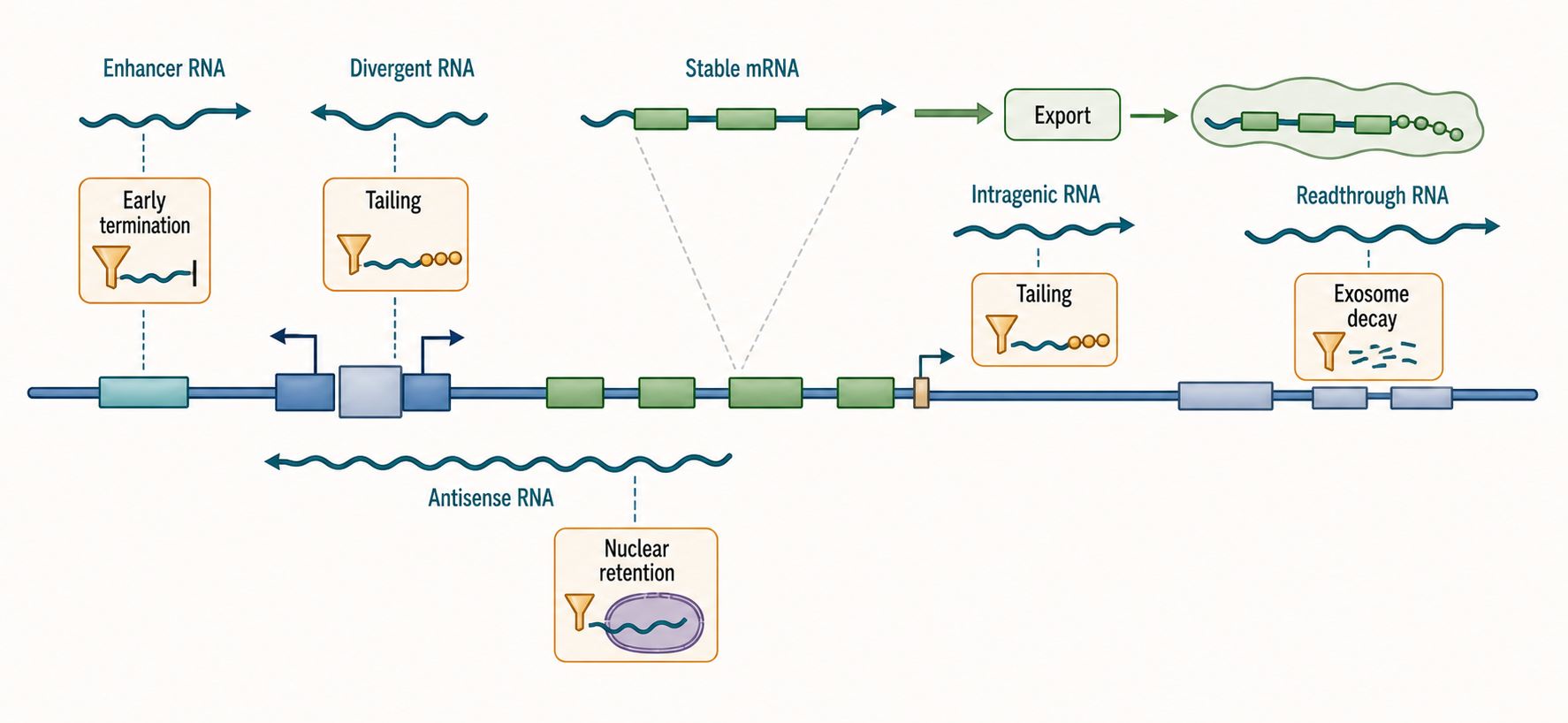
Figure 31.2. Recognition, Containment, and Disposal of Pervasive RNA Products. Pervasive products enter a surveillance sequence after synthesis: productive RNP assembly protects selected RNAs, whereas exposed ends, weak RNP protection, termination-linked features, or adaptor binding route other products toward tailing, nuclear retention, and exosome-mediated degradation. The visual should begin with already-produced RNA classes and emphasize disposal decisions; transcription-unit production architecture is handed to Chapter 15.
Containment begins when nascent products are sorted between protective maturation and disposal. Early termination can limit transcript length; retention prevents export; RNA-binding adaptors and helicases recognize poorly assembled RNPs; terminal tailing can create a decay handle; and the exosome removes substrates that remain exposed. These stages are kinetically coupled. A product retained near its site of synthesis can be degraded before it spreads into the nucleoplasm, invades neighboring transcription units, or enters an export pathway.
One concrete hazard is transcription-replication conflict. During S phase, replication forks and transcription complexes share the same DNA template. Nascent RNA can contribute to R-loops, which are three-stranded nucleic acid structures containing an RNA-DNA hybrid and displaced single-stranded DNA. R-loops have normal functions in some contexts, but persistent or mislocalized R-loops can obstruct replication and promote genome instability. Reviews of nascent RNA at the intersection of transcription and replication highlight that RNA processing and surveillance systems influence whether nascent transcripts remain compatible with DNA replication (Zhu et al. 2025). The MYCN-exosome work gives one mechanistic example in which exosome recruitment to RNA polymerase II helps prevent transcription-replication conflicts in MYCN-driven contexts (Papadopoulos et al. 2022).
Another hazard is local interference by products that remain chromatin associated, invade neighboring RNP pathways, or persist after readthrough and antisense transcription. The architecture that produces those products belongs to Chapter 15. Whether a particular RNA molecule itself regulates a nearby gene belongs to Chapter 93. The disposal question is whether containment reduces product lifetime, spatial spread, R-loop persistence, polymerase conflict, or access to downstream processing and export.
Containment systems differ across organisms. Budding yeast has provided many clean genetic examples because short unstable RNAs accumulate strongly when nuclear surveillance components are perturbed. Mammalian cells have more complex promoter and enhancer landscapes, longer introns, abundant repetitive elements, and specialized nuclear bodies. Plants add additional co-transcriptional processing and RNA modification contexts, and plant nuclear RNA pathways interact with silencing systems that are treated elsewhere in the book (Marquardt et al. 2023). The shared principle is that pervasive transcription is managed by layered decisions, but the exact factors and transcript classes are not interchangeable across organisms.
The phrase “pervasive transcription” describes production, not disposal status. For this chapter, the key classifications are protected versus exposed, retained versus released, trimmed versus completely degraded, and rapidly removed versus accumulated after surveillance failure. Functional adjudication of individual products is developed in Chapter 93.
31.4. Quality control of pre-mRNA, rRNA, tRNA, snRNA, and lncRNA biogenesis
Messenger RNA quality control begins while a transcript is still being synthesized. A productive pre-mRNA normally receives a 5′ cap, recruits cap-binding proteins, engages spliceosome assembly if introns are present, undergoes 3′ end cleavage and polyadenylation, and acquires export-competent mRNP proteins. Failure at any step can create a nuclear-retained substrate. For example, an unspliced or mis-spliced pre-mRNA may remain associated with nuclear factors rather than entering the export pathway described in Chapter 30. Splicing factor decisions can also generate poison exons or cryptic products discussed in Chapter 28. Nuclear surveillance is therefore not a single checkpoint at the end of transcription. It is a distributed competition between maturation and decay.
Pre-rRNA quality control occurs mostly in the nucleolus, where RNA polymerase I transcripts are processed, modified, folded, and assembled with ribosomal proteins. The initial pre-rRNA contains external and internal transcribed spacers that must be removed to produce mature rRNAs. Trimming and degradation are closely related in this setting: a nuclease can make a mature end if assembly is correct, but can also eliminate a defective precursor if processing stalls. This is why exosome-associated perturbations can affect both aberrant precursor accumulation and mature ribosome production. Chapter 42 gives the detailed pathway of rRNA processing and ribosome biogenesis; this chapter emphasizes the surveillance logic.
Pre-tRNA quality control has a different molecular shape. Transfer RNAs are short, structured RNA polymerase III products that need 5′ leader removal, 3′ trailer removal, CCA addition in many systems, base modifications, folding, and aminoacylation competence. Aberrant pre-tRNAs can be retained or degraded when processing, modification, or folding fails. The exosome is one part of the broader nuclear quality-control environment, but tRNA surveillance also includes endonucleolytic and exonucleolytic pathways treated in Chapter 39 and Chapter 41. A useful boundary case is a hypomodified tRNA: the RNA may have a correct sequence but an incorrect chemical state, so surveillance can be coupled to modification and folding rather than simple sequence recognition.
Small nuclear RNAs and small nucleolar RNAs also require quality control. Spliceosomal snRNAs such as U6 snRNA are not simply transcribed and used. They undergo end processing, modification, assembly with proteins, and localization. Work on human TUT1-mediated U6 snRNA oligouridylation provides a concrete example that terminal tailing of a stable nuclear RNA can be part of maturation and RNP biology rather than only a decay signal (Yamashita and Tomita 2023). Work on GPATCH4 and rRNA and snRNA 2′-O-methylation similarly illustrates that stable RNP biogenesis depends on coordinated modification pathways, helicases, and auxiliary factors (Kanwal et al. 2024). The chapter-level lesson is that surveillance must distinguish an immature normal precursor from an aberrant molecule, and that distinction often depends on RNP assembly state.
Long noncoding RNAs, or lncRNAs, are challenging surveillance substrates because many are nuclear, low abundance, cell-type specific, or unstable. Recognition can depend on incomplete processing, exposed ends, weak RNP protection, chromatin retention, or context-specific adaptor binding. Accumulation after exosome perturbation identifies surveillance sensitivity but does not distinguish a defective product from a regulated short-lived RNA. The causal evidence needed to assign regulatory function is treated in Chapter 93.
Quality-control evidence must therefore be matched to the RNA class. For pre-mRNA, useful measurements include splice isoforms, chromatin association, export competence, and rescue of a processing defect. For rRNA, evidence includes precursor intermediates, nucleolar localization, ribosome assembly, and mature output. For tRNA, evidence includes precursor ends, modification state, folding, and aminoacylation. For snRNA and snoRNA, evidence includes end chemistry, RNP assembly, modification, and localization. For lncRNA, surveillance experiments should identify the accumulating molecular species, its end state, RNP context, and direct dependence on the perturbed cofactor.
31.5. Consequences of nuclear surveillance failure in development, stress, aging, and disease
Development and stress expose surveillance systems to changing transcriptional loads. During differentiation, a cell changes promoter activity, enhancer activity, splicing programs, chromatin structure, and nuclear-body organization. During heat shock, hypoxia, DNA damage, viral infection, or nutrient stress, transcription and RNA processing can become unbalanced. Nuclear surveillance can buffer these changes by removing defective or excess RNAs, but surveillance can also become limiting. When transcription increases or processing slows, short-lived RNAs may accumulate, RNP assembly may become incomplete, and genome-stability hazards may rise.
Aging provides a useful example of why interpretation must be careful. Genome-wide RNA polymerase stalling has been reported to shape transcriptomes during aging, linking transcription dynamics to age-associated RNA changes (Gyenis et al. 2023). Single-cell transcriptome analysis of aging mouse liver provides a separate view of age-associated cell-state and RNA-expression shifts (Lin et al. 2024). These studies do not by themselves prove that nuclear exosome failure is the primary driver of aging. They do support a broader model in which altered transcription dynamics, processing capacity, stress responses, and RNA quality-control balance can contribute to age-associated transcriptome remodeling. Direct surveillance claims require measurements of surveillance factors, unstable substrates, RNA processing intermediates, and functional rescue.
In cancer, transcriptional amplification, replication stress, oncogenic transcription factors, and altered RNA-processing factors can increase the burden on nuclear RNA surveillance. The MYCN studies are important because they connect a specific oncogenic factor to the nuclear exosome targeting machinery and to prevention of transcription-replication conflict (Papadopoulos et al. 2022; Papadopoulos et al. 2024). This is stronger than a simple correlation between cancer and RNA abundance because it proposes a molecular route: MYCN binds RNA and helps recruit exosome targeting activity to RNA polymerase II-associated transcripts. The disease implication is context-dependent. MYCN-amplified or MYCN-driven systems may rely on particular surveillance adaptations, but other cancer types can use different RNA-processing vulnerabilities.
Consequences should be traced from the failed surveillance step. A direct chain begins with loss or overload of an exosome component or targeting cofactor, continues through accumulation of defined substrates or defective precursors, and reaches a cellular consequence such as impaired RNP biogenesis, transcription-replication conflict, R-loop persistence, altered chromatin-associated RNA, or stress signaling. Developmental or disease causality requires the same defect in a relevant cell state and improvement when surveillance or the substrate defect is corrected. Broad RNA-expression changes without this chain remain associations rather than evidence of surveillance failure.
Stress also changes nuclear compartmentalization. Speckles, paraspeckles, nucleoli, and chromatin-associated RNP assemblies concentrate processing factors and substrates. Work on SFPQ-linked nuclear microRNA biogenesis illustrates that an altered nuclear RNP environment can redirect processing without being reducible to exosome degradation (Thivierge et al. 2024). For surveillance, retention must therefore be distinguished from disposal: a retained RNA can remain repairable or processing competent, whereas a substrate committed to exosome decay loses the opportunity to re-enter productive maturation. Time courses, subnuclear localization, end-state measurements, and catalytic rescue can separate these fates.
Experimental Foundations and Evidence
The first experimental foundation is genetic or molecular perturbation of surveillance factors. If depletion of an exosome subunit or targeting cofactor causes a specific class of RNA to accumulate, the experiment supports a role for that factor in limiting the RNA’s abundance. The strongest versions add catalytic mutants, rescue experiments, time courses, and orthogonal detection methods. The weakest versions rely on a single knockdown and steady-state RNA-seq, which can be confounded by indirect stress responses.
The second foundation is nascent and chromatin-associated RNA measurement. These assays help separate synthesis from stability. If a transcript is newly synthesized at high rate but has low steady-state abundance, rapid degradation or processing is likely. If a transcript accumulates only after decay inhibition, the assay reveals surveillance sensitivity. However, nascent assays differ in what they capture: engaged polymerase, labeled RNA, chromatin-bound RNA, released RNA, or specific end states. Chapter 129 treats nascent and time-resolved RNA measurement in greater detail.
The third foundation is biochemical and structural mechanism. Structural work on NEXT provides a direct view of a surveillance adaptor rather than only a genomic phenotype (Puno and Lima 2022). Biochemical assays can test RNA binding, helicase activity, exosome activation, and nuclease dependence. The limitation is that purified systems may omit chromatin, competing RNP assembly pathways, and subnuclear compartment effects. In vivo and in vitro evidence should therefore be interpreted together.
The fourth foundation is imaging and single-cell analysis. Imaging of nascent RNA can reveal transcriptional bursting, locus-to-locus variability, and stochastic processing choices (Wan et al. 2021). Single-cell transcriptomics can reveal cell-type specific aging or disease states (Lin et al. 2024). These methods are powerful for heterogeneity, but they usually do not identify direct exosome substrates without targeted perturbation and molecular validation.
Biological Contexts Across Organisms and RNA Classes
Budding yeast remains a reference system for nuclear surveillance because genetic perturbations reveal many unstable RNAs and because compact gene architecture makes transcriptional interference easier to interpret. Mammalian cells add promoter complexity, enhancer transcription, long introns, abundant repeats, and disease-linked transcription factors. Plants combine co-transcriptional RNA processing and modification with plant-specific regulatory systems (Marquardt et al. 2023). Mitochondria and chloroplasts have their own RNA surveillance and processing systems, but organellar decay is treated in Chapter 37; the organelle reference in this chapter mainly reminds readers not to assume that nuclear exosome rules apply unchanged to every compartment (Barshad et al. 2018).
Subnuclear location also matters. Nucleoli concentrate rRNA synthesis and ribosome assembly. Speckles concentrate splicing and processing factors. Paraspeckles and other nuclear bodies can retain or organize subsets of RNAs and RNA-binding proteins. Chromatin-associated RNA-binding protein interactions can enable RNA-based regulation of transcription, as shown by broad mapping of chromatin-RNA binding protein interactions (Xiao et al. 2019). Such interactions can be regulatory, structural, or surveillance-linked, but binding alone does not prove functional control.
Technology, Computational, Clinical, and Engineering Links
Nuclear surveillance affects transcript annotation. Many transcript models are built from stable RNA data, so unstable promoter-associated and cryptic RNAs are underrepresented unless specialized methods are used. Genome browsers should therefore mark the assay type and perturbation context behind transcript evidence. A transcript detected only after exosome depletion should not be annotated as a stable isoform without additional evidence.
Surveillance also affects therapeutic and engineering strategies. Antisense oligonucleotides, splice-switching drugs, RNA-targeting small molecules, and synthetic expression cassettes can alter nuclear RNA processing. A therapeutic design that changes splicing or transcription termination may create new nuclear RNA substrates. Conversely, disease cells that rely on high transcriptional output may be vulnerable to perturbing RNA-processing or surveillance bottlenecks. Safety-focused reviews of RNA-targeting small molecules are relevant because changing RNA fate can have broad off-target consequences if a compound affects shared RNA-binding or processing factors (Lightfoot and Smith 2025).
Computationally, exosome-sensitive RNAs are difficult to classify. Features such as short length, low abundance, promoter proximity, antisense orientation, weak conservation, poor splice support, and decay sensitivity can suggest a cryptic or unstable transcript, but none is decisive alone. Integrative models should include transcription evidence, end mapping, chromatin context, perturbation response, conservation, RNP binding, and functional perturbation.
Box 31.2. Exosome-Sensitive Does Not Mean Aberrant
Some normal stable RNA precursors are exosome substrates as part of their correct maturation. Examples include pre-rRNA trimming in the nucleolus, snRNA end processing, and nuclear surveillance of lncRNA precursors selectively retained or turned over at specific developmental stages. Exosome sensitivity therefore describes a kinetic and processing property, not a functional category. An exosome-sensitive RNA may be a defective molecule, a normal intermediate awaiting a maturation step, or a functional RNA with a short half-life by design. Interpreting exosome sensitivity requires knowing the RNA class, the step blocked by perturbation, and whether the accumulating species is a precursor, an aberrant form, or a functional transcript.
Box 31.3. How a Short Promoter Transcript Becomes an Exosome Substrate
The following causal sequence describes the dominant pathway for promoter-associated RNA surveillance:
- A short promoter-associated product lacks a strong protective RNP or productive cleavage and polyadenylation pathway.
- Termination leaves an accessible RNA end or RNP state.
- Retention limits release into the nucleoplasm or export pathway.
- Exosome-targeting cofactors such as NEXT bind or remodel the substrate and present its 3′ end.
- Tailing can extend a single-stranded handle, after which the exosome trims or completely degrades the RNA.
Each step is a surveillance decision point: changes in RNP assembly, end accessibility, retention, tailing, or cofactor availability can shift the balance toward accumulation or more rapid degradation.
Box 31.4. From Surveillance Phenotype to Causal Disease Model
Observing altered RNA abundance or processing patterns in a disease context is not sufficient to conclude that nuclear surveillance failure causes the disease phenotype. A rigorous causal model requires:
- Identification of the altered surveillance factor, substrate class, or processing step.
- Evidence connecting the molecular defect to a cellular phenotype in a disease-relevant cell type.
- Demonstration that the change occurs in the disease context and not only in an artificial perturbation system.
- Rescue or reversal of the phenotype by restoring normal surveillance activity or correcting the substrate defect.
Disease-associated RNA changes may be upstream causes, downstream consequences, or coincidental correlates of the primary molecular lesion. The MYCN studies in this chapter illustrate a case where primary molecular, cellular, and disease-context evidence are available, but most reported surveillance-disease associations currently rest on weaker grounds.
Recent Consensus
The current consensus is that pervasive transcription is real, widespread, and actively managed. The observable transcriptome is a filtered output of transcription, RNA processing, RNP assembly, export, and decay. The nuclear exosome is a central filter, but the exosome’s specificity depends on cofactors and context. Many unstable transcripts are by-products or conditionally meaningful products of promoter and chromatin architecture; some become regulatory molecules or reflect regulatory transcription. Mature stable RNA production also requires surveillance, because defective pre-mRNA, pre-rRNA, pre-tRNA, snRNA, snoRNA, and lncRNA intermediates can interfere with cellular function if allowed to accumulate.
Surveillance sensitivity is a fate measurement, not a functional classification. Detection, conservation, inducibility, chromatin association, or protein binding can motivate further study, but causal adjudication of the RNA product, DNA element, and act of transcription belongs to Chapter 93.
Open Questions, Controversies, Deprecated Models, and Common Misconceptions
Open questions:
- What determines how nuclear surveillance systems choose among trimming, complete degradation, retention, and release? The answer likely depends on substrate class, RNP assembly state, subnuclear location, RNA end chemistry, and the kinetics of competing processing reactions.
- Which recognition features are read directly by NEXT, TRAMP-like systems, tailing enzymes, retention factors, or transcription-associated adaptors, and which associations arise indirectly after RNP assembly fails?
Common misconceptions:
- “Pervasive transcription implies pervasive organism-level function.” It does not. Pervasive transcription means widespread biochemical activity. Function must be demonstrated at the appropriate molecular, cellular, developmental, or organismal level.
- “Exosome-sensitive means aberrant.” Some normal precursor RNAs are exosome-sensitive because controlled trimming is part of maturation. Some functional lncRNAs are unstable because their activity is local or transient. Exosome sensitivity is evidence about RNA fate, not a complete functional classification.
Deprecated or weakened claims:
- A deprecated oversimplification is the idea that nuclear RNA decay is only a terminal cleanup pathway. Current evidence supports a more integrated view in which surveillance is co-transcriptional, structurally organized, and linked to transcription elongation, termination, chromatin, DNA replication, and RNP assembly.