Chapter 137. In Vitro Selection, SELEX, and Directed Evolution of Functional RNAs
Scope Note
This chapter owns the experimental logic by which diverse nucleic-acid populations are iteratively partitioned, recovered, copied, diversified, sequenced, and validated to discover functional RNA and DNA. It treats systematic evolution of ligands by exponential enrichment (SELEX) as one member of a broader family of genotype-linked selection and directed-evolution workflows. The primary objects are folded aptamers and catalytic RNAs, but the principles also apply to RNA switches, binding motifs, internalizing ligands, and other selectable nucleic-acid functions. Natural riboswitch biology and ligand-recognition mechanisms hand off to Chapter 79; pooled cellular perturbation screens to Chapter 136; general experimental design and statistics to Chapter 139; circuit and sensor construction to Chapter 147; catalytic-RNA mechanism and natural-ribozyme evolution to Chapter 9; and therapeutic product design, pharmacology, and translation to Chapter 155.
Executive Summary
In vitro selection converts molecular function into differential survival of sequences. A starting library contains many nucleic-acid genotypes, each physically linked to a molecule whose fold and chemistry create a phenotype. A selection step retains molecules that bind a target, perform a reaction, enter a cell, reach a tissue, or satisfy another operational criterion. Recovery and amplification regenerate the survivors. Repetition can enrich functional families from populations in which no individual sequence was initially detectable. The name SELEX emphasizes ligand enrichment, but successful experiments are better understood as engineered evolutionary systems with explicit genotype–phenotype linkage, selection, inheritance, mutation, population bottlenecks, and measurement.
The selectable phenotype is never simply “good aptamer” or “good ribozyme.” It is survival under a particular experimental path. A protein-target aptamer can survive because it recognizes the intended protein conformation, but it can also survive by binding an immobilization tag, bead, membrane, denatured surface, or copurifying molecule. A catalytic RNA can survive because it forms the desired product, but it can also exploit spontaneous chemistry, carryover of a capture tag, substrate binding without catalysis, or an amplification advantage. Partitioning chemistry and amplification therefore contribute to selection fitness alongside the desired molecular property.
Library design establishes what evolution can reach. A random region of length N has 4^N possible canonical sequences, but a tube contains only the number of molecules synthesized and recovered. For a 60-nucleotide random region, the theoretical sequence space vastly exceeds any physical library. Base-coupling bias, deletions, fixed-primer interactions, transcription efficiency, reverse-transcription compatibility, and unequal starting copy number further reduce effective diversity. Modified nucleotides can expand chemical functionality beyond the canonical bases, but only if synthesis, polymerases, partitioning, copying, and final validation preserve the relevant modification pattern.
Cycle design determines evolutionary pressure. Target concentration, incubation time, wash duration, competitor concentration, counterselection, recovery threshold, and amplification depth can be changed across rounds. Increasing stringency too early can lose rare functional molecules through stochastic sampling. Increasing it too slowly can enrich abundant mediocre binders, support-binding sequences, or fast-amplifying parasites. Bottlenecks create genetic drift; overamplification creates composition-dependent PCR distortion; reverse transcription penalizes stable or modified RNA folds; and transcription regenerates phenotypes with sequence-dependent yield. Replicate selections, process controls, round-resolved sequencing, and prespecified stopping rules help distinguish intended selection from these hidden pressures.
High-throughput sequencing changes selection from a final-clone assay into a population time series. Counts across rounds can reveal early enrichment, family convergence, motif emergence, lineage turnover, and sequence neighborhoods. Yet enrichment is not binding affinity or catalytic rate. A sequence can rise because it survives partitioning or copies efficiently, while a high-affinity sequence can fall because it is initially rare, partitions stochastically, or amplifies poorly. Family-level and sequence–structure analyses are often more informative than the most abundant exact sequence, and empirical fitness landscapes expose epistasis, mutational robustness, and environment-dependent rankings. All computational interpretations remain conditional on sampling, sequencing error, clustering choices, and the unobserved molecules lost between rounds.
Selection ends with independent biochemical validation, not with convergence. Candidate sequences should be resynthesized outside the selected pool, tested with and without fixed regions, and evaluated against the intended target state or reaction. Aptamer validation separates equilibrium affinity, association and dissociation kinetics, specificity, stoichiometry, competition, and matrix dependence. Ribozyme validation separates substrate binding, chemical step, product identity, active fraction, single-turnover rate, multiple-turnover behavior, and background reaction. Orthogonal assays with different artifacts, targeted mutations, structure probing, product mapping, and context transfer establish whether the selected phenotype is molecularly real and useful.
Cell, tissue, and in vivo selections change what survival means. Whole-cell selection can enrich ligands to native membrane targets without knowing the target identity, and internalization selection can add uptake and recovery gates. Tissue and in vivo selection expose libraries to extracellular matrices, blood components, clearance, vascular barriers, and organ recovery. These contexts can select useful composite phenotypes, but they make mechanism and denominator harder to define. A sequence enriched from a tumor may bind endothelium, extracellular matrix, immune cells, dead cells, or a recovery reagent rather than the intended tumor-cell receptor. Deconvolution and transfer testing are therefore indispensable.
Current consensus favors transparent, measurement-rich selection rather than ritual repetition for a fixed number of rounds. The strongest studies characterize the input library; preserve samples from every cycle; quantify retained and amplified material; include matrix, support, homolog, and process controls; sequence early and intermediate rounds; stop before diversity collapses unnecessarily; resynthesize multiple families; and report failures as well as successful candidates. Selection is powerful because it searches molecular spaces that cannot be designed exhaustively. It becomes reliable only when the experimental environment that defines fitness is made explicit.
Concept Inventory
- In vitro selection: an iterative process that enriches nucleic-acid sequences whose molecules survive an experimentally defined functional partition and can be copied into the next population.
- SELEX: systematic evolution of ligands by exponential enrichment, originally named for iterative selection of nucleic-acid ligands; the acronym is often used broadly for aptamer-selection variants.
- Directed evolution: repeated inheritance, selection, and intentional or copying-derived diversification of a population toward an operationally defined phenotype.
- Genotype–phenotype linkage: the physical association between a nucleic-acid sequence and the folded molecule or reaction product whose performance determines whether that sequence is recovered.
- Library: a population of related nucleic-acid molecules containing designed variable and fixed regions.
- Random region: positions synthesized with mixtures of nucleotides to create combinatorial sequence diversity.
- Fixed region: constant sequence used for priming, transcription, capture, barcoding, structural scaffolding, or other operations.
- Theoretical sequence space: all sequences allowed by the alphabet and variable length, such as
4^Ncanonical sequences forNfully randomized positions. - Physical library diversity: the number and distribution of distinct molecules actually synthesized, recovered, and competent to enter selection.
- Selection fitness: expected contribution of a sequence to the next round under the complete workflow, including functional partition survival, recovery, copying, and regeneration.
- Partitioning: physical separation of selected molecules from rejected molecules.
- Counterselection: exposure to an undesired target, state, support, matrix, or cell population so binders to that feature are depleted.
- Negative selection: a broad term for depletion steps; counterselection is a targeted form directed against a defined undesired feature.
- Stringency: the combined severity of conditions that determine survival, including target concentration, competitor, incubation, washing, temperature, matrix, and recovery threshold.
- Bottleneck: a reduction in population size that limits which lineages enter the next stage.
- Genetic drift: stochastic change in lineage frequency caused by finite sampling rather than systematic functional advantage.
- Amplification parasite: a sequence that increases mainly because it is copied, reverse-transcribed, transcribed, or recovered efficiently rather than because it has the desired phenotype.
- Enrichment: increase in a sequence or family frequency between measured populations.
- Convergence: reduction of population diversity as one or more sequence or structural families dominate.
- Fitness landscape: a mapping from sequence or genotype to reproductive success under specified selection and amplification conditions.
- Aptamer: a nucleic-acid molecule that adopts a fold capable of selective noncovalent target recognition.
- Ribozyme: an RNA molecule that catalyzes a chemical reaction; selected ribozymes require a recoverable link between product formation and genotype.
- Active fraction: the fraction of molecules in a preparation that occupy a chemically competent state.
- Context transfer: testing whether a selected phenotype persists after changing target presentation, matrix, temperature, ionic conditions, fixed regions, molecular format, cell type, tissue, or organism.
- Orthogonal validation: confirmation by methods whose decisive failure modes differ from those used during selection.
What to Know Before Reading This Chapter
Readers should understand that RNA sequence creates a population of conformations rather than a single rigid shape. Cations, temperature, concentration, crowding, target binding, fixed primer regions, and chemical modifications shift that population. A selected sequence is therefore a conditional folding system. Basic knowledge of polymerase chain reaction (PCR), reverse transcription, in vitro transcription, equilibrium binding, and enzyme kinetics is helpful, but the chapter defines their selection-specific roles.
The central population model is simple. If sequence i has frequency p_i before a cycle, survives functional partition and recovery with probability s_i, and is regenerated with net amplification factor a_i, its expected next-round frequency is proportional to p_i × s_i × a_i. The desired molecular phenotype should dominate s_i, but supports, matrices, nonspecific adsorption, and stochastic loss also contribute. Copying efficiency should make a_i approximately equal across sequences, but primer interactions, structure, length, base composition, modification, and cycle number often violate that assumption. High-throughput sequencing observes frequencies after only some of these gates; it does not by itself separate them.
Two running examples make the distinctions concrete. The aptamer example begins with an RNA library and a purified protein that occupies active and inactive conformations. The desired ligand should recognize the active untagged protein in physiological salt and discriminate a homolog. The ribozyme example begins with an RNA pool in which each candidate carries or encounters a substrate. Desired catalysis creates a covalent product handle that permits selective recovery. At every stage, the chapter asks which alternative route could create the same observed enrichment.
137.1. Library architecture, chemical diversity, synthesis, and quality
A selection library is both a molecular search space and a process substrate. Its variable region supplies potential folds and chemical surfaces; its fixed regions make the population copyable and may supply promoters, priming sites, capture handles, barcodes, or structural scaffolds. The design is successful only if molecules can be synthesized, folded, selected, recovered, and regenerated without destroying the genotype–phenotype relationship. A nominally enormous library that cannot be copied or that folds mainly through primer interactions is not a useful search space.
RNA and DNA libraries create different opportunities and burdens. RNA has a 2′-hydroxyl group, A-form helical preferences, and a large natural repertoire of tertiary motifs, metal-binding pockets, and catalytic architectures. RNA is also hydrolytically and nuclease sensitive, and most iterative workflows require reverse transcription to complementary DNA, PCR amplification, and renewed transcription. DNA libraries are chemically more stable and can often be amplified directly, but they still require a route back to single-stranded molecules and can form rich G-quadruplexes, hairpins, pseudoknots, and other tertiary structures. The choice should follow the intended final molecule and chemistry. Selecting DNA merely for convenience and later converting the sequence to RNA generally changes sugar geometry and fold; the phenotype cannot be assumed to transfer.
The fixed regions are active parts of the molecule. Primer sites can base-pair with the random region, stabilize a selected fold, compete with a target-binding motif, or create a common structural scaffold. A sequence that functions only with the selected fixed regions may still be useful, but trimming it without mapping that dependence can destroy activity. Conversely, fixed regions may create artifactual binding to a support or protein. Library designs can place stems between fixed and random regions, use short priming sites, introduce removable primer handles, or embed random nucleotides within a known scaffold. Each design narrows or redirects accessible folds. A scaffolded library can search local loop and junction variation efficiently but cannot discover architectures excluded by the scaffold.
Random-region length does not translate linearly into useful diversity. A canonical N-nucleotide region permits 4^N sequences. At N = 25, a sufficiently large library could in principle sample much of the space; at N = 60, exhaustive coverage is physically impossible. A typical experimental pool of roughly 10^13–10^15 molecules samples only a tiny subset, and some nominal sequences occur multiple times while most are absent. Longer regions can build more complex folds and catalytic cores, but they reduce average coverage of sequence space, increase synthesis truncations, create more opportunities for primer interactions, and can amplify less uniformly. Zhu et al. (2021) experimentally linked random-region length to capillary-electrophoresis SELEX behavior and PCR uncertainty. The correct length is therefore an architectural decision, not a contest to maximize entropy.
Box 137.1 distinguishes theoretical sequence space from molecules actually present.
Box 137.1.
4^NIs Not the Number of Molecules in the Tube
4^Nis not the number of molecules in the tubeA canonical random region of length
Npermits4^Nsequences. At 60 nucleotides, that number is far larger than any experimental library. A pool containing 10^14 molecules therefore samples only a minute fraction, even before synthesis bias, repeated molecules, truncations, purification loss, promoter preference, folding incompatibility, and copying failure are considered. Report theoretical space, input molecule count, full-length fraction, and empirical sequence distribution separately. A failed campaign tests the physical pool and workflow, not every theoretically possible sequence.
Chemical synthesis introduces a prior distribution before selection begins. Mixed phosphoramidites may not couple with equal efficiency, and the bias can vary by position and neighboring chemistry. Deletion products, depurination, incomplete deprotection, oxidation, and length-dependent purification alter the pool. If a DNA template is transcribed into RNA, promoter-proximal sequence preferences and abortive initiation add another filter. An input-library quality assessment should measure size distribution, full-length fraction, concentration, base composition across positions, fixed-region integrity, and, when feasible, the frequency distribution of unique sequences from deep sequencing. Sequencing cannot recover molecules that never entered the library, but it can reveal severe compositional bias, fixed-region errors, duplicated templates, and unexpected motifs.
Modified nucleotides expand functional chemistry. Canonical RNA presents phosphates, ribose hydroxyls, hydrogen-bonding edges, aromatic bases, and metal-binding groups, but lacks many side-chain-like functionalities common in proteins. Libraries can incorporate 2′-fluoro or 2′-amino sugars for nuclease resistance, hydrophobic base substituents for protein interfaces, boronic acids or amines for specialized recognition, and other functional groups. Vaught et al. (2010) and later modified-aptamer platforms demonstrated that polymerase-compatible base modifications can expand selectable binding surfaces. The resulting phenotype belongs to the modified polymer, not merely to the encoded canonical sequence.
Compatibility is a chain of gates. A modified nucleotide triphosphate must be accepted by the polymerase at useful yield and fidelity; the modified product must fold and survive partitioning; reverse transcription must read through it or a chemical route must preserve genotype; amplification must regenerate a template; and the modification must be reinstalled reproducibly in every round. Some chemistries are installed after enzymatic synthesis by click or other conjugation reactions. That route separates encoding from display but creates coupling-efficiency and positional-heterogeneity problems. A modification that improves binding while sharply reducing copying can be selected against unless genotype and phenotype are separated or amplification is normalized.
The protein-aptamer running example uses an RNA library with a 45-nucleotide variable region flanked by primer sites and a promoter upstream of the transcribed molecule. Before selection, the team compares full-length RNA by denaturing electrophoresis, sequences the DNA template pool, and measures how fixed regions affect predicted and experimentally probed structures. If nuclease-resistant pyrimidines are intended in the final aptamer, the modified triphosphates are included during selection rather than added after a canonical-RNA campaign. The catalytic-ribozyme library instead embeds a partially randomized region around a weak ligase scaffold, preserving known substrate-binding arms while diversifying the catalytic core. This doped design tests a local fitness neighborhood; a fully random pool would ask a broader origin question.
Figure 137.1 maps the physical library, genotype–phenotype linkage, and the difference between intended functional fitness and workflow fitness.
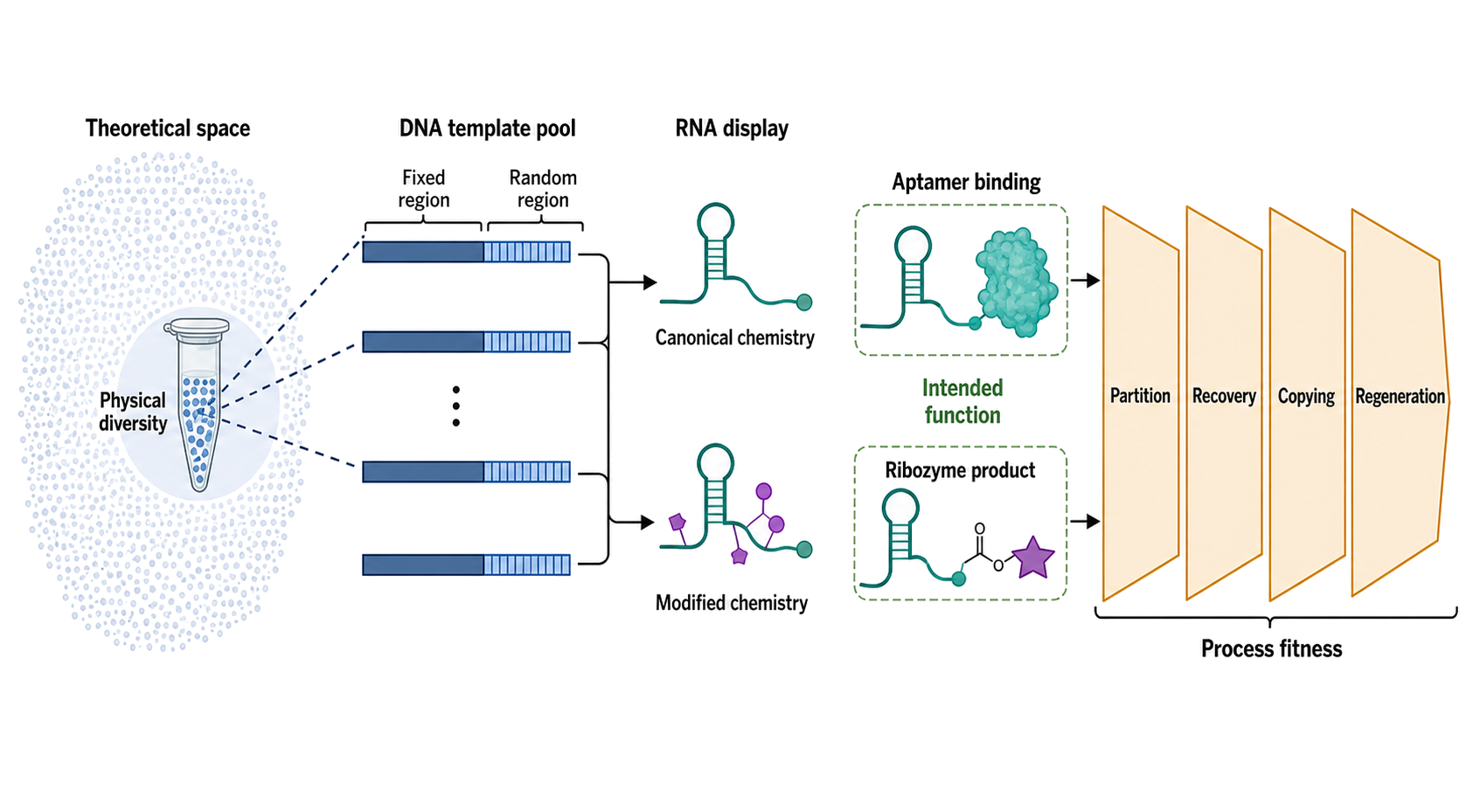
Figure 137.1. Library architecture, genotype–phenotype linkage, and workflow fitness. A physical library is smaller and more biased than its theoretical sequence space. Each sequence displays a folded or catalytic phenotype, but its cycle fitness multiplies desired function by partition, recovery, copying, and regeneration. An aptamer and covalent-product ribozyme illustrate two forms of genotype–phenotype linkage.
Table 137.1 compares fully random, scaffolded, doped, genomic-fragment, and chemically expanded libraries.
Table 137.1. Library architectures and the search spaces they create. Library architecture changes accessible folds, physical coverage, copying burden, and the claims that selection can support.
| Library architecture | Principal question | Strength | Main excluded space | Required quality control | Characteristic risk |
|---|---|---|---|---|---|
| Fully random canonical RNA | Which folds or catalysts can arise without a prescribed scaffold? | Broad architectural novelty and RNA-like chemistry | Most theoretical sequences remain physically unsampled | Full-length RNA, promoter output, input composition, RT compatibility | Rare functional molecules lost amid huge undersampling |
| Fully random DNA | Which stable single-stranded DNA folds bind or react? | Direct PCR inheritance and chemical stability | RNA-specific sugar chemistry and folds | ssDNA fraction, complementary-strand carryover, size and composition | Convenient DNA hit assumed to transfer to RNA |
| Scaffolded library | Which loop, junction, or pocket variants improve a known framework? | Efficient local search and easier family analysis | Architectures incompatible with scaffold | Scaffold integrity, variable-position distribution, fixed-region folding | Scaffold or primer dominates function |
| Doped family library | Which local mutations improve or diversify an existing molecule? | Dense fitness-neighborhood sampling | Distant sequence solutions | Position-specific doping rates and parent carryover | Excess parent or mutation rate hides epistasis |
| Genomic-fragment library | Which natural sequence fragments possess selected function? | Connects selection to organismal sequence repertoire | Non-genomic and rearranged solutions | Fragment boundaries, strand, length, transcript representation | Abundant genomic fragments dominate starting counts |
| Modified-nucleotide library | Which expanded chemical groups improve recognition or catalysis? | Protein-like hydrophobic or reactive functionality and stability | Chemistries incompatible with synthesis or copying | Modification occupancy, polymerase fidelity, regeneration, product identity | Genotype reproduced but phenotype chemistry not faithfully reinstalled |
Library quality has a boundary with later statistics. Replicates and randomization cannot restore sequence classes absent from the synthesized input. Conversely, a biased input is not automatically unusable if the bias is measured and the scientific claim is restricted to the searched population. General experimental-design standards belong to Chapter 139; this chapter owns the molecular definition and quality control of the selectable population.
137.2. Target presentation, partitioning, wash stringency, and counterselection
Selection requires a physical event that separates survivors from the rest of the library. For an aptamer, that event is usually retention with a target-containing fraction. The target must first be defined as a molecular state: purified monomer or oligomer, active or inactive conformation, ligand-bound or apo form, glycosylated or unglycosylated protein, isolated domain or full-length membrane protein, soluble analyte or surface-presented receptor. “An aptamer to protein X” is underspecified when the protein changes conformation, oligomerization, modification, or accessibility across preparations. Selection will faithfully optimize recognition of the state that is actually presented, even if that state is biologically irrelevant.
Immobilization makes partitioning convenient and creates new selectable surfaces. A target can be adsorbed to nitrocellulose, coupled to agarose or magnetic beads, captured through biotin–streptavidin, displayed through a histidine tag, or attached to a sensor. Coupling may block an epitope, orient molecules heterogeneously, raise local density, partially unfold the target, or create avidity not present in solution. The library can bind the bead, linker, tag, blocking reagent, damaged target, or neighboring target molecules. Blank-support selection and selection against the isolated tag are therefore necessary controls, but they cannot fully restore the unimmobilized state. Whenever possible, final candidates should be tested against target in solution or on a biologically relevant surface.
The running protein-target campaign begins by comparing active and inactive conformations using an independent activity assay. The active state is captured through a tag placed away from the desired epitope. Before positive selection, the RNA pool is passed over blank beads, tag-loaded beads, and beads carrying the inactive conformation. These depletion steps reduce obvious support and state-independent binders. They also create a risk: a rare ligand that weakly contacts the tag but strongly recognizes the desired active-state epitope may be discarded. Counterselection should therefore be strong enough to remove dominant alternatives but not treated as a logically perfect filter.
Partition methods create different relationships between affinity, kinetics, and survival. Nitrocellulose filtration retains many protein–nucleic-acid complexes while free nucleic acid passes through, but membrane binding and complex dissociation during filtration affect recovery. Affinity beads permit extensive washing and automation, but target density and rebinding can make weak binders appear persistent. Capillary electrophoresis separates complexes from free oligonucleotide in solution with few cycles and low input, yet requires a detectable mobility difference and precise collection. Microfluidic free-solution and magnetic systems can control flow, washing, and small volumes. Particle display links clonally amplified sequences to beads and permits fluorescence-activated sorting by target binding and specificity. Each method measures survival through its own time, transport, surface, and detection window.
Target concentration sets an important thermodynamic pressure. At equilibrium, a lower free target concentration favors molecules with lower dissociation constants, but only if the system approaches equilibrium, the target is active, nonspecific loss is controlled, and retained complexes remain bound during partition. Very high target concentration allows many weak binders to survive. Extremely low target concentration can make capture stochastic and can favor sequences present in more starting copies. The retained fraction should be quantified rather than inferred from a planned concentration. When target depletion by the library is non-negligible, the usual assumption that free target equals added target fails.
Incubation and washing add kinetic selection. Short association times can favor fast k_on; prolonged competitor challenge or washing can favor slow k_off. On a dense surface, dissociated molecules may rebind nearby targets, producing apparent residence time through avidity or transport rather than one-site kinetics. A “slow off-rate” campaign must suppress rebinding and define the competitor and time window. Equilibrium affinity, association rate, dissociation rate, and surface retention are related but distinct phenotypes. A stringency schedule should name which one it intends to improve.
Stringency is multidimensional. It can be increased by lowering target concentration, reducing incubation time, lengthening washes, increasing wash volume or flow, adding nonspecific nucleic acid or protein competitors, raising salt, changing pH or temperature, adding serum, including target homologs, or demanding survival through another compartment. Changing several dimensions simultaneously makes the cause of enrichment difficult to interpret. Early rounds often use permissive conditions to retain rare functional families; later rounds can progressively introduce the final matrix and discriminating targets. The schedule should be driven by retained fraction and population behavior, not by a universal round number.
Negative selection and counterselection require explicit objects. A blank support removes support binders. A close homolog tests molecular specificity. An inactive conformer tests state selectivity. Cells lacking a receptor can deplete lineage, membrane, or uptake binders shared with positive cells. Serum or tissue extract can remove sticky sequences, but it can also sequester promising candidates nonspecifically. Counterselection can be alternated with positive selection, performed before every round, or introduced late. If introduced only after a family dominates, there may be too little remaining diversity to discover a specific alternative.
Figure 137.2 shows how target state, presentation, partition physics, and counterselection define the phenotype that survives.
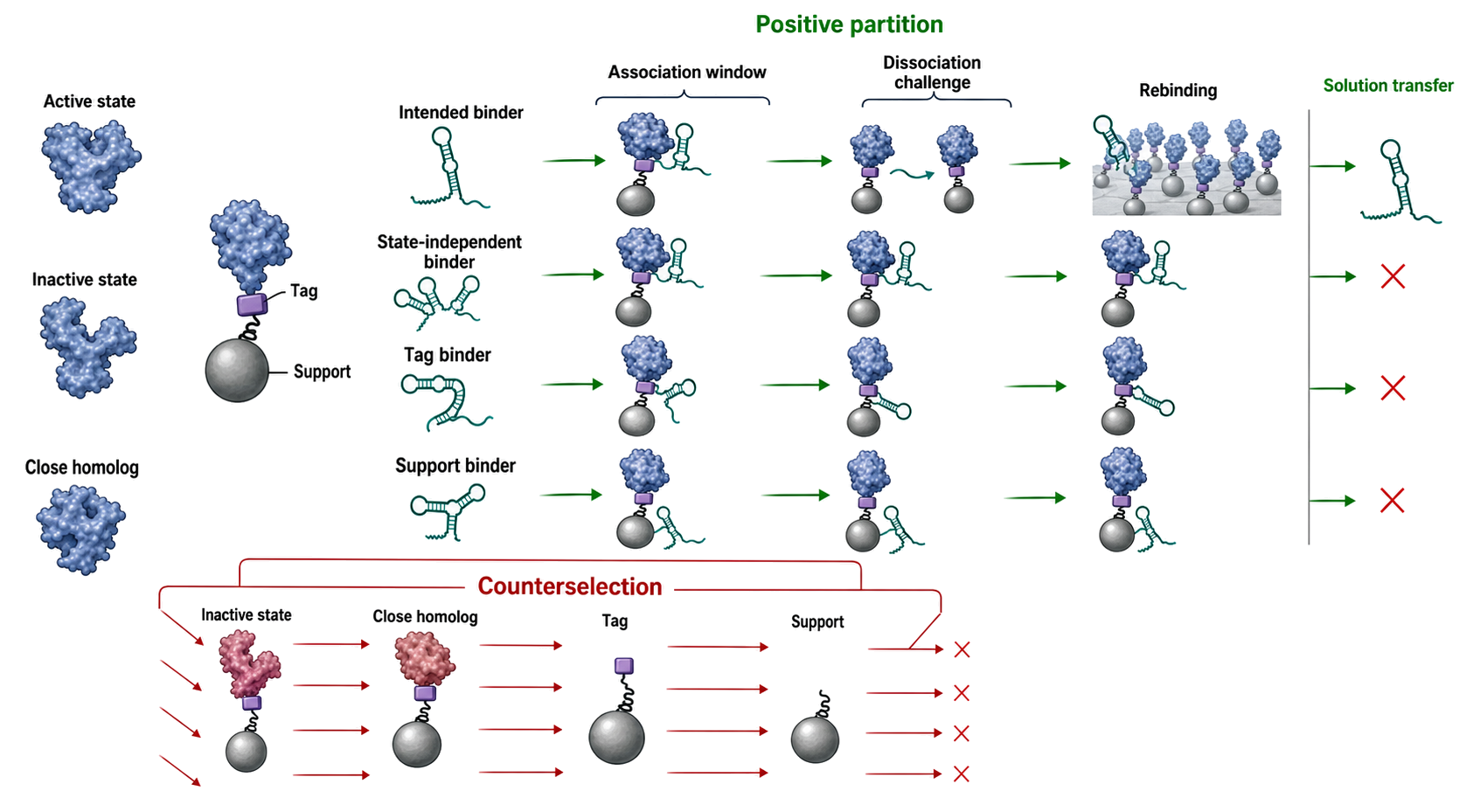
Figure 137.2. Target state, presentation, partition, and counterselection define survival. Selection sees a presented molecular state, not a target name. Positive partition retains intended binders together with support-, tag-, and state-independent binders. Matched counterselection and solution validation remove different alternatives, while target concentration and timed washing change thermodynamic and kinetic pressure.
Table 137.2 compares membrane, bead, capillary-electrophoresis, microfluidic, particle-display, cell, and product-capture partitions by immediate signal and artifact.
Table 137.2. Partition methods and their immediate selection phenotypes. Partition technologies differ in what they retain and in the artifacts that couple molecular function to survival.
| Partition method | Immediate survivor | Main controllable pressure | Strength | Dominant artifact | Essential control |
|---|---|---|---|---|---|
| Nitrocellulose filtration | Nucleic acid retained with a protein-associated fraction | Target concentration, filtration time, wash | Rapid classical protein–aptamer separation | Membrane binding and complex dissociation during filtration | No-target membrane retention and solution competition |
| Affinity or magnetic beads | Molecule remaining on target-bearing beads | Target density, wash volume/time, competitor | Automation, repeated washing, small samples | Support/tag binding, rebinding, avidity, target orientation | Blank bead, tag-only bead, density series, untagged target transfer |
| Capillary electrophoresis | Collected mobility-resolved complex | Incubation and collection window | Free-solution selection with few rounds | Inadequate mobility separation, collection error, complex dissociation | Target-free mobility and independently measured recovery |
| Microfluidic selection | Molecule routed by controlled flow or magnetic/fluorescent signal | Flow, timing, target amount, threshold | Quantitative control, low sample, rapid cycles | Device adsorption, transport, threshold bias | Device blank and recovery calibration |
| Particle display and sorting | Clonal particle above fluorescence and specificity gates | Target and countertarget concentration, sorting gate | Quantitative clone-level screening | Multivalent particle avidity and display heterogeneity | Monovalent validation and countertarget channel |
| Whole-cell partition | Molecule associated with positive versus negative cells | Cell state, wash, temperature, negative cell | Native membrane presentation without known target | Dead-cell, membrane, uptake, or lineage-state binding | Isogenic negative/rescue cells, viability, target deconvolution |
| Catalytic product capture | Genotype linked to recoverable product state | Reaction time, substrate, cofactor, capture threshold | Direct evolution of chemical function | Spontaneous product, handle exposure, substrate binding, linkage escape | Synthetic product, inactive mutant, no-cofactor and no-substrate controls |
Catalytic selection replaces reversible binding with product formation, but still needs a partition. In the ribozyme running example, each RNA carries a substrate that acquires a capture handle only after ligation. Product molecules bind an affinity matrix and unreacted molecules wash away. The design couples genotype to product intramolecularly, preserving the sequence that performed the reaction. Controls include substrate lacking the reactive group, a catalytically inactive scaffold, no-cofactor reactions, quenched reactions, and a synthetic product standard. If the unreacted substrate itself sticks to the matrix, or if a damaged substrate exposes the handle, the partition no longer uniquely reports catalysis.
Partition efficiency limits both sensitivity and false enrichment. Suppose one in 10^12 input molecules is functional, the reaction converts half of that lineage, and background capture retains one in 10^6 inactive molecules. Background survivors then vastly outnumber the true lineage even though the functional molecule is excellent. Multiple rounds can still enrich it if the survival ratio is favorable and the lineage is not lost, but recovery and amplification operate on a background-heavy pool. Quantifying positive-control recovery and negative-control carryover makes the selection coefficient experimentally visible.
The main evidence from a selection round is therefore operational: a specified fraction survived a specified partition under specified conditions. It is not yet evidence for a dissociation constant, a native epitope, or a chemical rate constant. Those quantities require independent validation in Section 137.5.
137.3. Recovery, amplification, mutagenesis, and cycle design
After partitioning, selected molecules must be recovered without changing which genotypes are represented. Recovery may involve heat or competitive elution, salt or pH change, proteolysis, target denaturation, organic extraction, direct reverse transcription on beads, cleavage of a linker, or release of a product tag. Harsh release can damage RNA or introduce sequence-dependent recovery. Gentle release may leave the tightest binders behind. For cell and tissue selections, recovery additionally requires separating surface-bound, internalized, extracellular, and degraded material. The recovery method is a second partition and should have positive controls, yield measurements, and carryover blanks.
RNA selection usually traverses an information cycle: selected RNA is reverse-transcribed to complementary DNA, amplified by PCR, transcribed back to RNA, purified, and refolded. Each step has a different sequence preference. Stable hairpins, pseudoknots, modified residues, damaged bases, and long products can impede reverse transcriptase. Primer binding may be blocked by folding. Polymerases differ in processivity and modification tolerance. PCR favors templates with efficient primer annealing, accessible structures, moderate length, and amplification-compatible composition. Transcription depends on promoter context and can produce abortive, heterogeneous, or prematurely terminated RNAs. Lucas et al. (2023) showed that reverse-transcription conditions can generate substantial and structured-library-dependent amplification bias, reinforcing that the copying system must be benchmarked against the selected molecule class.
DNA selection avoids transcription and reverse transcription but still must regenerate single-stranded DNA. Strategies include asymmetric PCR, strand-selective enzymatic digestion, biotinylated-strand capture and denaturation, size-asymmetric strands separated by electrophoresis, or specialized amplification. Each can leave complementary-strand contamination, truncate products, or recover strands unequally. Double-stranded carryover changes folding and partitioning. A strand-generation assay should measure the fraction, length, and integrity of the intended single strand rather than assuming that PCR product automatically becomes selectable DNA.
PCR is most faithful during its exponential phase. When primers or reagents become limiting, products reanneal, heteroduplexes accumulate, and composition-dependent plateau behavior increases. Overcycling can produce shorter deletion parasites that retain primer sites, primer dimers, chimeras from incomplete extension and template switching, or high-yield sequences unrelated to target binding. The minimum cycle number that yields enough material for the next step should be established for each round. Splitting a recovered pool into parallel low-cycle reactions and combining them can reduce jackpot effects; emulsion PCR or other compartmentalized amplification can limit competition among templates, although it introduces its own droplet and recovery biases.
Box 137.2 explains why population enrichment is a composite phenotype rather than a direct binding measurement.
Box 137.2. Enrichment Is the Product of More Than Binding
Enrichment is the product of more than binding
For sequence
i, expected next-round abundance depends on starting copies, partition survival, recovery, reverse transcription or strand generation, PCR, transcription, transfer, and sampling. A high-affinity RNA can decline if it is rare or copies poorly. A weak binder can rise if it sticks to the support or amplifies rapidly. Sequence the selected and flow-through fractions, benchmark defined mixtures through copying, use target-free controls, and resynthesize candidates. Report enrichment as workflow fitness until direct molecular assays identify the contributing property.
Bottlenecks convert small technical losses into evolutionary events. If ten copies of a promising lineage remain after partitioning and only one enters reverse transcription, its next-round representation depends on one molecule. A lineage can disappear even when its average survival exceeds that of competitors. Wang et al. (2022) formalized capture and loss probabilities in stochastic SELEX models, emphasizing that target amount, library size, sampling, and cycle count interact. Early rounds with rare functional sequences are especially vulnerable. Excessively stringent capture, aggressive washing, small elution volumes, incomplete transfer, and subsampling for amplification can all reduce the effective population below the nominal molecule count.
Genetic drift is not always visible from total yield. A recovered pool may contain many molecules but few surviving lineages if one sequence has undergone a PCR jackpot. Technical replicates that split before partitioning test the entire cycle; splits made only before sequencing test library preparation and sequencing but not evolutionary repeatability. Independent replicate selections commonly converge on different sequences or even different structures because the starting physical samples and early stochastic events differ. Repeated recovery of the same family strengthens evidence that the landscape contains a robust solution, but divergent solutions are not automatically failures.
Mutation can enter unintentionally through synthesis and polymerase error or intentionally through error-prone PCR, doped resynthesis, mutagenic polymerases, recombination, or family shuffling. Exploration is useful after a functional family appears because local variants can improve affinity, specificity, rate, or robustness. It can also destroy rare solutions or let an amplification-optimized parasite invade. Mutation rate should be matched to the information already present: high mutation early broadens search but weakens inheritance; low mutation late permits fine-scale optimization. Recombination can join beneficial modules but breaks long-range epistatic interactions and may create PCR chimeras that look like natural lineages.
In the catalytic-ribozyme campaign, early rounds allow longer reaction times so weak ligases can produce enough tagged product to survive. Later rounds shorten the reaction, lower substrate concentration, change magnesium, and add competing substrate analogs. Once a ligase family is detected, a doped library explores its neighborhood while retaining the core. This is directed evolution rather than simple enrichment. A sequence that reacts quickly only at unrealistically high magnesium may be useful for mechanistic study but not for physiological engineering; changing the ionic environment can deliberately select another part of the landscape. Catalytic mechanism itself belongs to Chapter 9.
A cycle can stop for several reasons. The retained fraction may plateau; families may converge; sequence diversity may collapse; negative-control recovery may rise; target-specific signal may no longer improve; or individual resynthesized candidates may already meet the intended performance. Continuing past convergence can replace a high-function family with a faster-amplifying derivative or erase useful minority families. Conversely, stopping solely because a dominant sequence appears can miss later-emerging rare lineages. Archiving input, flow-through, wash, selected, amplified, and regenerated material from every round supports retrospective diagnosis.
Figure 137.3 follows desired and parasitic lineages through partition, recovery, copying, bottleneck, mutation, and the next cycle.
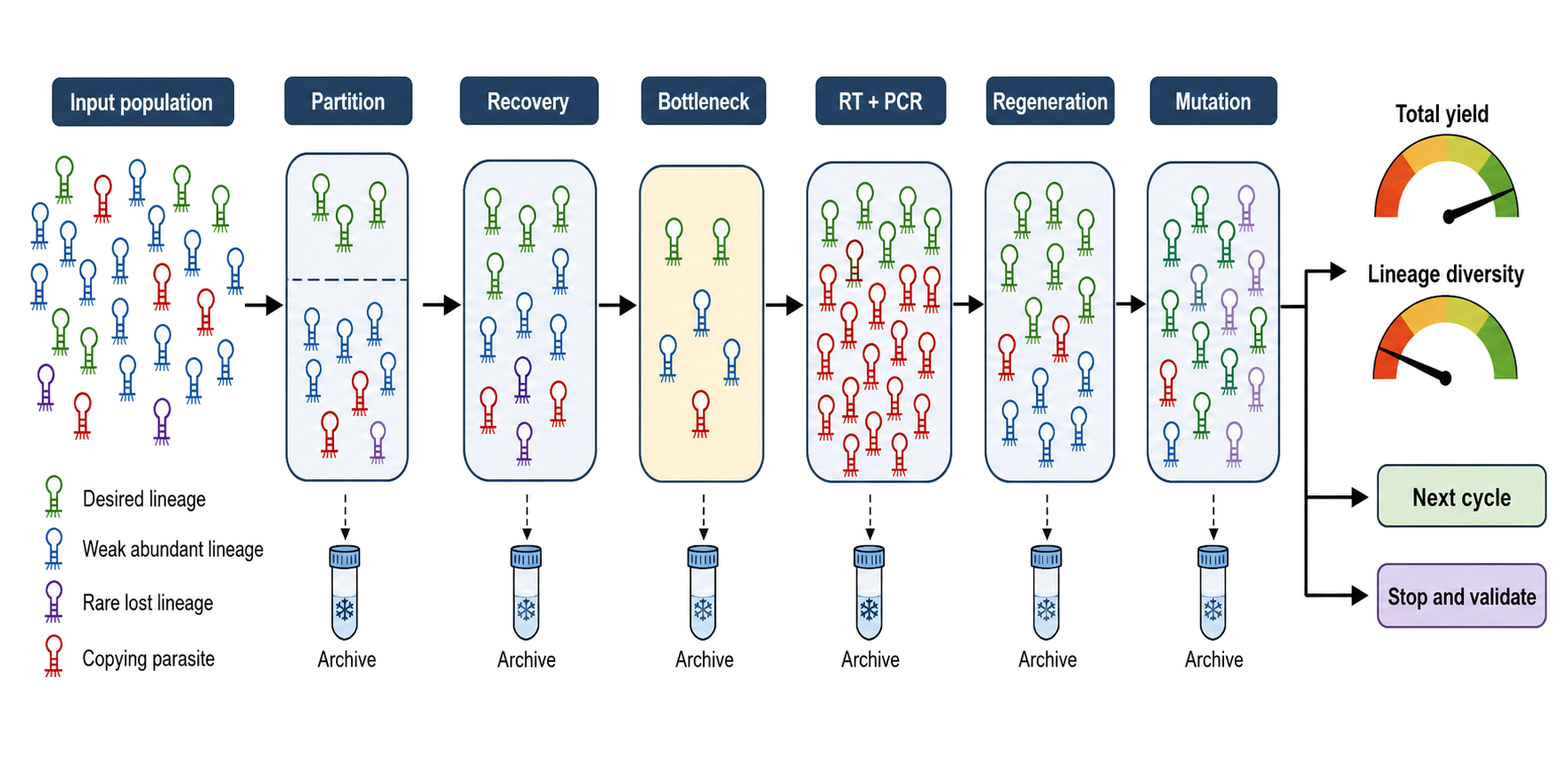
Figure 137.3. Population dynamics through one selection cycle. Partition enriches desired function imperfectly; recovery and bottlenecks remove molecules stochastically; reverse transcription, PCR, and transcription alter frequencies; mutation creates neighbors; and the next round inherits the transformed population. Total yield can remain high while lineage diversity collapses.
Table 137.3 relates cycle-design levers to the pressure they impose, the measurement needed, and the failure mode created by excess pressure.
Table 137.3. Cycle-design levers, intended pressures, and failure modes. Each cycle lever should have an intended molecular pressure, an observed measurement, and a limit beyond which it promotes stochastic loss or artifacts.
| Cycle lever | Intended pressure | Measurement | Excessive-pressure failure | Corrective design |
|---|---|---|---|---|
| Lower target concentration | Favor lower equilibrium K_D |
Retained fraction and candidate affinity | Rare families lost below capture probability | Stepwise decrease guided by recovery and diversity |
| Shorter association | Favor faster k_on |
Time-resolved capture | High-copy weak binders dominate stochastic encounters | Normalize input and test association kinetics directly |
| Longer competitor challenge | Favor slower k_off |
Retention versus challenge time | Surface rebinding mimics slow dissociation | Soluble competitor, low target density, flow control |
| Stronger counterselection | Remove support, homolog, or state-independent binders | Negative-fraction counts | Desired families with weak shared contacts discarded | Stage introduction and monitor family-specific depletion |
| Fewer PCR cycles | Reduce plateau and chimera bias | Product yield and defined-mixture distortion | Insufficient material for next step | Parallel low-cycle reactions and improved recovery |
| Deliberate mutagenesis | Explore local neighborhood | Mutation spectrum and family performance | Functional core destroyed or parasites invade | Tune error rate and preserve unmutated archive |
| Shorter catalytic reaction | Favor faster product formation | Product fraction versus time | Slow rare catalysts vanish | Progressive schedule with positive-control recovery |
| Stop selection | Preserve useful families before artifact sweep | Control enrichment, diversity, resynthesized function | Premature stop misses rare families; late stop loses them | Prespecified multimetric stopping rule |
The boundary with pooled genetic screens is the phenotype carrier. In SELEX and ribozyme selection, the nucleic-acid molecule itself usually binds or reacts and carries its genotype. Pooled CRISPR, RNA interference, reporter, and Perturb-seq screens link an encoded perturbation to a cellular phenotype through barcodes or sequencing; their screen design and causal interpretation belong to Chapter 136.
137.4. High-throughput sequencing, enrichment, convergence, and fitness landscapes
High-throughput sequencing (HTS) samples the evolving population rather than waiting for a few final-round clones. The most informative design sequences the input library, early rounds, intermediate rounds, final rounds, negative-selection outputs, and selected-versus-flow-through fractions. Exact molecules need not be sequenced exhaustively for the time series to reveal large changes, but depth, subsampling, and library preparation determine which low-frequency lineages are visible. Schütze et al. (2011) showed that round-by-round sequencing can expose early enrichment and amplification-associated artifacts that final cloning misses; Cho et al. (2010) coupled quantitative microfluidic selection with HTS to connect partition behavior and sequence recovery.
Counts require denominators. A sequence with 100 reads in round five may have enriched from one read, declined from 10,000 reads, or appeared through sequencing error. Frequency within a round, fold change between rounds, selected-to-input ratio within a partition, and replicate consistency answer different questions. Pseudocount choices dominate fold changes for rare sequences. Because the same material often passes through PCR before sequencing, observed counts are molecule counts only approximately. Unique molecular identifiers can identify some duplicate families if added before amplification, but they do not correct sequence-dependent loss before tagging.
Enrichment is evidence that a lineage reproduced under the workflow. It does not specify which component supplied the advantage. A sequence can bind the support, evade nuclease, reverse-transcribe efficiently, amplify rapidly, transcribe at high yield, or fold quickly after regeneration. Neutral or control selections that omit the target can reveal lineages enriched by the process itself. Sequencing the initial library and target-free cycles can identify fixed-region motifs, short deletions, and base-composition trends that reflect synthesis and amplification. The relevant comparison is not simply “round zero versus round ten,” but the smallest set of fractions that separates selection survival from copying.
Exact-sequence ranking can fragment a biological family. Mutations, sequencing errors, recombination, and multiple solutions produce neighborhoods rather than isolated winners. Family clustering can use edit distance, shared motifs, k-mer composition, predicted structure, covariance, or experimentally supported secondary structure. Each method has failure modes. A tight edit-distance threshold splits a diversified family; a loose threshold merges convergent motifs from unrelated folds. Sequence similarity can miss structurally homologous solutions, while predicted structural similarity can be dominated by inaccurate folding assumptions. Cluster definitions and representative choices should be versioned and tested for robustness.
Motif emergence can be more informative than final abundance. A short sequence element that rises across many backgrounds may form a target-contact loop, catalytic residue arrangement, primer-interaction artifact, or copying motif. AptaTRACE and related methods analyze changes in sequence–structure contexts across rounds rather than only counts of final sequences. Covariation within a family can support base pairs, but enrichment-generated phylogenies are shallow and share amplification history. Structure probing and compensatory mutations are stronger tests of the proposed fold.
Convergence is not synonymous with success. A population can converge because stringency found a narrow functional optimum, because a PCR parasite swept the pool, because the physical bottleneck removed alternatives, or because a support-binding family exploited the partition. Useful minority families may remain below the dominant sequence. Diversity metrics such as unique-sequence count, Shannon entropy, family entropy, and pairwise distance summarize aspects of convergence, but all depend on sampling depth and error correction. A stopping rule should combine diversity with control enrichment and resynthesized function.
The protein-aptamer time series illustrates the distinction. One family rises immediately in positive and blank-bead fractions; it is a support binder despite high final abundance. A second family increases only after inactive-conformer counterselection and is reproducible across independent campaigns. A third remains rare but shows a motif across many sequence variants and strong selected-to-flow-through enrichment. Resynthesis may reveal the third as the best active-state ligand. Ranking solely by final reads would choose the artifact.
Fitness landscapes formalize relationships among genotype and cycle performance. An empirical landscape can be built by synthesizing many variants or by measuring a densely sampled mutational neighborhood in selection. Single mutations reveal local slopes; double and higher-order mutants reveal epistasis, in which the effect of one change depends on another. Pitt and Ferré-D’Amaré (2010) developed rapid empirical RNA fitness-landscape construction, and later ribozyme landscapes revealed neutral networks, inaccessible paths, mutational robustness, and frustrated peaks. A landscape measured under one magnesium concentration, temperature, target state, or amplification regime can change under another environment.
Selection fitness is not necessarily molecular fitness of interest. In a catalytic selection, read enrichment may correlate with reaction yield over a fixed time but not with k_cat, K_M, active fraction, or turnover. If product capture saturates once a molecule reacts, a catalyst that reacts once rapidly and a catalyst that turns over many times may receive the same reproductive benefit. If substrate is tethered intramolecularly, the landscape describes cis reaction rather than trans catalysis. Peri et al. (2022) showed environment-dependent changes in a group I ribozyme fitness landscape, underscoring that rank order is conditional.
Figure 137.4 traces sequencing data from exact reads to error-controlled sequences, families, motifs, and a conditional fitness landscape.
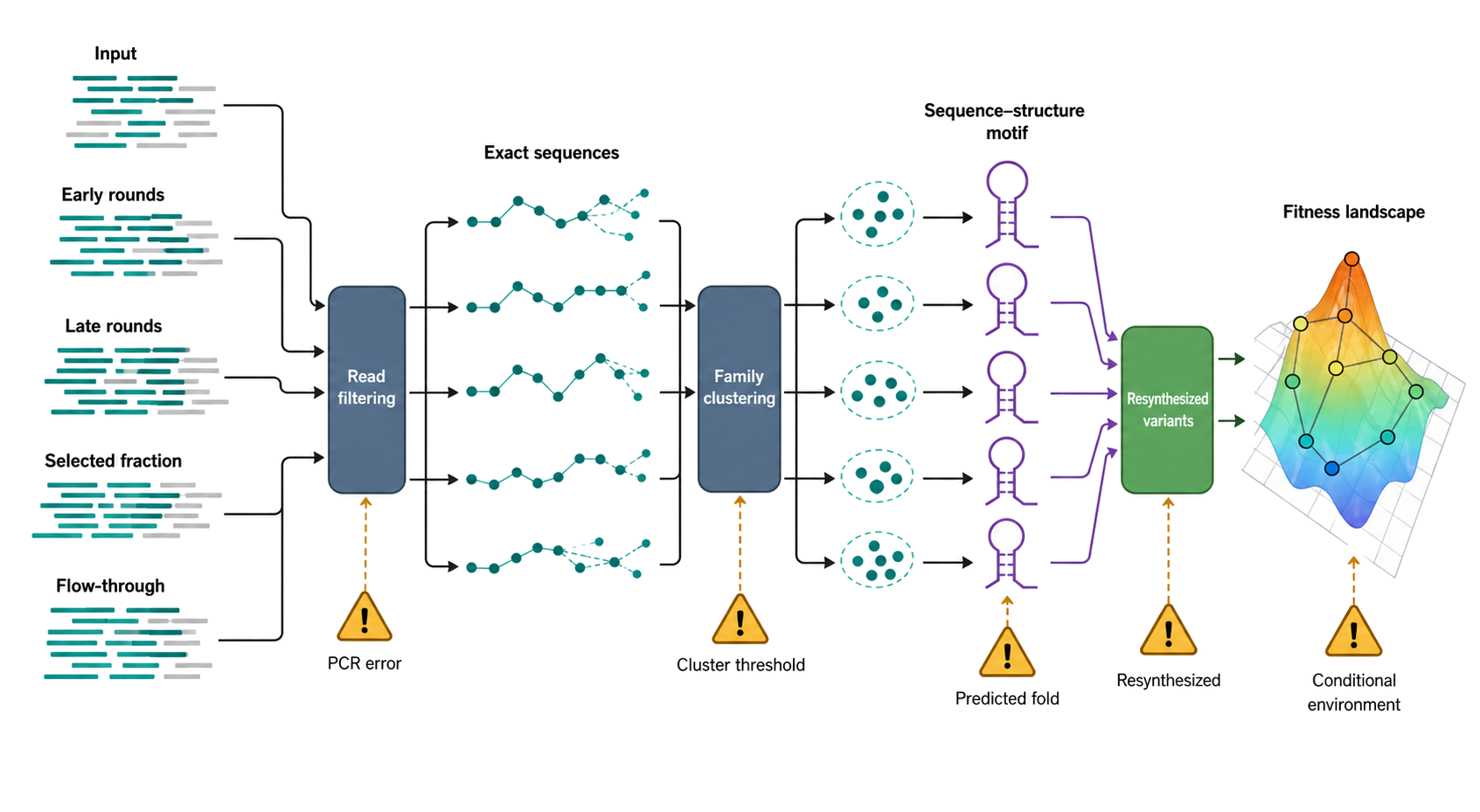
Figure 137.4. From selection reads to families, motifs, and fitness landscapes. Round-resolved reads are filtered and counted, exact sequences are grouped into candidate families, motifs are inferred from recurrent sequence–structure contexts, and selected variants can be resynthesized to build conditional fitness landscapes. Every level introduces assumptions and requires direct functional validation.
Table 137.4 distinguishes abundance, enrichment, family convergence, motif trend, mutational effect, and direct molecular performance.
Table 137.4. Population-analysis outputs and their valid interpretations. HT-SELEX outputs support progressively richer population claims, but none replaces direct candidate validation.
| Output | Calculation or observation | Valid inference | Major confounder | Validation handoff |
|---|---|---|---|---|
| Round frequency | Reads for sequence divided by total reads in one sample | Representation in sequenced post-process pool | Depth, PCR, starting copy, index error | Replicate trajectory and resynthesis |
| Fold enrichment | Frequency ratio across rounds or fractions | Relative workflow reproduction | Rare-count pseudocounts and changing denominator | Selected/flow-through comparison and direct assay |
| Family convergence | Frequency summed across clustered variants | Rise of a sequence neighborhood under cluster model | Threshold splitting/merging and errors | Multiple representative candidates |
| Sequence–structure motif trend | Context frequency change across rounds | Recurrent feature associated with survival | Predicted folding and process motif | Mutations, compensatory rescue, probing |
| Empirical mutational effect | Measured performance of designed variants | Local genotype–phenotype relationship | Assay and environment dependence | Repeat under transfer conditions |
| Fitness landscape | Performance network over many genotypes | Peaks, paths, epistasis, neutral networks | Incomplete sampling and workflow fitness | Molecular property-specific landscape |
Sequencing reproducibility requires ordinary controls and selection-specific ones. Index hopping or barcode misassignment can transfer abundant final-round reads into early rounds. PCR errors can mimic low-frequency mutants. Unequal sequencing depth and batch-specific library preparation distort trajectories. Technical sequencing replicates assess measurement noise; biological selection replicates assess the full evolutionary process. Raw reads, primer-trimming rules, orientation, quality filters, deduplication, cluster parameters, count tables, and code should be deposited. General multiple-testing and statistical standards belong to Chapter 139, while this chapter owns the interpretation of round-resolved population trajectories.
137.5. Affinity, specificity, catalytic function, and orthogonal validation
A candidate becomes scientific evidence only after it is removed from the evolving pool and tested as an individual molecule. Resynthesis breaks the candidate’s association with neighboring sequences, pooled competitors, shared amplification products, and accidental contaminants. The candidate should be prepared in the same chemical form intended for use, and identity and purity should be checked. Full selected fixed regions, truncated variants, and the minimal proposed core should be compared. A scrambled sequence, disruptive mutation, and compensatory rescue help distinguish sequence-specific structure from generic polyanion behavior.
Box 137.3 provides a compact resynthesis gate before any affinity or catalytic superlative is used.
Box 137.3. Resynthesize Before You Rank
Resynthesize before you rank
Prepare each candidate independently in the claimed DNA, RNA, modified, or stereochemical form. Confirm length, purity, concentration, and terminal chemistry. Test the full selected construct, proposed truncation, disruptive mutant, and when informative a compensatory rescue. Reproduce folding conditions and compare with the final intended matrix. A sequence that is abundant in a pool but inactive after independent preparation is evidence about the selection workflow, not a validated high-performance molecule.
Equilibrium affinity is commonly summarized by the dissociation constant K_D, but the value is meaningful only for a defined binding model and active concentrations. If target T and aptamer A form a one-to-one complex, K_D = [T][A]/[TA] at equilibrium. Many selected systems violate the simple model through target oligomerization, aptamer dimerization, multiple sites, conformational heterogeneity, depletion, or nonspecific adsorption. An apparently subnanomolar fit can result when the active target concentration is overestimated or when a multivalent surface creates avidity. The fitted model, concentration range, replicates, residuals, and active-fraction assumptions should accompany the number.
Direct methods observe different properties. Fluorescence anisotropy or polarization can report complex-dependent rotational change but requires a fluorophore that may alter binding. Electrophoretic mobility shift assays separate complexes but can perturb equilibrium during electrophoresis. Nitrocellulose filtration inherits membrane-retention artifacts from some selections. Surface plasmon resonance and biolayer interferometry provide association and dissociation traces but immobilize one partner and can be transport- or rebinding-limited. Microscale thermophoresis measures movement in a temperature gradient and is sensitive to labeling, aggregation, and buffer composition. Isothermal titration calorimetry provides stoichiometry and thermodynamics but requires more material and sufficient heat. Agreement across solution and surface methods is stronger than repeated measurements with one artifact.
Association and dissociation kinetics can matter more than equilibrium affinity. Two aptamers with the same K_D = k_off/k_on can reach occupancy at different rates and have different residence times. A short selection incubation can favor rapid association; a long competitor challenge can favor slow dissociation. Kinetic measurements should test whether the selected pressure produced the expected change. Sensor density should be varied to detect mass-transport and rebinding effects, and an untagged target in solution should compete if the claimed epitope is native.
Specificity is a matrix, not a single negative control. The protein-target aptamer should be tested against the immobilization tag, support, inactive conformer, close homologs, abundant matrix proteins, unrelated proteins of similar charge, and target variants relevant to use. Selectivity can mean lower K_D, slower dissociation, greater signal at one concentration, or functional discrimination. These claims are not interchangeable. Testing only one unrelated protein does not establish family-wide specificity. Competition with native ligand or epitope mutants can map whether binding occurs at a functionally relevant surface.
Matrix transfer tests whether the folded phenotype survives crowding and competition. Affinity measured in a clean low-salt buffer may disappear in serum, cytosol-like salts, cell-culture medium, tissue extract, or the final formulation. Proteins can bind the nucleic acid nonspecifically; nucleases can reduce active concentration; divalent-ion changes can refold it; and target state can shift. Matrix-spike recovery, serial dilution, competitor panels, and orthogonal target-engagement measurements separate matrix suppression from loss of intrinsic affinity. Translation and pharmacology beyond this gate belong to Chapter 155.
Catalytic validation begins with product identity. A selected ligase may produce the expected phosphodiester bond, another linkage, a branched product, or a covalent adduct created by side chemistry. A cleavage selection may enrich general RNA degradation or substrate hydrolysis. Denaturing gels show mobility but not exact chemistry. Product-end mapping, mass spectrometry, nuclease sensitivity, chemical tests, and appropriate synthetic standards determine what reaction occurred. No-substrate, no-cofactor, inactive-mutant, quenched, and background-time-course controls establish the spontaneous baseline.
The observed first-order rate constant k_obs in a single-turnover experiment combines active fraction and reaction kinetics under specified conditions. An endpoint can look low because most molecules are inactive even if the active subpopulation reacts rapidly; it can look high after long incubation even if the rate is poor. Time courses should resolve the burst amplitude and rate rather than relying on one endpoint. Multiple-turnover assays additionally require product release and repeated substrate binding. A ribozyme selected in cis with tethered substrate may have no useful trans turnover until binding arms, substrate concentration, and product release are redesigned.
Substrate specificity should be tested as deliberately as aptamer specificity. Vary nucleotides around the reaction center, substrate length, competing RNAs, chemical groups, and structured contexts. A selected catalyst can achieve apparent sequence specificity through long binding arms while the catalytic core remains permissive. Conversely, strong binding can inhibit turnover by slowing product release. k_cat, K_M, k_cat/K_M, single-turnover k_obs, product yield, and active fraction describe different stages and should not be collapsed into “activity.” Catalytic mechanism and metal-ion interpretation hand off to Chapter 9.
Orthogonal validation connects function to structure without overclaiming. Structure probing can identify accessible and protected regions; compensatory mutations can test proposed helices; target or substrate mutations can map contacts; and chemical modification interference can identify important groups. High-resolution structure is valuable when available but one static conformation does not measure active fraction or pathway. For aptamers, a structure can reveal a binding pocket but not guarantee specificity in serum. For ribozymes, a fold can support catalytic plausibility but product chemistry and kinetics remain necessary.
Figure 137.5 organizes validation as a ladder from resynthesis and identity through direct molecular performance, orthogonal mechanism, context transfer, and intended-use evidence.
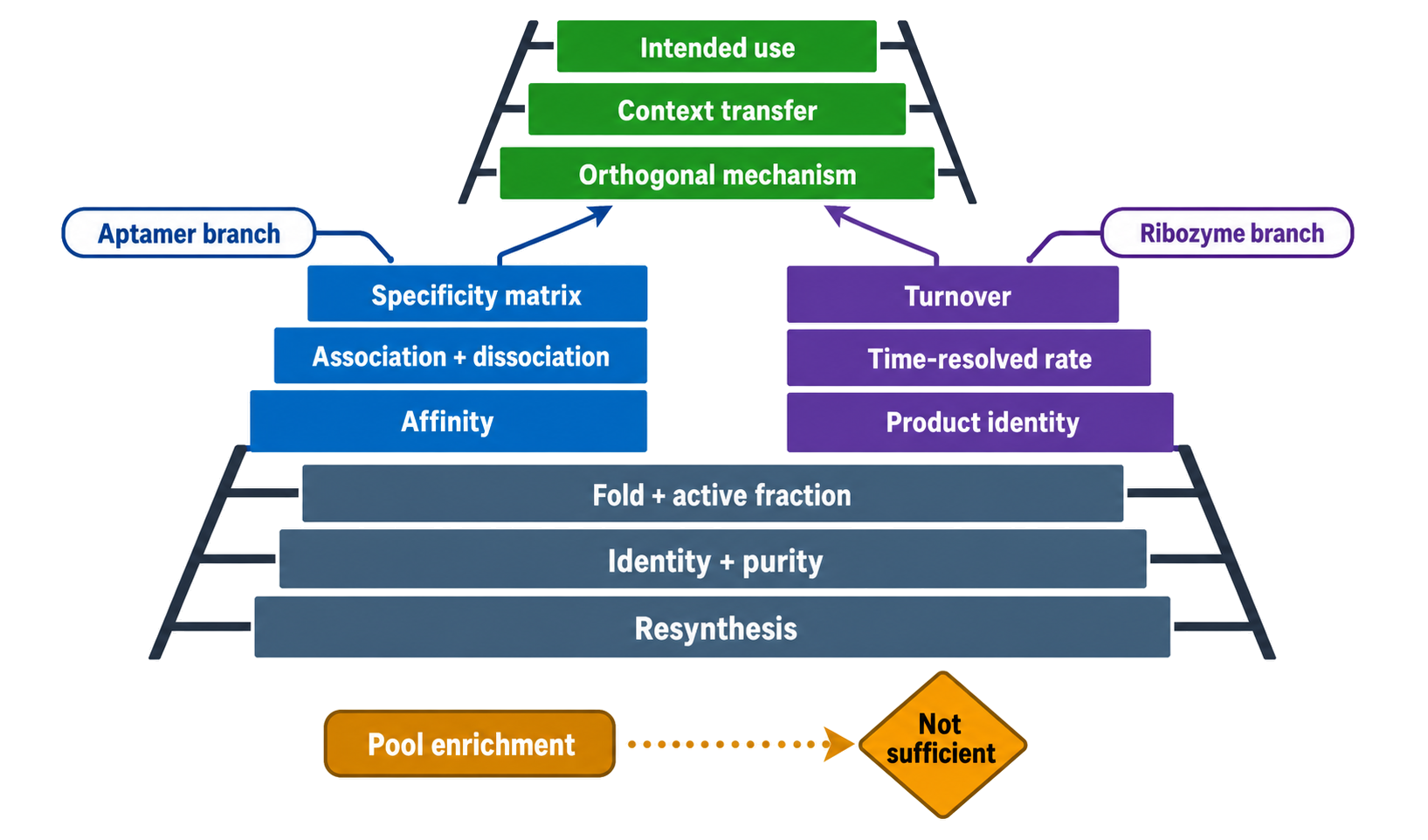
Figure 137.5. Validation ladder for selected aptamers and ribozymes. Aptamer and ribozyme validation share an evidence ladder but use different measurements. Binding requires affinity, kinetics, stoichiometry, and specificity; catalysis requires product identity, time-resolved rate, active fraction, substrate specificity, and turnover. Both require orthogonal assays and context transfer.
Table 137.5 separates aptamer and ribozyme measurements by immediate output, valid inference, and common overinterpretation.
Table 137.5. Candidate measurements, outputs, and overinterpretations. Direct measurements support bounded claims. Assay format, active fraction, surface effects, product identity, and matrix transfer determine the inference.
| Measurement | Immediate output | Supports | Does not by itself establish | Essential boundary control |
|---|---|---|---|---|
| Solution binding titration | Bound fraction versus concentration | Model-conditional equilibrium affinity | Native target engagement or specificity | Active concentration, target depletion, matrix blank |
| Surface sensor kinetics | Association and dissociation traces | Apparent k_on, k_off, residence time |
Solution kinetics when transport/rebinding occurs | Density series and soluble competitor |
| Specificity panel | Binding across targets/states | Defined discrimination matrix | Universal specificity | Homologs, support/tag, abundant matrix components |
| Catalytic time course | Product fraction over time | k_obs, endpoint, active amplitude under model |
Product identity or turnover | Synthetic product and inactive/no-cofactor controls |
| Product chemistry | Mass, termini, linkage-sensitive behavior | Intended or alternative reaction identity | Rate or useful catalysis | Orthogonal chemical and enzymatic tests |
| Multiple-turnover assay | Product per catalyst over time | Catalyst recycling and kinetic parameters | Cellular activity | Product release, substrate depletion, active fraction |
| Context transfer | Performance after changing format or matrix | Boundary and robustness of phenotype | Product readiness | Final chemistry, target state, relevant biological matrix |
The strongest candidate is not always the sequence with the lowest reported K_D or highest endpoint yield. Reproducible synthesis, a large active fraction, specificity, robustness to ionic and matrix changes, compactness, compatibility with chemical stabilization, and absence of support dependence can dominate downstream value. Selection discovers conditional solutions; validation decides which conditionally fit molecules are transferable.
137.6. Aptamer, ribozyme, cell-, tissue-, and in vivo selection variants
Selection variants differ mainly in what molecular event preserves the genotype. Purified-target aptamer SELEX retains reversible complexes. Catalytic selection retains a reaction product. Cell selection recovers molecules associated with a chosen cell population. Internalization selection requires entry into or through a compartment. Tissue and in vivo selections recover sequences from anatomical sites after exposure to biological transport and clearance. Each variant adds desired pressures and additional alternative routes to survival.
Purified-target aptamer selection offers the clearest control over target amount, buffer, competitor, and partition. It is well suited to soluble proteins, small molecules, isolated domains, and defined target states. Small-molecule selection is difficult when binding causes little mass or mobility change and when immobilization occludes much of the ligand. Competitive elution, structure-switching designs, capture-SELEX formats, and solution partition can couple small-molecule recognition to recovery. These constructs can select a switching mechanism rather than binding alone, which is useful for sensors but must be stated. Natural riboswitch aptamer domains provide biological comparisons, not templates that eliminate the need for selection; their mechanisms belong to Chapter 79.
Mirror-image selection is an important stereochemical variant. A conventional D-nucleic-acid library is selected against a chemically synthesized mirror image of the intended target. The winning D sequence is then synthesized as an L-nucleic acid expected to bind the natural D target. The route can yield nuclease-resistant Spiegelmers, but only when the mirror-image target faithfully represents the natural epitope. Large, glycosylated, membrane, or conformationally dynamic targets may not be accessible as mirror-image preparations. Product implications hand off to Chapter 155.
Cell-SELEX presents membrane proteins in a native lipid and glycosylation environment without requiring target purification. Positive cells and closely matched negative cells are incubated with the library, washed, and used to recover bound sequences. Repeated cycles can enrich cell-type-selective aptamers even when the molecular target is unknown. Sefah et al. (2010) formalized widely used Cell-SELEX workflows. The advantage is composite native presentation; the cost is that cell state, passage, confluence, viability, receptor abundance, endocytosis, extracellular matrix, and culture conditions become part of the target definition.
Negative cells should differ by the intended biological feature while matching irrelevant features. An unrelated cell line removes generic cell binders but may also select for lineage differences unrelated to the desired receptor. Isogenic target-knockout and rescue cells provide stronger target-specific contrasts, although knockout can cause compensatory changes. Sorting positive and negative cells by receptor state, using mixed-cell competition, or alternating donors can improve generalization. After selection, target deconvolution may use affinity purification, crosslinking, expression cloning, knockout resistance, competition with antibodies or ligands, and proteomic identification. Cell selectivity without molecular target identity can still be useful for delivery, but mechanism claims must remain bounded.
Internalization SELEX adds a recovery gate intended to distinguish cell-surface binding from uptake. Surface-bound molecules can be stripped with high salt, acid, protease, nuclease, or competitive ligand before internal RNA or DNA is recovered. No stripping method is perfectly compartment-specific. Membrane invaginations, damaged cells, endosomes open to the exterior, and protected surface pockets can survive treatment. Xiao et al. (2008) illustrated cell-specific internalization analysis after whole-cell selection. Imaging with quenching controls, temperature dependence, endocytic perturbation, and subcellular fractionation can strengthen the claim, but uptake still does not establish cytosolic delivery.
Tissue and organ selections occupy a middle ground between purified targets and whole-animal selection. Libraries can be passed over tissue sections, perfused through isolated organs, or incubated with three-dimensional organoids. These formats preserve extracellular matrix and multicellular organization but introduce diffusion, section damage, autofluorescence, abundant structural proteins, and nonspecific trapping. A ligand recovered from diseased tissue may recognize a stromal, vascular, immune, or necrotic feature rather than the nominal disease cell. Parallel healthy tissue, unrelated disease tissue, adjacent regions, and cell-type-resolved localization help define specificity.
In vivo selection administers a library to an animal and recovers sequences from a target organ, tumor, lesion, or cell population. Mi et al. (2010) selected tumor-targeting RNA motifs in vivo, and Cheng et al. (2013) used in vivo selection to identify brain-penetrating aptamers. The selected phenotype combines stability in biological fluids, avoidance of rapid clearance, transport through vascular and tissue barriers, binding or retention, and recoverability. This composite can be exactly what delivery requires. It also means that an enriched sequence is not automatically a high-affinity ligand to a single receptor.
Dose, route, circulation time, perfusion, tissue processing, and normalization define in vivo enrichment. Highly abundant blood sequences can contaminate tissue; vascular retention can masquerade as parenchymal penetration; nuclease-resistant sequences can enrich without tissue specificity; and PCR recovery can favor a small protected fraction. Input library counts, blood and nontarget organs, perfused versus unperfused tissue, spike-in recovery, and histological localization provide denominators. Repeating selection across animals and biological states tests whether a lineage generalizes beyond one host and one early bottleneck.
Ribozyme selection requires the selected RNA to mark its own successful reaction or remain linked to a marked product. Robertson and Joyce (1990) selected an RNA enzyme that cleaved DNA, while Bartel and Szostak (1993) isolated new ribozymes from a large random pool and subsequent ligase selections produced complex, highly active RNA catalysts. Product selection can exploit acquisition or loss of an affinity tag, mobility shift, resistance or sensitivity to an enzyme, primer-extension competence, fluorescence activation, or compartmentalized reporter production. The partition must distinguish chemical reaction from substrate binding, spontaneous background, and damage.
Cis selection makes genotype–phenotype linkage simple because catalyst and substrate reside on the same molecule. It can favor architectures that exploit tethering and high effective substrate concentration. To develop a trans catalyst, the selected core must be separated from substrate, binding arms must be redesigned, and multiple-turnover constraints must be tested. Trans selection can use clonal compartments, droplets, beads, or covalent linkage between catalyst genotype and product. Compartmentalization prevents a product generated by one catalyst from rescuing unrelated genotypes, but droplet occupancy, fusion, leakage, and unequal amplification become selection variables.
Reaction conditions define the catalytic landscape. Metal identity and concentration, pH, temperature, substrate structure, reaction time, and product-capture efficiency can all be scheduled. Early long incubations discover weak catalysts; later short windows select faster chemistry. Counterselection against substrate analogs can improve chemical or sequence specificity. Alternating conditions can favor robustness, whereas continuously changing conditions can prevent any lineage from adapting. Directed evolution of RNA polymerase ribozymes illustrates how repeated redesign of selection pressure can extend a function far beyond the initial weak activity, although mechanism and RNA-world implications belong to Chapter 9.
Figure 137.6 compares the survival event and principal ambiguity in purified-target, cell, internalization, tissue, in vivo, and catalytic selections.
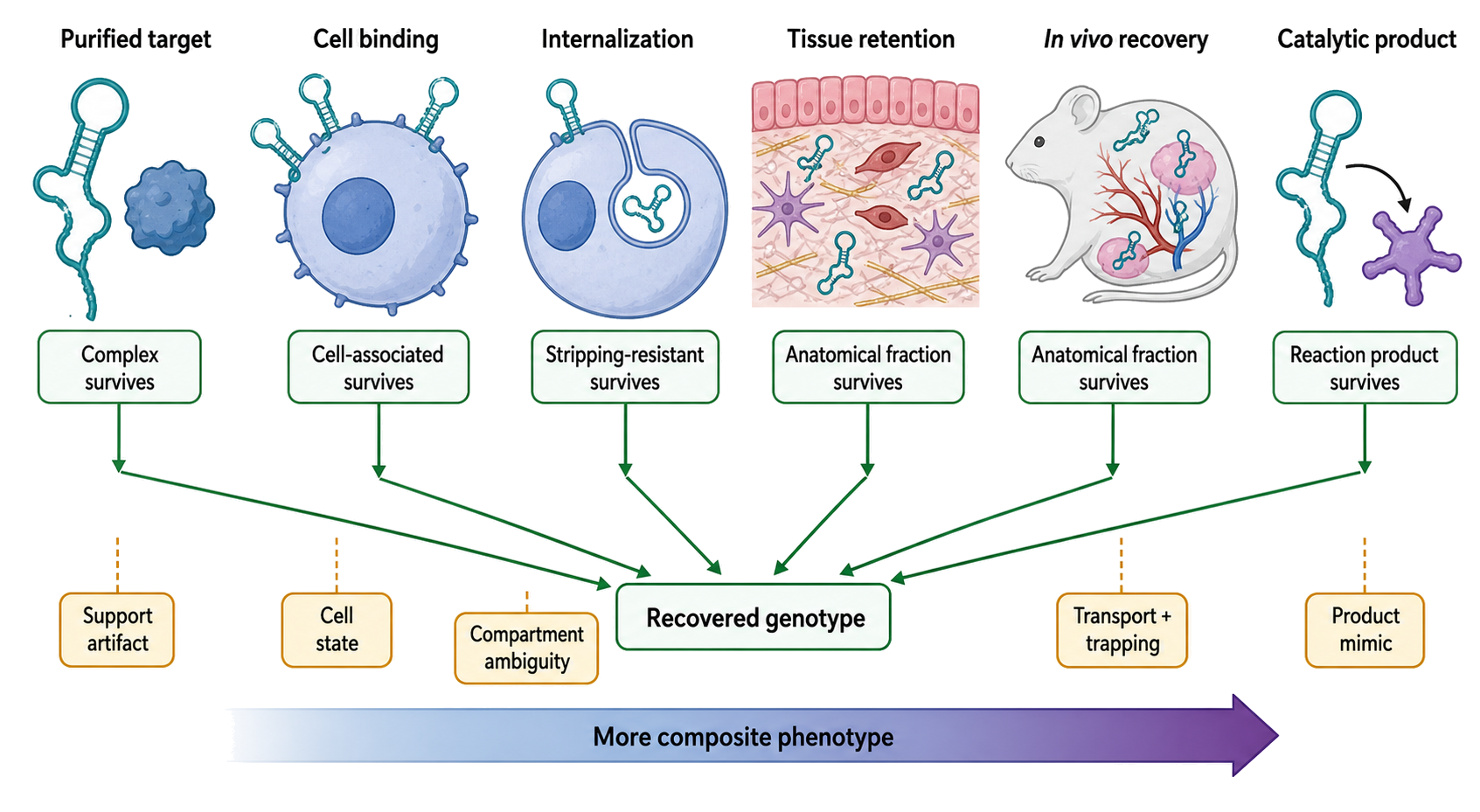
Figure 137.6. Selection variants classified by their survival gate. Purified-target selection retains a complex; internalization selection recovers cell-associated compartments after stripping; tissue and in vivo selection add transport, stability, and recovery; catalytic selection captures a chemical product. The phenotype becomes more application-like and less mechanistically singular from left to right.
Table 137.6 maps selection variants to genotype–phenotype linkage, controls, immediate output, and validation handoff.
Table 137.6. Selection variants, linkage, controls, and validation handoffs. Selection variants gain biological realism by adding more survival gates; controls and validation must expand accordingly.
| Variant | Recovered phenotype | Genotype–phenotype linkage | Essential negative/control | Principal ambiguity | Validation handoff |
|---|---|---|---|---|---|
| Purified-target aptamer | Complex surviving bound–free partition | Aptamer sequence is the binding molecule | Support/tag, inactive state, homolog, untagged solution target | Presentation artifact | Direct affinity, kinetics, specificity, transfer |
| Structure-switching selection | Target-dependent change in capture or reporter state | Sequence carries binding and switching architecture | No-target release, capture-strand controls, analogs | Selected switch may not have strongest binding | Separate binding and switch-performance assays |
| Cell-SELEX | Association with positive versus negative cells | Bound nucleic acid recovered from cell fraction | Isogenic negative/rescue, dead-cell and viability controls | Unknown receptor and cell-state dependence | Target deconvolution and native-cell validation |
| Internalization SELEX | Recovery after surface stripping | Cell-associated nucleic acid surviving stripping | Low-temperature, stripping efficiency, damaged-cell exclusion | Surface protection or endosomal trapping | Imaging, fractionation, cytosolic-delivery assay |
| Tissue/ex vivo selection | Retention in tissue or organ model | Sequence recovered from material or compartment | Healthy/adjacent tissue, perfusion, region control | Matrix, vascular, stromal, or necrotic binding | Cell-type localization and molecular target |
| In vivo selection | Organ/tumor recovery after administration | Sequence recovered from anatomical fraction | Blood, nontarget organs, perfused tissue, replicate animals | Stability, clearance, vascular trapping, recovery | Biodistribution, histology, target deconvolution |
| Ribozyme product selection | Reaction-dependent capture or release | Genotype covalently linked or compartmentally tied to product | Inactive mutant, no-cofactor, no-substrate, synthetic product | Background reaction or linkage escape | Exact product and kinetic validation |
Selection can also be embedded in synthetic systems. Aptamers can be selected for ligand-dependent folding, ribozymes for allosteric control, and RNA devices for reporter output. Once a selected domain is coupled to an expression platform, linker and host context create a new fitness problem. Sensor, circuit, and cell-free design-build-test-learn cycles belong to Chapter 147; this chapter owns how the initial functional molecules are discovered and evolved.
137.7. Selection artifacts, context transfer, reproducibility, and reporting
Artifacts are alternative causal paths from input sequence to recovery. They occur at every stage and often reinforce one another. A support binder is retained, elutes efficiently, reverse-transcribes well, amplifies rapidly, and becomes abundant; its dominance then reduces diversity and makes later counterselection ineffective. A structured high-affinity aptamer binds the intended target but reverse-transcribes poorly and disappears. The final pool is therefore a historical product of all gates, not an unbiased ranking of the starting library’s molecular functions.
Support, linker, tag, blocking reagent, membrane, tube, and target-preparation artifacts should be tested with matched blanks. Target degradation across rounds can shift selection from native protein to fragments or aggregates. Batch changes can create an unplanned alternating target. The target’s activity, oligomeric state, purity, modification, and immobilization density should be measured over the campaign. When cells are used, passage number, receptor abundance, mycoplasma status, viability, dissociation method, and culture state are similarly part of the reagent definition.
Copying artifacts include reverse-transcription stops, PCR base-composition bias, primer competition, heteroduplexes, deletions, chimeras, template switching, transcriptional yield differences, and polymerase errors. Process parasites can be diagnosed by target-free or partition-free cycles, amplification of defined mixtures, cycle-number titration, and comparison of pre- and post-amplification fractions. A deletion that retains primer sites should be removed by size purification, but size selection can also discard real variants if the selected process changes length. Every correction changes the evolutionary environment and should be documented.
Cross-round contamination can mimic spectacular early enrichment. Aerosols containing final-round amplicons, reused workspaces, index misassignment, or sample swaps can place a mature sequence in the input or early round. Physical separation of pre- and post-amplification areas, unidirectional workflow, dedicated reagents, negative controls, unique dual indexes, archived aliquots, and sequence-based contamination checks reduce risk. A dominant exact sequence appearing abruptly in many unrelated campaigns is a warning, especially if it matches a prior library or published aptamer.
Context transfer is a planned stress test, not a final afterthought. Remove the immobilization tag; reverse which partner is surface-bound; move from purified buffer to biological matrix; test monomer and oligomer; vary salt, magnesium, temperature, pH, and competitor; truncate fixed regions; synthesize the final chemical form; and compare target homologs. For cell-selected ligands, test independently sourced cells, primary material, target knockout and rescue, and tissue localization. For ribozymes, transfer from tethered cis substrate to trans substrate and from selection buffer to intended conditions. A function that disappears is not necessarily false—it is conditional—but the boundary must be reported.
Reproducibility has several levels. Technical repeatability asks whether the same pool yields similar partition and measurement results. Independent selection replicates ask whether separate populations and cycles find similar families or functions. Candidate reproducibility asks whether resynthesized molecules perform across preparations, operators, and laboratories. Mechanistic reproducibility asks whether independent methods support the same target, structure, or reaction. Application reproducibility asks whether the phenotype persists in the final matrix or biological context. One level cannot substitute for another.
Round number is not a reproducibility standard. Reports should explain why each cycle changed or stayed constant and why selection stopped. At minimum, report input molecule count and mass, estimated unique diversity, variable and fixed sequences, synthesis and purification, chemical modifications, folding procedure, target identity and state, presentation and density, partition method, incubation, wash, competitors, positive and negative selections, retained fraction, recovery, amplification enzymes and cycle counts, strand regeneration or transcription, mutation, archived samples, sequencing fractions, computational pipeline, candidate choice, resynthesis, validation conditions, and raw data access.
Table 137.7 is a minimum-information checklist for interpretable selection and directed evolution.
Table 137.7. Minimum information for reproducible selection and directed evolution. Reproduction requires the molecular and population definition of every gate, not merely target name, primer sequence, and round count.
| Reporting domain | Minimum information | Why it matters | Common omission |
|---|---|---|---|
| Physical input library | Alphabet and modifications, fixed/random sequence, length, architecture, molecule count, mass, full-length fraction, empirical composition | Defines the searched population | Reporting only 4^N theoretical diversity |
| Target or reaction | Identity, preparation, activity/state, conformation, oligomerization, modification, substrate and product chemistry | Defines the intended phenotype | Target name without molecular state or activity |
| Presentation and partition | Support, tag, linker, density, orientation, device, collection window, product capture | Defines alternative survival routes | Method family named without surface or recovery details |
| Cycle schedule | Target/library concentration, time, temperature, salt, competitor, washes, counterselection, round-specific changes | Defines selection pressure | “Stringency increased” without values or rationale |
| Recovery and population size | Elution/extraction, retained fraction, transfer fraction, bottleneck estimates, archived fractions | Makes loss and background interpretable | Reporting amplified yield instead of selected recovery |
| Copying and regeneration | RT/polymerase, primers, PCR cycles, strand generation or transcription, purification, defined-mixture bias tests | Defines inheritance fitness | Enzyme names without cycle count or regenerated-pool QC |
| Diversification and stopping | Mutation/recombination method and spectrum, stop rule, convergence/control status | Defines directed evolution and endpoint | Fixed round count without performance criterion |
| Sequencing and computation | Fractions and rounds, indexes/UMIs, depth, trimming, quality filters, clustering, motif/structure model, counts, code, accessions | Enables trajectory reanalysis | Only final candidates or motif logo disclosed |
| Candidate disclosure | Full sequence, orientation, fixed regions, chemical/terminal groups, parent/truncation relationship, purity | Defines the molecule being claimed | Sequence name without exact chemistry |
| Validation and transfer | Resynthesis, affinity/kinetic or product/rate model, specificity controls, orthogonal assay, matrix/context transfer | Separates selected fitness from intended molecular performance | Reusing the selection assay as sole validation |
Negative results need denominators. Failure to enrich may reflect absence of a compatible fold, insufficient physical diversity, loss at an early bottleneck, wrong target state, excessive background, copying incompatibility, or an insensitive partition. Failure of a candidate in validation may reflect support dependence, wrong fixed regions, altered chemistry, inactive synthesis, target-batch change, or a genuinely artifactual lineage. Reporting retained fractions, control recovery, amplification behavior, and candidate purity lets readers distinguish these possibilities.
Candidate naming and sequence disclosure matter. A sequence should include alphabet, chemical modifications, 5′ and 3′ groups, fixed-region boundaries, orientation, and whether it is DNA, RNA, or a stereochemical analog. A “minimal aptamer” should be linked to the parent sequence and truncation evidence. A catalytic core should specify substrate arms and product chemistry. Depositing only a motif logo or a final candidate without the round trajectories prevents independent reinterpretation.
Reproducibility also benefits from reporting unsuccessful families and artifacts. A support-binding family can become a reusable negative-control sequence. A PCR parasite reveals vulnerable primer architecture. A candidate that binds purified but not native target maps a presentation boundary. Selection is an exploratory technology, so a transparent failure can be scientifically valuable even when it does not yield a product. Selective publication of only low K_D winners exaggerates general reliability.
The broader statistical questions—randomization, replication, power, multiple testing, batch effects, uncertainty intervals, and prespecification—belong to Chapter 139. The selection-specific obligation is to expose the molecular and population gates to which those principles apply.
Experimental Foundations and Evidence
The founding 1990 studies established two complementary principles. Tuerk and Gold iteratively enriched RNA ligands to bacteriophage T4 DNA polymerase and named SELEX. Ellington and Szostak selected RNA molecules that bound small organic dyes, demonstrating that randomized RNA could form ligand-recognition sites. Robertson and Joyce applied selection to an RNA enzyme, while Bartel and Szostak expanded catalytic discovery from very large random pools. These studies established that folded nucleic-acid phenotypes could remain linked to amplifiable genotypes.
Later technical work made hidden variables measurable. Microfluidic quantitative selection and particle display improved control over partition and specificity. Round-resolved HTS exposed early lineages, amplification artifacts, and multiple families. Modified-nucleotide selections expanded chemical repertoire but made polymerase compatibility and product identity central. Cell and in vivo selections moved the fitness environment toward native presentation and transport while increasing mechanistic ambiguity. Empirical RNA fitness landscapes showed that mutation effects are epistatic and environment dependent rather than additive constants.
The evidence ladder in this chapter follows those experimental layers. Population enrichment supports survival under the workflow. Control fractions identify some alternative routes. Individual resynthesis supports sequence-linked phenotype. Direct biophysics or product chemistry defines the molecular event. Perturbation and structure test mechanism. Context transfer defines where the phenotype persists. Application studies ask whether the selected function changes a biological or technological outcome. Skipping layers produces the common error of treating an enriched sequence as a validated functional molecule.
Biological, Technological, and Engineering Contexts
In vitro selection is a discovery engine rather than a single application class. Aptamers can become affinity reagents, sensors, purification ligands, imaging agents, therapeutics, or targeting components. Catalytic RNAs can become mechanistic models, synthetic regulators, reaction catalysts, or evolutionary probes. Cell and in vivo selections can discover composite recognition and transport phenotypes even before a molecular target is known. Each use imposes a different final matrix, chemical form, performance threshold, and acceptable ambiguity.
Natural riboswitches and ribozymes demonstrate that RNA can recognize metabolites and catalyze phosphodiester chemistry in cells, but laboratory selection explores different sequence priors and pressures. A selected aptamer is not automatically a riboswitch aptamer domain; an allosteric device needs productive coupling to an expression platform. A selected catalyst is not evidence that the same reaction evolved naturally. Natural mechanisms and comparative evolution hand off to Chapter 79 and Chapter 9.
Therapeutic development imposes additional requirements: stability, exposure, target engagement, potency, immunological compatibility, manufacturing, and clinical evidence. These are not solved by selection and belong to Chapter 155. Synthetic circuit integration imposes host burden, dynamic range, leakage, evolutionary stability, and containment, treated in Chapter 147. Keeping these handoffs explicit prevents impressive selection metrics from being mistaken for product readiness.
Comparative Synthesis: Selection as an Engineered Evolutionary System
Every selection can be represented by five linked questions. What physical library entered the experiment? What event linked the intended phenotype to recovery? Which alternative events produced the same recovery? How did copying and bottlenecks change lineage frequencies? What independent assay established the molecular property? The answers differ between a protein aptamer, internalizing ligand, in vivo homing sequence, and ligase ribozyme, but the reasoning structure is the same.
The aptamer and ribozyme examples expose a useful symmetry. For the aptamer, reversible complex formation must be converted into separation; for the ribozyme, chemical product formation must be converted into capture. Both require genotype linkage, background measurement, recovery, unbiased inheritance, and context-matched validation. Affinity and catalytic rate are not identical, but both can be displaced by a workflow advantage. Directed evolution succeeds when the reproductive advantage tracks the property the investigator actually wants.
Recent Consensus
Recent consensus treats SELEX as a quantitatively observable evolutionary process rather than a recipe with a standard number of rounds. Library size should be described as physical molecules and sequence distribution, not only theoretical 4^N space. Target state and presentation must be validated. Counterselection should be matched to plausible alternatives. Retained fraction and copying behavior should be measured. HTS should include early and intermediate populations, and sequence families should be evaluated alongside exact winners. Candidate resynthesis and orthogonal validation are required before affinity, specificity, internalization, or catalysis is claimed.
There is also broad agreement that enrichment can diverge from desired molecular performance. PCR and reverse-transcription bias, support binding, stochastic bottlenecks, and context-dependent folding can dominate. Modified nucleotides expand function only when their display and inheritance are chemically controlled. Cell, tissue, and in vivo selection can discover valuable composite phenotypes but require stronger deconvolution than purified-target selection. Fitness landscapes are conditional on the entire environment, including amplification, not permanent properties of sequences.
Open Questions, Controversies, Deprecated Models, and Common Misconceptions
Open questions:
- How accurately can molecule-resolved barcoding and direct sequencing separate partition fitness from reverse-transcription, PCR, and transcription fitness?
- Which library architectures maximize access to complex folds without sacrificing physical coverage, copying, and interpretability?
- How should selection stringency be adapted algorithmically from retained fraction, lineage diversity, and control enrichment without prematurely losing rare families?
- Can general models predict when a candidate selected on purified protein will transfer to native membrane, tissue, or organismal context?
- Which target-decoding strategies most reliably identify the molecular receptor of cell- and in vivo-selected ligands?
- How should empirical sequence–structure fitness landscapes incorporate kinetic folding, chemical modification, and population bottlenecks?
- Can ribozyme selections be designed so reproductive fitness reports multiple-turnover catalysis rather than one successful cis reaction?
- What minimum-information standard will make independent reanalysis and cross-laboratory replication routine for SELEX campaigns?
Controversies:
- The ideal stopping rule remains context dependent. Early stopping preserves diversity but may leave functional families rare; late stopping improves signal but can promote parasites and erase alternatives.
- Computational structure and machine-learning ranking can prioritize candidates, but their benefit over transparent family and trajectory analysis depends on training data, held-out validation, and compatibility with the selection chemistry.
- Cell or in vivo selection without target identification can be useful for delivery, yet mechanistic and safety interpretation may remain too weak for some applications.
Deprecated or weakened claims:
- A fixed schedule of eight to fifteen rounds is not a universal definition of successful SELEX. Measured enrichment, controls, diversity, and candidate performance are more informative than round count.
- Final-pool cloning alone is inadequate for describing selection dynamics when round-resolved sequencing is feasible.
- A single low fitted
K_Dfrom the same immobilized assay used in selection is insufficient validation of a native-target aptamer.
Common misconceptions:
- “A 60-nucleotide random library contains all 4^60 sequences.” The theoretical space is vastly larger than the physical molecule count; synthesis and process biases reduce effective diversity further.
- “The most abundant final sequence is the best binder.” Final abundance combines starting count, partition survival, recovery, copying, bottlenecks, and sequencing; direct resynthesis and binding measurements are required.
- “More rounds always improve a selection.” Additional cycles can enrich amplification parasites, support binders, and historical accidents while eliminating useful minority families.
- “Counterselection proves specificity.” Counterselection depletes sequences that survive a particular negative condition; it cannot represent every undesired target state or matrix.
- “Cell internalization means cytosolic delivery.” A sequence can remain surface protected, enter endosomes, or associate with damaged cells without reaching the cytosol.
- “An enriched catalytic sequence is a fast enzyme.” Product-capture enrichment may report one cis reaction, active fraction, or recovery efficiency rather than intrinsic rate or turnover.
- “High-throughput sequencing removes experimental bias.” Sequencing measures the molecules that survived preparation and copying; it can reveal but does not automatically correct upstream bias.
- “A chemically modified aptamer can be selected as canonical RNA and modified later without consequence.” Chemical groups alter polymerase compatibility, folding, binding, and specificity; the final chemistry must be selected or revalidated.
- “Replicate sequencing libraries are replicate selections.” Sequencing replicates measure downstream technical noise; independent selection replicates must split before the evolutionary cycle.