Chapter 50. Endogenous ADAR/APOBEC Biology and Programmable RNA-Editing Principles
Scope Note
RNA editing changes the base identity read from an RNA after transcription. This chapter owns endogenous ADAR/APOBEC pathways, programmable guide and recruitment principles, off-target validation, and editing evidence. Chapter 47 places deaminase chemistry within the broader comparison of modification-enzyme mechanisms but does not replace this pathway-specific editing owner. Delivery, dosing, pharmacology, manufacturing, and clinical development belong to Chapter 154.
Executive Summary
ADAR enzymes convert adenosine to inosine in RNA. Inosine base-pairs more like guanosine than adenosine, so reverse transcriptases, ribosomes, spliceosomes, and RNA-binding proteins often interpret inosine-containing RNA as if the edited position were guanosine. The most common endogenous ADAR substrates in many mammalian transcriptomes are double-stranded RNA regions formed by inverted repeats, especially primate Alu elements, but the most famous functional examples are individual recoding sites in neuronal transcripts such as the glutamate receptor transcript that encodes the GluA2 Q/R site. ADAR1 is also a central self-nonself discrimination factor: editing of endogenous double-stranded RNA helps prevent inappropriate activation of cytosolic RNA sensors such as MDA5, whereas loss of ADAR1 activity can drive interferon-associated disease phenotypes and embryonic lethality in model systems.
APOBEC-family cytidine deaminases are best known for cytidine-to-uridine chemistry in nucleic acids. APOBEC1-mediated editing of apolipoprotein B mRNA is the classical mammalian RNA example: cytidine deamination changes a glutamine codon into a stop codon and produces a shorter protein isoform in a tissue-specific context. Other APOBEC and AID/APOBEC family members are more strongly associated with DNA editing, antiviral restriction, immunoglobulin diversification, and mutagenesis, but several family members bind RNA or can be engineered to edit RNA. The boundary between endogenous RNA editing, RNA binding by cytidine deaminases, and DNA-directed mutagenic activity must be kept explicit because the same enzyme family name does not imply the same substrate, cellular compartment, or biological consequence.
Programmable RNA editing attempts to redirect endogenous or engineered deaminases to user-specified RNA positions. ADAR-based platforms use guide RNAs, antisense oligonucleotides, small nuclear RNA scaffolds, or RNA-targeting protein fusions to form a local double-stranded structure around a target adenosine. APOBEC-based C-to-U systems use RNA-targeting modules or engineered recruitment designs to position a cytidine deaminase near a target cytidine. These platforms are attractive because they can in principle install transient, reversible changes in RNA sequence, correct pathogenic transcript variants, alter protein function without permanent genome editing, or create programmable sensors. The central design problem is not simply how to produce editing at the intended site; the central design problem is how to produce enough editing at the intended site while limiting bystander edits, transcriptome-wide off-targets, innate immune activation, delivery toxicity, and ambiguous readouts.
Detection is part of the biology. A-to-I editing is commonly inferred as an A-to-G mismatch between RNA-derived reads and the reference genome or matched DNA. C-to-U editing is commonly inferred as a C-to-T mismatch in cDNA sequence. These signatures are useful but indirect. Genomic variants, mapping errors, paralogous transcripts, repetitive elements, strand confusion, RNA damage, reverse-transcription errors, library preparation biases, and uneven cell-type composition can all mimic or distort editing calls. A credible editing claim therefore needs a defined RNA molecule, a defined position or editing cluster, matched genomic information when possible, adequate read depth, strand-aware analysis, controls for expression and mapping, and orthogonal validation when the biological conclusion is important.
Concept Inventory
- RNA editing: used in several ways across RNA biology. In this chapter, RNA editing means an enzymatic post-transcriptional change that alters the identity read from an RNA base. The chapter does not use the term for ordinary RNA processing events such as splicing, capping, polyadenylation, or RNA decay, even though those processes also modify RNA molecules. Chapter 51 covers organellar editing systems and insertion-deletion editing, which use different specificity factors and often different biochemical logic.
- Adenosine-to-inosine editing: the hydrolytic deamination of adenosine in RNA. The adenosine base loses an amino group and becomes inosine. Inosine can pair with cytidine in a Watson-Crick-like geometry, so many molecular machines interpret inosine as guanosine. In sequencing data, A-to-I editing is usually observed as an A-to-G difference when cDNA reads are aligned to the genome. This is a readout convention, not a literal guanosine insertion into RNA.
- ADAR: adenosine deaminase acting on RNA. Mammals encode ADAR1 and ADAR2 as catalytically active enzymes and ADAR3 as a brain-enriched ADAR-family protein generally treated as catalytically inactive or much less active under ordinary conditions. ADAR1 has major isoforms with different localization and regulation, including a constitutive nuclear-enriched p110 isoform and an interferon-inducible p150 isoform that can act on cytoplasmic double-stranded RNA. ADAR proteins combine double-stranded RNA-binding domains with a deaminase domain, so substrate recognition depends on RNA structure as well as sequence context.
- APOBEC: apolipoprotein B mRNA editing catalytic polypeptide-like. The name comes from APOBEC1, the enzyme responsible for the classical apolipoprotein B mRNA C-to-U editing reaction. The larger AID/APOBEC family includes cytidine deaminases with diverse biological roles in RNA editing, DNA editing, antiviral defense, antibody diversification, and cancer-associated mutagenesis. Because several family members act primarily on DNA or have context-dependent substrate preferences, APOBEC-family membership alone is not evidence that a protein edits cellular RNA.
- Programmable RNA editing: the deliberate targeting of an editing activity to a chosen RNA. The targeting component may be an antisense oligonucleotide, a guide RNA expressed from a vector, a modified small nuclear RNA scaffold, an RNA aptamer, or an RNA-targeting protein such as a catalytically inactive CRISPR effector. The catalytic component may be endogenous ADAR recruited by the guide, an engineered ADAR domain, or an APOBEC-derived cytidine deaminase. The editing window is the local region in which nearby editable bases can be modified once the enzyme is recruited. A bystander edit is an unintended edit within or near the intended guide-target duplex. A transcriptome-wide off-target edit is editing at an unintended RNA elsewhere in the cell, either because the guide binds an unintended site or because the recruited deaminase edits promiscuously.
What to Know Before Reading This Chapter
The reader should keep four prerequisite ideas in view. First, RNA molecules can fold back on themselves or pair with complementary RNAs to form double-stranded regions. A double-stranded RNA region does not have to be viral; introns, untranslated regions, repetitive elements, and antisense transcripts can all create duplexes inside normal cells. Second, a base change in RNA can have different consequences depending on where the edited base sits. An edit in a codon can change an amino acid or termination signal, an edit at a splice site can alter exon inclusion, an edit in a microRNA seed or target site can change regulation, and many edits in intronic repeats may mainly alter structure or immune recognition rather than protein sequence.
Third, editing level is a fraction. At a given position, some RNA molecules may be edited and others unedited. A 30 percent editing level does not mean that 30 percent of cells are edited, because the same average can arise from partial editing in every cell, strong editing in a subset of cells, or a mixture of transcript isoforms and cell states. Fourth, sequencing readouts usually infer editing from base substitutions in cDNA, not from direct chemical observation of inosine or uridine. A mismatch is a clue that requires interpretation, not by itself a complete editing mechanism.
50.1. ADAR enzymes and inosine editing
ADAR enzymes solve a biochemical problem that is simple to state and complex in cells: they identify adenosines within RNA duplexes and convert selected adenosines to inosines. The reaction is hydrolytic deamination. The enzyme binds a double-stranded RNA region through double-stranded RNA-binding domains, positions the target adenosine in the catalytic domain, flips or exposes the base for chemistry, and replaces the exocyclic amino group with oxygen. The product, inosine, changes base-pairing and decoding behavior while leaving the RNA backbone intact.
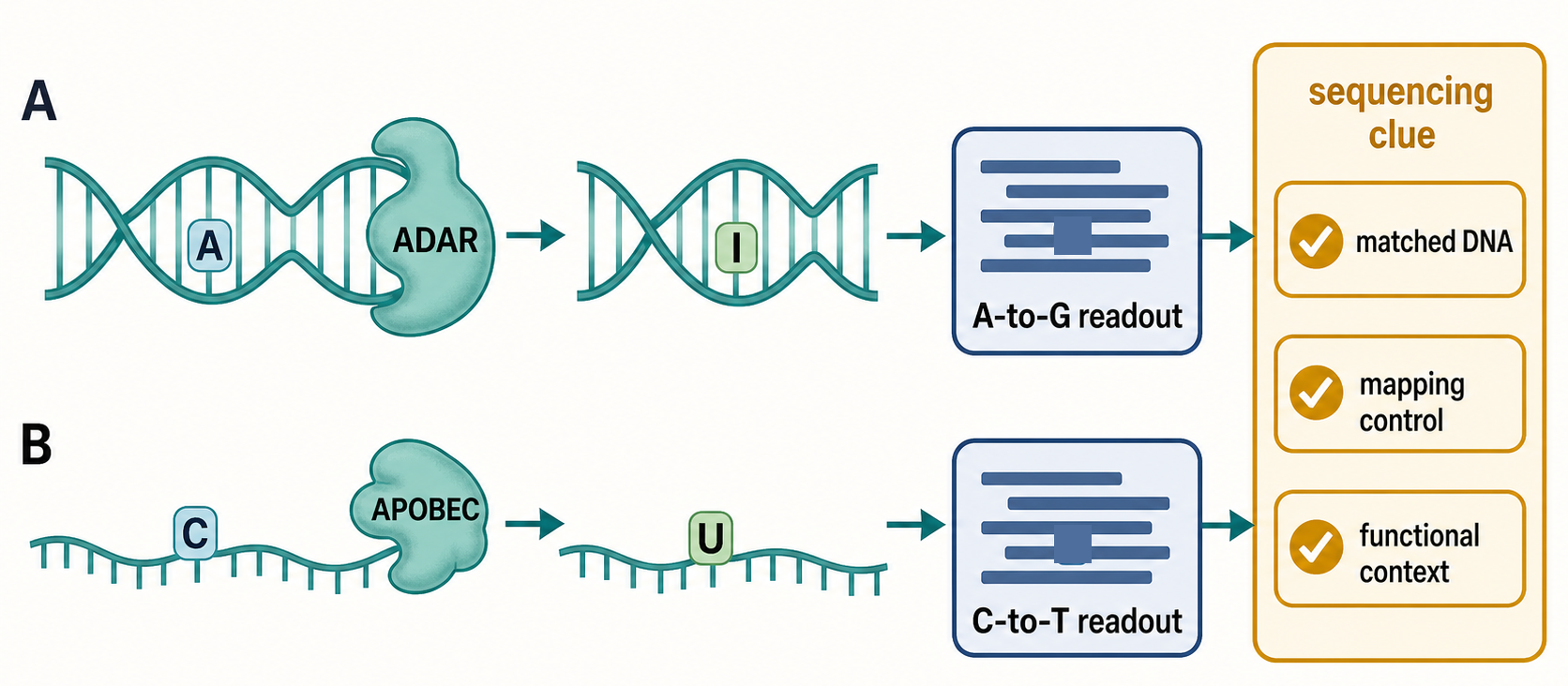
Figure 50.1. Deamination Chemistry and Sequencing Readouts. ADAR and APOBEC systems alter RNA information by deamination, but their substrate logic and readout caveats differ. ADAR converts adenosine to inosine within a double-stranded RNA context, and inosine is often read in a guanosine-like manner, so A-to-I editing appears as an A-to-G mismatch in cDNA sequencing. APOBEC-family cytidine deamination converts cytidine to uridine, observed as a C-to-T mismatch in cDNA. Both signatures are indirect and require controls for genomic variants, mapping errors, strand assignment, and technical noise before an editing call is considered credible.
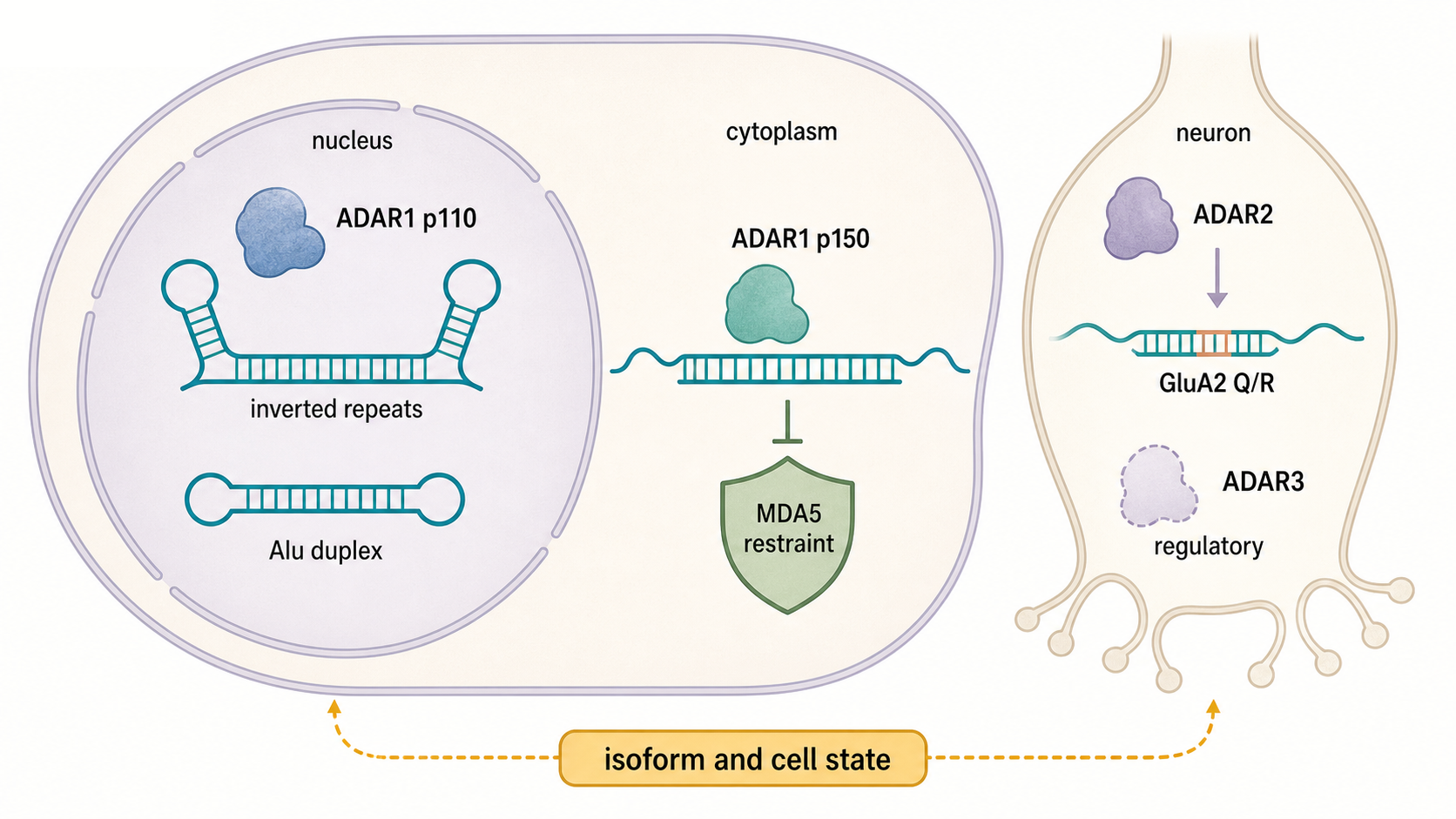
Figure 50.2. Endogenous ADAR Biology Across Compartments. Endogenous A-to-I editing spans site-selective recoding and broad editing of structured RNAs. ADAR1 p110 acts constitutively in the nucleus, editing repetitive double-stranded regions derived from inverted Alu repeats, while interferon-inducible ADAR1 p150 can act on cytoplasmic double-stranded RNA and restrains MDA5-linked innate immune activation by endogenous RNA duplexes. ADAR2 is prominent in neuronal recoding, with the GluA2 Q/R site serving as a conceptual example of how a single edit alters receptor calcium permeability. ADAR3, enriched in brain, is generally treated as catalytically inactive or regulatory rather than a primary editing enzyme; isoform localization and cell state shape the substrate spectrum for each family member.
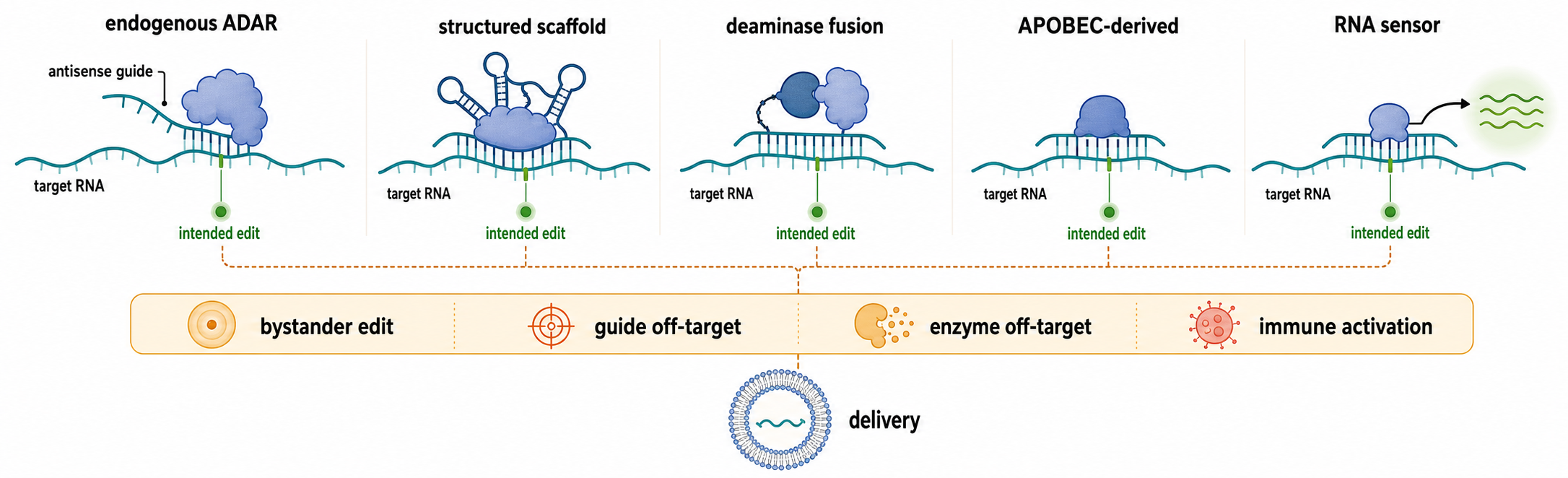
Figure 50.3. Programmable RNA Editing Architectures. Programmable editing platforms use guides or RNA-targeting modules to create a local molecular environment in which a deaminase acts on a chosen base. Strategies include antisense oligonucleotides that recruit endogenous ADAR, engineered scaffold guides, RNA-targeting protein fusions carrying a deaminase domain, APOBEC3A-derived architectures, and ADAR-based RNA sensors. Performance depends on enzyme availability, guide architecture, target accessibility, bystander bases, and guide-dependent and guide-independent off-target activity. Delivery and product behavior belong to Chapter 154.
Table 50.1. Outcomes of RNA Editing. Editing outcome depends on where the edited base lies and what molecular process reads that base; the same chemical reaction can recode protein, alter RNA processing, tune immune sensing, or serve as an engineered perturbation.
| Outcome class | Molecular location | Example | Evidence needed | Main caveat |
|---|---|---|---|---|
| Protein recoding | Coding sequence | GluA2 Q/R site (ADAR2) | Edited and unedited protein function compared | Editing fraction and cell type both matter |
| Premature stop or isoform change | Coding sequence | Apolipoprotein B mRNA (APOBEC1) | Edited codon and shorter protein isoform identified | Cofactor dependence and tissue specificity required |
| Splicing alteration | Splice signals or local RNA structure | Candidate pre-mRNA edits at regulatory sites | Isoform-specific validation by RT-PCR or long reads | Expression-level changes can mimic splicing changes |
| MicroRNA retargeting | miRNA seed or target site | Edited miRNA precursor or target site | Argonaute loading and target repression assayed | Sequencing mismatch alone is insufficient |
| Immune modulation | Repeat-derived double-stranded RNA | ADAR1-edited Alu duplexes | Sensor activation and genetic interaction with MDA5 | Collective duplex effects may dominate single sites |
| Programmable correction | Disease-associated transcript | Guide-directed A-to-I or C-to-U edit | Intended edit, off-targets, and protein rescue measured | Reporter success may not translate to endogenous transcripts |
ADAR specificity is not equivalent to a short sequence motif. A short motif can influence editing, but the enzyme usually sees a structural substrate: a duplex of sufficient length, a local mismatch or bulge, neighboring bases, and the three-dimensional accessibility of the target adenosine. This is why ADAR editing can be highly site-selective in some transcripts and broadly distributed across long repetitive duplexes in others. A transcript that contains an inverted repeat can form a long intramolecular double-stranded region with many adenosines, and ADAR may edit a cluster rather than a single position. A transcript that forms a short imperfect duplex around a recoding site can instead present one preferred adenosine that is edited with high biological consequence.
The classical conceptual example is recoding. A codon is a three-nucleotide unit in messenger RNA that specifies an amino acid or a stop signal. If ADAR converts an adenosine in a codon to inosine, the ribosome often reads the edited codon as if it contained guanosine. In the glutamate receptor transcript encoding the GluA2 subunit, editing at the Q/R site changes the encoded amino acid and strongly affects calcium permeability of the receptor channel. This example matters pedagogically because it shows that RNA editing can alter protein function without a genomic mutation. It also shows why editing stoichiometry matters: the physiological effect depends on how much of the relevant RNA pool is edited in the cells that express the receptor.
Most mammalian A-to-I editing events are not protein recoding events. In primates, many editing sites lie in Alu-derived inverted repeats located in introns and untranslated regions. Alu elements are short interspersed repeats that can occur in opposite orientations within the same transcript. When such repeats pair, they can create long double-stranded RNA structures. ADAR editing within these regions can destabilize perfect duplex character, alter nuclear retention or processing, change binding by double-stranded RNA sensors, and sometimes influence splice or regulatory outcomes. The abundance of repeat editing is a reminder that numerical frequency and functional prominence are different properties. A small number of conserved recoding sites can have clear organismal consequences, while very large numbers of repeat-associated sites may have collective effects on RNA structure and immune discrimination.
ADAR1 and ADAR2 are not interchangeable labels for the same activity. ADAR2 is strongly associated with many neuronal recoding events and has been studied in relation to nervous-system physiology. ADAR1 has broad roles in editing repetitive double-stranded RNAs and restraining innate immune activation by endogenous RNAs. ADAR1 p150 is induced by interferon and can act in the cytoplasm, while ADAR1 p110 has more constitutive nuclear roles. ADAR3 is enriched in brain and is often discussed as a potential regulator or competitor rather than a robust canonical editing enzyme. These distinctions matter for experimental design. Knockdown of ADAR1, knockdown of ADAR2, overexpression of a deaminase domain, and recruitment of endogenous ADAR by a guide RNA can have different substrate spectra and different cellular consequences.
Mechanistically, ADAR editing can change an RNA in at least five ways. First, it can recode protein sequence when the edited base lies in an open reading frame. Second, it can alter splicing if an edit creates or disrupts splice signals, splicing enhancers, or local RNA structures that affect spliceosome access. Third, it can change microRNA biology when editing occurs in a microRNA precursor, mature microRNA seed region, or target site. Fourth, it can alter RNA structure by changing base-pairing preferences in a duplex. Fifth, it can change how innate immune sensors perceive double-stranded RNA. These outcomes are not mutually exclusive. A single transcript can contain multiple edited regions with different mechanistic meanings, and the same editing enzyme can produce both a rare high-impact recoding event and many lower-impact structural edits.
The evidence basis for ADAR biology combines biochemistry, genetics, sequencing, and disease observation. Purified proteins and defined RNA substrates support the enzymatic mechanism. Mutant mice and human genetic data connect ADAR1 dysfunction to immune activation and disease phenotypes. Transcriptome sequencing identifies editing landscapes by detecting A-to-G mismatches in RNA-derived reads. Reporter assays and targeted amplicon sequencing test specific sites. Structural and biochemical studies define domain organization and substrate engagement, although many endogenous substrates are too flexible or heterogeneous to reduce to one static structure. A well-supported ADAR claim usually gains strength when several of these approaches converge: enzyme perturbation changes the site, matched DNA rules out a genomic variant, the RNA structure is plausible, and the edited RNA has a measurable molecular or cellular consequence.
50.2. APOBEC and cytidine deamination systems
Cytidine deamination changes cytidine to uridine. In RNA, this means that a C in the transcript can be read as U. If the edited cytidine lies within a codon, the codon can change the encoded amino acid or become a stop codon. The classical mammalian example is apolipoprotein B mRNA editing by APOBEC1. In a tissue-specific context, APOBEC1 and associated RNA-binding cofactors edit a cytidine in the apolipoprotein B transcript so that a glutamine codon becomes a stop codon. The result is a shorter protein isoform with different physiological behavior. This example establishes the core principle that cytidine deamination can be a regulated RNA-processing event rather than a random damage reaction.
The AID/APOBEC family is broader than APOBEC1. Activation-induced cytidine deaminase (AID) is central to antibody diversification through DNA cytidine deamination in immunoglobulin loci. APOBEC3 proteins participate in antiviral defense and can restrict retroelements and viruses, often through cytidine deamination of DNA intermediates or through deamination-independent interactions with nucleic acids and viral complexes. Several APOBEC3 proteins bind both DNA and RNA, and RNA binding can influence localization, complex formation, or substrate engagement. However, RNA binding is not the same as productive RNA editing. A rigorous account must specify whether a cited experiment shows RNA binding, RNA deamination, DNA deamination, antiviral restriction, mutagenesis, or an engineered activity.
The catalytic logic of APOBEC-family enzymes differs from ADAR logic. ADAR enzymes primarily recognize double-stranded RNA and deaminate adenosines within RNA duplexes. APOBEC-family cytidine deaminases use a zinc-dependent active site and often prefer single-stranded nucleic-acid contexts, with family-specific sequence preferences and cofactor requirements. APOBEC1-mediated RNA editing of apolipoprotein B mRNA requires more than a naked enzyme and an isolated cytidine; RNA sequence elements, local RNA structure, and auxiliary factors help define the editable site. This cofactor dependence is one reason endogenous C-to-U RNA editing has a narrower and more context-specific footprint than the abundant repeat-associated A-to-I editing found in many mammalian transcriptomes.
APOBEC biology also illustrates a recurring boundary case in RNA editing: an enzyme family can be beneficial, antiviral, regulatory, mutagenic, and potentially oncogenic depending on substrate and context. AID-mediated DNA deamination is a programmed source of antibody diversity but can become dangerous when mistargeted. APOBEC3 activity can restrict mobile elements and viruses but can also leave mutation signatures in cancer genomes. APOBEC1 can edit RNA in a controlled physiological setting, but overexpression or mislocalization of cytidine deaminases can generate off-target effects. For RNA biologists, the important lesson is not that APOBEC enzymes are good or bad, but that deamination is powerful chemistry whose biological meaning depends on targeting.
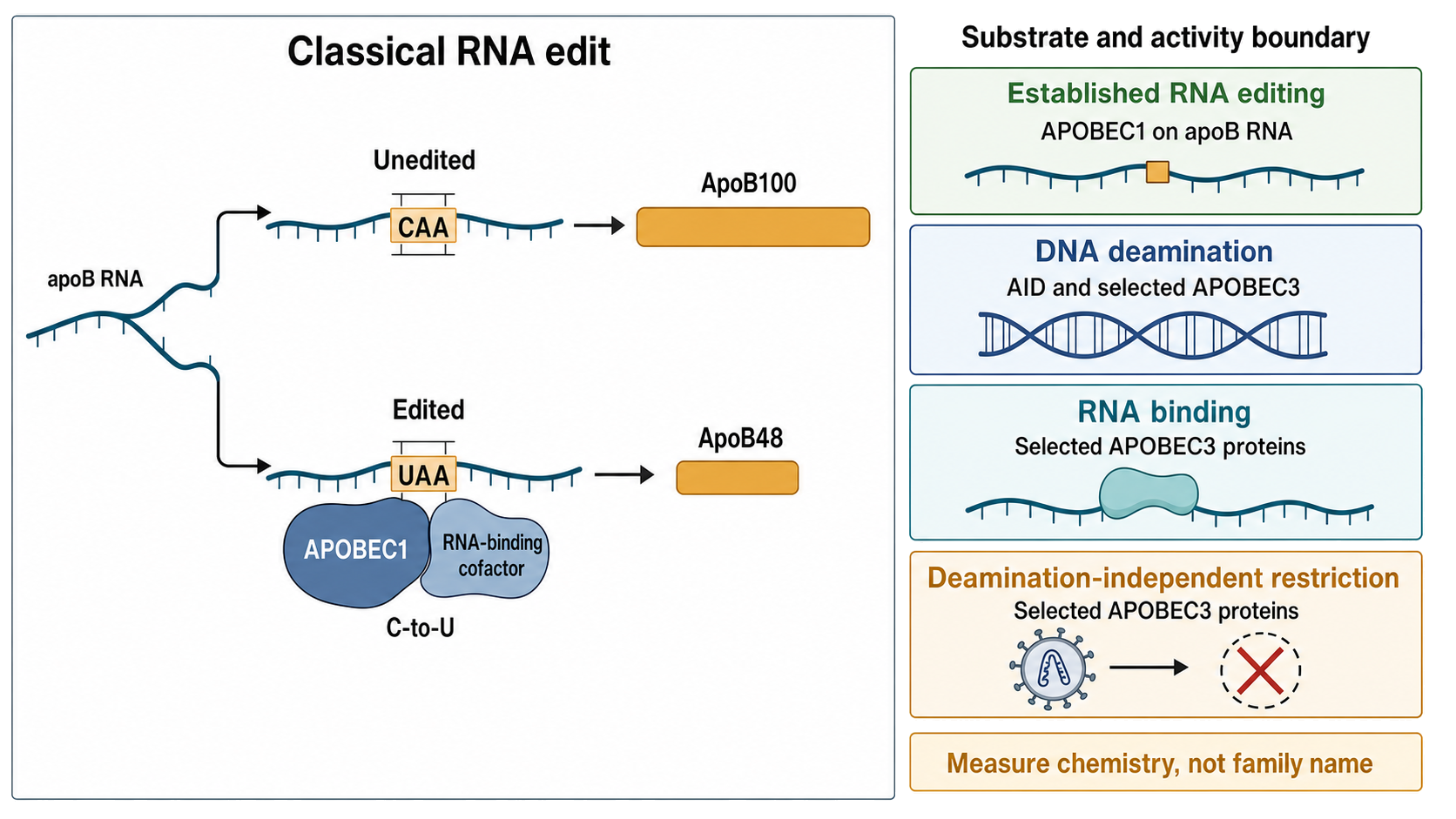
Figure 50.4. APOBEC1 RNA Editing and the AID/APOBEC Substrate Boundary. APOBEC1-mediated apolipoprotein B RNA editing is a defined, cofactor-dependent C-to-U reaction with a stop-codon and protein-isoform consequence. Other AID/APOBEC-family observations must be named by the measured substrate and activity: DNA deamination, RNA binding, and deamination-independent restriction are not interchangeable with endogenous RNA editing.
Engineered cytidine-to-uridine RNA editing systems take advantage of APOBEC chemistry while trying to impose artificial targeting specificity. One strategy fuses an APOBEC-derived deaminase to an RNA-targeting module so that a guide RNA brings the deaminase close to a selected cytidine. Another strategy designs recruitment architectures that localize the cytidine deaminase to a chosen transcript. Huang and colleagues reported programmable C-to-U RNA editing using human APOBEC3A, providing an important primary-method anchor for cytidine-directed programmable RNA editing. The engineering challenge is that a deaminase domain that can edit the intended cytidine may also edit nearby cytidines in the same local window or transcriptome-wide sites if expression, localization, and RNA binding are not controlled.
50.3. Endogenous editing in development, immunity, and neural systems
Endogenous editing means editing that occurs as part of normal or disease-associated cellular biology, without an engineered guide supplied by the experimenter. Endogenous editing is not uniformly distributed across all RNAs. It depends on enzyme expression, isoform localization, RNA structure, developmental timing, cell type, interferon state, and species-specific repeat content. A neural transcriptome, an interferon-stimulated immune cell, and a proliferating cancer cell can therefore have different editing landscapes even if they express overlapping sets of editing enzymes.
Neural systems have historically provided some of the clearest functional examples of A-to-I editing. Neurons depend on precise control of ion channels, neurotransmitter receptors, synaptic proteins, and signaling pathways. A recoding edit that changes channel conductance or receptor kinetics can therefore have a measurable physiological effect. ADAR2-linked editing of neuronal transcripts is a central part of this literature. The GluA2 Q/R site example is often used because it connects a defined molecular event to receptor physiology. Other neuronal editing events affect transcripts involved in excitability and signaling, although each candidate site requires site-specific evidence rather than inference from editing alone.
Developmental biology adds another layer: editing activity can be required not because one edited codon is indispensable in every tissue, but because the organism must manage large populations of structured endogenous RNAs while cells differentiate. ADAR1 loss-of-function studies support the view that editing of endogenous double-stranded RNA helps prevent inappropriate innate immune activation during development. In mouse and human genetics, ADAR1 dysfunction has been linked to interferon-driven pathologies, and genetic interaction with RNA sensing pathways has been used to interpret how unedited self dsRNA can become immunostimulatory.
The immune system is where the distinction between RNA structure and RNA origin becomes especially important. Cytosolic sensors such as MDA5 recognize features of double-stranded RNA that are often associated with viral replication. Yet host transcripts can also produce long double-stranded regions, especially from inverted repeats and mitochondrial or nuclear sources under some conditions. ADAR1 editing can weaken or mark these endogenous duplexes so that they are less likely to be treated as viral RNA. This does not mean that every ADAR1-edited site has a separate regulatory function. Many edits may collectively reduce duplex immunogenicity or alter the population of structures sensed by innate immune pathways.
Cancer illustrates both biological and interpretive complexity. Editing enzymes can influence tumor biology through recoding, immune signaling, transcript stability, microRNA interactions, and stress responses. ADAR1 has been studied in relation to cancer progression and therapy response, and ADAR-mediated editing can modulate downstream targets in cancer contexts. The difficulty is that tumors also vary in cell composition, copy number, interferon state, RNA expression, RNA quality, and mutation burden. A difference in apparent editing between tumors and controls may reflect enzyme regulation, substrate abundance, immune infiltration, alternative isoform use, or mapping artifacts. Claims about editing as a cancer driver need functional perturbation and rescue, not only differential editing catalogs.
Endogenous cytidine editing is narrower but still biologically instructive. APOBEC1-mediated apolipoprotein B editing is tissue regulated and cofactor dependent. AID and APOBEC3 biology intersects immunity and genome defense, but much of that biology is DNA-centered or antiviral rather than canonical RNA editing. When APOBEC-family enzymes are discussed in development or immunity, the substrate must be stated. Does the enzyme edit an RNA transcript, edit a DNA intermediate, bind RNA to regulate an antiviral complex, or create mutational diversity in genomic DNA? Without this distinction, the term “APOBEC editing” can hide incompatible mechanisms.
50.4. General programmable editing principles and guide design
Programmable RNA editing begins with a practical ambition: choose an RNA molecule and a base within that RNA, then use a designed guide or targeting module to install a predictable base change. For A-to-I editing, the most direct strategy is to create an RNA duplex around the target adenosine so that endogenous ADAR or an engineered ADAR domain recognizes the site. For C-to-U editing, the strategy is to position an APOBEC-derived cytidine deaminase near a selected cytidine while limiting access to other cytidines. In both cases, the guide does not “write” the edit. The guide creates a local molecular environment in which a deaminase can act.
Endogenous ADAR recruitment uses the cell’s own editing machinery. A guide RNA or antisense oligonucleotide pairs with the target transcript and presents the target adenosine in a duplex context that ADAR can edit. Merkle and colleagues and Qu and colleagues provide primary-method anchors for recruiting endogenous ADARs with antisense or engineered RNAs. The advantage is that no exogenous protein deaminase needs to be expressed, which may reduce immunogenicity and simplify some delivery scenarios. The limitation is that editing depends on endogenous ADAR abundance, isoform localization, cell state, and competition with natural substrates. A guide that works in one cell type may fail in another if the relevant ADAR isoform is absent or sequestered.
Protein-fusion strategies take a different path. An RNA-targeting protein can be fused to an ADAR deaminase domain or APOBEC-derived deaminase domain, while a guide RNA positions the fusion protein at the target transcript. These systems can increase editing activity and broaden cell-type applicability, but they also introduce expression-level and off-target problems. A highly expressed deaminase fusion can edit unintended RNAs even without perfect guide targeting, and a protein fusion may have immune or delivery liabilities. Because canonical CRISPR-Cas systems were built for DNA targeting, RNA-targeting platforms require separate guide rules, validation assays, and safety assumptions rather than direct borrowing from DNA-editing guide design.
Guide design for ADAR editing has several recurring principles. The guide must be complementary enough to bind the intended RNA in the relevant cellular compartment. The target adenosine must be placed in a favorable local structure, often with an intentional mismatch opposite the edited adenosine to improve access and editing. Nearby adenosines should be minimized or placed in less favorable contexts if bystander editing would be harmful. The guide should avoid strong complementarity to unintended transcripts, especially in gene families, paralogs, pseudogenes, and repetitive regions. The guide chemistry or scaffold must support stability and localization without triggering excessive innate immune sensing. These principles are design heuristics, not guarantees.
Recent engineering has emphasized guide scaffolds as much as guide sequence. A simple antisense guide can recruit endogenous ADAR, but structured scaffolds can increase local concentration, localization, or enzyme engagement. Engineered U7 small nuclear RNA scaffolds have been reported to increase ADAR-mediated programmable RNA base editing. Guides mimicking highly edited endogenous ADAR substrates have also been used to improve editing performance. These findings support a mechanistic lesson: ADAR does not only care about Watson-Crick complementarity to the target. ADAR responds to an RNA architecture, and guide design can exploit architectures that resemble efficient natural substrates.
Programmable RNA sensors are a related application. If editing depends on the presence of a target RNA or cellular state, an engineered construct can convert RNA recognition into an editable reporter output. Modular ADAR-based RNA sensing systems use guide-like architecture to connect target RNA detection with editing in living cells. Such platforms blur the boundary between editing as therapy and editing as information processing. A sensor does not necessarily aim to correct a disease-causing transcript; it may aim to record whether a transcript or pathway was present.
The C-to-U programmable editing problem is similar in outline but different in detail. APOBEC-derived systems must position a cytidine deaminase near a target cytidine while avoiding collateral cytidine edits. Cytidine distribution, local single-stranded character, enzyme motif preference, and deaminase engineering all influence outcomes. Huang and colleagues’ APOBEC3A-based platform showed that human APOBEC-derived chemistry can be redirected to RNA targets. The same result highlights the safety problem: a deaminase that has been made more active or more permissive can increase intended editing and unintended editing at the same time unless specificity is engineered and measured.
Performance at an endogenous transcript cannot be inferred from a reporter. Native transcript abundance, isoform choice, RNA structure, bound proteins, compartment, endogenous enzyme abundance, and cell state all alter guide access and editing. These variables belong in mechanistic guide validation. Delivery, dosing, biodistribution, durability, and therapeutic product design are handed to Chapter 154.
50.5. Specificity, off-target mechanisms, and general validation principles
Specificity has several mechanistically distinct layers. A bystander edit occurs near the intended base within the guide-target duplex or editing window. A guide-dependent off-target occurs when the guide binds an unintended transcript strongly enough to recruit editing. A guide-independent off-target occurs when an expressed or recruited deaminase acts on other cellular RNAs without the intended guide-target interaction. These classes require separate measurements because guide redesign can reduce bystanders or complementarity-driven events but may not correct promiscuous enzyme activity.
Target specificity begins with molecular context. The intended transcript isoform, strand, local secondary structure, competing RNA-binding proteins, editable neighboring bases, and target abundance all affect the realized editing window. Guide uniqueness must be evaluated against paralogs, pseudogenes, repeats, and alternative isoforms. An enzyme-only control tests guide-independent activity; a guide-only or catalytically inactive control tests whether binding changes RNA abundance, structure, or processing without deamination.
Validation should connect chemical change to mechanism and consequence. Targeted deep sequencing measures intended and bystander edits. Transcriptome-wide analysis searches for distal events but is limited to RNAs expressed and adequately covered in the tested cells. Multiple independent guides, expression-matched controls, enzyme-dead variants, and orthogonal detection reduce design-specific artifacts. When the purpose is functional correction, the edited RNA should produce the predicted protein, splice isoform, sensor response, or cellular phenotype.
Endogenous ADAR recruitment and engineered deaminase expression have different specificity baselines. Endogenous recruitment avoids adding a broadly active protein but depends on native ADAR abundance, localization, and natural substrates. Engineered editors can raise activity or broaden applicability while also increasing guide-independent editing. Comparisons must therefore report editor abundance, guide abundance, target RNA abundance, cell state, and time, rather than comparing only peak editing percentages.
Safety and clinical relevance cannot be inferred from transcriptome specificity alone. Delivery distribution, repeat dosing, pharmacology, edited-protein persistence, immunogenicity, toxicology, manufacturing, and product-level benefit-risk assessment belong to Chapter 154. This chapter’s endpoint is a mechanistically validated editing event and its immediate molecular consequence.
Table 50.2. Off-Target Categories and Mitigation Strategies. Programmable editing risks should be categorized mechanistically because each category requires a different measurement strategy and mitigation approach.
| Risk class | Mechanism | Detection approach | Mitigation strategy | Residual caveat |
|---|---|---|---|---|
| Bystander editing | Nearby editable bases in guide-target duplex | Targeted amplicon sequencing across the guide window | Guide redesign or editing-window engineering | Local RNA structure may differ in cellular context |
| Guide-dependent off-target | Partial guide complementarity to unintended transcript | Transcriptome-wide RNA-seq and computational off-target prediction | Improve guide uniqueness and mismatch tolerance | Low-expression transcripts are hard to assess |
| Guide-independent deaminase off-target | Overexpressed or mislocalized editor acts on natural substrates | Editor-only controls and unbiased RNA-seq | Lower expression level, alter localization, or use endogenous recruitment | Natural substrate changes may persist at low level |
50.6. Editing detection, quantification, and evidence interpretation
Most editing maps are built from sequencing comparisons. For A-to-I editing, the analyst aligns RNA-derived reads to a reference genome or transcriptome and searches for positions where reads contain G at a genomic A position on the appropriate strand. For C-to-U editing, the analogous cDNA signature is T at a genomic C position. The apparent simplicity of this rule hides many traps. A genomic single-nucleotide variant can look like editing if matched DNA is absent. A read from a paralog or pseudogene can misalign to a related locus. A repetitive element can attract ambiguous reads. A sequencing or reverse-transcription error can create a low-level mismatch. A strandedness error can invert the interpretation. A site in a poorly annotated isoform can appear inconsistent with the reference transcript model.
Editing quantification is usually reported as an editing fraction: edited reads divided by the sum of edited and unedited reads at a site. This fraction is useful only when the denominator is meaningful. Low read depth creates unstable estimates. Allele-specific expression can bias interpretation when the edited site is near genetic variation. RNA degradation can favor short fragments and distort coverage. PCR duplicates can inflate confidence. Cell-type mixtures can create apparent intermediate fractions even if editing is binary within individual cells. Alternative isoforms can include or exclude the edited region. A careful report states the molecule, coordinate system, strand, read depth, filtering rules, genomic controls, and transcript model used to compute the fraction.
Direct measurement and orthogonal validation can reduce ambiguity, but each method has limits. Targeted amplicon sequencing can provide depth at a candidate site but may preserve PCR or reverse-transcription biases. Sanger sequencing can validate abundant edits but is insensitive to low-level or mixed isoform events. Inosine-sensitive chemical or enzymatic approaches can support A-to-I detection, but they require controls for specificity and completeness. Direct RNA sequencing and nanopore-based strategies can potentially detect modifications or single-nucleotide differences without cDNA conversion, yet signal interpretation, training data, and modification cross-talk remain active methodological issues. Nanopore nanolatch approaches illustrate ongoing efforts to detect single-nucleotide RNA changes and modifications more directly.
Interpretation requires distinguishing editing of a transcript from regulation by editing. If an edited base lies in a coding sequence and changes a protein, the causal path can be tested by expressing edited and unedited versions or by changing the editing site. If an edit lies in an intronic repeat, the functional path may involve RNA structure, splicing, nuclear retention, decay, or innate immune sensing. If a site is differentially edited in disease, the difference might be causal, compensatory, or a marker of altered cell state. The strongest claims use perturbation and rescue: change the editing enzyme or site, observe a molecular phenotype, restore the edited or unedited state, and test whether the phenotype follows.
MicroRNA editing requires particular care. Editing in a primary or precursor microRNA can alter processing efficiency, while editing in a mature microRNA seed can retarget the microRNA. Editing in a messenger RNA target site can alter recognition by an unedited microRNA. These are distinct mechanisms. A sequencing read showing a mismatch in a microRNA locus does not by itself establish a new regulatory network. Evidence should show the edited microRNA species, its abundance, its loading into Argonaute when relevant, its target engagement, and the downstream effect on target RNA or protein.
Programmable editing readouts add further caveats. A guide may increase apparent editing at a target because it recruits ADAR, but it may also change target RNA abundance, splicing, stability, or reverse-transcription efficiency. A deaminase fusion may raise intended editing and global background editing at the same time. A reporter may overestimate performance because reporters are abundant, accessible, and simplified compared with endogenous transcripts. A short-term cell-culture assay may miss immune activation, delivery toxicity, or protein-level consequences that emerge in primary cells or organisms. Therefore a credible programmable-editing benchmark includes endogenous targets, multiple guide designs, negative guides, enzyme-dead controls when applicable, transcriptome-wide off-target analysis, and functional rescue when the intended edit is therapeutic.
The most common overgeneralization is to treat every A-to-G mismatch in RNA-seq as ADAR editing and every C-to-T mismatch as APOBEC editing. This is not defensible. Mismatch class is a starting hypothesis. The claim becomes stronger when the site occurs in an appropriate RNA structure or sequence context, responds to the relevant enzyme, is absent from matched genomic DNA, appears with strand-consistent evidence, survives mapping filters, and has an interpretable biological consequence. Editing biology is strongest when chemical plausibility, enzyme dependence, sequencing evidence, and functional logic align.
Box 50.1. How to Read an Editing Fraction
- Editing fraction equals edited reads divided by total reads covering a site.
- The denominator depends on read depth, mapping quality, transcript isoforms present, PCR duplicate removal, and correct strand assignment.
- A 30 percent editing fraction can arise from uniform partial editing across all cells, strong editing in a subset of cells, or a mixture of transcript isoforms and cell states; these scenarios are not equivalent.
- Matched genomic DNA helps distinguish RNA editing from a genomic single-nucleotide variant at the same position.
- Functional interpretation requires evidence of a molecular consequence, not only a percentage value.
Technology, Computational, and Translational Handoffs
Computational analysis supports endogenous site discovery, guide selection, structure-aware targeting, bystander prediction, transcript uniqueness checks, and off-target detection. A pipeline designed for repeat-rich endogenous A-to-I discovery is not automatically appropriate for evaluating a programmable guide, because the expected sites, controls, and evidence thresholds differ.
Programmable editing also serves nonclinical research: installing or preventing a candidate edit can test causality, create transient protein variants, or build RNA-responsive sensors. These uses still require intended-site, bystander, distal off-target, enzyme-dead, abundance, and functional controls.
Therapeutic delivery, tissue exposure, dosing, durability, pharmacodynamics, immunogenicity, toxicology, manufacturing, regulatory evidence, and product safety are developed in Chapter 154. They should not be inferred from reporter editing or a clean cell-culture transcriptome profile.
Box 50.2. Misconceptions in RNA Editing
- An A-to-G mismatch in RNA-seq does not automatically mean ADAR editing; genomic variants, mapping errors, paralogous transcripts, and repetitive elements can produce the same signature.
- A C-to-T mismatch in cDNA does not automatically mean APOBEC RNA editing.
- Editing does not automatically imply biological function; many sites may be low-level, repetitive, or condition-dependent with no unique named function.
- RNA-level reversibility describes turnover of edited RNA; therapeutic benefit-risk implications require modality-specific assessment in Chapter 154.
- APOBEC-family membership does not automatically define RNA as the substrate; many family members act primarily on DNA or have context-dependent and cofactor-dependent substrate preferences.
- Reporter editing efficiency does not automatically predict performance at endogenous transcripts expressed at physiological levels in primary cells or tissue.
Recent Consensus
Several points are now well supported. ADAR-mediated A-to-I editing is a major endogenous RNA-editing process in mammals, with both site-specific recoding functions and broad editing of double-stranded repeat-derived RNA. ADAR1 has an established role in restraining inappropriate innate immune sensing of endogenous double-stranded RNA. ADAR2 has especially important links to neuronal recoding and nervous-system physiology. Inosine is functionally meaningful because many molecular processes read inosine in a guanosine-like manner, but the consequence of any particular edit depends on transcript context.
The APOBEC field has a more heterogeneous consensus. APOBEC1-mediated apolipoprotein B RNA editing is a clear endogenous C-to-U RNA-editing paradigm. AID/APOBEC family proteins have broad roles in DNA deamination, antiviral defense, retroelement restriction, and mutagenesis, and some family members bind RNA or can be engineered for RNA editing. It is not correct to generalize all APOBEC-family activity as endogenous RNA editing. The substrate and biological context must be specified.
Programmable RNA editing is a credible and rapidly developing technology, not a solved therapeutic platform. Endogenous ADAR recruitment, engineered guide scaffolds, deaminase fusions, APOBEC-derived C-to-U systems, and RNA-sensing designs have all shown important proof-of-concept advances. The common bottlenecks remain specificity, bystander editing, delivery, durability, immune activation, and quantitative validation at endogenous transcripts. Recent reviews emphasize that RNA editing’s reversibility and programmability are attractive, but safety and measurement standards will determine which applications mature.
Open Questions, Controversies, Deprecated Models, and Common Misconceptions
Open questions:
- How can researchers best engineer specificity? Increasing deaminase activity, guide stability, or local recruitment can improve intended editing, but each change can also increase bystander or off-target editing. Endogenous ADAR recruitment reduces the need to deliver a deaminase protein but depends on endogenous enzyme availability. Deaminase fusions can be potent but can create guide-independent background. Structured scaffolds can increase activity but may alter localization or immune recognition. There is no universally optimal platform independent of target, tissue, and use case.
- How should function be assigned to the large background of editing sites? Some editing events clearly recode proteins or alter immune recognition. Many others are low-level, repetitive, tissue-specific, or condition-dependent. The existence of editing at a site does not prove that selection maintains that site for a specific function. Conversely, collective editing of many repetitive duplexes may be biologically important even when individual sites have no unique named function.
Controversies:
- A third controversy concerns how editing should be benchmarked across platforms. Editing percentage at a single reporter site is easy to report but insufficient. A more informative benchmark reports intended editing, bystander edits, transcriptome-wide off-targets, guide expression, target RNA abundance, cell state, immune activation, protein-level effect, and reproducibility across endogenous targets. The field still needs careful comparisons that separate target difficulty from platform capability and delivery performance from catalytic specificity.
Common misconceptions:
- “ADAR editing mutates DNA.” ADAR enzymes alter RNA sequence information after transcription; the genomic DNA sequence remains unchanged.
- “Inosine is guanosine.” Inosine is not guanosine, even though many readouts treat it as G-like.
- “APOBEC-family membership automatically means endogenous RNA editing.” APOBEC-family membership alone does not establish that an enzyme edits RNA in vivo.
- “A high number of RNA-seq mismatches implies high biological function.” Mismatch counts need controls for genomic variation, mapping, expression, editing fraction, and functional consequence.
- “A reversible RNA edit is automatically safe.” Reversibility does not eliminate risks from delivery, immune activation, off-target editing, protein persistence, or tissue context.
- “A guide that gives high editing in a reporter is automatically effective in a therapeutic transcript.” Therapeutic editing depends on target accessibility, transcript abundance, delivery, bystander editing, protein effect, and safety.