Chapter 9. Catalytic RNAs and Ribozymes: Mechanisms, Structures, Evolution, and Engineering
Scope Note
This chapter owns comparative catalytic-RNA enzymology: how RNA folds create active sites, how those sites accelerate chemical reactions, how catalytic performance is measured, and how natural and selected ribozymes illuminate one another. Small self-cleaving ribozymes, group I and group II introns, ribonuclease P (RNase P), RNase MRP, the ribosome, the spliceosome, metabolite-assisted ribozymes, and engineered catalysts are compared through a common substrate–catalyst–product framework. It also owns the reaction-specific design of catalytic-RNA selections: linking each genotype to its reaction product, choosing tethered or trans-acting substrates, imposing pressure on rate, yield, turnover, or selectivity, and validating the chemistry and kinetics of recovered catalysts. Chapter 137 owns the full generic workflow for in vitro selection, systematic evolution of ligands by exponential enrichment (SELEX), library construction, partition platforms, sequencing, and directed evolution across functional RNA classes. Chapter 8 owns origin-of-life models and the limits of inference from modern ribozymes; Chapter 27 owns spliceosomal pathway regulation; Chapter 39 and Chapter 42 own tRNA and rRNA processing contexts; Chapter 79 owns riboswitch regulatory biology; Chapter 119 owns pathogen life cycles; and Chapter 154 owns therapeutic products. Those chapters use catalytic RNA in context, whereas this chapter asks what the RNA active site physically does and what a catalytic selection actually rewards.
Executive Summary
A ribozyme is an RNA whose folded structure contributes directly to chemical rate enhancement. The definition is mechanistic, not merely functional: an RNA that recruits a protein enzyme is regulatory or scaffolding RNA unless the RNA itself supplies part of the catalytic environment. Catalysis can reside in an RNA alone under simplified conditions, in an RNA–protein holoenzyme, or in an active center whose decisive groups are RNA even though proteins organize the complex. Demonstrating catalysis therefore requires a chemically defined reaction, turnover or single-turnover rate measurements, product identification, and perturbations that distinguish an RNA active site from contaminating protein or spontaneous cleavage.
RNA has fewer chemically diverse side chains than protein, but its bases, ribose hydroxyls, phosphate backbone, bound metal ions, water, and recruited small molecules form a substantial catalytic repertoire. Ribozymes accelerate reactions by aligning reactive atoms, stabilizing charge, shifting nucleobase pKa values, excluding water, coordinating metal ions, and coupling local chemistry to global folding. These strategies usually operate together. A pH-rate profile consistent with general acid–base catalysis does not identify the catalytic residue by itself, and metal dependence does not prove that a metal ion contacts the scissile phosphate. Atomic substitution and rescue experiments, isotope effects, structures of multiple reaction states, and kinetic models provide stronger assignments when their assumptions agree.
Small self-cleaving ribozymes repeatedly solve internal phosphoester transfer: a 2’-hydroxyl attacks the adjacent phosphorus, producing a 2’,3’-cyclic phosphate and a 5’-hydroxyl. Hammerhead, hairpin, hepatitis delta virus (HDV), Varkud satellite (VS), glmS, twister, twister-sister, pistol, and hatchet ribozymes share that net chemistry but differ in active-site architecture and catalytic emphasis. “Self-cleaving” describes cis action in the natural transcript; engineered trans-cleaving forms separate substrate-recognition arms from a catalytic core. Product rebinding, conformational heterogeneity, and the reverse ligation reaction determine whether an apparent single-cut catalyst can turn over.
Large catalytic RNAs show how RNA chemistry becomes embedded in biological machines. Group I introns use an exogenous guanosine nucleophile and two transesterifications; group II introns usually use a bulged branch-point adenosine to form a lariat and then ligate exons. Both require tertiary folding and commonly protein assistance in vivo, but the RNA houses the catalytic core. RNase P cleaves precursor-tRNA 5’ leaders through hydrolysis. Bacterial RNase P RNA can catalyze this reaction under elevated ionic conditions, whereas proteins increasingly stabilize substrates and active conformations across evolution; some eukaryotic organelles have replaced the RNA-based system with protein-only RNase P. The contrast demonstrates that conserved function does not require a universally conserved molecular catalyst.
The ribosomal peptidyl transferase center is built from ribosomal RNA and catalyzes peptide-bond formation chiefly through precise substrate positioning, proton-shuttle organization, and transition-state stabilization. The spliceosome likewise arranges catalytic metal ions with small nuclear RNAs in an architecture related to group II introns, although its changing ribonucleoprotein states make “ribozyme” a claim about the catalytic center rather than about an isolated RNA molecule. These cases broaden catalytic RNA beyond compact autonomous motifs without erasing protein contributions.
Some ribozymes link sensing to chemistry. The glmS ribozyme binds glucosamine-6-phosphate, whose amino group participates in catalysis, so the metabolite acts as both ligand and chemical cofactor. Other natural self-cleavers can be placed downstream of aptamer domains to form aptazymes whose cleavage depends on ligand-controlled folding. In vitro selection extends RNA catalysis into reactions not represented among known natural ribozymes, but catalytic selection is possible only when reaction changes recovery while the product remains linked to its encoding RNA. Tethered substrates simplify that linkage but can select cis-reactive molecules that fail with free substrate or fail to turn over. Reaction time, substrate concentration, partition stringency, counterselection, carryover, and amplification jointly define assay-specific fitness. A recovered sequence therefore requires independent product identification and kinetic resynthesis; enrichment alone is neither a catalytic rate constant nor evidence that the same chemistry was biologically used or prebiotically available. Chapter 137 develops the generic selection cycle, while this chapter develops these catalyst-specific consequences.
Reliable ribozyme enzymology separates folding, chemistry, and product release. Observed rate constants may report a slow conformational transition rather than bond cleavage; apparent metal requirements may reflect global compaction; end-point fractions may reveal inactive subpopulations rather than thermodynamic equilibrium. Single-turnover measurements, multiple-turnover measurements, substrate titrations, chase experiments, reaction-state structures, orthogonal product analysis, and mutation-rescue cycles are complementary. The central discipline is to match each mechanistic claim to the part of the reaction pathway that the experiment actually observes.
Concept Inventory
- Catalytic RNA: RNA whose folded atoms contribute directly to lowering the activation barrier of a specified chemical reaction.
- Ribozyme: a catalytic RNA molecule or RNA-centered catalytic component, with the RNA contribution stated explicitly for ribonucleoprotein systems.
- Scissile phosphate: the phosphorus center at the phosphodiester bond being cleaved or transferred.
- Internal phosphoester transfer: attack by a ribose 2’-oxygen on the adjacent phosphorus, yielding a 2’,3’-cyclic phosphate and 5’-hydroxyl.
- General acid–base catalysis: proton donation and abstraction by active-site groups during the chemical step.
- Metal-ion catalysis: direct or indirect metal participation in nucleophile activation, charge stabilization, leaving-group assistance, or active-site organization.
- Electrostatic catalysis: transition-state stabilization through organized charge, including protonated bases, metal ions, and polarized hydrogen-bond networks.
- Conformational catalysis: rate enhancement from preferentially organizing reactive geometry and suppressing unproductive conformations.
- Single-turnover kinetics: conditions in which active catalyst is in excess over substrate, emphasizing steps through the first chemical event.
- Multiple-turnover kinetics: conditions in which substrate exceeds active catalyst, so product release and catalyst recycling can influence rate.
- Chemical rescue: restoration of mutant or atomic-substitution activity by an added ion or small molecule predicted to replace a lost interaction.
- Ribozyme fitness landscape: mapping from RNA sequence and assay conditions to selectable catalytic performance.
- Genotype–product linkage: a physical or informational connection that lets the product-forming RNA be recovered through its own reaction while retaining its amplifiable sequence.
- Substrate tethering: covalent or stable attachment of a reactant to the candidate RNA so that intramolecular product formation remains linked to the candidate genotype.
- Reaction partition: separation of reacted from unreacted candidate molecules through a chemical or physical property created by the intended product.
- Assay-specific fitness: the composite probability that a sequence reacts, survives partition, is copied, and seeds the next round under one defined selection protocol.
- Kinetic resynthesis: independent preparation and time-resolved testing of selected sequences outside the enrichment pool to measure active fraction, product identity, rate, and turnover.
- Aptazyme: an engineered or natural RNA device coupling a ligand-binding aptamer to a catalytic RNA output.
- Ribonucleoprotein catalyst: a catalytic complex in which RNA and protein contributions must be experimentally partitioned.
What to Know Before Reading This Chapter
RNA is a 5’-to-3’ polymer of ribonucleotides joined by phosphodiester bonds. Each ribose carries a 2’-hydroxyl that can act as a nucleophile if deprotonated and aligned for in-line attack on the adjacent phosphorus. Because a phosphodiester is negatively charged and chemically stable in water, catalysis must manage charge, geometry, proton transfer, and leaving-group departure. Chapter 2 explains RNA chemical stability and spontaneous cleavage; Chapter 4 explains secondary and tertiary folding, while Chapter 3 develops folding landscapes. Here, those foundations are treated as parts of a reaction coordinate.
Four running examples organize the chapter. A hammerhead ribozyme demonstrates compact self-cleavage and how tertiary contacts transform a minimal motif into a fast catalyst. The Tetrahymena group I intron demonstrates two-step splicing, substrate recognition by base pairing, and a guanosine-binding active site. Bacterial RNase P demonstrates a catalytic RNA whose biological activity depends on protein and ionic context. The ribosomal peptidyl transferase center demonstrates RNA-centered catalysis in a protein-rich molecular machine. The examples differ in scale, reaction, and autonomy but can all be analyzed by asking: What is the substrate? Which atoms react? Which groups organize and stabilize the transition state? What product forms? Which step limits the measured rate?
Rate enhancement is relative to a specified uncatalyzed reaction under specified conditions. A first-order cleavage rate, k_obs, may approximate the chemical rate only when folding and binding are faster and the population is active. For a trans-acting enzyme, Michaelis–Menten-like parameters can be useful, but K_M need not equal a dissociation constant and k_cat may be limited by product release. Many ribozymes display bursts, biphasic time courses, inactive fractions, or ion-dependent conformational exchange. These features are information about the mechanism rather than inconveniences to be hidden by a single exponential fit.
Structural models are snapshots or ensemble summaries. A crystal structure may stabilize one conformation through packing, ions, analog substitutions, low temperature, or nonreactive substrate chemistry. Cryogenic electron microscopy can resolve large ribonucleoprotein states but may average mobile catalytic atoms. Nuclear magnetic resonance and single-molecule fluorescence can reveal dynamics, yet their labels and timescales are also conditional. Mechanistic confidence rises when structural states, solution kinetics, chemical perturbations, and correctly identified products converge.
9.1. Catalytic-RNA definitions, discovery logic, classification, and evidence standards
The most useful definition of a ribozyme begins with causality. RNA must do more than bind a substrate or recruit a protein: atoms in the folded RNA must organize reactive geometry, exchange protons, coordinate catalytic ions, stabilize charge, or otherwise lower the activation barrier. An RNA can satisfy this definition even when protein is required for biological efficiency. Conversely, an RNA scaffold that recruits a protein nuclease does not become a ribozyme merely because the complex cleaves RNA. The question is not whether protein is present but whether the RNA contributes directly to the chemical step.
Catalytic RNAs can be classified along several independent axes. Reaction chemistry separates phosphoester transfer, hydrolysis, ligation, peptide-bond formation, and selected synthetic reactions. Architecture separates compact motifs, large introns, and ribonucleoprotein centers. Biological deployment separates self-processing elements, trans-acting enzymes, and catalytic centers embedded in machines. Autonomy separates RNAs active alone in vitro from RNA–protein holoenzymes. No one axis is sufficient: “small ribozyme” describes size and usually reaction class, whereas “self-cleaving” describes substrate connectivity, not a unique mechanism.
Discovery routes create different evidence burdens. Classical biochemical discovery began when a purified Tetrahymena intron excised itself and when the RNA component of bacterial RNase P cleaved precursor tRNA under protein-free conditions. Comparative genomics can identify conserved motifs near plausible processing sites; biochemical assays must then establish the predicted products and rate enhancement. High-throughput reporter screens can reveal sequence-dependent cleavage in cells, but differential RNA abundance can also arise from transcription, decay, or translation. In vitro selection enriches molecules linked to a selectable product, yet parasitic amplification, carryover, and noncatalytic binding can imitate enrichment.
A strong catalytic claim identifies both products and kinetics. For self-cleavage, denaturing electrophoresis reveals fragment sizes but not necessarily end chemistry. Mass spectrometry, end-specific enzymes, ligation tests, or nuclear magnetic resonance can distinguish 2’,3’-cyclic phosphate/5’-hydroxyl products from hydrolytic ends. Time courses should include no-RNA, inactive-mutant, metal-free or chelator, and contamination controls. The dependence of rate on catalyst concentration distinguishes unimolecular cis cleavage from intermolecular action or aggregation. Turnover, when claimed, requires repeated product formation per active catalyst rather than more product than total RNA measured by an uncertain concentration estimate.
In ribonucleoproteins, component-removal and reconstitution experiments define division of labor. Loss of activity after degrading RNA shows necessity but not catalytic participation. Protein-free RNA activity is powerful when achievable, although nonphysiological salt can compensate for protein functions. Site-specific RNA perturbation at a predicted active center, combined with rescue and reaction-state structures, makes a more direct case. For the ribosome and spliceosome, extensive structural and biochemical evidence locates substrates and catalytic metals in RNA-built environments even though isolated catalytic RNA is neither the natural nor the experimentally appropriate standard.
Classification must preserve negative and borderline cases. Deoxyribozymes are selected DNA catalysts and should not be merged with ribozymes. Riboswitches are ligand-binding regulatory RNAs; only subclasses that catalyze chemistry, such as glmS, are ribozymes. Small nuclear RNAs participate in spliceosomal catalysis, but the dynamic spliceosome is not equivalent to a free small RNA enzyme. RNA-guided protein nucleases use RNA specificity without RNA catalysis. These distinctions prevent the broad and scientifically unhelpful claim that every functional RNA is catalytic.
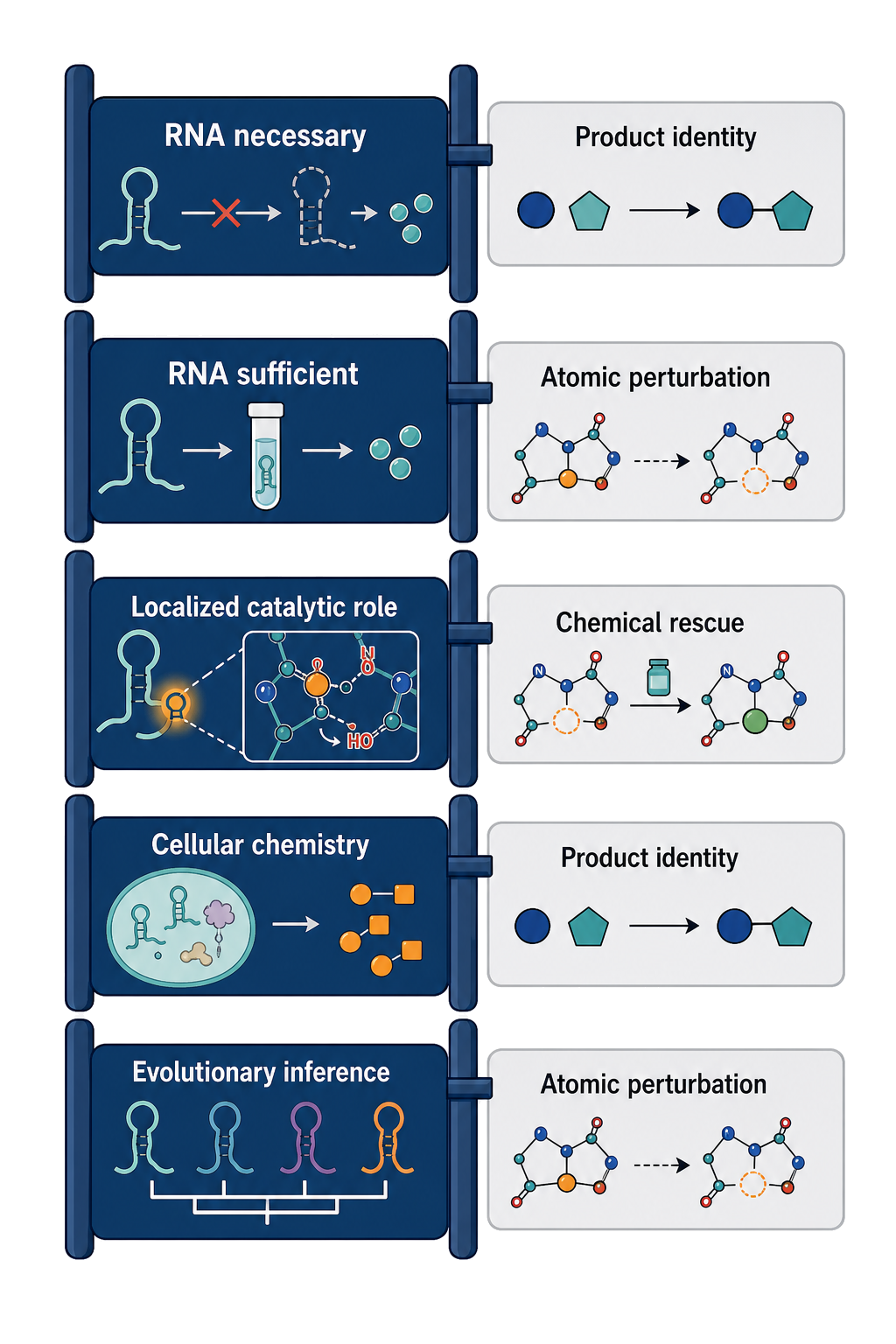
Figure 9.1. Evidence ladder for assigning catalytic RNA. Distinguish RNA necessity, RNA sufficiency, localized catalytic participation, cellular function, and evolutionary inference.
Table 9.1. What each catalytic-RNA evidence level establishes. Match experimental observations to bounded claims.
| Observation | Supported claim | Main unresolved alternative | Strong next test |
|---|---|---|---|
| RNA degradation abolishes holoenzyme activity | RNA is necessary | RNA may scaffold a protein catalyst | Component reconstitution |
| Purified RNA forms correct product | RNA is sufficient under stated conditions | Nonphysiological ions may replace proteins | Localized perturbation and rescue |
| Atomic RNA substitution changes chemical phase | Tested atom contributes locally | Subtle conformational change | Folding control and chemical rescue |
| Expected product depends on catalytic RNA in cells | Physiological catalytic function supported | Indirect RNA-fate effect | Cleavage-end mapping and inactive control |
| Fold and catalytic residues are homologous across lineages | Shared ancestry supported | Incomplete ancestral reconstruction | Phylogeny plus structural covariation |
9.2. General acid-base, metal-ion, electrostatic, and conformational catalytic strategies
Internal phosphoester transfer illustrates the core catalytic tasks. The 2’-hydroxyl nucleophile must lose a proton, its oxygen must approach the adjacent phosphorus nearly in line with the departing 5’-oxygen, negative charge must be stabilized as the phosphorus passes through a pentacoordinate-like transition state, and the leaving group must be protonated or otherwise stabilized. A spontaneous RNA backbone samples this geometry rarely. A ribozyme can accelerate cleavage by increasing the population of an in-line conformation, shifting acid–base equilibria, organizing charged groups, and excluding competing solvent arrangements.
General acid–base catalysis uses a group that accepts a proton from the nucleophile and another that donates a proton to the leaving group. RNA nucleobases have solution pKa values that are often far from neutrality, but active-site electrostatics and hydrogen bonding can shift them. Cytosine in the HDV ribozyme is a well-supported general-acid participant, while a hydrated metal ion or other group helps activate the nucleophile. Guanine bases participate prominently in several small ribozymes. Assignments require more than a bell-shaped pH-rate curve: pH can alter global folding, metal speciation, substrate ionization, and the fraction of active molecules.
Metal ions support RNA catalysis in two mechanistically distinct ways. Diffuse ions neutralize the phosphate backbone and permit tertiary folding. Site-bound ions can contact substrate oxygen atoms, activate water or a ribose hydroxyl, stabilize developing negative charge, or assist leaving-group departure. A rate that rises with magnesium concentration can reflect either role. Phosphorothioate interference replaces a nonbridging phosphate oxygen with sulfur; rescue by a thiophilic metal can implicate direct coordination, but stereochemistry, altered folding, and metal toxicity complicate interpretation. The strongest metal assignments combine stereochemically defined substitutions, rescue, structural occupancy, and kinetic effects that track the chemical step.
Electrostatic catalysis is broader than metal binding. Protonated bases, backbone phosphates, organized water, and cations create an electric field that preferentially stabilizes the transition state. The folded RNA need not form a protein-like hydrophobic pocket to organize charge. Nevertheless, high concentrations of magnesium or monovalent ions used in vitro can produce structures that are poorly populated in cells. Physiological polyamines, proteins, molecular crowding, and cotranscriptional folding can substitute partly for laboratory ionic conditions, so catalytic architecture should be distinguished from the conditions used to reveal it.
Conformational catalysis describes the reduction of entropic and geometric costs. Substrate-binding helices place the scissile bond near the active core; tertiary contacts lock peripheral elements; local nucleotide stacks orient attacking and leaving groups. The full-length hammerhead is much faster at moderate magnesium than the historically studied minimal motif because distal loops dock and stabilize the active structure. This lesson generalizes: deletion constructs can preserve a recognizable secondary structure while removing the interactions that make the natural catalyst kinetically competent.
Catalysis can be limited by conformational change. If an RNA folds slowly into an active state and cleavage is rapid once docked, k_obs reports docking. A mutation that slows folding may appear to remove a catalytic group even if the chemistry of the molecules that reach the active state is unchanged. Pulse–chase experiments, temperature jumps, single-molecule trajectories, and parallel probes of folding and cleavage help partition the pathway. Conversely, an apparently inactive fraction may exchange into the active population over hours; fitting one exponential and declaring the remainder permanently misfolded can be wrong.
No single catalytic vocabulary should be forced onto every ribozyme. The ribosome emphasizes substrate positioning and proton shuttling through substrate and RNA-organized water. RNase P performs hydrolysis with catalytic metal ions. The glmS ribozyme recruits a metabolite amine. Small self-cleavers combine nucleobase and metal effects in family-specific ways. Comparative enzymology is most informative when it identifies shared catalytic tasks while allowing different molecular solutions.
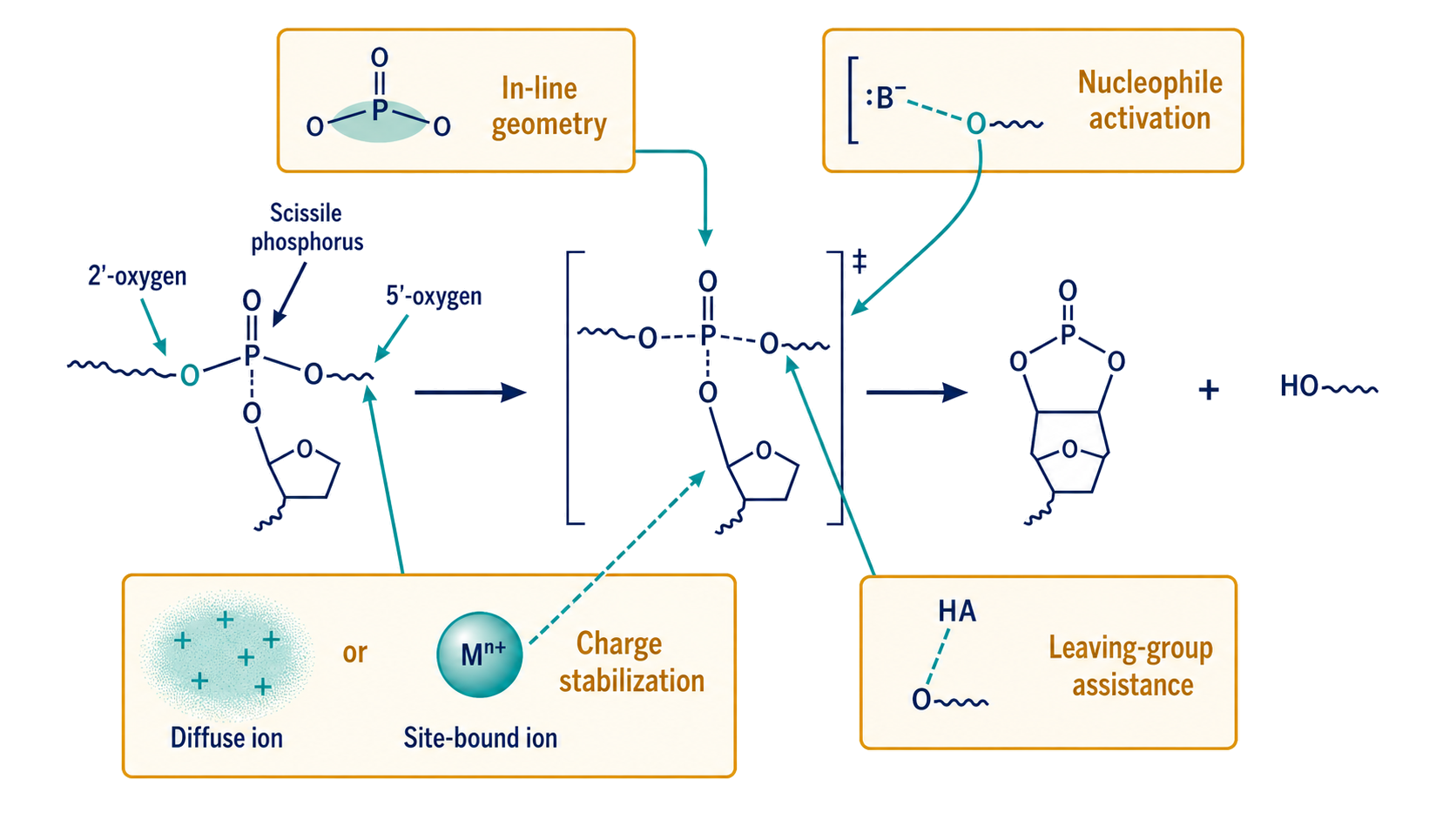
Figure 9.2. Four catalytic tasks during internal phosphoester transfer. Relate in-line geometry, nucleophile activation, transition-state charge stabilization, and leaving-group assistance to candidate RNA, ion, and cofactor strategies.
Table 9.2. Mechanistic probes and their interpretation limits. Prevent single-assay overinterpretation.
| Probe | Direct observable | Useful inference | Principal limit |
|---|---|---|---|
| pH-rate profile | Rate versus proton activity | Kinetically important ionizations | Folding and metal speciation also change |
| Magnesium titration | Rate or active fraction versus ion | Ion dependence | Structural and catalytic roles are merged |
| Phosphorothioate/rescue | Sulfur effect and ion-specific recovery | Candidate direct metal contact | Stereochemistry and geometry can change |
| Base analog | Localized chemical perturbation | Nucleobase functional-group role | Incorporation can alter folding |
| Solvent isotope effect | Proton-transfer sensitivity | Proton movement in rate-limiting pathway | Conformational exchange can contribute |
| Single-molecule docking | State occupancy and transitions | Conformational gating | Label and surface can perturb kinetics |
9.3. Small self-cleaving and self-ligating ribozyme families
Most small self-cleaving ribozymes catalyze the same net reaction: the 2’-oxygen attacks the adjacent phosphorus, the upstream fragment ends in a 2’,3’-cyclic phosphate, and the downstream fragment begins with a 5’-hydroxyl. This reaction is reversible. Ligation becomes appreciable when products remain aligned and when reaction conditions favor attack of the 5’-hydroxyl on the cyclic phosphate. Thus “cleaver” and “ligase” can describe kinetic bias rather than mutually exclusive chemical capacities.
The hammerhead ribozyme contains three helices meeting at a conserved catalytic core. Minimal constructs helped define sequence requirements but cleaved slowly at moderate ionic strength. Natural tertiary contacts between distal loops stabilize a conformation that positions the scissile phosphate and catalytic guanine residues, reconciling early structures with faster natural activity. Hammerheads occur in plant subviral RNAs, retroelements, and diverse genomes. Their biological consequences depend on transcript context, which belongs in Chapter 119 for pathogen-associated examples; the comparative active-site mechanism belongs here.
The hairpin ribozyme uses loop–loop docking to assemble its active site and can catalyze cleavage and ligation without an obligatory directly coordinated divalent metal. Nucleobases participate in proton transfer and transition-state stabilization. The VS ribozyme uses a substrate stem–loop recognized by a larger RNA scaffold and brings a guanine and adenine into a catalytic arrangement. Both illustrate how tertiary docking separates substrate recognition from the local chemical center. A trans-cleaving construct may retain chemistry while changing docking, product release, and specificity.
The HDV ribozyme adopts a compact nested-pseudoknot architecture. A conserved cytosine has a shifted ionization behavior and participates in general acid catalysis, while a metal ion contributes to nucleophile activation and electrostatic stabilization. HDV-like motifs occur beyond hepatitis delta virus, including cellular genomes. Sequence similarity alone can miss them because secondary and tertiary architecture conserve function despite substantial sequence change; comparative genomics therefore combines covariation, structural models, and biochemical validation.
The glmS ribozyme is both a metabolite sensor and self-cleaver. Glucosamine-6-phosphate binds in the active site, and its amine supplies chemical functionality that RNA itself lacks at neutral pH. Related metabolites may bind without catalyzing efficiently, separating affinity from cofactor competence. Because cleavage can trigger downstream RNA degradation in bacteria, the complete regulatory pathway extends beyond the chemical event and is owned by Chapter 79. The ribozyme is mechanistically important because it demonstrates recruitment of a cellular metabolite as a catalytic cofactor.
Comparative genomics uncovered twister, twister-sister, pistol, and hatchet ribozymes among additional families. These motifs expanded the known architectural solutions for internal phosphoester transfer. Twister structures revealed a compact active site that strongly organizes the scissile phosphate, although different constructs and crystal contacts initially yielded apparently different local conformations. Pistol and hatchet use distinct folds and catalytic residue arrangements. A family name should therefore predict evolutionary and structural relationships, not merely the reaction it performs.
Biochemical comparison requires matched conditions. Reporting one maximal rate for each family under different pH, temperature, salt, and construct design creates a misleading speed ranking. Full-length natural contexts, minimal constructs, and trans-cleaving derivatives can differ by orders of magnitude. Cleavage endpoints also depend on the fraction that folds correctly. A useful panel measures active fraction, ion dependence, pH dependence, substrate saturation, product rebinding, and end chemistry under common conditions while retaining family-specific optima.
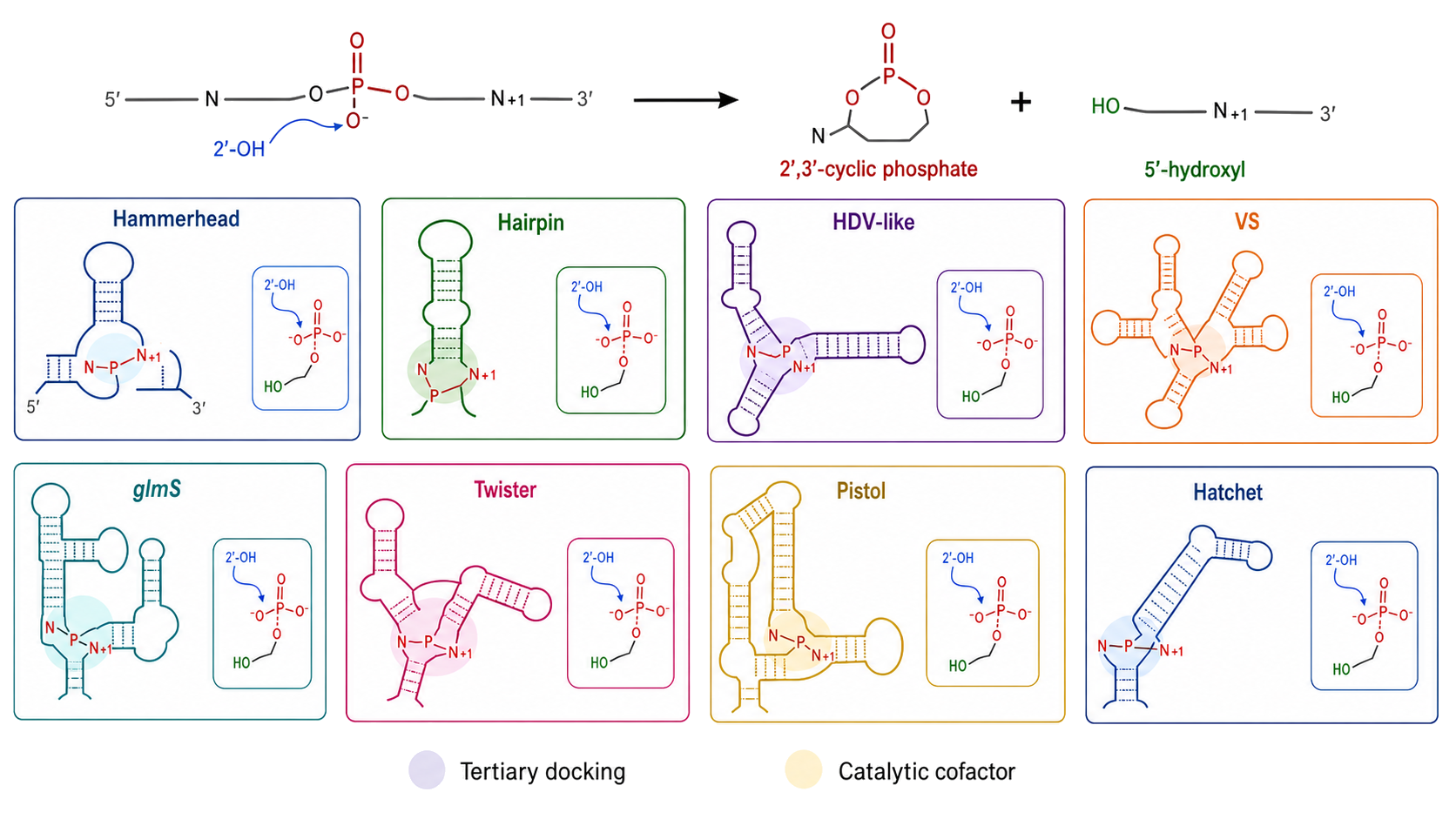
Figure 9.3. Shared products, distinct folds in small self-cleaving ribozymes. Compare hammerhead, hairpin, HDV, VS, glmS, twister, pistol, and hatchet without implying one common architecture.
Table 9.3. Small self-cleaving family comparison. Preserve shared chemistry and family-specific solutions.
| Family | Architectural feature | Prominent catalytic contribution | Boundary case |
|---|---|---|---|
| Hammerhead | Three stems plus peripheral contacts | Guanine-centered acid–base network and geometry | Minimal cores understate natural rate |
| Hairpin | Docking of two internal loops | Nucleobase acid–base/electrostatic catalysis | Divalent ions aid folding but need not contact phosphate |
| HDV-like | Nested pseudoknot | Cytosine general acid plus metal assistance | Cellular and viral motifs share architecture |
| VS | Substrate stem–loop docks to scaffold | Guanine/adenine-centered chemistry | Trans constructs alter docking and release |
| glmS | Metabolite pocket beside cleavage site | Glucosamine-6-phosphate amine cofactor | Binding affinity is not cofactor efficiency |
| Twister/pistol/hatchet | Distinct compact folds | Family-specific nucleobase and geometric solutions | Common product does not imply homology |
9.4. Group I and group II introns: splicing chemistry, structure, mobility, and protein assistance
Group I introns catalyze two sequential transesterifications. First, the 3’-hydroxyl of an exogenous guanosine attacks the phosphate at the 5’ splice site, releasing the upstream exon and attaching guanosine to the intron. The newly exposed 3’-hydroxyl of the upstream exon then attacks the 3’ splice site, ligating the exons and releasing a linear intron. The reaction conserves the number of phosphodiester bonds and does not require ATP for chemistry, although proteins and helicases can consume energy to assemble, remodel, or resolve the RNA in vivo.
The group I fold creates paired regions that recognize splice junctions and a conserved catalytic core that binds guanosine and catalytic metal ions. The internal guide sequence base-pairs with the 5’ exon, but base pairing alone cannot define the splice site: tertiary contacts and active-site geometry select the reactive phosphate. Two-metal-ion models explain how hydrated divalent ions activate nucleophiles and stabilize leaving groups. Metal substitutions and atomic mutagenesis support specific contacts, yet assigning every observed ion as catalytic requires care because the RNA contains many structural ion sites.
Group II introns usually splice through a branching pathway. A bulged adenosine within domain VI presents its 2’-hydroxyl to the 5’ splice site, generating a 2’-5’ branch and a lariat intron–3’ exon intermediate. The upstream exon 3’-hydroxyl then attacks the 3’ splice site to ligate exons. Some group II introns use hydrolysis instead of branching, so lariat formation is common rather than definitional. Conserved domain V supplies central catalytic ligands, and long-range interactions dock substrates around a metal-ion center.
Group II intron-encoded proteins commonly provide maturase and reverse-transcriptase activities. The maturase stabilizes the active RNA fold in vivo; after splicing, the ribonucleoprotein can recognize a DNA target, reverse-splice the intron RNA, and reverse-transcribe it. This mobility cycle explains why group II introns are both ribozymes and retroelements. Chapter 13 owns the evolutionary ecology and movement of these elements; this section owns how splicing chemistry and catalytic architecture enable that life cycle.
Group I and group II introns demonstrate why protein assistance does not negate RNA catalysis. An RNA may self-splice in a high-salt test tube but depend on proteins in a cell because transcription, competing folds, RNA-binding proteins, and low free magnesium change the folding landscape. Protein cofactors can stabilize native tertiary contacts, resolve kinetic traps, or bind exons without providing the groups that perform bond rearrangement. The appropriate mechanistic experiment measures which reaction step changes when the protein is removed or mutated.
These introns also discipline evolutionary inference. Structural and chemical parallels between group II introns and the spliceosome support a historical relationship, but a modern group II intron is not a frozen spliceosomal ancestor. Group I introns provide no simple universal template for early RNA biology merely because they self-splice. Chapter 8 evaluates RNA-world arguments, the availability of substrates and ions, and the difference between retained molecular relics and convergent solutions. The catalytic evidence here supplies constraints, not a complete origin narrative.
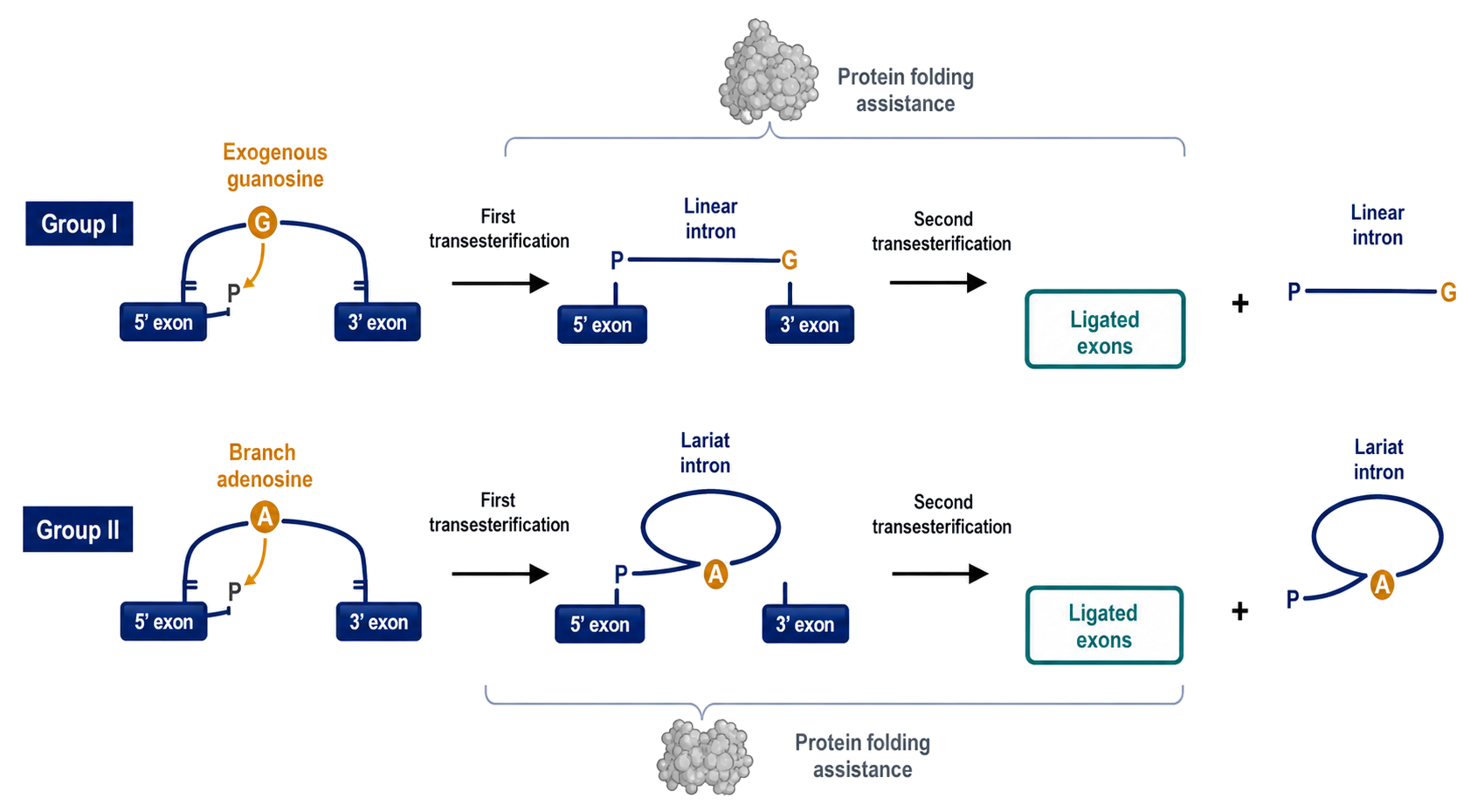
Figure 9.4. Two paths to exon ligation. Compare group I exogenous-guanosine splicing with group II branch-point/lariat splicing step by step.
Table 9.4. Group I and group II splicing chemistry. Map nucleophile, intermediate, product topology, and biological assistance.
| Feature | Group I intron | Group II intron |
|---|---|---|
| First nucleophile | Exogenous guanosine 3’-hydroxyl | Usually branch adenosine 2’-hydroxyl |
| First intermediate | Guanosine attached to linear intron–3’ exon | 2’-5’ lariat intron–3’ exon |
| Second nucleophile | Upstream exon 3’-hydroxyl | Upstream exon 3’-hydroxyl |
| Released intron | Initially linear | Usually lariat; hydrolytic pathways exist |
| Frequent protein help | Maturases and general RNA-folding factors | Intron-encoded maturase/reverse transcriptase |
| Mobility link | Homing endonucleases in many elements | Reverse splicing and reverse transcription |
9.5. RNase P, RNase MRP, and the changing division of labor between catalytic RNA and protein
RNase P removes 5’ leader sequences from precursor tRNAs by hydrolysis. Water attacks the scissile phosphate, generating a mature tRNA with a 5’-phosphate and a leader with a 3’-hydroxyl. This end chemistry differs from the cyclic-phosphate/5’-hydroxyl products of small self-cleaving ribozymes and reflects a different catalytic strategy. Correct cleavage must recognize a three-dimensional tRNA-like substrate and choose a bond at the boundary of the mature acceptor stem.
In bacteria, the holoenzyme contains one large catalytic RNA and a small protein. Purified RNA can catalyze cleavage at high ionic strength, establishing that RNA houses the chemical center. The protein improves activity under physiological conditions by stabilizing RNA structure, contacting the leader, increasing substrate affinity, and suppressing incorrect interactions. In archaea and eukaryotic nuclei, RNase P contains more proteins; the RNA retains a conserved catalytic core, but division of labor shifts toward protein-supported assembly, substrate recognition, and regulation.
Reaction-state structures reveal a preorganized RNA scaffold around the substrate and metal-ion center. Conserved RNA elements recognize the tRNA elbow and acceptor-end geometry, while bacterial protein contacts the 5’ leader. Catalytic magnesium ions participate in hydrolysis and charge stabilization. A crystal or cryo-EM density assigned as metal remains a model constrained by resolution and chemistry; metal rescue, ion competition, and kinetic perturbations are required to connect occupancy to function.
Protein-only RNase P enzymes in human mitochondria and some other systems show that the same biological reaction can be reinvented. These enzymes are not protein versions of the same ribozyme mechanism in a strict structural sense. They replace the RNA-based catalyst while retaining the processing outcome. This evolutionary replacement is a boundary case that refutes any claim that precursor-tRNA 5’ maturation is universally ribozyme-catalyzed. Chapter 39 owns how cleavage is coordinated with the rest of tRNA maturation; this chapter owns the comparative chemistry and changing RNA–protein labor.
RNase MRP is a related eukaryotic ribonucleoprotein with an RNA related to RNase P RNA and a partially shared protein inventory. RNase MRP participates prominently in precursor-rRNA processing and has other context-dependent substrates. Its cleavage specificity and catalytic mechanism are less completely reconstructed than bacterial RNase P. Similarity of RNA core and components supports homology and a related catalytic strategy, but it does not justify transferring every RNase P substrate-recognition rule to MRP.
Assays must distinguish cleavage-site choice from total activity. A mutant can retain cleavage while shifting the cut by one nucleotide, which may be biologically severe even if an end-point gel reports similar product abundance. Pre-steady-state time courses, leader-sequence variants, mature-domain variants, and metal titrations can partition binding, positioning, chemistry, and product release. Cellular depletion adds evidence for physiological ownership but can produce indirect effects through tRNA shortage, ribosome stress, or organellar dysfunction. Mechanistic claims should join reconstitution to genetics rather than substitute one for the other.
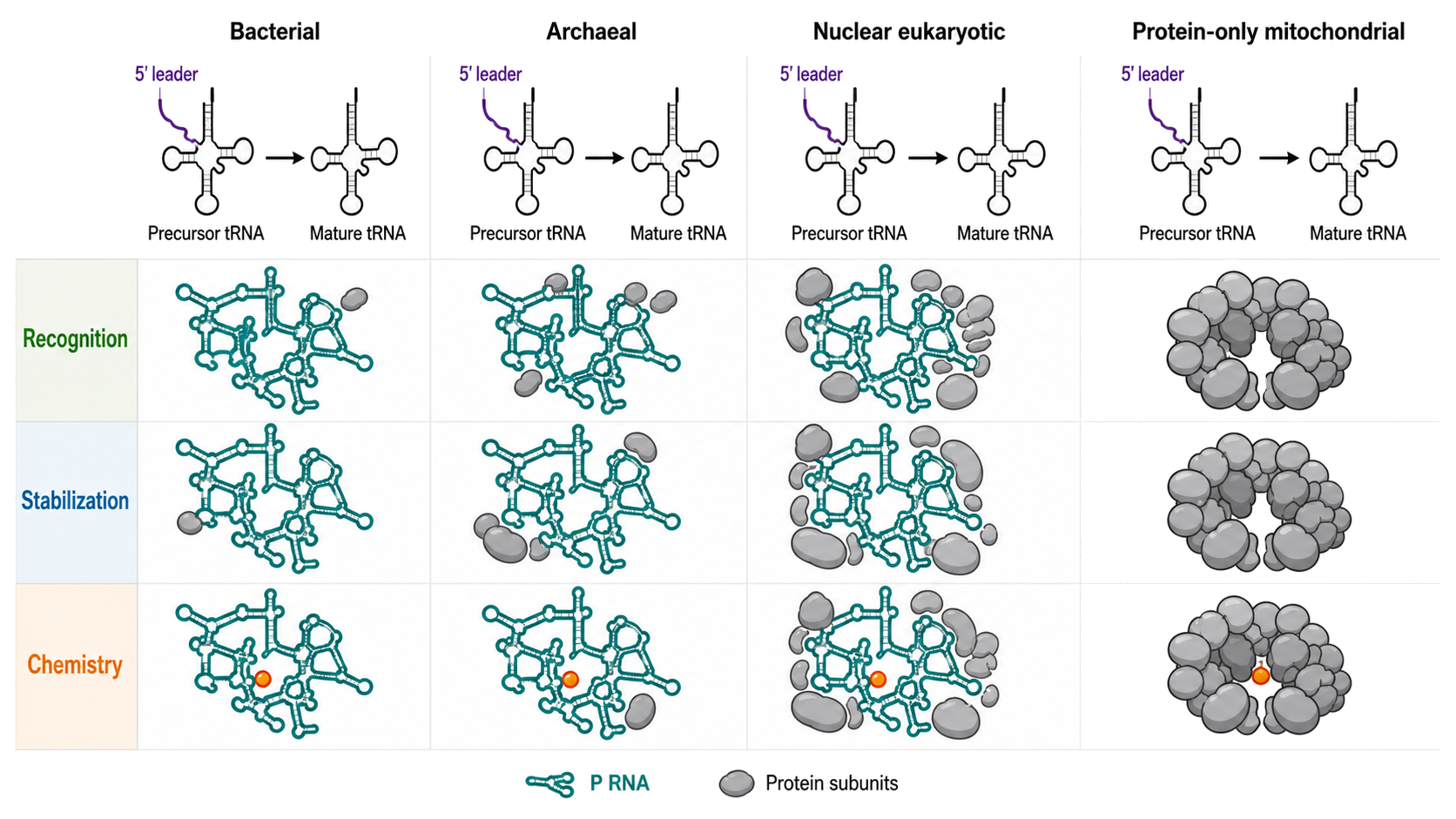
Figure 9.5. Evolutionary redistribution of labor in RNase P systems. Separate conserved processing outcome from changing catalyst composition.
9.6. RNA-centered catalysis in the ribosome and spliceosome
The ribosome catalyzes peptide-bond formation by positioning aminoacyl-transfer RNA (tRNA) substrates in the peptidyl transferase center of the large subunit. The alpha-amino group of the A-site aminoacyl-tRNA attacks the carbonyl carbon of the ester linking the growing peptide to the P-site tRNA. The products are a one-residue-longer peptidyl-tRNA in the A site and a deacylated tRNA in the P site. No covalent ribosomal intermediate forms. The reaction is thermodynamically driven by the activated aminoacyl ester and is accelerated by precise substrate orientation, exclusion and organization of water, and a proton-transfer network.
High-resolution structures place the reactive ends of both tRNAs in an active site built almost entirely from large-subunit ribosomal RNA. Protein side chains do not occupy the immediate chemical center. The 2’-hydroxyl of the P-site tRNA A76 participates in a proton shuttle, making the substrate itself part of the catalytic apparatus. Ribosomal RNA nucleotides position this network and stabilize the transition-state geometry. Describing the ribosome as a ribozyme is therefore justified at the catalytic-center level, while describing it as “RNA alone” would erase essential proteins, assembly pathways, and long-range dynamics.
Peptidyl-transfer kinetics require separation from accommodation and translocation. In complete translation assays, aminoacyl-tRNA selection and movement into the active center can limit the observed rate. Rapid-quench experiments with preassembled complexes and substrate analogs isolate chemical steps more directly. Transition-state analog structures reveal geometry but cannot reproduce every charge and proton-transfer event. Mutating rRNA often disrupts assembly, so a translation defect does not automatically identify a catalytic nucleotide. Atomic mutagenesis, substrate modifications, pH dependence, and rescue within intact ribosomes give more localized evidence. Chapter 68 owns the complete elongation cycle, fidelity, pausing, and cotranslational consequences.
The spliceosome catalyzes the same net two transesterifications as a branching group II intron. The branch-point adenosine attacks the 5’ splice site to form a lariat intermediate; the 5’ exon then attacks the 3’ splice site to ligate exons. U2 and U6 small nuclear RNAs form central catalytic architecture, and U6 RNA ligands organize two divalent metal ions. Proteins stabilize, inspect, and remodel this RNA center across the splicing cycle. The catalytic core is therefore RNA-centered, but the active spliceosome is an obligate and highly dynamic ribonucleoprotein.
Structural similarity between the spliceosomal U2/U6 core and group II intron domain V includes metal-binding geometry and substrate arrangement. This evidence supports evolutionary homology, reinforced by the shared lariat chemistry. It does not make the modern systems mechanistically identical. The spliceosome assembles in trans from multiple RNAs and proteins, uses adenosine triphosphate-dependent helicases for fidelity and transitions, and repeatedly rebuilds its active center. Group II introns integrate much of the architecture in one RNA and often a maturase. Chapter 27 owns splice-site recognition, assembly, proofreading, and regulated alternative splicing; this chapter owns the bond chemistry and RNA-centered active-site comparison.
Both machines illustrate substrate-assisted catalysis. The ribosomal A76 ribose participates directly in proton transfer, and the spliceosomal branch adenosine supplies the attacking nucleophile. A catalyst is not a passive holder when it exploits substrate functional groups; it shapes their ionization, alignment, and reaction path. This also complicates mutational interpretation because changing a substrate atom can alter binding and chemistry together. Mechanistic studies need matched nonreactive analogs, equilibrium binding measurements, and kinetic models that do not treat substrate affinity as the only role of RNA contacts.
The term “ribozyme” thus operates at different organizational scales. For a hammerhead, one RNA includes catalyst and substrate in cis. For RNase P, an RNA–protein enzyme acts in trans. For the ribosome and spliceosome, RNA builds the immediate catalytic center inside a much larger machine. The common claim is specific: RNA atoms create essential transition-state organization. The claim does not imply equal autonomy, equal evolutionary age, or equal sensitivity to protein removal.
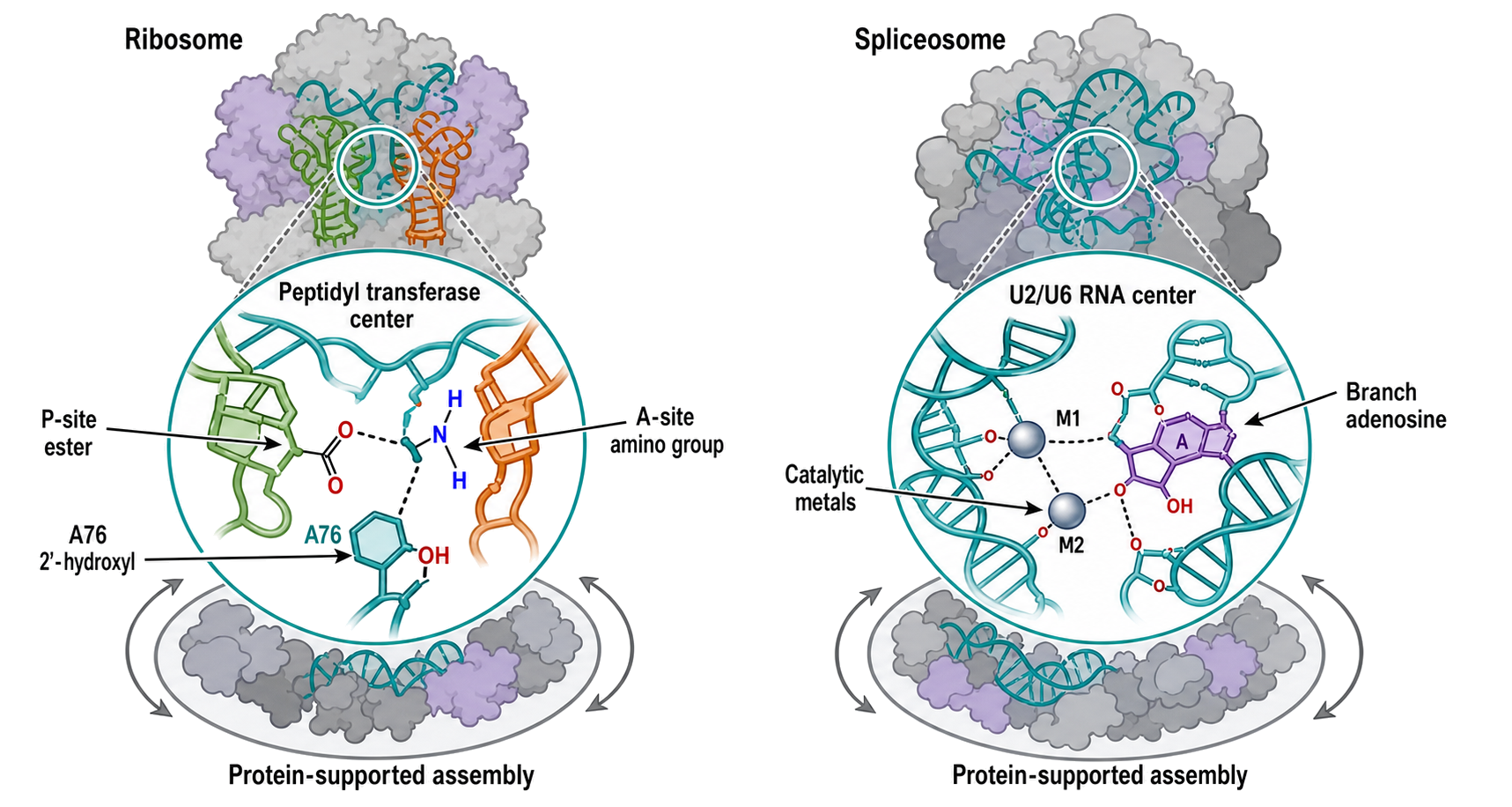
Figure 9.6. RNA-centered catalysis inside two molecular machines. Compare the ribosomal peptidyl transferase center and spliceosomal U2/U6 center at the correct organizational scale.
Table 9.5. RNA-centered catalysis at different organizational scales. Use one vocabulary without erasing system architecture.
| System | Chemical reaction | RNA contribution | Protein contribution | Autonomy statement |
|---|---|---|---|---|
| Hammerhead | Internal phosphoester transfer | Complete compact active fold | Context-specific binding/fate | RNA can be sufficient |
| Group II intron | Two splicing transesterifications | Catalytic domains and substrate docking | Folding, mobility, regulation | Some RNAs self-splice in vitro |
| RNase P | Precursor-tRNA hydrolysis | Active scaffold and metal center | Substrate recognition and stabilization | Lineage-dependent RNP |
| Ribosome | Peptide-bond formation | Immediate peptidyl transferase center | Assembly, architecture, dynamics | Obligate molecular machine |
| Spliceosome | Branching and exon ligation | U2/U6 metal-binding center | Assembly, fidelity, remodeling | Obligate dynamic RNP |
9.7. Metabolite-responsive, cofactor-dependent, and gene-regulatory ribozymes
A ligand can affect ribozyme chemistry in at least three ways. It can bind at a remote aptamer and shift folding, bind near the active site without participating chemically, or provide a functional group used in the reaction. These mechanisms produce different relationships among binding affinity, ligand concentration, and cleavage rate. A regulatory response curve alone cannot identify which mechanism operates. Direct binding measurements, ligand analog series, structures, and chemical rescue are needed to distinguish allostery from cofactor chemistry.
The glmS ribozyme provides the clearest natural example of a small-molecule chemical cofactor. Glucosamine-6-phosphate binds in a conserved pocket adjacent to the scissile phosphate. Its protonated amine can donate a proton during cleavage, while the RNA positions the metabolite and reacting backbone. Glucose-6-phosphate preserves much of the shape and charge but lacks the amine and is far less effective, showing that ligand binding and catalytic function are separable. The RNA is still a catalyst: it creates the binding pocket, aligns the cofactor, and organizes the reaction.
In many Gram-positive bacteria, glmS cleavage reduces expression of the glucosamine-6-phosphate synthetase gene when product accumulates. Cleavage exposes RNA ends that are handled by cellular decay enzymes. The chemical event and regulatory outcome must be distinguished. A mutant that reduces cleavage may change mRNA abundance, but the magnitude depends on transcription, nuclease access, growth condition, and metabolite pools. Chapter 79 treats this feedback loop as riboswitch biology; this section compares the cofactor-dependent active site with other ribozyme strategies.
Other natural regulatory self-cleavers illustrate kinetic coupling. A ribozyme positioned in an untranslated region, intron, or intergenic transcript can affect termination, splicing, stability, or translation if cleavage competes effectively with RNA synthesis and processing. The biologically relevant quantity is not the maximum in vitro rate alone. It is the probability of cleavage within a cellular time window, given cotranscriptional folding, ligand availability, proteins, ions, and alternative structures. A tenfold rate change may have little regulatory effect when both states cleave after the transcript has already committed to another pathway.
Engineered aptazymes make the coupling explicit. A selected or natural aptamer is connected to a self-cleaving ribozyme through a communication module. Ligand binding stabilizes either the active or inactive fold, producing ON or OFF behavior in a reporter. Modularity is incomplete: aptamer, linker, ribozyme, expression context, and host RNA decay machinery interact. A communication stem that functions in yeast may fail in mammalian cells because transcriptional environment, temperature, magnesium, RNA-binding proteins, and decay pathways differ.
RNA can also use protein or nucleic-acid binding as an allosteric input. These devices are valuable for biosensing and synthetic circuits, but a response should be decomposed into affinity, conformational coupling, cleavage chemistry, and downstream reporter gain. High fold-change can arise from strong degradation after a modest cleavage shift. Conversely, a chemically excellent switch can give a weak reporter if both products remain stable. Quantifying each layer prevents the downstream biological amplifier from being misreported as intrinsic ribozyme allostery.
Cofactor dependence invites evolutionary speculation because nucleotide-derived metabolites and metal ions are ancient cellular currencies. Modern cofactor-assisted ribozymes show chemical plausibility, but they do not establish the order in which metabolism and RNA catalysis arose. Availability, stability, stereochemistry, compartmentalization, and selection all matter. Those origin questions belong in Chapter 8. Here the secure conclusion is narrower: folded RNA can recruit non-RNA chemistry and use it in a defined active site.
Table 9.6. Ligand roles in responsive ribozymes. Distinguish binding, allostery, and direct cofactor chemistry.
| Ligand role | Predicted relationship | Diagnostic experiment | Example or boundary |
|---|---|---|---|
| Remote allosteric effector | Occupancy shifts active-state fraction | Matched binding and cleavage curves | Engineered aptazyme |
| Active-site binder | Affinity can stabilize reactive geometry | Analog series and reaction-state structure | Ligand may bind yet be chemically inert |
| Catalytic cofactor | A ligand functional group changes chemical step | Functional-group removal and rescue | glmS/glucosamine-6-phosphate |
| Downstream reporter input | Small cleavage shift becomes large expression change | Directly measure cleavage and RNA fate | Reporter gain is not intrinsic catalysis |
9.8. In vitro selection, engineered ribozymes, aptazymes, therapeutics, and synthetic biology
The generic selection cycle is simple to state: create a diverse library, expose it to a selection condition, partition retained from discarded molecules, copy the survivors, and repeat with inherited or introduced variation. Chapter 137 owns that general workflow, including library design, SELEX partition platforms, amplification, sequencing, and population analysis across aptamers and other functional RNAs. Catalytic selections add a stricter requirement. The intended chemical reaction must create the property used for partition, and the reacted molecule must remain physically or informationally linked to the sequence that caused the reaction. Otherwise, the experiment enriches binding, carryover, or a diffusible product rather than a catalyst.
This requirement is called genotype–product linkage. In a self-modifying selection, each candidate RNA carries or encounters a substrate and successful chemistry adds a capture handle, changes molecular length, exposes a previously blocked group, or creates another separable product while leaving the candidate sequence recoverable. A ligase selection can tether one reactant to the candidate so that bond formation appends a tagged oligonucleotide to the same molecule. A cleavage selection can place the candidate and scissile substrate in one construct and recover the product-bearing portion that still contains the variable region or a linked barcode. If catalysis acts on a freely diffusible substrate in trans, product and catalyst separate unless a compartment, particle, or other local barcode confines them together. Reaction-product linkage is therefore not merely a convenient assay feature; it is the causal bridge that converts chemical activity into heritable enrichment.
The reaction and partition should be written as an explicit scheme before the pool is designed. A minimal tethered scheme is unreacted genotype–substrate, G-S, converting to a linked product state, G-P, followed by a partition that recovers G-P and rejects G-S. A trans scheme includes binding, chemistry, product release, and catalyst recycling: G + S ⇌ G·S → G·P → G + P. A capture step that recognizes P alone breaks genotype linkage unless P remains confined with G. Each arrow introduces alternatives. G-S may bind the capture reagent without reaction; S may undergo uncatalyzed background chemistry; the tether may hydrolyze; G-P may be lost during handling; or unreacted G-S may leak through the partition. No-RNA, no-substrate, inactive-pool, no-cofactor, and zero-time controls locate these background routes. Direct chemical analysis is needed because capture establishes a selectable property, not necessarily the intended bond and regiochemistry.
Substrate tethering trades clean inheritance for mechanistic realism. Tethering raises effective molarity and restricts relative orientation, so a weak or nonspecific intramolecular reaction can survive even when two free molecules would rarely meet. It can also convert a binding problem into a unimolecular folding problem and remove the need for product release. The selected catalyst may therefore be excellent in cis but poor in trans. A defensible engineering path first confirms the tethered product, then shortens or flexibilizes the linker, reduces substrate preorganization, tests a free substrate, and, when turnover matters, imposes a selection in which repeated product formation improves recovery. Direct selection of cis adenylyl-transferase activity followed by engineering into a site-specific trans-acting RNA-labeling catalyst illustrates this distinction; trans-acting phosphorylation ribozymes likewise require kinetic characterization with exogenous substrate rather than extrapolation from a linked precursor.
The initial pool constrains discovery, but catalytic pools have a second bottleneck after synthesis: the inactive majority can travel through the protocol. Random-region length sets fold diversity, yet only a minute fraction of sequence space is physically sampled. Fixed primer-binding regions can form catalytic or inhibitory structure. During early rounds, a permissive partition is often used to avoid losing rare catalysts; the cost is inactive-pool carryover. Even a small nonspecific recovery fraction can dominate when true catalysts are rare. Background reaction accumulated during long incubations can create authentic product without meaningful rate enhancement, while product generated before the intended start time can blur zero-time selection. Recovery should therefore be quantified in every round, compared with background controls, and tightened only when active material can survive the bottleneck. An abrupt stringent step can eliminate slow but evolvable lineages; permanently weak partitioning can enrich passengers.
Selection pressure is meaningful only through the reaction scheme. For a single irreversible event with a homogeneous active population, the reacted fraction after time t is approximately 1 - exp(-k_obs t). At long times, fast and slow catalysts may both reach the same endpoint, so selection favors yield, active fraction, stability, or survival rather than rate. Shortening reaction time increases pressure on the steps contributing to k_obs, which may include folding, substrate binding, docking, and chemistry. Lowering substrate concentration can emphasize capture and catalytic efficiency rather than saturated chemistry. Requiring multiple product molecules per genotype can impose turnover, whereas a one-product tethered capture cannot distinguish a single-use catalyst from a recycling enzyme. Counterselection against related substrates, missing cofactors, or absent allosteric ligands can favor selectivity, but overly strong counterselection may remove broadly useful scaffolds before specificity-enhancing mutations arise. The selected phenotype must therefore be named precisely: endpoint yield, first-event rate, catalytic efficiency, turnover, chemical selectivity, substrate selectivity, cofactor dependence, or robustness across conditions.
Amplification creates a second fitness landscape. A short deletion product, primer dimer, or rearranged template can replicate faster while retaining enough sequence to pass recovery; such molecules are amplification parasites. Highly structured or chemically modified catalysts may reverse-transcribe poorly and disappear despite superior chemistry. In an amplification-only competition of structured RNA libraries, reverse-transcriptase choice produced cumulative enrichment bias even without external functional selection, demonstrating that copying bias can overwhelm true selective advantage. Useful controls include amplification-only rounds, synthetic spike-ins spanning structure and abundance, full-length size selection, redesigned primer sites, lower-cycle amplification, replicate lineages, and round-by-round sequencing. These controls diagnose copying fitness; they do not replace catalytic measurement.
Inactive-pool carryover and parasites can interact. If a fast-amplifying passenger leaks through partition at a low but constant fraction, exponential copying can let it outgrow a slowly copied catalyst. Conversely, a chemically excellent sequence can be lost because product recovery damages it or reverse transcription stalls on its structure. Observed read abundance is therefore the product of at least four probabilities: reaction under the imposed condition, survival through partition and handling, successful reverse transcription or other copying, and amplification into the next pool. Deep sequencing can reveal lineage trajectories and convergent motifs, but enrichment is an assay-specific composite, not a direct rate measurement. Reconstructing ancestors and intermediates is useful only after independently synthesized molecules have been tested under the relevant chemistry.
Selected products must be verified at two levels. First, product identity should be established by mass, mobility, nuclease or end-group sensitivity, chromatographic behavior, or spectroscopy appropriate to the reaction. A ligation band does not by itself prove a 3′-5′ phosphodiester rather than a 2′-5′ linkage or a noncovalent complex; a capture tag does not prove that the expected atom formed the bond. The selected ligases using 2-aminoimidazole-activated substrates were strengthened by showing that independently prepared winners required substrate activation and generated the specified phosphodiester product rather than merely surviving capture. Second, the candidate sequence must be independently resynthesized, purified away from the selected pool, refolded under declared conditions, and tested in a time course with no-catalyst, inactive-mutant, background-reaction, and contamination controls.
Kinetic resynthesis asks what was actually improved. Tethered and untethered formats should be compared when trans activity is claimed. Single-turnover measurements distinguish binding and first-event chemistry from active fraction; multiple-turnover measurements test product release and recycling. Varying substrate concentration separates saturated rate from catalytic efficiency, and counter-substrate panels measure selectivity. Initial rates and complete time courses are more informative than a single selected endpoint. Resynthesized winners may display lower intrinsic rates than their enrichment suggested, yet still have high selection fitness because they recover or amplify efficiently. Conversely, a fast purified catalyst can lose in the selection because it is hard to copy. Selected fitness is therefore inseparable from the assay that defined it.
Selected ribozymes have catalyzed RNA ligation, phosphorylation, nucleotide synthesis, aminoacylation, carbon–carbon bond formation, covalent labeling, and other reactions. These achievements demonstrate chemical possibility under designed conditions. They do not imply that natural evolution explored the same sequence, substrate activation, or selection path. Substrates may be tethered at effective concentrations far above solution values, leaving groups may be laboratory-activated, and metal concentrations may be nonphysiological. Such catalysts are mechanistic probes and engineering parts; their relevance to early evolution requires the environmental analysis owned by Chapter 8. The generic population workflow and platform choices belong to Chapter 137, while this chapter retains the reaction-specific question: which chemistry, kinetic step, or engineering property did the selection make heritable?
Engineering often converts a cis-cleaving motif into a trans-cleaving enzyme by separating the substrate strand and installing recognition arms. Longer arms increase affinity but can slow product release, creating a specificity–turnover tradeoff. Mismatches near the cleavage site may improve discrimination but can also disrupt active docking. Chemical modification can increase stability in cells while altering folding or catalytic pKa values. The design loop should measure binding, chemical cleavage, product release, nuclease resistance, localization, and cellular consequences rather than optimize only an end-point gel.
Aptazymes add a ligand-sensing layer, and expression platforms add a biological transfer function. Synthetic circuits use cleavage to control RNA stability, translation, transcription termination, guide-RNA release, or transcript processing. Multiple devices can implement logic, but their outputs share cellular nucleases and RNA-binding factors, creating load and context dependence. Insulators and standardized expression contexts help, yet every host and compartment requires recalibration. Chapter 147 owns the larger design-build-test framework; this section supplies the catalyst-specific design variables.
Therapeutic ribozymes aim to cleave a disease-associated RNA or process a therapeutic transcript. Sequence recognition is necessary but not sufficient. Target structure and protein occupancy limit access; products may religate; intracellular magnesium differs from buffer; delivery and endosomal escape determine exposure; innate sensing and off-target cleavage affect safety. A cellular reduction in target RNA does not prove direct ribozyme chemistry without cleavage-site mapping, catalytically inactive controls, dose–response analysis, and rescue. Chapter 154 owns modality comparison, pharmacology, manufacturing, clinical evidence, and regulation.
Engineering can also exploit self-cleavage to generate precise RNA ends. Ribozyme-flanked guide RNAs and circular-RNA production schemes use predictable processing without asking the ribozyme to turn over on a separate target. In these applications, yield, end identity, side products, ligation competition, and residual ribozyme sequence are the critical outputs. A fast cleavage rate may lower final product if cleavage occurs before a required folding or ligation step. Process design must optimize the entire reaction network.
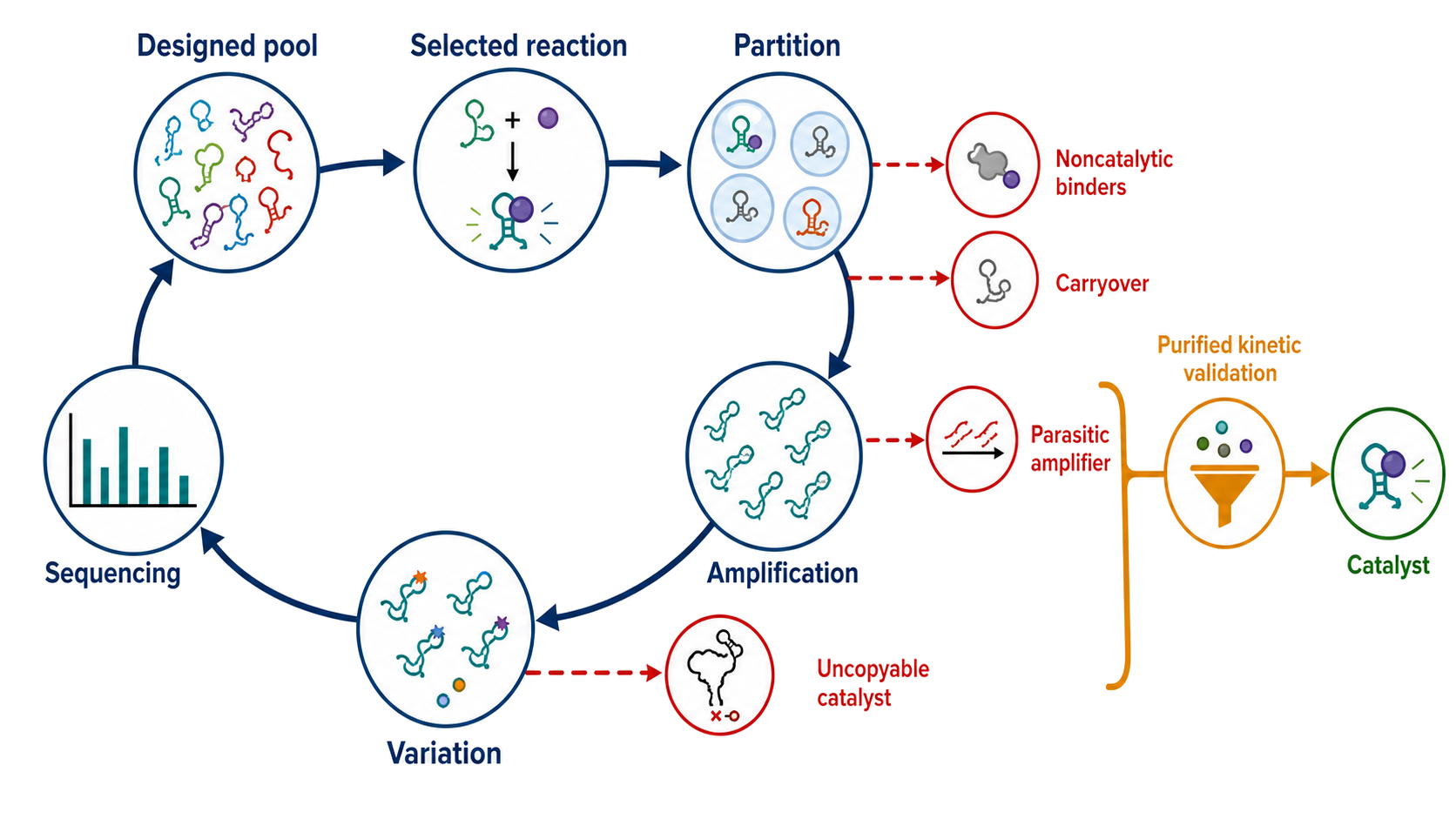
Figure 9.7. In vitro selection as a conditional evolutionary filter. Show how pool design, selectable chemistry, genotype–phenotype linkage, recovery, and amplification shape winners.
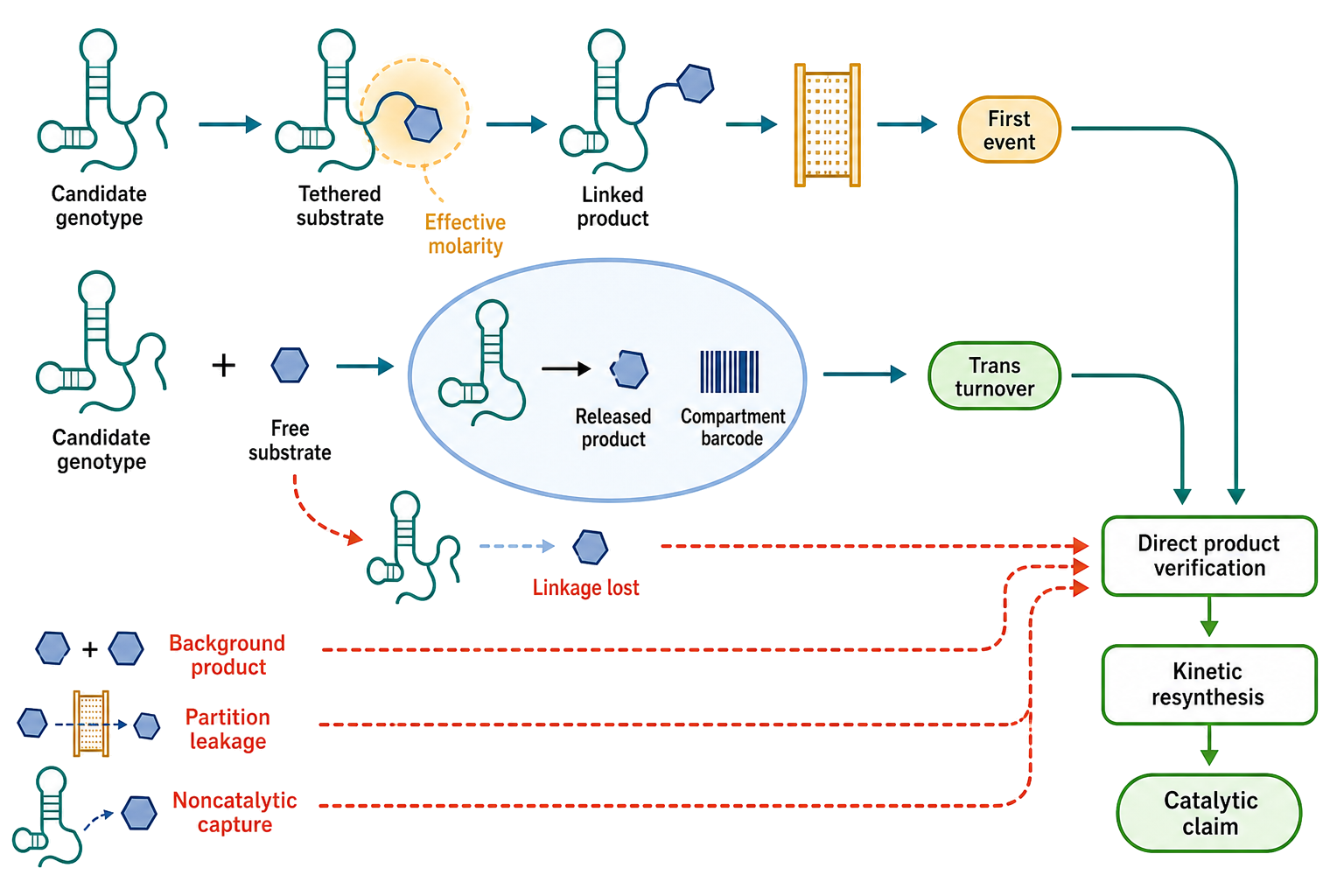
Figure 9.8. Genotype–product linkage determines what a catalytic selection can see. Compare how tethered cis selection and compartmentalized trans selection convert chemistry into heritable recovery, while locating routes that create false enrichment.
Table 9.7. Selection and engineering failure modes. Connect apparent success to controls.
| Failure mode | Why it wins or appears active | Diagnostic | Design response |
|---|---|---|---|
| Noncatalytic binder | Retained with product or capture reagent | Product chemistry and stringent wash | Counterselection and covalent product test |
| Background chemistry | Authentic product accumulates without meaningful RNA rate enhancement | Zero-time, no-RNA, no-cofactor, and time-dependent background controls | Shorten reaction; change activation chemistry; subtract measured background |
| Inactive-pool carryover | Unreacted molecules leak through permissive partition | Quantify recovery from an inactive control pool | Improve separation; tighten gradually; track leakage each round |
| Parasitic amplifier | Copies faster than active sequences | Round-resolved abundance without activity | Emulsion or redesigned primers |
| Reverse-transcription bias | Structured active RNAs copy poorly while easier templates accumulate | Amplification-only competition and structured spike-ins | Change RT/conditions; reduce cycles; require full-length cDNA |
| Tether-dependent catalyst | High effective molarity supports reaction | Untethered substrate kinetics | Select progressively less tethering |
| Wrong covalent product | Capture or gel shift cannot distinguish linkage or regioisomer | Mass, end-group tests, nuclease mapping, or spectroscopy | Make direct product identity a validation gate |
| Pressure mismatch | Long endpoint selection cannot distinguish fast from slow catalysts | Resynthesize winners and compare complete time courses | Shorten time or redesign recovery around the intended kinetic variable |
| Inactive cellular construct | Misfolding or inaccessible target | Structure/accessibility and cleavage-site assay | Redesign arms and expression context |
| Slow product release | Affinity prevents turnover | Single- versus multiple-turnover comparison | Shorten or destabilize product arms |
| Reporter-only effect | RNA fate changes without intended chemistry | Inactive catalyst and end mapping | Orthogonal product assay |
Table 9.8. What catalytic-selection pressures actually favor. Map experimental levers to the kinetic or chemical phenotype they can enrich and to the main confounder.
| Selection lever | Phenotype favored when linkage is valid | Main confounder | Required postselection test |
|---|---|---|---|
| Shorter reaction time | Larger reacted fraction at early times; faster contributing steps | Folding or binding may limit k_obs rather than chemistry |
Complete time course and step-resolving kinetics |
| Longer reaction time | Endpoint yield, active fraction, stability | Slow background can erase rate differences | Measured background and initial-rate comparison |
| Lower free-substrate concentration | Binding plus catalytic efficiency | Tethered substrate bypasses concentration dependence | Substrate titration in trans |
| One linked product per genotype | Successful first catalytic event | Cannot distinguish single use from recycling | Multiple-turnover kinetics |
| Product-count-coupled compartment | Repeated product formation and turnover | Compartment size and leakage alter apparent productivity | Bulk turnover and product-release measurements |
| Counterselection against analog | Substrate, cofactor, or ligand selectivity | Loss of evolvable generalist intermediates | Quantitative specificity panel |
| Alternating ions or temperatures | Robustness across conditions | Moderate generalists can beat specialists | Matched-condition rate matrix |
| Stringent capture or washing | Retention of desired product state | Affinity for matrix can masquerade as catalysis | Orthogonal product chemistry |
| Fewer amplification cycles or neutral RT | Reduced copying advantage | Rare true catalysts may remain below detection | Spike-ins and replicate selection lineages |
9.9. Kinetics, structures, assays, evolutionary inference, failure modes, and open questions
A kinetic experiment begins with a reaction scheme. For a trans-cleaving ribozyme, substrate binds, the complex may rearrange, chemistry occurs, products undock, and catalyst recycles. Under single-turnover conditions, excess active ribozyme can make binding fast, but the observed phase may still include docking. Under multiple-turnover conditions, a rapid chemical step can be hidden by slow product release. Measuring both regimes, varying substrate and catalyst independently, and using pulse–chase experiments can locate the limiting step. Reporting only the fastest fitted constant discards the active fraction and alternative phases needed to reproduce the mechanism.
Active concentration is often uncertain because some RNA is misfolded. Burst amplitude can estimate active catalyst when chemistry precedes slow turnover. Native gels, chemical probing, and single-molecule experiments can identify multiple conformers, but each assay perturbs the ensemble differently. Refolding by heat and magnesium addition is a protocol, not proof of a unique native state. Cotranscriptional folding can favor pathways unavailable to a fully synthesized RNA abruptly exposed to ions. Cellular activity should therefore be measured rather than inferred from one refolding recipe.
pH-rate profiles can identify the number and approximate ionization ranges of kinetically important groups. A single rising limb suggests that deprotonation activates the reaction; a falling limb can implicate a required protonated group. Apparent pKa values may belong to nucleobases, metal-bound water, substrate groups, or coupled conformational equilibria. Solvent isotope effects and site-specific base analogs can strengthen assignments. Mutation that removes activity is weakest by itself because it can disrupt folding, binding, or active-site geometry.
Metal-ion experiments need ionic-strength controls. Magnesium titration can change both folding and chemistry; cobalt hexammine can sometimes support electrostatic compaction without inner-sphere coordination; manganese or cadmium can rescue sulfur substitutions but may alter other steps. A metal-rescue result is most persuasive when the atomic substitution is stereochemically defined, the rescuing ion restores the predicted kinetic phase, and structure or spectroscopy places the interaction near the reactive center. Lack of rescue does not disprove metal involvement if the substitution changes geometry irreversibly.
Product validation prevents false chemistry. Denaturing gels can confuse cleavage with degradation or abortive transcription. Sequencing can map a boundary but usually loses terminal chemical information. Mass spectrometry can establish product mass while still requiring localization of isomers. Enzymatic end tests and ligation competence distinguish 5’-hydroxyl, 5’-phosphate, 3’-hydroxyl, and cyclic-phosphate states. For splicing, both junctions, exon ligation, and intron topology should be measured. For peptide-bond formation, substrate hydrolysis and nonenzymatic aminolysis are essential controls.
Structures should represent a reaction series when possible: unbound, substrate-bound, pre-catalytic, transition-state-analog, and product states. Noncleavable substitutions can change sugar pucker or metal binding. Crystal packing can favor docked conformations; cryo-EM classification can underrepresent rare reactive states; ensemble probing reports accessibility rather than direct catalytic contacts. A beautiful active-site image becomes a mechanism only when perturbations predict kinetic effects and those effects cannot be explained by lost global folding.
Evolutionary inference has different strengths. Homologous sequence and structure across a ribozyme family support shared ancestry. Similar two-metal-ion chemistry across unrelated folds may reflect convergence because phosphoryl-transfer reactions impose common physical demands. Group II intron–spliceosome homology is supported by multiple structural and chemical correspondences; a direct lineage can be argued more strongly than for superficial similarity alone. Claims about the RNA world require additional evidence about ancestral availability and selection and remain within Chapter 8.
Common failures recur across the field. Trace nuclease contamination can create cleavage; high magnesium can reveal nonbiological hydrolysis; a mislabeled substrate can imitate ligation; selecting only active molecules can hide a large inactive population; and fitting an end point can obscure reversible reaction. Cellular reporters can amplify tiny cleavage differences or respond to unrelated RNA stability changes. Preregistration is unusual in mechanistic biochemistry, but declaring the reaction scheme, fitting alternatives, excluded data, and product criteria before comparing mutants reduces confirmation bias.
Open questions include how many catalytic RNA families remain undiscovered, how cotranscriptional folding shapes their active fractions in cells, how often proteins replace versus elaborate ancestral RNA active sites, and how reliably designed sequence–structure models predict catalysis rather than binding. Progress will require matched biochemical panels, direct intracellular cleavage measurements, time-resolved structures, and selection systems that report mechanistic variables rather than survival alone.
Box 9.1. Audit a proposed ribozyme mechanism
- Questions: What atoms react? What products and terminal groups form? Which kinetic phase is measured? What fraction is active? Does metal support folding or chemistry? Does the structural state correspond to the reaction? Which atomic perturbation and rescue distinguish the model? What is shown in cells? Which evolutionary claim exceeds the biochemical evidence?
- Output: A nine-row audit card: substrate; product; reaction scheme; active fraction; ions; proton transfer; structure; cellular context; evolutionary boundary.
- Misconception prevented: A cleavage band plus one structure is a complete catalytic mechanism.
Experimental Foundations and Evidence
Four evidence classes answer different questions. Biochemical reconstitution establishes sufficiency under defined conditions and permits rate laws, metal dependence, product chemistry, and atomic perturbation. Structural biology locates substrates, RNA groups, proteins, ions, and conformational states but does not alone establish which feature controls rate. Genetics and cellular perturbation establish physiological importance but can propagate indirect effects through RNA abundance and stress. Comparative genomics identifies conserved motifs and covariation but cannot replace product and kinetic validation.
The strongest mechanistic arguments form cycles. A structure predicts that one RNA atom contacts a catalytic ion; atomic substitution selectively impairs the chemical phase; a chemically appropriate ion rescues that defect; and the correctly identified product returns without restoring unrelated folding defects. Similarly, a proposed general acid is supported when a base analog shifts the relevant pH dependence without collapsing the global structure. No experiment is infallible, but independent assumptions reduce the space of alternative explanations.
Evidence should be labeled by level. “The RNA is necessary” follows from RNA disruption in a holoenzyme. “The RNA is sufficient under these conditions” follows from protein-free reconstitution. “This nucleotide is catalytic” requires a localized effect on the chemical step. “This catalyst functions in vivo” requires the expected product and biological dependence in cells. “This mechanism is ancestral” adds comparative and evolutionary assumptions. Keeping these levels separate makes disagreements tractable.
Biological Contexts Across Organisms, Cell Types, and Systems
Catalytic RNA is distributed unevenly. Self-cleaving motifs occur in subviral plant pathogens, retrotransposons, bacterial regulatory regions, and eukaryotic transcripts. Group I and group II introns are frequent in organelles and microbes but sparse in many nuclear genomes. RNA-based RNase P is widespread across cellular life, yet protein inventories and exceptional protein-only replacements vary. Ribosome catalysis is nearly universal, while spliceosomal RNA catalysis characterizes eukaryotic nuclei.
Context changes phenotype without changing core chemistry. A hammerhead embedded in a rolling-circle replication transcript supports precise processing; the same core in a mammalian untranslated region may regulate stability; a trans-cleaving derivative may be an engineering reagent. A group II intron in a bacterial genome combines splicing with mobility, whereas an organellar intron may require lineage-specific maturases. The chapter’s comparative mechanism should therefore be handed back to organism and pathway chapters rather than used to erase biological differences.
Cellular ion activities, macromolecular crowding, transcription rate, RNA modification, and protein binding reshape folding. In vitro conditions are valuable controlled worlds, not direct copies of cytoplasm, nucleus, or organelle. Demonstrating intracellular catalysis requires product-sensitive assays and perturbations that preserve expression and localization. Apparent lineage absence also depends on motif-detection sensitivity: structurally conserved ribozymes may evade sequence-only searches.
Technology, Computational, Clinical, and Engineering Links
Structure prediction and RNA language models can propose catalytic folds, but active sites demand atom-level geometry, alternative-state modeling, and experimental calibration beyond ordinary secondary-structure accuracy. Comparative covariation is powerful for natural families; generative design may explore nonnatural sequences; molecular simulation can test proton and metal configurations. Each method inherits training-data and force-field biases. A predicted pocket is not a catalytic mechanism, and a predicted cleavage site is not a measured product.
High-throughput selection and mutational scanning can map sequence–activity landscapes. Barcoded assays increase scale but often measure end-point enrichment. Connecting enrichment to rate requires calibration standards, repeated time points, explicit partition and amplification controls, and kinetic resynthesis of representative variants. Models trained on one construct and buffer may learn tether geometry, substrate arms, reverse-transcription bias, or folding artifacts rather than transferable catalysis. Mechanistically chosen test sets—free substrates, new scaffolds, ion regimes, turnover conditions, and cellular contexts—are more informative than random held-out variants. Chapter 137 owns general selection-data analysis; the catalyst-specific benchmark is whether predictions survive a changed reaction format.
Applications include biosensors, RNA logic, precise transcript-end generation, conditional RNA decay, and therapeutic target cleavage. Clinical translation adds delivery, exposure, durability, immunogenicity, off-target effects, manufacturing, and regulatory evidence that are outside catalytic rate. Those system-level questions belong in Chapter 154. A ribozyme should enter that pipeline with verified product chemistry, target-site accessibility, inactive-catalyst controls, and an explicit account of how intracellular conditions change its active fraction.
Comparative Synthesis: One Chemistry, Many Organizational Scales
Catalytic RNAs are best compared by reaction tasks rather than by romantic categories such as “ancient” or “autonomous.” Small self-cleavers orient a ribose nucleophile for internal transfer. Group I and II introns coordinate sequential transesterifications. RNase P activates water for hydrolysis. The ribosome positions aminoacyl esters for aminolysis. The spliceosome rebuilds a two-metal center during an assembly cycle. In every case, the measured rate is the output of chemistry embedded within binding, folding, and product handling.
Protein assistance forms a continuum. Protein can stabilize RNA, recognize substrate, remodel inactive conformers, enforce fidelity, promote assembly, or replace the RNA catalyst. The correct question is which microscopic step each component changes. “Protein-dependent” and “RNA-catalyzed” can both be true, while protein-only RNase P marks a genuine replacement. This vocabulary supports comparison without forcing all systems into one definition of autonomy.
Recent Consensus
RNA catalysis uses a chemically diverse combination of nucleobases, ribose hydroxyls, phosphates, metal ions, organized water, recruited metabolites, and substrate groups. Natural ribozymes repeatedly use acid–base, electrostatic, and conformational strategies rather than relying on one universal mechanism. Small self-cleaving families share product chemistry but not a single fold. Group I and group II introns, RNase P, the peptidyl transferase center, and the spliceosomal core are strongly supported as RNA-centered catalysts with system-specific protein contributions.
Mechanistic assignments now require convergence across kinetics, product chemistry, atomic perturbation, rescue, and reaction-state structures. Metal dependence alone does not establish direct metal catalysis; mutational loss alone does not identify a catalytic residue; and in vitro sufficiency does not establish physiological autonomy. Catalytic in vitro selection reliably demonstrates activity only when the intended reaction creates the partitioned product and remains linked to the responsible genotype. Tethering, reaction time, recovery, copying, and counterselection define an assay-specific fitness landscape. Direct product verification and kinetic resynthesis are therefore part of the catalytic claim, while evolutionary or therapeutic relevance requires separate evidence.
Open Questions, Controversies, Deprecated Models, and Common Misconceptions
Open questions:
- How many natural catalytic-RNA families remain invisible to sequence-centered comparative searches?
- Which ribozymes attain their active folds cotranscriptionally, and which require protein-guided refolding in cells?
- How often did proteins elaborate an RNA active site, and how often did they independently replace it?
- Can computation predict catalytic rate and product specificity across folds rather than merely recognize known motifs?
- Which selected catalytic chemistries can operate with untethered substrates and cellularly plausible cofactors?
- Which selection architectures can impose genuine multiple-turnover pressure without losing genotype–product linkage?
- How can round-resolved models separate catalytic enrichment from partition leakage and structured-template amplification bias?
- How should intracellular rate constants be measured when cleavage is coupled immediately to RNA decay or processing?
Controversies:
- The exact proton-transfer networks of several small ribozymes remain construct- and condition-sensitive even when the participating residues are broadly agreed.
- The label “ribozyme” for the complete spliceosome can obscure its protein requirements, whereas denying RNA catalysis obscures the RNA-built metal center; the catalytic-center formulation is more precise.
- Structural ions are not always catalytic ions, and disagreement often reflects different evidence thresholds rather than incompatible observations.
Deprecated or weakened claims:
- Minimal hammerhead constructs are not adequate models of all natural hammerhead rates because peripheral tertiary contacts can be essential under moderate ionic conditions.
- Divalent-metal dependence is no longer treated as proof that a metal ion directly contacts the scissile phosphate.
- Catalytic activity of a modern ribozyme is not, by itself, direct evidence that the same catalyst existed in an RNA-world stage.
Common misconceptions:
- “Every noncoding RNA with an important function is a ribozyme.” A ribozyme must contribute directly to chemical rate enhancement; scaffolding, recognition, and regulation are not sufficient.
- “A self-cleaving ribozyme must be a single-use catalyst.” Cis connectivity makes one cleavage event natural, but the chemistry is reversible and trans constructs can turn over when products dissociate.
- “If protein is required in vivo, the RNA cannot be catalytic.” Protein can stabilize, recognize, or remodel while RNA provides the active center.
- “High magnesium proves direct metal-ion catalysis.” Magnesium may primarily neutralize charge and stabilize folding; direct coordination needs more localized evidence.
- “A crystal structure shows the transition state.” Structures use ground-state molecules or analogs and must be connected to kinetics and perturbation.
- “In vitro selection samples all RNA sequence space.” The sampled pool is tiny relative to possible sequences and is filtered by library, chemistry, and amplification design.
- “The most enriched sequence is the fastest catalyst.” Enrichment combines reaction, partition survival, copying, and amplification; purified kinetic resynthesis is required to measure catalytic rate.
- “A catalyst selected with a tethered substrate is already a trans-acting enzyme.” Tethering increases effective molarity and removes product-release pressure, so free-substrate binding, chemistry, and turnover must be tested separately.
- “Capturing a selected molecule proves the intended product formed.” Background chemistry, tag hydrolysis, noncatalytic binding, and alternative covalent products can all survive partition; product structure requires orthogonal chemical verification.
- “A fast buffer rate predicts a strong cellular or therapeutic effect.” Folding, target access, product release, localization, decay, delivery, and safety intervene.
- “The ribosome is made only of RNA because its active center is RNA.” The immediate peptidyl transferase center is RNA-built, but proteins are essential to the natural ribosome’s assembly, architecture, and operation.