Chapter 86. Noncanonical miRNA Biogenesis, Argonaute Specialization, and Small-RNA Pathway Crosstalk
Scope Note
This chapter explains how eukaryotic small-RNA systems depart from the canonical animal microRNA (miRNA) pathway and how those departures reveal the pathway’s molecular constraints. The focus is biological rather than therapeutic: Microprocessor bypass, Dicer bypass, unusual precursor production and export, Argonaute paralog specialization, guide sorting, shared-factor competition, and the evidence needed to classify a small RNA as a functional miRNA. Canonical miRNA production and repression remain owned by Chapter 84, miRNA turnover by Chapter 85, endogenous and antiviral siRNA biology by Chapter 87, piRNA biology by Chapter 88, and therapeutic manipulation by Chapter 152.
Executive Summary
The canonical animal miRNA pathway is a reference model, not a definition that every functional miRNA must satisfy. In that model, RNA polymerase II produces a primary transcript, the Drosha-DGCR8 Microprocessor releases a hairpin precursor in the nucleus, Exportin-5 carries the precursor to the cytoplasm, Dicer generates a short duplex, and one strand loads into an Argonaute protein. Noncanonical pathways preserve the final regulatory logic while replacing one or more upstream operations. A mirtron uses splicing and lariat debranching instead of Drosha cleavage. A capped pre-miRNA can begin at a transcription start site, leave the nucleus through an Exportin-1 route, and yield only the uncapped arm as an efficiently loaded guide. Vertebrate miR-451 retains Microprocessor cleavage but bypasses Dicer because its short hairpin is loaded and cut directly by catalytic AGO2 before exonucleolytic maturation.
These pathways are not arbitrary exceptions. Each exposes a physical requirement. Mirtrons show that a splice junction and debranching reaction can create the end geometry normally produced by Microprocessor. Capped precursors show that export route and 5-prime chemistry constrain which hairpin arm can become an Argonaute guide. miR-451 shows that hairpin length can exclude Dicer and that AGO2 slicing can participate in guide production rather than only target destruction. Noncanonical biogenesis therefore functions as a natural perturbation series for determining what each canonical enzyme contributes.
Argonaute is also not a passive final container. Eukaryotes often encode multiple Argonaute-family proteins with overlapping but unequal catalytic activities, guide preferences, interaction partners, tissue distributions, and biological roles. In mammals, AGO2 is the principal robust slicer, while AGO1, AGO3, and AGO4 usually support non-slicing repression but can have distinct structural and biological properties. In flies, duplex structure helps partition small RNAs between AGO1-centered miRNA machinery and AGO2-centered RNA interference machinery. In plants, the guide’s 5-prime nucleotide is one strong sorting determinant among a much larger Argonaute family. The same short sequence can therefore acquire different stability, targets, and outputs depending on which Argonaute receives it.
Pathway sharing creates crosstalk. miRNAs, siRNAs, engineered hairpins, and some other small RNAs can compete for export factors, Dicer-associated machinery, Argonaute loading, or the finite pool of Argonaute proteins. Strong competition is most obvious in overexpression experiments, where high-copy hairpins can depress endogenous miRNAs and produce toxicity. Physiological competition is usually more selective because substrates differ in abundance, compartment, structure, and preferred Argonaute. A perturbation that changes one small-RNA class can nevertheless change another indirectly by redistributing shared machinery. This is a mechanistic alternative to claims that every correlated small-RNA change reflects transcriptional regulation.
Classification requires an evidence ladder. A short sequencing read aligned to a hairpin, tRNA, snoRNA, rRNA, or repetitive locus is not automatically a miRNA. Strong annotation combines a discrete and reproducible precursor-product pattern, appropriate RNA ends, dependence on the proposed biogenesis factors, Argonaute loading at functional abundance, target regulation, and genetic or mutational rescue. Argonaute association strengthens a functional claim but does not prove miRNA-like activity by itself. The field’s most durable conclusions come from joining molecular processing evidence to endogenous regulatory consequences.
Concept Inventory
- Canonical animal miRNA pathway: A reference pathway in which Drosha-DGCR8 and Dicer sequentially cleave a hairpin precursor before a guide strand loads into Argonaute.
- Noncanonical miRNA biogenesis: Production of a functional miRNA-like guide through a route that bypasses or replaces at least one canonical processing, export, or loading step.
- Mirtron: A short intron that becomes a pre-miRNA-like hairpin after splicing and lariat debranching, thereby bypassing Microprocessor cleavage.
- Tailed mirtron: A mirtron whose debranched intron requires 5-prime or 3-prime trimming before it becomes a suitable Dicer substrate.
- Capped pre-miRNA: A short hairpin precursor bearing a 5-prime cap and generated directly by transcription rather than Drosha cleavage; selected examples use Exportin-1 and yield a guide primarily from the 3-prime arm.
- Dicer-independent miRNA: A miRNA whose maturation does not require Dicer. Vertebrate miR-451 is the best-established example.
- Ago2-cleaved precursor miRNA: The intermediate created when AGO2 slices a loaded pre-miR-451-like hairpin before 3-prime resection.
- Guide sorting: Preferential loading of a small-RNA strand or duplex into one Argonaute pathway based on structure, end stability, terminal nucleotide, loading factors, compartment, and Argonaute abundance.
- Slicing competence: The capacity of an Argonaute to cleave a sufficiently complementary RNA through its PIWI-domain catalytic center.
- Pathway competition: A change in one small-RNA pathway caused by two substrates or guide classes drawing on a shared limiting factor.
- Functional miRNA annotation: Classification supported by precursor processing, mature-product precision, Argonaute loading, endogenous target effects, and causal perturbation rather than read length alone.
What to Know Before Reading This Chapter
Readers should first understand the canonical miRNA pathway in Chapter 84. A pri-miRNA is a longer transcript containing a hairpin. Microprocessor cleavage creates a pre-miRNA with end geometry suitable for export and Dicer recognition. Dicer cuts the hairpin to a duplex, and Argonaute retains one guide strand. The loaded guide usually recognizes partially complementary target sites and recruits repression and decay machinery. The present chapter asks which of those steps can be replaced and what evidence proves that the replacement operates in living cells.
Three distinctions are essential. First, “noncanonical” describes biogenesis relative to a reference pathway; it does not mean rare, weak, recently evolved, or biologically unimportant. Second, a noncanonical precursor can still converge on canonical downstream machinery. Mirtrons bypass Drosha but usually require Dicer and Argonaute. Third, a small RNA derived from an abundant structured RNA is not necessarily a miRNA. Cleavage fragments can have the right length by chance, and even Argonaute-bound fragments may lack sufficient abundance, reproducible processing, or endogenous target effects.
The running examples are a conventional mirtron and vertebrate miR-451. A mirtron is created by the spliceosome, released as a lariat, linearized by the debranching enzyme DBR1, folded into a hairpin, and passed to Dicer. miR-451 follows almost the opposite exception: Drosha makes its precursor, but the hairpin is too short for normal Dicer processing and instead becomes a substrate for AGO2 slicing and subsequent trimming. Together these examples separate the nuclear precursor-generation problem from the cytoplasmic maturation problem.
Readers also need a minimal structural vocabulary. A hairpin has two paired arms joined by a terminal loop. Cleavage positions determine the 5-prime and 3-prime ends of the products, and the mature guide’s 5-prime end defines its seed sequence and much of its target repertoire. A one-nucleotide shift in processing can therefore change biological specificity even when total small-RNA abundance is unchanged. A guide strand is retained in Argonaute, whereas the passenger strand is usually discarded or degraded; this asymmetry is probabilistic rather than absolute. End chemistry matters because AGO-clade proteins bind a 5-prime monophosphate, while a cap or other blocked end can prevent ordinary loading.
Finally, “independence” must always name the bypassed operation. Drosha independence says nothing about Dicer; Dicer independence says nothing about Drosha; and persistence in a knockout does not establish new synthesis. The chapter repeatedly follows substrate, enzyme, intermediate, compartment, product, and function. This causal sequence is the same pedagogical standard used in Chapter 84-Chapter 88, even when the enzymes differ.
86.1. Canonical pathway as a reference and the boundaries of noncanonical miRNA classification
The canonical pathway supplies a useful set of molecular checkpoints. A miRNA locus must generate a precursor with defined ends; the precursor must reach the appropriate cellular compartment; a short guide must load into an Argonaute; and the resulting complex must regulate targets. Drosha and Dicer are common solutions to the first and third operations, but evolution can substitute other RNA-processing reactions if they generate compatible structures and ends. The endpoint is not simply a short RNA. The endpoint is a reproducibly produced guide in a functional Argonaute complex.
This operational view prevents circular classification. If miRNAs were defined only as products of Drosha and Dicer, miR-451 would be excluded despite strong genetic and biochemical evidence that it is an Argonaute guide with miRNA-like regulatory activity. If miRNAs were defined only by length and hairpin origin, random degradation products would be included. A defensible definition therefore combines biogenesis with function: a miRNA is an endogenous small guide produced from a defined precursor and used by an AGO-clade Argonaute to regulate complementary targets. The exact processing route is a subcategory rather than the sole criterion.
The evidence ladder begins with locus architecture. Strand-specific RNA data should support transcription through the proposed precursor. Read ends should form a discrete pattern rather than diffuse degradation across an abundant RNA. For a hairpin-derived guide, the guide and passenger products should be compatible with a specific cleavage geometry. A dominant 5-prime end is especially informative because shifting that end changes the seed sequence and therefore target identity. Conservation can strengthen the case, but rapidly evolving miRNA loci may lack deep conservation, and conserved hairpins may have functions unrelated to miRNA production.
The next level is pathway dependence. Loss of Drosha, DGCR8, Dicer, a splice factor, DBR1, AGO2 catalytic activity, or another proposed factor should alter the precursor and mature products in the pattern predicted by the mechanism. A global knockout must be interpreted cautiously because core processing factors change cell state and many RNAs indirectly. Strong experiments therefore include precursor rescue, catalytic-dead controls, end mapping, and a comparison with canonical miRNAs that serve as internal pathway controls.
Argonaute association supplies another level. Immunoprecipitation or crosslinking should show that the mature species enters an Argonaute complex. Yet Argonaute binding alone is not sufficient. Studies of small RNAs derived from snoRNAs, tRNAs, rRNAs, and Y RNAs show that some fragments bind Argonaute without producing detectable reporter repression at endogenous abundance. Functional evidence should connect the loaded guide to target recognition through seed-site mutation, target response, guide perturbation, and ideally rescue. Chapter 89 treats the broader fragment-versus-function problem.
The canonical reference also clarifies what is conserved across exceptions. Every productive route must generate an RNA that survives long enough to encounter loading machinery, presents an acceptable 5-prime end, and forms a guide-target complex with sufficient abundance and residence time to alter an RNA target. A bypass may replace a nuclease but cannot bypass these physical requirements. This is why noncanonical pathways frequently converge on Dicer or AGO even when precursor production differs.
Classification is context-dependent at the locus level. An RNA hairpin can be processed differently across tissues if host-gene transcription, splicing, export factors, Dicer abundance, or Argonaute composition changes. A locus can also produce a functional guide in one species and only low-level fragments in another. Annotation should therefore record organism, cell type, developmental stage, precursor isoform, and Argonaute partner rather than assigning a timeless label to the genomic sequence.
Figure 86.1 should display this classification ladder from precursor evidence to endogenous regulation. The figure’s central warning is that read length, hairpin prediction, or Argonaute binding cannot independently establish a miRNA.
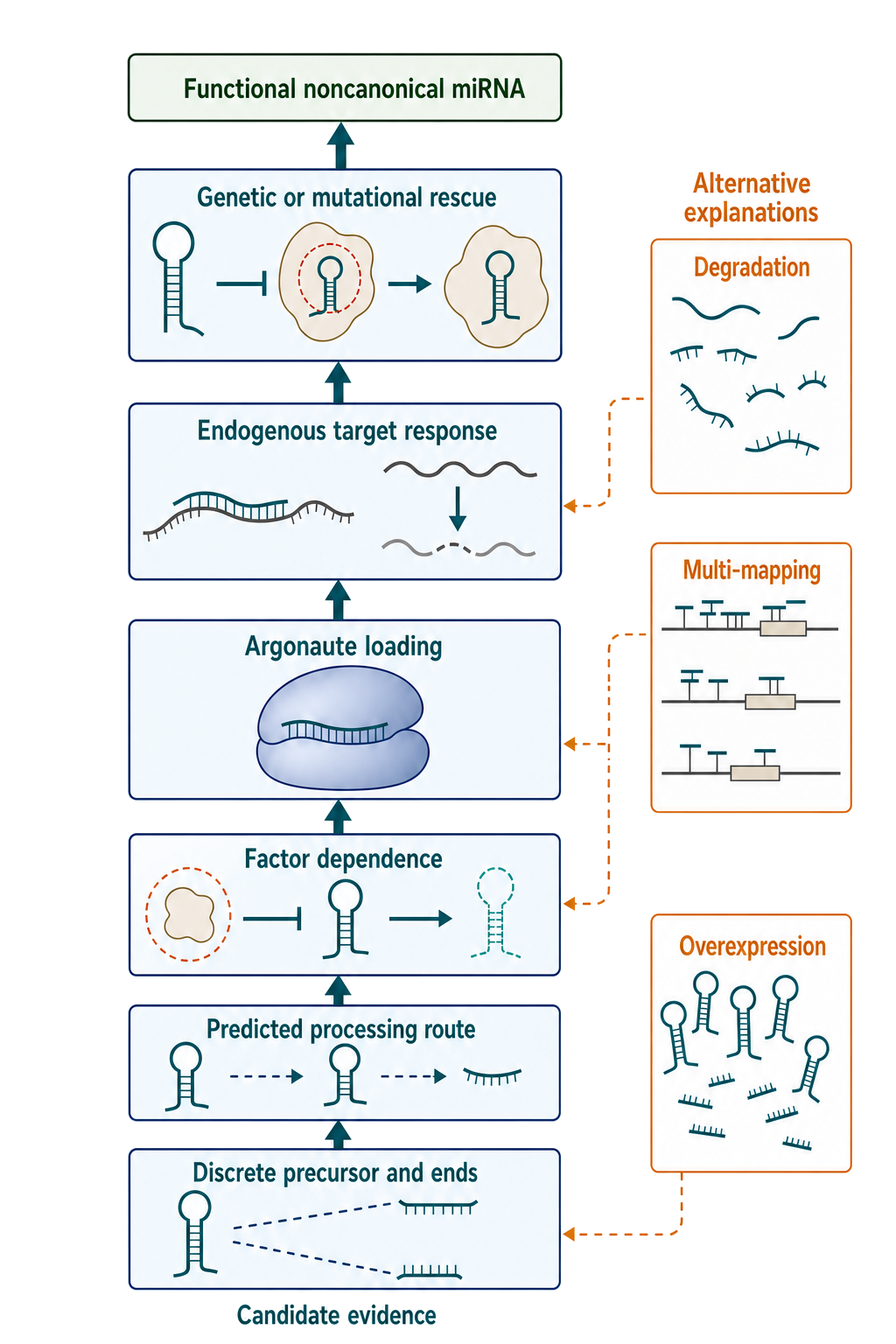
Figure 86.1. Evidence ladder for classifying a functional noncanonical miRNA. “Noncanonical miRNA annotation requires convergent evidence. Read length, hairpin prediction, or Argonaute recovery can prioritize a candidate, but none independently demonstrates endogenous miRNA function.”
86.2. Drosha-independent pathways: mirtrons, capped precursors, and other Microprocessor bypass routes
Drosha-independent pathways solve the nuclear precursor-generation problem without Microprocessor cleavage. The best-established solution is the mirtron. A mirtron is encoded within a short intron whose boundaries and internal complementarity allow the debranched intron to fold into a pre-miRNA-like hairpin. The host pre-mRNA is transcribed and spliced. The excised intron initially forms a lariat because the branch-point adenosine is joined through a 2-prime,5-prime linkage. DBR1 opens that linkage, producing a linear RNA whose ends correspond to splice sites. If those ends and the hairpin stem fit downstream requirements, the RNA can enter export and Dicer pathways without Drosha.
This mechanism couples miRNA output to host-gene transcription and splicing. A mutation that weakens a splice site can reduce both mRNA maturation and mirtron production. Conversely, an intron optimized for rapid splicing may generate the mirtron efficiently even if no Microprocessor-recognition motifs are present. The coupling also creates experimental ambiguity: a phenotype attributed to the mirtron may instead result from altered host-gene splicing. Clean tests alter the hairpin while preserving splice signals, or alter mirtron production while rescuing the host protein independently.
Not every mirtron is bounded by a ready-to-use hairpin. Tailed mirtrons retain extra nucleotides at one end after splicing and debranching. A 3-prime tail can be removed by exonucleolytic processing, including RNA-exosome-dependent routes in characterized systems, before export or Dicer cleavage. Five-prime-tailed routes are less uniformly understood. These cases show that “splicing bypasses Drosha” does not imply that splicing alone completes precursor maturation. Several enzymes may cooperate to recreate the geometry that Microprocessor normally supplies in one cleavage step.
Capped pre-miRNAs use a different solution. For the mammalian miR-320 family and related loci, transcription begins at or very near the hairpin’s 5-prime end, producing a short 7-methylguanosine-capped precursor. These RNAs are Microprocessor-independent and preferentially use a PHAX-Exportin-1 route rather than the conventional Exportin-5 pathway. Dicer cleavage can release a guide from the 3-prime arm. The capped 5-prime arm is a poor ordinary Argonaute guide because AGO-clade Argonautes anchor a 5-prime monophosphate, so precursor chemistry biases productive arm choice. This is a direct example of transcription and export determining guide identity.
Other bypass routes combine familiar processing systems in new ways. Viral transcripts can use tRNA-like elements, Integrator cleavage, or other host nucleases to release pre-miRNA-like hairpins. Some RNA polymerase III transcripts generate miRNA precursors without ordinary Microprocessor processing. A recently described C. elegans mir-1829 family is produced by an independent RNA polymerase III route and loaded into multiple miRNA Argonautes, illustrating how young loci can enter an established regulatory system. Such examples should be presented with organism and evidence qualifiers because a mechanism proven for one viral or nematode family is not a general alternative pathway in mammals.
The mirtron mechanism can be followed experimentally as a precursor-product chain. Host transcription first supplies the intron. Spliceosome catalysis defines the intron boundaries, DBR1 removes the lariat branch, and folding exposes a pre-miRNA-like stem. Export and Dicer cleavage then create a duplex, after which Argonaute sorting determines which end becomes regulatory. Perturbing each step predicts a different intermediate: unspliced host RNA after splice failure, lariat accumulation after debranching failure, a tailed hairpin after trimming failure, or precursor accumulation after Dicer loss. Observing the predicted intermediate is more discriminating than measuring only loss of the mature guide.
Mirtrons also illustrate biological coupling. Their output is tied to host-gene transcription and splice choice, so cell-type-specific splicing can control guide production without changing a dedicated miRNA promoter. The cost of this coupling is constraint: selection on splice sites and host protein production may limit evolution of the hairpin. Comparative claims should ask whether conservation preserves the host intron, the hairpin, the mature seed, or all three, because each pattern implies a different selective target [Westholm and Lai 2011].
Capped precursors supply a contrasting running example in which transcription defines one precursor end directly. The 5-prime cap supports nuclear RNA handling but is incompatible with ordinary AGO anchoring. Dicer can still process the hairpin, yet the uncapped 3-prime arm is favored as guide. Thus promoter position, cap chemistry, export route, and arm choice form one causal chain. Merely detecting a capped short RNA is insufficient; cap-sensitive precursor evidence, export dependence, Dicer processing, and Argonaute-resolved arm asymmetry must agree [Xie et al. 2013].
Figure 86.2 should compare canonical Microprocessor cleavage with mirtron, tailed-mirtron, capped-precursor, and RNA polymerase III routes. The shared endpoint is a precursor compatible with downstream maturation; the upstream enzymes and end chemistries differ.
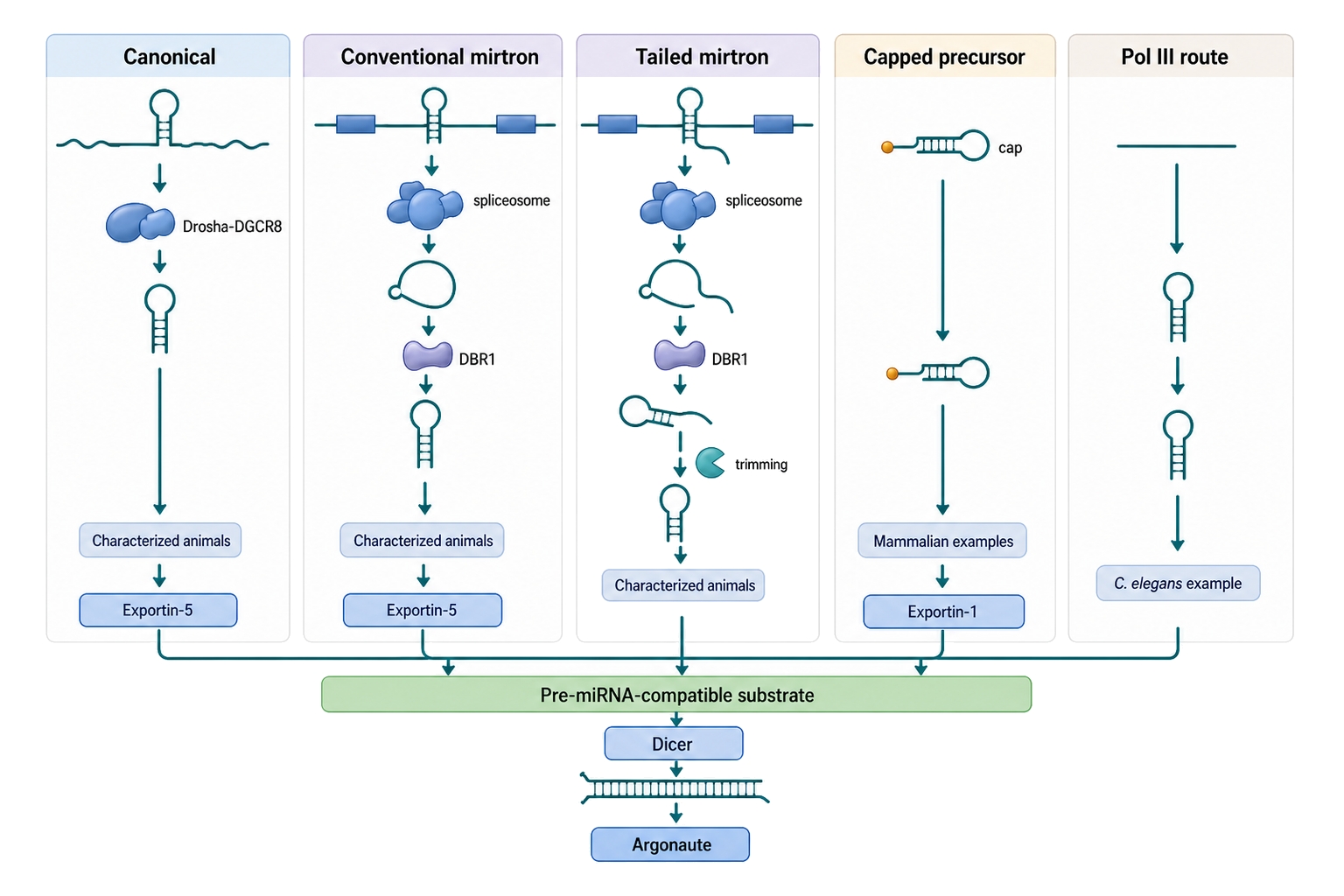
Figure 86.2. Multiple routes to a pre-miRNA-compatible substrate. “Microprocessor-bypass pathways use transcription, splicing, debranching, or other processing reactions to generate an RNA with ends and structure compatible with downstream maturation.”
86.3. Dicer-independent pathways: AGO2-mediated miR-451 maturation and other exceptions
Vertebrate miR-451 is the clearest Dicer-independent miRNA. Its primary transcript is processed by Drosha, so the pathway begins canonically. The resulting pre-miR-451 hairpin is unusually short and extensively paired. Normal Dicer measurement requires a longer stem, and pre-miR-451 does not fit that substrate geometry. Instead, the hairpin is loaded directly into AGO2. AGO2’s PIWI catalytic center slices the 3-prime arm opposite the guide segment, producing an AGO2-cleaved precursor intermediate. Exonucleolytic resection, involving PARN in mammalian systems, then shortens the exposed 3-prime end to a mature guide distribution.
Genetics established that this was not merely an in vitro alternative. Zebrafish deficient in Dicer retained miR-451 production, whereas loss of Ago2 or its catalytic activity impaired miR-451 and delayed erythropoiesis. Rescue with a mature miR-451 duplex or catalytically competent AGO2 distinguished guide function from a nonspecific developmental effect. Structural redesign experiments further showed that hairpin length and pairing can route substrates between Dicer-dependent and AGO2-dependent maturation. The pathway therefore links a physical substrate feature to an organismal phenotype.
Box 86.1 follows the miR-451 evidence chain from genetic exception through catalytic rescue, precursor cleavage, resection, and organismal function.
Box 86.1. miR-451: from genetic exception to biochemical mechanism
- Misconception prevented: Dicer-independent does not mean processing-independent.
The same AGO2 protein performs two chemically similar but biologically distinct reactions. During ordinary RNA interference, an already loaded guide directs AGO2 to slice a separate target RNA. During miR-451 maturation, the precursor itself enters AGO2 and one arm is sliced as part of guide production. The distinction depends on substrate topology and timing, not on a different active site. This is why descriptions such as “AGO2 processes miR-451” should specify the intermediate and should not imply that AGO2 replaces all Dicer functions globally.
Maturation after slicing is heterogeneous rather than ruler-like. The AGO2 cleavage position creates one end, while 3-prime resection generates a distribution of mature lengths. Uridylation and other end modifications can be observed, but their contribution depends on species and context. The seed-containing 5-prime end remains the more important determinant of target identity. Small-RNA sequencing should therefore preserve isomiR information instead of collapsing all miR-451 reads to one reference sequence.
Erythroid biology makes miR-451 more than a biochemical curiosity. The zebrafish phenotype connected impaired Ago2-catalyzed maturation to delayed erythropoiesis, and guide rescue helped place the small RNA downstream of the processing defect [Cifuentes et al. 2010]. Mammalian erythroid cells likewise provide a context in which miR-451 is abundant and biologically consequential. The running example teaches how an unusual precursor geometry, one Argonaute paralog, a maturation intermediate, and a cell-type phenotype can be joined into a single evidence chain.
The miR-451 pathway also exposes a boundary between biogenesis and turnover. AGO2 cleavage creates a precursor that must be resected, and mature-length distributions reflect subsequent 3-prime processing. Those steps concern production of the guide; later target-directed tailing, trimming, or destruction of a loaded mature miRNA belongs to Chapter 85. The same enzyme class or end modification can appear in both chapters, but the causal stage is different.
Other Dicer-independent claims require stricter qualification. Some short RNAs can load into Argonaute as single strands, and engineered chemical guides can bypass duplex production. Those observations establish biochemical flexibility but do not automatically define an endogenous miRNA pathway. Likewise, loss of Dicer may leave stable fragments or previously loaded guides in a cell. A true Dicer-independent biogenesis claim needs newly synthesized product, pathway-specific genetics, correct ends, Argonaute loading, and function.
Table 86.1 compares the enzyme dependencies and diagnostic intermediates of canonical miRNAs, mirtrons, capped precursors, and miR-451. The table is intended to make knockout interpretation explicit rather than treating “independent” as an all-or-none label.
Table 86.1. Enzyme dependencies and diagnostic intermediates. Make “independence” specific to one step and list the intermediate expected when the route is blocked.
| Route | Precursor-generation step | Microprocessor | Export route | Dicer | Argonaute catalytic role | Diagnostic evidence |
|---|---|---|---|---|---|---|
| Canonical animal miRNA | Drosha-DGCR8 cleavage | Required | Usually Exportin-5 | Required | Loading and effector; slicing usually unnecessary | pri-miRNA accumulates after Microprocessor loss; pre-miRNA accumulates after Dicer loss |
| Conventional mirtron | Splicing plus DBR1 debranching | Bypassed | Often Exportin-5-like downstream route | Usually required | Loading and effector | Splice/debranch dependence with a hairpin bounded by splice sites |
| Tailed mirtron | Splicing, debranching, and end trimming | Bypassed | Route depends on processed precursor | Usually required | Loading and effector | Tailed intermediate accumulates after relevant nuclease perturbation |
| Capped pre-miRNA | Direct transcription of capped hairpin | Bypassed | PHAX-Exportin-1 in characterized mammalian examples | Required | Efficient loading mainly from uncapped arm | Cap-sensitive precursor and export dependence |
| miR-451 | Drosha cleavage of short hairpin | Required | Downstream precursor transfer | Bypassed | AGO2 slices precursor before resection | AGO2-cleaved precursor and dependence on AGO2 catalytic activity |
86.4. Argonaute paralogs, guide sorting, slicing competence, and cell-type specialization
Argonaute proteins convert small RNAs into regulatory complexes. Their conserved architecture includes an N-terminal region and PAZ, MID, and PIWI domains. The MID domain anchors the guide 5-prime end, the PAZ domain engages the guide 3-prime end, and the PIWI domain adopts an RNase H-like fold. Catalytic residues in the PIWI domain support slicing when the target pairs extensively enough to align the scissile phosphate. Non-slicing repression uses the same guide-target recognition platform but recruits effector proteins that alter translation and mRNA stability.
Humans encode AGO1, AGO2, AGO3, and AGO4. The four proteins share many miRNAs and can support miRNA-mediated repression, which creates substantial functional redundancy. AGO2 nevertheless has uniquely robust and broadly established slicing activity and is required for miR-451 maturation. AGO1, AGO3, and AGO4 should not be described as inert copies. Structural comparisons reveal differences in target engagement, conformational dynamics, and partner interactions, and cell-specific studies report nonredundant phenotypes. The strength and physiological scope of those distinctions vary, so a claim about one paralog should not be generalized from overexpression of another.
Guide sorting occurs before and during stable Argonaute loading. Duplex-end stability influences which strand becomes the guide; a strand whose 5-prime end is less stably paired is often favored. Terminal nucleotide identity can interact with the Argonaute 5-prime-binding pocket. Duplex mismatches and central pairing influence recognition by loading factors. Argonaute abundance and localization change the available destinations. Sorting is probabilistic: the same precursor can yield major and minor guides, and changes in cell type or pathway components can alter their proportions.
Drosophila provides a clear comparative model. AGO1 is the main miRNA effector, while AGO2 is central to siRNA-mediated RNA interference. Imperfect miRNA-like duplexes generally favor AGO1, whereas extensively paired duplexes favor the Dicer-2/R2D2 loading route and AGO2. Some passenger strands and particular miRNA isoforms enter AGO2, showing that precursor class does not rigidly determine destination. In Arabidopsis, several Argonautes display preferences associated with the guide’s 5-prime nucleotide, and redirecting that nucleotide can redirect loading and biological activity. These are system-specific sorting grammars, not universal rules for mammalian AGO1-AGO4.
Cell type adds another layer. Argonaute paralog abundance, small-RNA precursor expression, loading cofactors, target transcriptomes, and subcellular compartments can all change. A guide detected in total RNA may be functionally irrelevant if its preferred Argonaute is absent, whereas a modestly abundant guide can be important if efficiently loaded into the locally active effector. Argonaute-resolved small-RNA sequencing is therefore more informative than total small-RNA abundance when paralog specialization is the scientific question.
Paralog specialization should be tested at endogenous dosage. Overexpressed AGO proteins can accept guides they rarely encounter naturally, alter the limiting loading pool, or repress targets through mass action. A strong comparison uses paralog-specific loss or acute degradation, verifies guide occupancy, measures catalytic and noncatalytic outputs, and rescues with wild-type or slicing-defective protein. If a phenotype is rescued by a catalytic mutant, the paralog may act through non-slicing repression, scaffolding, localization, or competition rather than endonucleolysis.
Guide sorting also interacts with guide stability. Loaded small RNAs are protected by Argonaute, whereas unloaded duplex products can disappear rapidly. A change in total guide abundance after paralog perturbation may therefore reflect altered loading rather than altered transcription or precursor processing. Precursor, total mature guide, paralog-bound guide, and target response should be measured together. Chapter 85 develops the downstream stability consequences once loading has occurred.
The fly and plant examples are valuable precisely because their sorting systems are experimentally separable. Drosophila uses distinct AGO1- and AGO2-centered pathways with duplex-structure cues, whereas Arabidopsis distributes guides among a larger AGO family in which the 5-prime nucleotide is a prominent determinant [Tomari et al. 2007; Mi et al. 2008]. Mammalian AGO1-AGO4 share many miRNAs and lack an equally simple sorting grammar. The comparative lesson is to infer a rule from the host machinery, not from guide sequence alone.
Figure 86.3 should represent sorting as a set of weighted decisions rather than a deterministic switch. The input features include duplex structure, end stability, 5-prime nucleotide, loading factors, and Argonaute availability; outputs include distinct Argonaute-guide complexes and different effector modes.
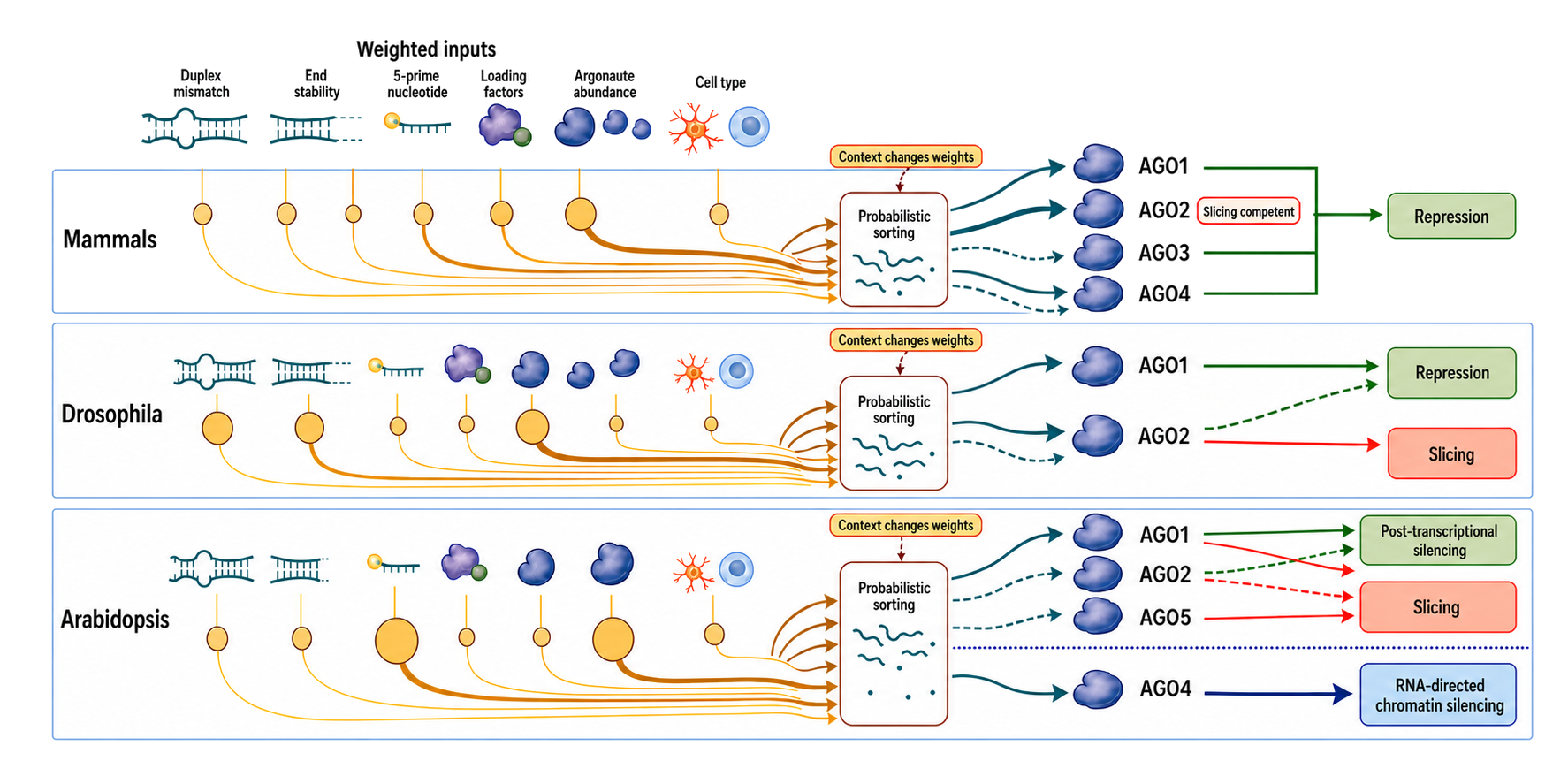
Figure 86.3. Weighted guide sorting among Argonaute pathways. “Guide sorting integrates RNA structure, end chemistry, loading machinery, and the available Argonaute pool. The relative weight of each determinant is lineage- and cell-context-dependent.”
86.5. Competition, saturation, and crosstalk among miRNA, siRNA, and other small-RNA pathways
Small-RNA pathways are often drawn as independent pipelines, but several steps use shared or finite components. Exportin-5 can transport canonical pre-miRNAs and some engineered hairpins. Dicer and associated double-stranded RNA-binding proteins process multiple duplex substrates. HSP90-linked loading machinery and AGO-clade proteins receive guides from different sources. Targets and highly paired trigger RNAs can also alter guide stability after loading. Crosstalk can therefore occur during precursor export, processing, loading, target search, or turnover.
The strongest demonstrations come from dosage perturbations. Sustained high expression of some short hairpin RNAs in mouse liver reduced endogenous miRNA abundance and produced dose-dependent toxicity. Mechanistic work implicated saturation of shared factors, including Exportin-5, while later studies also identified Argonaute availability as a limiting point in some contexts. The lesson is not that any added small RNA poisons the pathway. Toxicity depended on hairpin sequence, expression, vector dose, tissue, and the identity of the limiting step. These experiments define a capacity constraint, not a universal threshold.
Box 86.2 separates what high-dose overexpression can reveal about pathway capacity from what it cannot establish about physiological competition.
Box 86.2. What overexpression can and cannot reveal
- Required controls: dose series, nonloading precursor, innate-sensing control, endogenous-abundance comparison, precursor and Argonaute-bound measurements.
Competition at Argonaute can change both guide abundance and apparent targeting. A newly abundant duplex may occupy loading-competent Argonaute, displacing or preventing loading of lower-abundance endogenous guides. Because unloaded small RNAs are often less stable, the secondary result can look like reduced transcription or increased decay. Conversely, increasing Argonaute abundance can rescue some competition phenotypes but may alter silencing independently. Measurements should include pri-miRNA or precursor abundance, mature total RNA, Argonaute-bound guide, and target response to locate the affected step.
Pathway crosstalk also occurs through sorting. In flies, duplex features partition miRNA-like and siRNA-like products between AGO1 and AGO2 pathways. Changing precursor structure can therefore redirect a guide rather than merely change its total amount. In plants and nematodes, larger Argonaute families and amplification systems create additional routes by which a small-RNA trigger changes secondary guide populations or chromatin effects. Those mechanisms belong in their organism-specific contexts and should not be imported into mammalian miRNA models without evidence.
Target competition is related but distinct from machinery competition. RNAs bearing miRNA sites can compete for a loaded guide when their concentration and affinity are high enough. Quantitative studies show that susceptibility depends on the ratio between active miRNA and the affinity-stratified target pool. This is not the same as two precursors competing for Argonaute loading. A study that observes target derepression after overexpressing a sponge-like RNA must distinguish target-site competition from saturation of biogenesis or loading machinery.
The practical experimental rule is to use dose series and orthogonal perturbations. A physiological change should be reproduced near endogenous abundance, with controls for innate sensing and generic transfection stress. A precursor mutant that cannot load should separate sequence-independent burden from guide-mediated effects. Rescue by additional pathway factor can identify a limiting step, but rescue must not be treated as proof by itself. Chapter 139 develops the broader perturbation and reproducibility logic.
Competition can occur at different timescales. Acute precursor overexpression can transiently occupy export or loading machinery, while sustained expression can change Argonaute abundance, cell fitness, and transcriptional feedback. Chronic knockout of one pathway may free shared components and allow compensation by another. Time-resolved measurements distinguish immediate redistribution from adaptive rewiring. This matters when comparing cultured cells, developing tissues, and vector-driven expression in adult organs.
Cell type determines capacity. Hepatocytes exposed to high-copy shRNA vectors, proliferating cultured cells, neurons with long-lived miRNAs, and germ cells with abundant PIWI proteins do not share one limiting pool. Even within a tissue, a rare cell population may experience saturation that is invisible in bulk RNA. Claims of physiological crosstalk should therefore specify precursor dose per cell, the relevant Argonaute family, and whether the affected guides are newly synthesized or pre-existing.
Pathway boundaries are also asymmetric. Mammalian miRNAs and experimentally introduced siRNA-like duplexes can share AGO-clade loading, but piRNAs normally use PIWI-clade proteins and distinct precursor pathways. Crosstalk with piRNA biology should not be inferred merely because both products are small. In flies or nematodes, endogenous siRNA amplification and specialized Argonautes create additional interactions described in Chapter 87 and Chapter 88. The current section owns the comparative principle and the evidence required to demonstrate a shared limiting component.
Table 86.2 separates precursor competition, Argonaute competition, target competition, and target-directed guide turnover by their predicted molecular signatures.
Table 86.2. Distinguishing small-RNA crosstalk mechanisms. Link each proposed competition mechanism to measurements that can falsify it.
| Mechanism | Shared object | Expected upstream signature | Expected guide signature | Discriminating experiment |
|---|---|---|---|---|
| Precursor export or processing competition | Exportin, Dicer, or accessory factor | Precursor accumulation or altered processing precision | Reduced mature output across susceptible substrates | Dose series plus factor rescue and precursor-end mapping |
| Argonaute-loading competition | Loading machinery or Argonaute pool | Precursors may remain unchanged | Total and Argonaute-bound guides diverge; unloaded guides destabilize | Argonaute-resolved sequencing with controlled Argonaute expression |
| Target competition | Loaded guide and affinity-stratified target pool | Biogenesis unchanged | Loaded guide often unchanged | Competitor-site mutation and quantitative target-pool titration |
| Target-directed guide turnover | Loaded guide plus highly paired trigger | Biogenesis may remain unchanged | Tailing, trimming, unloading, or guide loss | Trigger pairing mutants and time-resolved guide-end analysis |
86.6. Comparative evolution, experimental identification, artifacts, and open questions
Noncanonical pathways reveal how new miRNA genes can evolve. A short intron that already forms a hairpin can acquire productive Dicer processing after splicing. A transcription start site and termination pattern can create a capped hairpin. A short, highly paired precursor can become compatible with catalytic Argonaute. These routes reduce the number of new molecular features a locus must evolve at once because existing RNA-processing systems supply precursor ends. Most candidate loci will remain nonfunctional or lineage-restricted, but a subset can acquire stable Argonaute loading and selectable target regulation.
Comparative analysis must account for different machinery. Animals, plants, fungi, and protists do not share one uniform miRNA system. Plants use Dicer-like proteins and expanded Argonaute families with strong connections to siRNA and chromatin pathways. Some animal lineages have duplicated or lost Argonautes, Dicers, or accessory factors. Nematodes use specialized Argonautes and secondary small-RNA amplification in pathways that lack direct mammalian equivalents. A conserved hairpin sequence is informative only when the host lineage has compatible processing and effector machinery.
Small-RNA sequencing creates several recurrent artifacts. Adapter ligation favors some end chemistries and structures, so read abundance is not a direct molecule count. Multi-mapping can assign repeat-derived reads to an attractive hairpin locus. Reverse transcriptase stops or modifications can distort tRNA- and rRNA-derived fragments. Degradation during extraction can create reproducible-looking short products from abundant RNAs. A high-copy transgene can overwhelm these biases and appear cleaner than the endogenous locus. Replicate consistency is necessary but cannot replace biochemical end validation and genetics.
Annotation pipelines should test alternative explanations. A candidate mirtron must coincide with real splice junctions and should depend on splicing and debranching. A capped precursor requires cap-sensitive evidence and an export route consistent with the proposed mechanism. A Dicer-independent candidate must persist under acute Dicer loss while showing dependence on its alternative maturation factor. A claimed miRNA-like tRNA or snoRNA fragment should be compared with the parent RNA’s processing and degradation products. In every case, the target-regulation experiment should use endogenous concentrations and mutated recognition sites.
Comparative evolution should distinguish pathway conservation from guide conservation. The same processing solution can evolve independently at unrelated loci, while a conserved guide can change its precursor route after gene duplication or promoter turnover. Mirtrons may arise relatively easily from hairpin-forming introns, but most will be lost unless their production and target effects become selectively useful. Deep conservation of a seed and regulated targets is strong evidence, yet recently evolved guides can be functional within one lineage. Absence from distant species is therefore a boundary condition, not automatic disproof.
Organismal comparisons reveal different innovation opportunities. Drosophila and other insects possess sharply partitioned AGO1/AGO2 pathways that make duplex routing visible. Nematodes have expanded Argonaute systems and, in the mir-1829 example, a germline-enriched Pol III route into miRNA Argonautes [Sakhawala et al. 2025]. Vertebrates provide the conserved miR-451 pathway and multiple broadly overlapping AGO paralogs. Plants use Dicer-like and AGO families with terminal-nucleotide sorting and chromatin-linked small-RNA outputs. A discovery pipeline must encode these differences before labeling a candidate “noncanonical.”
Box 86.3 turns these requirements into a checklist for deciding when a candidate small RNA has enough evidence to be named a miRNA.
Box 86.3. Before naming a small RNA a miRNA
- Checklist: locus transcription; discrete ends; precursor-product geometry; proposed factor dependence; Argonaute loading; endogenous target-site response; rescue; alternative fragment explanation.
- Misconception prevented: annotation database presence is not equivalent to mechanistic validation.
The most useful negative result is a localized failure in the evidence chain. A discrete fragment that never reaches Argonaute may be a regulated processing product rather than a miRNA. An Argonaute-bound RNA that lacks target effects may be below the functional concentration threshold or may use an untested mode of action. A reporter-active guide produced only by overexpression may be a useful engineering substrate without being an endogenous regulator. These outcomes refine classification instead of forcing every candidate into “functional” or “junk” categories.
Open questions include how frequently noncanonical routes contribute substantially to endogenous regulation, how cell-type-specific Argonaute composition redirects guides, which factors limit pathway capacity under physiological conditions, and how many young miRNA loci pass from opportunistic processing to selected regulatory function. Long-read precursor mapping, quantitative Argonaute proteomics, single-cell small-RNA methods, acute degron perturbations, and endogenous locus editing should make these questions more tractable.
Figure 86.4 should compare the main organismal systems without implying a universal hierarchy: mammalian AGO overlap and miR-451, fly AGO1/AGO2 partitioning, nematode specialized Argonautes and Pol III innovation, and plant 5-prime-nucleotide sorting.
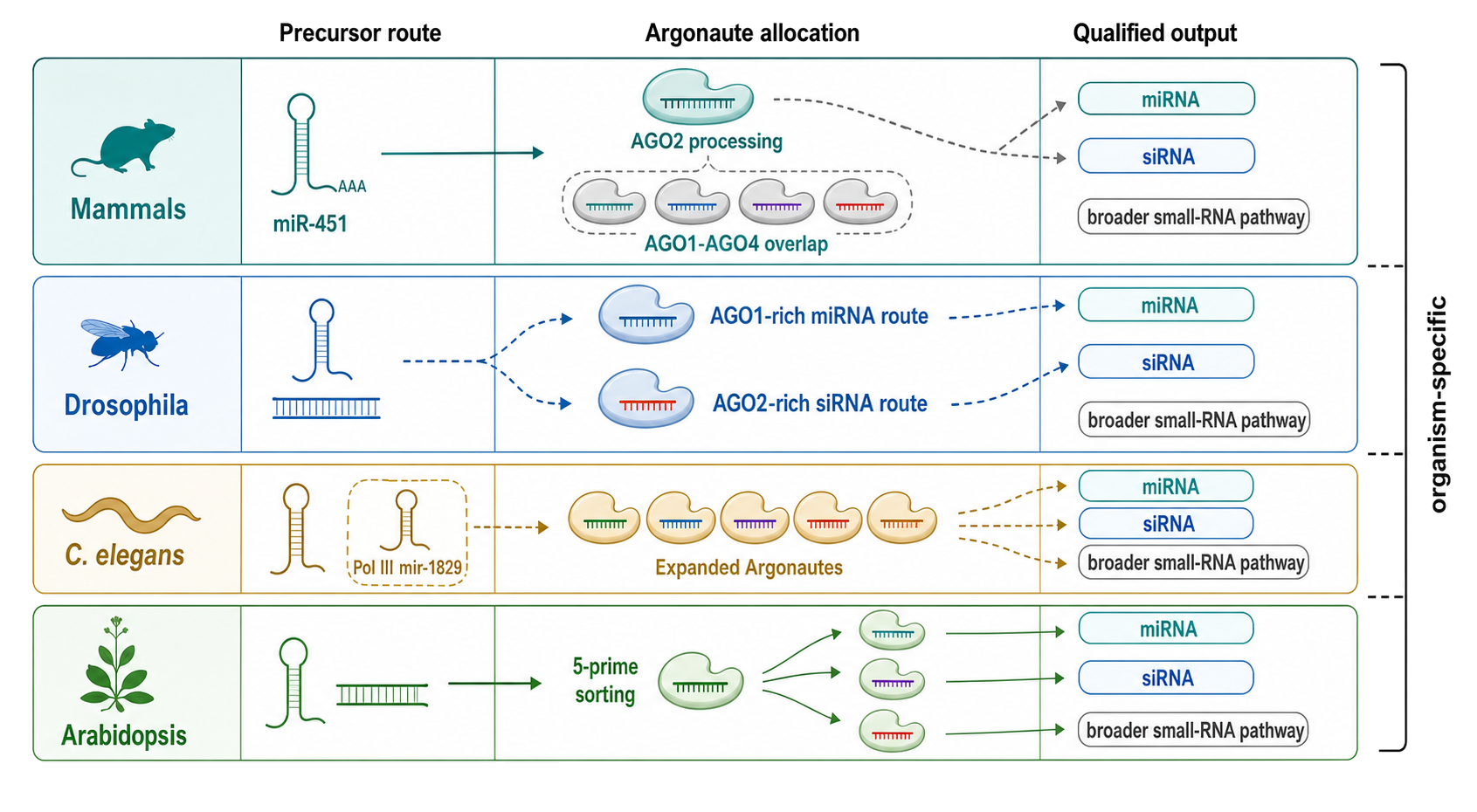
Figure 86.4. Organism-qualified solutions to noncanonical biogenesis and guide sorting. “Noncanonical pathways reuse the machinery available in each lineage. Similar guide lengths do not imply identical precursor enzymes, sorting rules, or regulatory outputs.”
Experimental Foundations and Evidence
The chapter’s core mechanisms are supported by complementary evidence classes. Precursor-end mapping identifies the RNA species entering each step. Genetic loss and catalytic mutants test necessity. In vitro cleavage and structural studies test biochemical sufficiency and substrate geometry. Argonaute immunoprecipitation establishes loading, while reporters and endogenous site mutation connect the guide to target recognition. Developmental rescue, as in the miR-451 system, connects molecular maturation to organismal function. No single assay supplies the full chain.
Do not overgeneralize from knockout persistence. A mature guide can remain after its biogenesis enzyme is removed, and incomplete depletion can preserve low-level processing. Acute perturbation with metabolic labeling is stronger than a chronic knockout for measuring new production. Conversely, a global factor loss can change transcription, splicing, growth, and cell composition, so loss of a small RNA does not prove direct processing. Mechanistic attribution requires the predicted precursor or intermediate to accumulate.
Evidence should be ordered in time. Nascent host transcription precedes splicing-derived mirtron release; debranching precedes export; Dicer or AGO2 cleavage precedes stable loading; and target repression follows guide accumulation. A time course can exclude the interpretation that a mature small-RNA change is secondary to altered cell identity. Pulse labeling, inducible factor loss, or acute catalytic inhibition can be combined with precursor-end and Argonaute-bound measurements when steady-state abundance is ambiguous.
Biochemical sufficiency and cellular necessity answer different questions. Defined substrates can show that Dicer rejects a short hairpin or that AGO2 slices a pre-miR-451-like structure, but purified reactions do not establish that the route dominates in a tissue. Genetics can establish requirement but may leave the direct substrate unclear. Structure-function mutations that reroute the same precursor, followed by endogenous rescue, connect the physical rule to biological production [Yang et al. 2012].
Biological Contexts Across Organisms and Cell States
Erythropoiesis is the principal running context for Dicer-independent maturation. miR-451 abundance rises in erythroid cells, and its AGO2-dependent production connects an exceptional biochemical route to red-cell development. The example cautions against judging importance by pathway size: a route with few known substrates can still control a prominent cell-type phenotype. It also demonstrates that cell differentiation changes the abundance of precursor, enzyme, and target together, so acute rescue is essential for causal ordering [Cifuentes et al. 2010].
The germline provides a different context. The C. elegans mir-1829 family is germline enriched and produced through a Pol III-dependent, Microprocessor-independent route, then enters multiple miRNA Argonautes [Sakhawala et al. 2025]. Nematode Argonaute diversity and germline small-RNA systems differ profoundly from mammalian somatic cells. The correct generalization is that new transcriptional architectures can feed established guide effectors—not that Pol III is a universal alternative miRNA polymerase.
Neural cells make Argonaute specialization and pathway capacity especially interesting because many neuronal miRNAs and their targets are long lived, spatially localized, and developmentally regulated. A transient change in loading can have consequences that outlast precursor expression. Yet the current evidence base for mammalian AGO1, AGO3, and AGO4 specialization remains thinner than that for AGO2. Claims should name the neural cell type, developmental stage, paralog perturbation, bound-guide repertoire, and target phenotype rather than extrapolating from total brain RNA.
The liver overexpression studies provide a stress test, not a normal physiological model. High-copy shRNA expression can reveal finite export or Argonaute capacity and can produce severe toxicity [Grimm et al. 2006]. These results are valuable for experimental design and vector engineering, but they do not show that endogenous miRNAs routinely saturate the pathway. Primary tissues should be examined at endogenous or modestly perturbed dosage, ideally with cell-resolved guide loading and precursor measurements.
Viruses can exploit noncanonical precursor generation because compact genomes favor overlapping transcription and host-enzyme reuse. Viral examples are useful mechanistic probes, but infection also changes transcription, RNA decay, innate sensing, and Argonaute availability. A viral hairpin that functions in an overexpression reporter is not automatically produced during infection at regulatory abundance. Infection-stage precursor mapping and viral genetic rescue are needed before assigning a natural miRNA role.
Across these contexts, the same analytical questions recur. Which cell makes the precursor? Which processing factor is present there? Which Argonaute receives the guide? Does the target coexist in the same compartment and developmental window? Does perturbing the guide alter the target before the cell state changes broadly? Organism and cell type are not metadata decorations; they are parts of the mechanism.
Technology, Computational, and Engineering Links
Discovery technologies should preserve precursor and effector information. Standard short-read small-RNA sequencing measures mature products well but often loses the longer precursor and can distort ends through ligation bias. Long-read or targeted precursor approaches can connect a guide to host transcript, splice junction, cap, tail, or alternative start site. Argonaute immunoprecipitation or crosslinking identifies loaded species, while paralog-resolved experiments test sorting. Chapter 133 owns RNA-protein interaction methods, and Chapter 139 owns general perturbation and reproducibility design.
Computational annotation should begin with competing generative models. A read cluster may arise from a canonical hairpin, mirtron, tailed mirtron, capped precursor, other structured-RNA processing, or degradation. The pipeline should score end precision, strand asymmetry, splice boundaries, cap or tail evidence, Dicer-compatible geometry, multi-mapping, conservation, and Argonaute association. A classifier trained only on database miRNAs risks circularly reproducing historical annotations. Mechanistic validation remains necessary for unusual candidates.
Engineering can deliberately exploit pathway routing. Shortening a hairpin can favor AGO2-dependent processing; changing duplex pairing can redirect a fly guide between AGO pathways; changing a plant guide’s 5-prime nucleotide can alter AGO preference; and scaffold design can couple guide production to splicing or transcription. These interventions are valuable because they test physical rules as well as create tools. Engineered success does not establish that an endogenous locus uses the same route.
Capacity constraints matter when small-RNA tools are expressed in cells or animals. Dose series, nonloading hairpins, Argonaute-resolved measurements, and target-site mutants can separate shared-machinery saturation from sequence-specific repression. Therapeutic chemistry, delivery, pharmacology, and clinical use remain in Chapter 152; this chapter supplies the biological design constraints those applications inherit.
Table 86.3 should align biological questions with the minimum evidence combination: precursor origin, processing dependence, loading, target response, cell-type context, and rescue.
Table 86.3. Evidence combinations for biological claims. Match each biological question to observations that establish mechanism rather than merely association.
| Biological claim | Minimum precursor evidence | Effector evidence | Functional evidence | Key alternative to exclude |
|---|---|---|---|---|
| Mirtron biogenesis | Host transcript, splice junction, lariat/debranched or tailed intermediate | Dicer dependence and AGO loading | Endogenous target response or rescue | Host-gene splicing phenotype |
| Capped precursor | Cap-sensitive start, hairpin, and export dependence | Dicer product and arm-selective AGO loading | Guide-site-dependent target response | Short capped degradation product |
| Dicer-independent guide | New product persists after acute Dicer loss with alternative intermediate | Dependence on catalytic AGO2 or other proposed factor | Guide rescue and organismal or cellular consequence | Residual pre-existing mature guide |
| Argonaute specialization | Same precursor or guide compared across endogenous paralogs | Paralog-resolved occupancy and catalytic-state controls | Paralog-specific target or phenotype rescue | Overexpression-driven promiscuous loading |
| Pathway competition | Dose and precursor measurements | Shared-factor occupancy or AGO-bound redistribution | Recovery after mechanism-specific rescue | Sequence-specific targeting or generic stress |
Recent Consensus
Current consensus recognizes that most animal miRNAs use the Drosha-DGCR8 and Dicer pathway, while a smaller but mechanistically important set bypasses one or more canonical steps. Mirtrons and capped precursors are established Microprocessor-bypass classes, and miR-451 is the established model for AGO2-catalyzed, Dicer-independent maturation. Argonaute paralogs overlap substantially but are not universally interchangeable. Guide sorting is influenced by several features whose relative weight differs among lineages. Annotation standards increasingly require pathway and functional evidence rather than accepting every miRNA-sized fragment.
Open Questions, Controversies, Deprecated Models, and Common Misconceptions
Open questions:
- Which recently annotated noncanonical loci contribute enough guide at endogenous abundance to alter organismal phenotypes?
- How often does changing Argonaute paralog abundance redirect guide repertoires in normal development or disease?
- Which pathway components are limiting in specific primary cells rather than in high-expression experimental systems?
Common misconceptions:
- “Noncanonical means unimportant.” A pathway label says which canonical step is bypassed; it does not grade biological effect.
- “Every 20-24-nucleotide hairpin read is a miRNA.” Degradation, other processing pathways, and mapping artifacts can create the same superficial pattern.
- “Argonaute binding proves repression.” Loading is important evidence, but abundance, target geometry, and endogenous target response remain necessary.
- “Mammalian AGO proteins are either AGO2 or redundant non-slicers.” AGO2 has distinctive catalytic roles, but other paralogs can have nonredundant structural, expression, and interaction properties.
- “Pathway saturation explains every effect of small-RNA overexpression.” Sequence-specific targeting, innate sensing, generic stress, target competition, and shared-factor competition must be separated.