Chapter 57. RNP Machines, Remodeling Cycles, and Molecular Architecture
Scope Note
Ribonucleoprotein machines, abbreviated here as RNP machines, are RNA-protein assemblies that do more than bind RNA. They use RNA and protein components together to catalyze reactions, select substrates, move along nucleic acids, remodel molecular complexes, or organize transient cellular states. This chapter explains how large RNP machines are built, how they change conformation during use, how energy-consuming factors drive remodeling cycles, and how static molecular structures can be connected to dynamic mechanisms. The central examples include ribosomes, spliceosomes, small nuclear RNPs, 7SK RNP, viral ribonucleoprotein complexes, CRISPR-Cas RNPs, RNA-processing enzymes, and RNA-rich granules at the boundary between discrete complexes and mesoscale assemblies. Detailed biology of individual systems appears in Chapter 24 for 7SK-mediated pause control, Chapter 27 for spliceosomes, Chapters 42 and 43 for ribosome biogenesis, Chapter 45 for Y and vault RNPs, and Chapters 54, 56, 58, 59, 82, 116, 118, 133, 138, and 161 for the corresponding physical, viral, interaction, and therapeutic contexts.
Executive Summary
An RNP machine is best understood as a sequence of states rather than as a single object. The RNA component may provide a scaffold, a guide, a catalytic center, a substrate-recognition module, or a conformational switch. The protein components may stabilize RNA folds, read sequence or shape, bind cofactors, consume adenosine triphosphate (ATP) or guanosine triphosphate (GTP), recruit clients, and impose directionality on a reaction. A mature RNP machine usually emerges from an assembly pathway with checkpoints, not from a random collision of parts. Ribosome biogenesis, spliceosome assembly, viral ribonucleoprotein packaging, and 7SK RNP remodeling all illustrate the same design principle: productive complexes are selected through ordered binding, structural rearrangement, energy-dependent remodeling, and disposal or recycling of incorrect intermediates.
The phrase “molecular architecture” refers to the three-dimensional organization of RNA, proteins, cofactors, and bound substrates within an RNP machine. Architecture determines which parts can contact one another, which conformations are accessible, and which reactions can occur. However, architecture is not the same as mechanism. Cryogenic electron microscopy and crystallography can reveal high-resolution snapshots, but many RNP machines operate through transient states that are underrepresented in purified samples. Dynamic methods, including single-molecule measurements, time-resolved crosslinking, perturbation-rescue experiments, and biochemical kinetics, are needed to connect a structural state to a causal step in a cycle. Early spliceosome assembly is a useful example because structural and interaction studies show that weak, reversible contacts and rapid rearrangements can be as important as stable complexes.
NTPases are common engines of RNP remodeling. RNA helicases can separate base-paired regions, displace proteins, clamp onto RNA, or remodel local RNA structure without fully unwinding a duplex. GTPases often act as timing factors, especially in translation and ribosome-associated reactions, where GTP binding and hydrolysis couple substrate recognition to irreversible commitment. ATPases in ribosome assembly, spliceosome activation, RNA decay, and granule remodeling often create kinetic barriers that improve fidelity by giving incorrect complexes a higher probability of rejection. The energy from nucleotide hydrolysis is not a generic push; it is coupled to specific conformational changes, altered binding affinities, or mechanical movements.
Substrate handoff is a recurring organizational problem. An RNA molecule may pass from a polymerase-associated processing factor to an export complex, from a spliceosomal recognition state to a catalytic state, from a viral nucleoprotein complex to a polymerase, or from a repressed mRNP granule to a translating ribosome. Handoff requires both compatibility and exclusion. A downstream factor must recognize the correct intermediate, while upstream factors must be released or remodeled so that the next state can form. Allostery, processivity, and kinetic proofreading are different ways to coordinate these transitions. Allostery links a local event, such as substrate binding, to a remote structural change. Processivity allows an enzyme or complex to perform multiple steps before dissociating. Kinetic proofreading spends energy or time to distinguish correct from incorrect substrates more sharply than equilibrium binding alone would allow.
Disease and pharmacology highlight the importance of interfaces rather than isolated components. Mutations in RNA-binding proteins can alter phase behavior, RNP assembly, splicing, translation, or RNA localization. Viral RNPs depend on protein-RNA and protein-protein interfaces that can be targeted by antiviral strategies. RNA-targeted small molecules may act by stabilizing a functional RNA fold, trapping a nonproductive conformation, changing RNP assembly, or modulating recruitment of a protein factor. Condensate-associated RNPs add another level of complexity because disease-relevant mutations may change material properties and client selection without abolishing a single catalytic activity.
Concept Inventory
- RNP machine: a ribonucleoprotein assembly whose function depends on coordinated RNA-protein architecture and a reaction or remodeling cycle. This definition includes the ribosome, spliceosome, RNase P, telomerase, signal recognition particle, many viral ribonucleoproteins, CRISPR-Cas effector complexes, and several RNA-processing assemblies. It excludes a simple one-protein one-RNA binding event unless the complex undergoes a regulated cycle, catalyzes a reaction, or forms part of a larger pathway.
- Assembly pathway: the ordered or partially ordered route by which RNA, proteins, cofactors, and substrates form a functional RNP. Some pathways are strongly hierarchical: one subcomplex creates a binding platform for the next. Others are more parallel: multiple modules form independently and then join. Assembly is not merely construction. It is also quality control, because incorrectly folded RNA, incomplete subcomplexes, wrong stoichiometry, or off-pathway aggregates must be recognized and corrected.
- Maturation checkpoint: a molecular decision point that allows a productive RNP intermediate to proceed while slowing, remodeling, degrading, or recycling incorrect intermediates. In ribosome biogenesis, checkpoint logic includes rRNA processing, modification, protein loading, export competence, subunit joining tests, and late remodeling. In spliceosome assembly, checkpoint logic includes recognition of splice sites, branch point positioning, catalytic metal alignment, exon ligation competence, and release of the spliced mRNA product. Canonical ribosome and spliceosome checkpoint citations are still needed for Chapter 57; see final reference item notes in the reference section.
- Remodeling factor: a protein or complex that changes RNA structure, protein occupancy, or RNP conformation. Helicases are a major class, but the term is broader. A remodeling factor may unwind RNA, anneal RNA, displace a protein, load a protein, pull RNA through a pore, or bias an ensemble of states. Many remodeling factors are ATPases, but some factors remodel by binding energy, competition, or cofactor exchange rather than by hydrolysis.
- Allostery: communication between distant sites in a molecule or complex. In RNP machines, allostery can connect RNA recognition to enzyme activation, substrate binding to factor release, or nucleotide hydrolysis to conformational change. Allostery is not limited to proteins. Structured RNA can transmit conformational information through helices, junctions, tertiary contacts, ligand-binding pockets, or protein-stabilized folds. The 7SK RNP, which regulates positive transcription elongation factor b through RNA conformational switching and protein contacts, is an instructive example.
- Processivity: that an enzyme or RNP remains associated with a substrate through multiple catalytic or translocation events. A viral RNA polymerase inside a ribonucleoprotein complex must stay engaged long enough to copy or transcribe long genomic segments; processive synthesis depends on substrate positioning, protein-RNA contacts, polymerase conformation, and sometimes nucleoprotein architecture. Processivity is not always good. A processive nuclease, helicase, or polymerase can be dangerous unless recruitment and release are controlled.
- Kinetic proofreading: an energy-consuming or time-dependent discrimination mechanism that rejects incorrect substrates after an initial binding event. The basic logic is that correct and incorrect substrates may bind with modest differences, but only correct substrates efficiently survive a later irreversible or quasi-irreversible step. In RNP systems, proofreading can involve ATP hydrolysis, GTP hydrolysis, conformational delay, splice-site sampling, or factor exchange. Splicing provides a central example because splice-site recognition must distinguish true splice sites from many near matches in pre-mRNA.
- Structural snapshot: an experimentally observed conformation, usually captured by cryogenic electron microscopy, crystallography, or another structural method. Dynamic mechanism means the causal sequence by which states interconvert during function. A snapshot can be essential evidence, but a snapshot alone rarely proves the order, rate, or necessity of transitions.
What to Know Before Reading This Chapter
Readers should already know that RNA is a polymer with directionality, local secondary structure, long-range tertiary contacts, and chemical groups that can be recognized by proteins. Chapters 2 to 4 provide the chemical and structural background. Readers should also know that RNA-binding proteins recognize RNA by sequence, shape, electrostatics, base stacking, and induced fit; Chapter 56 covers those recognition principles in detail. This chapter assumes a basic understanding of ATP and GTP hydrolysis as energy-coupled reactions, but it defines how those reactions are used in RNP remodeling rather than treating them as generic fuel.
Three running examples help connect abstract ideas to concrete systems. First, the spliceosome assembles on a pre-mRNA, rearranges small nuclear RNAs and proteins, catalyzes intron removal, and disassembles for reuse. Second, a viral ribonucleoprotein complex packages genomic RNA with nucleoproteins and polymerase components so that RNA synthesis can be processive and regulated. Third, the 7SK RNP uses a structured noncoding RNA and proteins to control transcription elongation through conformational switching. These examples are deliberately different in size and function, but all require controlled assembly, remodeling, and state transitions.
Do not overgeneralize from one RNP machine to all RNP machines. The ribosome contains catalytic RNA at its peptidyl transferase center, whereas many viral RNPs use RNA as a genome and scaffold for protein enzymes. CRISPR-Cas RNPs use guide RNA as sequence information for target recognition, whereas 7SK RNP uses RNA structure as part of a regulatory switch. RNP granules are not single stoichiometric machines, yet they can influence machine-like transitions by concentrating, repressing, storing, or remodeling mRNPs.
57.1. Assembly pathways and maturation checkpoints of large RNP machines
Large RNP machines create a special assembly problem because the RNA component must fold while proteins bind. RNA folding is often hierarchical, but it is also prone to kinetic traps. A local helix can form quickly and prevent a later long-range contact; a protein can stabilize either the correct fold or an off-pathway fold; a modification enzyme can mark a nucleotide before or after a structural transition. Assembly pathways solve this problem by breaking a large problem into smaller decisions. Early factors stabilize partially folded RNA. Chaperones and helicases resolve misfolded states. Modification enzymes install chemical marks that can tune local geometry, recognition, or stability. Late factors test whether the complex has the correct architecture before it joins a downstream pathway.
Table 57.1. Comparative Architecture of Representative RNP Machines. Representative RNP machines use different RNA roles, but all require state-specific architecture and regulated transitions.
| RNP System | RNA Role | Major Protein Roles | Remodeling / Timing Factors | Assembly Checkpoint | Key Evidence Types | Disease or Drug Relevance | Related Chapters |
|---|---|---|---|---|---|---|---|
| Ribosome | rRNA as catalytic center and scaffold | Ribosomal proteins, translation GTPases | ATPase and GTPase assembly factors | Subunit maturation and joining test | Cryo-EM, X-ray crystallography, genetics | Antibiotics; ribosomopathies | Ch. 39–41, 61–66 |
| Spliceosome | snRNAs define recognition and catalytic geometry; pre-mRNA is substrate | snRNP proteins, splicing regulators, eight spliceosomal ATPases | DEAD-box and Ski2-like ATPases remodel snRNAs and proteins | Splice-site alignment, branch-point positioning, exon-ligation competence | Cryo-EM, kinetics, genetics, crosslinking | Splicing disease variants; antisense and small-molecule modifiers | Ch. 26–27 |
| 7SK RNP | Structured regulatory RNA switches between conformations | P-TEFb kinase complex, HEXIM, LARP7, MePCE | RNA conformational switching triggered by protein occupancy changes | Regulatory state linked to RNA architecture | Structural biology, biochemical reconstitution | Transcription dysregulation; cancer | Ch. 42 |
| Influenza RNP | Genomic RNA as template and scaffold | Nucleoprotein, trimeric RNA polymerase | Architectural reorganization enables processive RNA synthesis | Packaging and replication competence of assembled RNP | Cryo-EM, biochemical reconstitution, viral genetics | Antiviral drugs targeting polymerase and nucleoprotein interfaces | Ch. 110 |
| Cas13 RNP | Guide RNA supplies target sequence information | Cas13 nuclease with HEPN domains | Guide loading; target-triggered conformational activation | Guide-target pairing activates nuclease domain | Cryo-EM, biochemical reconstitution, structural biology | RNA diagnostics and therapeutic RNA knockdown | Ch. 77, 138 |
| Stress-granule mRNP | mRNA as client; inhibitory RNA-RNA contacts form within granules | G3BP, DDX3X, TIA-1, PABP, other RBPs | DDX3X resolves inhibitory RNA-RNA interactions; G3BP promotes granule assembly | Granule entry, remodeling, and translation reactivation | Imaging, CLIP, translation assays, perturbation | Neurodegeneration (ALS, FTD); stress-response dysregulation | Ch. 53, 100 |
Ribosome biogenesis is the most familiar example of a highly staged RNP assembly pathway. Ribosomal RNA is transcribed, processed, chemically modified, and loaded with ribosomal proteins. The process is not a simple accumulation of parts. Many assembly factors bind transiently, shield premature functional surfaces, prevent early subunit joining, recruit enzymes, or check whether local rRNA domains have matured. A late ribosomal subunit is therefore a history-dependent object: its final architecture reflects transcription timing, folding kinetics, protein-loading order, modification state, and quality-control steps. A full citation set for ribosome biogenesis checkpoints is still needed for this chapter, but the conceptual point is stable and is treated in detail in Chapters 42 and 43. Final bibliography item: add current ribosome-biogenesis review and primary structural references to Chapter 57.
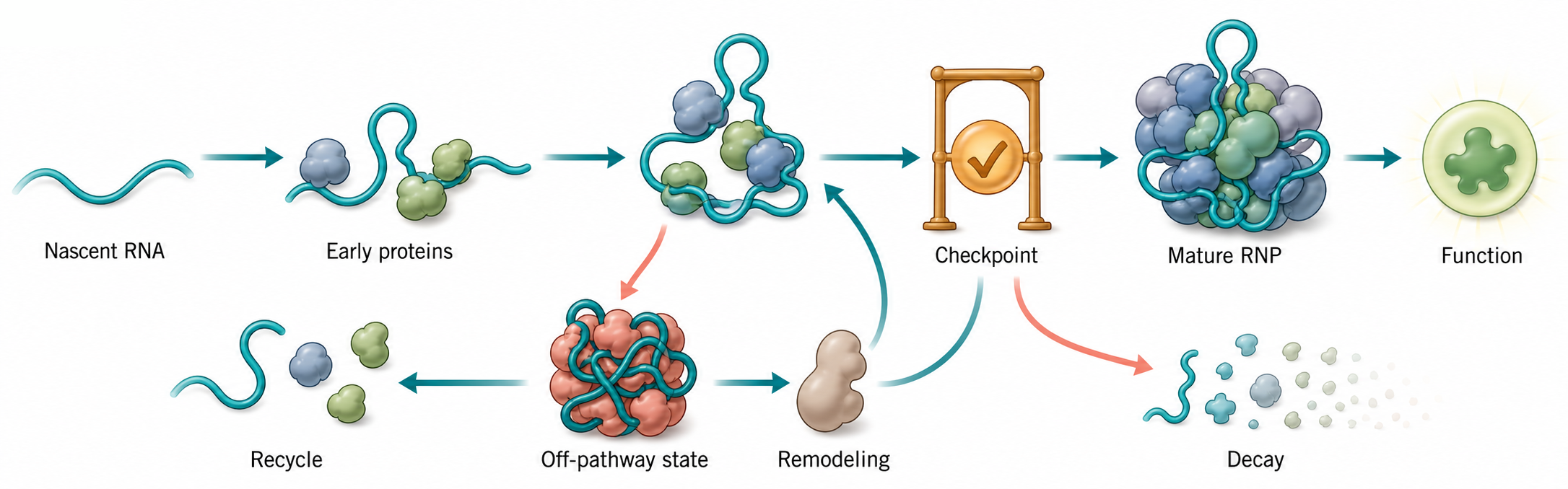
Figure 57.1. Assembly Pathway and Checkpoint Logic of a Large RNP Machine. Large RNP machines assemble through state pathways. Early factors stabilize RNA folds or prevent off-pathway contacts, remodeling enzymes resolve incorrect intermediates, and maturation checkpoints decide whether an intermediate proceeds to function, is recycled, or is degraded. The diagram is generic; ribosome biogenesis, spliceosome assembly, viral RNP formation, and regulatory RNP maturation use different components but share this logic.
The spliceosome illustrates a different assembly logic. It is not built once and then used repeatedly in the same form. Instead, each round of pre-mRNA splicing assembles a new machine around a specific intron. Small nuclear RNPs, or snRNPs, recognize splice-site features and branch point sequences, but initial recognition is not the catalytic state. The spliceosome undergoes extensive RNA-RNA and RNA-protein rearrangements before chemistry occurs. Early interactions are weak and dynamic, which allows sampling and correction. Later states position the branch point adenosine and splice sites for the two transesterification reactions that remove the intron. Dynamic-interaction studies of early spliceosome assembly emphasize that transient contacts can guide assembly without being stable enough to dominate endpoint structural preparations. Splicing fidelity also provides a major setting for proofreading models because a pre-mRNA contains many sequences that resemble splice sites but must not be used.
Stable regulatory RNPs often use modular assembly. The 7SK RNP contains 7SK RNA and associated proteins that regulate positive transcription elongation factor b, a kinase complex important for RNA polymerase II pause release. In this system, RNA conformation, protein occupancy, and regulatory state are linked. Structural work on RNA conformational switching in 7SK RNP supports the view that regulatory RNPs can switch between architectures rather than acting as inert scaffolds. This idea generalizes to many stable RNPs: the RNA component can provide a structural platform and an allosteric element, while proteins stabilize, mask, expose, or read particular RNA states.
Viral RNPs create assembly problems under different constraints. An RNA virus must package, protect, copy, and sometimes transport its genome while avoiding inappropriate host sensing or degradation. Influenza viral ribonucleoproteins, for example, organize genomic RNA with nucleoproteins and a polymerase complex. Structural and biochemical evidence indicates that assembly and architecture influence processive RNA synthesis, meaning that the polymerase’s ability to remain engaged is connected to the RNP state rather than to the polymerase alone. Alphaviruses and other RNA viruses use distinct replication and packaging architectures, but a common theme is that RNA synthesis, genome packaging, membrane association, and host-factor engagement are coordinated through structured viral assemblies.
RNP granules occupy a boundary category. A stress granule or related RNA-rich body is not a single stoichiometric machine like a ribosome, yet granules can impose assembly checkpoints on mRNPs. They can retain untranslated mRNAs, concentrate RNA-binding proteins, alter the probability of RNA-RNA contacts, and create local environments that favor repression or remodeling. G3BP-driven granules and DDX3X-dependent remodeling show how a granule-associated RNP state can change mRNA translatability by promoting or resolving inhibitory RNA-RNA interactions. The chapter on condensates treats material-state physics in depth; here the main point is that maturation checkpoints can occur in non-membrane compartments as well as in discrete complexes.
57.2. ATPases, GTPases, helicases, and remodeling factors
A remodeling cycle requires a source of directionality. Directionality can come from irreversible chemistry, substrate degradation, compartmental transport, a concentration gradient, or nucleotide hydrolysis. ATPases, GTPases, and helicases are common because they convert binding and hydrolysis into altered affinity or motion. In RNP machines, these enzymes rarely act as isolated motors. They are positioned by RNA, proteins, and substrates so that energy is spent at a particular transition.
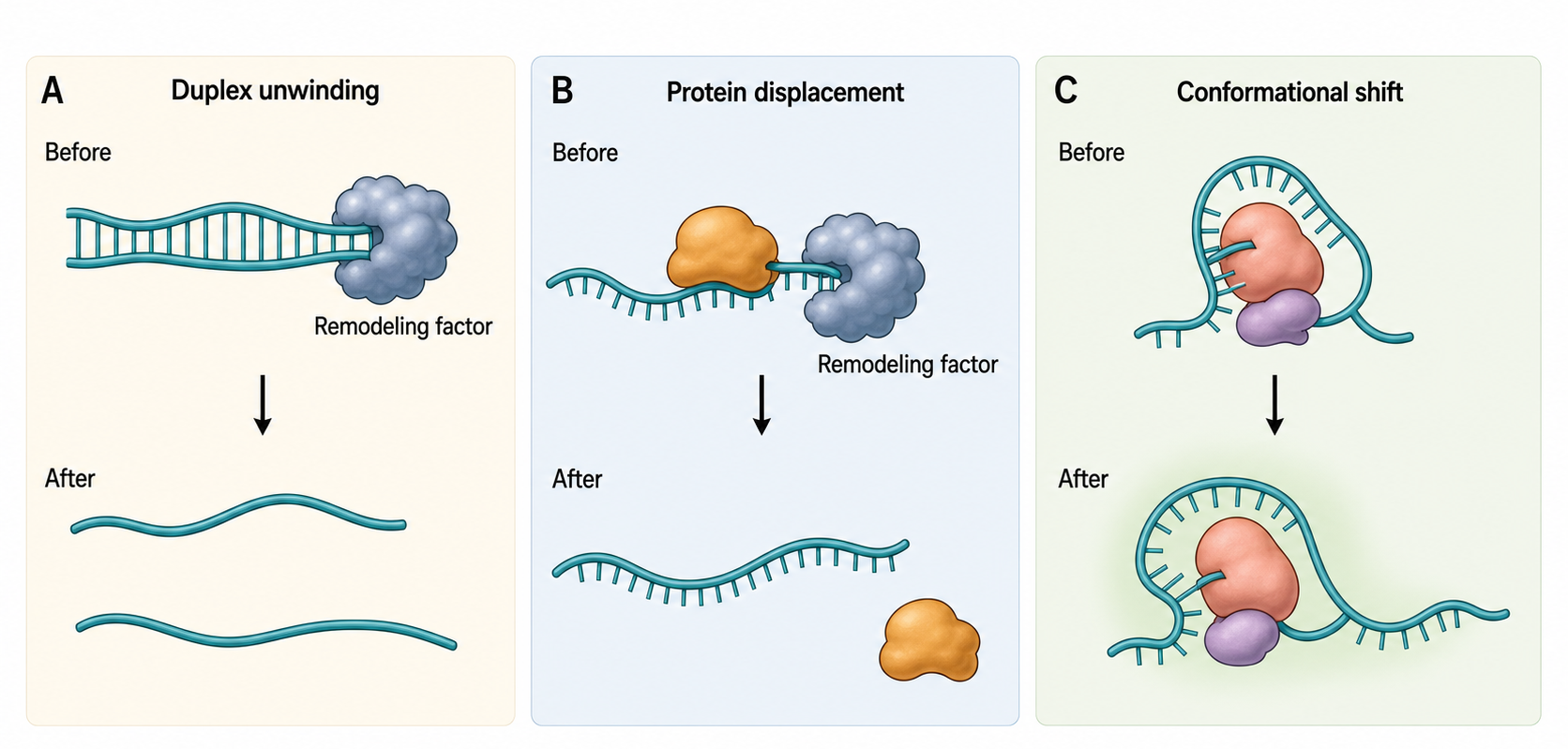
Figure 57.2. Three Modes of RNP Remodeling. Remodeling factors alter RNP state in several ways. Some unwind RNA duplexes, but others displace proteins, load new factors, alter residence time, or shift conformational ensembles. DDX3X-dependent resolution of inhibitory RNA-RNA interactions in G3BP-driven granules provides one example of remodeling connected to translation output.
RNA helicases are named for their ability to unwind RNA duplexes, but many helicases do not behave as simple zipper-like enzymes. Some unwind short duplexes. Some clamp onto single-stranded RNA and remodel local structure. Some displace proteins from RNA. Some act as RNA annealers or chaperones under particular conditions. The same helicase family can participate in splicing, translation initiation, ribosome biogenesis, decay, antiviral defense, or granule dynamics depending on recruitment domains and interaction partners. DDX3X is an example of a DEAD-box helicase whose biological roles include translation and stress-granule-associated remodeling; recent work links DDX3X activity to resolution of inhibitory RNA-RNA interactions in G3BP-driven granules. Chapter 54 covers helicase families and RNA folding traps in more detail.
ATP hydrolysis can remodel an RNP without producing long-distance movement. A common cycle begins with an ATP-bound state that binds RNA or a protein partner, followed by local conformational closure, hydrolysis, product release, and reopening. The energy difference is expressed as a change in residence time, binding surface, or structural strain. This is why it is misleading to say that ATP simply “powers” an RNP machine. A precise mechanism must specify which step is coupled to nucleotide binding, which step is coupled to hydrolysis, and which step is coupled to phosphate or ADP release.
GTPases often act as timers and commitment factors. During translation, GTPases help coordinate codon recognition, factor release, translocation, and subunit recycling. In broader RNP biology, GTPases can test whether a substrate-induced conformation has formed before a pathway proceeds. The timing function arises because GTP binding, hydrolysis, and product release create distinct conformational states. Correct substrate binding can accelerate or stabilize one state, whereas incorrect substrate binding can dissociate before commitment. Detailed translation factor mechanisms are covered in Chapters 67 to 69. Final bibliography item: add Chapter 57 citations for translation GTPase structural and kinetic studies.
Remodeling factors can also act by changing protein occupancy. A protein may bind an RNA early to prevent misfolding, then be removed so another factor can bind. A helicase may displace an RNA-binding protein without globally unfolding the RNA. A chaperone may stabilize an otherwise transient conformation long enough for an enzyme to act. These mechanisms are especially important when the same RNA surface must be used sequentially by different factors. Time-resolved RBP profiling across the mRNA life cycle supports the view that mRNA-associated proteins are dynamically exchanged rather than permanently installed at transcription. Newer crosslinking approaches such as irCLIP-RNP and Re-CLIP are designed to reveal patterns of dynamic protein assemblies on RNA, directly addressing the limitation that conventional interaction maps often average across states.
The specificity of a remodeling factor depends on recruitment as much as on catalytic activity. Many helicases can unwind or remodel simple substrates in vitro, but the cell uses adaptors, RNA features, subcellular localization, post-translational modifications, and competing proteins to restrict where remodeling occurs. This creates an important artifact-control issue: observing that a purified helicase can unwind an RNA duplex does not prove that the helicase unwinds that duplex in cells. A convincing cellular mechanism usually requires loss-of-function perturbation, rescue with catalytic mutants, substrate-state measurement, and evidence that the relevant RNA or RNP is physically engaged.
57.3. Substrate handoff, allostery, processivity, and kinetic proofreading
RNP machines must solve handoff problems because RNA molecules rarely interact with only one factor. A nascent pre-mRNA is passed from transcription-associated capping and splicing factors to export factors, cytoplasmic translation factors, decay machinery, and sometimes localization granules. A viral RNA is passed among nucleoproteins, polymerase, host factors, and packaging surfaces. A guide RNA is loaded into a CRISPR effector, then used to search for and bind a target. Handoff requires more than affinity. If two factors bind the same surface too strongly, the first factor blocks the second. If all contacts are weak, the substrate may diffuse away or be degraded. Productive pathways tune residence times so that the next factor arrives when a compatible intermediate exists.
Allostery helps coordinate handoff. In a simple allosteric model, binding at one site changes the shape or dynamics of another site. In RNP machines, the allosteric path may pass through RNA helices, protein domains, metal-ion sites, or quaternary contacts between subunits. For example, a guide RNA can organize the target-recognition channel of an RNA-centric CRISPR-Cas effector, so target binding is coupled to nuclease activation or collateral activity in system-specific ways. In 7SK RNP, RNA conformational switching changes the regulatory relationship between 7SK RNA, bound proteins, and transcription elongation control. In spliceosome assembly, splice-site recognition and snRNA rearrangements communicate across the pre-mRNA to align the catalytic center.
Processivity is essential when an RNP machine must perform repeated steps on the same substrate. Viral polymerases must often copy long RNA templates despite structured regions, bound proteins, and host defenses. The influenza ribonucleoprotein complex demonstrates that processive RNA synthesis depends on the architecture of the entire RNP complex, not only on the active site of the polymerase. Processivity can also describe helicases, exonucleases, and ribosomes. A processive machine increases efficiency because it avoids repeated substrate search, but processivity also increases risk: a wrongly recruited processive nuclease or polymerase can cause extensive damage.
Kinetic proofreading is a special form of delayed commitment. The initial binding event is reversible, so both correct and incorrect substrates can bind. A later step consumes energy, imposes a delay, or requires a rare conformational state. Correct substrates are more likely to reach the committed state, whereas incorrect substrates are more likely to dissociate. Splicing is a natural setting for this logic because many pre-mRNA sequences partially resemble splice sites. The cell cannot rely only on the strongest binding site, because regulated alternative splicing often uses weak sites deliberately. Proofreading must therefore reject many wrong sites while still allowing context-dependent use of nonconsensus sites. Current discussions of AI-assisted splicing proofreading reflect both the mechanistic complexity of splice-site selection and the computational challenge of predicting context-specific outcomes.
Proofreading should not be invoked casually. A pathway is not proven to use kinetic proofreading merely because it is accurate or because it consumes ATP. Evidence should show that an energy-consuming or time-dependent step increases discrimination beyond equilibrium binding, and that changing the step changes fidelity in the predicted direction. For the spliceosome, candidate proofreading steps include ATPase-dependent rearrangements and discard pathways. For CRISPR-Cas systems, candidate fidelity mechanisms include guide-target pairing geometry, conformational activation, and nuclease-domain positioning. For viral polymerases, proofreading may involve polymerase active-site selectivity, template positioning, or separate exonuclease functions in some viral families. Chapter 116 treats viral polymerase fidelity in more detail.
Box 57.1. What Would Prove Kinetic Proofreading in an RNP Pathway?
Proofreading is a mechanistic claim, not a synonym for accuracy. A pathway is not proven to use kinetic proofreading merely because it is accurate or consumes ATP; the following evidence is required.
- Define the initially bound correct and incorrect substrates.
- Identify the proposed delayed or energy-consuming discriminating step.
- Measure whether that step improves discrimination beyond equilibrium binding alone.
- Perturb the step and test whether fidelity changes in the predicted direction.
- Separate fidelity effects from changes in substrate abundance, complex stability, and cell viability.
Table 57.2. Evidence Classes for RNP-Machine Mechanisms. Matching common mechanistic claims about RNP machines to the methods, artifacts, and validation strategies that support or refute them.
| Claim Type | Useful Methods | What the Method Can Show | Common Artifact | Stronger Validation |
|---|---|---|---|---|
| Protein-RNA binding | CLIP, EMSA, pull-down assay | Physical association between protein and RNA | Crosslinking or lysis-induced rearrangement | Orthogonal binding assay with specificity mutant |
| RNP remodeling | ATPase assay, structural-shift assay, protein displacement assay | State change in RNP composition or conformation | Nonphysiological substrate or concentration | Catalytic mutant rescue in cells |
| Kinetic proofreading | Fidelity assay, kinetic titration, nucleotide-state perturbation | Discrimination above equilibrium-binding prediction | Indirect effects on substrate abundance or cell viability | Perturbation showing fidelity change in predicted direction |
| Structural state assignment | Cryo-EM, X-ray crystallography, NMR | Conformation of complex at a given moment | Purification bias or analog-trapping artifact | Kinetics, mutational tests, and functional reconstitution |
| Granule causality | Live imaging, perturbation, translation assay | Colocalization and translation output changes | Stress induction or overexpression artifact | Separation-of-function mutants affecting material state only |
Substrate handoff also requires negative regulation. A factor can act by preventing premature access rather than by recruiting a downstream enzyme. Assembly factors in ribosome biogenesis can cover functional sites until a subunit is mature. Spliceosomal proteins can stabilize a noncatalytic recognition state before activation. Viral nucleoproteins can protect genome RNA while still allowing polymerase access. Granule proteins can hold mRNAs away from ribosomes until remodeling factors release them. Negative regulation is easy to miss experimentally because removing an inhibitory factor can produce both gain-of-access and loss-of-quality-control phenotypes.
57.4. Structural snapshots versus dynamic mechanisms
Structural biology has transformed RNP research because it can reveal how RNA and protein components physically fit together. Cryogenic electron microscopy is especially powerful for large RNP machines because it can classify particles into different conformational states. X-ray crystallography remains powerful for stable domains, RNA motifs, and smaller complexes. Nuclear magnetic resonance, chemical probing, crosslinking, mass spectrometry, and single-molecule methods fill in flexibility, contacts, and kinetics. Chapter 59 treats these methods in detail. This chapter emphasizes the interpretive problem: a structure is a state, while a mechanism is a state-to-state path.
A purified structural snapshot can be misleading in several ways. First, purification may select the most stable state rather than the most biologically important state. Second, crosslinking, buffer composition, nucleotide analogs, mutations, inhibitors, or substrate mimics may trap a state that is real but artificially enriched. Third, compositional heterogeneity can be mistaken for conformational heterogeneity, or the reverse. Fourth, a low-occupancy transition state may be essential even though it is nearly invisible in endpoint samples. Finally, in vitro structural states may lack cellular partners that bias the ensemble.
The solution is not to distrust structures. The solution is to connect structures to perturbable mechanisms. If a structure suggests that a protein loop contacts an RNA helix during activation, mutating the loop should alter activation in a predictable way. If a cryo-EM classification suggests a sequence of conformations, kinetic experiments should test whether the order and rates are plausible. If a nucleotide analog traps a state, hydrolysis-defective and product-release mutants should help assign which step is represented. If a crosslinking map changes after perturbation, the perturbation should be interpreted in light of RNA abundance, protein abundance, and crosslinking efficiency.
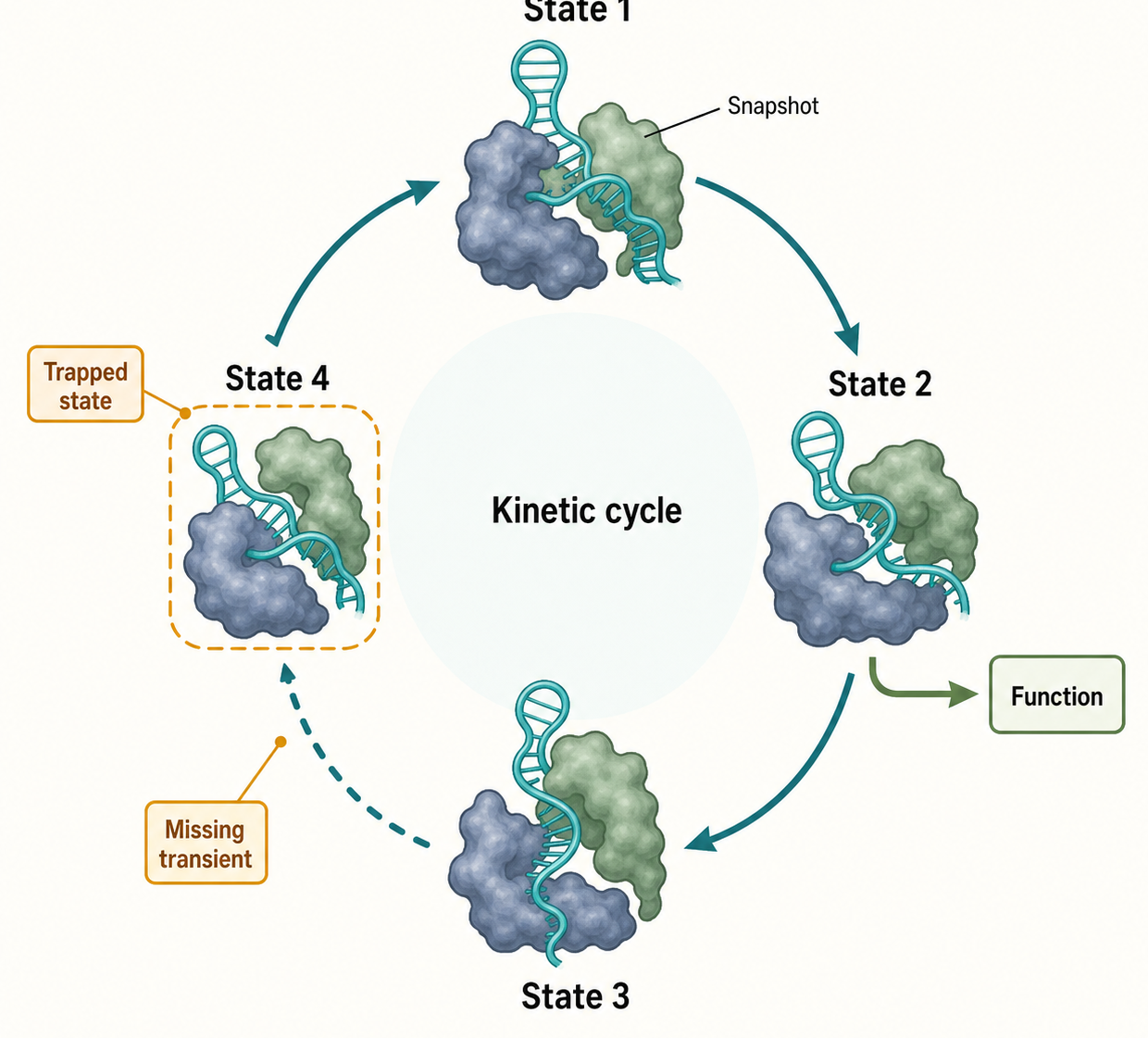
Figure 57.3. Structural Snapshots on a Dynamic Cycle. A high-resolution structure captures a state, not the full mechanism. RNP-machine mechanisms require assigning structural states to ordered transitions, rates, nucleotide states, and functional outputs. Missing transient states, purification bias, trapped analog states, and compositional heterogeneity can all distort the apparent cycle.
Early spliceosome assembly shows why dynamic mechanisms matter. A stable model of one assembled state cannot explain how weak splice sites are sampled, how branch-point recognition is stabilized, or how early contacts are rearranged. The field increasingly treats spliceosome assembly as a dynamic pathway with many reversible interactions rather than as a simple linear addition of parts. Similarly, time-resolved and state-sensitive RBP profiling methods show that mRNP composition changes across the mRNA life cycle and that RNA-associated protein assemblies cannot be represented by a single static binding map.
The 7SK RNP provides a compact example of structural snapshots becoming a mechanism. Structural work identified conformational switching in 7SK RNA and linked RNA architecture to regulatory protein interactions. The mechanism is not merely that 7SK RNA has a folded shape. The mechanism is that alternative shapes and protein-bound states affect the availability and activity of a transcription elongation factor. In this kind of system, the relevant unit is an ensemble of conformations with different binding and regulatory properties.
Viral RNPs emphasize another issue: the active machine may be embedded in a larger life cycle. A structural model of a viral polymerase or nucleoprotein complex is necessary but incomplete unless it is connected to genome packaging, replication organelles, host-factor interactions, immune evasion, and drug sensitivity. Structural reviews of alphavirus life cycles illustrate how viral RNA synthesis and assembly require coordinated architectures across multiple stages. For influenza RNP, processive RNA synthesis depends on molecular organization of the ribonucleoprotein complex.
57.5. Disease mutations and druggable RNP interfaces
Disease mutations in RNP systems often act through interfaces, dynamics, and material states rather than through complete loss of a single component. A mutation in an RNA-binding protein can alter RNA specificity, weaken or strengthen multivalent interactions, change granule recruitment, shift splicing choices, impair localization, or disturb decay. A mutation in an RNA can alter a protein-binding site, hide or expose a structural element, create a toxic repeat-containing RNP, or change the ability of a machine to assemble. These effects can be dosage-sensitive because RNP assembly depends on stoichiometry and competition.
RNP granule pathology illustrates interface-based disease logic. RNA-binding proteins with low-complexity regions can participate in dynamic assemblies that exchange components rapidly under normal conditions. Mutations, stress, age-related changes, or altered RNA composition can shift these assemblies toward less dynamic or more pathological states. Current reviews emphasize that RNP granules are functional cellular assemblies but that abnormal granule persistence, altered material properties, and mislocalized RBPs can contribute to disease. This disease logic is not equivalent to saying that all condensates are pathological or that phase separation automatically explains toxicity. Mechanistic evidence must connect a specific altered assembly state to a cellular defect.
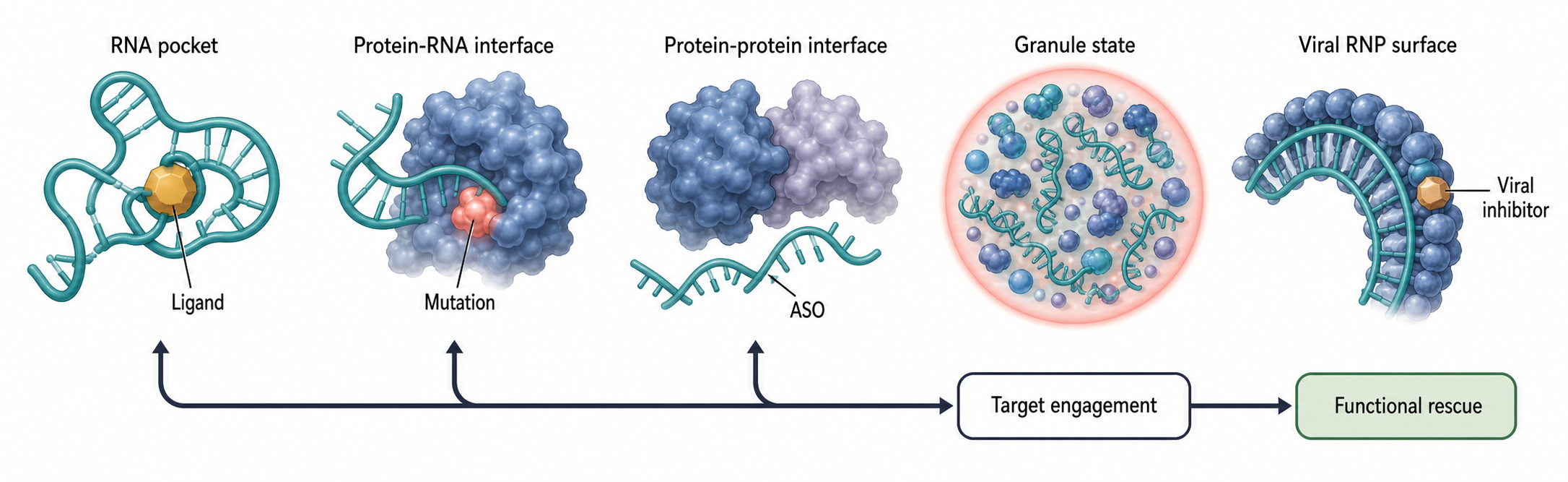
Figure 57.4. Disease and Drug Interfaces in RNP Machines. RNP disease and pharmacology often involve interfaces. Mutations, ligands, antisense oligonucleotides, or viral inhibitors may shift a conformational ensemble, alter protein-RNA binding, block a handoff, change processivity, or modify granule material properties. Cellular target engagement and mechanism-consistent functional rescue are needed before assigning causality.
Splicing disease provides a second interface-based example. Disease variants can disrupt splice sites, branch points, enhancers, silencers, snRNP contacts, or regulatory RBP binding. Some variants create cryptic splice sites that compete with authentic sites. Others alter the kinetic window in which an exon is recognized. Drugs or antisense oligonucleotides can sometimes redirect splicing by changing RNP assembly on a pre-mRNA rather than by changing the underlying DNA sequence. Antisense technology is covered in depth in Chapters 150 and 152, but the general RNP-machine principle is that a therapeutic oligonucleotide can mask a site, recruit RNase H, block a protein, or alter a local RNA structure. Final bibliography item: add chapter-specific references for approved splicing modifiers and spliceosome-targeting drugs.
Viral RNPs offer druggable interfaces because replication requires repeated protein-RNA and protein-protein contacts. A drug can target a polymerase active site, a polymerase-nucleoprotein interface, an RNA promoter element, a cap-snatching surface, a packaging signal, or a host-factor dependency. Direct structural information helps prioritize pockets and interfaces, but antiviral selectivity also requires pharmacological exposure, resistance analysis, and host toxicity assessment. For alphavirus and chikungunya-virus-related systems, recent structural and drug-target reviews summarize how nonstructural proteins, structural proteins, and viral RNA-related assemblies are being explored as antiviral targets. For influenza RNPs, assembly and processive synthesis mechanisms create potential target points beyond the polymerase catalytic center.
RNA-targeted small molecules expand the druggable landscape. A small molecule may bind a structured RNA pocket, stabilize an RNA conformation, prevent an RNA-protein interaction, promote a new interaction, alter splicing, or change RNP localization. Machine-learning perspectives on RNA-targeted small-molecule discovery emphasize that RNA is not an undifferentiated polymer; selectivity depends on shape, dynamics, chemical environment, cellular exposure, and functional validation. The strongest therapeutic claims require evidence that the compound engages the intended RNA or RNP in cells, changes the intended mechanism, and produces a phenotype at relevant concentrations.
CRISPR-Cas and Cas13 systems show that RNP interfaces can be engineered as well as drugged. RNA-centric Cas13 systems use guide RNA to recognize RNA targets and activate nuclease functions. Their utility depends on guide design, target accessibility, effector architecture, collateral activity, delivery, and off-target behavior. These systems are programmable RNP machines: the guide RNA supplies sequence information, while the protein supplies nuclease activity and conformational control. The same principle applies to therapeutic and diagnostic design more broadly: changing an RNA guide or ligand can redirect a protein machine, but biological specificity still depends on cellular context.
Experimental Foundations and Evidence
A strong mechanistic claim about an RNP machine usually combines several evidence classes. Structural evidence identifies candidate states and contacts. Biochemical reconstitution tests whether purified components can assemble and perform the proposed reaction. Kinetic assays measure rates, order, reversibility, and nucleotide dependence. Genetics and perturbation experiments test whether the same components matter in cells. Crosslinking and proximity methods identify RNA-protein contacts in more physiological contexts. Imaging and single-molecule approaches reveal heterogeneity, localization, residence time, and transitions that are lost in bulk averages.
Each evidence class has characteristic failure modes. Structural work may stabilize one state while missing others. Biochemical reconstitution may omit cofactors, modifications, crowding, compartmentalization, or competing pathways. Cellular perturbation may create indirect effects by changing RNA abundance, translation, stress, or protein homeostasis. Crosslinking methods depend on nucleotide identity, amino acid chemistry, UV exposure, ligation efficiency, antibody quality, and computational filtering. Time-resolved RBP profiling improves state resolution, but it still measures accessible and recoverable interactions rather than every contact. irCLIP-RNP and Re-CLIP address dynamic protein assemblies on RNA, yet their interpretation still requires controls for expression, recovery, and crosslinking bias.
The evidence standard should match the claim. A claim that an RBP binds an RNA can be supported by CLIP, electrophoretic mobility shift assays, or pull-down experiments. A claim that the binding event regulates a pathway requires perturbation and functional readout. A claim that ATP hydrolysis remodels an RNP requires nucleotide-state dependence and ideally catalytic-mutant rescue. A claim that a structural transition is necessary requires mutations or ligands that separate structural stabilization from global disruption. A claim that a granule state causes translational repression requires evidence that granule entry, RNA-RNA contacts, remodeling factors, and translation output are connected rather than merely correlated. Chapter 124 provides the quantitative assay and fitting framework needed to distinguish equilibrium occupancy, association and dissociation rates, stoichiometry, steady-state turnover, and single-turnover transitions; this chapter retains ownership of how those parameters support an RNP mechanism.
Artifact control is especially important for RNP machines because the same molecule can participate in multiple complexes. Overexpression can force nonphysiological assemblies. Cell lysis can rearrange weak RNPs after extraction. Crosslinking can freeze transient contacts but also create artificial proximity. Phase-separation assays can produce droplets at concentrations far above cellular levels. Cryo-EM classification can generate plausible but overinterpreted state orderings. Computational models can fit a structural ensemble without proving that the ensemble is populated in vivo. A rigorous chapter, paper, or experiment should distinguish observed contact, inferred state, proposed transition, and demonstrated mechanism.
Box 57.2. Artifact Controls for RNP Interaction and State Mapping
Interpreting RNP interaction maps and structural-state assignments requires systematic artifact controls at every stage of the experiment.
- Check RNA and protein abundance before interpreting enrichment ratios.
- Control for cell lysis, extraction conditions, and post-lysis complex rearrangement.
- Use orthogonal crosslinking or non-crosslinking methods to corroborate contacts.
- Distinguish direct contact from co-complex association using proximity and competition controls.
- Pair structural state assignments with kinetic or perturbational tests.
- Avoid inferring causal granule function from colocalization alone.
Biological Contexts Across Systems
RNP machines are ancient and universal, but their architectures differ across biological systems. Bacterial and archaeal RNPs include ribosomes, RNase P, CRISPR-Cas complexes, small-RNA regulatory assemblies, and RNA decay machineries. Eukaryotic cells add a larger spliceosome, elaborate ribosome-biogenesis pathways, nuclear export machinery, diverse stable noncoding RNPs, cytoplasmic transport granules, and many regulated mRNP states. Organelles retain specialized ribosomes and RNA-processing RNPs shaped by endosymbiotic evolution. RNA viruses use compact RNP architectures to replicate and package their genomes within host cells.
The same mechanistic vocabulary applies across these systems, but the biological constraints differ. A bacterial small-RNA RNP may need to respond within minutes to stress. A eukaryotic spliceosome must choose splice sites in long pre-mRNAs with many decoy sequences. A neuronal transport granule may keep mRNAs repressed during transport and then release them locally. A viral RNP must protect genomic RNA while allowing replication and avoiding host defenses. A CRISPR-Cas RNP must maintain guide-dependent specificity while scanning a large pool of possible targets.
Compartmentalization changes RNP behavior. The nucleolus concentrates rRNA transcription, processing, modification, and ribosome assembly. Nuclear speckles enrich splicing-related factors and may influence mRNP maturation. Cytoplasmic stress granules and processing bodies concentrate nontranslating mRNPs and decay or repression factors. Viral replication organelles create local environments for viral RNA synthesis. These compartments do not simply increase concentration. They can change competition, residence time, modification exposure, immune sensing, and access to remodeling enzymes.
Development and stress also alter RNP machines. Oocytes and early embryos store maternal mRNAs in repressed RNP states before activating translation. Neurons transport mRNAs long distances in granules and remodel them near synapses. Stress can shift mRNAs out of translation and into granules or decay pathways. Infection can reorganize host and viral RNPs, while host innate immune pathways detect abnormal RNA structures and RNP contexts. These contexts are treated in later chapters, but the shared principle is that RNP architecture converts environmental and developmental signals into altered RNA fate.
Technology, Computational, and Clinical Links
Technologies that measure RNP machines are moving from static inventories toward state-resolved maps. CLIP-family methods identify protein-RNA contacts. RNA-centric proteomics identifies proteins associated with selected RNAs. Time-resolved profiling follows changing RBP occupancy during the mRNA life cycle. irCLIP-RNP and Re-CLIP provide strategies for examining dynamic protein assemblies on RNA. Structure probing and cryo-EM describe RNA and RNP conformations. Single-molecule methods measure dwell times, transitions, and heterogeneity. The next experimental challenge is integration: connecting contact maps, structural states, kinetic transitions, and functional outcomes for the same RNP pathway.
Computational modeling of RNP machines operates at several scales. Atomic models can refine structures and simulate local dynamics. Coarse-grained models can explore conformational landscapes. Kinetic models can represent assembly pathways, proofreading steps, and processivity. Machine-learning models can predict RNA-binding protein motifs, guide RNA performance, splicing outcomes, or small-molecule RNA binders. These models are useful when they make testable predictions and respect the difference between correlation and mechanism. A model trained on binding data may not predict remodeling. A model trained on endpoint structures may not predict transition rates.
Clinically, RNP machines are drug targets, disease mechanisms, biomarkers, and therapeutic platforms. Antibiotics target ribosomal functional centers. Splicing modifiers and antisense oligonucleotides redirect pre-mRNA RNP assembly. Antiviral drugs target viral polymerases and RNP interfaces. RNA-targeted small molecules attempt to modulate structured RNA or RNA-protein interactions. CRISPR-Cas13 and related systems use engineered RNPs for RNA targeting. RNP granule biology contributes to neurodegeneration, cancer, infection, and stress pathology, although causal claims must be evaluated carefully.
Box 57.3. RNP Interface Druggability Checklist
Therapeutic targeting of RNP interfaces requires validation beyond binding affinity, addressing both mechanism and selectivity.
- Define the intended interface: RNA pocket, protein-RNA surface, protein-protein contact, NTPase active site, or material-state determinant.
- Demonstrate direct target engagement under cellular conditions.
- Show a mechanism-consistent shift in RNP state or functional output.
- Test selectivity against related RNAs, proteins, and pathways.
- Assess resistance emergence, pharmacological exposure, host toxicity, and disease relevance.
Recent Consensus
Current consensus treats RNP machines as dynamic ensembles with regulated state transitions, not as rigid objects. RNA is not merely a passive ligand for proteins. RNA can supply sequence information, catalytic geometry, scaffold architecture, conformational switching, and localization information. Proteins are not merely stabilizers. They contribute specificity, energy coupling, quality control, localization, and regulation. The functional unit is often a pathway of states rather than a single mature complex.
A second consensus is that high-resolution structures need kinetic and cellular validation. Cryo-EM and crystallography are central, but they are strongest when combined with mutational tests, nucleotide-state assignments, reconstitution, time-resolved interaction mapping, and cellular rescue. A third consensus is that RNP disease and druggability often reside at interfaces and transitions. A mutation, ligand, or therapeutic oligonucleotide may act by shifting an ensemble, changing a handoff, or altering a material state rather than by simply turning a component on or off.
Open Questions, Controversies, Deprecated Models, and Common Misconceptions
Open questions:
- How many cellular RNP states are discrete enough to describe as defined intermediates and how many are better represented as continuous ensembles? Cryo-EM classification and single-molecule trajectories can both suggest state models, but the number of states may depend on method, sample preparation, and analysis choices.
- How often granule localization is causal rather than correlative? RNP granules clearly influence RNA metabolism in some cases, but not every RNA found in a granule is functionally controlled by that granule.
Controversies:
- A major controversy concerns how to interpret weak and transient interactions. Some weak contacts are biologically meaningful because they allow reversible sampling, rapid handoff, or proofreading. Other weak contacts are nonspecific background. Distinguishing these cases requires perturbation and functional readout, not only enrichment. Another unresolved area is how to predict RNP assembly from sequence. RNA sequence, protein motifs, modifications, cellular concentration, timing, and compartment all contribute, so a purely sequence-based model will miss many determinants.
Common misconceptions:
- “A high-resolution structure is the mechanism.” A structure is evidence for a state; mechanism requires an ordered and tested path between states.
- “ATP use proves proofreading.” ATP use may drive remodeling, recycling, transport, or release without increasing substrate discrimination.
- “An RNA-binding protein found on an RNA is a regulator of that RNA.” Binding can be incidental, redundant, condition-specific, or only one part of a larger pathway.
- “Phase separation is automatically pathological.” Many RNP granules are normal regulated assemblies; pathology requires evidence of altered material state, persistence, localization, or client selection that causes dysfunction.
Deprecated or weakened claims:
- Purely linear assembly diagrams that imply each RNP intermediate proceeds irreversibly to the next, static scaffolding models in which RNA only holds proteins in place, and one-factor explanations for complex RNP disease phenotypes. These models may still be useful as simplified teaching sketches, but they should not be treated as mechanistic descriptions.