Chapter 74. RNA Transport Machinery, Localization Grammar, Anchoring, and Remodeling
Scope Note
RNA localization is the nonrandom placement and retention of RNA molecules within cells. This chapter owns the general grammar that connects cis-localization signals to RNA-binding proteins, messenger ribonucleoprotein (mRNP) assembly, motor-adaptor engagement, transport-granule behavior, anchoring, release, local remodeling, translation competence, and decay state. It also owns the measurement logic needed to distinguish enrichment, directed movement, retention, local translation, and local decay. Membrane and organelle targeting belongs in Chapter 75, developmental and cell-type-specific local translation belongs in Chapter 76, and neural or glial integration belongs in Chapter 103.
Executive Summary
Cells use RNA localization to place RNA function near a destination and to control when that function becomes available. A localized mRNA can remain repressed during movement, become translation-competent after docking, return to transport, enter storage, or undergo local decay. A localized noncoding RNA can scaffold a nuclear or cytoplasmic complex or tune local protein activity. Localization therefore converts a one-dimensional RNA sequence into a dynamic spatial regulatory object whose position, RNP composition, and biochemical state must be measured separately.
The most familiar localization signals are zipcode elements: cis-acting RNA sequences or structures that are sufficient or necessary for enrichment of an RNA at a subcellular destination. A zipcode is not usually a postal address in the simple engineering sense. Many localization elements are short motifs embedded in a broader structural context, repeated weak sites, or combinations of RBP-binding sites whose effect depends on isoform choice, RNA modification, translation state, and cell type. The beta-actin mRNA zipcode recognized by ZBP1/IGF2BP1 is a classic metazoan example, but the broader field now treats localization as a network property of RNA architecture and RNP assembly rather than a one-element-one-destination code (Farina et al. 2003; Lazzaretti and Bono 2017; Das et al. 2021).
Transport granules are messenger ribonucleoprotein assemblies that package RNAs with RNA-binding proteins, translational regulators, motors, adaptors, helicases, and remodeling factors. Granules can move on microtubules or actin filaments, pause, reverse, switch tracks, split, fuse, or dock. Some granules resemble condensates, whereas others are smaller particles organized by specific interactions. Motor movement is therefore coupled to RNA regulation: the same RNP state can determine whether a transcript engages a motor, remains translation-incompetent during transit, and becomes accessible to remodeling at a destination (Basyuk et al. 2021; Das et al. 2021).
Localization is productive only if arrival is followed by the appropriate retention and state transition. Anchoring can involve direct tethering, scaffold capture, compartment association, granule incorporation, or repeated kinetic capture. Release can be triggered by signaling, phosphorylation, RNP remodeling, ribosome recruitment, or changes in tail and RBP state. Translation competence and decay susceptibility are coupled to localization because ribosome occupancy, RBP exchange, helicase activity, poly(A)-tail state, and quality-control factors change whether a transcript remains available, is translated, returns to transport, or is eliminated.
The evidence base for RNA localization is strong but method-sensitive. Fixed-cell in situ hybridization can show spatial enrichment, live imaging can show transport kinetics, and perturbation of cis-elements or RBPs can test causality. However, overexpression of tagged RNAs, repeated aptamer arrays, fixation artifacts, probe accessibility, cell stress, and segmentation biases can create false localization patterns or distort transport. Proximity labeling and spatial RNA methods add molecular breadth, but they require controls for enzyme radius, labeling time, compartment leakage, and RNA recovery bias. The best-supported claims combine imaging, endogenous perturbation, biochemical or sequencing evidence, and rescue experiments (Le et al. 2022; Wang et al. 2023; Zuo et al. 2024).
Concept Inventory
- RNA localization: enrichment or retention of RNA at a subcellular site relative to the cell-wide RNA distribution. Localization can arise from directed transport, local stabilization, local transcription in organelles or nuclei, local capture, or local decay elsewhere.
- Cis-localization signal: a sequence, structure, modification pattern, splice isoform feature, poly(A)-site choice, or coding-region feature in the RNA that contributes to localization.
- Zipcode element: a cis-localization signal often defined experimentally by deletion, mutation, transplant into a reporter, and rescue. The term is strongest when a defined RNA segment is necessary and sufficient for localization in a specific system.
- Trans-acting localization factor: a protein or RNP component that recognizes a cis-signal or associated RNP feature and promotes localization.
- Transport granule: a moving or docked RNP assembly containing RNA plus proteins. A transport granule is not necessarily a large phase-separated body.
- Anchoring: retention of an RNA or RNP at a destination after transport or local capture.
- Local translation: protein synthesis from an RNA at a restricted subcellular site, often after translational repression during transport.
- Decay coupling: coordination between localization, translation, and RNA turnover, including local deadenylation, decapping, exonucleolytic degradation, or translation-coupled quality control.
- Artifact-prone distinction: RNA enrichment at a site does not prove directed transport, and the presence of a transcript near a structure does not prove local translation from that transcript.
What to Know Before Reading This Chapter
The reader should know that most mature eukaryotic mRNAs have a 5′ cap, a coding sequence, untranslated regions, and a poly(A) tail, and that RNA-binding proteins assemble with mRNAs throughout transcription, processing, export, translation, and decay. The chapter uses “mRNP” for a messenger ribonucleoprotein particle: an mRNA together with its bound proteins. The chapter also assumes basic familiarity with microtubules, actin filaments, kinesin, dynein, myosin, ribosomes, and translation initiation.
The beta-actin mRNA zipcode provides the running cis-signal example because it connects a mapped RNA element, an RBP, cytoskeletal association, and spatial output. Generic transport particles then provide a running mechanistic model for motor engagement, pausing, anchoring, release, and remodeling. Developmental and neural systems appear only long enough to show why the shared grammar matters; their detailed biological programs belong in Chapter 76 and Chapter 103.
74.1. Zipcode elements and cis-localization signals
A cis-localization signal is a feature within an RNA molecule that helps determine where that RNA accumulates. The signal may be a short sequence motif, a folded RNA structure, a cluster of RBP-binding sites, a splice-dependent exon junction context, a 3′ untranslated region segment, a coding-region feature, or a modification-dependent binding platform. A zipcode element is a historically important type of cis-localization signal, usually defined by experiments showing that a specific RNA segment is required for normal localization and can confer localization on a reporter RNA. This chapter uses “zipcode” for well-mapped transferable elements and “cis-localization signal” for the broader class.
The basic causal chain is straightforward. First, the RNA sequence or structure creates a binding surface. Second, a trans-acting factor, often an RNA-binding protein, binds that surface. Third, the bound protein recruits other proteins that package the RNA into an mRNP, repress or license translation, and connect the mRNP to transport or anchoring machinery. Fourth, the RNP is moved, captured, stabilized, or locally translated in a way that enriches the RNA at the destination. Each step is conditional: a sequence element may be inactive if it is masked by RNA structure, excluded by alternative polyadenylation, competed away by another protein, or placed in a cell type lacking the required trans-factor.
The beta-actin mRNA zipcode illustrates the principle. In motile fibroblasts and neurons, beta-actin mRNA can enrich at leading edges or growth cones. A localization element in the 3′ untranslated region binds ZBP1/IGF2BP1 family proteins. Farina and colleagues showed that ZBP1 KH domains contribute to beta-actin mRNA localization, granule formation, and cytoskeletal attachment, supporting a model in which an RBP recognizes a 3′ UTR element and helps build a transport-competent mRNP (Farina et al. 2003). The example is pedagogically useful because it connects a defined RNA element, an RBP, a cytoskeletal destination, and local translation control. It is also a caution: beta-actin is not a universal template for all localized RNAs.
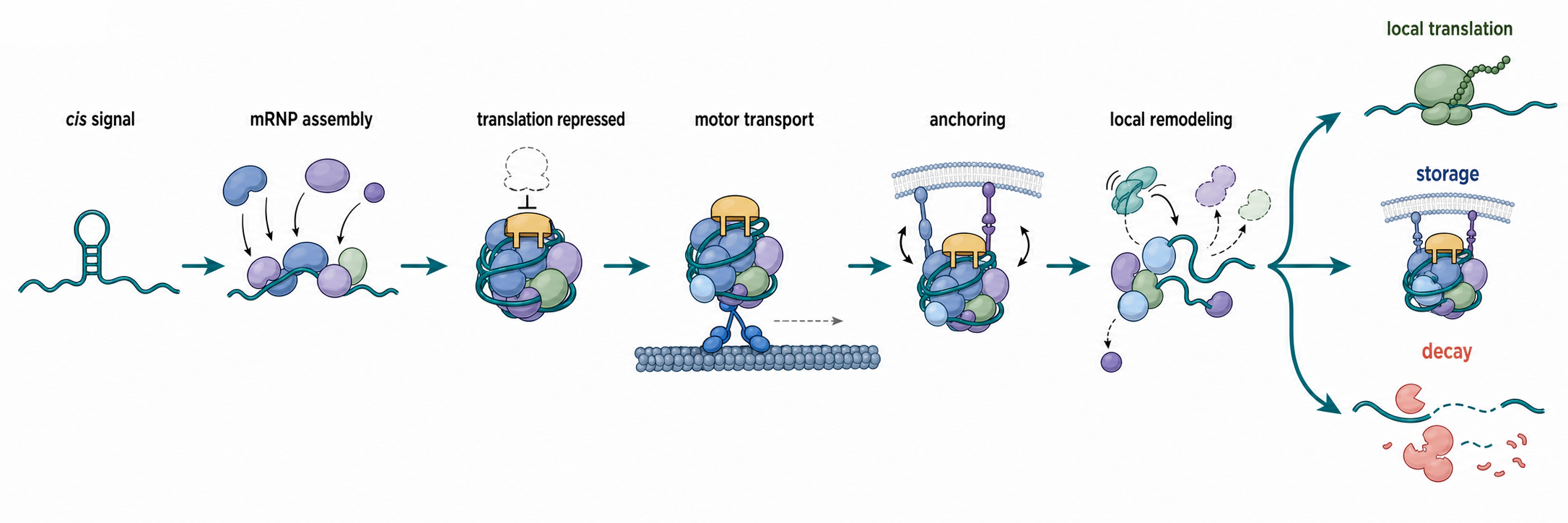
Figure 74.1. Lifecycle of a Localized mRNA. A localized mRNA begins as a processed transcript with cis-localization signals in the UTR, coding region, structure, or modification pattern. RNA-binding proteins assemble a transport-competent mRNP, regulate translation competence, connect the mRNP to motor-adaptor machinery, and move the RNA through the cytoplasm. At a destination, anchoring and remodeling can switch the RNA among translation-competent, decay-competent, stored, released, or renewed transport states.
Many localization signals are more distributed than a single beta-actin-like element. Some RNAs contain repeated low-affinity motifs that recruit multiple copies of an RBP. Some signals depend on secondary structure, such as stem-loops that arrange bases in a binding geometry. Some signals reside in long 3′ UTR isoforms generated by alternative polyadenylation, linking localization to transcript-end choice. Coding sequences can also influence localization through translation state, nascent peptide targeting, codon usage, RNA structure, or RBP binding. Noncoding RNAs add another boundary case: a localizing lncRNA may act through protein-binding surfaces and structural scaffolds without ever being translated. The evidence basis for a zipcode claim should be stronger than colocalization. A minimal test asks whether deleting or mutating the candidate element disrupts localization of the endogenous or reporter RNA. A stronger test asks whether placing the element into a normally nonlocalized reporter confers localization. A still stronger test rescues the mutated endogenous locus and measures both RNA position and biological function. Binding evidence from crosslinking, electrophoretic mobility shift assays, structural studies, or mutational binding assays then connects the element to the responsible protein. Reviews emphasize that structural context matters: an RBP-binding motif found by sequence alone may not bind in the native transcript, and a CLIP peak does not prove that the binding event causes localization (Lazzaretti and Bono 2017; Das et al. 2021; Wang et al. 2023).
Do not overgeneralize the word “zipcode.” A real postal code maps to one address system. Cellular localization signals are probabilistic, combinatorial, and context-dependent. The same RNA can use different signals in different cell types; the same signal can promote transport, anchoring, translational repression, or stability depending on the RNP state; and different transcripts can converge on the same destination by different mechanisms. The main cross-chapter connection is to Chapter 73, where UTR regulatory grammar and RBP motif interpretation are treated in more detail.
Box 74.1. Why a Zipcode Is Not a Deterministic Postal Address
- A validated zipcode is context-specific: it may direct localization in one cell type but not another.
- Many RNAs use multiple weak or redundant elements rather than a single dominant signal.
- RNA secondary structure and local RBP concentration affect whether a motif is recognized.
- Alternative polyadenylation can include or exclude localization-relevant 3′ UTR segments.
- The same element may contribute to transport, anchoring, translational repression, or RNA stability depending on RNP state.
74.2. Motor adaptors and transport granules
Once an RNA has assembled with proteins, the cell must move the resulting mRNP through a crowded cytoplasm. Microtubules provide long-range tracks, especially in neurons and large embryonic cells. Actin filaments support short-range movement, cortical transport, and anchoring near cell edges. Kinesins usually move toward microtubule plus ends, dynein usually moves toward minus ends, and myosins move on actin. The phrase “usually” matters because microtubule polarity differs among dendrites, axons, epithelial cells, and mitotic or developmental contexts.
A motor adaptor is a molecule, complex, or regulated state that connects an RNP to a motor. For RNA, the adaptor is rarely a simple hook. It can be an RBP bound directly to the RNA, a scaffold bound to several RBPs, or an RNP conformation that licenses motor engagement. The RNP often contains translation regulators because premature translation during transport could alter cargo state or destination. Helicases, poly(A)-binding proteins, decay factors, and signaling proteins can make the granule responsive to local cues. Membrane- and organelle-coupled adaptor systems are treated in Chapter 75.
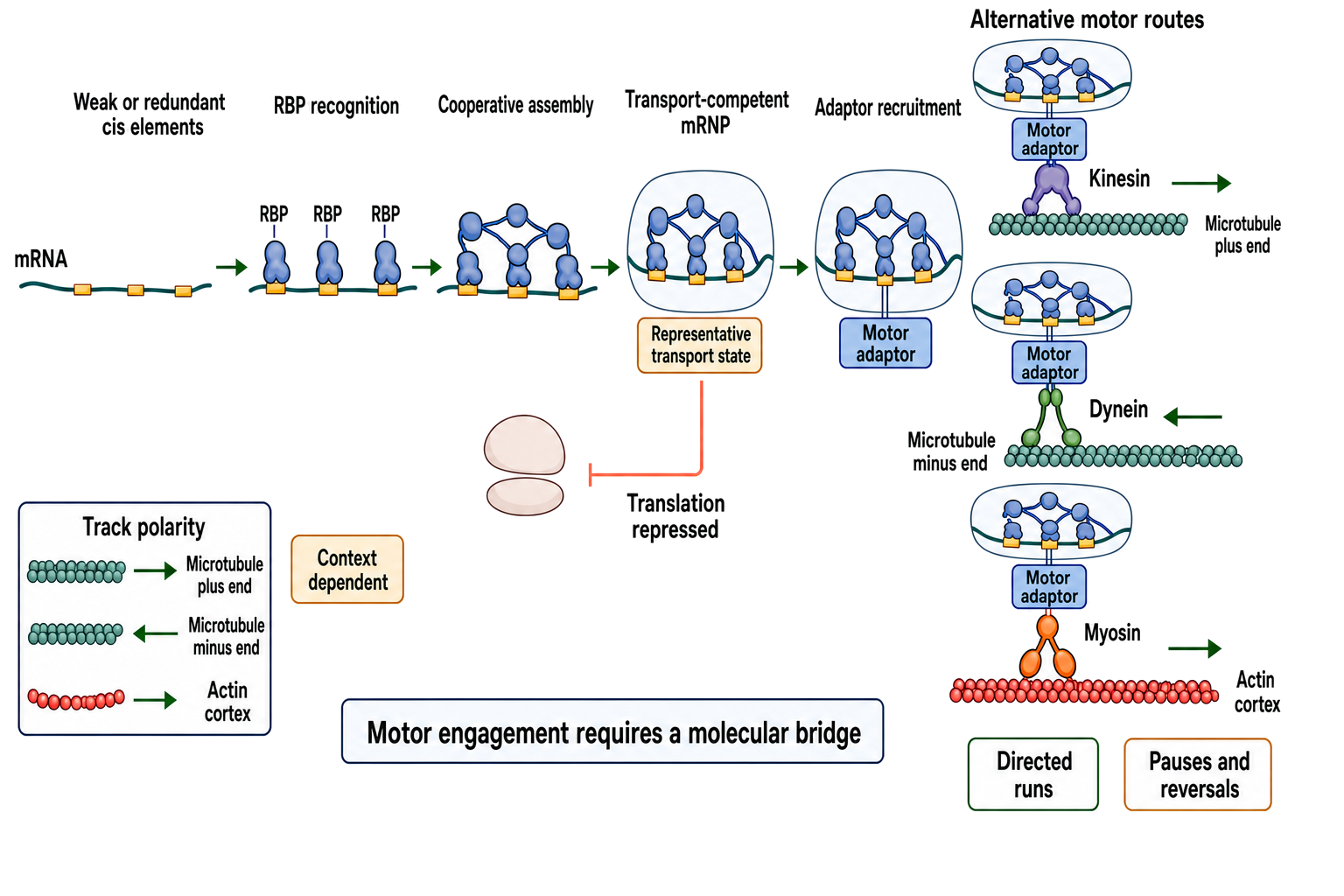
Figure 74.3. From Cis-Signal Recognition to Motor-Adaptor Engagement. A cis element does not contact a cytoskeletal motor by itself. RBP occupancy, cooperative mRNP assembly, translation-state control, and a direct or multicomponent motor-adaptor bridge create a transport-competent cargo that can engage polarity-aware microtubule or actin routes.
Transport granules are heterogeneous. Some are small particles containing one or a few RNAs; others are larger assemblies containing many RNAs and proteins. Some behave like liquid condensates, showing fusion, exchange, and sensitivity to weak multivalent interactions. Others are more stable particles organized by specific protein-RNA interactions. RNA granule reviews have cautioned against treating all puncta as equivalent condensates simply because microscopy shows cytoplasmic foci (Tian et al. 2020). For localized mRNAs, the mechanistic question is not whether a punctum exists, but what RNA species it contains, whether those RNAs are moving or docked, whether ribosomes are present, and what perturbation changes the RNA’s destination or use.
Motor engagement must be established rather than inferred from directional motion alone. A credible motor-adaptor model identifies the RNA-bound factor or RNP scaffold, the motor complex, the interaction state that permits coupling, and the consequence of disrupting that coupling. Perturbation should distinguish loss of motor attachment from global cytoskeletal collapse, altered cell polarity, or reduced RNA abundance. Neuron-specific motor complexes and axonal outcomes are integrated in Chapter 103, while membrane- and organelle-coupled transport platforms are treated in Chapter 75.
Transport is bidirectional and stochastic at the single-particle level. A granule may move anterogradely, pause, reverse, detach, or switch tracks. Net localization can arise from small biases in run length, motor engagement, capture probability, or degradation at non-destination sites. Single-molecule perspectives therefore changed the field by replacing a simple conveyor-belt model with a kinetic model in which many particles sample the cytoplasm and are selectively retained or used (Basyuk et al. 2021). This matters experimentally: a snapshot showing more RNA at one site cannot distinguish directed motor transport from local stabilization, local release from a larger granule, or degradation elsewhere.
Stress granules are a boundary case. Stress-induced partitioning shows that translation state can change RNA location, but a stress granule is not a transport granule and punctum formation does not establish directed movement. The general lesson retained here is that ribosome association, RBP exchange, and stress state can alter granule entry. Condensate physics and stress-granule life cycles belong in Chapter 58 and Chapter 105.
74.3. Anchoring, release, and local remodeling
Transport produces enrichment only if the RNA is retained or used at a destination. Anchoring is the set of mechanisms that keep an RNA or RNP near a cellular structure after movement or local capture. Anchoring can be direct, as when an RNP binds cytoskeletal or cortical components. It can be indirect through a scaffold, compartment, or granule, and it can be kinetic: repeated local capture and slow release can produce enrichment without a long-lived physical tether. Specialized membrane/organelle, developmental, and neural anchors belong in their successor chapters.
A localized RNP usually must be remodeled before translation, decay, or long-term storage. During transport, translation may be repressed by an RBP that blocks initiation, by a closed RNP conformation, by a short poly(A) tail, or by exclusion of ribosomes. At the destination, signaling can phosphorylate an RBP, recruit a helicase, lengthen a poly(A) tail, displace a repressor, or expose a translation initiation region. The same remodeling can release an RNA from an anchor, move it into a different granule, or make it accessible to decay enzymes. Local remodeling is therefore not an afterthought; it is part of the localization program.
Remodeling becomes mechanistic when a trigger is connected to a molecular state change. A strong study identifies the local signal, the RBP, helicase, tail regulator, or scaffold whose state changes, the resulting gain or loss of ribosome or decay-factor access, and the effect on retention or release. Developmental activation programs are treated in Chapter 76, and activity-dependent neural remodeling is integrated in Chapter 103; the general causal grammar remains the same across those systems.
Anchoring and release are difficult to prove because static enrichment can arise through several paths. A fixed image cannot show whether an RNA just arrived, was synthesized locally, was stabilized locally, or failed to diffuse away. Fluorescence recovery after photobleaching, photoactivation, pulse-chase labeling, endogenous tagging, and single-particle tracking can help distinguish retention from repeated arrival. Perturbing candidate anchors is necessary but must be interpreted carefully: disrupting actin, microtubules, or membrane trafficking can globally stress the cell and indirectly change RNA transcription, export, translation, and decay.
The local extracellular RNA literature is a useful boundary caution. RNA can be released from cells in vesicles or RNP particles, processed extracellularly, and detected near cell surfaces or in biofluids. Tosar and colleagues reviewed extracellular RNA release, processing, and function, emphasizing that release and extracellular stability have distinct mechanisms and artifacts (Tosar et al. 2021). That field is not the central topic of this chapter, but it shows why “RNA found near a location” must not automatically be interpreted as a purposeful intracellular anchoring event.
74.4. Coupling localization state to translation competence and decay
Localization state and translation competence are related but distinct variables. A transported mRNP may exclude ribosomes, carry initiation repressors, or remain only intermittently translated. Anchoring or destination signaling can change RBP occupancy, RNA structure, poly(A)-tail state, initiation-factor access, and granule membership, thereby increasing or decreasing translation competence without changing RNA position. Conversely, ribosome loading can change motor engagement, granule partitioning, anchoring, and exposure to decay machinery.
A useful state model contains four transitions: transport-competent, anchored, translation-competent, and decay-competent. These states are not a mandatory linear sequence. Some RNAs cycle between movement and anchoring, some travel while associated with ribosomes, some remain stored after arrival, and some are cleared without a detectable translation burst. The mechanistic question is which molecular change alters the transition probability: RBP phosphorylation, helicase recruitment, tail remodeling, ribosome association, or access by a deadenylase, decapping factor, or nuclease.
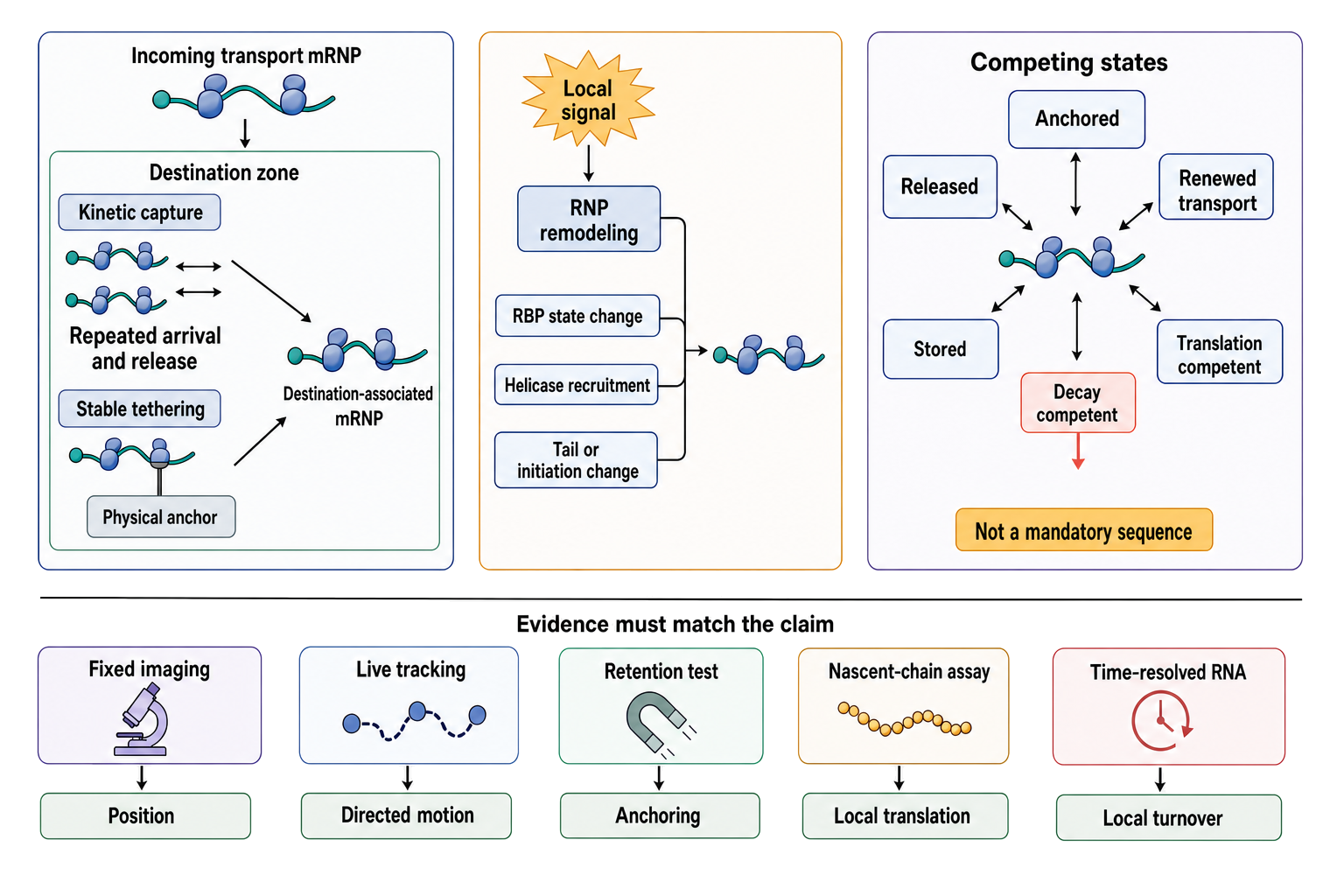
Figure 74.4. Destination Capture and Competing Localized-RNA States. Destination enrichment can arise from kinetic capture or stable
Evidence must therefore measure position and biochemical state independently. RNA enrichment does not establish translation; a local protein pool does not establish local synthesis; and local RNA loss does not establish local decay. Translation competence can be tested with nascent-chain reporters, compartment-resolved ribosome association, or spatial metabolic labeling, while local turnover requires time-resolved RNA measurement and perturbation of the relevant decay machinery. Detailed developmental and cell-type-specific translation programs belong in Chapter 76, neural integration belongs in Chapter 103, and membrane- or organelle-triggered translation belongs in Chapter 75.
Translation-coupled surveillance provides a boundary condition rather than a second localization pathway. Abnormal ribosome states can recruit quality-control and decay factors, but the detailed mechanisms are covered in Chapter 35, Chapter 36, and Chapter 71. This chapter retains the localization consequence: changes in ribosome state can alter granule entry, residence time, release, and the probability that a localized RNA remains available.
74.5. Methods for transport and localization dynamics
Table 74.1. Evidence Standards for RNA Localization Claims. Each row describes a distinct localization claim type, the minimal evidence required to support it, a stronger causal standard, the most common experimental artifact, and a brief interpretation note.
| Claim type | Minimal evidence | Stronger causal evidence | Common artifact | Example interpretation |
|---|---|---|---|---|
| RNA is enriched at a site | smFISH or validated in situ imaging | Multiple probe sets with endogenous abundance controls | Probe accessibility | Enrichment requires controls for local RNA abundance |
| RNA is actively transported | Live single-particle tracking | Motor or adaptor perturbation and rescue | Overexpressed tagged reporters | Transport must be distinguished from directed diffusion |
| RNA is anchored | Retention or photoactivation assays | Anchor perturbation and restored tethering | Cytoskeletal stress | Kinetic capture can mimic stable anchoring |
| RNA is locally translated | Nascent protein or compartment-resolved ribosome evidence | Local template mutation and functional rescue | Transported protein accumulation | Local protein enrichment does not imply local synthesis |
| RNA is locally degraded | Local decay reporter or compartment-resolved decay factor activity | Decay-factor perturbation with compartment-specific controls | Global stress response | Compartment-specific decay requires controls for cell-wide stress |
RNA localization became a mechanistic field because researchers could see RNAs. Fixed-cell RNA fluorescence in situ hybridization uses labeled probes that hybridize to target RNAs, allowing spatial detection of endogenous transcripts. Single-molecule FISH can count individual RNA molecules in fixed cells when probe design, signal-to-noise, and segmentation are sufficient. Live-cell imaging uses RNA tags, fluorescent RNA-binding proteins, aptamers, molecular beacons, or newer fluorescent RNA systems to follow RNA movement over time. Each approach answers a different question. Fixed imaging is strong for endogenous localization patterns; live imaging is strong for kinetics; perturbation imaging is necessary for causality. Chapter 123 provides the measurement, calibration, and artifact framework for these targeted assays.
Live imaging is powerful but intrusive. Repeated stem-loop arrays, fluorescent RBP fusions, and RNA aptamers can change RNP size, RNA folding, factor occupancy, transport, translation, or stability. Improved brightness reduces exposure but does not remove these biological perturbations (Zuo et al. 2024; Le et al. 2022). Live trajectories should therefore be checked against endogenous fixed-cell distributions, RNA abundance, translation output, and functional rescue where feasible.
Proximity labeling asks which RNAs are near a compartment or protein during a labeling window. Enzymes such as engineered peroxidases, biotin ligases, or RNA-editing-based proximity tools can mark nearby molecules, after which labeled RNAs are purified or sequenced. The advantage is molecular breadth: many RNAs can be profiled from a defined neighborhood. The limitation is spatial blur and biochemical bias. Labeling radius, enzyme localization, reaction time, diffusion of reactive intermediates, RNA recovery, sequencing depth, and compartment purity all affect the result. A proximity-labeled RNA list is a candidate localization map, not direct proof that every listed RNA is functionally anchored or locally translated.
The methods form an inference ladder rather than a single tutorial workflow. Fixed imaging supports position; live tracking supports kinetics; perturbation of a cis element, RBP, adaptor, motor, or anchor supports causal placement; proximity labeling and fractionation support neighborhood enrichment; translation and decay assays support local biochemical state. No modality supplies every inference. Computational prediction can prioritize candidates, but heterogeneous training data can encode cell-type markers, abundance, or annotation bias rather than causal localization grammar (Wang et al. 2023).
Cross-modal agreement is the strongest safeguard. A localization claim should state which experiment measures position, movement, retention, molecular neighborhood, translation competence, or turnover, and it should identify the perturbation that connects those observations. The accompanying evidence table and artifact box summarize method-specific limitations without repeating instrument-by-instrument procedures.
Box 74.2. Common Artifacts in RNA Localization Experiments
- Overexpressed reporters can saturate RBPs or nucleate artificial granules not present endogenously.
- Repeated fluorescent stem-loop arrays increase RNP size and may alter transport or translation.
- Chemical fixation can redistribute soluble RNA or change probe accessibility.
- Proximity-labeling radius and reaction time blur compartment boundaries in labeled RNA lists.
- Subcellular fractionation can contaminate local transcriptomes with material from adjacent compartments.
- Stress from imaging conditions, transfection, or starvation can induce stress granules unrelated to the localization pathway under study.
Recent Consensus
RNA localization is now understood as a multi-step RNP lifecycle rather than as a simple final address. UTRs, coding regions, structures, modifications, and processing history influence which proteins bind a transcript. Those proteins package the RNA into an mRNP that can engage motors, pause, switch tracks, dock, remodel, become translation-competent, return to transport, or undergo decay. Single-molecule imaging and transcriptome-wide methods agree that localization is dynamic, probabilistic, and cell-state-dependent (Basyuk et al. 2021; Das et al. 2021; Wang et al. 2023).
The field also agrees that local translation and decay cannot be separated from transport. Ribosome association, translation initiation, elongation problems, RNA modifications, and quality-control factors influence whether an RNA enters a granule, remains localized, is translated, or is degraded. This consensus connects RNA localization to broader chapters on mRNA architecture, RBP regulation, translation control, and RNA decay rather than treating it as a standalone trafficking pathway.
Open Questions, Controversies, Deprecated Models, and Common Misconceptions
Open questions:
- How much of localization grammar can be predicted from sequence? Zipcode elements are real, but many transcripts use distributed signals that are hard to infer without cell-type-specific RBP concentrations, RNA structure, isoform information, translation state, and stress state. Computational models will likely improve, but causal prediction remains limited.
- How many observed RNA granules are functionally specialized bodies rather than transient concentration zones? Condensate language has helped describe weak multivalent assemblies, but a punctum should not be called a functional condensate without evidence for composition, dynamics, perturbation response, and biological consequence.
Controversies:
- Methodologically, the largest controversy is not whether RNA localization exists, but how to assign causality. The strongest claims require endogenous measurements, perturbation of defined elements or factors, controls for abundance and cell stress, and functional rescue.
Common misconceptions:
- “Local RNA enrichment proves local translation.” It does not. Translation must be measured separately.
- “Local translation proves zipcode-mediated transport.” Local protein synthesis can arise from mRNAs localized by membrane targeting, local stabilization, or selective decay elsewhere.
- “Every RBP knockdown phenotype reflects mislocalized RNA.” RBPs often regulate splicing, export, stability, translation, and stress responses in parallel.