Chapter 61. McCaskill Partition Functions, Ensembles, Pseudoknots, and Probabilistic Models
Scope Note
This chapter explains RNA secondary-structure partition functions, base-pair probabilities, ensemble summaries, stochastic sampling, pseudoknot limits, and probabilistic uncertainty reporting. It treats the McCaskill-style ensemble as a thermodynamic and computational object, not as a guarantee that every biologically relevant RNA state has been captured. The chapter also connects ensemble reasoning to RNA probing, design, viral and regulatory pseudoknots, synthetic mRNAs, and model reporting.
Executive Summary
RNA secondary-structure prediction is often introduced through a single minimum-free-energy structure, but a single structure is rarely the most honest representation of an RNA molecule’s folding possibilities. The McCaskill partition-function framework sums Boltzmann weights over a defined set of possible secondary structures and converts that sum into probabilities for base pairs, unpaired positions, and ensemble-level summaries. The important conceptual shift is from asking “Which structure wins?” to asking “How is probability distributed across compatible and competing structures under this model?”
The standard McCaskill-style calculation depends on a restricted secondary-structure grammar, usually excluding pseudoknots, and on a thermodynamic energy model. Within those boundaries it provides powerful outputs: the partition function, ensemble free energy, base-pair probability matrix, positional entropy, ensemble diversity, and samples from the Boltzmann ensemble. These outputs are useful because many RNAs do not fold into a single dominant secondary structure in silico, and because even RNAs with one stable core often contain uncertain helices, alternative local stems, or long-range contacts whose probability depends on temperature, ions, ligands, proteins, transcriptional history, and chemical modifications.
Base-pair probabilities are not experimental measurements. They are model-conditioned probabilities. A dot plot showing a 0.8 probability for pair i-j means that, under the sequence, energy parameters, constraints, and structure class included in the calculation, 80% of the Boltzmann weight contains that pair. It does not mean that 80% of molecules in a cell necessarily contain that exact contact. Cellular folding may be altered by RNA-binding proteins, ribosomes, helicases, co-transcriptional folding, ligand binding, crowding, modification, degradation, or compartment-specific conditions. Structure probing and ensemble-deconvolution methods can narrow the gap between model and experiment, but probing signals still need careful interpretation because each reagent reports a chemical accessibility or modification tendency, not a full structure by itself (Aviran and Incarnato 2022).
Stochastic sampling and centroid or maximum expected accuracy estimators are ways to summarize an ensemble without pretending that the minimum-free-energy structure is the only meaningful object. Stochastic sampling draws representative structures according to model probability. Centroid-style estimators choose a structure that minimizes expected distance from the ensemble or maximizes expected base-pair accuracy. These summaries are useful for design, visualization, and downstream modeling, but they are still reductions of a distribution. When the ensemble has multiple separated basins, a single centroid may mix features that rarely coexist in any real molecule.
Pseudoknots expose the boundary between biological reality and tractable dynamic programming. Pseudoknots are widespread and functional in gene regulation, viral translation, ribosomal recoding, RNA stability, and RNA-protein recognition, but unrestricted pseudoknotted folding expands the search problem dramatically. Many practical tools either exclude pseudoknots, search restricted pseudoknot classes, use heuristics, add hierarchical constraints, or combine thermodynamic and machine-learning approaches. Recent method papers such as CParty and reviews of pseudoknot prediction emphasize that pseudoknot-aware methods must be reported with their allowed structure class, constraints, and benchmark context rather than treated as direct replacements for ordinary nested secondary-structure partition functions (Hollar et al. 2023; Gray et al. 2024).
The best current practice is therefore uncertainty-aware reporting. RNA folding predictions should report the energy model, constraints, temperature and salt assumptions when available, whether pseudoknots are included, base-pair probabilities or ensemble diversity when possible, and the distinction between predicted, probed, and structurally resolved features. For biological and engineering use, ensemble information is often more useful than a single structure because it can identify robust helices, fragile design elements, mutually exclusive conformations, and regions that need experimental validation.
Concept Inventory
- Partition function: the weighted sum over all structures in a specified model class, where each structure contributes a Boltzmann factor determined by its free energy.
- McCaskill algorithm: a dynamic-programming framework for computing the partition function and base-pair probabilities for RNA secondary structures without pseudoknots under a nearest-neighbor style energy model. Final bibliography item: add original McCaskill citation when allowed by the chapter bibliography.
- Boltzmann ensemble: the probability distribution over structures induced by the partition function and energy model.
- Base-pair probability: the marginal probability that nucleotide i pairs with nucleotide j in the modeled ensemble.
- Pair-probability matrix or dot plot: a two-dimensional representation of pair probabilities, often used to compare high-probability helices, uncertain alternatives, and mutually exclusive stems.
- Ensemble free energy: the free-energy quantity derived from the partition function; it summarizes all modeled structures rather than only the minimum structure.
- Ensemble diversity: an expected distance or variability measure that indicates how concentrated or diffuse the predicted ensemble is.
- Positional entropy: an uncertainty measure for a nucleotide’s pairing state or partner identity.
- Stochastic sampling: generation of structures according to their probability in the ensemble, often by probabilistic backtracking through dynamic-programming recursions.
- Centroid estimator: a representative structure chosen to minimize expected distance from the ensemble or maximize expected agreement under a defined loss function.
- Maximum expected accuracy structure: a structure optimized for expected correctness, often using base-pair probabilities and sometimes unpaired probabilities.
- Pseudoknot: an RNA base-pairing pattern in which paired intervals cross when drawn along the sequence; pseudoknots are excluded from most classical dynamic-programming secondary-structure grammars.
- Probabilistic model: a model that assigns probabilities or uncertainty measures to structural alternatives rather than only choosing one best structure.
- Ensemble deconvolution: inference of multiple structural states or mixtures from experimental data, especially probing data that may average across conformations.
What to Know Before Reading This Chapter
The reader should already know that RNA is a single-stranded polymer with 5′ to 3′ polarity, that intramolecular base pairs can form stems and loops, and that RNA folding is governed by free-energy differences rather than by a deterministic sequence-to-structure code. A secondary structure is a simplified map of base pairs; it usually ignores atomic coordinates, many tertiary contacts, most protein interactions, and the time path by which the RNA folded.
The minimum-free-energy structure is the single secondary structure with the lowest modeled free energy. It is not automatically the dominant biological state. A modest energy gap, a long RNA with many local alternatives, or a biologically active metastable conformation can make the minimum structure misleading. Chapter 60 covers dynamic programming for minimum-free-energy prediction. This chapter uses the same physical vocabulary but changes the output from one optimal structure to a distribution over many structures.
The key mathematical idea is the Boltzmann factor. At thermodynamic equilibrium, a state with lower free energy receives more weight than a state with higher free energy, but the higher-energy state is not impossible. The partition function sums these weights. Once the sum is known, the probability of a structural feature is the fraction of total weight containing that feature. The calculation is exact only for the defined model class and parameters. If pseudoknots, proteins, ligands, modified bases, or co-transcriptional kinetic traps are outside the model, their effects are outside the formal probability.
The running examples in this chapter are an mRNA untranslated region with alternative local stems, a riboswitch-like RNA with ligand-dependent conformational change, a viral RNA pseudoknot that supports translation recoding or internal initiation, and a synthetic mRNA or RNA origami sequence whose function depends on avoiding unwanted structural alternatives. These examples show why ensemble reasoning matters for both biology and engineering.
61.1. McCaskill partition functions
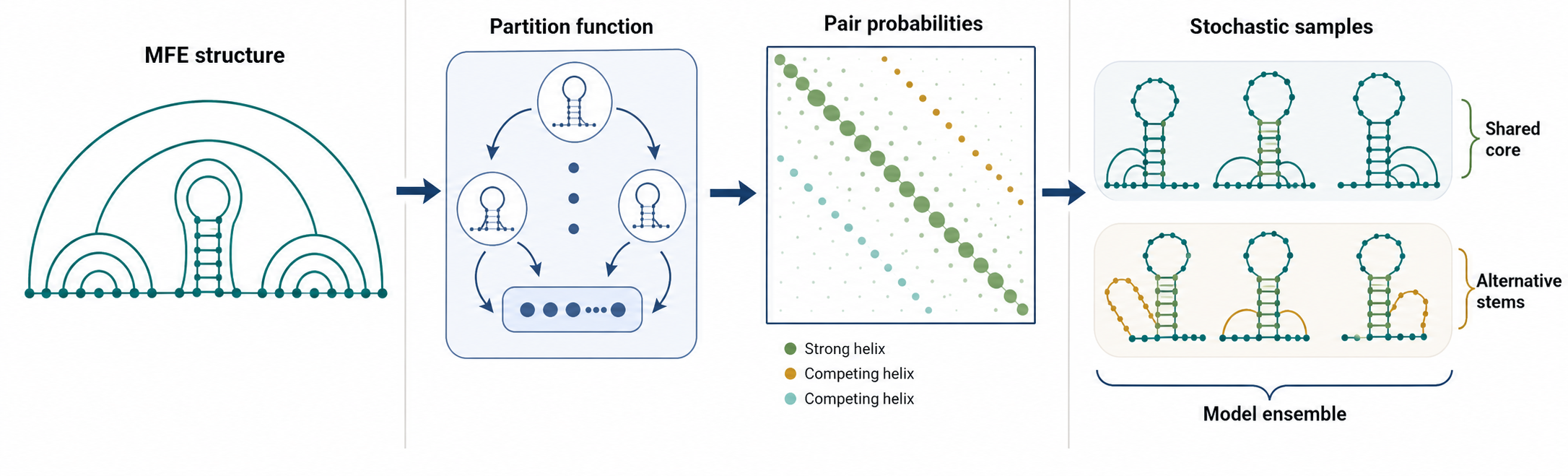
Figure 61.1. From One Best Structure to an Ensemble. A McCaskill-style partition function converts the folding problem from selection of one minimum-free-energy structure into a probability distribution over allowed secondary structures. Shared high-probability helices can be robust even when low-probability local alternatives differ among sampled structures. Comparing an arc-diagram minimum-free-energy structure, a base-pair probability dot plot with one strong and two weaker competing helices, and clusters of stochastic samples from the Boltzmann ensemble illustrates why a single predicted structure can conceal biologically relevant uncertainty.
The McCaskill partition-function framework answers a question that the minimum-free-energy framework leaves open: how much probability mass is near the best predicted structure, and how much is spread among alternatives? For an RNA sequence, the algorithm considers a defined set of secondary structures, assigns each structure a free energy, converts each free energy into a Boltzmann weight, and sums those weights. That sum is the partition function. The partition function is not a list of all structures; it is a compact dynamic-programming result from which many ensemble quantities can be derived.
Table 61.1. Ensemble Outputs and What They Mean. Each computational output from McCaskill-style folding summarizes a different aspect of the ensemble and carries distinct interpretation limits and validation requirements.
| Output | What it summarizes | Typical use | Common overinterpretation | Evidence needed for biological validation |
|---|---|---|---|---|
| Minimum-free-energy structure | Single lowest-energy secondary structure under the model | Initial structure hypothesis | Treating it as the cellular state of the RNA | Functional mutant assays, structure probing, covariation |
| Partition function | Boltzmann-weighted sum over all allowed secondary structures | Basis for all ensemble-level outputs | Confusing model-specific weight with molecular truth | Validation of model constraints against experimental data |
| Ensemble free energy | Free energy derived from partition function, including entropy of multiple states | Comparing folding stability across sequences or conditions | Treating it as a directly measurable thermodynamic quantity in vivo | Calorimetry, thermal denaturation, or stability assays |
| Base-pair probability | Marginal probability that positions i and j pair in the modeled ensemble | Identifying robust versus fragile helices | Treating computed probability as experimental occupancy | Mutational rescue, SHAPE or DMS probing, covariation analysis |
| Pair-probability dot plot | Visual map of all pairwise base-pair probabilities | Comparing competing helices and ensemble shape | Assuming high-probability dots are biologically confirmed pairs | Structure probing or comparative sequence analysis |
| Ensemble diversity | Expected base-pair distance among structures in the ensemble | Assessing whether the ensemble is concentrated or diffuse | Equating high diversity with an unfolded or disordered RNA | Probing data across multiple conditions or temperatures |
| Positional entropy | Uncertainty in pairing state or partner identity for each nucleotide | Identifying high- and low-uncertainty positions along the sequence | Conflating computational entropy with experimental flexibility | Per-nucleotide probing reactivity data |
| Stochastic samples | Structures drawn proportionally from the Boltzmann ensemble | Revealing structural basins and recurring helical patterns | Treating samples as kinetic time trajectories of one molecule | Ensemble deconvolution from chemical probing or FRET data |
| Centroid or MEA structure | Structure minimizing expected distance from, or maximizing expected accuracy within, the ensemble | Selecting one representative structure for downstream workflows | Assuming centroid is more accurate than MFE without justification | Comparison with high-resolution structure or functional perturbation data |
| Pseudoknot-aware prediction | Crossing base pairs predicted under restricted grammars or machine-learning models | Identifying candidate pseudoknots in functional RNAs | Equating a predicted pseudoknot with a thermodynamically validated one | Functional perturbation, structure probing, or high-resolution structure |
A useful way to introduce the object is by contrast. In minimum-free-energy folding, one structure is selected because its modeled free energy is lowest. In partition-function folding, every allowed structure contributes, but lower-energy structures contribute more. If one conformation is much lower in free energy than all alternatives, most of the partition function is concentrated there. If many conformations have similar free energy, the partition function is distributed across them. This distinction matters because many RNAs have locally stable stems that compete with one another, especially in untranslated regions, viral genomes, repetitive RNAs, and synthetic coding sequences where synonymous codons can change local pairing without changing protein sequence.
The classical dynamic-programming strategy works because ordinary RNA secondary structures are nested. A nested structure can be decomposed into intervals: a base pair encloses a smaller substructure, an exterior loop can be split into independent parts, and loop energy terms can be combined recursively. This interval decomposition is what allows a dynamic program to sum over an astronomically large number of structures without enumerating them one by one. The same conceptual machinery also explains the limitation: crossing base pairs, or pseudoknots, break the simple nesting property and require different grammars, restrictions, heuristics, or more expensive algorithms.
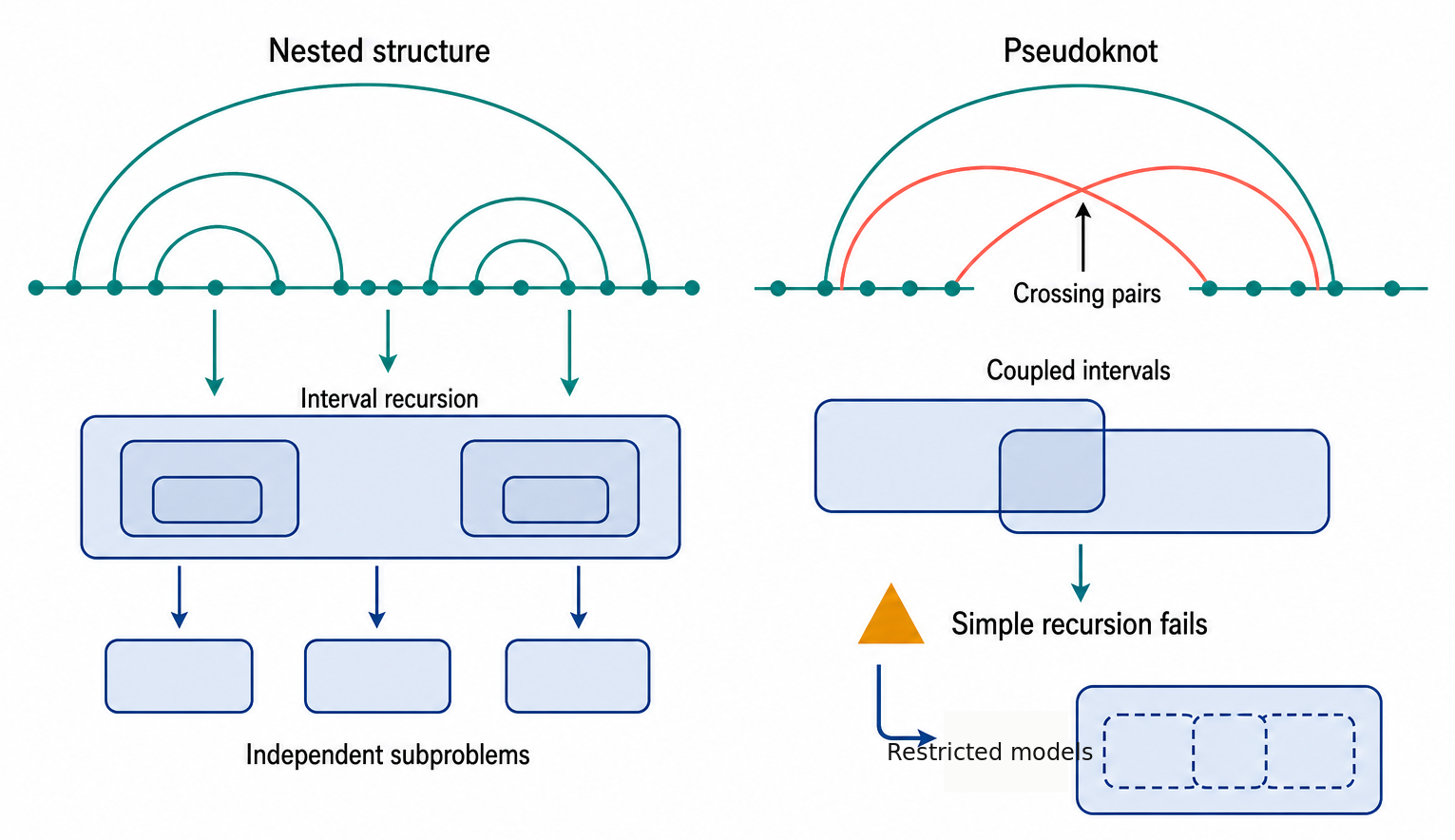
Figure 61.2. Why Pseudoknots Break Simple Interval Recursion. Nested secondary structures can be decomposed into intervals, enabling dynamic programming over many structures without enumerating them. Pseudoknots introduce crossing dependencies—where stems pair positions i, j and k, l with i < k < j < l—that break the independent-interval property and require restricted grammars, heuristics, hierarchical constraints, or different model classes to handle computationally.
Table 61.2. Pseudoknot Prediction Strategy Comparison. Pseudoknot prediction methods differ in the structure classes they allow, making explicit reporting of the allowed grammar essential for interpreting any pseudoknot prediction.
| Strategy | Allowed structure class | Strength | Limitation | Best-use context |
|---|---|---|---|---|
| Pseudoknot-free nested partition function | Nested secondary structures only | Exact and efficient; well-parameterized energy model | Excludes all crossing base pairs by definition | General ensemble analysis when pseudoknots are absent or peripheral |
| Restricted pseudoknot topology | H-type or selected simple pseudoknot shapes | Captures the most common functional pseudoknot types | Misses complex topologies; incomplete energy parameters for crossing pairs | Frameshift-stimulating elements, simple viral pseudoknots |
| Hierarchically constrained pseudoknot partition function | Defined nested pseudoknot hierarchy (e.g., CParty) | Ensemble probabilities available for the constrained structure class | Allowed class must be stated; not an unrestricted pseudoknot space | Research requiring ensemble uncertainty estimates for pseudoknotted RNAs |
| Heuristic pseudoknot search | Various crossing structures added after nested folding | Fast; can find diverse pseudoknot topologies | No formal probability; no partition function; algorithm-dependent | Exploratory or de novo pseudoknot discovery in novel sequences |
| Machine-learning pseudoknot prediction | Crossing structures within training-data coverage | Can recognize patterns inaccessible to thermodynamic models | Confidence scores may not be calibrated probabilities; training-set bias | Long or unusual RNAs where classical thermodynamic methods are unreliable |
| Experimental or comparative constraint-guided modeling | Any structure class constrained by covariation, probing, or known data | Narrows prediction uncertainty with biological evidence | Requires high-quality experimental or comparative data | Well-studied RNAs with covariation, probing, or crystallographic data |
In practice, McCaskill-style algorithms are usually coupled to nearest-neighbor thermodynamic parameters. A stem is stabilized by stacked base pairs; loops and bulges carry penalties; dangling ends, terminal mismatches, and multibranch loops receive parameterized contributions. The partition function therefore reflects both the grammar of allowed structures and the energy parameterization. If the energy model underestimates a loop penalty or lacks a term for ligand stabilization, the probability distribution inherits that limitation. The result should be read as “probability under this model” rather than as an unconditional molecular truth.
The most common formal output is an ensemble free energy, often written as a function of the partition function and temperature. Conceptually, ensemble free energy summarizes the free-energy contribution of all allowed structures. It can be lower than the minimum-free-energy structure’s free energy because the ensemble includes entropy from multiple accessible conformations. This is not a contradiction. A collection of many structures, each individually less stable than the minimum, can collectively carry substantial statistical weight.
Partition functions can also be modified by constraints. A structure-probing experiment may suggest that a nucleotide is often accessible; a comparative analysis may support a conserved helix; a designer may require that a domain remain unpaired for translation initiation or guide-RNA recognition. Soft constraints adjust energies or probabilities without making a feature absolutely mandatory. Hard constraints forbid or require features. The distinction is important. A hard constraint can produce a clean output that hides uncertainty, while a soft constraint can preserve disagreement between the thermodynamic model and the experimental evidence. Aviran and Incarnato (2022) review computational approaches that use structure-probing data to deconvolve or constrain RNA structure ensembles, emphasizing that probing data are indirect and often averaged across molecules or states.
The modern literature also extends partition-function ideas into differentiable computation. Differentiable partition-function calculation makes it possible to embed thermodynamic folding objectives inside gradient-based optimization and machine-learning workflows. Matthies et al. (2024) present a differentiable RNA partition-function calculation, illustrating how a classical dynamic-programming object can become part of trainable or optimization-oriented RNA design systems. The scientific interpretation remains the same: differentiability improves how a model can be optimized, but it does not by itself remove uncertainty in thermodynamic parameters, missing pseudoknots, or cellular context.
For reader-facing interpretation, the minimum standard is to report the structure class and assumptions. A statement such as “the RNA has low ensemble diversity” is incomplete unless the reader knows whether pseudoknots were excluded, whether experimental constraints were applied, and which temperature or energy model was used. A McCaskill partition function is a precise object only after the allowed structures and energy model have been defined.
61.2. Base-pair probabilities and ensemble diversity
Base-pair probabilities are the most widely used window into the RNA secondary-structure ensemble. The marginal probability P(i,j) asks how much of the ensemble contains the pair between nucleotide i and nucleotide j. A base pair can have high probability even if the exact minimum-free-energy structure is not known with confidence, because many similar structures may share the same helix. Conversely, a base pair in the minimum-free-energy structure can have low probability if many nearly equivalent alternatives replace it.
The pair-probability matrix is often visualized as a dot plot. Each possible pair is placed at a coordinate defined by the two sequence positions, and the dot size or color indicates probability. A clean, high-probability helix appears as a diagonal band. Alternative stems appear as competing bands. A diffuse dot plot signals that the model cannot concentrate probability into a single structural explanation. For a long RNA, the dot plot is usually more informative than a single bracket notation because it shows which local decisions are robust and which are fragile.
Interpreting base-pair probabilities requires attention to marginalization. A probability for pair i-j ignores which other pairs coexist with it except through the ensemble weight. Two high-probability local features may be mutually exclusive if they compete for the same nucleotides or require incompatible global arrangements. Pair probabilities therefore should not be assembled naively into a structure by choosing every pair above a threshold. A thresholded set can violate secondary-structure consistency or produce a structure that no individual molecule can adopt. Estimators such as maximum expected accuracy structures handle this by choosing a consistent structure under an explicit scoring function.
Pair probabilities also help identify stable substructures. In a riboswitch aptamer, a ligand-bound structural core might show high-probability stems when ligand constraints or experimentally derived information are included. In an mRNA 5′ untranslated region, a start-codon-proximal stem with moderate probability may be biologically significant if it competes with ribosome loading, but the same probability should not be overread as a direct measurement of translational repression. The model can identify candidates for testing; it cannot establish causality without genetic perturbation, reporter assays, ribosome profiling, biochemical binding, or structural evidence.
Ensemble diversity summarizes how different structures are from one another in the modeled distribution. One common intuition is expected base-pair distance: if two structures drawn from the ensemble tend to share most pairs, diversity is low; if they share few pairs, diversity is high. Low diversity means the model predicts a concentrated ensemble, not necessarily that the RNA is rigid in three dimensions. High diversity means many secondary-structure alternatives are plausible, not necessarily that the RNA is unfolded. A long RNA may have low-diversity cores and high-diversity peripheral regions at the same time, so positional or domain-level measures are often more useful than a single whole-molecule number.
Positional entropy is another helpful summary. A nucleotide with low entropy may be consistently paired to the same partner or consistently unpaired. A nucleotide with high entropy may pair with several alternative partners or switch between paired and unpaired states. This matters for interpreting chemical probing: a reactive nucleotide may be unpaired in most structures, transiently exposed, modified for reasons unrelated to pairing, or located in a tertiary environment that changes reagent access. Aviran and Incarnato (2022) emphasize that ensemble inference from probing data must distinguish structural heterogeneity from measurement noise and model misspecification.
The physical environment can shift probabilities. Temperature changes Boltzmann weights; magnesium, polyamines, and proteins can stabilize compact structures; ligand binding can select a conformation; ribosome movement can unfold coding regions; and RNA modifications can change pairing or stacking. Lightfoot and Hall (2014) review the RNA perspective on endogenous polyamines, illustrating how cellular small molecules can interact with RNA folding and function. A model that omits such factors can still be useful for comparative or design reasoning, but its probabilities should be treated as a baseline.
The evidence basis for base-pair probabilities is computational, not direct experimental counting. Pair probabilities are derived from a mathematical model and parameter set. Experimental support enters when predictions agree with covariation, mutational rescue, structure probing, high-resolution structures, or functional perturbation. The strongest claims combine multiple evidence classes: for example, a predicted high-probability helix supported by covariation and loss-of-function mutations with compensatory rescue is much stronger than a predicted helix alone.
61.3. Stochastic sampling and centroid estimators
Stochastic sampling gives the ensemble a concrete form by drawing individual structures according to their modeled probabilities. Instead of listing the single minimum-free-energy structure, a researcher may sample hundreds or thousands of structures and ask which helices recur, whether structures cluster into families, and whether alternative folds differ in functionally important regions. Sampling is especially useful when the ensemble is too complex to summarize by a small number of probabilities.
The sampling procedure usually relies on probabilistic backtracking through the dynamic-programming tables used for the partition function. Each backtracking decision is chosen with a probability proportional to its contribution to the partition function. The result is a structure drawn from the same Boltzmann ensemble that produced the pair-probability matrix. This makes sampling different from heuristic generation of “plausible-looking” structures. Each sample has a defined relationship to the model.
Sampling has a simple biological interpretation but also a common trap. A sample is not a time trajectory of one molecule. It is a draw from an equilibrium model. If an RNA folds co-transcriptionally into a kinetic trap, or if a protein binds during transcription and prevents equilibration, equilibrium sampling may not match cellular state occupancy. Chapter 25 treats co-transcriptional folding and RNP assembly in more detail. In this chapter the key point is that equilibrium samples represent thermodynamic alternatives, not folding histories.
Sampling can reveal ensemble basins. Suppose a bacterial small RNA has two alternative seed-region structures. One cluster of samples exposes the seed region, while another buries it in a local stem. A single predicted structure might miss this regulatory ambiguity, but sampled structures can guide experiments: mutate one competing stem, measure target repression, and test whether the predicted exposure change matches function. The same logic applies to viral regulatory elements, riboswitch expression platforms, and synthetic RNAs whose performance depends on avoiding off-target folds.
Centroid and maximum expected accuracy estimators answer a different need: selecting one representative structure when a downstream workflow requires one. A centroid structure is chosen to minimize expected distance from the ensemble under a defined metric. A maximum expected accuracy structure is chosen to maximize expected correctness, commonly balancing predicted base pairs and unpaired positions. These structures often differ from the minimum-free-energy structure because their objective is not energy minimization. They reward features that are probable across the ensemble.
The advantage of centroid-style estimators is that they are less brittle when the minimum-free-energy structure contains low-probability details. If ten nearly equivalent alternatives share a helix but differ in loop refinements, a centroid may preserve the shared helix and avoid overcommitting to one uncertain refinement. The disadvantage is that a centroid can be a compromise. In a two-state riboswitch-like ensemble, the centroid may combine elements from incompatible states or obscure the fact that the biology depends on switching rather than on the average structure.
Waldispuhl and Clote (2007) studied partition functions and sampling for saturated RNA secondary structures under a Turner-style model, illustrating how sampling questions can be adapted to restricted structure classes. Although saturated structures are a specialized case, the paper is useful pedagogically because it separates three ideas that are often merged: the thermodynamic energy model, the allowed grammar of structures, and the sampling algorithm used to draw structures from that grammar.
Modern RNA design often uses ensemble summaries as fitness components. A designer may want a target helix to have high probability, an off-target alternative to have low probability, and the whole sequence to have low ensemble defect relative to a desired structure. Ward et al. (2023) discuss fitness functions for RNA structure design, a setting where centroid, pair-probability, and ensemble-defect ideas become design objectives rather than merely diagnostic outputs. The same caution applies: optimizing a computational ensemble objective improves the design under the model, not necessarily in the cellular or manufacturing environment.
61.4. Pseudoknot limits and algorithmic complexity
Pseudoknots are base-pairing patterns in which two stems cross in sequence coordinates. If one stem pairs positions i-j and another pairs positions k-l with i < k < j < l, the two stems cannot be represented as a purely nested secondary structure. This crossing pattern is common enough in functional RNAs that excluding pseudoknots is a biological approximation, not a statement that pseudoknots are rare curiosities.
Pseudoknots have documented roles in gene expression control, viral RNA function, ribosomal frameshifting, internal ribosome entry, RNA stability, and RNA-protein interactions. Peselis and Serganov (2014) review pseudoknots involved in gene expression control. Li et al. (2024) review type IV internal ribosome entry sites in picornaviruses, a viral context where RNA architecture and long-range interactions are central to translation initiation. Recent primary studies continue to identify functional pseudoknot effects, including Alu RNA pseudoknot alterations that influence SRP9/SRP14 association and a toxin-antitoxin system in which an RNA pseudoknot mediates toxin translation and antitoxin inhibition (Gussakovsky et al. 2025; Eleftheraki and Holmqvist 2024).
The computational difficulty is not that one pseudoknot is impossible to draw. The problem is that unrestricted pseudoknotted structures destroy the simple interval independence used by standard dynamic programming. Once crossing dependencies are allowed, the number and type of interactions that must be tracked grow sharply. Many general formulations become computationally expensive or formally intractable under realistic scoring. Practical pseudoknot prediction therefore relies on restrictions: allow only certain pseudoknot topologies, search pseudoknots after nested structures, use heuristic assembly, apply comparative constraints, or use machine-learning predictors trained on known structures.
This creates a reporting obligation. A tool that “predicts pseudoknots” may mean many different things. It may predict H-type pseudoknots but not more complex topologies. It may score pseudoknots with simplified energy terms because nearest-neighbor parameters are less complete for crossing structures. It may output a single pseudoknotted structure without a partition-function ensemble. Or it may estimate a constrained pseudoknot partition function over a restricted hierarchy. Hollar et al. (2023) review pseudoknots in RNA structure prediction and provide a useful anchor for these distinctions.
Gray et al. (2024) present CParty, a hierarchically constrained partition function for RNA pseudoknots. The phrase “hierarchically constrained” is important. It signals that the method does not simply sum over every imaginable pseudoknotted structure in the way a nested McCaskill calculation sums over nested secondary structures. Instead, it defines a constrained class that can be handled computationally. Such methods are valuable because they let ensemble reasoning approach pseudoknotted RNAs, but the constraints must be part of the scientific interpretation.
Machine-learning methods add another route. Wang et al. (2023) describe TransUFold for unlocking the structural complexity of short and long RNA with pseudoknots. Learning-based models can recognize patterns that are hard to encode in classical dynamic programming, especially when trained on structural data or augmented representations. They also introduce different uncertainties: training-set bias, limited coverage of RNA classes, difficulty extrapolating to long or unusual RNAs, and calibration of confidence scores. A predicted pseudoknot from a neural model should not be treated as equivalent to a thermodynamic pair probability unless the model actually provides calibrated probabilities and has been validated for that context.
The biological boundary case is that some pseudoknots depend on tertiary stabilization, proteins, ligands, or translation machinery. A frameshift-stimulating pseudoknot is not just a crossing secondary-structure pattern; it is a mechanical and kinetic object encountered by the ribosome. A viral internal ribosome entry site may use a structured domain whose function depends on three-dimensional architecture and protein interactions. Secondary-structure pseudoknot prediction is therefore a starting point for mechanistic hypotheses, not a complete explanation.
For this chapter’s purposes, the main rule is direct: ordinary McCaskill base-pair probabilities exclude pseudoknots unless the implementation explicitly extends the grammar. If a biologically important pseudoknot is known or suspected, a nested ensemble can still be informative about competing local structures, but it cannot assign probability to the pseudoknotted contact itself. Reports should say this explicitly.
61.5. Probabilistic models and uncertainty reporting
Probabilistic RNA structure inference is broader than thermodynamic partition functions. It includes models that use sequencing data, probing data, comparative signals, machine-learning predictions, or hybrid evidence to assign uncertainty to structural features. The unifying principle is that the output should include uncertainty, not only a best structure.
High-throughput probabilistic RNA structure inference is useful when thousands of RNAs or many experimental conditions must be interpreted. Kuksa et al. (2020) present HiPR, a high-throughput probabilistic RNA structure inference framework. Such methods are valuable because RNA biology increasingly deals with transcriptome-scale data, where manual inspection of every dot plot is impossible. However, high-throughput outputs also increase the risk of false precision. A probability printed to three decimals may reflect model assumptions, read depth, normalization, and constraints as much as molecular certainty.
Structure probing illustrates the difference between data and interpretation. A SHAPE-like reagent, DMS, or other chemical probe reports reactivity influenced by local flexibility, pairing, solvent accessibility, chemical context, and experimental conditions. A computational model may transform those reactivities into pseudoenergies or likelihood terms. The final base-pair probability is then conditioned on both the thermodynamic model and the data model. If the data model is poorly calibrated, if the RNA population is mixed, or if a protein protects a region without changing base pairing, the inferred structure can be misleading. Aviran and Incarnato (2022) frame this problem as ensemble deconvolution from structure-probing data.
Uncertainty reporting should distinguish several levels. First is parameter uncertainty: thermodynamic parameters, pseudoenergy coefficients, or learned weights may be imperfect. Second is model-class uncertainty: nested secondary structures, restricted pseudoknots, tertiary contacts, and protein-bound states are different hypothesis spaces. Third is data uncertainty: probing noise, sequencing depth, batch effects, mapping ambiguity, and normalization choices can alter inference. Fourth is biological heterogeneity: different molecules may occupy different states because of ligand binding, cell cycle, localization, translation, or RNP assembly. Reporting only one “predicted structure” collapses all four levels.
General transcriptomic guidelines are relevant by analogy. Single-cell and RNA-seq reporting papers emphasize metadata, experimental design, and reproducibility because downstream probabilistic inference depends on the data-generation process (Füllgrabe et al. 2020; Simoneau et al. 2021). Although these sources are not RNA folding papers, they support the broader principle that RNA computational claims require transparent reporting of input data, preprocessing, model assumptions, and uncertainty. For folding-specific work, the same discipline should include sequence version, temperature, constraints, software and parameter version, pseudoknot treatment, and whether probabilities are calibrated or merely scores.
Probabilistic quantification in RNA-seq also provides a useful analogy. Bray et al. (2016) present near-optimal probabilistic RNA-seq quantification, where reads are assigned across transcript isoforms under uncertainty. The analogy is not that transcript abundance inference and RNA folding are the same problem. The analogy is that ambiguous evidence should be propagated rather than forced into a single deterministic assignment too early. RNA structure inference benefits from the same habit: keep alternatives visible until biological evidence resolves them.
Differentiable partition functions add another uncertainty-reporting challenge. When a differentiable folding model is used inside optimization, the output may be an optimized sequence with favorable expected properties. The design report should state the objective, the ensemble summaries optimized, and the constraints omitted. Matthies et al. (2024) supports the feasibility of differentiable partition-function calculation, but the biological validation burden remains external to the differentiable computation.
The practical reporting template is short but powerful. Report the predicted structure if needed, but also report base-pair probabilities, ensemble diversity or ensemble defect when available, the model class, the energy or learned parameter source, any experimental constraints, pseudoknot handling, and a statement of which claims require experimental validation. This turns computational folding from an opaque answer into a testable model.
Box 61.1. Reporting Checklist for RNA Ensemble Predictions
- Exact RNA sequence and coordinate system used.
- Software, version, and energy or model parameters.
- Temperature, salt, and other environmental assumptions when available.
- Whether pseudoknots are excluded, restricted, or explicitly modeled.
- Whether constraints are hard (mandatory) or soft (probabilistic adjustments).
- Source and calibration of structure-probing data, if used.
- Base-pair probabilities or ensemble diversity reported, not only one structure.
- Experimental evidence still needed for any biological claim.
61.6. Ensemble interpretation in biology and design
Ensemble interpretation is biologically useful because RNA function often depends on conditional structure rather than on a single static fold. Riboswitches change regulatory output when ligand binding stabilizes one structural state over another. Viral RNAs can use long-range structures and pseudoknots to control translation or replication. Bacterial small RNAs may expose or occlude seed regions. Eukaryotic untranslated regions can contain structures that affect scanning, stability, localization, or protein binding. Synthetic mRNAs and guide RNAs are designed partly by avoiding structures that interfere with translation, targeting, or editing.
The first design principle is robustness. A desired helix should not merely appear in the minimum-free-energy structure; it should have high probability across the ensemble and remain stable under plausible sequence or environmental variation. Conversely, an unwanted off-target fold should have low probability, especially near functional sites such as ribosome-binding sites, splice sites, start codons, guide regions, aptamer pockets, or protein-binding motifs. Ensemble defect and pair-probability objectives formalize this intuition for RNA design (Ward et al. 2023).
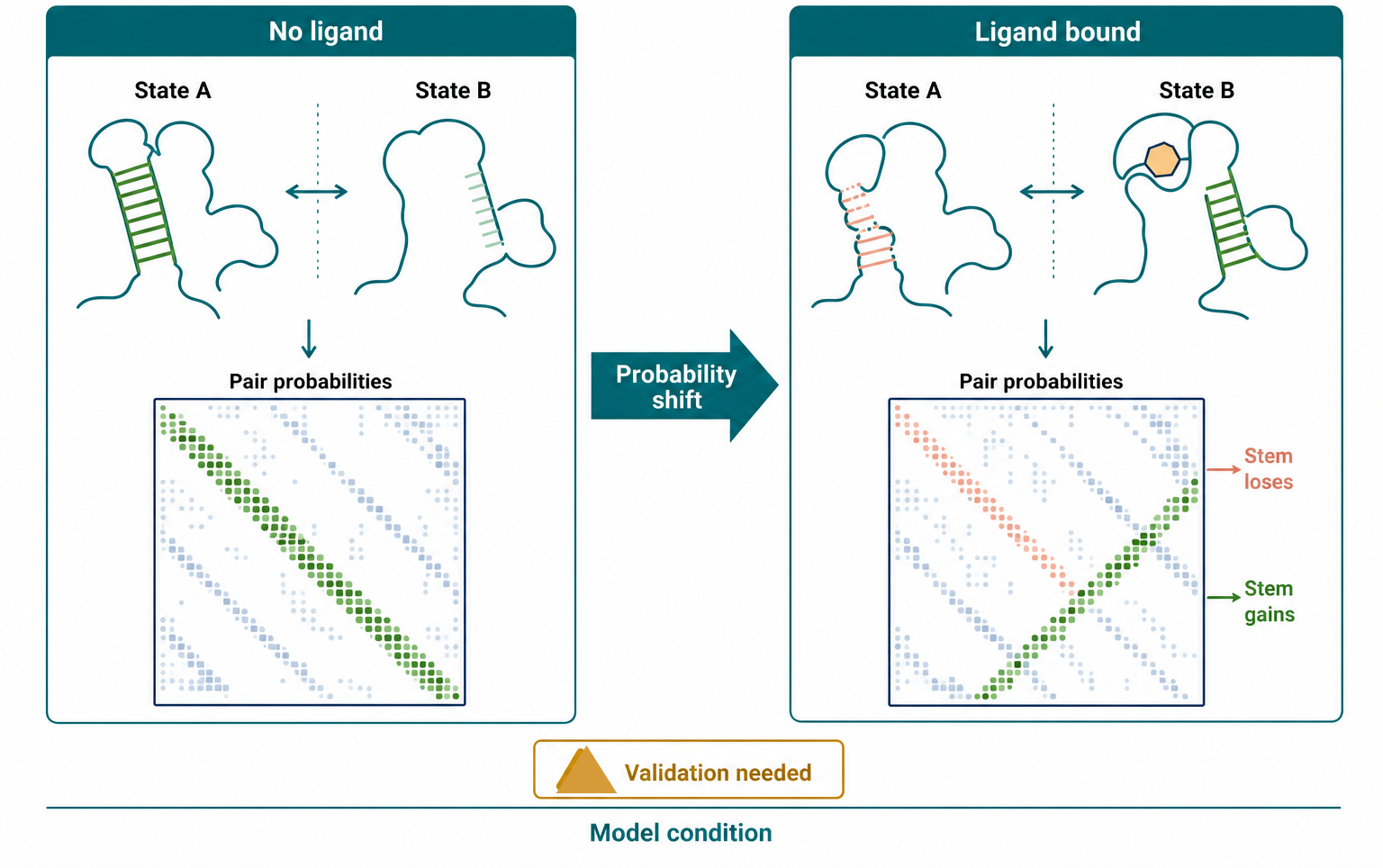
Figure 61.3. Ensemble Shift in a Ligand-Responsive RNA. Ligand binding, protein binding, ion conditions, or translation can redistribute ensemble probability between alternative secondary structures. A functional RNA switch should be represented as condition-dependent structural probabilities rather than as a single drawing; comparing pair-probability matrices before and after ligand addition reveals which stems gain and which lose weight when the environment changes.
The second principle is switchability. Some RNAs are meant to have more than one accessible state. A riboswitch expression platform, an RNA thermometer, a synthetic toehold switch, or a ligand-responsive design may fail if the target structure is too stable before the input arrives. In such cases, high ensemble diversity is not necessarily bad. The useful question is whether the ensemble contains the correct alternatives with the correct energy balance and transition logic. A centroid structure can be misleading here because the functional object is the distribution and the shift between distributions.
The third principle is manufacturability and context. Therapeutic mRNAs must be transcribed, capped, purified, formulated, delivered, translated, and degraded in biological environments. Sequence and structure design affects translation, stability, innate immune recognition, and manufacturability, but each effect is mediated by multiple mechanisms. Recent reviews of mRNA vaccine sequence and structure design emphasize optimization challenges and tradeoffs rather than a single universal design rule (Jin et al. 2025; Lu et al. 2025). An ensemble prediction of reduced secondary structure near a start codon may support a design rationale, but it does not replace cell-based translation, stability, immunogenicity, and formulation assays.
RNA origami and nanotechnology provide a different design setting. Here the target may be a planned architecture rather than a natural regulatory fold. Poppleton et al. (2023) review RNA origami design, simulation, and application. Ensemble thinking matters because a designed scaffold can misfold into alternative helices, fail to assemble co-transcriptionally, or require ions and helper interactions not captured in a simple secondary-structure model. Pair probabilities can identify vulnerable domains, while sampling can reveal recurring misfolds.
Experimental structural biology also uses ensemble ideas. Cryo-EM and molecular simulations can reveal heterogeneity beyond a single fitted model. Posani et al. (2025) describe ensemble refinement of mismodeled cryo-EM RNA structures using all-atom simulations. This is not the same as a McCaskill secondary-structure ensemble, but it reinforces a common lesson: RNA structural interpretation often requires distributions of states and uncertainty-aware refinement.
Biological interpretation should avoid two opposite mistakes. The first mistake is overconfidence: treating a predicted high-probability helix as established biology. The second mistake is dismissal: ignoring ensemble predictions because they are imperfect. The right use is hypothesis generation and prioritization. If a predicted regulatory region has high ensemble uncertainty, that uncertainty is a reason to design compensatory mutations, probing experiments, or reporter assays. If a designed RNA has a robust target ensemble across plausible constraints, that robustness is a reason to advance it to experimental validation.
For readers building models or agents from RNA knowledge, the reusable rule is to preserve the evidence label. A statement such as “the 5′ UTR forms a stable inhibitory stem” should be separated into “the model predicts a high-probability stem under specified conditions” and “the stem inhibits translation in a specified assay.” Only the second is a functional claim, and it needs functional evidence. This separation prevents computational convenience from being mistaken for biological causality.
Box 61.2. Model Probability Is Not Cellular Occupancy
A predicted 5′ UTR stem with 0.85 base-pair probability in an unconstrained partition-function calculation is a model-conditioned result. In cells, an RNA-binding protein, a translating ribosome, a helicase, or an ion environment not captured by the energy model may unfold or stabilize that region, shifting actual occupancy away from the computed value. Base-pair probabilities are conditional on the model, the allowed structure class, and the constraints provided; they are not measurements of how often the pair exists in living cells. Functional claims require biological assays such as structure probing, mutational rescue, reporter experiments, or ribosome profiling.
Recent Consensus
Current consensus supports partition-function and base-pair probability calculations as central tools for RNA secondary-structure analysis when their assumptions are reported. The ensemble view is often more informative than a single minimum-free-energy structure, especially for RNAs with alternative local stems, regulatory switches, design constraints, or uncertain probing signals.
The consensus is also that pseudoknots remain a major boundary condition. Pseudoknots are biologically important and cannot be ignored in many viral, regulatory, and structured RNA contexts, but unrestricted pseudoknot prediction and pseudoknotted partition functions are not solved in the same routine way as nested secondary-structure partition functions. Restricted, hierarchical, heuristic, and machine-learning approaches are useful, but their allowed structure classes and validation contexts must be stated (Peselis and Serganov 2014; Hollar et al. 2023; Gray et al. 2024; Wang et al. 2023).
For structure probing and high-throughput inference, consensus favors explicit uncertainty and ensemble-aware interpretation. Probing data can constrain or deconvolve ensembles, but chemical reactivity is not itself a structure. Computational outputs should preserve the distinction between predicted pairing, experimental accessibility, and validated mechanism (Aviran and Incarnato 2022; Kuksa et al. 2020).
For RNA engineering, ensemble metrics are now part of practical design thinking. Fitness functions, differentiable partition functions, and mRNA or RNA origami design workflows use ensemble summaries to optimize target structures and avoid off-target structures. The consensus is pragmatic: ensemble optimization is useful, but experimental validation remains necessary because cellular context and manufacturing conditions are incompletely modeled (Matthies et al. 2024; Ward et al. 2023; Jin et al. 2025; Poppleton et al. 2023).
Open Questions, Controversies, Deprecated Models, and Common Misconceptions
Open questions:
- How should thermodynamic parameters be updated for modified nucleotides, nonstandard ionic conditions, crowded cellular environments, and protein-bound RNAs? Many biologically important RNAs fold under conditions that differ from parameter-training experiments.
- How can pseudoknotted ensemble methods scale to long RNAs while preserving interpretable probabilities? Hierarchical and restricted methods are promising, but the field still lacks a universal pseudoknotted counterpart to ordinary nested partition-function folding.
- How should structure-probing data be calibrated for mixed RNA populations, protein protection, RNA modification, and co-transcriptional folding states? Ensemble deconvolution is powerful, but the inverse problem can be underdetermined.
Controversies:
- Machine-learning structure predictors can outperform classical models in some benchmarks, but calibration, training-set bias, and generalization to unusual RNA classes remain major issues.
Common misconceptions:
- “Machine-learning confidence scores are thermodynamic probabilities.” Confidence scores are model outputs and must be calibrated before they are interpreted as physical probabilities.
- “The minimum-free-energy structure is the structure of the RNA.” It is the lowest-energy structure under a model. The ensemble may be broad, and the biological state may be controlled by kinetics, proteins, ligands, or cellular context.
- “A base-pair probability is an experimental measurement.” It is a model-conditioned marginal probability. Experimental data can constrain the model, but the probability remains conditional on the model and data-processing assumptions.
- “A centroid structure is always more biologically realistic than the minimum-free-energy structure.” A centroid is optimized under a loss function. It can be useful, but it can also hide discrete switching behavior.
- “Pseudoknot-free predictions are useless for pseudoknotted RNAs.” They can still reveal competing nested structures and local stability, but they cannot assign probability to the pseudoknotted contact unless the algorithm includes it.