Chapter 101. RNA-Guided Mobile Elements, Bridge RNAs, IS110 Systems, Fanzors, and Programmable Insertion
Scope Note
RNA-guided mobile elements connect two themes that were once treated separately: mobile DNA as an evolutionary force and RNA-guided nucleases as programmable molecular machines. This chapter covers RNA-guided transposition and recombination systems, bridge RNAs that specify both donor and target DNA, guide RNAs used by TnpB, IscB, Fanzor, and CRISPR relatives, and the emerging use of these systems for programmable insertion, deletion, and genome engineering. The emphasis is mechanistic: what the RNA is, what the protein or transposon complex does, how DNA targets are specified, and where current engineering claims remain limited by specificity, delivery, safety, and ecological uncertainty.
Executive Summary
RNA-guided mobile elements show that guide RNAs are not restricted to immune systems or transcript regulation. In several mobile-element families, small RNAs specify DNA substrates for nucleases, recombinases, or transposase complexes. Some systems cut DNA, some insert DNA, and the newly described bridge RNA systems can specify both a genomic target and a donor element through two separable RNA-DNA recognition arms. This modularity gives the field a route toward programmed insertion of large DNA without relying entirely on double-strand-break repair by the host cell.
The core distinction is between RNA-guided cleavage and RNA-guided integration. TnpB, IscB, and Fanzor are compact RNA-guided DNA endonucleases related to the evolutionary roots of class 2 CRISPR effectors. They use guide-like RNAs to locate complementary DNA sequences and introduce cuts, but cleavage alone does not install a chosen DNA payload. CRISPR-associated transposases and IS110-family bridge recombinases instead couple RNA-guided target recognition to movement or recombination of DNA. These systems are attractive for gene insertion because they can, in principle, place defined cargo at defined positions.
Bridge RNAs are especially important because they teach a new design rule. A single RNA can contain a target-binding region that recognizes genomic DNA and a donor-binding region that recognizes the mobile element or cargo. The RNA therefore acts as a molecular address label that brings two DNA molecules into one recombination reaction. The 2024 IS110 bridge RNA work and 2026 human-cell bridge recombinase work make this one of the most rapidly moving areas in programmable genome engineering, although many mechanistic, specificity, and delivery details remain unsettled.
The evolutionary picture is also important. TnpB and IscB are transposon-associated RNA-guided nucleases; Cas12 and Cas9 are thought to have evolved from related mobile-element nucleases; Fanzors are eukaryotic TnpB-like RNA-guided nucleases; and CRISPR-associated transposases adapt CRISPR target recognition to transposition. These relationships imply that mobile elements repeatedly generated RNA-guided DNA recognition modules, some of which were domesticated into immunity or engineering tools.
Current applications remain early. Programmable insertion systems must be judged by cargo size, insertion orientation, insertion-site precision, sequence constraints, host range, off-target integration, bystander cleavage, chromosomal rearrangement risk, delivery feasibility, immunogenicity, and ecological containment. The most useful comparison is not “better than CRISPR” in general, but which editing problem each system solves: nuclease editing, base editing, RNA editing, short indel formation, targeted deletion, or precise insertion of a defined DNA sequence.
Concept Inventory
- RNA-guided mobile element: a mobile genetic element whose movement, cleavage, or recombination is directed at least partly by an RNA that base-pairs with DNA. The RNA may specify a target site, a donor element, or both.
- Bridge RNA: an RNA encoded by an IS110-family system that contains separate sequence regions able to pair with target DNA and donor DNA. In the current model, bridge RNA helps a recombinase align the genomic target and mobile-element donor before DNA strand exchange or integration.
- Guide RNA: a general term for an RNA that directs a protein or ribonucleoprotein to a nucleic acid target by base-pairing. In this chapter, guide RNA includes omega RNAs of TnpB/IscB systems, Fanzor guide RNAs, CRISPR guide RNAs, and bridge RNAs, but the molecular architectures are not interchangeable.
- IS110 system: a family of bacterial insertion sequences that encode a recombinase and, in recently characterized examples, a bridge RNA. IS110 systems differ from canonical cut-and-paste transposons because target and donor recognition can be RNA-programmed.
- TnpB: a compact transposon-associated RNA-guided DNA endonuclease found in IS200/IS605-related mobile elements. TnpB is a likely evolutionary relative of Cas12-like CRISPR effectors.
- IscB: a transposon-associated RNA-guided DNA endonuclease related to Cas9-like effectors. IscB systems use omega RNAs and help explain how large CRISPR nucleases may have evolved from mobile-element ancestors.
- Fanzor: a eukaryotic RNA-guided DNA endonuclease related to TnpB-like systems. Fanzors show that compact programmable RNA-guided DNA cleavage is not limited to bacteria and archaea.
- CRISPR-associated transposase: a transposase complex that uses CRISPR-derived target recognition, often through Cascade or related surveillance machinery, to insert DNA near a specified target.
- Programmable insertion: genome engineering in which a user-defined guide RNA or bridge RNA directs placement of a donor DNA sequence at a chosen genomic locus.
What to Know Before Reading This Chapter
The reader should distinguish DNA cleavage from DNA integration. A nuclease creates a break, and cellular repair pathways determine the final edit unless the nuclease is coupled to a specialized editor or donor-repair strategy. A transposase or recombinase moves DNA or exchanges DNA strands, so the editing product can be a defined insertion even without ordinary homology-directed repair.
The reader should also know the meaning of complementarity. A guide RNA recognizes DNA because bases in the RNA can pair with bases in one DNA strand after local DNA opening or R-loop formation. Complementarity is powerful but incomplete as a specificity rule: nearby motifs, RNA structure, protein contacts, chromatin state, DNA accessibility, mismatch tolerance, concentration, and delivery duration all affect editing.
Finally, mobile elements are selfish genetic systems as well as toolkits. A mobile element evolves to spread or persist, not to satisfy engineering criteria. A system that is elegant in its native host may require extensive redesign before it is predictable in a human cell, a crop genome, a microbial consortium, or an environmental release context.
101.1. RNA-guided transposition and recombination systems
RNA-guided transposition and recombination systems are mobile DNA systems in which an RNA contributes address information. In classic transposition, a transposase recognizes transposon-end sequences and inserts the element into target DNA using protein-DNA interactions and, in many cases, broad target preferences. In RNA-guided systems, a guide RNA or bridge RNA adds a programmable base-pairing layer. The mobile element is no longer restricted to the target preferences encoded in the protein alone; target choice can be altered by changing an RNA sequence, at least within the biochemical constraints of the system.
The term “RNA-guided transposition” covers several mechanistically distinct systems. CRISPR-associated transposases use CRISPR target-recognition modules to recruit a transposase complex. The best-known examples are Tn7-like systems in which a Cascade-like complex recognizes a target sequence and directs insertion at a defined distance and orientation from the target. These systems demonstrate that target recognition and DNA insertion can be physically coupled without requiring the host cell to repair a nuclease-induced double-strand break. Strecker et al. (2019) provided landmark evidence that CRISPR-associated transposases can mediate RNA-guided DNA insertion, and subsequent engineering work, including laboratory-evolved systems, has focused on improving activity in mammalian cells.
RNA-guided recombination is related but not identical. A recombinase catalyzes DNA strand exchange or joining between defined DNA substrates. In the IS110 bridge RNA systems, the RNA can specify both sides of the reaction: one arm pairs with the genomic target and another arm pairs with donor DNA associated with the mobile element. The protein supplies catalytic chemistry and substrate handling, while the RNA supplies addresses. This two-address logic is why the RNA is called a bridge RNA rather than merely a guide RNA.
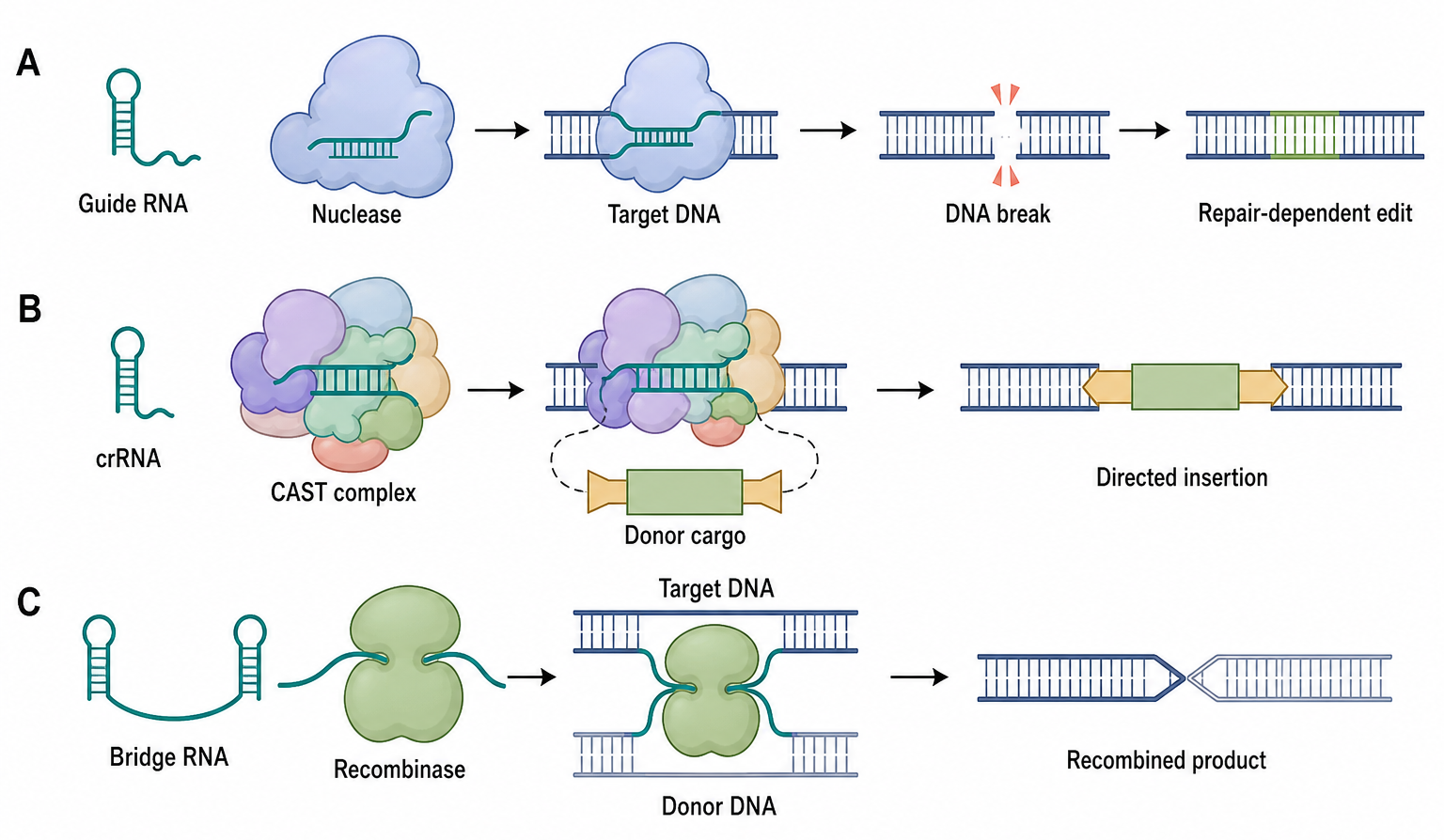
Figure 101.1. RNA-guided routes to DNA mobility and genome editing. RNA guidance is a targeting principle, not a single mechanism. The editing product depends on whether the system cuts, inserts, or recombines DNA.
The distinction matters for engineering. A programmable nuclease can knock out a gene efficiently by making an indel, but precise insertion of a long sequence often requires homology-directed repair, prime editing, or a separate recombination pathway. A programmable transposase or recombinase is attractive because the insertion machinery is built into the effector system. In principle, such machinery could insert therapeutic cassettes, regulatory elements, landing pads, or synthetic circuits into safer genomic sites. In practice, current systems must still satisfy demanding criteria: high on-target integration, low off-target integration, defined orientation, limited rearrangements, controllable expression, cargo compatibility, and delivery into the relevant cell type.
Box 101.1. Cleavage, Insertion, and Recombination Are Different Claims
RNA guidance describes how a system finds a nucleic acid address; it does not by itself define the molecular product. A TnpB, IscB, Fanzor, Cas9, or Cas12 nuclease can be programmable because a guide RNA specifies the target sequence, but the immediate product is DNA cleavage. The final edit then depends on repair, editor fusion chemistry, or a supplied donor strategy.
CRISPR-associated transposases add a separate insertion machine. A guide RNA helps position the transposase complex, and the transposon machinery installs cargo with system-specific spacing, orientation, and end requirements. IS110 bridge recombinases use a different logic: the bridge RNA can address both target DNA and donor DNA, while the recombinase catalyzes joining or exchange.
When reading an engineering claim, ask three questions: What molecule supplies target specificity? What enzyme performs the chemistry? What product was actually measured?
The evidence base for these systems combines comparative genomics and biochemical experimentation. Comparative genomics identifies mobile elements with candidate guide RNAs, conserved catalytic motifs, transposon ends, target-site patterns, and evolutionary links to CRISPR effectors. Biochemical reconstitution tests whether purified components can bind or modify DNA substrates. Cellular assays then ask whether the same system works in bacteria, yeast, plants, or mammalian cells. Each evidence class has limitations. A genomic association does not prove RNA guidance. An in vitro reaction may tolerate conditions that do not occur in cells. A plasmid assay may exaggerate activity relative to chromosomal DNA, where chromatin, DNA repair, replication timing, and toxicity become important.
A useful mental model is to divide an RNA-guided mobile-element reaction into five steps. First, the system expresses or processes the guide RNA or bridge RNA. Second, the RNA assembles with a protein or protein complex to form a ribonucleoprotein. Third, the ribonucleoprotein searches DNA and tests target-site compatibility. Fourth, the catalytic machinery cuts, joins, inserts, or recombines DNA. Fifth, host repair, replication, or selection determines which molecular products persist. Programmability enters mainly at the second and third steps, but engineering success depends on all five.
101.2. Bridge RNAs, guide RNAs, and target-site specification
A bridge RNA is not simply a short spacer fused to a structural scaffold. The defining property is dual substrate recognition. One segment of the bridge RNA is complementary to a target DNA sequence, and another segment is complementary to a donor DNA sequence. In an IS110-type reaction, the RNA can therefore bring a selected genomic address and a selected donor element into the same recombination complex. Durrant et al. (2024) provided the key demonstration that bridge RNAs can direct programmable recombination of target and donor DNA. The central engineering implication is that target choice and donor choice may be altered independently by changing different RNA segments.
This is a different design principle from Cas9 or Cas12 guide RNAs. A single-guide RNA for Cas9 includes a target-complementary spacer and structural regions that bind Cas9. The guide RNA chooses the target, but donor DNA is not specified by a second guide arm. When Cas9 is used for insertion, donor DNA must be supplied separately and installed through host repair or through an appended editor. In bridge RNA systems, donor recognition is part of the RNA-guided reaction. This makes the RNA a programmable adaptor between two DNA molecules rather than a target locator alone.
Target-site specification has several layers. The most obvious layer is Watson-Crick complementarity between the RNA and DNA. A bridge RNA or guide RNA cannot be retargeted arbitrarily if the system also requires a local sequence motif, a constrained distance from an insertion site, a structural feature of the donor, or a protein-contacted sequence outside the programmable region. Many RNA-guided nucleases use protospacer-adjacent motifs or related constraints. Mobile-element systems may have analogous target-site preferences, insertion geometry requirements, and constraints imposed by transposon-end chemistry.
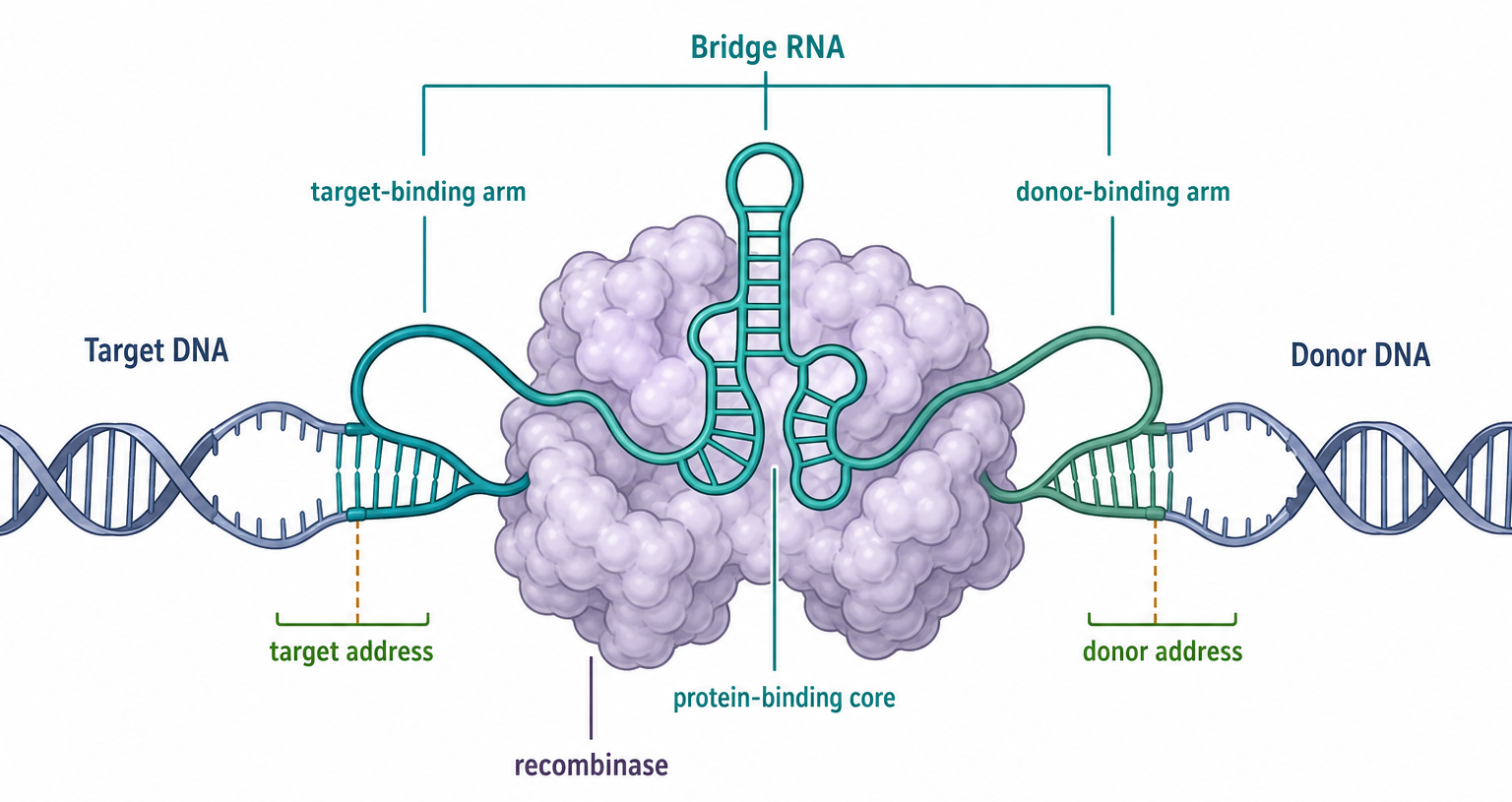
Figure 101.2. Bridge RNA architecture and dual-address target specification. Bridge RNAs differ from ordinary target-only guide RNAs because one RNA can specify both sides of a recombination reaction.
The physical problem is also more complex than a written alignment suggests. RNA-DNA pairing requires DNA opening. In CRISPR systems, proteins stabilize an R-loop, in which the guide RNA pairs with one DNA strand while the other DNA strand is displaced. Bridge RNA systems must coordinate at least two pairing events or equivalent recognition interactions. The order of these events, the stability of intermediate complexes, and the tolerance of mismatches are active mechanistic questions. A system that forms stable target and donor contacts may be efficient, but excessive tolerance could increase off-target recombination.
Box 101.2. How to Read a Bridge RNA Design
A bridge RNA design has at least three functional parts to evaluate. The target-binding segment is the genomic address: it must pair with the intended DNA site and satisfy any sequence, spacing, or structural constraints imposed by the recombinase. The donor-binding segment is the cargo address: it helps specify which donor molecule participates in the reaction. The remaining RNA regions are not inert spacers; structural elements can recruit the protein, position the paired substrates, and constrain the geometry of recombination.
Changing one arm can retarget one substrate without necessarily preserving the activity of the whole complex. Mismatches, alternative RNA folds, repeated donor-like sequences, or local DNA accessibility can shift the product distribution. A bridge RNA design is therefore not validated by sequence complementarity alone. It is validated by product sequencing that shows the intended donor joined to the intended genomic site with the expected orientation and junction structure.
Guide RNAs in TnpB, IscB, and Fanzor systems are often called omega RNAs or system-specific guide RNAs. These RNAs contain both a target-complementary region and structural features needed for effector binding. Altae-Tran et al. (2021) and Karvelis et al. (2021) established that transposon-associated TnpB systems encode diverse programmable RNA-guided DNA endonucleases. Saito et al. (2023) then showed that Fanzor proteins can function as eukaryotic programmable RNA-guided endonucleases. These systems are guide-RNA-programmable, but their native role and engineering output are cleavage rather than bridge-mediated insertion.
Specificity cannot be inferred from perfect-match target design alone. A guide may tolerate mismatches at some positions but not others. Protein contacts may favor particular sequences near the target. Repeated sequences in a genome may create multiple partially matched substrates. In a chromosomal setting, target accessibility can vary by chromatin, methylation, transcription, replication, and local DNA topology. For bridge RNAs, donor misrecognition adds another dimension: the wrong donor, a rearranged donor, or a repeated donor-like sequence could create unexpected products.
For this reason, target-site specification should be described with experimental qualifiers. A statement that a bridge RNA “targets” a sequence may mean that a plasmid reporter shows recombination at a designed site, that deep sequencing detects enriched products at one chromosomal locus, or that genome-wide off-target analysis was performed under specific delivery and expression conditions. These are different evidence levels. A mature engineering system requires not only a programmable rule but a measured error profile.
101.3. IS110, TnpB, IscB, Fanzor, and CRISPR evolutionary links
The evolutionary relationships among these systems are a major reason they belong in the same chapter. Mobile elements have repeatedly carried compact nucleases, recombinases, guide RNAs, and target-recognition modules. Some of those modules appear to have seeded or shaped class 2 CRISPR-Cas systems, in which a single large effector protein and a guide RNA provide adaptive immunity. The connection is not merely historical. Evolutionary relationships identify which domains are catalytic, which RNA structures are conserved, and which engineering constraints may be inherited from mobile-element ancestors.
TnpB is a transposon-associated RNA-guided endonuclease. It is widespread in IS200/IS605-related elements and is smaller than many commonly used CRISPR nucleases. The compact size is attractive for delivery, especially for viral vectors or mRNA delivery, but compactness does not automatically mean broad utility. TnpB systems have system-specific guide RNAs, target-adjacent constraints, activity differences, and mismatch profiles that must be characterized individually. Their native association with transposons suggests a role in mobile-element biology, although the precise biological functions of many TnpB proteins remain incompletely resolved.
IscB provides a parallel evolutionary lesson. IscB proteins are transposon-associated RNA-guided nucleases related to Cas9-like effectors. In simplified terms, IscB-like systems help explain how a transposon-encoded nuclease and an associated RNA could be elaborated into the larger Cas9 architecture used in type II CRISPR immunity. Makarova et al. (2020) placed these relationships within a broader evolutionary classification of CRISPR-Cas systems and derived variants. The important point for this chapter is that CRISPR should not be viewed as an isolated invention of adaptive immunity; it is part of a larger mobile-element landscape.
Fanzors extend the same logic into eukaryotic contexts. Saito et al. (2023) identified Fanzor as a eukaryotic programmable RNA-guided DNA endonuclease, and later reviews have treated Fanzors as a family of eukaryotic RNA-guided nucleases. Fanzor proteins are related to TnpB-like systems but occur in eukaryotic and eukaryote-associated genetic contexts. Their discovery changed the boundary of RNA-guided DNA cleavage: programmable RNA-guided DNA recognition is not confined to bacteria and archaea, and eukaryotic genomes or associated mobile elements have also hosted compact RNA-guided nucleases.
Table 101.1. Families of RNA-guided mobile-element and mobile-element-derived systems. Systems that are often described together differ in RNA architecture, catalytic output, and engineering use.
| System family | Native genetic context | RNA component | Protein or complex | Main molecular output | Engineering relevance | Key caveat |
|---|---|---|---|---|---|---|
| TnpB | IS200/IS605-related bacterial and archaeal mobile elements | Omega RNA or guide-like RNA with target-complementary and effector-binding regions | Compact RNA-guided DNA endonuclease related to Cas12-like effectors | Programmable DNA cleavage, not donor insertion by itself | Small nuclease candidate for delivery-constrained knockout or cleavage workflows | Target-adjacent constraints, guide architecture, activity, and mismatch tolerance are system-specific |
| IscB | Transposon-associated bacterial and archaeal mobile-element contexts | Omega RNA or associated guide RNA | RNA-guided DNA endonuclease related to Cas9-like effectors | Programmable DNA cleavage | Evolutionary and engineering model for Cas9-like RNA-guided nucleases | Less mature as an editor than canonical Cas9; targeting rules require system-by-system validation |
| Fanzor | Eukaryotic or eukaryote-associated mobile-element contexts, including fungi, protists, algae, and giant-virus-associated systems | Fanzor guide RNA with target-complementary and structural regions | Eukaryotic TnpB-like RNA-guided DNA endonuclease | Programmable DNA cleavage | Demonstrates compact RNA-guided DNA targeting outside bacteria and archaea | Cleavage-only output; efficiency, specificity, and delivery remain engineering constraints |
| CRISPR-associated transposase | Bacterial CRISPR-associated Tn7-like transposon systems | crRNA or guide RNA in a CRISPR targeting module, often Cascade-like | CRISPR surveillance complex plus Tns transposition proteins | Donor cargo insertion near an RNA-specified target site | Large-DNA insertion without relying only on host homology-directed repair | Multi-component delivery, cargo-end requirements, insertion geometry, and off-target integration must be measured |
| IS110 bridge recombinase | Bacterial IS110-family insertion sequences | Bridge RNA with separable target-binding and donor-binding arms | IS110 bridge recombinase | RNA-directed recombination between target DNA and donor DNA | Donor-aware programmable insertion and deletion concepts, including early mammalian-cell reports | Cargo limits, chromosomal-context effects, off-target recombination, and genotoxicity remain unsettled |
CRISPR-associated transposases represent a different evolutionary solution. Instead of a compact nuclease alone, these systems link CRISPR target recognition to a transposition complex. In Tn7-like systems, a CRISPR-derived surveillance module can define a target site, and transposition proteins then insert cargo at a defined position relative to that target. This modular combination is powerful because it separates target recognition from insertion chemistry. It also introduces engineering constraints: the distance and orientation of insertion may be system-defined, the cargo must be carried by appropriate transposon ends, and the host environment must support complex assembly and DNA integration.
IS110 bridge RNA systems show yet another form of RNA-guided mobility. The recombinase is not a Cas nuclease, and the RNA is not a canonical CRISPR guide. The bridge RNA specifies target and donor sequences. This architecture suggests that mobile elements can evolve RNAs that function as programmable DNA-DNA adaptors. The term “bridge” is therefore mechanistic rather than decorative: the RNA bridges two DNA substrates by base-pairing logic.
The evolutionary landscape should be interpreted carefully. Homology and shared domain architecture support common ancestry or module exchange, but they do not imply that all systems have the same native function or the same engineering behavior. A TnpB protein, a Fanzor protein, a Cas12 nuclease, a CAST system, and an IS110 bridge recombinase all use RNA-guided logic, but they differ in catalytic output, RNA architecture, target constraints, cargo capacity, and cellular requirements. Treating them as one generic “CRISPR-like” technology obscures the most important mechanistic distinctions.
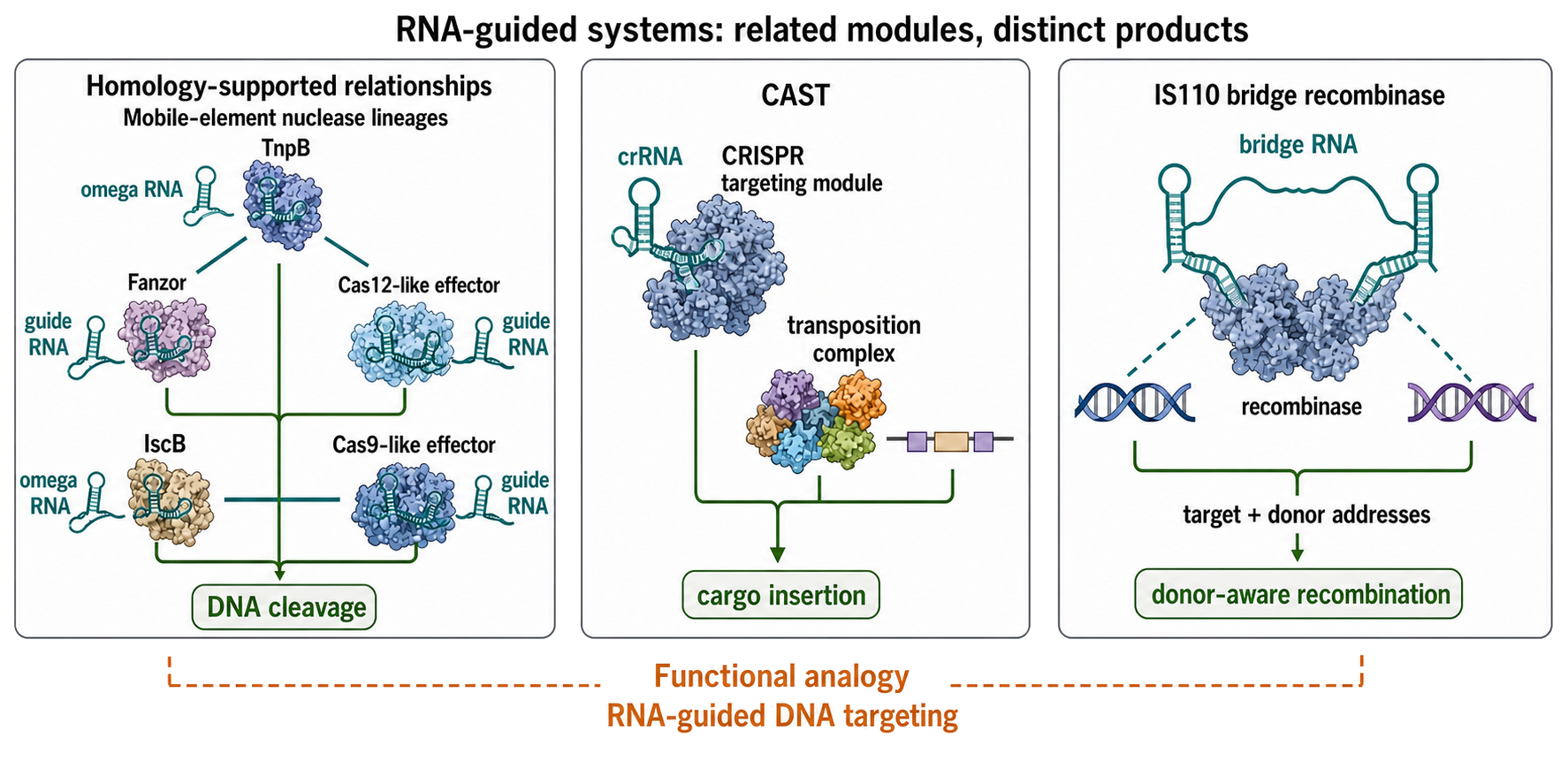
Figure 101.5. Evolutionary and mechanistic relationships among RNA-guided mobile-element systems. “Evolutionary and mechanistic relationships among RNA-guided mobile-element systems. Solid undirected links mark homology-supported family relationships: TnpB is related to Fanzor and Cas12-like effectors, whereas IscB is related to Cas9-like effectors. These cleavage-centered nuclease lineages differ from CAST, which combines CRISPR target recognition with transposition machinery to insert cargo, and from IS110 bridge recombinases, which use a dual-address bridge RNA to specify target and donor DNA. The shared feature is RNA-guided DNA recognition, not one linear ancestry or one molecular product.”
101.4. Programmable insertion, deletion, and genome-engineering applications
Programmable insertion is the clearest application that distinguishes RNA-guided mobile-element systems from conventional nuclease editing. A therapeutic or research goal often requires adding information, not only disrupting a gene. Examples include inserting a full coding sequence, repairing a large pathogenic deletion, adding a regulatory element, installing a synthetic landing pad, tagging an endogenous gene, or integrating a safety switch into an engineered cell. Nuclease-based approaches can do this, but they often depend on homology-directed repair, which is inefficient in many nondividing cells and can compete with indel-forming repair pathways.
CRISPR-associated transposases address this problem by placing a donor sequence through transposition chemistry. A guide RNA selects a target, and the transposase inserts cargo near that target. Early bacterial systems showed the principle. Later engineering work has attempted to move the activity into human cells, where nuclear localization, chromatin, DNA repair, protein expression, cargo delivery, and toxicity create new barriers. Witte et al. (2025) reported programmable gene insertion in human cells with a laboratory-evolved CRISPR-associated transposase, illustrating the need for substantial optimization beyond native bacterial activity.
Bridge recombinases create a related but distinct route. Because a bridge RNA can specify target and donor DNA, the same RNA-guided complex can be programmed to bring a chosen donor to a chosen target. Durrant et al. (2024) established bridge RNA-directed programmable recombination, and Pelea et al. (2026) reported programmable genome editing in human cells using RNA-guided bridge recombinases. These results suggest a path toward donor-aware programmable insertion in mammalian cells, but the field is still defining the rules for cargo size, chromosomal context, off-target recombination, and durable expression.
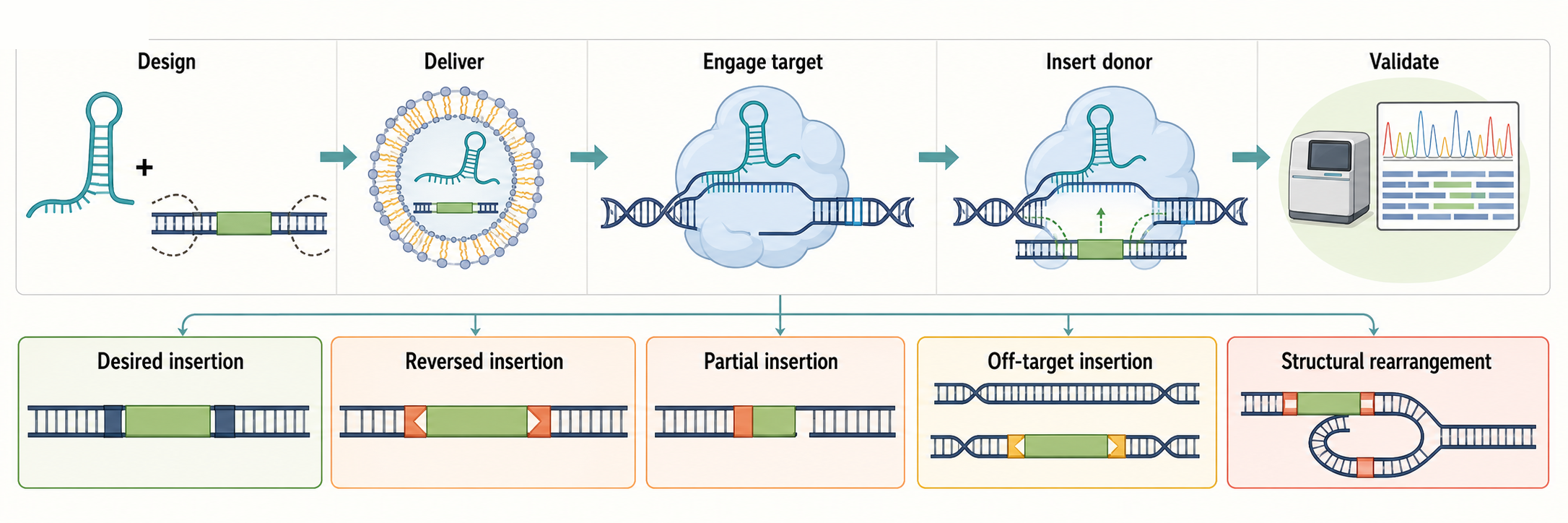
Figure 101.3. Programmable insertion workflow and product classes. The engineering endpoint is not simply activity; the product distribution must be measured.
Programmable deletion can also be imagined or implemented through mobile-element logic. If two sites are recognized and recombined in a defined orientation, the intervening sequence may be excised, inverted, or rearranged depending on substrate geometry. CRISPR nucleases can already delete genomic segments by cutting at two sites, but repair outcomes are variable and can include inversions or complex rearrangements. A recombinase-based system could, in principle, make deletion more defined if both recombination sites are specified and the reaction geometry is controlled. However, this remains a design goal rather than a universally solved property of current bridge RNA tools.
The engineering comparison should include the intended edit. For gene disruption, compact nucleases such as TnpB or Fanzor may be useful if they can be delivered efficiently and shown to have acceptable specificity. For precise base substitution, base editors or prime editors may be more appropriate. For RNA-level perturbation, Cas13 or RNA-targeting editors are better conceptual matches. For large DNA insertion, RNA-guided transposases and bridge recombinases address a problem that cleavage-only tools do not solve directly. The best system is therefore edit-dependent, cell-type-dependent, and delivery-dependent.
Table 101.2. Editing goals and suitable RNA-guided tool classes. Tool choice should be matched to the desired edit rather than ranked by generic programmability.
| Editing goal | Candidate tool class | Expected product | Main advantage | Main limitation | Validation priority |
|---|---|---|---|---|---|
| Gene knockout | Compact RNA-guided nuclease such as TnpB or Fanzor; conventional Cas nuclease remains a comparator | Frameshift indel, early stop codon, or disruptive splice-region lesion | Simple design goal; compact systems may ease delivery | Repair outcomes and off-target cleavage are variable | Deep sequencing of target and candidate off-target sites plus protein-loss assay |
| Short deletion | Paired RNA-guided nucleases or engineered recombination between two specified sites | Excision of the interval, with possible inversion or complex repair product | Removes a defined regulatory or coding segment | Two-site editing increases rearrangement and junction-heterogeneity risk | Junction sequencing, copy-number assay, and structural-variant screen |
| Base substitution | Base editor or prime editor rather than a mobile-element insertion system | Single-base or short templated sequence change | Matches small correction goals without installing a large donor | Editing-window, motif, bystander-editing, and off-target constraints | Allele-resolved amplicon sequencing and transcriptome or genome off-target checks |
| RNA knockdown or RNA editing | Cas13, antisense or siRNA, or ADAR-recruiting RNA editor | Reduced RNA abundance or altered RNA base without genomic integration | Reversible and useful when permanent DNA editing is unnecessary | Incomplete, transient, and vulnerable to transcript-level off-target effects | RNA-seq, target-protein measurement, and duration-of-effect assay |
| Targeted large insertion | CRISPR-associated transposase or IS110 bridge recombinase | Cargo integrated at or near a chosen genomic locus | Insertion chemistry is supplied by the mobile-element system | Cargo size, orientation, partial insertion, and off-target integration remain limiting | Full-length junction sequencing, orientation and copy-number assays, and genome-wide insertion mapping |
| Landing-pad installation | CAST, bridge recombinase, or nuclease-assisted donor insertion followed by clonal validation | Reusable recombinase site, tag cassette, or payload acceptor at a safe locus | Converts later edits into controlled cassette exchange or payload swapping | First installation must be precise and compatible with local gene regulation | Long-read confirmation of the full locus and expression check of neighboring genes |
| Microbial trait insertion | CAST or bridge recombinase adapted to the host microbe | Metabolic, resistance-marker, reporter, or regulatory cassette inserted into a microbial genome or plasmid | Useful where homologous recombination is inefficient or strain-specific | Horizontal transfer, fitness selection, host range, and containment are major uncertainties | Population-level insertion mapping, trait-stability assay, and mobility-containment test |
Cargo design is a central practical issue. A donor sequence may require transposon ends, recombinase recognition features, bridge RNA complementarity, promoter and polyadenylation signals, splice-compatible exon structure, insulators, or selectable markers. The cargo should not carry unwanted bacterial backbone sequences, cryptic splice sites, immunostimulatory motifs, or repeated elements that promote recombination. Therapeutic cargo must also be sized for delivery. Viral vectors, lipid nanoparticles, electroporation, and ribonucleoprotein delivery each impose different size and formulation limits.
Genome-engineering applications also require product-level assays. It is not enough to detect that insertion occurred. The experiment must determine orientation, copy number, junction sequence, target-site duplication or scar, partial insertion, backbone integration, concatemer formation, chromosomal translocation, local deletion, and off-target insertion. Short-read sequencing can detect many junctions but may miss complex structural variants. Long-read sequencing, targeted capture, optical mapping, and orthogonal molecular assays become increasingly important as cargo size grows.
Box 101.3. Product-Level Validation for Programmable Insertion
For programmable insertion, “activity” is only the first rung of evidence. A useful validation ladder asks whether the experiment shows:
- the intended left and right junctions at the target locus;
- correct cargo orientation and full-length cargo integrity;
- single-copy insertion rather than concatemer or backbone integration;
- absence of large local deletions, inversions, or translocations;
- genome-wide mapping of off-target insertions under the same delivery conditions;
- stable expression or function without disrupting neighboring genes.
Short-read amplicons can confirm simple junctions, but large insertions often need long-read sequencing, targeted capture, copy-number assays, and orthogonal functional tests. The key standard is product identity: the assay should distinguish the desired insertion from partial, reversed, duplicated, rearranged, or ectopic products.
101.5. Specificity, delivery, safety, and ecological implications
Specificity is the central safety problem for programmable insertion systems. A nuclease off-target event can create an unwanted indel or chromosomal break. An insertion system can create those problems plus ectopic integration of a donor sequence. Off-target integration may disrupt tumor suppressor genes, activate oncogenes, alter regulatory regions, create fusion transcripts, or introduce persistent expression cassettes. For microbial or ecological applications, off-target mobility could alter horizontal gene transfer, antibiotic-resistance spread, or population fitness in ways that are difficult to reverse.
Specificity must be measured at several levels. RNA-DNA mismatch profiling tests target recognition. Donor specificity tests whether the system uses only the intended donor. Genome-wide insertion mapping tests where cargo lands. Transcriptomic and cellular-stress assays test whether expression of the system perturbs the cell. Genotoxicity assays test DNA damage, rearrangements, and growth selection. For therapeutic applications, these assays must be performed in the relevant cell type, at clinically realistic dose and duration, and with a delivery modality that matches the proposed use.
Delivery is not a secondary detail. Compact systems such as TnpB and Fanzor are attractive partly because smaller proteins may fit more easily into adeno-associated viral vectors or be more practical for mRNA delivery. Bridge recombinases and CAST systems may require larger proteins, multiple components, donor DNA, and one or more RNAs. A delivery method must co-deliver all required components in the correct stoichiometry and timing. If the donor arrives without the guide, or the protein persists after the donor is depleted, the edit profile can change. If expression persists too long, off-target exposure may increase.
RNA delivery experience from mRNA vaccines and RNA therapeutics is relevant but not sufficient. Lipid nanoparticles, viral vectors, electroporation, and exosome-like systems each have tissue tropism, inflammatory profile, dose limit, and manufacturing constraints. Reviews on RNA therapeutic delivery and primary studies on lipid nanoparticle barriers are useful background, but RNA-guided mobile-element editing adds a distinct payload problem: the delivered material may include mRNA or protein, guide RNA or bridge RNA, and donor DNA. The safety profile is therefore a combined property of the delivery vehicle, editing machinery, RNA design, donor sequence, and edited cell.
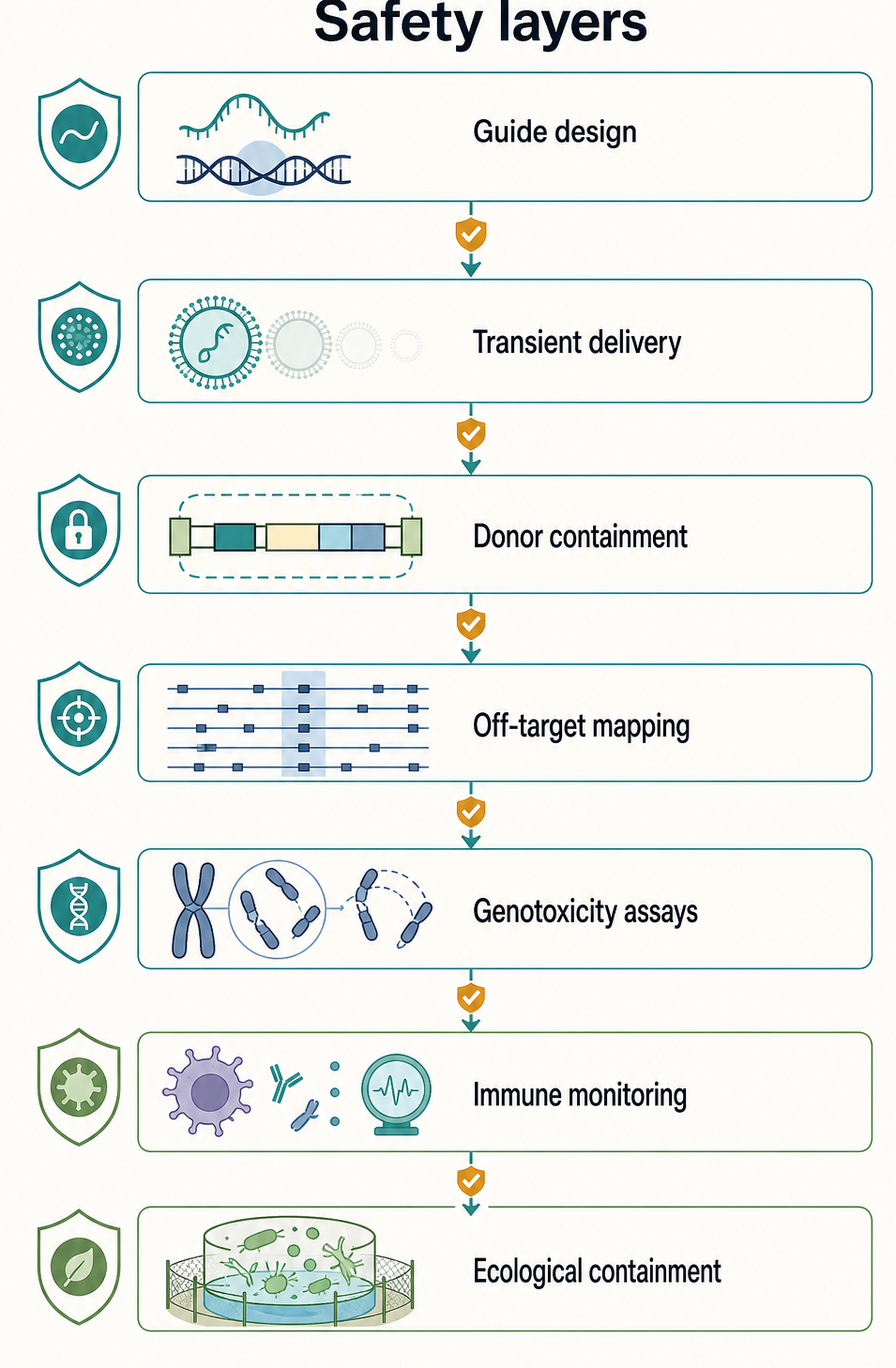
Figure 101.4. Safety layers for RNA-guided mobile-element editing. Programmable insertion adds integration-specific risks that require safeguards beyond ordinary nuclease off-target analysis.
Immune recognition is another concern. Bacterial and mobile-element proteins may be immunogenic in humans. RNA components can trigger innate immune sensors depending on sequence, structure, chemical modification, and delivery context. Donor DNA can activate cytosolic DNA sensing if it reaches the wrong compartment. For ex vivo cell therapies, immune exposure may be more controllable because edited cells can be screened before infusion. For in vivo editing, distribution, persistence, redosing, and anti-vector immunity become major constraints.
Ecological implications are broader than clinical safety. Mobile elements are natural agents of genome evolution and horizontal gene transfer. Engineering programmable mobility into microbes, plants, insects, or environmental systems raises containment questions. A system designed to insert a beneficial trait could move in an unintended host if components recombine, if guide RNAs are retargeted, or if donor sequences are mobilized by related elements. Even disabled systems should be evaluated for recombination with wild mobile elements, especially when deployed in microbial communities or agricultural environments.
Safety design should therefore include molecular safeguards. Possible strategies include transient delivery, split components, self-limiting RNAs, target-site insulation, donor designs lacking mobilizable backbone, tissue-specific expression, inducible activity, orthogonal guide structures, kill switches in engineered organisms, and extensive off-target mapping before release or clinical use. No safeguard is absolute. The purpose of layered safeguards is to make failure modes independent enough that a single mutation, delivery error, or recombination event does not create an uncontrolled mobile editing system.
Recent Consensus
The current consensus is that RNA-guided mobile-element biology is real, diverse, and mechanistically important. TnpB and IscB support the view that mobile elements contributed to the evolution of class 2 CRISPR effectors. Fanzor shows that eukaryotic contexts also contain programmable RNA-guided DNA endonucleases. CRISPR-associated transposases and IS110 bridge recombinases show that RNA-guided target recognition can be coupled to DNA insertion or recombination rather than only cleavage.
The engineering consensus is more cautious. Programmable insertion is a major unmet need, and RNA-guided transposases or bridge recombinases are promising solutions. However, efficiency in human cells, insertion-site precision, off-target insertion, delivery feasibility, cargo constraints, and genotoxicity remain system-specific and incompletely solved. Early success should be read as proof of concept plus platform-development opportunity, not as evidence that all guide-designed insertions are already safe or routine.
Open Questions, Controversies, Deprecated Models, and Common Misconceptions
Open questions:
- How do bridge RNA complexes coordinate target and donor pairing? The order of substrate engagement, the structure of the active recombination intermediate, and the effect of mismatches in either RNA arm remain central to specificity engineering. Structural and kinetic work is needed to convert sequence-level programming rules into predictive design.
- What is the native biological function of mobile-element-associated nucleases and RNAs? Many mobile-element-associated nucleases and RNAs are inferred from genomic context, but their roles in element propagation, host defense, competition, or regulation may differ across families. It is tempting to describe every RNA-guided mobile-element nuclease as a primitive genome editor, but native selection acted on mobile-element fitness, not on human editing goals.
Common misconceptions:
- “RNA guidance automatically implies arbitrary programmability.” In practice, guide design is constrained by motifs, RNA folding, protein compatibility, target accessibility, donor architecture, and cell biology.
- “Insertion systems eliminate DNA-damage risk.” They may reduce dependence on host double-strand-break repair for some edits, but they introduce integration-specific risks that must be measured directly.
Deprecated or weakened claims:
- A deprecated simplification is the idea that CRISPR systems and mobile elements are separate categories. Current evidence supports a modular evolutionary continuum. Mobile elements contributed RNA-guided nuclease modules, CRISPR systems domesticated and elaborated some modules for immunity, and engineering now recombines modules again for programmable editing.