Chapter 12. Evolution and Evidential Interpretation of RNA Families
Scope Note
This chapter explains how RNA-family histories are inferred and how strongly comparative observations justify evolutionary claims. A family can be as familiar as transfer RNAs, ribosomal RNAs, microRNAs, small nucleolar RNAs, riboswitches, bacterial small RNAs, viral RNA structures, CRISPR-associated guide RNAs, or long noncoding RNA loci. It can also be a local evolutionary object: a conserved hairpin in an untranslated region, a structured viral element, a repeated guide-RNA array, or a lineage-restricted locus. The central question is not merely whether two RNAs look similar. The central question is what evolutionary relationship the evidence supports: homology, orthology, paralogy, inherited structural constraint, divergence, family birth, horizontal movement, lineage-specific loss, or no resolved history.
Comparative genomics is powerful because evolution leaves multiple kinds of signal. Homologous RNAs may preserve sequence motifs, base-pairing relationships, gene order, processing signals, expression patterns, protein partners, or phylogenetic distributions. Comparative analysis is also fragile because many RNA genes are short, rapidly evolving, repeat-associated, structure-dominated, or expressed in narrow conditions. A weak alignment can manufacture covariation. A database label can propagate an old error. A transcribed fragment can be mistaken for a functional RNA. A patchy distribution can be read too quickly as horizontal transfer or ancient loss.
The chapter treats comparative RNA biology as an evidence discipline. It owns homology, orthology, paralogy, RNA-family definitions, compensatory change as evolutionary evidence, family birth, divergence, horizontal transfer, loss, sampling bias, alignment uncertainty, and false evolutionary inference. Chapter 62 owns comparative secondary-structure inference, covariation statistics, covariance-model principles, and structural benchmarking. Chapter 140 owns operational homology search, alignment construction, Infernal and Rfam workflows, thresholds, record assignment, and annotation pipelines. This chapter uses those outputs only as evidence inputs to evolutionary interpretation. Chapter 11 covers deeper inference about ancient RNA-protein systems, and Chapter 13 continues with mobile elements and viral relics.
Executive Summary
Homology means shared ancestry. Two RNA sequences, two RNA genes, two RNA structural elements, or two RNA-guided systems are homologous if they descend from a common ancestral element. Similarity can support a homology hypothesis, but similarity is not homology itself. Orthology and paralogy are more specific kinds of homology: orthologs diverge after speciation, whereas paralogs diverge after duplication. RNA biology makes these terms harder than they look because an RNA locus can produce precursor transcripts, mature products, edited products, isoforms, overlapping transcripts, or short motifs that are not equivalent evolutionary units. A comparative claim must state whether it compares genomic loci, transcript isoforms, precursors, mature RNAs, structural motifs, processing products, or functional systems.
An RNA family is an operational grouping. In the strictest evolutionary sense, an RNA family is a set of homologous RNAs. In practice, the term may also refer to RNAs grouped by conserved structure, common biogenesis, shared mature sequence, related function, syntenic locus, or a curated database model. Rfam families, microRNA families, long noncoding RNA families, bacterial small-RNA families, and viral RNA element families do not always use identical evidence standards. Rfam uses curated seed alignments, consensus structures, and covariance models for many structured RNA families. Long noncoding RNA nomenclature and function claims require special caution because transcription, conservation, molecular mechanism, and phenotype can be weakly coupled.
Covariation is correlated nucleotide change across an alignment. In RNA structure analysis, the most important form is covariation between positions that form a conserved base pair. If an ancestral G-C pair becomes G-U in one lineage and A-U in another, the primary sequence changes while pairing can be preserved. A compensatory substitution is a change that restores or preserves the pairing relationship after a potentially disruptive change. Repeated compensatory substitutions in a reliable alignment provide strong evidence for conserved secondary structure. The evidence is strongest when phylogenetic relatedness, alignment quality, compositional bias, overlapping coding sequence, and other constraints have been considered. Engineered disruptive and rescue mutations test the same causal idea experimentally: if a predicted pair matters, disruption should impair the phenotype and restoration should rescue it.
Comparative tools expose candidate relationships; they do not supply the complete evolutionary conclusion. A family-model hit can support membership in a modeled family, and a curated Rfam record can provide a reusable alignment and family hypothesis. The evolutionary interpretation must still distinguish locus from product, orthology from paralogy, vertical inheritance from transfer, ancestral absence from detection failure, and conserved ancestry from conserved function. Comparative structure inference is developed in Chapter 62, while model searches, Rfam curation, thresholds, and annotation operations are developed in Chapter 140.
RNA family evolution includes birth, duplication, divergence, horizontal movement, domestication, decay, and loss. New family members can arise by local duplication, segmental duplication, retroposition, transposition, repeat exaptation, promoter capture, de novo transcription from preexisting sequence, or assembly of modules. Existing family members can diverge in sequence while preserving structure or biogenesis. RNA-linked systems can also move horizontally through plasmids, phages, viruses, transposons, and other mobile elements. CRISPR-associated transposons and TIGR-Tas-like systems provide examples of RNA-guided modules with complex distributions, but these are examples of particular mobile systems rather than a general explanation for all patchy RNA families.
The most common error in comparative RNA annotation is premature certainty. Sampling bias, metadata error, incomplete assemblies, RNA degradation, library-specific artifacts, low-complexity sequence, repeats, ambiguous alignments, annotation circularity, and weak expression evidence can all create evolutionary false positives. A robust family claim integrates multiple evidence layers: sequence similarity, structure-aware alignment, covariation, phylogenetic distribution, synteny or genomic context, expression reproducibility, biogenesis evidence, and, when possible, experimental validation.
Concept Inventory
- Homology: shared ancestry. It is a historical relationship, not a measurement of percent identity. Orthology is homology produced by speciation. Paralogy is homology produced by duplication. Xenology, used less often in RNA chapters, is homology produced by horizontal transfer.
- RNA family: a group of RNAs compared as a unit because they share ancestry, conserved sequence, conserved structure, biogenesis, function, genomic context, or a curated database model. The term should be accompanied by the evidence criterion being used. A family of homologous tRNAs is not the same kind of claim as a family of long transcripts with similar expression or a family of short mature microRNAs sharing seed nucleotides.
- Covariation: correlated variation among alignment columns. Compensatory substitution is the specific case in which a change at one side of a base pair is accompanied by a change at the other side that preserves pairing. Conserved RNA structure is a secondary or tertiary structural feature maintained across related sequences by evolutionary constraint.
- Comparative signal: an observation such as sequence similarity, compensatory change, synteny, genomic context, phylogenetic distribution, expression, or biogenesis that can support but does not alone dictate an evolutionary claim. Alignments, covariance models, Rfam records, and search hits are inputs whose construction and operation are treated in Chapter 62 and Chapter 140.
- Evolutionary RNA-family claim: an inference that specified RNA entities share ancestry or underwent speciation, duplication, divergence, transfer, birth, or loss. Family birth is the emergence of a new RNA family or family member. Divergence is the accumulation of differences after speciation, duplication, transfer, or isolation. Horizontal transfer is movement between lineages outside vertical inheritance. Family loss is deletion, decay, silencing, or functional inactivation.
- Alignment uncertainty: uncertainty about which residues correspond across sequences. Sampling bias is distortion caused by unevenly represented taxa, genomes, transcriptomes, tissues, environments, or metadata. An evolutionary false positive is a sequence, structure, expression pattern, or distribution incorrectly interpreted as evidence for homology, family membership, conserved function, or horizontal transfer. Annotation circularity is the propagation of a label because later analyses reuse earlier predictions without independent validation.
What to Know Before Reading This Chapter
The reader should know the basic RNA structure vocabulary from Chapter 4. RNA sequence is written 5′ to 3′. RNA secondary structure includes stems, loops, bulges, internal loops, junctions, pseudoknots, and long-range contacts. Base pairs can be Watson-Crick, wobble, or noncanonical. A conserved base pair is not necessarily made from the same two nucleotides in every species. The pairing relationship can be conserved even when primary sequence changes.
The reader should also know the evidence vocabulary from Chapter 5. A sequence alignment is a hypothesis about evolutionary correspondence. A computational prediction is an inference. A database entry is curated evidence, not immutable truth. An expression signal means that RNA molecules or fragments were detected under specific assay conditions; expression does not automatically establish function. A structural model needs independent support when it becomes the basis for mechanistic claims.
Several running examples appear throughout this chapter. MicroRNA precursors illustrate the need to distinguish locus history, mature-product similarity, and shared biogenesis. Viral RNA structures illustrate how compensatory change contributes to evolutionary evidence without by itself proving a complete fold or function. Long noncoding RNA loci illustrate why transcription and weak conservation require careful interpretation. CRISPR-associated mobile systems illustrate how RNA-guided modules can move between lineages without making every patchy RNA distribution a horizontal-transfer story. Rfam and Infernal appear only as examples of evidence sources; their operational use belongs to Chapter 140.
12.1. Homology, orthology, paralogy, and RNA family definitions
Homology is a claim about origin. Two molecules or loci are homologous if they descend from the same ancestral molecule or locus. The claim is binary in principle but uncertain in practice because researchers infer ancestry from present-day evidence. Strong sequence similarity over an informative length can be excellent evidence for homology. So can conserved gene order, conserved structure, conserved processing, and a plausible phylogenetic distribution. But the word homology should not be used as a synonym for similarity. A sequence is not 40 percent homologous; it is either homologous or not, while the evidence for that homology can be strong, weak, or unresolved.
Table 12.1. Comparative Terminology for RNA Genes and Transcripts. Terms used to describe evolutionary relationships among RNA loci and their products, with the RNA-specific complications that arise at each level of comparison.
| Term | Definition | Evolutionary event | RNA-specific complication | Evidence needed |
|---|---|---|---|---|
| Homology | Shared ancestry between sequences, loci, or structures | Common descent | Short length and convergent motifs can mimic ancestry | Informative alignment, phylogenetic plausibility |
| Orthology | Homology produced by speciation | Lineage splitting | Isoform and processing-product level must be specified | Cross-species comparison with species-tree support |
| Paralogy | Homology produced by duplication | Locus or gene duplication | Copies may diverge in expression, targets, or biogenesis | Duplication history, genomic synteny |
| Xenology | Homology produced by horizontal transfer | Cross-lineage genetic transfer | Mobile-element association can mimic bona fide transfer | Phylogenetic incongruence, mobile-element context |
| Analog | Functional similarity without shared ancestry | Independent origin | Convergent short motifs are common in RNA | Phylogenetic distribution, structural independence |
| RNA family | Operational group of related RNAs | Ancestry, structure, or curated model | Evidence criterion must be stated explicitly | Depends on the definition applied |
| Transcript isoform | Alternative transcript from the same locus | No new evolutionary event | Isoform change is not the same as locus change | Transcriptomics, splice-site evidence |
| Mature processing product | Short or trimmed RNA derived from a longer precursor | Processing rather than speciation | Seed-sharing mature microRNAs may differ in precursor ancestry | Small-RNA sequencing, biogenesis assay |
| Structural motif | Conserved RNA secondary or tertiary structural element | Constraint on fold | Overlap with coding or regulatory constraints confounds inference | Covariation, probing, mutational rescue |
Orthology and paralogy refine the homology claim. Orthologous loci diverged because a species lineage split. Paralogous loci diverged because a locus duplicated. Consider an ancestral small RNA gene in a vertebrate ancestor. If that gene is inherited by both human and mouse after speciation, the human and mouse loci may be orthologs. If the ancestral locus duplicated before the human-mouse split, the resulting copies are paralogs, and each copy may have its own orthologs in descendant species. This logic is familiar for protein-coding genes, but RNA genes add complications that must be stated explicitly.
The first RNA-specific complication is the comparison level. An RNA gene can be a genomic locus, a primary transcript, a processed precursor, a mature RNA, or a functional motif within a larger transcript. A microRNA locus produces a hairpin precursor and one or more mature small RNAs. A small nucleolar RNA can be encoded in an intron of a host gene. A long noncoding RNA locus can produce multiple isoforms. A viral genome can contain local structural elements embedded in coding sequence. Orthology at the locus level does not automatically imply orthology of every transcript isoform or every processed product.
The second complication is short length. Many functional RNAs and RNA motifs are short enough that chance similarity, low-complexity sequence, and repeated elements can mimic ancestry. A seven-nucleotide seed shared by two mature microRNAs is biologically meaningful for target recognition, but seed sharing alone is not a complete evolutionary relationship. A short hairpin can arise repeatedly from unrelated sequence. A small RNA fragment can map to many repeated loci. Shortness does not make homology impossible; it raises the evidence standard.
The third complication is structural conservation with weak primary-sequence conservation. A structured RNA can preserve a fold while changing many nucleotides. A riboswitch aptamer, tRNA, ribosomal RNA expansion segment, viral pseudoknot, or microRNA precursor may retain stems, loops, and motifs even when direct sequence alignment is difficult. In these cases, homology detection often needs structure-aware alignment rather than ordinary sequence search.
The fourth complication is overlap with other genomic functions. RNA elements can overlap protein-coding sequence, promoters, terminators, splice sites, repeats, transposons, antisense transcription, or chromatin-associated regulatory regions. A conserved nucleotide in such a region may be constrained by a protein-coding amino acid, codon usage, splice signal, RNA-binding protein motif, DNA regulatory motif, RNA structure, or several of these at once. The family definition must specify which object is being compared.
An RNA family is therefore not a single evidence category. In a strict evolutionary usage, an RNA family contains homologous RNAs. In database and biological practice, a family can be defined by a curated model, a conserved structure, a biogenesis pathway, a shared mature product, a shared genomic context, or a shared function. Rfam families are curated around alignments, consensus structures, and covariance models. MicroRNA family definitions may emphasize precursor ancestry, mature sequence, seed identity, or curated organismal complements. Long noncoding RNA family claims may depend on synteny, transcript structure, weak sequence conservation, or functional experiments, and consensus recommendations urge caution in connecting names, functions, and mechanisms.
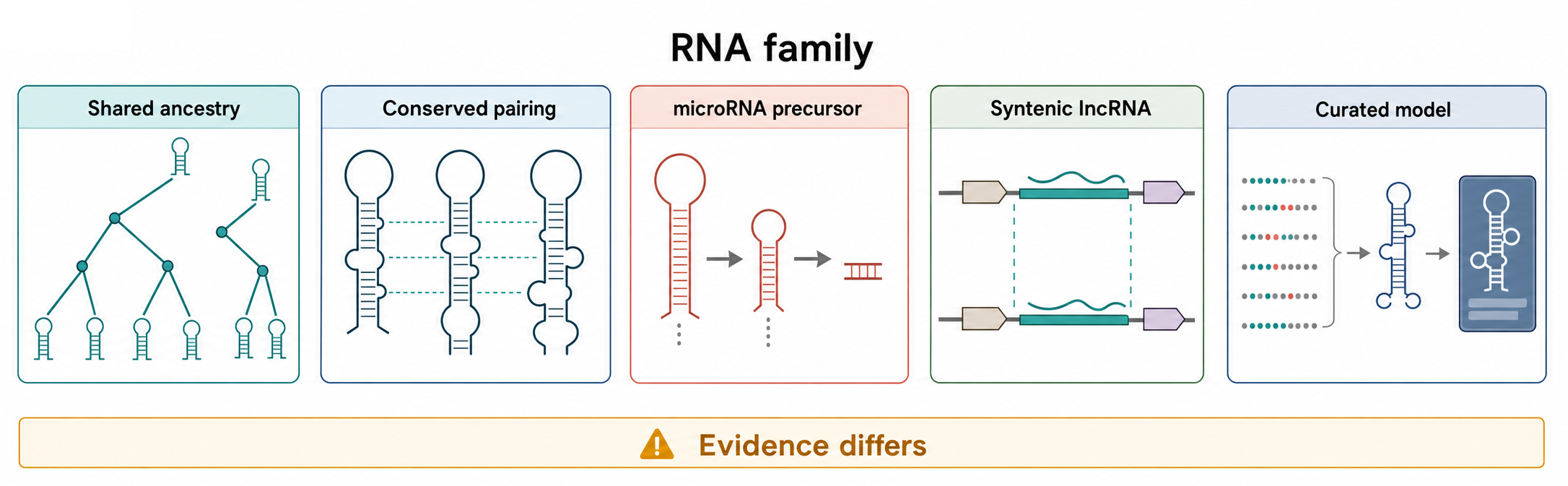
Figure 12.1. What Counts as an RNA Family? An RNA family can be defined by several different evidence standards, and the definition used shapes every downstream comparative claim. This figure compares five conceptually distinct family types: loci sharing a common ancestral origin through speciation or duplication; structured RNAs united by conserved base-pairing relationships; microRNA precursors grouped by hairpin structure and biogenesis criteria; long noncoding RNA loci identified by syntenic position with limited sequence conservation; and curated database families defined by a covariance model and seed alignment.
MicroRNAs show why the distinction matters. An animal microRNA precursor is a hairpin transcript processed by Drosha and Dicer pathways. The mature microRNA is much shorter than the precursor and recognizes targets partly through a seed region. Two mature microRNAs with the same seed may regulate overlapping target sets even if the precursor histories are not identical. Two precursor homologs may produce related mature products but diverge in arm usage, expression, or targets. MirMachine uses trained covariance models of curated microRNA complements to improve animal genome annotation, which ties its family calls to precursor models and curated biological criteria rather than to seed identity alone.
Long noncoding RNAs illustrate a different boundary. A long transcript can be detected reproducibly, named consistently, and associated with a phenotype without being part of an ancient conserved RNA family. Some long noncoding RNAs have deeply conserved loci or functions; many others are lineage-specific or poorly conserved at the primary-sequence level. A claim that two long noncoding RNA loci are homologous should say whether the evidence is synteny, exon structure, sequence similarity, promoter conservation, expression pattern, structural motif, or experimental functional conservation.
Box 12.1. Homology Is Not Similarity
Similarity is evidence. Homology is the ancestral relationship that the evidence may support. Strong similarity over a long, informative region often supports homology, but similarity can also arise from repeats, low-complexity sequence, contamination, convergent motifs, or biased composition. Conversely, homologous RNAs can lose obvious primary-sequence similarity if structure, processing, or context is conserved more strongly than exact nucleotides. A careful comparative claim separates the observation from the evolutionary interpretation.
Similarity is evidence. Homology is the ancestral relationship that the evidence may support. Strong similarity over a long, informative region often supports homology, but similarity can also arise from repeats, low-complexity sequence, contamination, convergent motifs, or biased composition. Conversely, homologous RNAs can lose obvious primary-sequence similarity if structure, processing, or context is conserved more strongly than exact nucleotides. A careful comparative claim separates the observation from the evolutionary interpretation.
12.2. Covariation and compensatory change as evolutionary evidence
RNA structure gives comparative genomics a special source of evidence. Protein-coding genes are often compared through amino acid conservation and codon-aware alignments. Structured RNAs can be compared through base-pairing relationships. In a stem, two positions are not independent: the nucleotide at one position affects which nucleotide can pair at the other position. If a stem is biologically important, evolution can accept substitutions that preserve pairing and reject substitutions that break pairing.
Covariation is correlated change between alignment positions. In a conserved RNA helix, covariation often appears as coordinated changes between paired columns. Imagine an ancestral RNA with a G-C pair. In one lineage, the G changes to A and the C changes to U, preserving an A-U pair. In another lineage, the pair becomes G-U, preserving a wobble pair. In a third lineage, the pair becomes C-G, reversing the orientation while maintaining Watson-Crick pairing. The exact letters differ, but the pairing relationship is maintained. This is the basic comparative signature of conserved secondary structure.
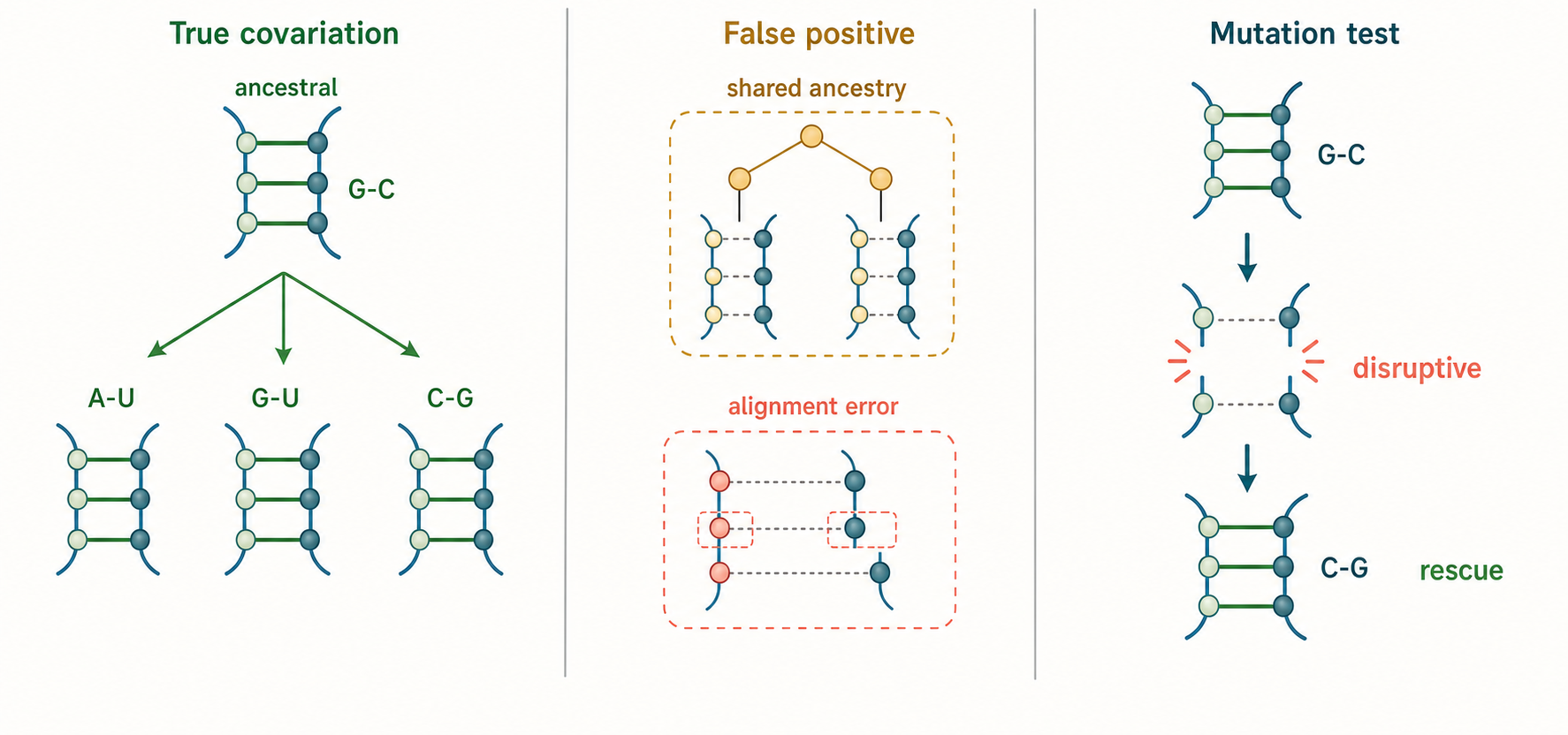
Figure 12.2. Covariation and Compensatory Change as Evolutionary Evidence. Conserved RNA secondary structures leave a distinctive comparative signature: paired positions change together rather than independently. Starting from an ancestral G-C base pair, different lineages can substitute to A-U, G-U, or C-G while preserving the pairing relationship — these are compensatory substitutions. This figure also contrasts genuine covariation with a false positive caused by shared ancestry or alignment error, and shows the experimental counterpart: engineered disruptive and rescue mutations that test whether a predicted base pair is causally required.
Table 12.2. Evidence Types for RNA Family Membership. The principal evidence types used to support RNA family membership, their interpretive scope, characteristic failure modes, and representative methods.
| Evidence type | What it supports | What it does not prove | Common failure mode | Example method |
|---|---|---|---|---|
| Primary sequence similarity | Candidate homology over informative lengths | Homology in short, repeat-derived, or low-complexity regions | Repeat or low-complexity sequence mimics ancestry | BLAST, HMMER |
| Conserved secondary structure | Shared fold constraint across related sequences | Exact tertiary contacts or cellular function | Alignment circularity inflates apparent conservation | RNAalifold, comparative folding |
| Covariation | Conserved base-pairing relationship at specific positions | Complete fold, function, or protein partners | Shared ancestry and alignment error produce false covariation | R-scape, RNAz |
| Covariance-model score | Membership in a modeled RNA family | Expression, processing, or function | Permissive threshold accepts low-complexity or repeat matches | Infernal cmsearch |
| Synteny | Conserved genomic locus position across species | Sequence similarity or conserved function | Syntenic position can be coincidental in gene-dense regions | Genome alignment, microsynteny tools |
| Genomic context | Plausible regulatory or operon neighborhood | Functional role of the RNA itself | Neighboring genes can move independently | Gene-order comparison |
| Expression | RNA molecules detected under specified conditions | Function, processing, or family membership | Degradation fragments and read-through transcription are detected | RNA-seq, northern blot |
| Processing signature | Biogenesis through the expected pathway | Canonical function in a given cell type | Pathway use may differ by tissue or condition | Small-RNA cloning, Drosha/Dicer knockout |
| Perturbation | Locus or sequence required for an observable phenotype | Specific molecular mechanism | Off-target effects and indirect regulation confound interpretation | Deletion, antisense knockdown |
| Mutational rescue | A predicted base pair or motif is causally important | Complete structural or functional mechanism | Single-pair rescue does not resolve the full fold | Compensatory mutagenesis |
| Structure probing | Nucleotide accessibility under assay conditions | Universal in-cell structure or ligand-bound state | Condition-dependent reactivity may not reflect the functional state | SHAPE, DMS-seq |
| Biochemical assay | Molecular interaction with a specific partner | Cellular relevance or in vivo function | In vitro conditions may not recapitulate the physiological context | EMSA, RIP, co-immunoprecipitation |
A compensatory substitution is a substitution that restores or preserves a structural relationship after another substitution would otherwise weaken it. Natural compensatory substitutions are observed by comparing related sequences. Engineered compensatory substitutions are introduced experimentally. Both forms are informative, but they answer different questions. Natural compensatory substitutions support the claim that evolution preserved a pairing relationship across a family. Engineered disruptive and rescue mutations test whether a predicted pair matters for a phenotype in a specific molecule and context.
The evolutionary evidence becomes stronger when the alignment is reliable, the paired columns contain enough informative variation, and similar states arise on independent branches rather than being inherited once by a single clade. Statistical tests such as R-scape can ask whether apparent covariation exceeds phylogenetic and alignment background, and they have exposed cases in which proposed long noncoding RNA structures had weaker comparative support than initially claimed. The statistical machinery, comparative secondary-structure inference, and benchmarking belong to Chapter 62. The evolutionary question here is narrower: does the observed pattern support sustained constraint on a relationship between positions, and how much additional history or function can legitimately be inferred?
Covariation is sometimes described as evolution performing a natural mutagenesis experiment. This metaphor is useful but incomplete. Natural evolution does not sample all mutations evenly, does not test one position at a time, and does not isolate a single phenotype. A base pair may be conserved because it affects folding, protein binding, processing, translation, replication, packaging, localization, or several of these. A covarying pair can be real without revealing the complete biological role of the structure.
Conserved viral RNA structures provide a useful example. Viral genomes often carry RNA structures inside coding regions or untranslated regions. These structures can influence replication, translation, immune evasion, packaging, or RNA stability. A study of a group C enterovirus RNA described conserved motifs and a long-range kissing-loop interaction linked to inhibition of RNase L, connecting comparative structural features with functional evidence. The example illustrates a general principle: covariation becomes more persuasive when it is integrated with direct biological assays.
Experimental compensatory rescue is a related but distinct standard. If one mutation disrupts a predicted base pair and reduces function, and a second mutation restores pairing and rescues function, the result supports the predicted pair. The rescue does not necessarily prove the entire predicted fold or its ancestry, because the mutation may affect local structure, protein binding, RNA stability, or expression. Natural compensatory change is historical evidence across lineages; engineered rescue is a causal experiment in a specified molecule. Confusing those evidential roles can turn a strong local result into an overbroad evolutionary claim.
Several confounders must be considered. Shared ancestry can make two columns correlated even without direct pairing. A clade-specific mutation at one site and another clade-specific mutation at a second site can look coordinated because both mark the same branch. Alignment uncertainty can put noncorresponding residues into the same columns. Overlapping protein-coding regions can impose amino acid constraints that create nucleotide correlations. Splice sites, RNA-binding protein motifs, editing sites, modification motifs, and DNA regulatory elements can constrain sequence independently of RNA base pairing. Repeats and low-complexity regions can create apparent patterns with little evolutionary meaning.
The absence of covariation is also not decisive. A base pair may be conserved but invariant because the family is too closely related. A base pair may be essential and tolerate few alternatives. A family may be too small, too biased, or too poorly aligned to detect covariance. Some structures are conserved through tertiary contacts, protein binding, or local shape rather than canonical secondary structure. Other structures may be functional only in a narrow cellular state and not strongly conserved across broad phylogeny.
Box 12.2. Compensatory Change Is Strong but Bounded Evidence
Covariation supports conserved relationships between positions, most often base pairs. It does not automatically prove a full three-dimensional fold, a cellular function, or a universal mechanism. Strong use of covariation requires reliable alignment, appropriate phylogenetic correction, enough independent sequence diversity, and independent biological support when the claim extends from conserved structure to conserved function.
Covariation supports conserved relationships between positions, often base pairs. It does not automatically prove a full three-dimensional fold, a cellular function, or a universal mechanism. Strong use of covariation requires reliable alignment, appropriate phylogenetic correction, enough independent sequence diversity, and independent biological support when the claim extends from structure to function.
12.3. From comparative signals to evolutionary RNA-family claims
Evolutionary claims are assembled from comparative signals rather than read directly from one score or database label. Primary-sequence similarity, structure-aware correspondence, compensatory change, synteny, genomic context, taxonomic distribution, processing evidence, and expression can each strengthen or weaken a proposed family history. Their meanings differ. Sequence similarity supports relatedness over an informative region; compensatory change supports constraint on relationships between positions; conserved neighborhood can support locus continuity; and coherent distribution can support vertical inheritance, duplication, transfer, or loss depending on the lineage pattern.
A covariance-model score is one example of an input, not an evolutionary verdict. Covariance models combine sequence and pairing information and can expose homolog candidates whose primary sequences have diverged. Building models, choosing thresholds, searching with Infernal, constructing alignments, curating Rfam families, and assigning annotation records belong to Chapter 140. Comparative structure inference and tests of structural covariation belong to Chapter 62. For evolutionary interpretation, the essential point is that every hit inherits the assumptions and taxonomic coverage of its model and search space.
Rfam illustrates the distinction between a curated family hypothesis and a reconstructed evolutionary history. Its alignments and models make family evidence reusable, and expanded metagenomic, viral, and microRNA sampling changes which sequences and lineages are represented. Yet an Rfam record does not by itself determine whether two particular loci are orthologs or paralogs, whether a patchy distribution reflects loss or transfer, whether an apparent absence is real, or whether every member retains the same function.
The evolutionary unit must then be specified. A model hit can correspond to a whole RNA gene, a processed precursor, a mature product, a local structural element within another transcript, or a fragment. Orthology at one level need not imply orthology at another. A microRNA precursor family, for example, describes a different historical object from a mature seed group. Likewise, a conserved hairpin inside a viral coding region may have a history constrained by both RNA structure and protein coding.
Next, alternative histories must be compared explicitly. A group of related loci may reflect descent through speciation, ancestral duplication followed by differential loss, recent lineage-specific duplication, horizontal movement, or a mixture of these processes. Sequence and structure evidence establish candidate relationships; synteny, species-tree context, copy number, mobile-element association, and taxon sampling help distinguish the historical alternatives. A high match score cannot choose among these histories by itself.
Finally, conserved ancestry must be separated from conserved function. Homologous RNAs can retain ancestry while diverging in expression, processing, partners, targets, or phenotype. Conversely, analogous RNAs can converge on similar functions or short motifs without shared ancestry. Expression and perturbation evidence can support present-day biology, but they do not retroactively define the family history. The claim should state exactly which inference is supported: family membership, orthology, paralogy, structural constraint, lineage-specific innovation, transfer, loss, or functional conservation.
A defensible evolutionary statement therefore contains four parts: the entities being compared, the comparative observations, the historical relationship inferred, and the alternatives not excluded. “These loci are homologous” is different from “these are orthologs,” and both are different from “this family was horizontally transferred” or “this structure has conserved function.” The evidence ladder becomes stricter as the claim becomes more specific.
12.4. Birth, divergence, horizontal transfer, and loss of RNA families
RNA families have evolutionary histories. They do not simply appear as static database entries. A family member can be born, duplicated, altered, moved, domesticated, silenced, fragmented, or lost. The comparative signals left by these processes often overlap, which is why family evolution must be interpreted as a set of alternative hypotheses rather than as a single story.
Family birth can begin with duplication. A local duplication can copy an RNA gene or a structured region. Segmental duplication can move a larger block containing one or more RNA loci. Retroduplication can copy an RNA-derived sequence back into the genome. After duplication, one copy may maintain the ancestral role while the other changes. The new copy may acquire a different promoter, expression pattern, processing route, target set, structural stability, or genomic neighborhood. If both copies persist, they become paralogous family members.
MicroRNA evolution provides a concrete example. A hairpin-forming locus can duplicate. One copy may preserve the original mature sequence and targets. The other may accumulate substitutions in the mature region, loop, flanking sequence, or expression control. A change in the seed region can redirect target recognition. A change in precursor structure can affect processing. A change in expression can restrict the microRNA to a particular tissue or developmental stage. Curated covariance-model approaches such as MirMachine are useful because they evaluate precursor structure and curated family complements rather than treating every hairpin as a confident microRNA.
Family birth can also occur by exaptation. Exaptation means that an existing sequence acquires a new role. A repeat-derived transcript may become regulated and functional. A transposable element may donate a promoter, splice site, polyadenylation signal, or structured RNA segment. A viral RNA element may be domesticated into a host regulatory context. A random hairpin may become processable by a small-RNA pathway. These events are difficult to prove because the critical intermediates are usually extinct. Evidence comes from present-day distribution, sequence relationships, insertion age, synteny, structure, expression, and experimental perturbation. Long noncoding RNA repertoires provide one well-studied case in which transposable elements, rapid turnover, and lineage-specific transcription complicate family-birth and family-loss claims.
Divergence is not the same as decay. Homologous RNAs can diverge in primary sequence while preserving the feature under selection. A tRNA must preserve a recognizable cloverleaf and identity elements, but many positions can vary. A riboswitch aptamer must preserve ligand recognition and regulatory architecture, but peripheral stems can differ. A viral RNA element may preserve a long-range interaction while changing coding sequence around it. A long noncoding RNA locus may preserve syntenic position or promoter logic more clearly than primary sequence. Divergence can also change function, especially after duplication.
Table 12.4. Mechanisms of RNA Family Birth, Divergence, Transfer, and Loss. Molecular mechanisms by which RNA family members arise, spread, or disappear, together with their expected comparative signatures and common confounding explanations.
| Mechanism | Molecular route | Expected comparative signal | Confounding explanation | Example RNA class or system |
|---|---|---|---|---|
| Local duplication | Tandem copy of RNA locus | Nearby paralogs with high sequence similarity | Segmental or chromosomal rearrangement | MicroRNA gene clusters |
| Segmental duplication | Large chromosomal block carrying RNA locus | Paralog pairs in syntenic blocks | Convergent insertion in conserved neighborhood | Duplicated snoRNA arrays |
| Transposition | Transposable element carrying or generating an RNA gene | Mobile-element insertion hallmarks flanking RNA locus | Convergent insertion at similar genomic context | CRISPR-associated transposons |
| Retroposition | RNA-to-DNA reverse transcription and reinsertion | Intron-free processed copy of RNA gene | Template switching or recombination | Processed tRNA pseudogenes |
| De novo transcription | Transcription from sequence with no prior RNA function | Lineage-specific transcript with no deep homologs | Repurposed promoter from mobile element or viral sequence | Lineage-specific lncRNAs |
| Repeat exaptation | Functional recruitment of repetitive element sequence | Repeat-derived origin detectable by transposon database | Independent repeat insertion at similar locus | SINE-derived regulatory RNAs |
| Viral or phage transfer | Movement of RNA gene within viral genome across hosts | Phylogenetic incongruence with host tree | Mobile-element domestication or convergent acquisition | Viral RNA structural elements |
| Plasmid transfer | Horizontal transfer of RNA locus via conjugative plasmid | Presence across unrelated bacterial lineages with plasmid markers | Chromosomal transfer via phage | Bacterial small-RNA regulatory genes |
| Mobile-element domestication | Host co-option and stabilization of an RNA-linked mobile system | Loss of mobility markers with retention of RNA guide function | Convergent capture of an unrelated element | CRISPR arrays in bacterial genomes |
| Promoter loss | Disruption of transcription start site | RNA expression absent with intact downstream sequence | Assembly gap obscuring the promoter region | Silenced pseudogene miRNA precursors |
| Structural decay | Substitutions disrupting conserved fold | Loss of covariation signal; misfolded in silico model | Rapid true divergence under relaxed constraint | Decayed riboswitch aptamer copies |
| Deletion | Physical removal of RNA locus | Locus absent from assembly with syntenic flanking genes present in relatives | Assembly gap or contig fragmentation | Lost tRNA gene copies in reduced-genome bacteria |
Horizontal transfer is movement between lineages outside ordinary parent-to-offspring inheritance. RNA genes and RNA-linked systems can move with plasmids, phages, viruses, transposons, integrative elements, retroelements, and endosymbiotic events. CRISPR-associated transposons illustrate this complexity. Distinct horizontal transfer mechanisms have been described for type I and type V CRISPR-associated transposons, showing that RNA-guided transposition systems can move through different routes. TIGR-Tas systems provide another example of modular RNA-guided DNA-targeting systems distributed in prokaryotes and their viruses.
These mobile systems are useful examples, but they also warn against overgeneralization. A CRISPR-associated transposon is not merely an RNA family. It is a system containing guide RNAs, protein effectors, mobile-element machinery, target-site logic, and host context. Its distribution reflects the evolution of a whole module. By contrast, the distribution of a riboswitch, microRNA family, or bacterial small RNA may be shaped by duplication, loss, metabolic need, regulatory network structure, or limited sampling. Horizontal transfer should be argued, not assumed.
Family loss can occur through several molecular routes. A locus can be deleted. A promoter can be disrupted. A processing signal can decay. A stem can accumulate substitutions that prevent folding. A target site or binding partner can disappear, reducing constraint. A family member can become a pseudogene-like fragment. A transcript can remain detectable but lose its ancestral function. In databases, a family can also appear to be lost because the assembly is incomplete, the model misses a divergent homolog, or the organism has not been sampled in the right condition.
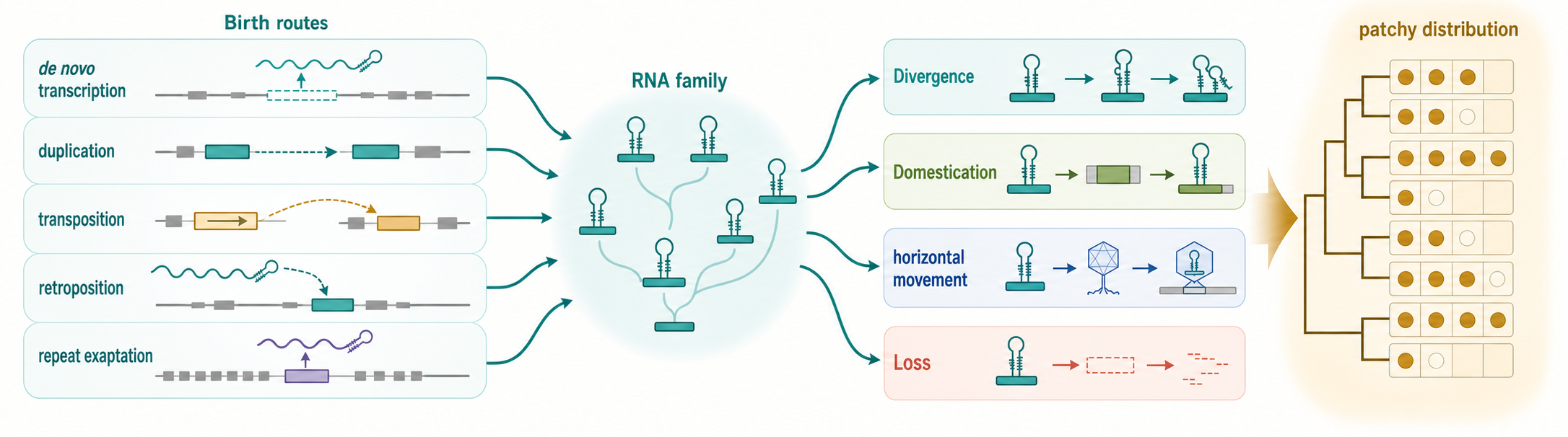
Figure 12.4. RNA Family Life Cycle. RNA family members arise through multiple mechanisms — including de novo transcription, duplication of an existing locus, transposition, retroposition, and exaptation of repeat sequence — and then undergo divergence, domestication, horizontal movement by mobile elements or phages, or eventual loss through decay and deletion. A patchy phylogenetic distribution can reflect any combination of these processes, and horizontal transfer should not be assumed without eliminating vertical inheritance with lineage-specific loss, rapid divergence beyond detection, and incomplete genome sampling.
Patchy phylogenetic distribution is therefore ambiguous. Suppose a structured RNA family is present in several bacterial phyla, absent from close relatives, and present again in distant lineages. One explanation is horizontal transfer. Another is ancient origin with repeated loss. Another is rapid divergence that prevents detection in some lineages. Another is incomplete genome sampling. Another is contamination or assembly error. Another is a family boundary that combines unrelated elements. The correct interpretation depends on genomic context, tree reconciliation, sequence and structure evidence, mobile-element association, taxon sampling, and independent validation.
RNA-associated proteins can help interpret a family history without replacing it. FinO/ProQ-family proteins, for example, have been reviewed from an evolutionary perspective. Such protein-family histories can explain why certain RNA regulatory systems diversify or spread. They do not by themselves establish the ancestry of every associated RNA. The RNA family and the protein family may have different histories, especially when proteins bind many RNAs or when RNA partners are gained and lost quickly.
Box 12.4. lncRNA Family Claims Need Extra Care
Long noncoding RNA loci can be transcribed reproducibly, assigned consistent names, and linked to phenotypes without forming a well-supported ancient conserved RNA family. Transcript detection, weak sequence conservation, broad expression, proposed function, and mechanistic model can each be substantiated independently — or any of them can be absent while others appear solid. Consensus guidelines recommend evaluating definition, conservation, molecular mechanism, and phenotypic evidence separately rather than inferring one from another. Caution is not dismissal: some long noncoding RNAs are deeply conserved and mechanistically validated, but that status must be demonstrated rather than assumed from transcription alone.
A family found in some lineages and not others may have been horizontally transferred, vertically inherited with lineage-specific losses, rapidly diverged beyond detection, missed because of poor sampling, hidden by assembly gaps, removed by annotation filters, confused with repeats, or defined too broadly. A horizontal-transfer claim should show why these alternatives are less likely.
12.5. Sampling bias, alignment uncertainty, and false evolutionary inference
Comparative genomics begins with available data, and available data are uneven. Human, mouse, fruit fly, worm, yeast, common pathogens, cultured microbes, crop plants, and clinically important viruses are deeply sampled. Many environmental microbes, rare eukaryotes, uncultured lineages, host-associated organisms, organelles, and RNA viruses are poorly sampled. Metagenomic and metatranscriptomic data have widened the view, but they can be fragmented, contaminated, difficult to assign to species, or missing syntenic context. A family can look young, rare, or lineage-specific simply because the relevant lineages are absent from databases.
Metadata bias can distort conclusions even when the sequence data are real. Comparative RNA interpretation often depends on organism identity, strain, tissue, developmental stage, environmental condition, infection state, library strategy, sequencing platform, read length, RNA quality, assembly version, and annotation version. Bias-invariant RNA-sequencing metadata annotation work illustrates the broader problem that metadata labels themselves may need standardization and correction. If the metadata are wrong, an apparent tissue-specific RNA, lineage-specific family, or disease-associated transcript can be a labeling artifact.
RNA quality matters because degradation can imitate biology. Degraded long RNAs can produce fragments that look like small RNAs. Partial degradation can enrich ends, internal fragments, or stable structured pieces. Library preparation can add more bias: size selection enriches particular length classes; adapter ligation has sequence preferences; reverse transcriptase can stop at structured or modified positions; rRNA depletion changes background composition; mapping filters can discard multi-mapping repeat-derived reads. Alignment-free RNA degradation quality-control methods address one part of this problem by detecting degradation patterns.
Table 12.5. Failure Modes in Comparative RNA Evolution. Common analytical failure modes in comparative RNA annotation, how each manifests, why it misleads, and the controls that can detect or prevent it.
| Failure mode | How it appears | Why it misleads | Control or validation |
|---|---|---|---|
| Sampling bias | Family appears rare or lineage-specific | Unsequenced lineages are absent from databases | Check taxon coverage; supplement with metagenome or environmental sequence |
| Metadata error | Apparent tissue specificity or disease association | Sample labels misclassify origin or condition | Curate metadata; use bias-invariant annotation approaches |
| Poor genome assembly | Family member absent from certain taxa | Contig fragmentation or assembly gap excludes locus | Verify with long-read sequencing or synteny-based assembly |
| Alignment uncertainty | Covariation or conservation in unreliable columns | Forced alignment creates artifactual structural signal | Use multiple alignment methods; report alignment confidence |
| Low-complexity sequence | Weak model match in AU-rich or repetitive region | Low-complexity tracts score nonspecifically against many models | Mask low complexity before search; require structural coverage |
| Repeat-derived similarity | Multiple hits per genome from related repeats | Repeated insertions generate independent sequence copies | Check for transposable-element overlap; use repeat-masked sequence |
| Convergent short motifs | Short motif found in distant unrelated families | Simple sequence requirements can evolve independently | Require full-length structure, phylogenetic distribution, and context |
| RNA degradation | Small RNA fragments from degraded long transcripts | Degradation produces stable structured termini or internal fragments | RNA quality metrics; fragment-pattern controls; degrade-comparison experiments |
| Library preparation bias | Enrichment of specific size class or sequence context | Adapter ligation, size selection, or RT stops skew detection | Multiple library preparations; adapter and size controls |
| Annotation circularity | Label propagated from early prediction without re-evaluation | Downstream databases inherit the original error unchecked | Trace annotation to primary evidence; require independent re-validation |
| Overinterpretation of expression | Transcript detection treated as proof of function | Transcription can be spurious, read-through, or condition-specific | Require reproducibility, biogenesis evidence, and functional perturbation |
Alignment uncertainty is one of the most serious failure modes for RNA family inference. A multiple sequence alignment is a statement that residues in the same column descend from corresponding ancestral positions or occupy comparable structural positions. For short, divergent, repeat-rich, or structure-dominated RNAs, that statement can be uncertain. Forced alignment can create artificial columns. Structure-aware alignment can overfit a preferred structure. Tools such as R-Coffee were developed to improve noncoding RNA alignment by incorporating RNA-specific evidence, but even improved methods leave uncertainty that should be reported rather than hidden. Covariance analysis can then find support for the structure partly because the alignment was built to imply it. This is a form of circularity.
Evolutionary false positives arise when a pattern is real but the interpretation is wrong. A low-complexity AU-rich segment may match a weak model. A repeat family may generate many similar transcripts that are not independent functional RNAs. A pseudogene fragment may retain enough sequence to look like a family member but no longer be expressed or processed. A short motif can evolve convergently because the sequence requirement is simple. A long noncoding RNA may be transcribed and named but lack evidence for conserved molecular function, especially when repeat-derived sequence and rapid repertoire turnover blur the boundary between transcriptional novelty and conserved RNA family biology. A database annotation may be inherited by later analyses without rechecking the original evidence.
Detection error becomes evolutionary error when it changes the reconstructed history. A permissive family model can admit unrelated sequences and create a false impression of ancient breadth or horizontal spread. A narrow model can miss divergent homologs and create false lineage specificity or repeated loss. Repetitive genomes and metagenomic assemblies can inflate candidate lists, whereas incomplete assemblies erase true members. Threshold selection and search sensitivity are operational matters for Chapter 140; this chapter owns the consequence for historical interpretation: presence and absence must carry detection uncertainty.
False evolutionary inference can also arise from circular evidence. If a database label defines the alignment, the alignment defines a family model, and later studies treat hits to that model as independent confirmation of the original label, the apparent support has been counted more than once. Learned methods can amplify the same problem when training labels, test families, and downstream interpretations are not independent. The control is not to reject computational evidence but to trace dependencies and seek evidence that is independent of the original family definition.
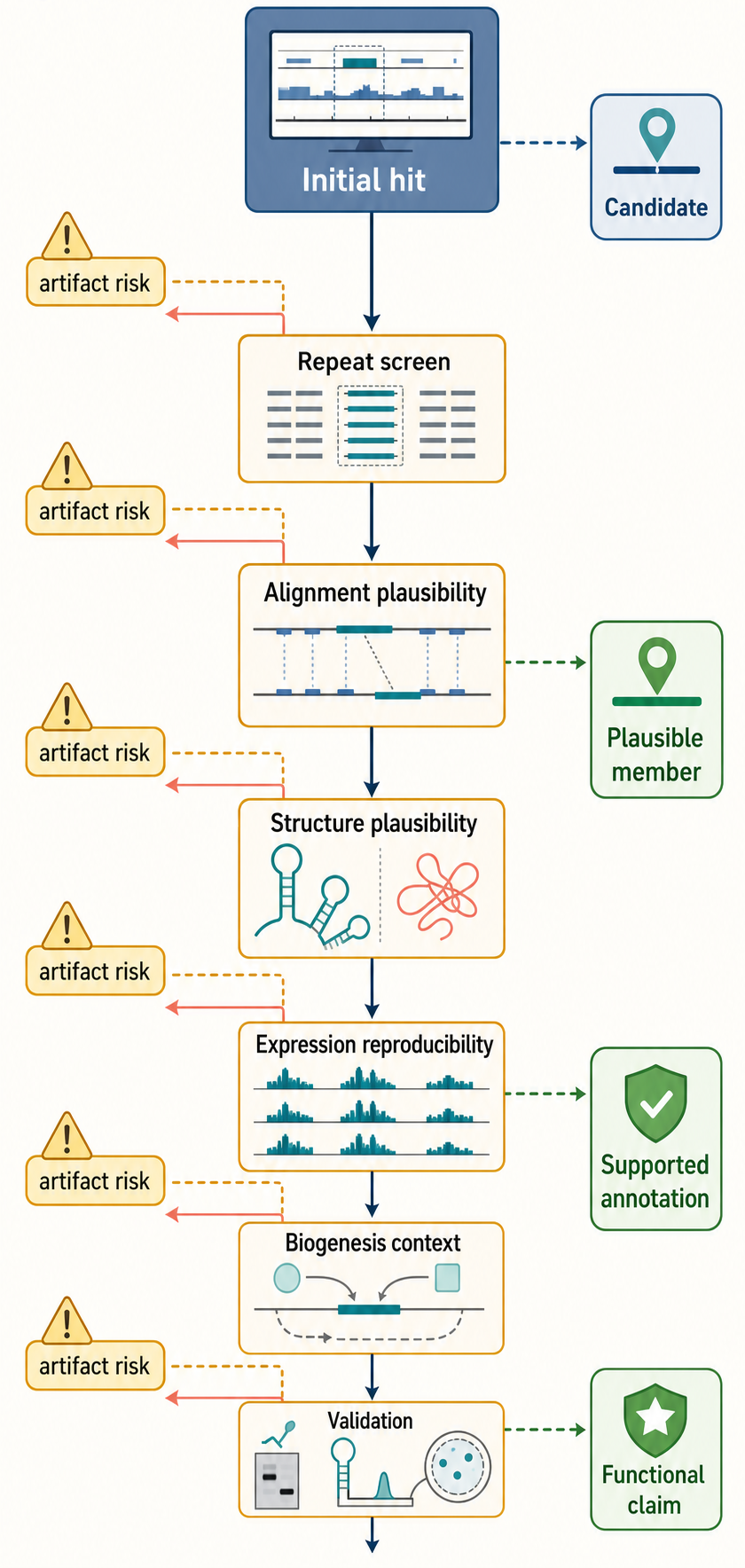
Figure 12.5. From Comparative Observation to Bounded Evolutionary Claim. The figure should move from observations—sequence similarity, compensatory change, synteny, genomic context, taxonomic distribution, expression, and biogenesis—to progressively more specific claims: candidate family membership, homology, orthology or paralogy, transfer or loss, conserved function, and mechanism. Each transition should show the independent evidence and alternative explanations required. Sampling gaps, alignment uncertainty, repeat similarity, detection failure, and annotation circularity should limit the claim rather than disappear from the final panel.
A practical triage ladder helps prevent overclaiming. The first rung is a candidate: a sequence hit, structure prediction, expression signal, or database match. The second rung is a plausible family member: the candidate has reasonable length, alignment, structure, score, and context. The third rung is a well-supported annotation: the candidate is found in a coherent phylogenetic distribution, has reproducible expression or biogenesis evidence when relevant, and passes repeat and artifact filters. The fourth rung is a functional family claim: perturbation, rescue, biochemical activity, structure probing, or organismal phenotype supports the proposed role. The final rung is a mechanistic claim: the evidence explains how the RNA sequence, structure, partners, and cellular context produce the function.
Box 12.5. Patchy Distribution Has Many Causes
A family found in some lineages and absent from others may have been horizontally transferred, vertically inherited with lineage-specific losses, rapidly diverged beyond detection, missed because of poor sampling, hidden by assembly gaps, removed by annotation filters, confused with repeats, or defined too broadly. A horizontal-transfer claim should show why these alternatives are less likely before transfer is accepted as the preferred explanation.
Presence of a candidate sequence does not prove family membership or function. Absence of a detected homolog does not prove true biological absence. Both claims depend on sampling, assembly quality, model sensitivity, annotation thresholds, and independent biological evidence.
Experimental Foundations and Evidence
Comparative RNA claims are strongest when independent evidence types converge. Sequence similarity is usually the first clue. It can identify close homologs, define conserved motifs, and reveal family expansion. Its weakness is that short RNAs and repeated sequences can appear similar by chance or by nonhomologous processes.
Structure-aware alignment adds information when base pairing is conserved. It asks whether sequences can be aligned so that corresponding paired positions maintain plausible base pairs. Its weakness is that the alignment can become circular if the assumed structure determines the alignment and the alignment is then used as evidence for the same structure.
Covariation is a strong comparative test for conserved pairing. Its weakness is that correlated substitutions can reflect phylogeny, alignment error, composition, or other constraints. The chapter uses covariation as strong evidence only when the alignment, sampling, and statistical treatment are plausible.
Expression evidence shows whether RNA molecules are detected under specified conditions. It is essential for many RNA-gene claims but insufficient by itself. A transcript can be a byproduct, a degradation fragment, or an artifact. Expression is stronger when reproducible across experiments, compatible with expected processing, and supported by independent assays.
Biogenesis evidence asks whether the RNA is made by the expected pathway. MicroRNAs require hairpin precursors and small-RNA processing signatures. Small nucleolar RNAs often have characteristic boxes and RNP partners. CRISPR guide RNAs are produced from arrays and processing pathways. Long noncoding RNAs may require promoter, splicing, polyadenylation, localization, and chromatin-context evidence depending on the claim.
Mutational evidence tests causality. A disruptive mutation can show that a sequence or structure matters. A compensatory rescue can show that a base-pairing relationship matters. A deletion can show that a locus is required for a phenotype. Mutational evidence is most interpretable when expression, stability, processing, and off-target effects are controlled.
Biochemical and structural evidence connect molecules to mechanism. Binding assays can show interaction with proteins, RNAs, DNA, metabolites, or small molecules. Chemical probing can report structural constraints in vitro or in cells. High-resolution structural biology can define folds and contacts. These methods are powerful but condition-dependent, and their results should be aligned with the comparative claim being made.
Biological Contexts Across RNA Classes
Transfer RNAs and ribosomal RNAs represent ancient structured RNA families with strong conserved structures and deep comparative signal. They demonstrate that primary sequence can change while core structure and function remain recognizable. They also show that even ancient families contain lineage-specific expansions, modifications, processing differences, and specialized paralogs.
Riboswitches are useful examples of conserved structured regulatory RNAs. A riboswitch family may be recognized by conserved aptamer structure, ligand-binding motifs, genomic context near metabolic genes, and covariation. A riboswitch-like structure without the expected ligand-binding residues or genomic context should be interpreted cautiously.
MicroRNAs illustrate family birth, duplication, and false-positive control. A plausible microRNA annotation needs a hairpin precursor, mature small-RNA evidence, processing compatibility, and comparative support. Trained covariance models can improve annotation when built from curated complements.
Bacterial small RNAs often evolve faster and may be tied to local regulatory networks. Some have conserved structures or syntenic positions; others are lineage-specific. RNA-associated protein evolution, such as FinO/ProQ-family history, can provide context for regulatory systems but does not substitute for direct RNA-family evidence.
Long noncoding RNAs require especially careful interpretation. Some are conserved and mechanistically well supported. Many are lineage-specific, lowly expressed, or incompletely annotated. Consensus recommendations emphasize definition, evidence, and functional validation because the mere existence of a transcript does not establish conserved family function.
Viral RNAs and RNA-linked mobile systems show how rapidly evolving genomes can preserve functional RNA structures or move RNA-guided modules. Viral coding constraints, compact genomes, recombination, and host-specific selection make comparative interpretation difficult. CRISPR-associated transposons and TIGR-Tas-like systems are examples where RNA-guided modules and mobile genetic elements intersect.
Technology and Computational Links
Comparative technology supplies the evidence inputs used here. Structure-aware alignments, statistical covariation tests, and probing-informed comparisons can strengthen structural correspondence; their assumptions, statistics, and benchmarking are treated in Chapter 62. Profile and covariance-model searches, Infernal operation, Rfam curation, thresholds, family classification, and annotation records are treated in Chapter 140.
The evolutionary reader should ask what those outputs justify. A ranked hit list supports candidate membership under a model; it does not alone distinguish orthology from paralogy or transfer from loss. A structure-supported alignment can strengthen historical correspondence; it does not alone establish conserved function. Metadata correction and RNA-quality controls matter because false sample identities or degradation fragments can change apparent taxonomic distributions.
Recent Consensus
Current comparative RNA annotation rests on several stable principles. First, homology is shared ancestry, while orthology and paralogy describe the evolutionary event separating homologs. The level of comparison must be stated for RNA loci, transcripts, mature products, and motifs.
Second, RNA family definitions are operational. A family defined by Rfam covariance models, a microRNA precursor family, a seed-defined mature microRNA group, a syntenic long noncoding RNA locus, and a bacterial small-RNA regulatory class are not automatically equivalent kinds of families.
Third, covariation and compensatory substitutions provide strong evidence for conserved RNA base pairing when alignment, phylogenetic sampling, and statistical interpretation are reliable. Statistical covariation tests such as R-scape help separate structural covariation from phylogenetic or alignment background, and covariation is strongest as part of an integrated evidence set.
Fourth, search and curation outputs are evidence inputs rather than complete evolutionary histories. A model hit or family record can support candidate membership, but orthology, paralogy, transfer, loss, and conserved function require additional historical and biological evidence.
Fifth, RNA families evolve through multiple processes: duplication, divergence, exaptation, horizontal movement, domestication, decay, and loss. Patchy distribution is an observation, not a diagnosis.
Sixth, false positives are common enough that comparative annotation must include artifact controls. Repeats, low complexity, poor assemblies, RNA degradation, metadata errors, alignment uncertainty, and database circularity are routine failure modes rather than rare exceptions.
Open Questions, Controversies, Deprecated Models, and Common Misconceptions
Open questions:
- How should family boundaries be drawn for RNAs that conserve genomic context or biogenesis more clearly than sequence?
- How much structural similarity is enough to support homology when sequence similarity is weak?
- How can comparative evidence dependencies be tracked so that a curated family label, its alignment, and later model hits are not counted as independent support?
- Which lineage-specific long noncoding RNAs are functional homologs, convergent regulatory products, or transcriptional byproducts?
- How much environmental sampling is needed before absence of a family becomes meaningful?
- Should remain visible when they affect interpretation. Many older RNA annotations were propagated from weak similarity, uncurated transcript detection, or broad database labels. Such annotations should be revisited rather than silently inherited. The correction of older labels is not a failure of comparative genomics; it is a normal consequence of better sampling, better models, and stricter evidence standards.
Common misconceptions:
- “High sequence similarity proves homology.” High similarity often supports homology, but repeats, low-complexity sequence, contamination, and convergence can mislead. The reverse misconception is that weak sequence conservation proves lack of function. Some functional RNAs are lineage-specific or structure-conserved rather than sequence-conserved. The correct response is not automatic dismissal or automatic acceptance; it is matching the claim to the evidence.
- “Homologous RNAs must have the same function.” Homology concerns ancestry. Function can be conserved, partitioned between duplicates, modified, lost, or replaced. A duplicated microRNA can change targets. A small RNA can move into a new regulatory network. A long noncoding locus can preserve synteny while changing transcript structure or expression.
- “Covariance proves the complete structure.” Covariation can strongly support particular paired positions, but it does not automatically resolve tertiary structure, folding pathway, ligand binding, protein partners, or cellular function.
- “An Rfam or Infernal hit proves that a sequence is an expressed and functional RNA gene.” A model hit supports membership in a modeled family. Expression, processing, and function require additional evidence.
- “Patchy distribution automatically means horizontal transfer.” Patchy distribution can reflect transfer, loss, divergence, incomplete sampling, assembly gaps, contamination, model failure, or wrong family boundaries.