Chapter 21. Comparative Enzymology and Functional Specialization of Archaeal and Eukaryotic RNA Polymerases I, II, and III
Scope Note
This chapter owns the comparative enzymology and functional specialization of archaeal RNA polymerase and eukaryotic RNA polymerases I, II, and III. These multisubunit DNA-dependent RNA polymerases conserve a two-metal-ion catalytic center and a common nucleic-acid-handling architecture, yet they are not interchangeable enzymes. Polymerase-specific subunits, promoter-recognition systems, initiation-factor assemblies, elongation controls, termination routes, chromatin environments, transcript classes, and RNA-maturation pathways specialize each machine for a different biological workload. The organizing question is therefore how conserved catalysis was redistributed among distinct regulatory systems, rather than which polymerase merely makes which RNA.
Bacterial RNA polymerase and sigma-dependent transcription are covered in Chapter 20. Specialized nuclear, organellar, and viral-like polymerases are covered in Chapter 22. RNA-dependent RNA polymerases and reverse transcriptases are covered in Chapter 23. This chapter compares elongation, pausing, termination, and processing only far enough to explain polymerase specialization. Generic elongation-state mechanisms and detailed promoter-proximal pausing belong to Chapter 24, whereas termination pathways and co-transcriptional RNA maturation belong to Chapter 25.
Executive Summary
Archaeal and eukaryotic transcription systems reveal two linked principles. First, the catalytic core of multisubunit RNA polymerases is ancient and conserved. Archaeal RNA polymerase and eukaryotic nuclear polymerases share subunit architecture, active-site organization, nucleic-acid scaffold geometry, and factor-control logic more closely with each other than either resembles the bacterial sigma-factor initiation system. Archaeal transcription commonly uses a TATA-binding protein, TFIIB-related initiation factors, and Spt4/5-family elongation factors, making archaeal systems powerful models for the conserved core of eukaryote-like transcription.
Second, eukaryotes did not merely add more regulation to one polymerase. They divided nuclear DNA-dependent transcription among RNA polymerase I, RNA polymerase II, and RNA polymerase III. Pol I is specialized for high-output transcription of the large ribosomal RNA precursor. Pol II is specialized for protein-coding genes and many noncoding RNA genes, and it carries a distinctive C-terminal domain that coordinates transcription with RNA maturation. Pol III is specialized for tRNAs, 5S rRNA, U6 snRNA, and other short structured RNAs. This division reflects evolutionary duplication and specialization of ancestral polymerases, but modern polymerase identity is defined by more than ancestry. Each polymerase has characteristic promoters, initiation factors, transcript classes, processing pathways, chromatin environments, regulatory inputs, and disease vulnerabilities.
Pol I and Pol III should not be treated as uninteresting housekeeping enzymes. Ribosome biogenesis and tRNA supply are central to cell growth, metabolic state, stress responses, and proliferative disease. Pol I acts in the nucleolus on ribosomal DNA repeats, where transcription is coordinated with rRNA processing and ribosome assembly. Pol III acts on compact genes, many with internal promoter elements, and produces abundant structured RNAs whose maturation is tightly coupled to RNA identity. Changes in Pol I or Pol III output can alter growth capacity, nucleolar stress, translation capacity, genome organization, and stress adaptation.
Pol II is the most studied nuclear polymerase because it produces mRNA, many regulatory noncoding RNAs, and numerous unstable transcription products. Its largest subunit contains the C-terminal domain, often abbreviated CTD. The CTD is a low-complexity tail made of repeated heptapeptide motifs that are phosphorylated and bound by many factors. CTD phosphorylation patterns help recruit capping enzymes near the 5′ end, splicing and chromatin factors during elongation, and cleavage and polyadenylation factors near transcript ends. The CTD is sometimes described as a “code,” but that phrase can mislead. The CTD is better understood as a dynamic interaction platform whose modification state, binding partners, polymerase position, chromatin context, transcript sequence, and kinetic history jointly shape which factors act.
Eukaryotic initiation requires more than polymerase recruitment to DNA. General transcription factors assemble a preinitiation complex, often abbreviated PIC, that positions Pol II at a promoter, opens DNA, selects a start site, and supports early RNA synthesis. Mediator is a large coactivator complex that helps connect enhancer-bound and promoter-bound regulatory proteins to the Pol II initiation machinery. Chromatin controls transcription by changing promoter accessibility, nucleosome positions, histone modifications, regulatory-factor occupancy, enhancer-promoter communication, and elongation barriers. Structural studies of Mediator-bound human preinitiation complexes show why initiation is a physical assembly problem rather than a simple on-off promoter label.
Transcription does not end with initiation. Archaeal and eukaryotic polymerases pause, backtrack, cleave nascent RNA, recruit elongation factors, and coordinate with RNA maturation. In metazoans, promoter-proximal pausing creates a regulatory checkpoint after Pol II initiation, so control can occur after a transcript has already begun. During productive elongation, the nascent RNA emerges into a protein environment that can cap, splice, modify, cleave, polyadenylate, fold, or assemble it into ribonucleoprotein complexes. The correct interpretation of transcription data therefore requires asking not only whether a polymerase is present, but whether it is initiating, paused, elongating, processing RNA, terminating, or trapped by perturbation.
Functional specialization is visible at every transition in that cycle. Archaeal RNAP offers a compact reference for conserved initiation and elongation logic. Pol I invests in repeated, high-flux rRNA synthesis and couples transcription to nucleolar ribosome assembly. Pol II invests in regulatory range and uses its C-terminal domain to coordinate heterogeneous transcripts with multiple processing pathways. Pol III invests in efficient reinitiation, compact promoter grammars, and termination suited to short structured RNAs. These are relative emphases rather than absolute properties: all four systems must initiate accurately, elongate processively, recover from arrest, end transcription, and deliver RNA to downstream pathways.
Concept Inventory
- Archaeal RNA polymerase: the multisubunit DNA-dependent RNA polymerase used by archaea. It contains a conserved catalytic center and resembles eukaryotic nuclear RNA polymerases in subunit architecture and factor interactions. Archaeal RNAP is not identical to any one eukaryotic polymerase and should not be described as simply “primitive Pol II.” It is a living archaeal enzyme with lineage-specific factors, promoters, genome organization, and regulation.
- RNA polymerase I: the eukaryotic nuclear polymerase specialized for transcription of the large ribosomal RNA precursor. In many eukaryotes this precursor is processed into 18S, 5.8S, and 28S or 25S rRNAs. Pol I works in the nucleolus on ribosomal DNA repeats and is coupled to ribosome biogenesis. Pol I output is tightly regulated by growth and stress signaling.
- RNA polymerase II: the eukaryotic nuclear polymerase that transcribes protein-coding genes and many noncoding RNA genes. Pol II products include pre-mRNAs, many long noncoding RNAs, enhancer RNAs, promoter-proximal unstable transcripts, some small nuclear RNAs, and other regulatory transcripts. Pol II identity is linked to its CTD, to complex initiation factor requirements, to chromatin regulation, and to co-transcriptional RNA processing.
- RNA polymerase III: the eukaryotic nuclear polymerase specialized for tRNAs, 5S rRNA, U6 snRNA, and other short structured RNAs. Pol III genes often use compact promoter architectures, including internal promoter elements within the transcribed region for many tRNA and 5S rRNA genes. Pol III termination often occurs at short oligo(dT) tracts in the non-template DNA, producing U-rich 3′ ends in RNA.
- General transcription factor: an initiation factor required at many promoters for productive polymerase initiation. The word “general” does not mean biologically inert. General factors can influence promoter specificity, assembly kinetics, DNA opening, start-site selection, regulatory-factor communication, and responses to signaling. Preinitiation complex means the promoter-associated assembly that contains polymerase, general transcription factors, promoter DNA, and sometimes large cofactor complexes such as Mediator. A PIC is competent to proceed toward DNA opening and initiation, but a PIC is not necessarily productive.
- TATA-binding protein: a conserved DNA-binding protein that recognizes TATA-box-like promoter elements in many archaeal and eukaryotic contexts and helps nucleate initiation-complex assembly. TFIIB-family factors are initiation factors related to eukaryotic TFIIB and archaeal TFB. Mediator is a large multiprotein coactivator complex best known for Pol II transcription. The Pol II CTD is a repetitive low-complexity tail on the largest Pol II subunit. Spt4/5 and DSIF are conserved elongation-factor systems that bind elongating polymerases and affect processivity, pausing, and elongation control. Promoter-proximal pausing is the accumulation of initiated Pol II near promoters before transition into productive elongation. Chromatin-transcription coupling means the reciprocal relationship between chromatin state and transcription.
- Functional specialization: evolutionary and mechanistic partitioning in which related polymerases retain common catalytic requirements but acquire different subunits, factor interfaces, promoter grammars, transcript portfolios, kinetics, and processing handoffs. Specialization is comparative: it identifies which transition is emphasized or solved differently, not a claim that one polymerase alone possesses a universal transcription property.
- Polymerase state: a defined physical and kinetic condition such as promoter-bound preinitiation complex, initially transcribing complex, paused complex, productive elongation complex, backtracked complex, termination complex, or inhibited complex. Occupancy assays often combine several states, whereas state-resolved structural, biochemical, and nascent-transcription measurements distinguish them more directly.
What to Know Before Reading This Chapter
The reader should know four basic facts before entering this chapter. First, RNA polymerases synthesize RNA 5′ to 3′ by adding ribonucleoside triphosphates to the 3′ hydroxyl of a growing RNA. Second, a promoter is a DNA region that can direct transcription initiation, but promoter activity depends on protein factors, chromatin, DNA topology, and kinetic steps, not just a sequence motif. Third, eukaryotic nuclear DNA is packaged into chromatin. Fourth, most primary transcripts are not final functional RNAs. A new transcript may need capping, cleavage, splicing, modification, trimming, polyadenylation, export, assembly with proteins, or degradation.
Chapter 20 introduced bacterial RNAP, sigma factors, promoter opening, elongation, pausing, backtracking, transcript cleavage, termination, and inhibitor mechanisms. Those concepts are useful here, but they cannot be transferred one-to-one. Archaeal and eukaryotic systems use general transcription factors instead of bacterial sigma factors for promoter-specific initiation. Eukaryotic cells also split nuclear transcription among multiple specialized polymerases. The central question in this chapter is how similar catalytic machines became different regulatory machines.
Four running examples anchor the chapter. Archaeal RNAP with TBP, TFB, and Spt4/5 illustrates a compact eukaryote-like transcription system. Pol I transcription of ribosomal DNA illustrates high-output transcription coupled to rRNA processing and ribosome assembly. Pol II transcription of a protein-coding gene illustrates CTD-mediated coordination of capping, elongation, splicing, cleavage, and termination. Pol III transcription of a tRNA gene illustrates short structured RNA production from compact promoters and specialized termination.
The chapter also requires separating three related but distinct ideas. Polymerase recruitment means a polymerase or associated factor is present at a locus. Transcription initiation means RNA synthesis has started. Productive RNA output means transcript molecules are made, processed, and stabilized enough to be measured or used. Chromatin immunoprecipitation, nascent RNA sequencing, steady-state RNA sequencing, and imaging can emphasize different levels. Confusing these levels leads to many errors in transcription interpretation.
21.1. Archaeal RNA polymerase as a mechanistic and evolutionary reference
Archaeal transcription is a key comparative system because it combines a eukaryote-like polymerase and factor logic with archaeal genome biology. Most archaeal species encode one main multisubunit RNA polymerase for DNA-dependent RNA synthesis. This enzyme contains homologs or analogs of core eukaryotic polymerase subunits and uses initiation factors related to eukaryotic TBP and TFIIB. In a simplified initiation pathway, TBP binds promoter DNA, TFB helps position the polymerase relative to the transcription start site, and archaeal RNAP forms an initiation complex capable of opening DNA and beginning RNA synthesis. That logic differs from the bacterial model in which sigma factors bind core RNAP and provide promoter-recognition domains.
At the catalytic center, template DNA positions the incoming ribonucleoside triphosphate opposite its complementary DNA base, catalytic metal ions support phosphodiester-bond formation, pyrophosphate leaves, and the RNA 3′ end advances for the next addition cycle. The bridge helix, trigger-loop-like elements, clamp, DNA-RNA hybrid path, and RNA-exit route organize this chemistry. Conservation of those features explains why archaeal RNAP is mechanistically informative; differences in peripheral subunits and factor contacts explain why it is not a substitute for direct study of any eukaryotic polymerase.
The word “archaeal” must be used carefully. Archaea include diverse lineages with different promoters, transcription regulators, chromatin proteins, genome structures, and environmental lifestyles. Some archaeal genomes encode multiple TBP or TFB paralogs. Some lineages have histone-like proteins, while others use different chromatin-associated proteins. Many archaea live in extreme or metabolically unusual environments, and their transcription systems respond to heat, salt, nutrient state, and other conditions. Therefore, archaeal transcription is eukaryote-like in the conserved core, but archaeal organisms are not stripped-down eukaryotes.
The evolutionary importance of archaeal RNAP is clearest when the transcription cycle is broken into states. The enzyme must bind promoter DNA, melt a short region around the start site, choose a transcription start site, synthesize short RNAs while still promoter-associated, escape the promoter, elongate, pause, cleave backtracked RNA when needed, respond to elongation factors, and terminate. Single-molecule and biochemical studies of archaeal transcription can track RNAP movement, pausing, backtracking, and factor effects in a compact system.
Spt4/5 provides a concrete bridge from archaea to eukaryotes. In archaea, Spt4/5 can bind elongating RNAP and influence processivity and pausing. In eukaryotes, the related DSIF complex participates in Pol II pausing and productive elongation. In bacteria, the NusG family occupies a related broad functional space. The details differ, but the shared principle is that an elongating polymerase is not simply a moving catalytic clamp. It is a platform whose behavior can be changed by factors binding near the nucleic-acid scaffold.
Transcript cleavage is another conserved principle. If an elongating RNAP backtracks, the RNA 3′ end can move away from the active site and become unable to accept the next nucleotide. Cleavage of the extruded RNA can create a new 3′ end correctly positioned for elongation. Archaeal transcription factor S stimulates cleavage by archaeal RNAP, analogous in broad logic to eukaryotic TFIIS and bacterial Gre factors. The analogy should not erase molecular differences among these systems, but it shows that proofreading and arrest rescue are conserved problems for multisubunit polymerases.
Table 21.1. Comparison of Archaeal RNAP and Eukaryotic Pol I, Pol II, and Pol III. Properties of the four major systems sharing a conserved multisubunit polymerase ancestry, highlighting their distinct transcript classes, initiation factors, processing links, regulatory emphases, and key caveats.
| Polymerase system | Major transcript classes | Initiation factors | Processing links | Regulatory emphasis | Major caveat |
|---|---|---|---|---|---|
| Archaeal RNAP | rRNA, mRNA, other transcripts | TBP, TFB, Spt4/5 | Limited cotranscriptional processing described | Growth, stress, environmental conditions | Not a simplified eukaryote; archaeal lineage diversity is large |
| Pol I | Large rRNA precursor (18S, 5.8S, 28S/25S) | TBP-containing complex, Pol I-specific factors | Cotranscriptional rRNA cleavage and ribosome assembly | Growth signals, nutrient state, nucleolar stress | Does not produce 5S rRNA or organellar rRNAs |
| Pol II | Pre-mRNAs, lncRNAs, eRNAs, snRNAs, unstable transcripts | TFIID, TFIIA, TFIIB, TFIIF, TFIIE, TFIIH, Mediator | Capping, splicing, 3′ cleavage, polyadenylation | Initiation, promoter-proximal pausing, elongation, chromatin | Occupancy does not equal productive RNA output |
| Pol III | tRNAs, 5S rRNA, U6 snRNA, 7SL RNA, short structured RNAs | TFIIIB, TFIIIC, TFIIIA (for 5S rRNA) | End trimming, CCA addition, modification, splicing (some tRNAs) | Growth, stress, nutrient and metabolic status | Not all short RNAs are Pol III products |
The eukaryotic split into Pol I, Pol II, and Pol III is usually interpreted as the product of ancient duplication and specialization of multisubunit polymerase lineages. Specialization allowed each polymerase to acquire different initiation factors, peripheral subunits, regulatory contacts, and RNA-output roles. The result is not three interchangeable enzymes. A Pol II promoter cannot generally be transcribed productively by Pol I, and a Pol III tRNA promoter uses factor logic not used by ordinary Pol II protein-coding genes. Polymerase identity is therefore a combined property of enzyme structure, promoter recognition, initiation factors, transcript type, processing route, and cellular compartment.
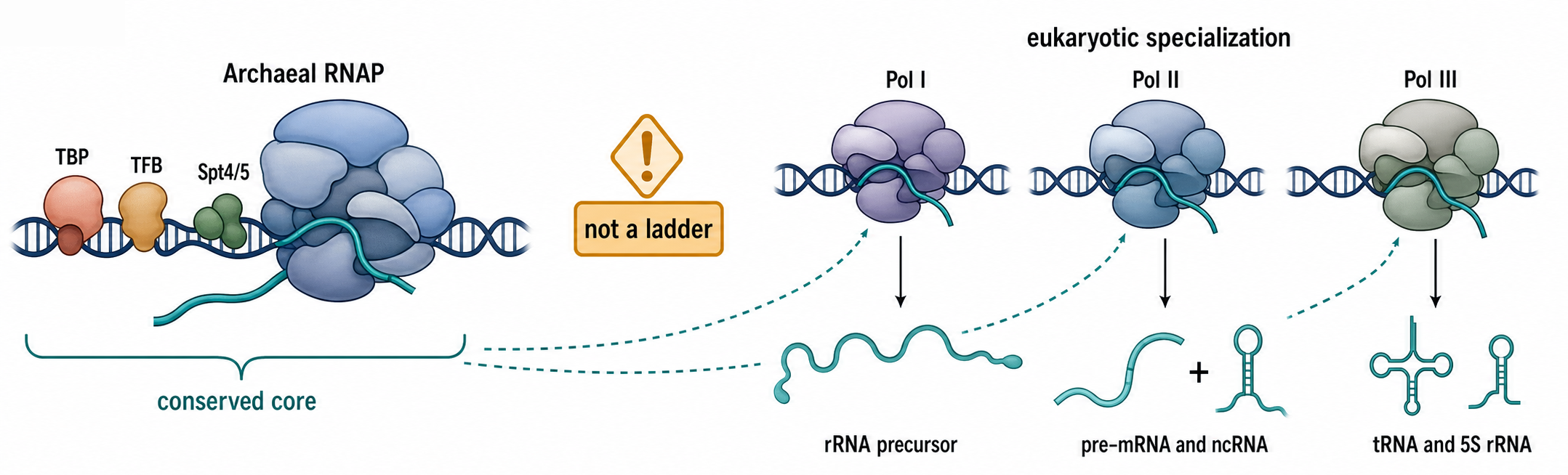
Figure 21.1. Archaeal-to-Eukaryotic Polymerase Specialization. Archaeal RNA polymerase shares core subunit architecture, active-site organization, and factor-control logic with eukaryotic nuclear polymerases, using TBP- and TFB-related initiation factors and Spt4/5-family elongation factors in a compact eukaryote-like transcription system. Eukaryotes divided nuclear DNA-dependent transcription among RNA polymerase I, II, and III, each specialized for distinct gene classes, processing pathways, and regulatory inputs. This figure presents the conserved catalytic core alongside the divergent regulatory identities of the three eukaryotic polymerases, without implying that living archaea are simplified or ancestral eukaryotes.
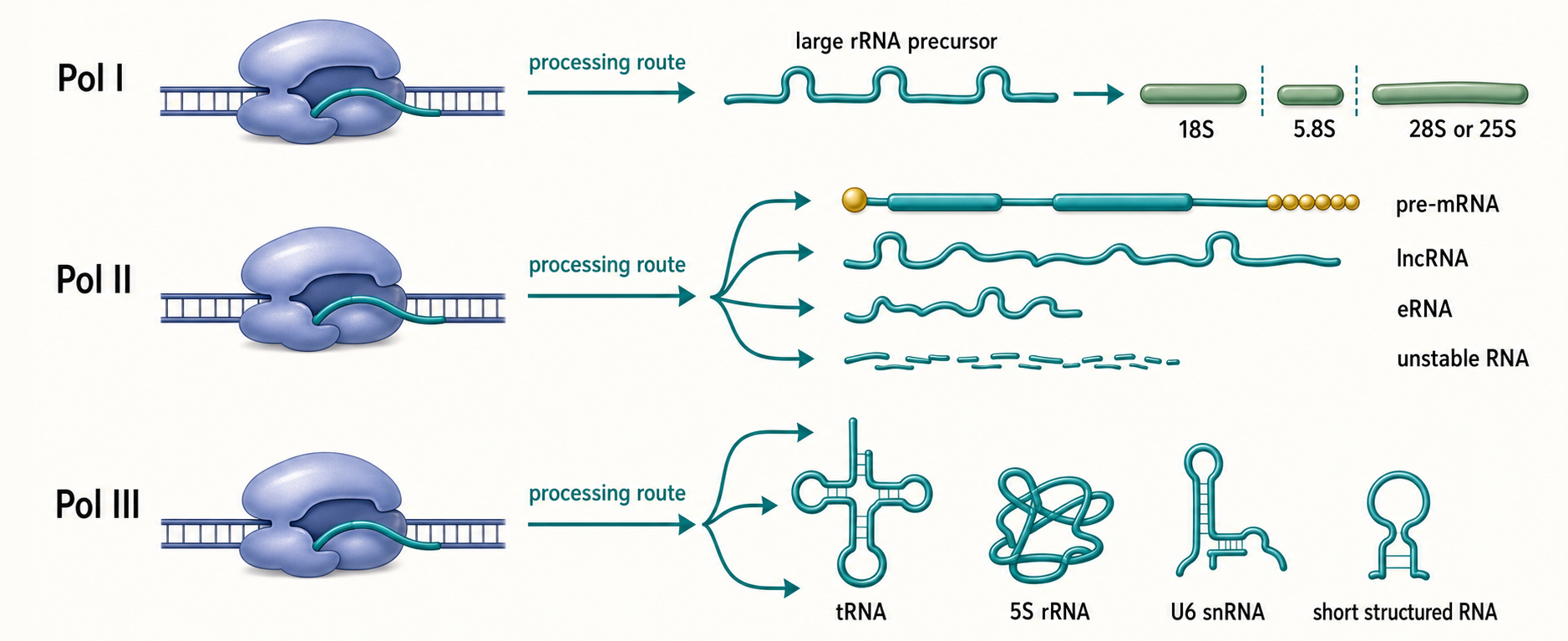
Figure 21.2. Polymerase I, II, and III Output Map. Each eukaryotic nuclear RNA polymerase is matched to a distinct transcript class and downstream processing route. Pol I transcribes the large ribosomal RNA precursor in the nucleolus, which is cleaved and modified into 18S, 5.8S, and 28S or 25S rRNAs for ribosome assembly. Pol II transcribes protein-coding genes and many noncoding RNA genes, producing pre-mRNAs, long noncoding RNAs, enhancer RNAs, and promoter-proximal unstable transcripts whose processing involves capping, splicing, and cleavage-polyadenylation. Pol III transcribes tRNA genes, 5S rRNA genes, U6 snRNA genes, and other short structured RNA genes using internal promoter elements and oligo(dT)-directed termination signals that differ fundamentally from the Pol II system.
Table 21.2. General Transcription Factors and Their Main Roles. Selected initiation factors for archaeal RNAP, Pol I, Pol II, and Pol III, with their polymerase associations, main functions, relevant mechanistic states, and chapter cross-references.
| Factor | Polymerase system | Main function | Mechanistic state | Chapter cross-reference |
|---|---|---|---|---|
| TBP | Archaeal RNAP, Pol I, Pol II, Pol III | Binds TATA-like DNA elements; nucleates initiation complex assembly | DNA bending; platform for downstream factor recruitment | Section 21.1, Section 21.5 |
| TFB/TFIIB | Archaeal RNAP, Pol II | Bridges TBP-DNA to polymerase; contributes to start-site positioning | Preinitiation complex before DNA opening | Section 21.1, Section 21.5 |
| TFIID | Pol II | TBP-containing complex recognizing core promoter elements | Promoter recognition and PIC nucleation | Section 21.5 |
| TFIIA | Pol II | Stabilizes TBP-DNA interactions; can antagonize repressors | Preinitiation complex stabilization | Section 21.5 |
| TFIIF | Pol II | Escorts Pol II into initiation complex; stabilizes PIC | Pol II recruitment and early elongation | Section 21.5 |
| TFIIE | Pol II | Recruits and regulates TFIIH | Between PIC assembly and DNA opening | Section 21.5 |
| TFIIH | Pol II | DNA melting (XPB translocase), CTD phosphorylation (CDK7), NER function | DNA opening and promoter escape | Section 21.5, Section 21.7 |
| Pol I initiation factors | Pol I | Recognize Pol I core and upstream control elements; assemble nucleolar PIC | Pol I preinitiation complex assembly | Section 21.2 |
| TFIIIB | Pol III | Recruits Pol III after TFIIIC positions it upstream of start site | Upstream PIC assembly for tRNA and 5S genes | Section 21.4 |
| TFIIIC | Pol III | Binds A and B box internal promoter elements; recruits TFIIIB | Internal promoter element recognition | Section 21.4 |
Evidence for archaeal-eukaryotic ancestry comes from comparative genomics, structural biology, biochemistry, and single-molecule approaches. Comparative genomics identifies homologous subunits and factor families. Structural biology shows conserved polymerase folds, active-site geometry, clamps, bridge helix and trigger-loop-like elements, and nucleic-acid scaffold paths. Biochemistry shows related initiation and elongation states. No single evidence class proves the full evolutionary pathway, but together they support a strong consensus that archaeal transcription machinery is the closest living comparative framework for the core of eukaryotic nuclear transcription.
Do not overgeneralize: “archaeal transcription is eukaryote-like” does not mean every archaeal regulatory feature has a eukaryotic counterpart, and it does not mean all eukaryotic complexity was present in archaeal ancestors. The useful statement is narrower and stronger: the core multisubunit polymerase architecture and several initiation and elongation factor principles are shared deeply enough that archaeal systems can illuminate conserved mechanisms.
21.2. RNA polymerase I specialization: rRNA synthesis, initiation, elongation, and regulation
RNA polymerase I is specialized for one dominant output: the large precursor ribosomal RNA transcript. In many eukaryotes, this precursor contains sequences that will become 18S, 5.8S, and 28S or 25S rRNAs, separated by external and internal transcribed spacers. The precursor is not a final RNA. It enters a processing pathway involving cleavage, nucleotide modification, folding, and assembly with ribosomal proteins and small nucleolar ribonucleoproteins. Pol I transcription is therefore the entry point to ribosome biogenesis, not a stand-alone RNA-production reaction.
The biological importance of Pol I follows from the scale of ribosome production. Growing cells need many ribosomes, and rRNAs are among the most abundant RNAs in the cell. Ribosomal DNA genes are arranged in repeats, and active rDNA repeats are transcribed at high density in the nucleolus. The nucleolus is a nuclear compartment in which rDNA transcription, rRNA processing, ribosome-subunit assembly, and stress signaling are physically and functionally linked. When nutrient availability, growth-factor signaling, DNA damage, or cell-cycle state changes, Pol I output can change rapidly.
Pol I initiation uses a promoter and factor system distinct from Pol II and Pol III. In well-studied eukaryotes, Pol I promoters contain a core element around the transcription start site and upstream control elements that recruit Pol I-specific initiation factors. TBP can participate as part of a Pol I factor assembly, but TBP use does not make the promoter a Pol II promoter. Shared factors can be repurposed by different polymerase systems; their partners, DNA contacts, and polymerase contacts determine the transcription system.
Mechanistically, Pol I-specific factors first recognize rDNA promoter elements and establish a platform that recruits Pol I in the nucleolus. DNA opening and initial RNA synthesis produce a stable elongation complex, after which polymerase-specific subunits and rDNA-associated factors support rapid passage through the transcription unit. At the far end, termination and polymerase release must be coordinated with the continuing maturation of the precursor. This section owns how those steps make Pol I a specialized enzyme; the general logic and diversity of termination mechanisms and detailed rRNA-processing reactions continue in Chapter 25 and Chapter 42.
Pol I elongation is tuned for high output through repetitive rDNA. The enzyme must remain processive through long rRNA precursor units while coordinating with nascent rRNA folding and processing. Pol I has subunits and associated factors that influence elongation stability, cleavage, and pausing. A12.2 is a useful example. It contributes to cleavage-related functions and can destabilize or remodel Pol I elongation complexes in ways that support elongation-state control. Pol I is not merely Pol II without a CTD; it has its own built-in solutions to elongation, fidelity, and transcript handling.
The rDNA chromatin environment is unusual. Some rDNA repeats are active, others are inactive or poised, and their chromatin states differ. Active rDNA must be accessible to Pol I and processing machinery, while inactive repeats are packaged more repressively. DNA topology, nucleosome organization, nucleolar proteins, growth signaling, nutrient state, energy status, and replication timing can all influence rDNA transcription.
Pol I is tightly connected to disease because ribosome production is connected to growth. Many cancer cells show increased ribosome biogenesis, nucleolar enlargement, or altered Pol I regulation. Pol I inhibition can activate nucleolar stress pathways, including pathways that stabilize p53 in some contexts. However, Pol I activity should not be interpreted as a simple cancer on-off switch. Normal proliferating cells also need high ribosome production, and different tumors have different dependencies on ribosome biogenesis, p53 status, metabolic state, and stress responses.
Concrete example: a mammalian cell stimulated by growth signals increases ribosome biogenesis. Pol I transcription of rDNA rises, rRNA processing factors become limiting or reorganized, and nucleolar activity increases. If Pol I is inhibited, newly synthesized rRNA precursors drop quickly, ribosome assembly is disrupted, and nucleolar stress signaling may appear before total cellular RNA levels collapse. A short inhibitor exposure may reveal direct Pol I-dependent effects; a long exposure may capture broad secondary stress, cell-cycle arrest, or apoptosis.
Do not overgeneralize: Pol I makes the major rRNA precursor in the nucleus, but 5S rRNA is usually made by Pol III, and mitochondrial rRNAs are made by organellar transcription systems.
Box 21.1. Why Pol I and Pol III Are Not Housekeeping Footnotes
- Pol I transcribes the large rRNA precursor in the nucleolus and feeds ribosome assembly; its output increases with growth-promoting signals and decreases under stress, nutrient deprivation, or DNA damage.
- Pol III transcribes tRNAs, 5S rRNA, U6 snRNA, and other short structured RNAs essential for translation, splicing, and RNA processing; Pol III output tracks growth and metabolic state.
- Elevated ribosome biogenesis driven by Pol I is a feature of many rapidly proliferating cells; Pol I inhibition can trigger nucleolar stress and p53 stabilization in some cellular contexts.
- Mutations and dysregulation affecting Pol I and Pol III have been linked to developmental syndromes, neurological disease, and cancer, making these regulated, disease-relevant transcription systems rather than passive background machinery.
21.3. RNA polymerase II specialization: mRNA synthesis, CTD logic, and regulatory coupling
RNA polymerase II is the nuclear polymerase most directly tied to gene expression in the everyday sense because it transcribes protein-coding genes. A protein-coding Pol II transcript begins as a pre-mRNA, not as a mature mRNA. The nascent RNA receives a 5′ cap, introns may be removed by splicing, the 3′ end is cleaved and polyadenylated, and the mature mRNA is packaged for export and translation. Pol II also transcribes many noncoding RNAs, including long noncoding RNAs, enhancer RNAs, promoter-proximal unstable transcripts, and some small nuclear RNA genes. Pol II is therefore not synonymous with mRNA, even though mRNA production is its most familiar role.
The distinctive feature of Pol II is the C-terminal domain of its largest subunit. The CTD consists of many repeats of a seven-amino-acid motif. In many animals the repeat consensus is Tyr1-Ser2-Pro3-Thr4-Ser5-Pro6-Ser7, and the number of repeats is large. Yeast and other eukaryotes differ in repeat number and sequence conservation. The CTD is flexible and extends from the polymerase surface, making it well suited to bind processing factors and regulatory proteins near the RNA-exit path.
CTD phosphorylation changes during transcription. Near initiation and early elongation, Ser5 phosphorylation is commonly enriched and is associated with recruitment of capping enzymes that modify the emerging 5′ end of the RNA. During productive elongation, Ser2 phosphorylation becomes more prominent and is associated with elongation, splicing coordination, cleavage, polyadenylation, and termination factors. Ser7 phosphorylation, Tyr1 phosphorylation, Thr4 phosphorylation, proline isomerization, and differential repeat sequence all add additional regulatory possibilities. These associations are useful, but they are not a simple deterministic table.
Table 21.3. CTD Features and Processing Associations. Modification states and structural features of the Pol II C-terminal domain, their enrichment relative to the transcription cycle, the processes they are associated with, and key boundary conditions that limit simple deterministic interpretation.
| CTD feature | Enriched transcription stage | Associated process | Boundary condition |
|---|---|---|---|
| Ser5 phosphorylation | Early elongation near the promoter | 5′ capping enzyme recruitment | Not strictly restricted to early stage; context- and gene-dependent |
| Ser2 phosphorylation | Productive gene-body elongation | Splicing coordination, cleavage, polyadenylation, termination factor recruitment | Increases during elongation but is not a simple elongation binary switch |
| Ser7 phosphorylation | Multiple stages | snRNA 3′ processing and other transcript-class-specific effects | Role varies by gene class, organism, and context |
| Proline isomerization | Conformational transitions throughout cycle | Alters binding-partner preferences without changing primary sequence | Not equivalent to phosphorylation; less well mapped across transcription stages |
| CTD-binding processing factors | Transcript-class-specific elongation stages | Capping, splicing, cleavage, polyadenylation, chromatin factor docking | Factor binding depends on modification state, neighboring repeats, and polymerase context |
The phrase “CTD code” is a helpful entry metaphor and a dangerous endpoint. A deterministic code would mean that one modification pattern always instructs one outcome. The real CTD behaves more like a changing binding surface. A factor may bind preferentially to one CTD phosphorylation state, but binding can also depend on neighboring repeats, other proteins, RNA sequence, chromatin context, polymerase speed, local concentration, and time since initiation. The CTD increases the probability that the right factors encounter the nascent RNA at the right stage; it does not by itself guarantee a unique outcome.
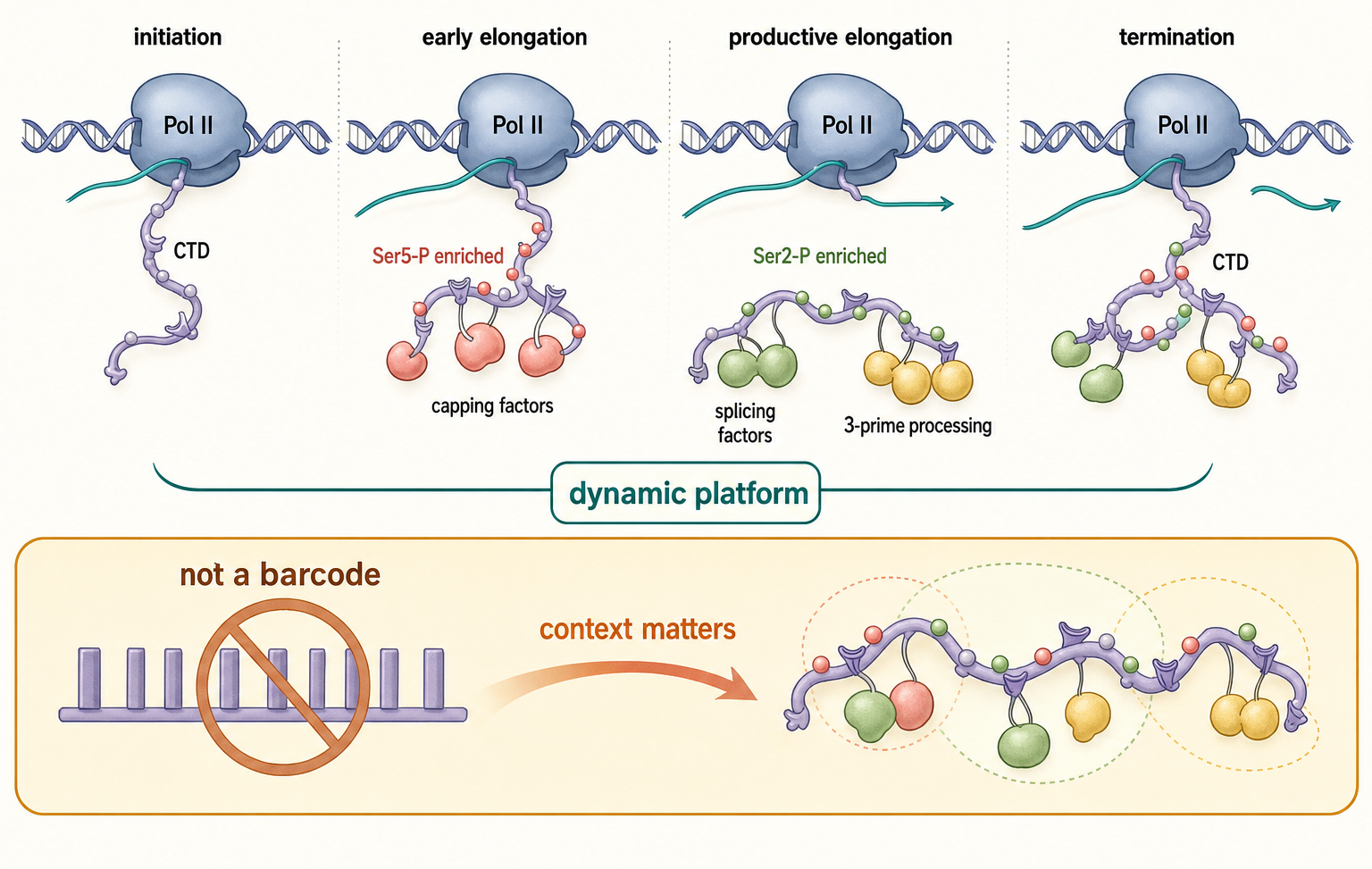
Figure 21.3. Pol II CTD as a Moving Interaction Platform. The C-terminal domain of the largest Pol II subunit consists of many heptapeptide repeats (consensus Tyr1-Ser2-Pro3-Thr4-Ser5-Pro6-Ser7) whose phosphorylation pattern shifts as the polymerase progresses from initiation through elongation to termination. Ser5 phosphorylation is enriched early and recruits capping enzymes that modify the emerging 5′ transcript end; Ser2 phosphorylation increases during productive elongation and coordinates splicing, cleavage, and polyadenylation factors; additional modifications on Tyr1, Ser7, and Thr4 and proline isomerization provide further regulatory possibilities. The CTD is better understood as a dynamic interaction platform whose modification state, binding partners, and polymerase position jointly shape factor recruitment than as a deterministic code in which each modification pattern specifies a unique outcome.
Box 21.2. The CTD Code Metaphor Has Limits
- The Pol II CTD heptapeptide repeats carry phosphorylation marks on Tyr1, Ser2, Thr4, Ser5, and Ser7, plus proline isomerization, creating a diverse modification landscape that shifts during the transcription cycle.
- The phrase “CTD code” implies a barcode in which each modification pattern uniquely commands a single downstream outcome; this framing is misleading.
- In practice, CTD modifications bias the probability that a given processing or regulatory factor docks onto the polymerase, but the actual outcome also depends on neighboring repeat states, competing binding partners, polymerase speed, chromatin context, and transcript sequence.
- A more accurate framing is that the CTD is a dynamic interaction platform whose modification landscape coordinates factor access across the transcription cycle rather than issuing deterministic instructions.
Pol II initiation at many protein-coding genes starts with recruitment of promoter-bound factors and assembly of the general transcription machinery. After initial RNA synthesis, Pol II must escape the promoter and enter elongation. In many metazoan genes, Pol II then pauses shortly downstream of the promoter. DSIF and NELF help stabilize paused Pol II, and kinase activity, especially through P-TEFb in canonical models, promotes release into productive elongation by phosphorylating Pol II CTD residues and pausing factors. This promoter-proximal pausing is not merely a failure to elongate. It can prepare genes for rapid activation, synchronize transcription with early RNA-processing events, and create a regulatory checkpoint.
Boundary cases are essential. Promoter-proximal pausing is prominent in many animal genes, especially regulated developmental and stimulus-responsive genes, but it is not identical in all eukaryotes. Budding yeast Pol II regulation often emphasizes initiation, chromatin, and elongation control without the same widespread NELF-stabilized pausing found in metazoans. Some genes have polymerase occupancy near promoters but little productive output. Other genes have high elongation with low apparent promoter-proximal accumulation. Therefore, a ChIP-seq peak for Pol II near a promoter is a starting observation, not a complete mechanistic diagnosis.
Pol II also transcribes small nuclear RNA genes in specialized contexts. The little elongation complex regulates small nuclear RNA transcription and provides a concrete example that Pol II does not use one universal elongation program for all transcript classes. A spliceosomal snRNA gene, for example, is transcribed by Pol II but has specialized promoter architecture, processing factors, and 3′-end formation machinery distinct from ordinary polyadenylated mRNAs. This illustrates the hierarchy of specificity: polymerase choice matters, but gene class and processing pathway further subdivide Pol II behavior.
Pol II transcription is also coupled to chromatin. Nucleosomes can block factor binding and polymerase passage, while chromatin remodelers and histone modifiers can open promoters, position nucleosomes, or alter elongation barriers. Histone marks associated with active promoters, enhancers, or transcribed gene bodies often correlate with Pol II states. The mechanistic interpretation must be specific. A histone modification can recruit a factor, stabilize a chromatin state, mark a past transcription event, or coexist with another causal feature. It is not automatically a command.
Concrete example: a Pol II protein-coding gene activated by an enhancer may assemble a promoter complex, initiate transcription, pause near the promoter, receive signals for pause release, elongate through chromatin, recruit capping enzymes as the 5′ end emerges, coordinate splicing as introns are transcribed, recruit cleavage and polyadenylation factors near the 3′ end, and terminate downstream. The transcript observed as mature mRNA is the final selected product of a long series of coupled decisions.
21.4. RNA polymerase III specialization: small stable RNAs, promoter classes, and termination
RNA polymerase III specializes in short, often highly structured RNAs. Its major products include tRNAs, 5S rRNA, U6 snRNA, 7SL RNA, RNase P RNA in some contexts, and other small RNAs depending on organism. These RNAs are not translated into proteins. They function as adaptors, structural RNAs, catalytic or ribonucleoprotein components, and regulatory molecules. Pol III output supports translation, splicing, protein targeting, RNA processing, and other basic cell functions.
tRNA genes provide the clearest Pol III example. A tRNA is an adaptor RNA that links an anticodon to an amino acid during translation. Many tRNA genes contain internal promoter elements called A and B boxes within the transcribed region. TFIIIC binds these internal elements and helps recruit TFIIIB upstream of the transcription start site. TFIIIB then recruits Pol III for initiation. This architecture is striking because promoter information can reside inside the future RNA sequence. After transcription, the tRNA precursor is processed by 5′ leader removal, 3′ trailer removal, CCA addition when needed, intron removal for some tRNAs, and extensive nucleotide modification.
5S rRNA genes use another Pol III promoter arrangement. 5S rRNA is a ribosomal RNA component, but unlike the large rRNA precursor made by Pol I, 5S rRNA is usually transcribed by Pol III. In many systems, 5S rRNA genes use internal control elements bound by TFIIIA and TFIIIC, followed by TFIIIB recruitment. U6 snRNA genes use still another promoter logic, often involving upstream promoter elements more similar to external promoters. These examples show that Pol III is one polymerase with multiple promoter classes, not one rigid promoter grammar.
Pol III termination is also specialized. Many Pol III transcripts terminate at short runs of thymidines in the non-template DNA strand, which correspond to U-rich RNA at the transcript end. This termination can occur without the same cleavage and polyadenylation logic used by Pol II mRNAs. The product often needs further processing, but the termination signal is compact and suited to repeated transcription of short genes.
The mechanistic fit among short genes, internal or compact promoters, efficient reinitiation, and oligo(dT)-directed termination is central to Pol III specialization. None of those features alone defines every Pol III gene: U6-class promoters are external, transcript lengths vary, and termination efficiency depends on sequence and organismal context. The comparative claim is that Pol III combines these features more systematically than Pol I or Pol II to produce abundant small stable RNAs.
Regulation of Pol III is closely tied to growth and stress. tRNA and 5S rRNA production must match cellular translational capacity, nutrient status, and biosynthetic state. Signaling pathways can regulate Pol III through TFIIIB components, chromatin state, repressive factors, and polymerase availability. Stress conditions often reduce Pol III output, while growth-promoting conditions can increase it. Therefore, Pol III genes are not passive housekeeping features.
Pol III genes also have genome-organization roles. tRNA genes and other Pol III-transcribed loci can contribute to chromatin boundaries, local nucleosome organization, replication timing effects, and spatial nuclear organization in some organisms. The mechanisms vary and should not be overgeneralized from yeast to mammals or from one locus to all tRNA genes. The important point is that Pol III transcription sites can be structural chromosomal features as well as RNA-production units.
Imaging studies have shown that Pol III transcription can be regionally organized in nuclei rather than uniformly diffuse. Such observations are valuable, but they must be interpreted with method limits. A visible polymerase focus may reflect a high local concentration, a repeated gene cluster, a fixation-sensitive structure, or a transcriptionally active compartment. Imaging should be paired with nascent RNA assays, chromatin occupancy, perturbation, and RNA processing measurements before assigning mechanism.
Concrete example: a proliferating yeast or mammalian cell must maintain tRNA pools appropriate for protein synthesis. If nutrient stress reduces growth signaling, Pol III transcription can decrease, limiting new tRNA precursor production. Mature tRNAs are stable, so steady-state tRNA abundance may change slowly. Nascent transcription assays may detect Pol III regulation before total mature tRNA measurements do. This distinction between nascent RNA output and mature RNA abundance is essential for interpreting Pol III experiments.
Do not overgeneralize: Pol III transcribes short RNAs, but not every short RNA is a Pol III product. Many small RNAs derive from Pol II transcripts, processing of longer precursors, organellar transcription, viral transcription, or degradation intermediates. Polymerase assignment requires promoter evidence, nascent transcription evidence, factor dependence, transcript-end logic, or perturbation support.
21.5. Shared and specialized initiation systems, Mediator, promoters, and chromatin
Eukaryotic polymerases require initiation factors because promoter DNA does not automatically enter the active site. General transcription factors assemble a promoter-bound initiation complex, position the polymerase, help open DNA, select or influence start sites, and support early RNA synthesis. The specific factor set differs by polymerase. Pol II uses TFIID or a related TBP-containing complex, TFIIA, TFIIB, TFIIF, TFIIE, and TFIIH. Pol I and Pol III use distinct factor systems with some shared components, especially TBP-containing assemblies, but different polymerase-specific contacts and promoter classes.
The informative comparison is shared architectural logic without shared interchangeability. Archaeal TBP-TFB, Pol I TBP-containing assemblies, Pol II general factors, and Pol III TFIIIB-containing assemblies all solve promoter placement, DNA opening, and start-site selection, but they recognize different DNA elements and contact different polymerase surfaces. TBP reuse demonstrates evolutionary conservation; polymerase-specific partner proteins demonstrate functional specialization. Mediator is chiefly a Pol II regulatory interface and must not be projected onto Pol I, Pol III, or archaeal initiation as a universal component.
For Pol II, the preinitiation complex is built through protein-DNA and protein-protein interactions. TFIID can recognize promoter elements and provide TBP, which bends TATA-containing DNA in many promoter contexts. TFIIA can stabilize TBP-DNA interactions. TFIIB bridges TBP-bound DNA to Pol II and contributes to start-site positioning. TFIIF travels with Pol II and helps recruit and stabilize the polymerase in the initiation complex. TFIIE helps recruit and regulate TFIIH. TFIIH contains activity that helps open promoter DNA and kinase activity that phosphorylates the Pol II CTD and contributes to promoter escape. This simplified sequence is useful, but real promoters can assemble through alternative orders and cofactor-dependent routes.
TFIIH illustrates why general transcription factors can be regulatory. DNA opening is needed for promoter melting, and CDK7 kinase activity in metazoan TFIIH contributes to CTD phosphorylation and initiation-factor release. Recent work indicates that CDK7 kinase activity promotes Pol II promoter escape in part by facilitating initiation-factor release. This does not mean CDK7 is a universal speed knob for all transcription. It means that a factor classified as general can control a specific transition in the initiation pathway, and the importance of that transition can vary among genes and cell states.
Box 21.3. General Transcription Factors Can Be Regulatory
- General transcription factors are required at many promoters for productive initiation, but this breadth of requirement does not make them biologically inert or interchangeable.
- TBP uses the same DNA-binding fold at TATA-containing promoters across polymerase systems, yet the partner proteins in TFIID, TFIIIB, or Pol I factor complexes confer polymerase-specific and promoter-class-specific selectivity.
- TFIIH contains both the XPB translocase that melts promoter DNA and the CDK7 kinase that phosphorylates the Pol II CTD; CDK7 activity promotes initiation-factor release and facilitates promoter escape, making it a regulated transition point rather than a passive component.
- General factors can differ in isoform composition, assembly order, cofactor contacts, and promoter architecture requirements, so their presence at many promoters is compatible with gene-specific and condition-specific regulatory control.
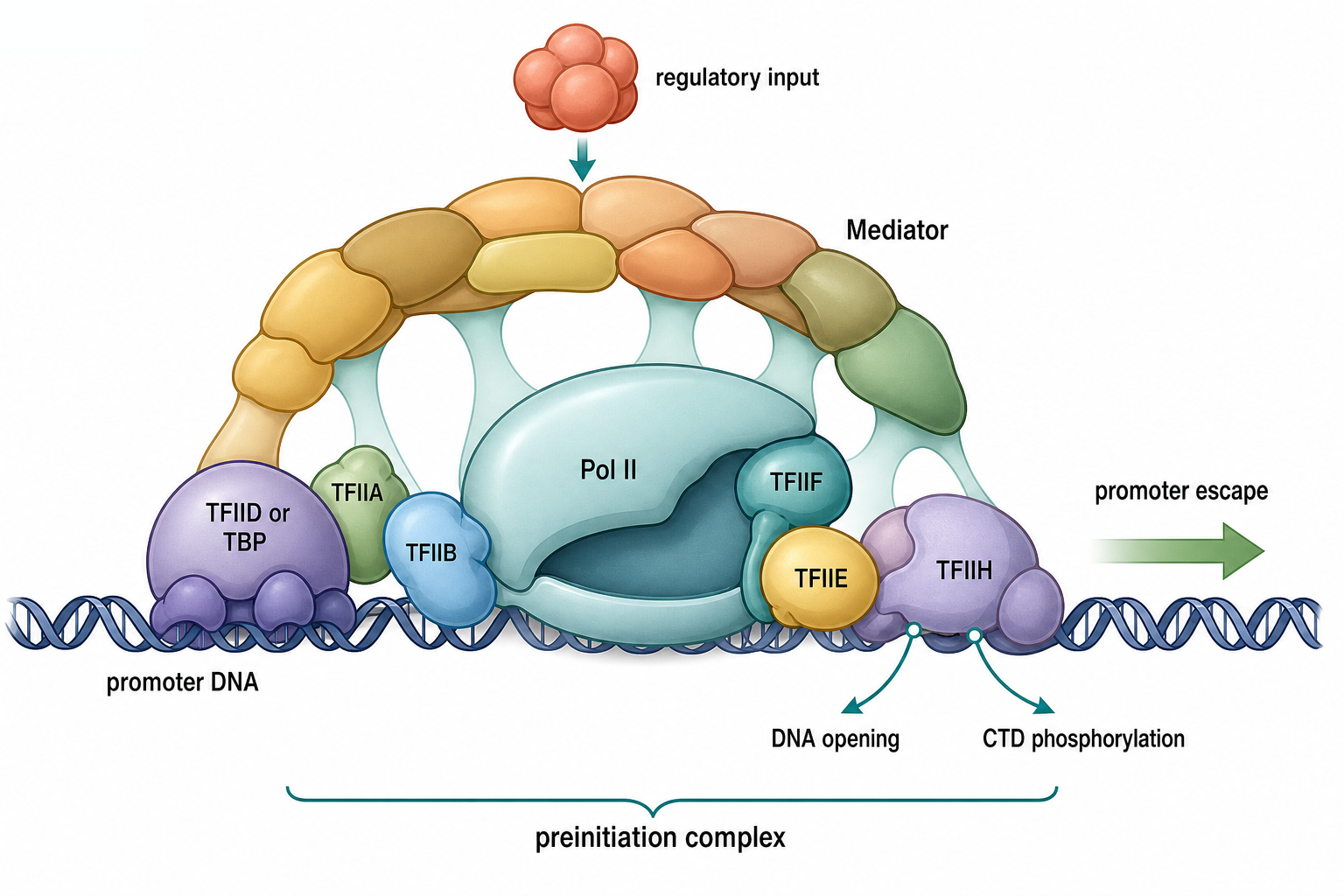
Figure 21.4. Mediator-Bound Preinitiation Complex. The Pol II preinitiation complex assembles at a promoter through recruitment of TFIID or TBP, TFIIA, TFIIB, TFIIF-Pol II, TFIIE, and TFIIH, with Mediator bridging regulatory transcription factor inputs to this core initiation machinery. Structural studies of the human Mediator-bound preinitiation complex show how activator-responsive contacts and promoter-specific interactions are arranged in a large molecular assembly that must subsequently undergo DNA opening, start-site selection, and promoter escape. TFIIH translocase and CDK7 kinase activities contribute to DNA melting and CTD phosphorylation, helping drive the transition from a promoter-bound preinitiation complex to a productively elongating polymerase.
Mediator adds another layer. Mediator is a large coactivator complex that can contact regulatory transcription factors, Pol II, general factors, and sometimes chromatin-associated proteins. Its role is often described as bridging enhancers and promoters, but that phrase is too narrow if taken literally. Mediator can stabilize initiation assemblies, alter Pol II and PIC conformations, contribute to enhancer-promoter communication, and integrate multiple regulatory inputs. Biochemical studies established Mediator as part of activator-responsive transcription systems, and structural studies now show human Mediator-bound preinitiation complexes in molecular detail. Mediator action is gene- and state-dependent; it should not be reduced to universal activation.
Promoters differ in architecture. Some Pol II promoters contain a TATA box near the transcription start site. Others use initiator elements, downstream promoter elements, CpG-rich regions, dispersed start sites, or combinations of sequence and chromatin features. A promoter should be understood as a functional region that supports initiation under defined conditions, not as one required sequence motif. Enhancers, silencers, insulators, promoter-proximal elements, and chromatin domains can all change promoter behavior. Chapter 15 treats these genomic elements; this chapter emphasizes the molecular machinery that acts on them.
Chromatin changes every step of eukaryotic initiation. A nucleosome can cover a promoter element and prevent factor binding. A remodeler can shift or evict a nucleosome and allow PIC assembly. Histone acetylation can weaken histone-DNA contacts and recruit bromodomain-containing proteins. Histone methylation can create binding sites for regulatory proteins or mark active, repressed, or poised states depending on residue and context. The common mistake is to treat chromatin marks as direct instructions. The safer interpretation asks what factor reads the mark, what perturbation changes the mark, whether transcription changes before or after the mark, and whether the locus context supports a causal model.
Pol I and Pol III initiation are also chromatin-sensitive. Active rDNA repeats have different chromatin and nucleolar protein environments from inactive repeats. tRNA genes and 5S rRNA genes require factor access to compact promoter elements, and their local chromatin can affect Pol III occupancy. The fact that Pol I and Pol III are specialized does not exempt them from chromatin regulation; it changes which chromatin features and factor assemblies matter.
Concrete example: a Pol II gene activated by a stimulus may first show transcription-factor binding at an enhancer, then Mediator and cofactor recruitment, promoter chromatin opening, PIC assembly, TFIIH-dependent DNA opening, early RNA synthesis, promoter escape, and elongation. A time-course experiment that samples only mature mRNA may miss early promoter assembly and pausing changes. A ChIP-seq experiment for Pol II may detect promoter occupancy but not distinguish inactive PIC, paused Pol II, or productive elongation unless paired with CTD-state, nascent RNA, or elongation-factor data.
21.6. Comparative elongation, pausing, termination, and cotranscriptional coordination
Elongation is the phase in which a polymerase moves along the DNA template while extending the RNA. The elongation complex contains downstream DNA, a transcription bubble, an RNA-DNA hybrid, upstream reannealed DNA, nascent RNA emerging from the polymerase, and bound factors. Elongation is processive, but it is not uniform. Polymerases pause, backtrack, respond to nucleotide concentrations, encounter nucleosomes or DNA-bound proteins, recruit factors, and change conformation.
All four systems must balance stability with reversibility. An elongation complex must hold DNA and RNA securely enough to synthesize thousands of phosphodiester bonds, yet translocate after each addition, accommodate regulatory factors, rescue a displaced RNA 3′ end, and eventually release DNA and RNA. Polymerase-specific solutions sit on this common physical problem: Pol I emphasizes sustained rDNA flux and intrinsic cleavage-related control, Pol II uses an extensive factor and CTD network, and Pol III couples compact transcription units to efficient termination and reinitiation. Table 21.4 compares representative factors without implying that similarly named states have identical kinetics in every system.
Archaeal elongation provides a compact view of conserved control. Archaeal RNAP can pause and backtrack, and Spt4/5 can modulate elongation complex behavior. Structural studies of archaeal elongation complexes with Spt4/5 show how an elongation factor can contact polymerase surfaces near the nucleic-acid scaffold and influence processivity. Transcript-cleavage stimulation by archaeal transcription factor S shows another conserved response to backtracking. These findings matter for eukaryotic biology because Pol II, Pol I, and Pol III all face the same physical problem: a stable elongation complex must be movable, accurate, and recoverable from nonproductive states.
Table 21.4. Elongation-Control Factors Across Domains. Factor families that regulate elongating multisubunit RNA polymerases in archaea, eukaryotes, and bacteria, illustrating conserved functional logic alongside divergent molecular details.
| Factor family | Archaeal example | Eukaryotic example | Bacterial analogy | Functional effect |
|---|---|---|---|---|
| Spt4/5-DSIF-NusG | Archaeal Spt4/5 | DSIF (Spt4/Spt5) | NusG | Modulates elongation complex processivity and pausing behavior |
| Cleavage factors | Transcription factor S | TFIIS | GreA/GreB | Stimulates RNA cleavage to rescue backtracked polymerase |
| Chromatin remodelers | None (no canonical chromatin) | RSC, ISWI, CHD family remodelers | None directly analogous | Reposition or evict nucleosomes to reduce elongation barriers |
| P-TEFb-related kinases | None established | P-TEFb (CDK9/cyclin T) | None directly analogous | Phosphorylates CTD, DSIF, and NELF to release promoter-proximally paused Pol II |
Pol II elongation is deeply coupled to RNA processing. The 5′ end of a nascent Pol II transcript emerges from the RNA-exit channel early, when the transcript is only a few tens of nucleotides long. Capping enzymes are recruited in part through early CTD phosphorylation and add an inverted 7-methylguanosine cap through a series of enzymatic steps. This cap protects the RNA, contributes to later processing and export, and helps distinguish Pol II transcripts from many other RNAs.
Splicing can occur while Pol II is still transcribing the gene. This means that spliceosome assembly, splice-site recognition, intron removal, elongation speed, chromatin features, and CTD-associated factors can influence each other. A slow elongation rate can give some splice sites more time to be recognized, while a fast rate can favor other outcomes, although gene-specific effects vary. The important point is not that slower is always better for splicing. The important point is that transcription kinetics and RNA-processing kinetics overlap in time and space.
The 3′ end of many Pol II mRNAs is formed by cleavage and polyadenylation rather than by polymerase simply stopping at the mature end. Cleavage and polyadenylation factors recognize sequence elements in the nascent RNA, cleave the transcript, add a poly(A) tail, and contribute to termination. Pol II can continue transcribing downstream before termination completes. CTD state, elongation factors, chromatin, RNA sequence, and processing-factor availability all influence the efficiency and position of 3′-end formation. Alternative polyadenylation illustrates the regulatory consequence: different 3′ ends can change mRNA stability, localization, translation, and regulatory-element content.
Promoter-proximal pausing is one of the most important Pol II elongation-control checkpoints in metazoans. After initiation, Pol II often pauses within the first several dozen nucleotides. This pause can allow capping, create a poised state for rapid activation, and integrate regulatory signals before full gene-body transcription. Release from pausing requires changes in DSIF, NELF, Pol II CTD phosphorylation, elongation-factor recruitment, and chromatin environment. Chapter 24 develops the detailed pausing and pause-release mechanisms; here the key point is that Pol II specialization includes regulation after RNA synthesis has begun.
Pol I and Pol III also coordinate transcription with processing. Pol I transcripts are processed co-transcriptionally or shortly after synthesis into mature rRNAs while assembling with ribosomal proteins and small nucleolar RNPs. Processing can influence rDNA transcription through feedback from ribosome-biogenesis state. Pol III transcripts such as pre-tRNAs are processed into mature tRNAs through ordered end trimming, splicing for intron-containing tRNAs, CCA addition, and modification. The polymerase creates a precursor in a local protein environment that helps route the RNA toward the correct maturation pathway.
Termination reveals the same specialization. Pol II often couples RNA cleavage and downstream polymerase release; Pol III commonly responds to compact oligo(dT) signals; Pol I uses rDNA-specific terminator and release systems; archaeal mechanisms vary among lineages. This chapter owns that comparison, not the detailed catalog of sequence signals and termination factors. Chapter 24 develops generic pausing, backtracking, elongation-factor, and arrest-rescue mechanisms, while Chapter 25 owns termination pathways and processing reactions in mechanistic depth.
Evidence for elongation and processing coordination comes from complementary methods. Nascent RNA sequencing can map recently synthesized RNA, but it may capture different polymerase states depending on protocol. Chromatin immunoprecipitation for Pol II or CTD phosphorylation can map occupancy and modification states, but occupancy is not identical to RNA synthesis rate. Reconstituted transcription assays can isolate factor effects, but they lack full chromatin and nuclear organization. Imaging can show nuclear compartments and transcription sites, but spatial resolution and fixation artifacts matter. Perturbation experiments with inhibitors or factor depletion can reveal dependencies, but indirect stress responses can appear quickly. Strong mechanistic interpretation usually requires several methods to converge. Table 21.5 compares the direct observables and principal ambiguities of these assay classes.
Table 21.5. What Common Transcription Assays Establish. The table should prevent state overcalling by pairing each evidence class with its direct observable, strongest mechanistic use, and principal ambiguity.
| Evidence class | Direct observable | Strongest use | Principal ambiguity or artifact |
|---|---|---|---|
| Purified reconstitution | RNA synthesis or factor dependence in a defined mixture | Causal assignment of components and kinetic steps | Missing chromatin, compartmental organization, and competing pathways |
| Cryo-EM or crystallography | Enriched molecular conformation and contacts | Structural basis of catalysis, factor binding, or inhibitor action | Stabilized or engineered states need not report state lifetime or flux in cells |
| Single-molecule transcription | Dwell times, movement, pausing, or state transitions on individual templates | Kinetic heterogeneity and factor effects | Simplified templates and tethering can alter behavior |
| ChIP-based occupancy | Crosslink-dependent enrichment of polymerase, factor, or modification at loci | Spatial distribution and relative occupancy | Cannot alone distinguish recruitment, pausing, productive elongation, or trapped complexes |
| Nascent-RNA sequencing or run-on | Newly synthesized or transcriptionally engaged RNA under assay-specific conditions | Locus-resolved synthesis and polymerase progression | Protocols capture different subsets of engaged complexes and can introduce sequence biases |
| Steady-state RNA sequencing | Accumulated RNA after synthesis, processing, and decay | Net abundance of measurable RNA populations | Conflates transcription with maturation, stability, and cell-state composition |
| Imaging | Position, colocalization, or dynamics of labeled complexes or RNA | Nuclear organization and temporal behavior | Resolution, fixation, labeling, and thresholding can create or obscure compartments |
| Acute inhibitor or depletion | Time-dependent response to a defined perturbation | Ordering of causal events when paired with direct readouts and rescue | Off-target effects and rapid secondary stress responses |
Do not overgeneralize: transcription and processing are coupled, but coupling does not mean every processing decision is made at the moment of synthesis. Some events are strictly co-transcriptional, some are mostly co-transcriptional but can continue after release, and others occur after export or after assembly into ribonucleoprotein particles. The timing must be stated for the RNA class and organism.
21.7. Comparative structural evidence, inhibitors, disease mechanisms, and experimental limits
Mutations in transcription machinery can cause disease by many mechanisms. A variant in a polymerase subunit, general transcription factor, Mediator component, elongation factor, CTD kinase, CTD phosphatase, chromatin factor, or processing factor can alter recruitment, initiation, promoter escape, pausing, elongation rate, transcript cleavage, RNA processing, termination, DNA repair, or genome stability. The phenotype may be developmental, neurological, hematological, immune-related, cancer-associated, or tissue-specific. A variant should not be interpreted only as “more transcription” or “less transcription” unless the affected step and cell context are known.
Ribosome biogenesis provides one disease-linked example. Pol I dysregulation can contribute to proliferative capacity, and Pol I inhibition can trigger nucleolar stress. But Pol I-linked phenotypes can arise from direct transcriptional changes, rRNA-processing defects, ribosomal-protein imbalance, p53 pathway activation, metabolic stress, or cell-cycle effects. A correct mechanistic claim must specify which step was measured. A decrease in mature rRNA abundance after long treatment does not by itself prove direct Pol I inhibition; it could reflect processing failure, cell death, or reduced growth signaling.
Pol III is also disease-relevant. Changes in Pol III transcription can affect tRNA abundance, translation capacity, stress responses, and innate immune biology in some contexts. Mutations in Pol III subunits and Pol III-related factors have been linked to developmental and neurological disease in the broader literature. Pol III products and promoter systems can also be exploited by viruses and mobile elements. Cytosolic DNA sensing through a Pol III-transcribed RNA intermediate is a boundary case showing that a nuclear transcription enzyme can matter in innate immune signaling outside ordinary gene-expression framing.
Pol II-associated disease mechanisms are especially diverse. Variants in Mediator subunits can alter enhancer-responsive transcription programs. TFIIH defects can combine transcription and DNA-repair problems because TFIIH participates in both Pol II initiation and nucleotide excision repair. CTD kinase or phosphatase perturbation can affect promoter escape, elongation, processing, and termination. Splicing-linked phenotypes may arise from transcriptional changes if elongation or CTD recruitment changes splice-site choice. Cancer cells can become dependent on particular transcriptional kinases, enhancer programs, or elongation factors, but such dependencies are context-specific.
Transcription inhibitors are powerful probes and potential drugs, but they require careful timing and specificity controls. A Pol I inhibitor can reduce nascent rRNA transcription rapidly and later induce nucleolar stress. A CDK7 inhibitor can affect Pol II initiation and promoter escape but can also influence cell-cycle and signaling pathways. A CDK9 or P-TEFb-targeting perturbation can affect pause release and elongation but may also alter RNA processing and survival. General transcription inhibitors can produce rapid secondary effects because many unstable RNAs, stress-response genes, and feedback regulators change quickly. Mechanistic use of inhibitors therefore requires early time points, dose-response controls, orthogonal genetic or chemical perturbations where possible, and direct nascent RNA or polymerase-state measurements rather than mature RNA alone.
Structural biology has changed how polymerase specialization is understood. Cryo-electron microscopy and crystallography can now capture archaeal elongation complexes, Pol II preinitiation complexes, Mediator-bound assemblies, Pol I and Pol III states, paused or backtracked complexes, and inhibitor-bound complexes. These structures show that regulatory specificity often resides in surfaces outside the active site: initiation-factor interfaces, peripheral subunits, stalk modules, clamp movements, RNA-exit paths, CTD-proximal regions, and factor-binding grooves. A small inhibitor or mutation can have a large effect if it stabilizes the wrong state or blocks a necessary transition.
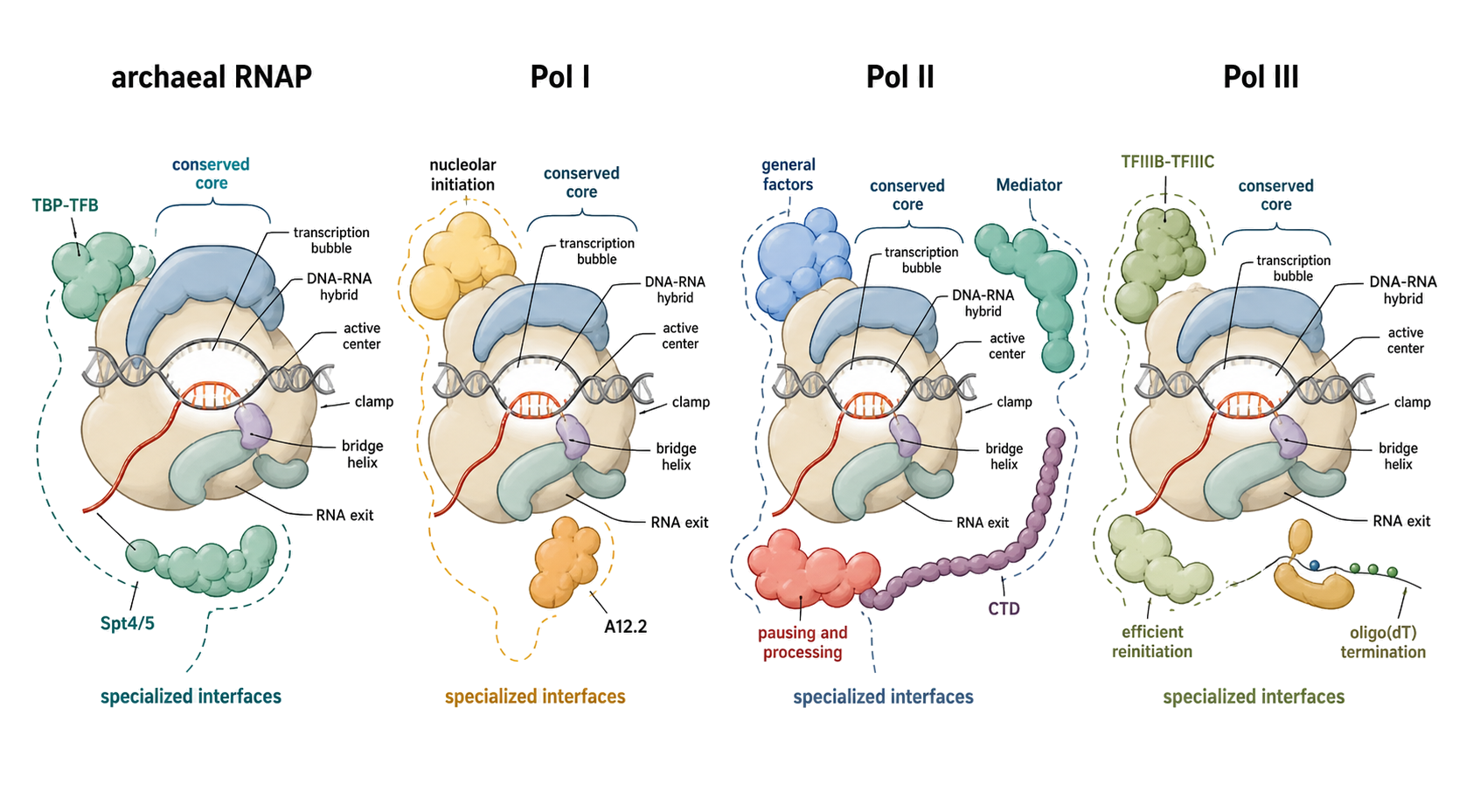
Figure 21.5. Conserved Catalytic Core and Specialized Regulatory Interfaces. An original four-panel state diagram should align archaeal RNAP, Pol I, Pol II, and Pol III around the conserved transcription bubble, DNA-RNA hybrid, active center, clamp, bridge helix, and RNA-exit path. Polymerase-specific outer layers should show the distinguishing interfaces: TBP-TFB and Spt4/5 for the archaeal reference; nucleolar initiation and A12.2-linked elongation control for Pol I; general factors, Mediator, CTD, pausing factors, and processing-factor docking for Pol II; and TFIIIB/TFIIIC, promoter classes, efficient reinitiation, and oligo(dT) termination for Pol III. Arrows should distinguish conserved physical problems from specialized solutions rather than implying a linear evolutionary ladder.
Structures also have limits. Many structures use engineered nucleic-acid scaffolds, stabilized complexes, truncations, antibodies, crosslinking, inhibitors, or selected conformations. A structure shows a possible or enriched state, not necessarily the full kinetic path. Conversely, genomics can show genome-wide effects but often cannot identify the molecular transition responsible. Strong conclusions come when structure, biochemistry, genetics, and cellular transcription measurements agree. Box 21.4 provides a practical caution against equating occupancy with state or output.
Box 21.4. Occupancy Is Not Polymerase State or RNA Output
- Polymerase enrichment at a promoter can represent recruitment, a preinitiation complex, initial transcription, promoter-proximal pausing, repeated initiation, or an inhibited complex.
- Polymerase enrichment across a gene body is more compatible with elongation but does not directly provide elongation rate, processivity, RNA completion, or processing success.
- Nascent RNA reports recent synthesis more directly than occupancy, whereas mature RNA additionally reflects cleavage, splicing, modification, export, decay, and cell-state composition.
- A defensible state assignment combines an appropriate time course with orthogonal evidence such as state-sensitive factors or modifications, nascent RNA, biochemical reconstitution, structural information, or perturbation and rescue.
Concrete example: if a kinase inhibitor reduces Pol II signal across gene bodies after one hour, several explanations are possible. The inhibitor may block promoter escape, reduce pause release, destabilize elongation, alter CTD-dependent processing, trigger stress signaling, or indirectly change chromatin. To distinguish these, one could measure nascent RNA within minutes, promoter-proximal versus gene-body Pol II, CTD phosphorylation, factor occupancy, mature RNA changes, cell stress markers, and rescue by inhibitor-resistant kinase. The mechanistic question is not whether transcription changed, but which step changed first.
Recent Consensus
The current consensus is that archaeal transcription provides a strong model for the conserved core of eukaryote-like multisubunit RNA polymerase mechanisms, especially initiation-factor logic, elongation control, Spt4/5-family regulation, pausing, and transcript cleavage. This consensus does not erase archaeal diversity or imply that modern archaea are ancestors of modern eukaryotes.
Comparative enzymology supports a conserved-core, specialized-interface model. Active-site chemistry and broad transcription-state problems are deeply shared, while promoter recognition, peripheral subunits, factor recruitment, transcript handling, and physiological control distinguish the systems. Similar catalytic cores therefore do not imply equivalent promoters, kinetics, products, or regulatory responses.
The eukaryotic division into Pol I, Pol II, and Pol III is interpreted as an ancient specialization of related multisubunit polymerases. Pol I is matched to high-output rRNA precursor transcription and ribosome biogenesis. Pol II is matched to mRNAs and many noncoding RNAs, with extensive CTD-mediated coordination of RNA processing. Pol III is matched to short structured RNAs such as tRNAs, 5S rRNA, and U6 snRNA. Polymerase choice is coupled to promoter architecture, factor systems, transcript processing, chromatin context, and cell physiology.
Pol II regulation is distributed across initiation, promoter escape, promoter-proximal pausing, elongation, CTD modification, chromatin remodeling, co-transcriptional processing, and termination. Initiation remains important, but it is not the only major checkpoint. Pol I and Pol III are now understood as regulated systems linked to growth, stress, genome organization, and disease rather than as background transcription machines.
Structural biology, single-molecule methods, and nascent RNA genomics have converged on a state-based view of transcription. Polymerases move through ensembles of conformational and factor-bound states, and regulatory factors alter the probabilities and lifetimes of those states. This view explains why static terms such as “bound,” “active,” or “repressed” are often insufficient unless the relevant molecular state is specified.
Open Questions, Controversies, Deprecated Models, and Common Misconceptions
Open questions:
- How CTD modification patterns are interpreted across organisms and gene classes?
- How Mediator conformational states correspond to gene-specific regulatory outputs?
- How Pol I and Pol III regulation differs among tissues and stress states?
- How archaeal transcription diversity maps onto eukaryotic origins?
Common misconceptions:
- “Pol II is the only regulated eukaryotic polymerase.” Pol I and Pol III are strongly regulated because rRNA and tRNA production are central to growth, nutrient response, stress adaptation, and proliferative disease.
- “Pol I makes all rRNAs.” Pol I usually makes the large precursor for 18S, 5.8S, and 28S or 25S rRNAs, while 5S rRNA is usually made by Pol III and organellar rRNAs are made by organellar polymerase systems.
- “Pol II makes only mRNA.” Pol II makes pre-mRNAs and many noncoding RNAs, including some unstable or rapidly processed transcripts that standard steady-state RNA sequencing may underrepresent.
- “The CTD code is a precise barcode.” CTD modifications bias factor recruitment and timing, but interpretation depends on context, neighboring marks, binding partners, polymerase position, chromatin, and transcript class.
- “General transcription factors are generic background proteins.” General factors can create specificity through isoforms, partner complexes, promoter architecture, assembly pathways, kinase activity, and regulated release.
- “Polymerase occupancy equals transcription output.” Occupancy can represent recruited polymerase, a preinitiation complex, paused polymerase, productive elongation, termination-associated polymerase, or a trapped state. Nascent RNA measurements and kinetic perturbations are needed to infer output.
- “The four polymerases differ only in the RNAs they transcribe.” Transcript class is one consequence of specialization; promoter grammar, factor interfaces, initiation and reinitiation kinetics, elongation control, termination, processing handoffs, chromatin environment, and physiological regulation also differ.