Chapter 145. RNA Variant Interpretation, Molecular QTLs, Allele-Specific Expression, and Trait Integration
Scope Note
This chapter explains how inherited and acquired DNA variation is connected to RNA phenotypes and, cautiously, to organismal traits. It begins with variant identity across genome assemblies, transcripts, isoforms, and haplotypes; develops the statistical logic of molecular quantitative trait locus mapping and allele-specific analysis; and then examines fine-mapping, colocalization, transcriptome-wide association, Mendelian randomization, functional assays, and clinical interpretation. The focus is interpretation: what each analysis takes as input, what it estimates, which assumptions support the estimate, and which alternative explanations remain. Read construction, transcript assembly, and abundance estimation are covered in Chapter 141 and are introduced here only where their errors change genetic conclusions.
Executive Summary
A variant is not fully specified by a short label such as a chromosome position or an amino-acid change. Reproducible interpretation requires a reference assembly, coordinate convention, reference and alternate alleles, strand and normalization rules, and, for transcript consequences, a versioned transcript. The same genomic allele can be synonymous in one isoform, splice-altering in another, untranslated in a third, and outside another gene model. Variants on the same chromosome form a haplotype, so a regulatory allele may act together with nearby alleles rather than as an isolated substitution. Reliable analysis preserves these identities instead of collapsing them into a single preferred consequence.
A molecular quantitative trait locus, or molecular QTL, is a genomic region where genotype is statistically associated with a measured molecular phenotype. Expression QTLs affect total gene expression; splicing QTLs affect exon or junction use; other QTLs can affect transcript usage, RNA stability, polyadenylation, translation, RNA modification, or RNA-protein interaction. A cis association near the affected locus is often consistent with a local regulatory mechanism, but proximity does not prove direct action. Trans associations can reveal distal regulators but are more vulnerable to confounding, batch effects, cell-composition differences, and low power. Every QTL result depends on the phenotype definition, covariates, ancestry and linkage structure, multiple-testing procedure, and sampled biological context.
Allele-specific expression compares the two alleles within a heterozygous individual. Because both alleles share the same cellular environment, allelic imbalance can be sensitive evidence for a cis-acting difference. It is nevertheless not a mechanism by itself. Reference-mapping bias, genotype error, phasing error, random monoallelic expression, imprinting, X-chromosome inactivation, copy-number change, nonsense-mediated decay, and sparse informative reads can all alter allele counts. Population QTL mapping and within-individual allelic analysis therefore provide complementary rather than interchangeable evidence.
Fine-mapping uses association patterns and linkage disequilibrium to distribute evidence among correlated variants. A credible set is a probability-qualified set under a specified model, not a list guaranteed to contain the causal variant. Colocalization asks whether two association signals are compatible with a shared causal variant; transcriptome-wide association tests whether genetically predicted expression is associated with a trait; Mendelian randomization uses genetic variants as instruments to estimate a directional effect under strong assumptions. These methods answer different questions and can all be misled by linkage, multiple causal variants, pleiotropy, context mismatch, or inaccurate reference panels.
Functional validation changes the evidentiary level by directly perturbing a candidate variant, regulatory element, transcript, or molecular mediator. Reporter assays test sequence activity in an engineered construct; genome editing tests an endogenous locus but can still introduce clonal, repair, and cellular-context artifacts. A strong causal chain links variant to molecular consequence, molecular consequence to cellular phenotype, and cellular phenotype to organismal trait in the relevant context. Clinical interpretation adds penetrance, effect size, ancestry, phenotype fit, segregation, and actionability; a statistically convincing molecular mechanism may still have little predictive value for an individual patient.
Concept Inventory
- Variant: a sequence difference relative to a named reference. A complete representation identifies the reference sequence or assembly, position, reference allele, alternate allele, and normalization convention. “Variant” does not itself mean harmful, rare, inherited, or causal.
- Haplotype: a set of alleles carried together on one homologous chromosome or molecular chromosome copy. Phase specifies which alleles reside on the same haplotype.
- Consequence annotation: a predicted relationship between a variant and a genomic or transcript feature, such as a splice-donor change, missense substitution, untranslated-region variant, or regulatory overlap. A predicted consequence is not proof of a biological effect.
- Molecular quantitative trait locus (molecular QTL): a locus whose genotype is statistically associated with variation in a molecular phenotype across individuals or samples. The association may tag rather than equal the causal allele.
- Cis QTL: a QTL tested within a defined local window around the molecular feature. “Cis” is operational in mapping and does not necessarily establish a direct molecular interaction.
- Trans QTL: a QTL affecting a distant locus, often on another chromosome or beyond the defined cis window. Trans effects may arise through diffusible regulators, signaling, cell composition, or confounding.
- Allele-specific expression (ASE): unequal RNA abundance from two alleles of a locus within a heterozygous sample. The observed count difference is allelic imbalance; interpretation as cis regulation requires technical and biological controls.
- Linkage disequilibrium (LD): nonrandom association of alleles at different sites in a population. LD makes nearby variants statistically correlated and often prevents association data from identifying one causal nucleotide.
- Fine-mapping: statistical allocation of causal evidence among correlated variants at an associated locus. Outputs may include posterior probabilities and credible sets.
- Colocalization: evaluation of whether association patterns for two traits in a region support a shared causal variant rather than distinct variants in LD.
- Transcriptome-wide association study (TWAS): a test relating a trait to a genetically predicted RNA phenotype, commonly gene expression, using prediction weights learned in a molecular reference panel.
- Mendelian randomization (MR): instrumental-variable analysis using genetic variants to estimate the effect of an exposure, such as expression, on an outcome under relevance, independence, and exclusion assumptions.
- Functional validation: an experiment that perturbs a candidate component and measures a predicted consequence. Validation strength depends on whether the endogenous locus, relevant cell state, appropriate molecular intermediate, and trait-relevant phenotype are tested.
What to Know Before Reading This Chapter
Readers should know that a diploid individual usually carries two homologous copies of each autosome and that meiotic recombination transmits blocks of linked alleles. A genotype records which alleles are present; a phased genotype records their haplotypic arrangement. RNA sequencing samples molecules produced from those chromosomes, but read depth, transcript abundance, isoform structure, mapping ambiguity, and library design determine which alleles can actually be observed. Chapter 141 explains how transcript structures and abundance estimates are generated. This chapter treats those outputs as measurements with uncertainty rather than repeating the assembly and quantification workflow.
The recurring example is a disease-associated region containing a common single-nucleotide variant near a gene with two isoforms. One allele is associated with lower total expression in liver, altered exon use in immune cells, and a metabolic trait in a genome-wide association study. This pattern admits several explanations: one variant may alter a shared regulatory element; different linked variants may control expression, splicing, and disease; the molecular signals may arise in different cell types; or the associations may be correlated without lying on the causal path. Each method in the chapter removes some explanations while leaving others.
The chapter follows that locus in the order in which uncertainty must be resolved. Variant, transcript, and haplotype identity come first; population molecular associations and within-sample allelic differences follow; fine-mapping distributes causal probability across linked variants; trait integration tests relationships to complex phenotypes; context analysis qualifies every result by biological and population setting; and perturbation and clinical evidence test the remaining causal chain. This order is an evidence ladder, not a mandatory software pipeline: investigators often move backward when a failed validation exposes an annotation, phenotype, or context error.
145.1. Variant representation across genome and transcript coordinates, haplotypes, isoforms, and consequence annotations
Variant interpretation starts with identity. A single-nucleotide variant can be represented on a chromosome, genomic contig, transcript, coding sequence, or protein, but the coordinate means nothing without the reference sequence and version. A chromosome coordinate from one genome assembly can name a different base after remapping to another assembly. Insertions and deletions can have multiple equivalent descriptions in repetitive sequence unless they are normalized. Strand reversal changes both position conventions and allele letters. A robust record therefore preserves assembly, reference accession, coordinate, reference and alternate alleles, normalization, and the source that asserted the call. Database shorthand is convenient for display but should not replace this minimal identity.
Transcript coordinates add dependence on gene annotation. A genomic variant can overlap several transcripts whose exons, coding frames, start sites, and untranslated regions differ. The same allele may be coding in one transcript and intronic in another; among coding transcripts it may be synonymous, missense, nonsense, or splice-proximal. Transcript choice and annotation software can substantially change the reported “most severe” consequence. Consequently, an interpretation should state the transcript identifier and version, explain why that transcript is biologically relevant, and retain alternative consequences rather than presenting one label as intrinsic to the variant. Clinical preference for a designated transcript is a reporting convention, not evidence that other isoforms are absent.
Consequence annotation pipelines take normalized variants, a reference genome, transcript models, regulatory annotations, and sometimes population or phenotype databases as inputs. They intersect each allele with features and apply rule sets to output consequence terms, affected transcripts, coding changes, splice-region flags, frequencies, and prediction scores. The assumptions include correct assembly and allele orientation, adequate transcript annotation, meaningful feature boundaries, and applicability of external annotations to the sample. Tutorials for the Ensembl Variant Effect Predictor emphasize that annotation is a configurable integration step rather than a direct biological assay. Errors commonly enter through assembly mismatch, stale transcripts, left/right normalization differences, multiallelic decomposition, or loss of the original variant during format conversion.
Haplotypes matter because alleles are inherited and can function together. If two nearby substitutions lie on the same chromosome, a reporter containing only one may not reproduce the endogenous sequence context. A coding variant may be in phase with an expression-reducing promoter allele, changing the amount of altered protein. Compound heterozygous variants on opposite haplotypes have different consequences from two variants in cis. Short-read genotype data often leave phase uncertain; statistical phasing infers haplotypes from population LD, whereas read-backed or family-based phasing uses molecules or inheritance. Every downstream allelic analysis should distinguish observed phase from inferred phase and carry uncertainty when phase is ambiguous.
The conceptual workflow is therefore a chain: identify and normalize the genomic allele; map it across assemblies if necessary; annotate all relevant transcripts; retain isoform-specific consequences; place nearby alleles on haplotypes; and attach evidence without erasing provenance. An integrated genome-transcriptome study can then relate the same inherited allele to total expression, isoform usage, and allelic imbalance while keeping those outcomes distinct. Figure 145.1 should make these coordinate transformations visible, because a flat variant table hides the reference and isoform choices on which every later inference depends.
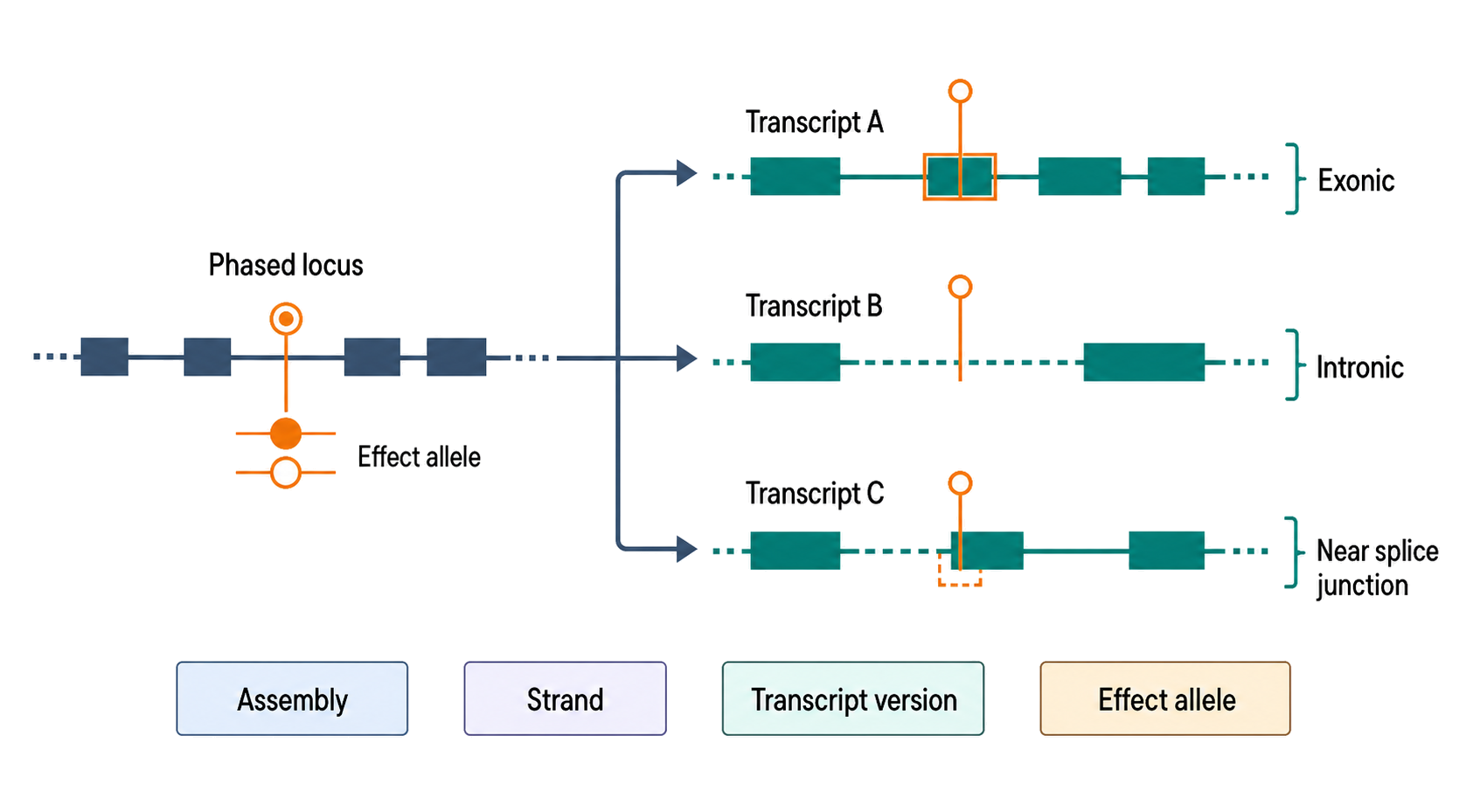
Figure 145.1. One DNA allele, multiple transcript-coordinate consequences. Makes transcript dependence concrete and prevents one consequence label from being treated as an intrinsic property of a variant.
A variant record should be auditable at a glance. Table 145.1 should contrast required fields for genome-, transcript-, protein-, and haplotype-level representations, including version, orientation, normalization, and uncertainty. This is especially important for indels, structural variants, splice-altering alleles, and loci in duplicated or poorly assembled regions.
Table 145.1. Minimum fields for an interpretable RNA variant record. An interpretable RNA-variant record must preserve genomic and transcript coordinates, alleles, annotation version, RNA consequence, tissue and assay context, uncertainty, and provenance; missing fields can change the variant’s molecular meaning.
| Field | Required content | Error prevented |
|---|---|---|
| Variant identity | Normalized alleles, left alignment, reference/alternate orientation, stable identifier when available | Treating equivalent representations as different variants or swapping effect alleles |
| Coordinate system | Genome assembly, chromosome or contig, one-based/zero-based convention | Applying positions to the wrong assembly or interval convention |
| Transcript context | Gene, transcript accession and version, strand, exon/junction/UTR context | Reporting one isoform’s consequence as universal |
| Haplotype and phase | Phased alleles, uncertainty, compound variants, parent of origin when relevant | Ignoring cis combinations or misassigning allele-specific reads |
| Molecular observation | DNA genotype, RNA allele count, splice junction, isoform abundance, editing call, translation readout | Collapsing distinct evidence layers into “the variant affects RNA” |
| Sample context | Organism, tissue, cell type, developmental or disease state, exposure | Generalizing a context-restricted effect |
| Analysis version | Annotation release, software/version, parameters, QTL resource release | Making results irreproducible after annotation drift |
The main boundary is between annotation and effect. A splice-region label says that an allele lies near a splice junction; it does not show altered spliceosome recognition. A high computational score ranks a hypothesis; it does not establish penetrance or disease causality. Conversely, an allele annotated as intronic can alter an enhancer, RNA structure, cryptic splice site, or transcript stability. Box 145.1 should provide a pre-analysis checklist that prevents coordinate, allele, transcript, and phase errors before biological prioritization begins.
Box 145.1. DNA Variant, RNA Edit, and Sequencing Artifact Are Different Objects
- Render-ready content:
Start by naming the molecular object. An inherited DNA variant is present in the genome and may influence an RNA phenotype. A somatic DNA variant is restricted to a lineage or clone. An RNA-editing event changes an RNA base relative to its DNA template. A sequencing or alignment artifact changes the observed reads without changing either molecule. RNA-seq alone can confuse these categories when DNA genotype, strand, paralogous sequence, splice-aware alignment, and base-quality evidence are missing. State which object was measured, which comparison supports the label, and which orthogonal test would distinguish the alternatives.
Once identity and phase are auditable, the locus can enter association analysis without silently changing alleles or transcript meanings. The next section therefore moves from representing a candidate variant to estimating whether genotype predicts a defined RNA phenotype across samples.
145.2. Mapping cis and trans expression, splicing, isoform, stability, translation, and other RNA molecular QTLs
A quantitative trait locus is detected by associating genotype with a quantitative phenotype across individuals. In an expression QTL (eQTL) study, the phenotype may be normalized gene expression; in a splicing QTL (sQTL) study, it may be intron excision, exon inclusion, or junction usage. Transcript-use QTLs measure relative isoform abundance. Other designs can map genetic effects on RNA decay rates, alternative polyadenylation, RNA modification, ribosome occupancy, translational efficiency, RNA-protein binding, or subcellular localization. These phenotypes are related but not interchangeable. A variant can change splice choice without changing total gene expression, or change translation while steady-state RNA remains constant.
The standard cis-QTL input consists of genotypes, a sample-by-feature molecular phenotype matrix, covariates, and genomic positions. For each feature, variants within a prespecified local window are tested with a regression or mixed model. The model estimates an allelic effect and uncertainty while covariates account for measured factors such as sex, ancestry components, batch, RNA quality, and cell composition. Latent factors may capture unmeasured technical and biological variation, but excessive correction can remove genuine trans or context-specific signals. Outputs include effect allele, effect size, standard error, significance, allele frequency, sample size, and often a conditionally independent signal set. Multiple testing occurs across many variants and features, so nominal P values cannot be read as genome-wide evidence.
“Cis” in this setting usually means local, not proven direct regulation. A promoter variant may directly change transcription-factor binding; a nearby coding variant may instead trigger nonsense-mediated decay; a local signal may tag a structural variant; or several variants in LD may make the same statistical association. The cis window is an analysis choice, often centered on a transcription start site or gene body. A variant outside that window can still act through a distal enhancer, and a variant inside it can operate through another gene. Large cross-tissue atlases reveal widespread cis-eQTLs and sQTLs but also show that effect detection depends on tissue, sample size, and phenotype definition.
Trans-QTL mapping tests distant variant-feature pairs. A true trans effect can occur when a variant changes a transcription factor, splicing factor, RNA-binding protein, signaling molecule, or noncoding RNA that regulates many targets. The statistical search is enormous, effects are often smaller, and unmodeled structure can create broad false signals. Batch, ancestry, infection, medication, cell proportions, and a few outlying samples may correlate with genotype and expression. A trans “hotspot” should therefore be tested for technical artifacts, local effects on a plausible regulator, replication, and coherent downstream biology. Earlier cross-tissue work established both shared and tissue-dependent regulatory effects while illustrating the power difference between cis and trans discovery.
Phenotype construction determines what can be discovered. Gene counts aggregate isoforms and may miss opposing transcript changes. Transcript abundance can be uncertain when isoforms share sequence. Junction- or intron-cluster approaches reduce dependence on full transcript annotation and can discover disease-relevant sQTLs, but the output describes local excision rather than complete molecules. Stability QTLs require a decay-sensitive phenotype or model that separates synthesis from degradation. Translation QTLs require ribosome-associated measurements and careful treatment of RNA abundance. A ratio such as translational efficiency couples numerator and denominator error, so a detected association must be checked against each component.
Population RNA-seq studies demonstrate that genetic effects contribute to gene and transcript diversity, but they also show why covariate control and replication are central. Figure 145.2 should compare the common model inputs and outputs for cis, trans, interaction, splicing, stability, and translation QTLs. It should show that the genotype is not the phenotype and that each molecular readout occupies a different causal position.
The GEUVADIS study provides a concrete population-genetic example of why those design fields belong in the interpretation, not only in a methods supplement. The study generated RNA sequencing from Epstein-Barr-virus-transformed lymphoblastoid cell lines from 462 people in five 1000 Genomes populations; 421 participants had Phase 1 sequence genotypes, whereas the remaining participants had genotypes imputed from arrays. QTL discovery was stratified into a pooled European group and a Yoruba group, tested common variants within a one-megabase cis window, adjusted molecular phenotypes for latent factors, and used permutations to control the false-discovery rate. Its gene-expression, exon, and transcript-ratio analyses showed both multiple regulatory signals at some genes and substantial separation between total-output and transcript-usage effects. These results are properties of an immortalized B-cell model, the sampled populations, the genotype set, and the 2013 transcript quantification framework; they are evidence for widespread and heterogeneous regulatory association, not a population-universal map or direct proof that each lead variant is causal.
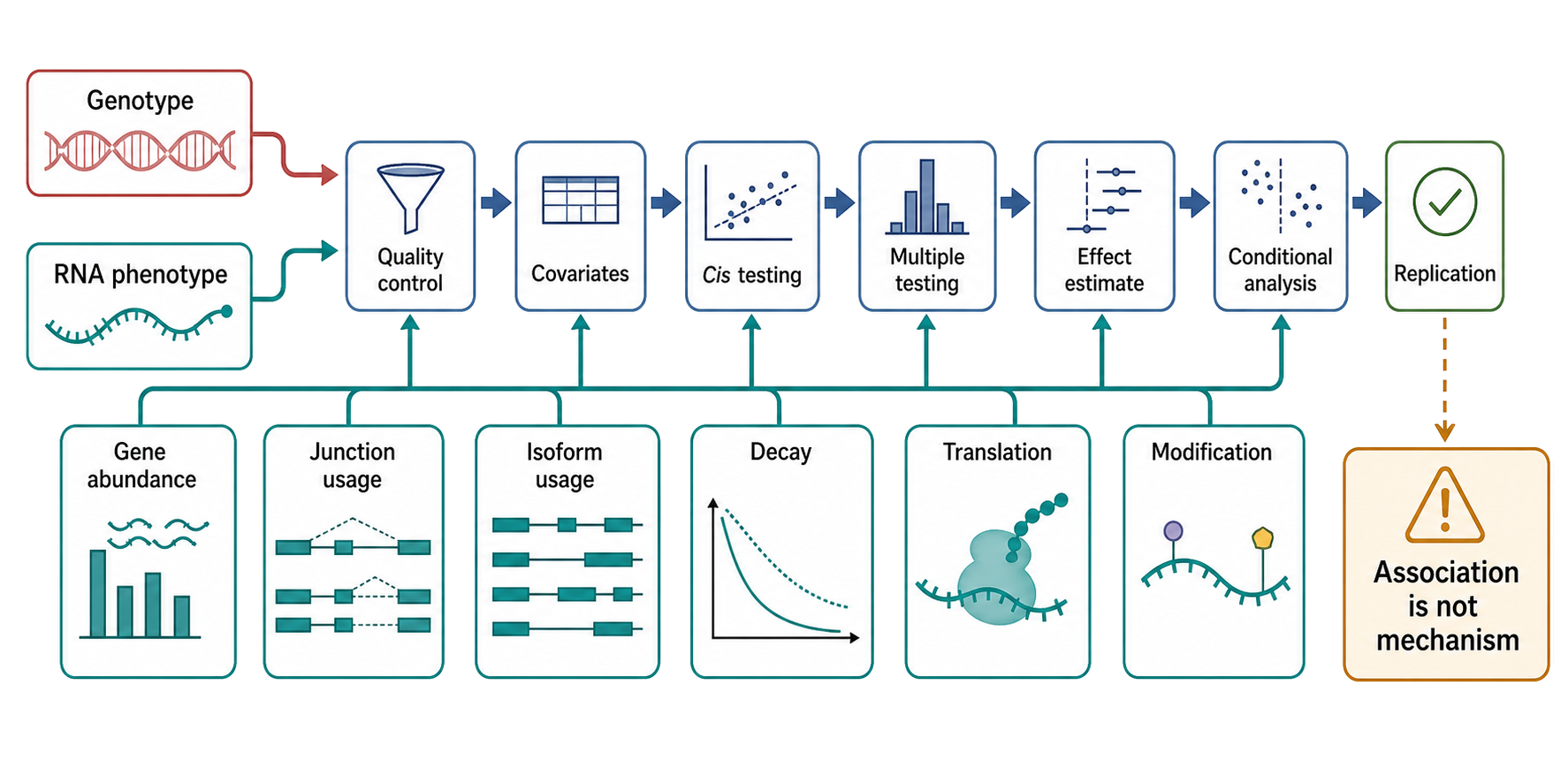
Figure 145.2. From genotype and RNA phenotype to a molecular-QTL association. Separates measured phenotype, statistical association, lead variant, and biological mechanism.
Table 145.2 should summarize the measurement object, typical statistical unit, major confounders, and valid interpretation for each molecular QTL class. It should explicitly distinguish “associated with total RNA,” “associated with relative splice usage,” and “associated with ribosome occupancy” from stronger mechanistic claims.
Table 145.2. RNA molecular-QTL phenotypes and their interpretation. Expression, splicing, editing, stability, translation, and other RNA molecular-QTL classes use different phenotypes and measurements; association can reflect linkage, cell composition, or context rather than a direct molecular mechanism.
| QTL class | RNA phenotype | Typical measurement | Main ambiguity |
|---|---|---|---|
| eQTL | Gene-level steady-state RNA abundance | Normalized RNA-seq counts | Transcription, processing, and decay can yield the same abundance change |
| sQTL | Splice-junction or intron-excision usage | Split reads or intron clusters | Annotation, mapping, and unproductive splicing may alter gene abundance |
| isoQTL/tuQTL | Transcript or isoform usage | Transcript estimates or event models | Short reads often cannot identify full-length isoforms |
| apaQTL | Cleavage/polyadenylation site or 3-prime UTR usage | End-focused or conventional RNA-seq | Internal priming and coverage gradients can mimic alternative ends |
| Stability QTL | RNA half-life or decay-related phenotype | Metabolic labeling or inferred decay | Synthesis and decay are difficult to separate in steady-state data |
| Ribosome/translation QTL | Ribosome occupancy or translational efficiency | Ribo-seq paired with RNA-seq | Occupancy is not identical to productive protein output |
| Modification QTL | Site signal, stoichiometry proxy, or modification-dependent phenotype | Chemical, antibody, enzyme, or direct-RNA assay | Genotype-dependent mapping and assay chemistry can mimic modification change |
| Trans-eQTL | Distant gene abundance | Genome-wide association | Cell composition, batch, and mediated networks inflate indirect signals |
Interaction QTLs extend the regression with a genotype-by-context term. The context may be stimulation, drug exposure, developmental stage, cell-state proportion, environmental exposure, or a continuous molecular program. The interaction coefficient asks whether the genetic effect changes with context; it is not simply a QTL detected in one group but not another. Different significance across groups can arise from different sample sizes. Interaction mapping can discover cellular and environmental modifiers, yet correlated contexts and noisy proxies complicate interpretation. A credible interaction requires a prespecified scale, adequate genotype counts across contexts, main effects in the model, robustness to composition and batch, and ideally replication or perturbation.
Cohort association estimates an average genotype effect among sampled people; it does not show whether the two chromosome copies behave differently inside the same cells. Allele-specific analysis supplies that complementary comparison and can expose rare or sample-specific cis effects that population mapping lacks power to discover.
145.3. Allele-specific expression and splicing, phasing, mapping bias, imprinting, and chromosome-specific confounders
Allele-specific analysis uses heterozygous sites as molecular barcodes. If a person carries alleles A and G at an exonic site, reads covering that site can be assigned to the A-bearing or G-bearing chromosome. Under equal expression and unbiased sampling, the expected allelic proportion is approximately one half. A reproducible deviation is allelic imbalance. Because both chromosome copies occupy the same nucleus and share trans-acting factors, a consistent imbalance often points to a cis-acting difference somewhere on the haplotype. It does not identify which linked variant causes the difference.
The raw inputs are phased or unphased heterozygous genotypes, allele-overlapping reads, mapping-quality information, and sample metadata. Counts can be modeled with a binomial distribution, but biological and technical overdispersion often motivate beta-binomial or hierarchical models. Across individuals, haplotype-level tests can combine several informative sites and compare imbalance with population QTL effects. For example, WASP’s combined haplotype test jointly models total read depth and phased allelic imbalance with shared effect parameters while allowing read-count overdispersion and a small probability that an apparent heterozygote is a mistyped homozygote. This joint test can increase power for a nearby cis QTL, but its current implementation assumes correct phase and tests a gene-level target; it neither identifies the causal nucleotide nor resolves isoform-specific effects. The output may be an allelic proportion, effect estimate, confidence interval, or QTL test. Low counts produce discrete and unstable estimates; selection of only highly covered genes can bias the analyzed set toward abundant, long, or polymorphic transcripts.
Mapping bias is the central technical threat. A read carrying the nonreference allele can have more mismatches to the reference genome and map less often or with lower quality than the reference-bearing read. This creates apparent reference-allele overexpression. A personalized reference reduces reference mismatches but is not sufficient by itself, because the two haplotype sequences can differ in which reads map uniquely. The WASP strategy starts from conventionally mapped reads, identifies reads overlapping known polymorphisms, generates every alternative allelic combination for those sites, and remaps each altered read. The original read is retained only if every remapped version returns uniquely to the same location; otherwise it is discarded. This symmetry strongly suppresses mapping-generated imbalance, but discarded reads can underestimate locus-level abundance, the original implementation discarded reads overlapping indels, and unknown variants, repeats, pseudogenes, and paralogs remain difficult. Duplicate filtering must also avoid selecting the highest-scoring—and therefore often reference-matching—read. Good practice verifies genotypes, filters low-quality bases, handles overlapping mates and duplicate molecules consistently, and checks global reference-direction bias.
Allele-specific splicing asks whether splice choice differs between haplotypes. Reads spanning allele-informative sites and junctions may directly link a haplotype to a splice event, but short reads often do not span both. Phasing then connects the transcribed marker to the candidate regulatory allele. Long reads can provide direct molecule-level phase across larger distances, although lower depth and sequencing error create other limitations. A splice imbalance can reflect altered splice-site recognition, enhancer or silencer binding, transcript degradation after a frameshift, or isoform-specific mapping. The phenotype definition must separate total allelic expression from relative allelic splice usage; otherwise, lower output from one allele can masquerade as altered splicing.
Biological monoallelic expression complicates a simple cis interpretation. Genomic imprinting causes parent-of-origin-specific expression at particular loci. Random monoallelic expression can vary among cells or clones. X-chromosome inactivation creates chromosome-wide dosage compensation in female mammals, with gene-specific escape and tissue variability. Y-linked paralogs, pseudoautosomal regions, and sex-biased cell composition add further complexity. Mitochondrial heteroplasmy and somatic copy-number alterations do not obey the ordinary diploid autosomal model. A bulk tissue may show partial imbalance because different cells express opposite alleles or because only one subpopulation is imbalanced.
Phasing distinguishes parent of origin, regulatory haplotypes, and compound configurations. Statistical phase is probabilistic and depends on ancestry-matched reference panels; family data can establish transmission; molecular phase uses reads or linked molecules. Errors can reverse the inferred direction between a candidate variant and expression. Figure 145.3 should show the path from diploid haplotypes through allele-aware mapping to total-expression and splice-specific counts, including locations where reference bias and phasing uncertainty enter.
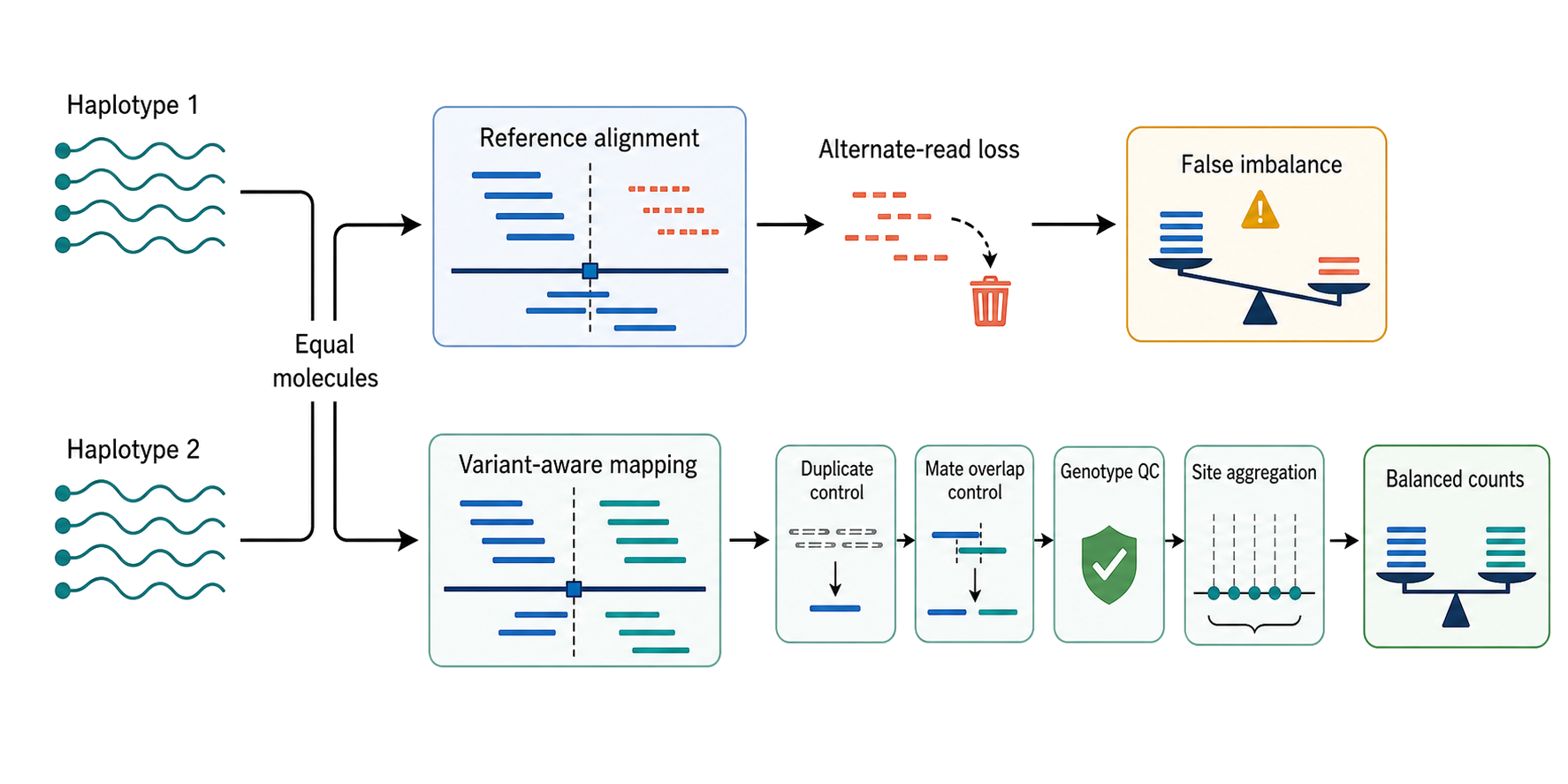
Figure 145.3. Allele-specific RNA analysis and the reference-mapping bias trap. Shows how a technical asymmetry can mimic cis regulation, why a personalized reference alone is insufficient, and why bias control trades some read depth for interpretability.
Box 145.2 should present a minimum ASE quality-control sequence: verify heterozygous genotype; exclude problematic mapping regions; control allele-dependent alignment; require adequate independent molecules; test reference-direction bias; model overdispersion; distinguish total from isoform-specific imbalance; and annotate imprinting, sex chromosomes, copy number, and clonal structure. These controls turn an appealing read-count ratio into interpretable evidence.
Box 145.2. Reference-Mapping Bias Can Manufacture Allelic Imbalance
- Render-ready content:
Equal molecular abundance need not produce equal aligned counts. Reads carrying the reference allele may align more readily than reads carrying an alternate allele, especially near additional phased variants, indels, repeats, or paralogs. A personalized genome does not guarantee symmetry because one haplotype can still create a uniquely mappable read where the other does not. For a WASP-style check, generate every alternative allelic version of a polymorphism-overlapping read and retain the original only if all versions map uniquely to the same location. A nominal reference-to-alternate ratio different from one half is therefore not sufficient evidence for cis regulation. Mapping-stability filters, unbiased duplicate handling, overlapping-mate control, genotype-quality checks, phase-aware aggregation, overdispersion models, and simulation or DNA controls turn an apparent imbalance into interpretable evidence, while the number of discarded reads and remaining unmappable regions must still be reported.
Population QTL and ASE evidence are strongest when they agree but remain informative when they do not. A common cis-eQTL may be visible across individuals but lack power for ASE if the transcript has few heterozygous exonic markers. ASE may reveal a rare private regulatory allele that a population test cannot map. In GEUVADIS lymphoblastoid cell lines, allele-specific expression and allele-specific transcript structure exposed many low-frequency signals that ordinary population QTL mapping was poorly powered to discover, while overlap between expression and transcript-structure imbalance showed that total output and isoform composition can confound one another. This is a cohort-level illustration, not evidence that every ASE event is genetic or that the assayed exonic marker is regulatory. Opposite QTL and ASE directions can expose allele coding, phase, cell composition, or mapping errors. Integrated analysis should compare effect alleles and haplotypes explicitly and should reproduce the association in ancestry- and context-appropriate samples rather than treating significance in two analyses as automatic replication.
Agreement between QTL and ASE narrows the explanation to a regulatory haplotype but usually leaves several linked variants. Fine-mapping is the next inferential step because it represents that linkage uncertainty instead of promoting the assayed exonic marker or the smallest P value directly to causal status.
145.4. Fine-mapping QTL signals, credible sets, linkage disequilibrium, and causal variant prioritization
An association peak rarely identifies one nucleotide because nearby alleles are correlated by linkage disequilibrium. If variants A, B, and C are usually inherited together, each can show a similar QTL association even if only B changes the molecular mechanism. Statistical fine-mapping asks how the observed association pattern should redistribute belief among candidate causal variants. Its input is typically summary statistics or individual-level genotypes and phenotypes, an LD matrix, and assumptions about the number and distribution of causal effects. Its outputs may include variant posterior inclusion probabilities, conditionally independent signals, and credible sets.
A credible set is constructed to contain a causal variant with a stated posterior probability under the model, commonly 95%. This statement is conditional: the causal variant must be present in the analyzed set; the LD must be accurate; the association model must fit; priors must be reasonable; and the assumed number of causal signals must be adequate. A 95% credible set is not a guarantee that nature placed the causal allele inside it. If a structural variant is untyped, an ancestry-mismatched reference panel distorts LD, or two causal variants are modeled as one, posterior probabilities can be miscalibrated. Statistical fine-mapping reviews emphasize that model and population choices are inseparable from the candidate list.
Conditional analysis attempts to separate multiple signals by including a lead variant or inferred effect in the model and testing residual association. Stepwise procedures are intuitive but can select unstable representatives from correlated groups. Bayesian multi-signal methods represent uncertainty more fully, but they still depend on LD and priors. Sample overlap and phenotype transformations must match the association statistics. Fine-mapping should report the full credible set, posterior values, variant coverage, LD source, ancestry, and sensitivity to alternative models rather than only the top-ranked allele.
Functional annotations can inform priors. A variant in an accessible promoter, splice motif, RNA-binding site, conserved element, or experimentally active enhancer may receive greater prior probability. This can improve resolution when annotations are relevant and independently derived. It can also create circularity when the same data define both the QTL and the annotation, or systematically deprioritize mechanisms absent from current catalogs. Molecular QTL enrichments can identify regulatory categories implicated in complex traits, but enrichment across loci does not validate every annotated candidate within a locus.
Ancestry changes fine-mapping because LD patterns and allele frequencies differ across populations. A block of tightly correlated variants in one population may be less correlated in another, providing natural resolution when the causal effect is shared. Combining ancestries requires more than pooling: effect heterogeneity, imputation quality, environmental context, local ancestry, and reference-panel representation must be modeled. Excluding a variant because it is rare or poorly imputed in one cohort can eliminate the actual causal allele. Conversely, apparent cross-ancestry heterogeneity may arise from different tagging rather than different biology.
Figure 145.4 should contrast an association peak with the hidden causal configuration, display two ancestry-specific LD patterns, and show how posterior evidence forms credible sets under one- and multiple-causal-variant models. The visual should prevent the common mental substitution of “small P value” for “high causal probability.”
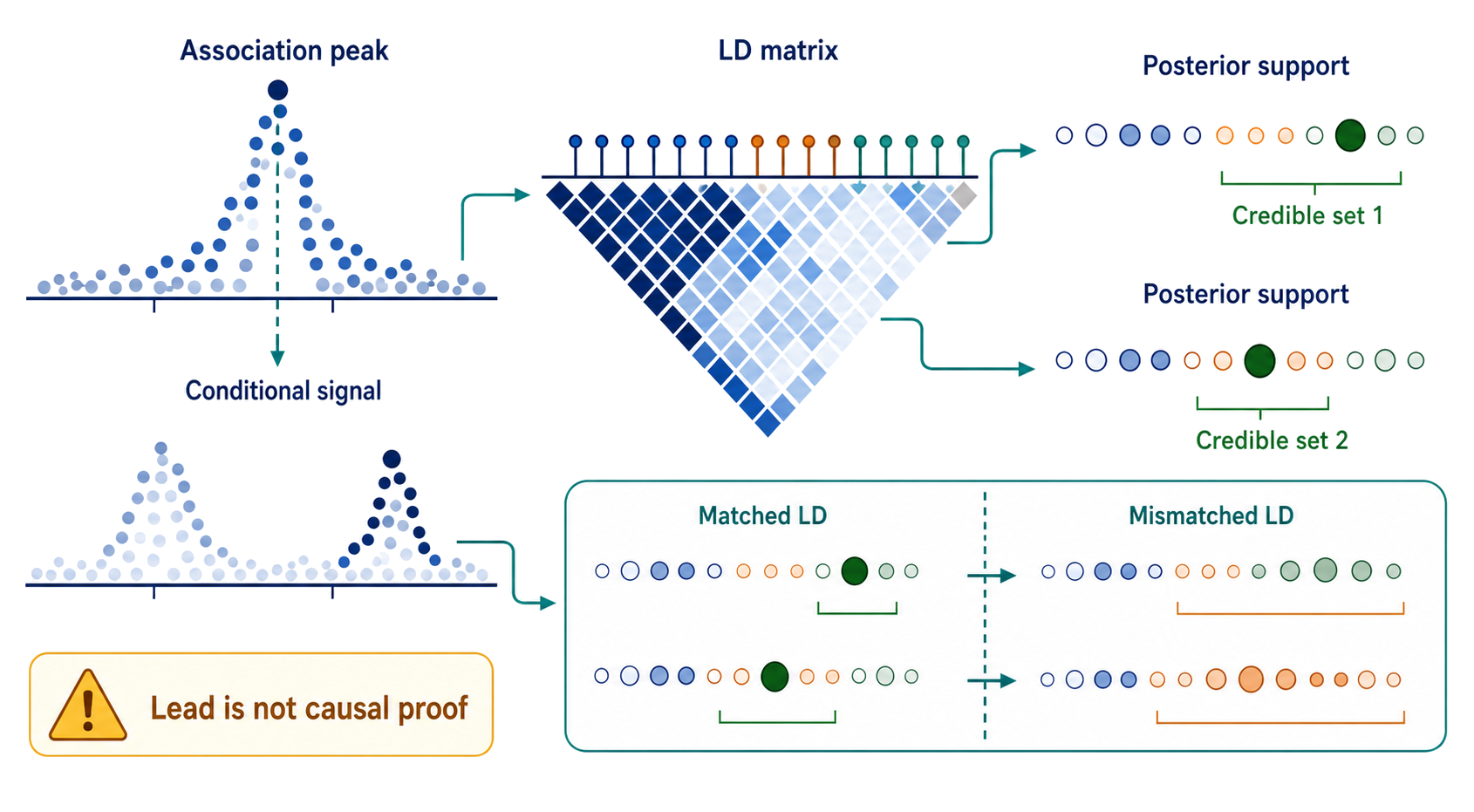
Figure 145.4. Association peak, linkage disequilibrium, and a calibrated credible set. Explains why the smallest P value is not automatically the causal variant.
Table 145.3 should list the assumptions, diagnostic checks, and failure modes for conditional analysis, single-signal fine-mapping, multi-signal fine-mapping, annotation-informed priors, and trans-ancestry fine-mapping. Each row should state what the method can prioritize and what it cannot prove.
Table 145.3. Evidence states from QTL association to mechanism. Evidence should progress from QTL association through colocalization, fine mapping, allele-specific effects, perturbation, rescue, and mechanism; each state defines what is and is not yet supported.
| Evidence state | Supported statement | Not yet supported | Useful next test |
|---|---|---|---|
| Significant QTL | Genotype predicts an RNA phenotype in the studied cohort | Lead variant is causal | Replication and conditional analysis |
| Fine-mapped credible set | Calibrated model assigns probability among correlated variants | One nominated variant is proven | Functional annotation and allele-specific evidence |
| Allelic imbalance | Haplotypes differ within heterozygous samples | The assayed site is the regulatory variant | Phased multi-site analysis and perturbation |
| QTL/GWAS colocalization | Signals are compatible with a shared causal variant under model assumptions | RNA change mediates the trait | Multi-signal colocalization, directionality, perturbation |
| TWAS association | Genetically predicted RNA phenotype associates with a trait | The named gene is uniquely causal | Conditional models, colocalization, functional testing |
| Endogenous edit/perturbation | Changing a candidate allele or element changes an RNA readout | The RNA change explains organismal disease | Rescue, downstream mechanism, relevant model validation |
Causal prioritization integrates, but should not collapse, statistical and biological evidence. A useful candidate dossier preserves variant identity and haplotype; QTL effect across contexts; ASE support; fine-mapping probability; predicted transcript and regulatory consequences; relevant chromatin or binding evidence; and feasibility of perturbation. Evidence conflicts should remain visible. A highly probable variant with no known annotation may expose missing biology, while a compelling motif disruption with negligible posterior support may be a correlated passenger. Prioritization ranks experiments; it is not the final causal verdict.
A calibrated candidate set is also the proper unit for comparison with a complex-trait locus. Trait integration begins only after allele orientation, independent signals, variant coverage, and LD are reconciled; otherwise, apparently overlapping peaks can manufacture a shared biological story.
145.5. Colocalization, transcriptome-wide association, Mendelian randomization, and complex-trait integration
Molecular QTLs become especially attractive when a genome-wide association study (GWAS) implicates the same region. However, overlapping peaks are expected when many variants share LD. Trait integration methods formalize different questions. Colocalization asks whether two association patterns support a shared causal variant. TWAS asks whether the genetically predictable component of an RNA phenotype is associated with a trait. Mendelian randomization asks whether genetic evidence supports a directional effect of an exposure on an outcome under instrumental-variable assumptions. None of these questions is equivalent to “does this gene cause disease?”
Bayesian colocalization takes association summaries for two traits in the same region, aligned alleles, and often LD or assumptions about causal-signal structure. A foundational framework compares hypotheses such as no association, association with only trait one, association with only trait two, two distinct causal variants, or one shared causal variant. The output is posterior support for these configurations. Results depend on priors, variant coverage, region definition, power, and the assumption about numbers of causal variants. A low shared posterior may reflect weak QTL power; a high posterior can be misleading if separate causal variants are unresolved in strong LD.
Before colocalization, alleles must be harmonized and each locus should be examined for multiple signals. Conditioning or multi-signal methods can compare corresponding components rather than entire marginal peaks. The molecular tissue and phenotype must be biologically plausible, but plausibility should not be used to conceal a mismatch. Colocalization of a disease signal with a liver eQTL supports a shared local genetic cause for the two measurements in the analyzed data. It does not establish that altered liver expression mediates disease, exclude another molecular phenotype, or identify the target cell within liver.
TWAS begins with a molecular reference panel in which genotype predicts expression or another RNA phenotype. A model learns variant weights for each feature. Those weights are applied to GWAS genotypes or summary statistics to test whether genetically predicted expression associates with the trait. PrediXcan established an influential individual-level formulation, while summary-statistic and multi-tissue frameworks enabled larger integration studies. The input/model/output distinction matters: the model predicts a genetic component of expression, not measured expression in each GWAS participant; the test reports association of that predictor with trait, not necessarily mediation by the transcript.
A TWAS association can arise when expression mediates a trait, when the same variant has separate effects on expression and trait, when distinct causal variants are correlated, or when prediction weights tag another gene’s causal signal. Genes near one another can produce correlated predictors. Reference panels may be small, ancestrally mismatched, or sampled in the wrong tissue. Prediction performance varies, and a feature with weak heritable prediction cannot be reliably tested. Fine-mapping predicted features and colocalizing the underlying signals can narrow interpretations, but experimental follow-up remains necessary.
Mendelian randomization frames genetic variants as instruments for an exposure. A valid instrument must be associated with the exposure (relevance), share no causes with the exposure-outcome relation (independence), and affect the outcome only through the exposure (exclusion restriction). In molecular MR, cis-eQTLs are often chosen as instruments for expression. Weak instruments bias estimates; LD between distinct causal variants mimics mediation; horizontal pleiotropy violates exclusion; and selecting instruments from the same data can inflate evidence. Multiple instruments permit sensitivity analyses, but nearby cis variants may not supply independent information. Directionality tests and colocalization help, yet cannot prove that every assumption holds.
Figure 145.5 should place colocalization, TWAS, and MR beside four causal diagrams: true molecular mediation, horizontal pleiotropy, two linked causal variants, and reverse or feedback relationships. It should show which diagrams each method can or cannot distinguish under ideal data.
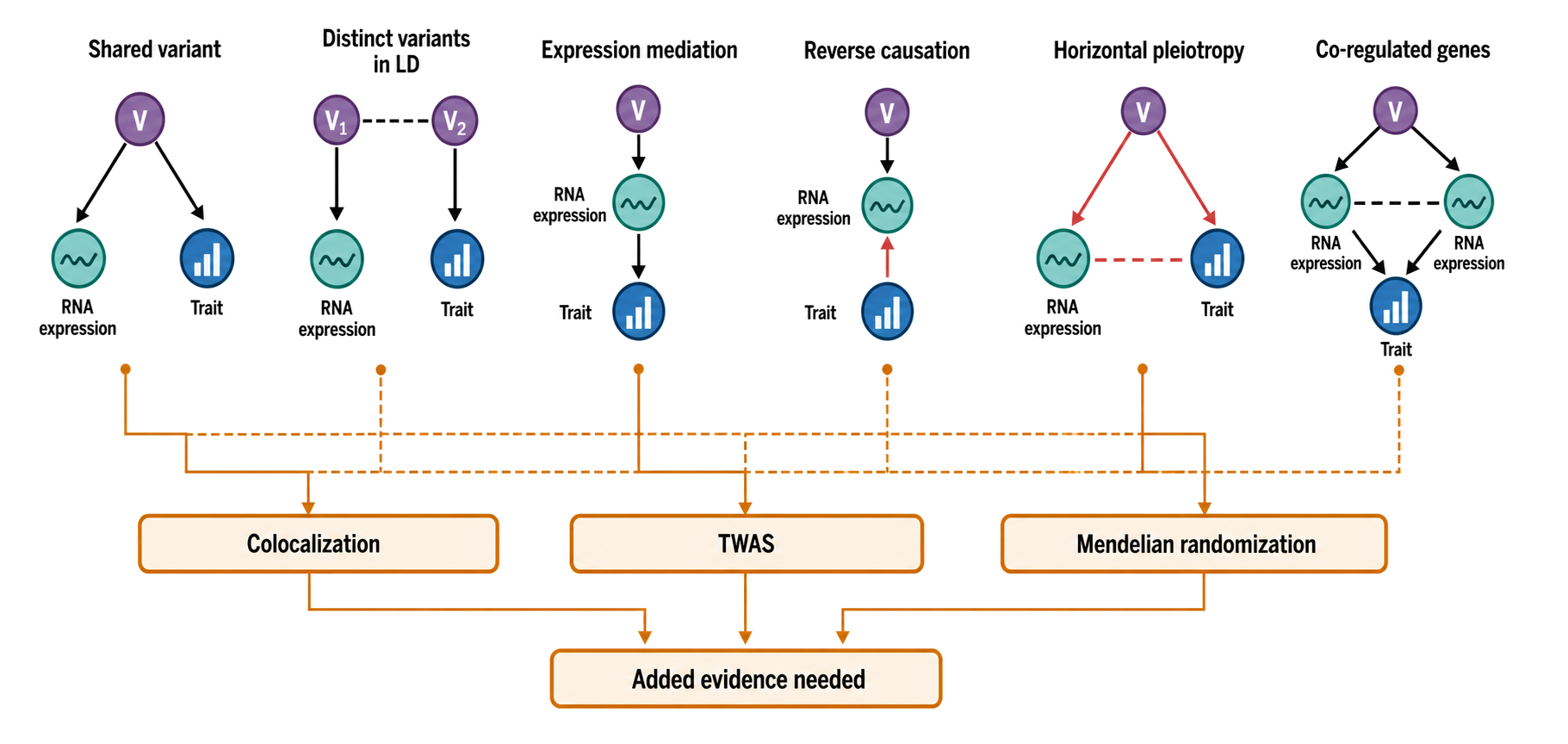
Figure 145.5. What colocalization, TWAS, and Mendelian randomization do and do not identify. Prevents gene prioritization statistics from being narrated as completed mechanisms.
Box 145.3 should define an evidence ladder for trait integration: regional overlap; formal shared-signal support; fine-mapped shared candidates; predicted molecular-trait association; directional instrumental evidence; endogenous perturbation of variant and mediator; and reproduction of the trait-relevant phenotype. The ladder should emphasize that later evidence can revise rather than merely add to earlier interpretations.
Box 145.3. Colocalization Is Not Mediation
- Render-ready content:
A shared association signal narrows hypotheses; it does not finish the mechanism. Colocalization can support compatibility with a shared causal variant for an RNA phenotype and a complex trait. The shared variant could affect both outcomes through separate branches, the RNA measurement could mark another causal process, or multiple unresolved signals could violate the model. Mediation requires a directional chain and evidence that changing the RNA process changes the downstream trait-relevant phenotype. Use colocalization to prioritize experiments, not to replace them.
Complex-trait integration is strongest when methods converge on an allele-consistent, context-matched mechanism. The effect allele should have the same orientation across QTL, ASE, fine-mapping, and trait analyses. The relevant transcript or splice event should be expressed in the implicated cell state. Multiple independent signals should be handled explicitly. The predicted mediator should respond to perturbation, and changing that mediator should affect a trait-proximal phenotype. Recent reviews organize colocalization, TWAS, and MR as complementary tools while stressing that their assumptions and failure modes differ. Convergence raises confidence; it does not make untested steps disappear.
Before any integrated signal is generalized, the same effect must be examined in the tissue, cell population, developmental window, exposure, ancestry, and chromosome system that give the proposed mechanism meaning. The next section treats those contexts as parts of the model rather than annotations added after significance testing.
145.6. Tissue, cell-type, developmental, environmental, ancestry, sex-chromosome, and rare-variant context
Regulatory effects are conditional on biological context. A variant may alter a transcription-factor site only where that factor is active, a splice event only where the relevant RBP is expressed, or RNA stability only after signaling changes a decay pathway. Tissue-level QTL atlases show both broadly shared and strongly tissue-dependent effects. Absence of a QTL in one tissue is not proof of no effect: the study may lack power, the causal cell type may be diluted, or the gene may be inactive. Conversely, a QTL detected in bulk tissue may reflect genotype-associated shifts in cell composition rather than regulation within a fixed cell type.
Single-cell and single-nucleus designs improve cellular resolution but introduce sparsity, donor structure, and state continua. Cells are not independent genetic samples when many cells come from the same donor; pseudoreplication inflates significance. Common strategies aggregate cells by donor and cell type or use hierarchical models that preserve within-donor information. Context can be continuous rather than categorical: activation, differentiation, cell cycle, and disease severity often form trajectories. CellRegMap models genotype effects that vary along cellular contexts, illustrating how single-cell data can detect regulatory heterogeneity beyond discrete labels. Its conclusions still depend on sufficient donors, balanced genotypes, accurate state representation, and control of technical covariates.
Development and environment alter both exposure and response. Prenatal and adult tissues can use different enhancers and isoforms. Infection, interferon signaling, diet, smoking, medication, temperature, hypoxia, and stress can expose interaction QTLs that are weak at baseline. In whole blood, cell proportions and interferon response have been used to identify context-dependent eQTLs. Such analyses require careful causal language: a genotype association with a context proxy can confound the interaction, and an exposure measured after disease onset may be a consequence rather than a cause.
Ancestry is both a population-genetic and an equity issue. Allele frequencies, LD, imputation accuracy, local ancestry, rare-variant spectra, and environmental covariates differ among cohorts. Models and QTL resources trained predominantly in one ancestry may transfer poorly, yielding lower discovery, inaccurate fine-mapping, and biased clinical interpretation elsewhere. Ancestry categories are coarse and socially entangled; genetic principal components or local ancestry capture only specific dimensions. Recent eQTL syntheses emphasize population history and representation as central to precision applications. Responsible analysis reports cohort composition, reference panels, transfer performance, and uncertainty rather than treating one population as universal.
Sex chromosomes require models beyond an autosomal default. The X chromosome differs by sex-specific copy number, X inactivation, escape from inactivation, pseudoautosomal recombination, and hemizygosity. The Y chromosome contains homologous and repetitive regions that complicate mapping. Sex can modify autosomal regulatory effects through hormones, cell composition, and exposures. Uniform QTL resources now include explicit X-chromosome analyses and transcript-level visualization, illustrating both technical feasibility and specialized requirements. Analyses should state sex-chromosome ploidy assumptions, dosage coding, inactivation model, mapping regions, and inclusion of sex-diverse karyotypes where data permit.
Rare variants pose a different power problem. A common-variant QTL estimates an average allelic effect across many carriers. A rare variant may occur in one family or individual and have a large effect that cannot be mapped by ordinary single-variant regression. Burden tests aggregate variants by gene, regulatory element, or predicted consequence, assuming the grouping is biologically coherent. Extreme expression, extreme splicing, and ASE can prioritize rare regulatory alleles, especially when family segregation and matched DNA are available. Yet outlier RNA phenotypes can also arise from sample quality, mosaicism, cell composition, or downstream disease effects. Rare-variant interpretation needs direct inspection, orthogonal genotype validation, ancestry-aware frequency data, family phase when possible, and functional testing.
Figure 145.6 should depict one genotype producing different molecular effects across tissues, cell states, development, and exposure, while ancestry-specific LD changes the variants that tag the effect. It should also show why a rare private allele is found through outlier and allelic evidence rather than conventional population mapping.
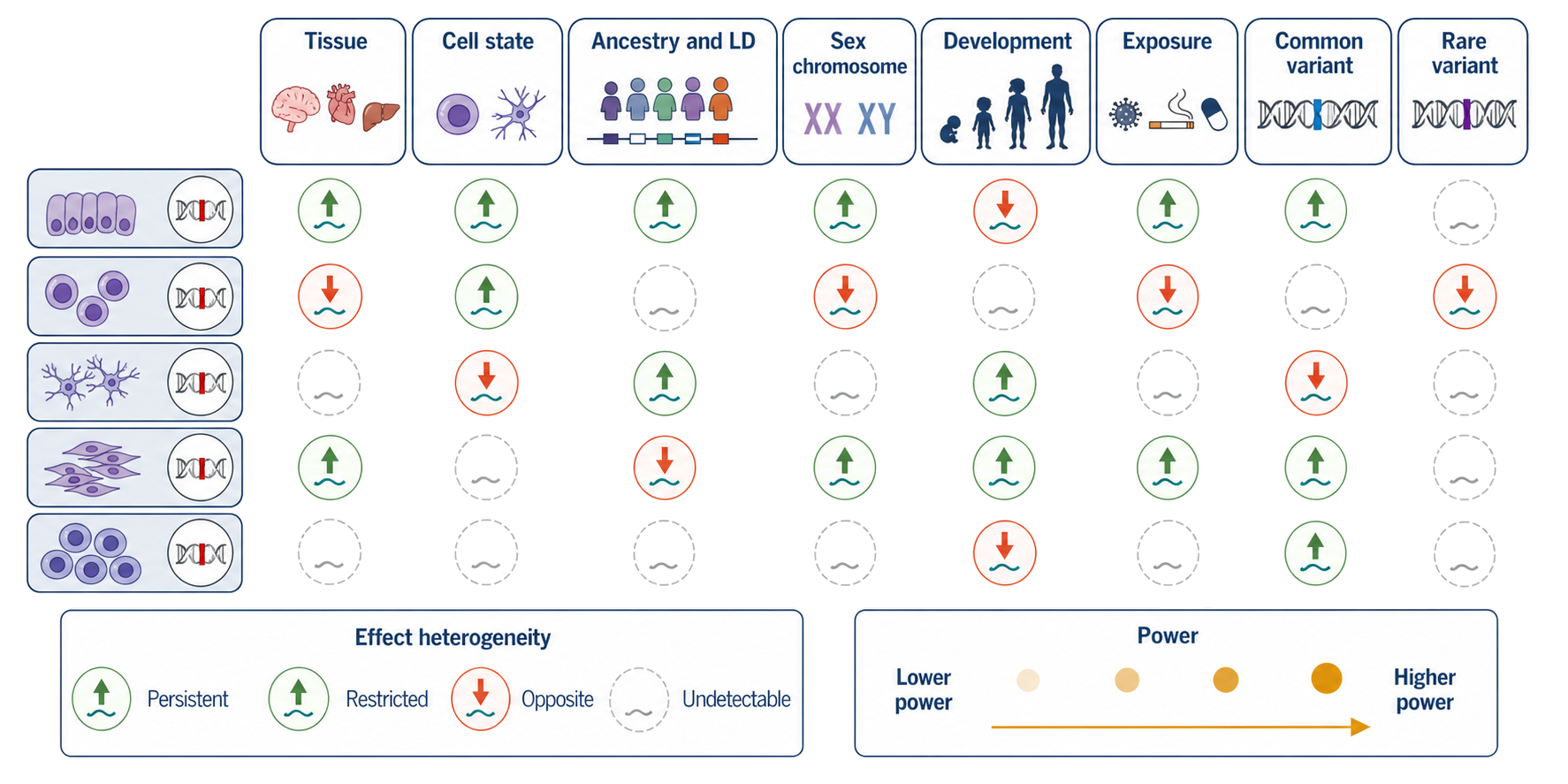
Figure 145.6. Regulatory effects depend on biological and population context. Replaces the false binary of universal versus nonreplicating QTL with explicit effect heterogeneity and power.
Table 145.4 should pair each context dimension with the appropriate design and the most dangerous confounder: donor-aware single-cell models for cell state, longitudinal or stimulated designs for environment, trans-ancestry models for population diversity, specialized ploidy and inactivation models for sex chromosomes, and family/outlier approaches for rare variants.
Table 145.4. Designs for resolving context-specific regulatory effects. Cell type, developmental stage, environment, stimulation, ancestry, and disease can change regulatory effects; matched designs and interaction tests improve context resolution but do not eliminate power and transportability limits.
| Context question | Design | Essential control | Residual limitation |
|---|---|---|---|
| Tissue specificity | Matched multi-tissue donors | Tissue quality and cell composition | Bulk tissue can hide cell-specific effects |
| Cell-type specificity | Sorted cells or population-scale single-cell RNA-seq | Donor-aware pseudobulk or mixed models | Sparse counts reduce power |
| Continuous cell state | Genotype-by-state models | State estimation independent of genotype signal | Inferred trajectories may not be causal time |
| Environmental response | Paired baseline/stimulus sampling | Genotype-by-condition interaction and batch balance | Exposure dose and timing may not transfer in vivo |
| Developmental effects | Repeated or stage-matched sampling | Age/stage and cell-composition adjustment | Cross-sectional cohorts confound cohort and development |
| Ancestry portability | Diverse cohorts with matched genotyping and RNA processing | Ancestry-matched LD and allele harmonization | Sample-size imbalance changes discovery power |
| Sex-chromosome effects | Explicit X/Y dosage and inactivation models | Sex-stratified QC and escape-status annotation | Tissue-specific escape and mosaicism remain difficult |
| Rare variants | Family, burden, outlier, or extreme-expression designs | Ancestry, technical outlier, and segregation checks | Individual variants often lack replication power |
Context matching is therefore part of causal inference, not a decorative annotation after discovery. A liver eQTL, blood TWAS association, and neuronal reporter result do not become a coherent mechanism merely because they name the same gene. A defensible synthesis explains why effects should transfer across those systems or labels the mismatch as unresolved. Broad catalogs define where to look; targeted cohorts and experimental models determine whether the effect operates in the disease-relevant setting.
Context-qualified candidates can then be assigned to experiments that discriminate among the remaining causal diagrams. Functional validation is not a generic last box to check: the perturbation target, cellular system, RNA readout, and downstream phenotype must correspond to the specific variant-to-trait chain proposed by the preceding analyses.
145.7. Functional validation, perturbation assays, clinical interpretation, and limits of causal inference
Functional validation asks whether deliberate intervention produces the predicted molecular and phenotypic changes. The candidate intervention can target the nucleotide, regulatory element, transcript, or downstream mediator. Each choice tests a different causal statement. Deleting an enhancer shows that the region contributes to regulation but does not isolate one allele. Editing the candidate base at its endogenous locus is more specific, but editing can alter nearby sequence, DNA damage responses, chromatin, or clone composition. Knocking down the transcript tests mediator function but not whether the associated allele acts through that transcript.
Reporter assays place candidate sequences upstream or within a measurable construct. Massively parallel reporter assays test thousands of alleles in parallel and can resolve nucleotide effects at scale. Their inputs are designed sequences and a cellular assay; the output is relative reporter activity. Assumptions include faithful representation of the endogenous regulatory grammar, relevant trans environment, adequate sequence context, and appropriate episomal or integrated chromatin. A large recent dissection demonstrates the reach of single-nucleotide reporter testing while emphasizing cell-type transfer limits. A reporter-positive variant is evidence for sequence-dependent activity, not proof that the endogenous locus mediates disease.
Genome editing provides a stronger endogenous test. Allelic replacement creates isogenic cells differing at the candidate base; CRISPR interference or activation perturbs regulatory elements; base and prime editors can reduce double-strand breaks; saturation editing tests many alleles. Controls should include multiple independent clones or pooled designs, edit verification, off-target assessment, matched handling, and rescue where feasible. The readout should span the proposed chain: transcription initiation, splice use, RNA abundance or stability, translation, molecular pathway, and trait-relevant cell phenotype. A change in total expression alone may not explain disease if the proposed mechanism is isoform-specific.
Perturbation in the wrong model can yield both false negatives and false positives. Immortalized cells may lack the developmental factor required for an enhancer. Induced cells may be immature. Overexpression can exceed physiological stoichiometry and create interactions absent in vivo. CRISPR delivery can activate innate immune pathways and alter RNA programs. Clonal selection may enrich compensatory states. Organoids, primary cells, animal models, and human cohorts each restore some context while introducing other limitations. Replication across complementary systems is stronger than repetition of one assay.
Computational variant-effect predictors can prioritize experiments by combining conservation, sequence context, chromatin, splicing, or learned representations. Their output scores are model-dependent rankings, not calibrated probabilities of clinical pathogenicity unless explicitly validated for that use. Benchmarking against human traits shows that predictor performance varies with endpoint, variant class, and evaluation design. Circular benchmarks, training-test overlap, nearby homologs, and ascertainment can inflate performance. A predictor should be evaluated on independent, ancestry-relevant, mechanism-relevant data and interpreted alongside, not instead of, genetic and experimental evidence.
Clinical interpretation asks whether a variant explains disease in a person or family and whether that conclusion changes care. Molecular evidence must be combined with population frequency, segregation, de novo status, phenotype match, penetrance, mode of inheritance, alternative diagnoses, and assay validity. A common cis-eQTL with a small effect may illuminate population risk but be insufficient for monogenic diagnosis. A rare splice variant with strong ASE and an endogenous rescue experiment may be compelling, yet incomplete penetrance or tissue restriction can complicate prediction. Somatic variants require tumor purity, clonality, and treatment context. Clinical labels should express uncertainty and be updated as evidence changes.
Causal inference is strongest when interventions reproduce the direction and magnitude expected from genetics. If the trait-risk allele lowers expression, editing that allele should lower expression in the relevant state; restoring expression should rescue a downstream phenotype without introducing an unrelated supraphysiological effect. Discordance is informative. It may reveal the wrong transcript, developmental timing, nonlinear dose response, linked causal variants, compensatory biology, or a false statistical integration. Experiments should be designed to discriminate alternatives rather than only to confirm the favored story.
Figure 145.7 should show a validation matrix crossing perturbation target with readout level: variant, element, transcript, molecular pathway, cell phenotype, organismal phenotype, and clinical observation. It should distinguish what each experiment establishes and which causal links remain open.
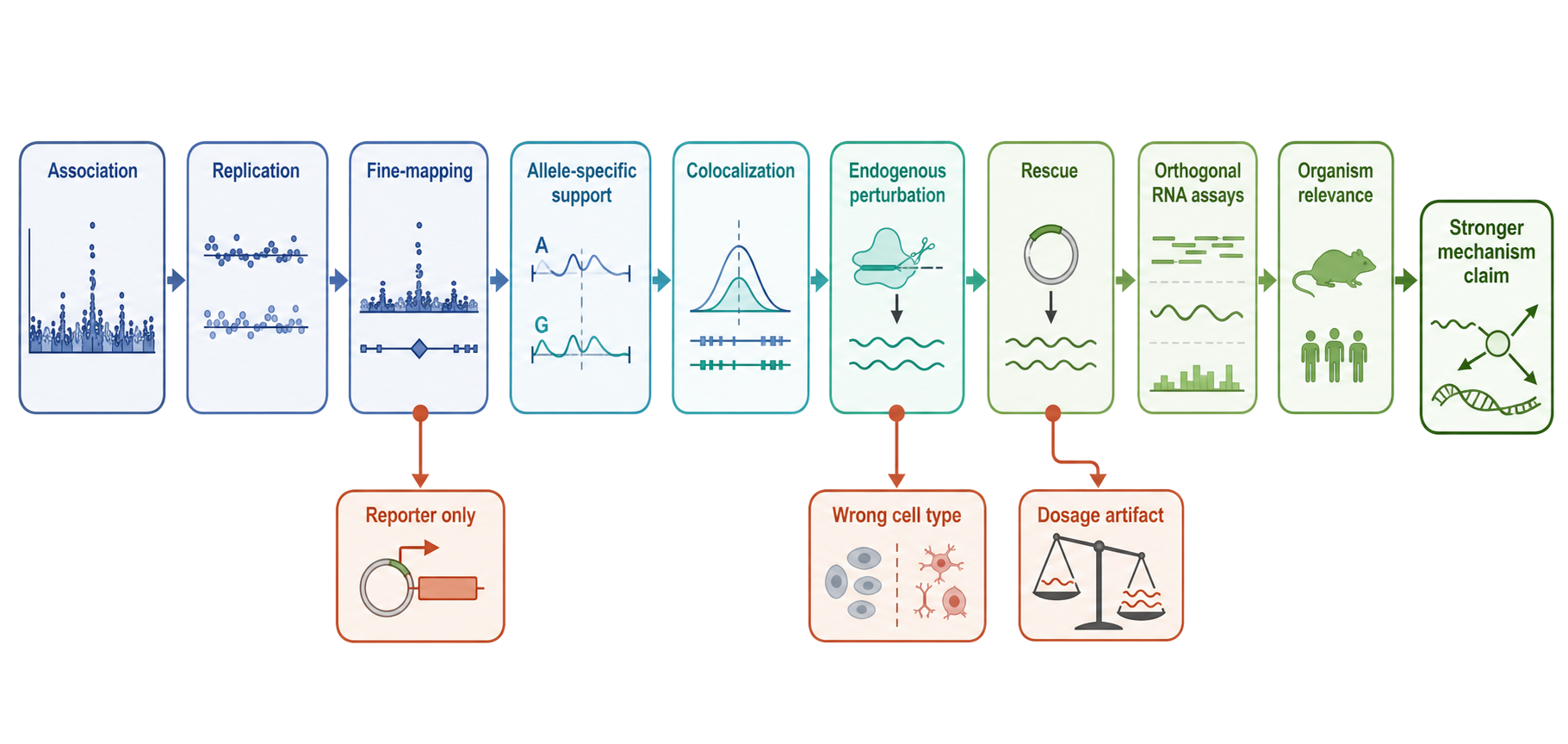
Figure 145.7. Evidence ladder from statistical locus to RNA mechanism. Links each experimental step to the causal claim it can support and the stronger claim it cannot establish alone.
The final evidence chain should be narrated without collapsing its steps: association localizes a region; allelic imbalance supports a cis difference; fine-mapping prioritizes variants; colocalization supports a shared signal; TWAS or MR evaluates a molecular-trait relation under assumptions; perturbation tests the variant and mediator; clinical data establish relevance to patients. No individual step is redundant, and no statistical step alone constitutes a complete molecular mechanism.
The next three synthesis sections reorganize this chain by evidence class, biological system, and application boundary. They are guides for comparing conclusions across studies; they do not replace the method-specific assumptions and controls in Section 145.1 through Section 145.7.
Experimental Foundations and Evidence
The experimental foundation is a set of linked measurements made at different units of observation. DNA sequencing or genotyping establishes which alleles are present; transcript annotation states which RNA objects could be affected; bulk, single-cell, or allele-aware RNA measurements quantify molecular phenotypes; population association models estimate genotype-phenotype covariance; and perturbation changes a candidate component deliberately. The individual or donor, not each read or each cell, is normally the independent genetic unit. Technical replication can refine a measurement, but only additional genetically independent samples strengthen population-level inference.
Each evidence class controls a different alternative explanation. Replicated QTL mapping shows that genotype predicts a named RNA phenotype in a sampled context. ASE compares homologous chromosomes within one heterozygous sample and reduces many shared environmental confounders, provided allele-dependent alignment, phase, copy number, and chromosome biology are controlled. Fine-mapping and colocalization represent LD and shared-signal uncertainty rather than observing molecular action. Reporter assays test sequence activity outside some endogenous constraints, whereas allele replacement and rescue can test the proposed direction at the native locus. Cohort, family, and clinical observations finally ask whether the molecular effect transfers to organismal phenotype.
Orthogonal evidence is valuable only when it is genuinely orthogonal. Reanalyzing the same RNA-seq reads with several association tools does not equal independent replication, and several methods using the same mismatched LD panel can share the same error. A persuasive locus dossier records sample independence, allele orientation, phenotype definition, context, measurement uncertainty, model assumptions, and the exact causal link tested by each experiment. Discordant results should trigger model comparison—wrong isoform, multiple causal alleles, cell-state mismatch, nonlinear dosage, or an assay artifact—rather than selective omission.
Biological Contexts Across Organisms, Cell Types, and Systems
Most evidence in this chapter comes from human cohorts because natural genotype variation, disease association, and ancestry-specific LD are central to the questions. Human bulk tissues provide donor-scale power and anatomical breadth, as illustrated by cross-tissue atlases, but a tissue measurement averages cell types and states. Sorted-cell and population-scale single-cell designs improve resolution; their effective genetic sample size is still the number of donors, and sparse cellular measurements require donor-aware aggregation or hierarchical models. Families add transmission and phase, while longitudinal or stimulated samples can distinguish stable regulation from response-dependent effects.
Experimental systems answer questions that observational cohorts cannot. Primary cells preserve more native context but may be scarce or difficult to perturb. Induced pluripotent stem cell derivatives enable isogenic editing and developmental comparisons but can remain immature. Organoids restore multicellular interactions incompletely; animal models test organismal consequences while changing sequence, regulatory grammar, physiology, and environment. Reporter constructs isolate sequence activity at scale, whereas endogenous editing preserves more chromosomal context. No system is globally superior: the appropriate model is the one that contains the molecular machinery and biological state required by the proposed effect.
The recurring locus illustrates the consequence of this hierarchy. Lower liver expression, altered immune-cell splicing, and a metabolic-trait signal should initially be treated as three context-qualified observations. A shared variant mechanism becomes plausible only if allele direction and molecular phenotype agree in the relevant cells, LD and ancestry are compatible, and perturbation reproduces the predicted RNA change. Cross-species conservation or an animal phenotype can strengthen a mechanistic claim, but failure to reproduce a human regulatory allele may reflect regulatory divergence rather than absence of function.
Technology, Computational, Clinical, and Engineering Links
This chapter sits between measurement infrastructure and decision-making. Chapter 141 supplies transcript construction, abundance estimation, and allele-aware RNA measurements; Chapter 139 supplies experimental-design and statistical-inference principles; Chapter 143 treats prediction and benchmarking; and Chapter 144 covers stable identifiers, databases, and provenance. A reproducible computational workflow must preserve assembly, transcript release, effect allele, phase, molecular phenotype, covariates, LD source, model version, and context as data move among those layers. A convenient gene-level summary is not an acceptable substitute when the evidence is isoform-, haplotype-, or cell-state-specific.
Technology changes resolution but not the evidentiary boundaries. Long reads can connect distant transcribed variants and isoforms on single molecules, yet depth and error still limit allelic estimates. Single-cell and spatial assays expose cell states and neighborhoods, yet donor independence, sampling, and measurement sparsity remain. High-throughput reporter and perturbation assays can test many candidates, but scale does not restore missing endogenous chromatin, developmental timing, or organismal physiology. Computational variant-effect scores and gene rankings are therefore prioritization devices whose calibration must match the variant class, ancestry, phenotype, and intended use.
Clinical interpretation begins after—not instead of—this technical chain. A reportable conclusion should connect an assembly-qualified allele to a relevant transcript and haplotype, an independently supported molecular effect, a disease-consistent mode of inheritance or risk model, and evidence appropriate to the proposed action. Population-risk loci, rare diagnostic alleles, and somatic variants require different effect-size, penetrance, segregation, clonality, and actionability reasoning. Engineering applications reverse the direction of inference: an experimentally supported regulatory rule can guide allele correction, splice modulation, or expression tuning, but intervention design must preserve dosage, isoform balance, tissue specificity, and off-target constraints.
Recent Consensus
- Variant interpretation must preserve assembly, allele, transcript version, isoform consequence, and haplotype context. A single consequence label is inadequate when transcript choice changes the result.
- Molecular QTL classes measure different regulatory layers. Cis-eQTLs, sQTLs, transcript-use QTLs, interaction QTLs, and translation-related QTLs should not be treated as equivalent evidence for “gene regulation.” Large tissue atlases and harmonized catalogs support extensive sharing alongside substantial context specificity.
- ASE is powerful within-individual evidence for cis regulation when mapping bias, genotyping, phasing, coverage, copy number, imprinting, and chromosome-specific biology are controlled.
- Fine-mapping and colocalization require models that allow multiple causal variants, accurate allele harmonization, appropriate LD, and uncertainty reporting. A lead variant, credible set, or shared posterior is not an experimental causal conclusion.
- TWAS and MR can prioritize molecular mediators but remain vulnerable to LD, horizontal pleiotropy, weak prediction, and context mismatch. Convergence with colocalization and functional perturbation is more informative than significance from one integration method.
- Diverse ancestry, sex chromosomes, cell state, development, and environment are parts of regulatory architecture rather than nuisance footnotes. Resources and models must report where an effect was measured and how well it transfers.
- Endogenous, context-matched perturbation that tests both the molecular intermediate and a relevant phenotype provides stronger causal evidence than reporter activity or computational prediction alone.
Open Questions, Controversies, Deprecated Models, and Common Misconceptions
Open questions:
- How much apparently tissue-specific regulation reflects true within-cell effects versus differences in cell composition, developmental state, exposure, and statistical power?
- Which combinations of long-read phasing, single-cell measurement, spatial context, and perturbation can identify isoform-specific causal mechanisms at population scale?
- How should multi-ancestry fine-mapping share information when causal alleles or effect sizes differ, without forcing false homogeneity or fragmenting already limited cohorts?
- How can rare regulatory variants be grouped for burden testing without combining variants that affect different transcripts, cell states, or directions of effect?
- Which validation systems best predict organismal and clinical effects for variants whose regulatory activity appears only during transient development or environmental response?
- How should molecular mediation be estimated when several correlated RNA phenotypes and feedback relationships lie between genotype and trait?
Controversies:
- The usefulness of TWAS gene rankings depends on whether they are treated as causal claims or as locus-level prioritization. Strong predictive association can arise without transcript mediation, but well-integrated TWAS remains valuable for generating testable hypotheses.
- Annotation-informed fine-mapping can improve resolution, yet disputed choices about functional priors can reinforce biases toward well-studied tissues and common mechanisms.
- Single-cell QTL studies increase contextual resolution, but the relative value of more cells per donor versus more genetically independent donors depends on effect size, phenotype sparsity, and model design.
Deprecated or weakened claims:
- Reporting only the nearest gene to a GWAS lead variant is no longer an adequate gene-prioritization strategy. Regulatory targets can be distal, context-specific, or isoform-specific.
- Treating the most significant variant as the causal variant is weakened by LD and multiple causal signals. Posterior uncertainty and unobserved variation must be retained.
- Declaring tissue specificity because a QTL is significant in one tissue and nonsignificant in another is invalid without a direct test of effect heterogeneity.
Common misconceptions:
- “A cis-eQTL is a variant that directly controls its nearest gene.” Cis is usually a distance-based testing category; the associated allele can tag another causal variant or act through a different local feature.
- “Allelic imbalance proves that the observed exonic variant is regulatory.” The observed variant may only mark a haplotype, and mapping bias, imprinting, copy number, or transcript decay can generate imbalance.
- “A 95% credible set has a 95% guarantee of containing the causal variant.” Coverage is conditional on the analyzed variants, LD, priors, causal-signal model, and calibration.
- “Colocalization proves that altered expression causes the trait.” Colocalization supports a shared genetic signal; the shared variant may affect expression and trait through separate pathways.
- “A TWAS-significant gene is the causal disease gene.” TWAS tests association with genetically predicted RNA phenotype and can implicate correlated predictors or linked mechanisms.
- “Mendelian randomization is automatically free of confounding.” Genetic instruments reduce some conventional confounding but can violate independence or exclusion through LD and pleiotropy.
- “Reporter activity validates a disease mechanism.” A reporter tests sequence activity in a constructed context; endogenous regulation, cell specificity, downstream mediation, and clinical relevance remain to be shown.
- “No QTL in a tissue means the variant has no effect there.” Low expression, small sample size, cellular dilution, context absence, or measurement error can hide a real effect.