Chapter 23. Comparative Enzymology of RNA-Dependent RNA Polymerases, Reverse Transcriptases, and Telomerase
Scope Note
This chapter compares enzymes that use RNA as a template for nucleic-acid synthesis. The main examples are RNA-dependent RNA polymerases, or RdRPs, which synthesize RNA from RNA; reverse transcriptases, or RTs, which synthesize DNA from RNA; and telomerase, an RNP reverse transcriptase that repeatedly copies an internal RNA template onto a chromosome end. Selected cellular or mobile-element enzymes appear as boundary cases when their substrate or primer requirements clarify the comparison. The chapter owns comparative folds, active sites, initiation, catalytic cycles, kinetics, specificity, fidelity, proofreading, template switching, inhibition, resistance biochemistry, assay design, and drug-target logic.
DNA-dependent RNA polymerases are treated in Chapters 20 through 22, and transcription elongation after initiation is treated in Chapter 24. RNA-virus replication complexes, genome replication and transcription programs, recombination products, mutation spectra, bottlenecks, selection, transmission, and population evolution hand off to Chapter 116. Retroviral and retrotransposon packaging, dimerization, target-primed reverse transcription, integration, latency, and complete life cycles hand off to Chapter 120. Telomerase RNA structure and biogenesis, telomeric repeat-containing RNA (TERRA), telomeric chromatin, alternative lengthening of telomeres, and organismal or disease consequences of telomere-length control hand off to Chapter 100. Those biological systems appear here only to establish enzyme properties and their limits.
Executive Summary
RNA-templated synthesis is one of the main reasons RNA biology cannot be reduced to transcription from DNA. RdRPs copy RNA into RNA during RNA virus replication and in some cellular RNA-silencing pathways. Reverse transcriptases copy RNA into DNA during retroviral replication, retroelement mobility, telomere extension, and several specialized mobile-element or repair-associated reactions. These enzymes share the chemical logic of template-directed nucleotide addition. An active site positions a template base, an incoming nucleoside triphosphate, a growing product strand, and catalytic metal ions so that a 3′ hydroxyl attacks the alpha phosphate of the incoming nucleotide. Yet the biological consequences differ sharply because the template, product, primer, cofactors, compartment, and product fate differ.
Most viral RdRPs have a polymerase core often described as a right-hand-like structure with palm, fingers, and thumb regions. The palm contains conserved catalytic motifs that coordinate divalent metal ions and support phosphodiester-bond formation. The fingers and thumb help shape template and product channels. Virus families modify this core with family-specific domains, cofactors, membranes, nucleocapsids, capping enzymes, helicases, or proofreading proteins. The SARS-CoV-2 polymerase illustrates a large replication-transcription apparatus in which nsp12 is the catalytic polymerase and nsp7 and nsp8 cofactors assist processivity and template handling.
RdRPs can start synthesis without a primer or by extending an existing 3′ hydroxyl. De novo initiation means that the first phosphodiester bond is formed without a preexisting primer; the enzyme must stabilize the initiating nucleotides and template end. Primer-dependent initiation means that the enzyme extends a primer supplied by a nucleic acid, a protein-linked nucleotide, a chromosome end, or another molecular scaffold. Flavivirus NS5 illustrates primer-independent initiation from viral RNA terminal structures, whereas poliovirus 3Dpol illustrates primer-dependent synthesis involving a protein-linked primer strategy in the viral life cycle.
Fidelity is central to RNA-templated synthesis. RdRP error rates are generally higher than DNA-replication error rates, and this lower fidelity creates viral genetic diversity. Diversity can help a virus adapt, but too much mutation destroys the genome. Observed viral mutation frequencies therefore reflect polymerase nucleotide selectivity, extension from mismatches, proofreading, replication cycles, host editing, selection, bottlenecks, and sequencing artifacts rather than polymerase error alone. Coronaviruses are an important boundary case because their replication machinery includes nsp14-associated exoribonuclease proofreading, which helps maintain unusually large RNA genomes and changes susceptibility to nucleoside analogs.
Reverse transcriptases use RNA templates to make DNA. A typical RT polymerase domain binds an RNA-DNA or DNA-DNA substrate, selects deoxynucleoside triphosphates, and extends a primer, while an associated RNase H domain in some enzymes cleaves RNA-DNA hybrids. Primer identity, hybrid geometry, cleavage timing, strand transfer, processivity, and nucleotide discrimination differ among enzyme classes. Retroviral RT provides a prominent mechanistic example, but its complete life cycle belongs to Chapter 120.
Reverse transcription is broader than retroviruses. Retroelements use RNA-templated DNA synthesis to move or copy genetic information. Telomerase uses an internal RNA template to add telomeric repeats to chromosome ends. Polymerase theta can reverse transcribe RNA in vitro and has been linked to RNA-templated DNA repair models, although the cellular scope and physiological frequency of such reactions require careful interpretation. Recent reports of unusual reverse-transcriptase systems and mobile-element polymerases continue to expand the biological range of RNA-templated DNA synthesis.
Polymerase inhibitors work only when their chemistry matches the enzyme and life cycle. Nucleoside analogs may require host or viral phosphorylation, compete with natural nucleotides, be incorporated, cause immediate or delayed chain termination, increase mutagenesis, alter extension kinetics, or be removed by proofreading. Non-nucleoside inhibitors can stabilize inactive conformations or block allosteric transitions. Resistance can arise by analog exclusion, improved discrimination, enhanced excision, altered proofreading, compensatory changes in processivity, or recombination that combines mutations. Polymerase drug-target logic must therefore be mechanistic rather than based only on the presence of a conserved catalytic motif.
Concept Inventory
- RNA-dependent RNA polymerase: an enzyme that synthesizes RNA using RNA as the template. In many viral contexts the same enzyme is called an RNA replicase or viral RNA polymerase. The term should be used with context because an RdRP in a positive-sense RNA virus, a negative-sense RNA virus, a double-stranded RNA virus, and a plant RNA-silencing pathway can be embedded in very different assemblies.
- Reverse transcriptase: an RNA-dependent DNA polymerase. It synthesizes DNA from an RNA template. Many RTs can also extend DNA primers on DNA templates, and some retroviral RTs contain or associate with RNase H activity that cleaves RNA in RNA-DNA hybrids. RT therefore names the direction of information flow, not a single organismal source.
- RNA-templated synthesis: any polymerase reaction in which RNA provides the base-pairing template for nucleotide addition. The product may be RNA, as in RdRP reactions, or DNA, as in reverse transcription. This term is broader than viral replication.
- De novo initiation: initiation in which the first phosphodiester bond is formed without extension from a preexisting primer. The polymerase must hold an initiating nucleotide pair in a productive active-site geometry before a stable duplex exists.
- Primer-dependent initiation: initiation by extension of an existing 3′ hydroxyl. The primer can be RNA, DNA, a host tRNA, a protein-linked nucleotide, a chromosome end, or a structured terminal element. Classification should follow the chemistry of the initiating 3′ hydroxyl, not the name of the pathway.
- Template switching: transfer of a polymerase and nascent product from one template region or molecule to another during synthesis. In virology this is often called copy-choice recombination. In retroviral reverse transcription, related events are called strand transfer. RNase H-assisted invasion, enzyme dissociation, terminal base-pair capture, and laboratory template switching are mechanistically distinct and must also be distinguished from post-synthesis ligation, genome reassortment, and selection of preexisting variants.
- RdRP fidelity: the accuracy with which an RNA-dependent RNA polymerase selects and incorporates nucleotides. Viral population diversity is not a direct measurement of RdRP fidelity because selection, bottlenecks, host editing, sequencing error, and proofreading can reshape the observed variant spectrum.
- Coronavirus proofreading: the error-correction activity associated with coronavirus nsp14 exoribonuclease, acting within a larger replication complex. It is not a general property of all RNA viruses and is especially important for interpreting coronavirus genome size and nucleoside analog susceptibility.
- RNase H activity: cleavage of RNA in an RNA-DNA hybrid. Retroviral reverse transcription depends on RNase H cleavage to remove RNA template segments and generate proper intermediates for strand transfer and plus-strand DNA synthesis. In HIV-1 RT, one hybrid can contact polymerase and RNase H sites simultaneously even though cleavage remains periodic and kinetically distinct from nucleotide addition. RdRPs do not generally require RNase H because their product remains RNA.
- Telomerase: a ribonucleoprotein reverse transcriptase that extends telomeric DNA using a short template sequence within its RNA component. In vertebrate terminology, TERT is the telomerase reverse-transcriptase protein and TERC is the telomerase RNA. Telomerase shares RNA-templated DNA synthesis chemistry with RTs but has specialized telomere-recruitment and repeat-addition functions.
- Telomerase translocation: movement of the RNA template and DNA product during synthesis. Nucleotide translocation advances the duplex by one register after an addition event; repeat translocation destabilizes the completed duplex, resets the RNA template, realigns the product 3′ end, and restores an elongation-competent active site.
- Nucleoside analog inhibitor: a modified nucleoside or nucleotide that perturbs polymerase synthesis after activation or delivery in a usable form. Some analogs terminate chains, some terminate only after additional incorporation, some cause mutagenesis, some are excised or proofread, and some fail because they are not activated in the relevant cell type.
What to Know Before Reading This Chapter
The basic polymerase reaction is a template-guided chemical process. A template strand provides base-pairing information. A primer or initiating nucleotide provides a 3′ hydroxyl. An incoming nucleoside triphosphate aligns with the template. Catalytic metal ions and active-site residues promote nucleophilic attack, pyrophosphate leaves, and the product strand lengthens by one nucleotide. Chapters 20 through 22 use this logic for DNA-dependent RNA synthesis. This chapter asks how the same logic changes when the template is RNA.
Three background distinctions are especially important. First, a polymerase reaction and a replication pathway are not the same thing. The purified enzyme may add nucleotides in a test tube, but a virus, retroelement, or chromosome end uses cofactors, primers, membranes, nucleocapsids, host enzymes, and quality-control steps that are absent from a minimal assay. Second, template identity and product identity must both be specified. RdRP means RNA template to RNA product; RT means RNA template to DNA product. Third, an observed sequence change in a viral population is not simply a polymerase mistake. Mutation, recombination, selection, bottlenecks, sequencing error, and host editing can all contribute to the final sequence data.
The chapter uses several running examples. SARS-CoV-2 illustrates a coronavirus RdRP embedded in a replication-transcription complex. Flavivirus NS5 illustrates de novo RNA initiation and coupling of polymerase and methyltransferase functions. Poliovirus illustrates a primer-dependent picornavirus strategy. HIV-like retroviral RT illustrates RNA-to-DNA conversion, RNase H, strand transfer, and inhibitor resistance. Telomerase illustrates a domesticated cellular RNP that uses an internal RNA template. Polymerase theta illustrates why RNA-templated DNA synthesis in repair must be treated as context-dependent rather than assumed to be a universal genome-maintenance pathway.
23.1. RNA-dependent RNA polymerase folds, active sites, and initiation modes
Table 23.1. Comparative RNA-Templated Enzyme Classes. RNA-templated enzyme classes differ in template and product, initiation substrate, and coupled activities; shared polymerase chemistry does not make RNA-dependent RNA polymerases, reverse transcriptases, and telomerases mechanistically interchangeable.
| Enzyme class | Template and product | Initiation substrate | Coupled activity | Comparative enzyme property |
|---|---|---|---|---|
| Viral RdRP | RNA to RNA | De novo or primer-dependent | Family-specific capping, helicase, or proofreading functions | Conserved palm chemistry with variable initiation and processivity |
| Retroviral RT | RNA or DNA to DNA | Nucleic-acid primer | RNase H in many retroviral enzymes | Primer extension, hybrid handling, cleavage, and strand transfer |
| Mobile-element RT-like enzyme | RNA to DNA | Element- or target-specific primer; rare de novo examples | System-specific nuclease or RNP functions | Broad substrate and primer specialization |
| Telomerase | Internal RNP RNA template to telomeric DNA | Chromosome 3′ end | RNP assembly and recruitment factors | Repeat-addition processivity and template repositioning |
| Polymerase theta boundary case | RNA to DNA in defined contexts | DNA repair 3′ end | DNA-repair activities | Context-dependent RNA-template use requiring stringent controls |
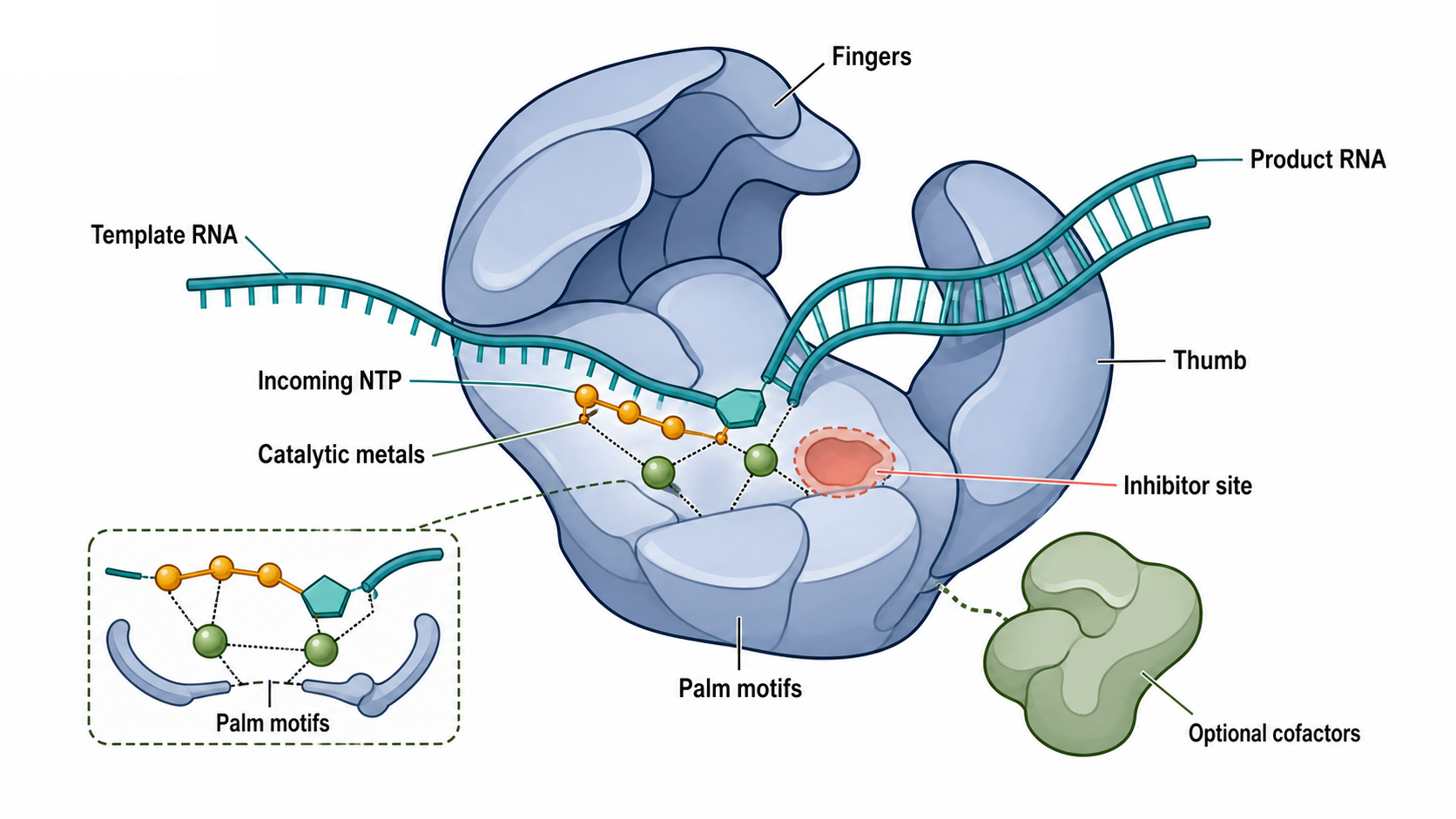
Figure 23.1. RdRP Architecture and Active-Site Motifs. Show template RNA, product RNA, incoming ribonucleoside triphosphate, catalytic metal ions, conserved palm motifs, and the fingers and thumb around the substrate channels. Add family-specific domains and cofactors only to illustrate how they alter initiation, processivity, substrate handling, or inhibitor access without changing the conserved catalytic reaction.
A Conserved Polymerase Core in Diverse Viral Machines
An RNA-dependent RNA polymerase must solve a difficult physical problem. RNA is often structured, chemically reactive, and associated with proteins or membranes. The polymerase must recognize a viral or cellular RNA template, position it in a defined register, select ribonucleoside triphosphates, catalyze phosphodiester-bond formation, and keep the product and template arranged long enough to copy the genome or transcript. Many viral RdRPs solve this problem with a conserved core fold that resembles a cupped right hand. The palm contains catalytic motifs, the fingers help bind incoming nucleotide and template, and the thumb helps enclose the product-template duplex.
The right-hand description is a useful teaching model, but it is not a complete structural classification. RdRPs from different virus families can include N-terminal capping or methyltransferase domains, membrane-association surfaces, priming loops, processivity cofactors, or interfaces for nucleoproteins and helicases. Positive-sense RNA viruses often replicate on membrane-associated replication organelles. Negative-sense RNA viruses often keep genome RNA coated by nucleoprotein and copy it within ribonucleoprotein assemblies. Double-stranded RNA viruses can copy RNA inside capsids. These contexts affect template access and product release.
The catalytic center uses the same broad two-metal-ion logic seen in many polymerases. Conserved acidic residues coordinate divalent metal ions, usually Mg2+ in physiological reactions, that help activate the primer 3′ hydroxyl and stabilize transition-state charge. The incoming nucleotide is selected by base pairing with the template and by contacts with the polymerase. The enzyme then translocates so the next template base can be read. This simple cycle becomes biologically rich because small changes in nucleotide selection, translocation, pausing, or product release can change viral fitness, recombination, and drug sensitivity.
Structural biology has made this logic visible. The SARS-CoV-2 RdRP structure showed nsp12 with nsp7 and nsp8 cofactors arranged to support RNA synthesis. The structure did not mean that every detail of coronavirus replication was solved, but it provided a physical framework for understanding template entry, product exit, cofactor function, and nucleotide analog inhibition. Structural reviews of viral RdRPs emphasize both conservation of the catalytic core and family-specific variations that shape initiation and drug targeting.
De Novo Initiation
De novo initiation is primer-independent synthesis. The enzyme forms the first phosphodiester bond without extending a preexisting 3′ hydroxyl on a primer. This is chemically demanding because a stable product-template duplex has not formed at the start of the reaction. The polymerase must hold the template base, initiating nucleotide, and next nucleotide in a geometry that permits bond formation. Many de novo-initiating polymerases use structural elements that stabilize the initiating nucleotides, such as priming loops or pockets that support the first base pair.
Flavivirus NS5 is a useful example. NS5 contains an N-terminal methyltransferase domain involved in RNA cap formation and a C-terminal RdRP domain that replicates viral RNA. Flavivirus RNA replication initiates without a primer at terminal RNA structures. A conserved arginine in NS5 contributes to binding of the genomic 3′ stem-loop RNA and supports primer-independent initiation. The important point is not that a single residue explains all initiation specificity, but that initiation depends on contacts among polymerase, terminal RNA structure, and initiating nucleotides.
De novo initiation influences genome-end biology. The first nucleotide of a viral genome end is hard to copy accurately if the enzyme slips, starts internally, or fails to stabilize the template terminus. Viruses therefore evolve terminal RNA structures, protein cofactors, or initiation platforms that protect genome-end identity. Failure at this stage can produce defective genomes, truncated products, or nonproductive abortive RNAs.
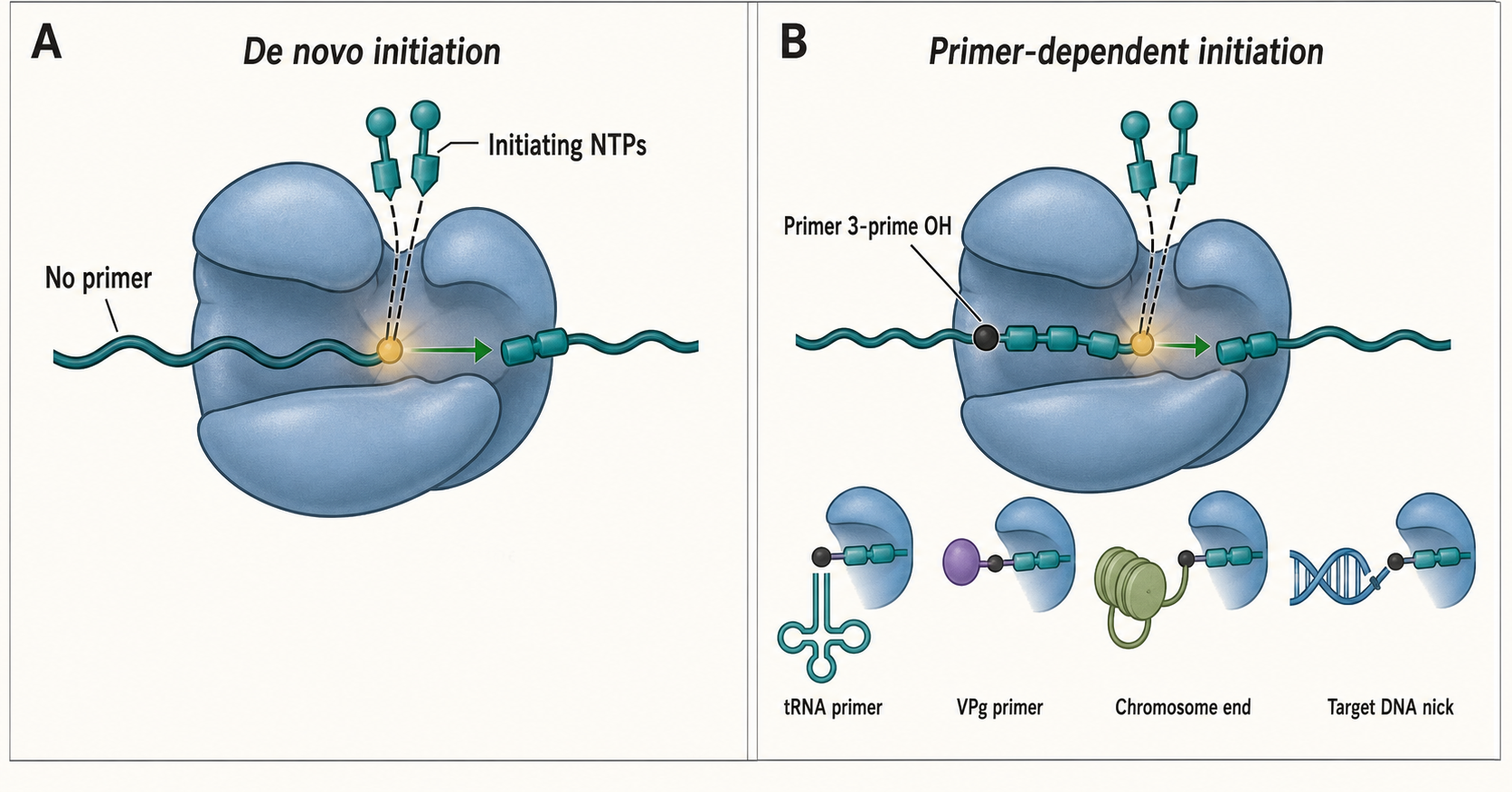
Figure 23.2. De Novo and Primer-Dependent Initiation. Compare stabilization of the first nucleotide pair without a preexisting primer against extension of a supplied 3′ hydroxyl. Label the distinct active-site geometry, template-end recognition, primer identity, and kinetic checkpoints; use viral or cellular systems only as brief enzyme examples.
Primer-Dependent Initiation
Primer-dependent initiation starts from an existing 3′ hydroxyl. The primer may be a small RNA, a host tRNA, a protein-linked nucleotide, a DNA end, or a product strand that folds back onto its own template. A primer gives the polymerase a chemical handle, but it creates a biological dependency: the system must provide the primer at the right position and time.
Picornaviruses illustrate protein-linked priming. Poliovirus uses a small viral protein, VPg, that becomes uridylylated and serves as a primer for RNA synthesis. Biochemical studies of poliovirus 3Dpol helped establish primer-dependent synthesis and covalently linked RNA products in this system. This strategy couples replication to a viral protein and helps define genome-end structures.
Retroviruses illustrate a different primer logic. A host tRNA anneals to the primer-binding site on the viral RNA genome, and RT extends the tRNA to begin minus-strand DNA synthesis. Telomerase uses the 3′ end of a chromosome as the primer. These examples show why primer-dependent is a chemical category, not a single biological strategy.
Boundary Cases and Assay Interpretation
The boundary between de novo and primer-dependent synthesis can be blurred by back-priming, snap-back structures, terminal transferase-like additions, and template switching. An RNA molecule can fold so that its own 3′ end primes synthesis. A polymerase can add non-templated nucleotides before templated synthesis. A nascent product can transfer to a new template and continue synthesis. These reactions should not be classified from sequence outcome alone. The classification requires biochemical evidence for the initiating 3′ hydroxyl and the reaction path.
Assays also matter. A purified RdRP may initiate on a short RNA oligonucleotide in vitro, but the same enzyme may require viral proteins, membranes, or nucleocapsid context in cells. Conversely, a reaction that looks inefficient in vitro may be productive in a replication organelle where local concentration, RNA structure, and cofactors are optimized. A careful chapter-level rule is to specify whether a statement comes from purified biochemistry, reconstituted complexes, infected-cell genetics, or structural snapshots.
23.2. Polymerase fidelity, proofreading, recombination, and template switching as enzyme properties
Table 23.2. Fidelity and Proofreading Measurements. Misincorporation, mismatch extension, proofreading, mutation rate, and mutation spectrum measure different stages of error production and survival, so assay context and downstream selection must be separated from intrinsic polymerase fidelity.
| Property | Direct enzyme measurement | Major confounder | Interpretive boundary |
|---|---|---|---|
| Nucleotide discrimination | Competing-substrate kinetics | Nonphysiological substrate or ion conditions | Does not alone determine total error rate |
| Misincorporation | Defined-template product analysis | Sequencing and library errors | Must distinguish incorporation from extension |
| Mismatch extension | Preformed mismatched primer terminus | Sequence-context dependence | A mismatch may pause without terminating synthesis |
| Proofreading | Excision or corrected-extension assay | Cofactor and substrate-presentation dependence | Not a universal RdRP property |
| Population variant frequency | Genome sequencing | Selection, bottlenecks, editing, and sampling | Hand off systems interpretation to Chapter 116 |
Fidelity Is a Balance, Not a Virtue
Fidelity is an enzyme property emerging from nucleotide binding, induced fit, chemistry, mismatch extension, translocation, pausing, and any coupled correction activity. It should be quantified with defined substrates and kinetic or product-based measurements rather than inferred from a generic label such as “error-prone.” Different sequence contexts and nucleotide pools can expose different discrimination steps.
Fidelity has an optimum for a biological system, but population adaptability is not the enzyme measurement. Excess misincorporation can reduce productive synthesis, whereas very high discrimination can impose kinetic or substrate costs. The systems and population consequences of these tradeoffs belong to Chapter 116; this chapter asks which catalytic step changes the error spectrum and at what kinetic cost.
Nucleotide selectivity has several layers. The active site must bind the correct ribonucleoside triphosphate, reject incorrect nucleotides, avoid deoxynucleotides when inappropriate, and decide whether to extend from a mismatch. A mismatch that is incorporated but poorly extended may slow replication, promote pausing, or create an opportunity for template switching. Reviews and fidelity measurements emphasize that polymerase fidelity must be measured with defined templates, substrates, sequence contexts, and analytical methods.
Population Mutation Frequency Is Not Polymerase Fidelity
A common overgeneralization is to infer polymerase error rate directly from viral genome sequences. Sequencing of viral populations captures the survivors of many processes. Polymerase errors occur during replication, but host editing enzymes can introduce changes, damaged templates can miscode, recombination can shuffle segments, bottlenecks can randomly amplify rare variants, and selection can remove lethal genomes. Sequencing and reverse-transcription steps used in the assay can also introduce artifacts. Therefore a mutation spectrum from infected cells is evidence about the viral population, not a pure measurement of polymerase chemistry.
Box 23.1. RNA Virus Mutation Rate Is Not Polymerase Error Rate
- Define fidelity through enzyme discrimination, incorporation, mismatch extension, pausing, and correction on controlled substrates.
- Explain that population variants also reflect host editing, selection, bottlenecks, sampling, and library artifacts.
- Hand off replication-system and population consequences to Chapter 116.
Biochemical fidelity assays narrow the problem by using defined templates and substrates, but they also have limitations. Short templates do not fully reproduce viral genome structure. Purified polymerase may lack cofactors that alter processivity or nucleotide selection. Endpoint assays may miss transient misincorporation or excision. Deep sequencing can be sensitive but must separate true low-frequency products from library artifacts. Strong conclusions about fidelity usually combine purified-enzyme kinetics, structural interpretation, viral genetics, and population sequencing.
Coronavirus Proofreading
Coronaviruses provide the most important exception to the simple statement that RNA viruses lack proofreading. Coronaviruses have unusually large RNA genomes, and their replication machinery includes nsp14, a bifunctional protein with exoribonuclease and methyltransferase activities. The exoribonuclease function, operating with other viral factors, can remove misincorporated nucleotides or certain incorporated analogs from nascent viral RNA. This proofreading capacity helps explain how coronaviruses maintain genomes larger than those of many RNA viruses and why some mutagenic or chain-terminating compounds behave differently against coronaviruses than against viruses without analogous correction.
Proofreading should not be overstated. nsp14 does not convert coronavirus synthesis into high-fidelity cellular DNA replication, and its activity depends on substrate presentation and other replication-complex components. As an enzyme property, proofreading changes the fate of mismatched termini and incorporated analogs and can intersect with pausing and template transfer. Viral genome-size and population consequences hand off to Chapter 116.
Template Switching and Recombination
Template switching occurs when a polymerase and nascent product disengage sufficiently from one template register, pair with another compatible region or molecule, and resume extension. Its probability depends on pausing, processivity, nascent-product stability, sequence complementarity, template structure, substrate concentration, damage, and cofactor geometry. A recombination junction is an outcome; template transfer is the enzyme event that must be demonstrated.
RdRPs, RTs, and RT-based laboratory enzymes can all switch templates, but they need not use the same physical route. In one reconstituted HIV-1 system designed to permit transfer without RNase H cleavage, a polymer trap still blocked transfer after donor synthesis. This result supports RT dissociation before the primer terminus completes transfer rather than a model in which the same RT necessarily escorts the terminus continuously to the acceptor. In the RNase H-dependent invasion route, periodic donor-RNA cleavage exposes the nascent DNA for acceptor pairing and branch migration; template-primer affinity, dissociation rate, and cleavage position can therefore alter transfer efficiency independently.
Group II intron RT provides a contrasting end-to-end mechanism. A thermostable group II intron RT can capture an acceptor whose 3′ terminal nucleotide forms a single base pair with the starter-duplex overhang, discriminate against a terminal mismatch, and then use high processivity to copy the acceptor from its end. These results explain why a junction alone cannot identify whether transfer required RNase H-generated invasion, polymerase dissociation, terminal base pairing, or a laboratory-library artifact. Viral recombination products and their population interpretation hand off to Chapter 116, while life-cycle-specific retroviral strand transfers hand off to Chapter 120.
23.3. Reverse-transcriptase folds, catalytic cycles, and substrate specificity
Reverse Transcription Converts RNA Information into DNA
Reverse transcriptase is an RNA-dependent DNA polymerase. The name reflects the historical surprise that genetic information can flow from RNA to DNA, opposite the usual direction emphasized in simple versions of the central dogma. In modern molecular biology, reverse transcription is not an exception that breaks information flow; it is a well-established enzyme chemistry used by viruses, mobile elements, telomerase, research methods, and some specialized cellular pathways.
Retroviral RTs are often multifunctional enzymes. Mature HIV-1 RT is an asymmetric p66/p51 heterodimer: the two subunits derive from the same Pol sequence, but their polymerase-region subdomains adopt different arrangements, and only p66 retains the C-terminal RNase H domain. The p66 palm contains the polymerase active site, whereas p51 primarily supports substrate and enzyme architecture. The landmark nevirapine-bound structure placed the inhibitor in a deep pocket adjacent to, rather than overlapping, the polymerase active site.
HIV-1 RT can use RNA or DNA templates for DNA polymerization, while its RNase H activity cleaves RNA in RNA-DNA hybrids. Structural and biochemical work resolves these as distinct active sites connected by one substrate-binding trajectory, not as one undifferentiated reaction. These activities are coordinated during conversion of the single-stranded viral RNA genome into double-stranded DNA. The DNA product then becomes a substrate for integration into host chromosomal DNA.
Polymerase and RNase H Catalytic Cycles
Reverse-transcriptase catalysis cycles through substrate binding, nucleotide selection, conformational closure, phosphodiester-bond formation, pyrophosphate release, and translocation. The polymerase domain must accommodate both RNA-DNA and DNA-DNA duplex geometries in many retroviral enzymes. Contacts with the primer terminus and template overhang determine processivity, mismatch extension, pause probability, and sensitivity to incorporated analogs.
RNase H activity adds a second catalytic track. An RNA-DNA hybrid is positioned so the RNase H active site cleaves the RNA strand at geometry-dependent distances from the polymerase site. A sufficiently long hybrid can contact both active sites at once; the enzyme does not have to toggle one substrate between mutually exclusive polymerase-competent and RNase H-competent poses. Pre-steady-state analysis nevertheless found that single-nucleotide polymerization was faster than cleavage, that only a fraction of enzyme-substrate complexes were productive at both sites, and that net cleavage was periodic while polymerization remained processive. Thus, the two chemistries can proceed simultaneously but are not stoichiometrically locked into one cleavage per added nucleotide. Cleavage specificity determines which RNA segments are removed or retained as primers, but the complete sequence of retroviral intermediates belongs to Chapter 120.
The comparative enzyme question is how domain spacing, hybrid conformation, cleavage preference, primer selection, and strand-transfer kinetics are coordinated. Too little cleavage can obstruct template removal; mistimed cleavage can destroy a needed primer; excessive pausing can promote transfer or dissociation. These are measurable catalytic properties rather than a tutorial on the viral life cycle.
Substrate and Primer Diversity
RT-like enzymes accept diverse primer-template substrates: tRNA-primed RNA, nicked DNA paired to an element RNA, chromosome ends aligned to an internal RNA template, structured mobile-element RNAs, and experimentally supplied RNA-DNA hybrids. Substrate specificity depends on duplex geometry, primer chemistry, template structure, accessory domains, and protein or RNA cofactors.
Table 23.3. Reverse-Transcriptase Catalytic Diversity. Retroviral, retroelement, group II intron, telomerase, and repair-associated reverse transcriptases use different primers, templates, products, and coupled activities; reverse transcription is broader than the retroviral life cycle.
| Enzyme example | Primer and template | Polymerase product | Coupled activity | Comparative question |
|---|---|---|---|---|
| Retroviral RT | tRNA- or RNA-primed RNA/DNA templates | DNA | RNase H | How can one hybrid engage polymerase and RNase H sites while cleavage remains periodic and transfer can require RT dissociation? |
| Group II intron RT | Structured intron RNA or an acceptor captured at its 3′ end | DNA | Intron- and RNP-specific functions | How do NTE/RT0, RT2a, the thumb, terminal base pairing, and high processivity support structured-RNA copying and end-to-end switching? |
| Mobile-element RT | Element- or target-specific substrate | DNA | Element-specific activities | How does substrate recognition restrict copying? |
| Telomerase | Chromosome end paired to internal RNA template | Telomeric DNA | RNP-dependent repositioning | What controls repeat-addition processivity? |
| Ec86 retron RT | Cognate ncRNA retained with its DNA product | msDNA in an RNA-DNA product | Effector-bound defense complex | How does a product wrapped around the RT become part of the functional assembly? |
| Polymerase theta | RNA template and DNA repair primer | Short DNA tract | DNA-repair functions | Is RNA-template use physiologically frequent or context-limited? |
Comparative examples show that primer requirements can be unusual, including biochemical systems with primer-independent DNA synthesis or specialized template recognition. Bacterial surveys separate group II intron, retron, diversity-generating, CRISPR-associated, Abi-like, and additional uncharacterized RT lineages. In a substrate-bound group II intron RT, the lineage-specific N-terminal extension/RT0 and RT2a insertion enlarge the template-primer interface, while the thumb follows the duplex minor groove. This extended grip gives a structural explanation for stable engagement of long, structured RNA that cannot be inferred from the retroviral RT fold alone.
Human LINE-1 ORF2p couples a nicked DNA primer to an element RNA during target-primed synthesis, and endogenous retrovirus-K retains an HIV-like RT core but differs in inhibitor response. In the Escherichia coli Ec86 retron, the RT copies part of a cognate noncoding RNA into multicopy single-stranded DNA (msDNA); the resulting RNA-DNA product wraps around an electropositive RT surface, and the defense effector contacts both RT and msDNA. The product is therefore a structural component of a defense complex, not merely a released cDNA. Direct biochemical comparison further shows that thermostable group II intron RTs can exceed common retroviral RTs in structured-RNA processivity, fidelity, and operating temperature. These examples broaden the RT-like enzyme landscape without requiring complete mobile-element life cycles. Target-primed reverse transcription, integration, and element propagation are treated in Chapter 120.
Repeat objects are treated in Chapter 16. Here the same broad RT fold is compared across different primers, templates, accessory domains, nucleotide pools, processivities, and products.
Reverse Transcriptase Fidelity and Inhibitors
RT fidelity depends on nucleotide discrimination, misincorporation chemistry, mismatch extension, pausing, and template transfer. Many retroviral RTs lack intrinsic exonucleolytic proofreading, but error frequency still varies by enzyme, sequence context, nucleotide concentration, substrate geometry, and assay. Direct comparative measurements and group II intron RT biochemistry demonstrate that fidelity is evolutionarily and mechanistically tunable rather than an invariant property of the RT fold. The resulting life-cycle and population consequences belong to Chapter 120.
RT inhibitors demonstrate mechanism-based drug design. Nucleoside or nucleotide RT inhibitors mimic natural substrates after activation and can terminate DNA synthesis or otherwise block extension. Non-nucleoside RT inhibitors bind allosteric pockets in susceptible RTs and inhibit conformational changes needed for polymerization. Resistance mutations may reduce inhibitor binding, alter nucleotide discrimination, promote excision of incorporated analogs, or compensate for loss of polymerase efficiency. These effects can be compared through binding, incorporation, excision, extension, and processivity measurements.
The inhibitor logic should not be transferred uncritically to every RT-like enzyme. Telomerase, LINE RTs, group II intron RTs, and retroviral RTs differ in template, primer, protein architecture, cellular compartment, and product fate. A compound optimized for HIV RT may not inhibit telomerase or a mobile-element RT, and an apparent biochemical inhibitor may fail in cells because the active triphosphate is not produced or because the relevant enzyme is shielded inside an RNP.
Box 23.2. Reverse Transcription Is Broader Than Retroviruses
- Compare retroviral RT, mobile-element RT-like enzymes, telomerase, defense-associated RTs, and context-dependent cellular RNA-templated synthesis by substrate and catalytic cycle.
- Emphasize that shared RNA-to-DNA chemistry does not imply shared primer requirements, coupled activities, product fate, or regulation.
- Contrast RNase H-assisted and dissociation-dependent HIV-1 strand transfer with one-base-pair capture and high-processivity switching by group II intron RT.
- Hand off retroviral and retrotransposon life cycles to Chapter 120.
- Hand off telomerase RNA, TERRA, telomeric chromatin, and telomere-length biology beyond catalysis to Chapter 100.
23.4. Telomerase reverse-transcriptase catalysis and use of an internal RNA template
Telomerase Is an RNP Reverse Transcriptase
Telomeres are repetitive DNA-protein structures at the ends of linear eukaryotic chromosomes. They help solve the end-replication problem: conventional DNA polymerases cannot fully replicate the extreme end of a linear chromosome after removal of the final RNA primer. Telomerase solves this problem in many eukaryotes by adding telomeric repeats to chromosome ends.
Telomerase is a ribonucleoprotein enzyme. The protein catalytic subunit, telomerase reverse transcriptase, contains reverse-transcriptase motifs. The RNA component, called TERC in vertebrates, provides a short template sequence used to copy telomeric DNA repeats and also contributes structural elements needed for RNP assembly and regulation. The chromosome end supplies the primer 3′ hydroxyl. Telomerase aligns that DNA end with the internal RNA template, adds nucleotides, then can reposition the DNA relative to the RNA template to add another repeat. Mechanistic review and substrate-bound cryo-electron microscopy support this sequence while distinguishing catalytic-core contacts from recruitment and RNP-biogenesis functions.
Two kinds of movement occur during this cycle. Nucleotide translocation advances the template-product duplex by one register after each nucleotide-addition event. Repeat translocation occurs after the template has been copied: the RNA-DNA duplex is destabilized and separated, the RNA template returns to its starting register, and the product 3′ end pairs again near the template beginning. Structures of Tetrahymena telomerase at several nucleotide-addition states show that fixed contacts to template-flanking RNA define the usable 5′ and 3′ boundaries while intervening RNA changes conformation; a proposed repeat-reset pathway passes through duplex distortion, melting, template repositioning, and re-pairing. Human telomerase structures instead emphasize two separated DNA-contact surfaces around the catalytic core and TEN–IFD region that can retain single-stranded product while the active-site duplex is reset. These structures support a distributed retention mechanism rather than requiring one permanently occupied, isolated “anchor site”. Species-specific RNP architecture should not be mistaken for a universally identical translocation machine.
This repeat-addition cycle makes telomerase different from retroviral RT. A retroviral RT copies much of a viral RNA genome into DNA. Telomerase copies a short internal RNA template repeatedly onto a DNA end. A retroviral product is integrated into the genome by viral integrase. A telomerase product remains at a chromosome end and is processed into telomeric chromatin. Telomerase is therefore a reverse transcriptase by chemistry, but a telomere-maintenance enzyme by biological role.
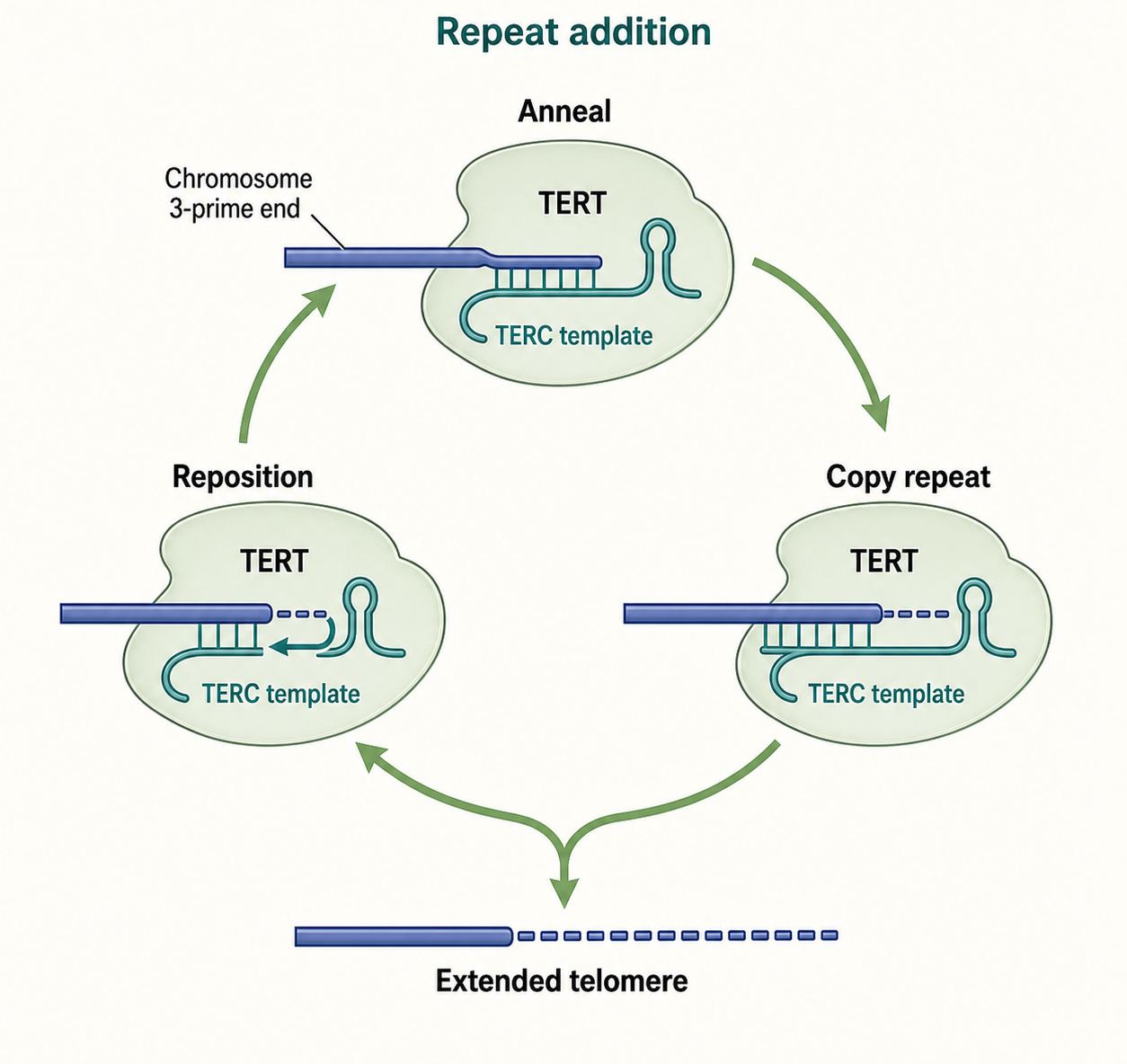
Figure 23.4. Telomerase Repeat-Addition Cycle. Show chromosome-end primer alignment to the internal telomerase RNA template, one-register nucleotide translocation during repeat synthesis, the template-encoded pause, repeat completion, duplex distortion and melting, template reset, rapid product 3′-end realignment, the slower return of the hybrid to an elongation-competent active site, and renewed extension. Distinguish nucleotide translocation from repeat translocation and nucleotide-addition processivity from repeat-addition processivity. Depict DNA retention as distributed contacts around the catalytic core and TEN–IFD region rather than one rigid, universally conserved anchor-site pocket. Mark the human single-molecule kinetic assignments separately from the Tetrahymena structural-state model so species and evidence type remain visible. Keep the diagram at the catalytic-cycle level and hand telomerase RNA biogenesis, TERRA, telomeric chromatin, and telomere-length regulation to Chapter 100.
Two forms of processivity must also be separated. Nucleotide-addition processivity describes how many nucleotides telomerase adds before dissociating during one pass across its RNA template. Repeat-addition processivity describes whether the enzyme retains the DNA product, repositions its new 3′ end at the beginning of the template, and synthesizes another telomeric repeat. The human RNA template encodes a sequence-dependent pause before the physical template boundary, which helps prevent copying of flanking nontelomeric RNA. Single-molecule measurements further separated rapid re-pairing of the product 3′ end at the template start from a slower conformational step that returns the realigned hybrid to an elongation-competent active site. Primer realignment itself was therefore not the rate-limiting step in that assay.
An endpoint ladder of products can reflect nucleotide-addition processivity, repeat-addition processivity, product rebinding, and the abundance of active enzyme. Direct extension, pulse–chase, substrate-trapping, single-turnover, and single-molecule assays answer different parts of this cycle. Telomerase catalysis in this chapter ends at alignment, nucleotide addition, translocation, and repeat synthesis; assembly of the RNA component and chromosome-end regulation are primary topics of Chapter 100.
Regulation and Disease Context
Telomerase activity is tightly regulated. Many somatic human cells have low or undetectable telomerase activity, whereas germ cells, stem-cell compartments, activated lymphocytes, and many cancer cells can maintain telomeres more actively. TERT expression, telomerase RNA abundance, RNP assembly, trafficking, recruitment to telomeres, and telomere-binding proteins all influence activity. These contextual variables matter here because they determine which enzyme species and substrate concentration an assay actually measures. In cultured-cell tests, complete loss of repeat-addition processivity was incompatible with telomere maintenance, whereas enzymes with reduced processivity could maintain short telomeres and could elongate telomeres when overexpressed. Catalytic processivity and enzyme abundance therefore interact rather than defining interchangeable phenotypes. Their biological regulation is treated in Chapter 100. Telomere length is not a direct readout of catalytic activity alone; it is the integrated outcome of replication, telomerase action, end processing, nucleases, shelterin proteins, recombination, and cell division history.
Telomerase is clinically important in two opposite directions. Insufficient telomere maintenance contributes to telomere biology disorders, whereas excess or reactivated telomerase supports long-term proliferation in many cancers. These examples explain why catalytic inhibition is biologically consequential, but the disease mechanisms and telomere-maintenance phenotypes belong to Chapter 100. From an enzyme perspective, telomerase inhibition can act by competing with nucleotide substrates, disrupting template-primer alignment, reducing repeat-addition processivity, or perturbing essential RNP conformations. Distinct noncanonical nucleotides illustrate why “inhibition” must be mapped to a catalytic step: incorporated 8-oxo-dGTP can terminate nucleotide addition, whereas 2-hydroxy-dATP and 6-thio-dGTP can preferentially impair repeat translocation and subsequent repeat addition.
The allosteric inhibitor BIBR1532 provides a different mechanism. Its crystallographic pose was determined in the catalytic subunit from Tribolium castaneum, where it occupies a conserved hydrophobic FVYL pocket on the outer thumb near an RNA-interaction surface; human TERT mutagenesis and RNA-binding assays support disruption of TERT–RNA assembly or function rather than active-site competition. The species difference, isolated-domain binding measurements, and cellular delay before telomere shortening all require orthogonal validation before a structural pose is equated with human cellular efficacy.
Boundary Cases
Not all organisms use telomerase in the same way, and not all chromosome ends are maintained only by telomerase. Telomerase RNA structure and accessory proteins vary among lineages, and some cells maintain chromosome ends by recombination rather than by telomerase. Therefore the conserved enzyme concept is RNA-templated extension of a DNA 3′ end, not uniform vertebrate telomerase architecture. Comparative telomere systems, TERRA, and alternative lengthening of telomeres are treated in Chapter 100.
Another misconception is that telomerase is only a viral RT captured by the cell. Telomerase and retroviral RTs share broad reverse-transcriptase ancestry and active-site chemistry, but telomerase is deeply specialized as an RNP that acts on chromosome ends. Treating telomerase as only a domesticated viral enzyme obscures telomere recruitment, repeat-addition processivity, RNP maturation, and chromosome-end regulation.
23.5. Primer-dependent and primer-independent RNA-templated synthesis
Primer Identity Shapes the Catalytic Cycle
Primer-dependent and primer-independent initiation are not minor mechanistic labels. They shape active-site geometry, initiation kinetics, substrate specificity, processivity, and inhibitor sensitivity. A primer-dependent enzyme must bind a suitable 3′ hydroxyl. A primer-independent enzyme must stabilize initiating nucleotides without one. Both strategies solve the same chemical requirement in different ways.
Host tRNA priming ties retroviral replication to abundant cellular RNAs and creates a defined primer-binding site on the viral genome. Protein priming, as in picornavirus VPg-linked initiation, physically links a viral protein to the nascent genome and helps specify terminal sequences. Telomerase uses a chromosome end as primer, linking reverse-transcriptase activity to cell-cycle-regulated telomere access. Target-primed reverse transcription uses a nicked DNA target as primer, linking DNA-site choice to cDNA synthesis.
Primer-independent RdRPs must solve the problem of initiation stability. They often rely on terminal RNA structures, initiation-specific conformations, or priming loops. The initiation complex can be more fragile than an elongation complex because few base pairs have formed. This fragility can make initiation a regulated or drug-sensitive step. It can also create abortive products if the polymerase repeatedly initiates but fails to escape into processive elongation.
Classification Table in Prose
The following examples anchor the classification. Flavivirus NS5 uses de novo initiation for RNA replication from structured viral RNA ends. Poliovirus uses a protein-linked primer strategy in which VPg uridylylation supports RNA synthesis. Retroviral RT uses a host tRNA primer to begin minus-strand DNA synthesis. Telomerase uses a telomeric DNA 3′ end as primer while reading its own RNA. LINE-like retroelements often use a nicked target DNA 3′ hydroxyl as primer for reverse transcription. Some mobile-element polymerases show primer-independent DNA synthesis in biochemical systems.
These examples show why the words RNA-templated and primer-independent answer different questions. RNA-templated identifies the template. Primer-independent identifies how synthesis starts. A telomerase reaction is RNA-templated but primer-dependent. A flavivirus RdRP reaction is RNA-templated and de novo. A target-primed LINE reaction is RNA-templated DNA synthesis but primer-dependent on a DNA break.
Experimental Caveats
Primer use can be misassigned if experiments rely only on product length. A product of the expected size could arise by de novo initiation, back-priming, primer extension, or template switching. Mapping the product ends, altering candidate primers, mutating terminal RNA structures, using chemically blocked 3′ ends, and reconstituting purified components can help distinguish mechanisms. In cells, genetic perturbations of primer-producing factors or template-end structures provide additional evidence, but indirect effects must be considered.
23.6. Inhibition, resistance, and catalytic consequences of template switching
Template Switching as an Enzyme Reaction
Template switching is a physical event during synthesis. A polymerase pauses, loosens or releases the original template register, allows the nascent product to pair with another compatible region or molecule, and resumes extension. The measurable enzyme properties are switch frequency, donor and acceptor dependence, homology requirement, pause duration, processivity, product-end stability, and the effects of cofactors or inhibitors.
Programmed retroviral strand transfer, RNA-virus template transfer, and RT-based sequencing provide distinct experimental examples. Laboratory RTs can deliberately switch templates to add adapters or capture RNA ends, while unintended switching creates artifacts. Complete viral and retroelement programs hand off to Chapter 116 and Chapter 120.
Template switching is influenced by sequence identity, RNA structure, polymerase processivity, template abundance, substrate geometry, and damage. RNA structures can pause polymerases and expose nascent product ends. Acceptor concentration can change the apparent reaction order. Observed recombinant products are a selected subset of enzyme switching events, so junction frequency in a population is not a direct switching-rate measurement.
Resistance to Polymerase Inhibitors
Polymerase inhibitors impose selection on both enzyme chemistry and viral life cycle. A nucleoside analog must reach the infected cell, be converted to the active triphosphate or delivered as a usable form, compete with natural nucleotides, enter the active site, be incorporated or block incorporation, and produce a harmful consequence before being excised, proofread, or bypassed. Failure at any step can produce apparent resistance.
Resistance mechanisms can be grouped mechanistically. Discrimination mutations reduce analog binding or incorporation. Excision or pyrophosphorolysis-like mechanisms remove incorporated analogs in some RT contexts. Proofreading can remove incorporated analogs in coronaviruses. Extension mutations allow a polymerase to continue after an analog that would otherwise terminate or pause the chain. Compensatory substitutions can restore catalytic efficiency or processivity lost by a resistance mutation. Population assembly of resistance combinations belongs to Chapter 116.
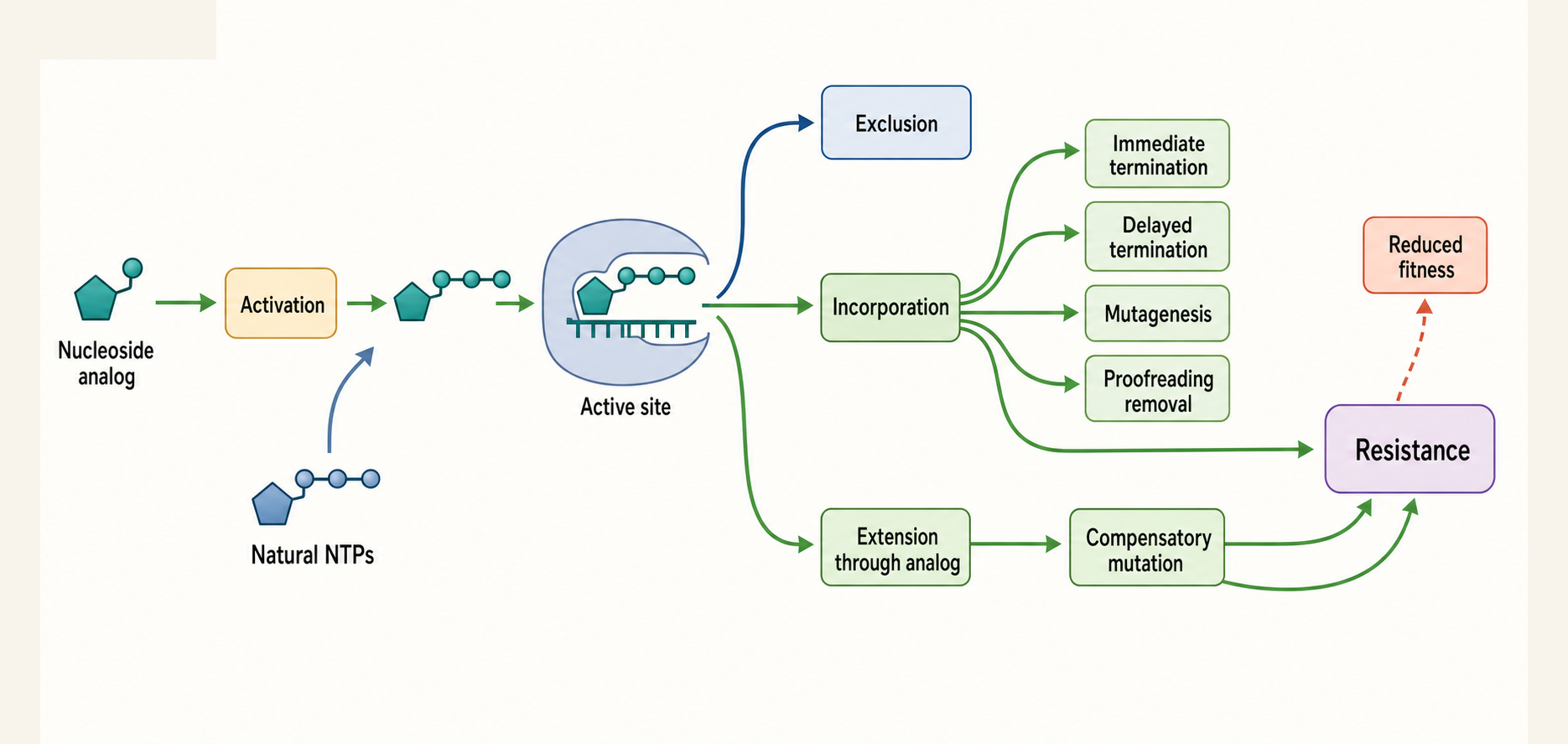
Figure 23.5. Inhibitor and Resistance Logic. Trace activation, active-site entry, substrate competition, incorporation or allosteric inhibition, extension outcome, excision or proofreading, and resistance substitutions. Separate immediate termination, delayed termination, mutagenesis, analog exclusion, extension past an analog, and compensatory effects on processivity.
Table 23.4. Nucleoside-Analog Mechanisms. Nucleoside analogs can be excluded, incorporated, terminate synthesis immediately or later, increase mutation, or be removed by proofreading; outcome depends on activation, enzyme context, and resistance route rather than a universal chain-termination model.
| Analog outcome | Enzyme-level observation | Resistance route | Essential caveat |
|---|---|---|---|
| Exclusion | Reduced binding or incorporation | Increased discrimination | Selectivity must be compared with host polymerases |
| Immediate termination | No extension after incorporation | Reduced incorporation or excision | Requires intracellular activation and access |
| Delayed termination | Several additions before stalling | Extension-permissive substitutions | Endpoint assays can misassign the arrest site |
| Mutagenesis | Increased ambiguous pairing or misincorporation | Increased discrimination or proofreading | Population spectra are filtered by selection |
| Proofreading-sensitive inhibition | Analog incorporation followed by removal | Enhanced excision or substrate presentation | Proofreading varies by enzyme complex |
| Telomerase nucleotide-addition arrest | 8-oxo-dGTP incorporation blocks further addition | Altered discrimination or incorporation | Nucleotide-addition arrest is not the same as failed repeat translocation |
| Telomerase repeat-translocation defect | 2-hydroxy-dATP or 6-thio-dGTP incorporation impairs subsequent repeat addition | Altered substrate handling | The modified product can perturb RAP without acting as a universal replicative-polymerase terminator |
| Allosteric inhibition | BIBR1532 occupies the telomerase thumb FVYL pocket or another inhibitor alters a conformational transition | Pocket or interface substitutions | An ortholog or isolated-domain pose does not by itself predict human holoenzyme or cellular potency |
Not all nucleoside analogs are obligate chain terminators. Some cause immediate termination because they lack a usable 3′ hydroxyl. Some cause delayed termination after additional nucleotides are added. Some increase mutation frequency by ambiguous base pairing. Some primarily slow the polymerase. Some are effective in one virus family and weak in another because of activation metabolism, active-site geometry, proofreading, or replication compartment access.
Box 23.3. Nucleoside Analogs Are Mechanistically Diverse
- Distinguish exclusion, immediate or delayed termination, mutagenesis, extension, excision, and proofreading.
- Separate enzyme inhibition from cellular activation, delivery, host selectivity, and clinical efficacy.
- Connect each resistance substitution to the catalytic or conformational step it changes.
The resistance lesson for therapeutics is that sequence conservation is only the first screen. A conserved active site can still be inaccessible, proofread, compensated, or intolerant of host toxicity. Conversely, an allosteric pocket can be less conserved but clinically useful if it creates a high-resistance barrier in a specific virus. Rational antiviral design requires chemistry, enzymology, cell biology, pharmacology, and evolutionary genetics.
RNA-Templated Repair and Cellular Boundary Cases
Polymerase theta is a DNA repair polymerase implicated in microhomology-mediated end joining and other repair contexts. Biochemical and cell-based work reported that polymerase theta can reverse transcribe RNA and may promote RNA-templated DNA repair in certain settings. This finding is important because it shows that RNA-templated DNA synthesis is not confined to retroviruses, retroelements, and telomerase.
The boundary is equally important. Evidence that an enzyme can reverse transcribe RNA in vitro does not mean that most DNA repair in cells uses RNA templates. Cellular RNA-templated repair claims require evidence for the RNA template, the DNA product, the enzyme, the repair context, and exclusion of alternative explanations such as DNA contamination, cDNA intermediates from retroelements, or sequencing artifacts. This field should be taught as an expanding but context-dependent area, not as a replacement for established DNA-repair mechanisms.
23.7. Comparative kinetics, specificity, assay design, and drug-target logic
Shared Chemistry, Different Biological Programs
RdRPs, retroviral RTs, telomerase, LINE-like RTs, and polymerase theta-like RNA-templated reactions all use template-directed nucleotide addition. They differ in five practical variables: template, product, primer, accessory machinery, and product fate. RdRPs read RNA and make RNA, usually to replicate viral genomes or generate viral transcripts. Retroviral RTs read RNA and make DNA that integrates. Telomerase reads an internal RNA template and extends a chromosome end. LINE-like elements often use target DNA as the primer and create new insertions. Polymerase theta-associated RNA-templated synthesis, where it occurs, is linked to repair outcomes rather than viral propagation.
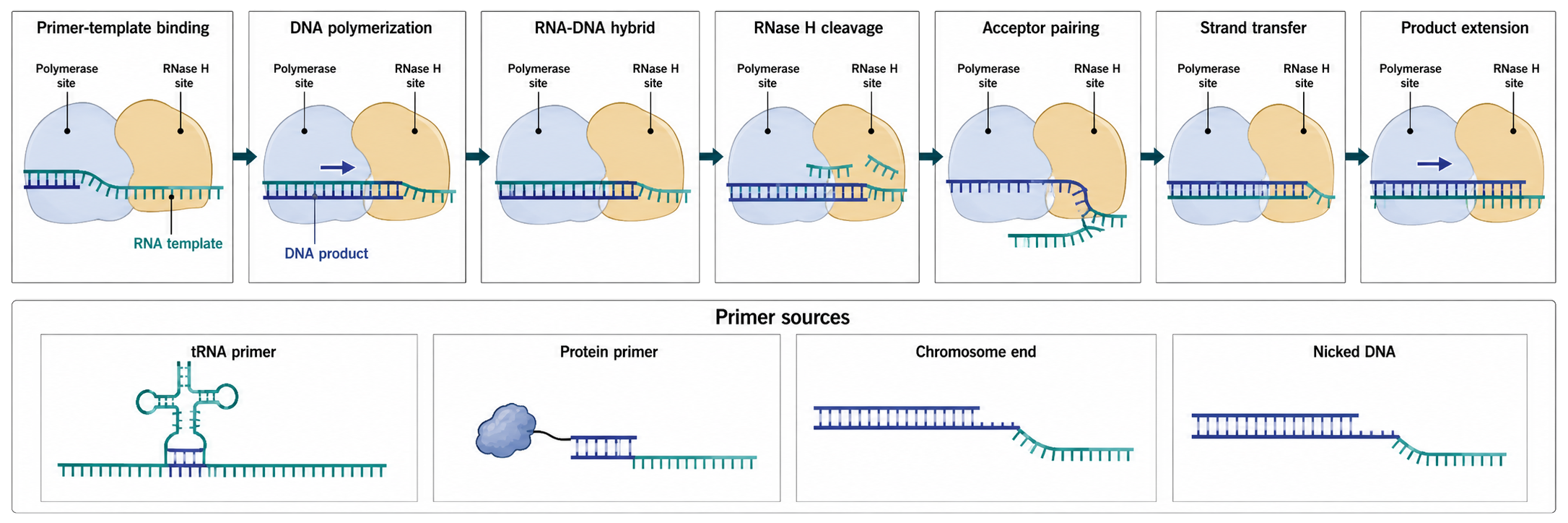
Figure 23.6. Reverse-Transcriptase Catalytic Cycle and Primer-Dependent Handoffs. Follow an enzyme-centered retroviral RT route through primer-template binding, DNA polymerization, RNA-DNA hybrid formation, RNase H cleavage of the RNA strand, acceptor pairing, strand transfer, and renewed DNA extension. Keep the polymerase and RNase H active sites distinct along one substrate trajectory and avoid the complete viral life cycle. A separated inset compares tRNA, protein, chromosome-end, and nicked-DNA primers across the enzyme classes in this chapter, emphasizing that shared primer dependence does not imply a shared pathway. Figure suffix 03 is retired because its former full retroviral reverse-transcription pathway duplicated the life-cycle ownership of Chapter 120. The suffix is reserved and must not be reused.
These distinctions explain why one inhibitor class does not automatically translate across systems. An RdRP nucleoside analog competes with ribonucleoside triphosphates in an RNA-synthesis active site. An HIV RT inhibitor competes with deoxynucleoside triphosphates or binds an allosteric RT pocket. A telomerase inhibitor must affect a low-abundance RNP whose phenotypic effects may appear only after telomeres shorten. A LINE inhibitor would need to reach a ribonucleoprotein assembly, a target-primed reaction, or a host dependency. The shared polymerase word can mislead if the biological program is ignored.
Enzymology Checklist for Drug Targets
A polymerase target should be evaluated by a checklist. What is the template, and is it naked, structured, protein-coated, membrane-associated, or chromatin-associated? What is the product, and how is product formation measured? Does synthesis start de novo or from a primer? Which cellular or viral factors are required? Which nucleotide pool is used? Are there proofreading, excision, or RNase H activities? Where in the cell does the reaction occur? How many genome copies or templates are present? What fitness cost follows resistance? What host enzymes are needed for drug activation? What host polymerases might be inhibited?
For RdRPs, active-site conservation supports broad-spectrum antiviral ambitions, but broad-spectrum activity is constrained by cellular activation, toxicity, viral proofreading, and family-specific active-site geometry. For RTs, decades of HIV therapy show that potent inhibition is possible, but resistance and toxicity require combination strategies and careful pharmacology. For telomerase, the target is attractive in cancer but slow phenotypic kinetics and effects on stem-cell compartments complicate development. For emerging RNA-templated repair or mobile-element systems, the first challenge is often target validation rather than inhibitor optimization.
Evidence Standards
The strongest mechanistic claims combine structural, biochemical, genetic, and cellular evidence. A structure can show how an inhibitor binds, but not by itself prove antiviral efficacy. A biochemical assay can show incorporation or termination, but not by itself prove cellular activity. A cell-based assay can show reduced viral replication, but not by itself prove direct polymerase targeting. Resistance mutations can link target and drug, but compensatory changes and indirect effects must be considered. Clinical efficacy requires pharmacokinetics, safety, and patient-level outcomes beyond enzyme inhibition.
This evidence ladder is especially important for natural products and repurposed compounds reported as RdRP inhibitors. Many compounds inhibit polymerase reactions at high concentration, interfere with assay readouts, or affect host-cell health. A credible inhibitor claim should specify potency, assay format, selectivity, cytotoxicity, intracellular activation if relevant, resistance mapping if possible, and orthogonal validation.
Assay Design Must Match the Enzyme Property
An endpoint product yield does not identify a catalytic rate. Yield can integrate active-enzyme concentration, substrate binding, initiation, elongation, pausing, processivity, dissociation, rebinding, product inhibition, and substrate depletion. Steady-state measurements can compare turnover under repeated catalytic cycles, whereas pre-steady-state or single-turnover experiments can isolate nucleotide binding, incorporation, or chemistry when enzyme is in excess over substrate. Apparent Michaelis constants should not be treated automatically as substrate-binding constants, and an inhibitor concentration that halves signal in one assay is not a universal measure of affinity.
Fidelity assays likewise answer different questions. A single-nucleotide competition assay measures discrimination under a defined sequence and substrate ratio. A full-length product assay integrates misincorporation, mismatch extension, pausing, and dropout. A sequencing-based fidelity assay adds reverse-transcription, amplification, and sequencing errors unless it has suitable molecular controls. Viral population frequencies add host editing, selection, bottlenecks, and sampling. Direct comparative measurements show that polymerase and RT fidelity can be evolutionarily tuned, but the estimate is meaningful only with the substrate, kinetic regime, and error model stated.
Assays also need class-specific controls. RdRP studies should distinguish de novo initiation from extension of contaminating or self-primed ends. RT studies should separate polymerase activity, RNase H cleavage, strand transfer, and template-switch artifacts. Telomerase studies should distinguish nucleotide-addition from repeat-addition processivity and control for rebinding. In the PCR-amplified telomeric repeat amplification protocol (TRAP), primer-dimer extension and staggered annealing of the repeat-complementary primer can generate a six-nucleotide ladder whose band lengths do not preserve the lengths of the original telomerase products. A modified reverse primer can suppress this slippage, but even a well-controlled TRAP signal reports amplifiable activity rather than the direct product distribution or processivity of one enzyme-binding event. Inhibitor studies should compare active-enzyme concentration, natural-substrate competition, aggregation or readout interference, host-polymerase selectivity, and cellular activation. These controls convert an observed product band or signal decrease into a defensible catalytic claim.
Experimental Foundations and Evidence
Structural methods reveal polymerase architecture and substrate positioning. Cryo-electron microscopy is especially powerful for large viral replication complexes and telomerase RNPs, whereas X-ray crystallography and cryo-EM both contribute to polymerase active-site models. Structural snapshots must be interpreted as states along a reaction path; they do not automatically define kinetics or cellular order.
Biochemical reconstitution tests what an enzyme can do with defined templates, primers, nucleotides, ions, and cofactors. Primer-extension assays, single-nucleotide incorporation assays, misincorporation assays, and chain-termination assays can dissect mechanism. These assays are strongest when templates are well-defined and product identities are mapped. They are weaker when product mixtures are inferred only by gel mobility.
Viral genetics tests whether a residue, cofactor, or reaction matters in the life cycle. Mutations in RdRP active-site motifs, priming residues, proofreading enzymes, or RT domains can affect replication, recombination, drug sensitivity, and fitness. The caveat is that lethal or pleiotropic mutations can be hard to interpret. A change that blocks viral growth may disrupt folding, assembly, localization, or interactions rather than the proposed catalytic step alone.
Sequencing reveals product populations, mutation spectra, recombination junctions, and resistance evolution. Sequencing is indispensable but artifact-prone. Library preparation may involve reverse transcription, PCR, template switching, damaged nucleotides, and alignment biases. Strong conclusions about RNA-templated synthesis use controls that separate biological template switching from sample-preparation switching.
Clinical and pharmacological evidence is required for therapeutic claims. Enzyme inhibition and cell-culture antiviral activity are not equivalent to clinical benefit. Drug exposure, tissue distribution, metabolism, toxicity, resistance barrier, disease timing, and host immune status shape outcomes. Polymerase enzymology provides the mechanism; clinical studies test whether that mechanism can be used safely and effectively.
Biological Contexts Across Systems
Viral RdRPs provide comparative examples of how a conserved catalytic core adapts to different template states. Positive-sense, negative-sense, and double-stranded RNA virus enzymes differ in initiation structures, cofactor interfaces, nucleoprotein handling, processivity, and product release. Their complete replication complexes and genome programs belong to Chapter 116.
Retroviral and retrotransposon RTs provide examples of primer-dependent DNA synthesis, RNA-DNA hybrid recognition, RNase H coupling, strand transfer, and inhibitor resistance. Their packaging, integration, target choice, latency, and complete life cycles belong to Chapter 120.
Telomerase, polymerase theta, mobile-element RT-like enzymes, and viroid-associated RNA-templated transcription broaden the comparative set. They show that internal RNA templates, chromosome-end primers, repair substrates, unusual initiation modes, and redirected polymerases can change specificity without changing the fundamental chemistry of template-directed nucleotide addition. Telomerase RNA, TERRA, telomeric chromatin, and telomere-length control beyond the catalytic cycle are treated in Chapter 100.
Technology, Computational, and Clinical Links
Reverse transcription is foundational to RNA measurement. Complementary DNA synthesis underlies RT-PCR, many RNA-seq workflows, rapid amplification of cDNA ends, and single-cell transcriptomics. The same RT properties that enable these methods also create biases: template switching, premature termination, sequence-dependent efficiency, RNA modification sensitivity, and misincorporation can affect data. Method chapters later in the book treat these workflows in detail, but the enzymology belongs here.
RdRPs and RTs are major therapeutic targets. SARS-CoV-2 renewed attention to RdRP inhibitors, especially nucleoside analogs and active-site strategies. Influenza polymerase inhibitors, hepatitis C polymerase inhibitors, HIV RT inhibitors, and hepatitis B reverse-transcription-linked inhibitors demonstrate that polymerase targeting can be clinically successful when mechanism, pharmacology, and resistance are handled together.
Computational analysis supports polymerase biology in several ways. Comparative genomics identifies conserved motifs and evolutionary relationships. Molecular dynamics and docking can generate hypotheses about nucleotide analog binding, although such predictions require biochemical validation. Deep sequencing tracks resistance mutations and recombination. Phylogenetics helps distinguish repeated mutation from recombination or reassortment. Computational confidence should be calibrated to experimental support.
Synthetic biology also uses RNA-templated enzymes. RTs support recording systems, mutagenesis tools, and RNA-to-DNA information transfer. RdRP-like activities and self-amplifying RNA platforms are relevant to vaccine and therapeutic design. These applications must account for innate immune sensing, fidelity, byproducts, and containment of replicative functions.
Recent Consensus
Current consensus supports several broad statements. Viral RdRPs share conserved catalytic logic while family-specific domains and cofactors alter initiation, substrate handling, processivity, fidelity, and inhibitor response. Initiation mode is a major mechanistic variable, with de novo and primer-dependent strategies distributed across enzyme classes. Polymerase fidelity cannot be inferred directly from population sequences. Coronavirus nsp14-associated exonuclease activity is a major comparative example of coupled RNA proofreading.
Reverse transcription is a broad biological process rather than a retrovirus-only pathway. Retroviral RTs, retroelements, telomerase, and selected cellular or mobile-element enzymes all use RNA-templated DNA synthesis, but they differ in primer use, product fate, and regulation. Retroviral RNase H and polymerase chemistry can be available on the same substrate without being locked into one-for-one catalysis, and template transfer uses mechanism-specific combinations of cleavage, dissociation, pairing, and processivity. Telomerase is firmly understood as an RNP reverse transcriptase specialized for telomere maintenance, with nucleotide translocation and repeat translocation as distinct steps rather than one generic processivity event.
For therapeutics, the consensus is mechanistic caution. Polymerase active sites are powerful drug targets, but drug success depends on activation metabolism, substrate competition, incorporation chemistry, proofreading or excision, cellular compartment, host toxicity, and resistance barrier. Broad claims based only on docking, sequence conservation, or high-concentration enzyme inhibition are insufficient.
Open Questions, Controversies, Deprecated Models, and Common Misconceptions
Open questions:
- How do cofactor geometry, template structure, substrate concentration, pausing, and processivity quantitatively determine RdRP and RT template-switching rates?
- How do RNA modifications in viral or host RNA templates influence RdRP and RT fidelity? Some modifications can alter base pairing, pausing, or reverse-transcription behavior, but effects are enzyme- and context-dependent.
- How widespread is physiologically meaningful RNA-templated DNA repair in cells? Polymerase theta and related findings support plausible mechanisms in specific settings, but the field still needs careful evidence separating direct RNA-templated repair from indirect effects and artifacts.
- Can broad-spectrum RdRP inhibitors be designed with high resistance barriers and acceptable host safety across virus families? Conserved catalytic motifs help, but proofreading, activation, toxicity, and family-specific active-site geometry complicate the goal.
Common misconceptions:
- “All RNA viruses have the same error-prone replication strategy.” In reality, fidelity differs among polymerases and lineages, and coronavirus proofreading is a major exception.
- “Reverse transcriptase means retrovirus.” Retroviruses are central examples, but telomerase, retroelements, group II intron-like systems, research enzymes, and some repair-associated contexts also use RNA-templated DNA synthesis.
- “Nucleoside analogs are simple chain terminators.” Some terminate immediately, some terminate after delay, some are mutagenic, some are excised, some are proofread, and some fail because they are not activated in the relevant cells.
- “A recombinant viral sequence proves that template switching occurred in the sampled host.” Recombination may have occurred earlier, may be selected from many invisible products, or may be mimicked by sequencing and assembly artifacts. Evidence should include junction patterns, controls, and epidemiological context.
- “Telomerase activity equals telomere length.” Telomere length reflects many processes, including replication history, nucleases, shelterin regulation, telomerase recruitment, recombination, and cell division.
- “A six-nucleotide TRAP ladder directly measures telomerase run length.” PCR primer dimers and staggered annealing can create or extend the ladder, so direct extension and kinetic controls are required to infer product length or processivity.