Chapter 85. miRNA Turnover, Target-Directed miRNA Degradation, Tailing, Trimming, and Argonaute Dynamics
Scope Note
MicroRNAs (miRNAs) are often introduced as stable regulatory guides that enter Argonaute proteins and repress target RNAs. That description is useful but incomplete. A mature miRNA is not only produced, loaded, and used; it is also protected, modified, unloaded, degraded, diluted by cell division, and sometimes actively destroyed by its own targets. This chapter explains how animal miRNA stability is controlled after Argonaute loading, with special attention to target-directed miRNA degradation (TDMD), 3′ tailing and trimming, uridylation and adenylation, nuclease pathways, ZSWIM8-linked Argonaute dynamics, viral and developmental trigger systems, and the experimental difficulty of proving miRNA decay rather than altered biogenesis or cell composition. The focus is animal miRNA biology, with plant and viral examples used where they clarify boundary cases.
Executive Summary
Mature miRNAs differ from many short RNA fragments because they are loaded into Argonaute proteins. Argonaute binding shields the miRNA’s phosphate backbone and ends from nonspecific nucleases, presents the seed region for target recognition, and creates a long-lived regulatory complex. Basal miRNA stability is therefore a property of both the guide RNA and its protein environment. A free mature miRNA is vulnerable, but an Argonaute-loaded guide can persist for many hours or days, depending on cell type, miRNA sequence, Argonaute abundance, target engagement, cell division, subcellular localization, and decay pathways. The important conceptual shift is that miRNA abundance at steady state is not simply a readout of transcription or processing. It reflects production, Argonaute loading, protection, target-dependent destabilization, and turnover of both the guide and the Argonaute protein.
Target-directed miRNA degradation is a special form of miRNA decay in which a target RNA accelerates destruction of the miRNA that binds it. Ordinary animal miRNA sites usually pair to the seed region and leave the miRNA 3′ end protected inside Argonaute. TDMD triggers are different. They pair strongly to the seed and often to the miRNA 3′ supplementary region, while avoiding efficient AGO2 slicing through central mismatches, bulges, or other geometry that prevents clean cleavage of the target. Structural work shows that such pairing can pull or expose the miRNA 3′ end from its protected position in Argonaute, making the guide susceptible to tailing, trimming, and decay (Sheu-Gruttadauria et al. 2019). TDMD is therefore not just stronger repression of a target; it is a change in the fate of the miRNA-loaded Argonaute complex.
The ZSWIM8 pathway changed the field’s model of TDMD. Earlier descriptions emphasized visible 3′ tailing and trimming of the miRNA, and those signatures remain useful readouts. Han et al. 2020 showed that a cullin-RING ubiquitin ligase pathway centered on the substrate receptor ZSWIM8 is required for many TDMD events and can mediate target-directed miRNA decay independently of tailing and trimming as the initiating cause. In the current working model, unusual trigger-bound Argonaute complexes are recognized by ZSWIM8-linked ubiquitin machinery, Argonaute is ubiquitylated or otherwise committed to remodeling, and the guide becomes destabilized through unloading, decay, or linked protein turnover. Tailing and trimming are therefore mechanistically important but should not be treated as the sole cause of TDMD in all systems.
Tailing and trimming describe 3′ end changes of miRNAs. Tailing is the addition of non-templated nucleotides, most often uridines or adenosines, by terminal nucleotidyltransferases. Trimming is shortening from the 3′ end by exonucleases. These changes generate isomiRs, which are mature miRNA variants that differ in length or terminal sequence. In some cases a single added nucleotide has little functional effect; in other cases oligouridylation marks an RNA for degradation, adenylation stabilizes or destabilizes a specific miRNA, and trimming changes target engagement or detection. The broader uridylation literature shows that 3′ uridylation can either promote decay or remodel RNA processing depending on substrate and context (De Almeida et al. 2018; de Almeida et al. 2018; Menezes et al. 2018; Pirouz et al. 2019). For miRNAs, the rule is context-dependent: a tail can be a decay mark, a processing intermediate, a consequence of trigger-bound exposure, or a stable isomiR feature.
Viruses, developmental programs, and tissue-specific regulatory states provide natural examples of miRNA turnover. Viral noncoding RNAs can act as TDMD triggers against host miRNAs, allowing infection-associated RNAs to reduce selected host miRNA activities. Conversely, engineered or retargeted TDMD sites can be used to deplete abundant viral or cellular miRNAs in experimental settings (Ortega et al. 2024). Developmental mammalian studies show that TDMD can regulate embryonic miRNA expression and growth rather than being only an artificial overexpression phenomenon (Jones et al. 2023). Disease-associated long RNAs have also been proposed to trigger TDMD of protective miRNAs, such as the GSTM3P1-derived lncRNA and miR-668 example in ischemic kidney injury (Wei et al. 2024), but such claims require especially careful controls because lncRNA perturbations often have indirect effects.
Measurement is a central theme because many observations can mimic miRNA decay. A drop in mature miRNA abundance could reflect reduced transcription, impaired Drosha or Dicer processing, altered arm selection, reduced Argonaute loading, cell-type composition changes, cell division dilution, library bias, or true degradation. A 3′ tailed read in small-RNA sequencing could be a decay intermediate, a stable isomiR, a cloning artifact, or a misassigned multimapping read. A trigger RNA overexpression experiment can create nonphysiological stoichiometry, saturate Argonaute, perturb translation, or act as a sponge rather than a decay trigger. Strong TDMD evidence therefore combines mature and precursor measurements, trigger-site mutation, endogenous perturbation, Argonaute association, ZSWIM8 dependence, 3′ end mapping, time-resolved decay assays, and rescue logic.
Concept Inventory
- Basal miRNA stability: The persistence of a mature miRNA in the absence of a specific induced decay trigger. Basal stability depends strongly on Argonaute loading, guide sequence, cell state, dilution, and decay enzyme access.
- Argonaute protection: The shielding of a loaded miRNA by Argonaute protein. Argonaute anchors the miRNA 5′ phosphate, organizes the seed, and protects much of the guide from nonspecific nuclease attack.
- Argonaute unloading: Removal or release of a guide RNA from Argonaute. Unloading can permit Argonaute reuse, expose the guide to decay, or accompany target-directed remodeling.
- Target-directed miRNA degradation (TDMD): Decay of a miRNA induced by binding to a highly complementary target or trigger RNA. TDMD changes the abundance or integrity of the miRNA, not merely the expression of the target.
- Trigger RNA: A target RNA whose pairing geometry and abundance are sufficient to induce TDMD. A trigger can be viral, cellular, engineered, or disease-associated.
- 3′ supplementary pairing: Pairing between the target RNA and the miRNA 3′ region outside the seed. In TDMD, extensive supplementary pairing helps expose the miRNA 3′ end and create an abnormal Argonaute-bound state.
- Tailing: Addition of non-templated nucleotides to the 3′ end of an RNA. For miRNAs, uridylation and adenylation are the most discussed forms.
- Trimming: Removal of nucleotides from the miRNA 3′ end, generating shorter isomiRs or decay intermediates.
- IsomiR: A miRNA isoform with a different end, length, or terminal addition relative to a reference mature miRNA. 5′ isomiRs can change the seed; 3′ isomiRs more often affect stability, loading, targeting strength, or detection.
- ZSWIM8: A substrate-recognition factor associated with cullin-RING ubiquitin ligase activity that is required for many TDMD events in animals.
- Cullin-RING ubiquitin ligase (CRL): A modular ubiquitin ligase system that transfers ubiquitin to selected substrates through a substrate receptor, cullin scaffold, and RING protein. In TDMD, a ZSWIM8-linked CRL pathway connects abnormal target-bound Argonaute states to protein and guide turnover.
- Causality in miRNA decay: The distinction between a modification correlated with miRNA loss and the molecular step that initiates or drives miRNA loss.
What to Know Before Reading This Chapter
Readers should understand the miRNA pathway described in Chapter 84: pri-miRNA transcription, Drosha and Dicer processing, guide-strand loading into Argonaute, seed pairing to target RNAs, and repression through target mRNA deadenylation, translational control, and decay. This chapter assumes that a mature animal miRNA is usually about 21-23 nucleotides long and that its seed region, especially nucleotides 2-8 counted from the 5′ end, often dominates target recognition. It also assumes basic familiarity with RNA decay, poly(A) tails, exonucleases, ubiquitin ligases, and proteasome-linked protein quality control.
The running example is a mammalian miRNA loaded into AGO2. Under ordinary targeting, the miRNA seed pairs with a 3′ untranslated region (3′ UTR) site, the target RNA is repressed, and the guide remains protected. Under TDMD, the target site has a different geometry: it pairs strongly with the seed and the miRNA 3′ region, avoids target slicing, exposes the guide’s 3′ end, and creates an Argonaute complex that can be recognized by ZSWIM8-linked ubiquitin machinery. The same guide therefore has different fates depending on the target it encounters.
Three cautions will recur. First, steady-state mature miRNA abundance is not a direct measurement of decay rate. Second, 3′ tailing and trimming are signatures that require mechanistic interpretation, not automatic proof of TDMD. Third, a target RNA can repress, sponge, slice, stabilize, or degrade a miRNA depending on pairing geometry, translation, abundance, localization, and Argonaute context.
85.1. Basal miRNA stability and Argonaute protection
Basal miRNA Stability and Argonaute Protection
A newly produced mature miRNA is not a durable regulator until it becomes part of an Argonaute ribonucleoprotein. Argonaute binding gives the guide RNA both specificity and protection. The guide’s 5′ phosphate is anchored in the MID domain of Argonaute, the seed region is displayed for rapid scanning of potential target sites, and the 3′ end is usually held near the PAZ domain. This architecture reduces access by nonspecific nucleases and explains why loaded miRNAs can be much more stable than free small RNAs. In practical terms, the cell does not maintain a pool of naked mature miRNAs waiting to act. The functional species is the Argonaute-loaded guide.
Basal stability means the half-life and integrity of the miRNA under ordinary cellular conditions, before a specific TDMD trigger or experimental perturbation is introduced. Many mature miRNAs are long-lived relative to mRNAs, but “miRNAs are stable” is not a universal law. Different miRNAs can decay at different rates in the same cell, and the same miRNA can behave differently across tissues, developmental stages, stress conditions, or Argonaute abundance states. Sequence features, end chemistry, loading efficiency, target engagement, subcellular localization, and the availability of decay enzymes all contribute. Han and Mendell 2023 review this field as a balance among tailing, trimming, targets, and Argonaute-centered protection.
The simplest way to understand basal miRNA turnover is as a mass-balance problem. The mature miRNA pool increases when transcription, processing, export, Dicer cleavage, and Argonaute loading produce new loaded guides. It decreases when loaded guides are degraded, unloaded, diluted by cell division, segregated into compartments with different decay rates, or lost with Argonaute turnover. A steady abundance can hide rapid production and decay, and a changing abundance can result from altered production without any change in degradation rate. This is why mature miRNA measurements should be interpreted together with pri-miRNA, pre-miRNA, Argonaute loading, and time-course data when the biological question is turnover.
Argonaute also imposes selectivity on decay. A nuclease that would rapidly chew a free RNA end may not reach a guide inside Argonaute. A terminal nucleotidyltransferase may add a tail only when the guide 3′ end is exposed or frayed. A target RNA may bind transiently to the seed without changing guide stability, whereas a TDMD trigger may hold the guide in a conformation that exposes the 3′ end and marks the complex for remodeling. Thus, the same mature sequence can be stable in one target environment and labile in another.
The first visual for this chapter should introduce basal stability as a protected-state diagram, not as a single half-life number.
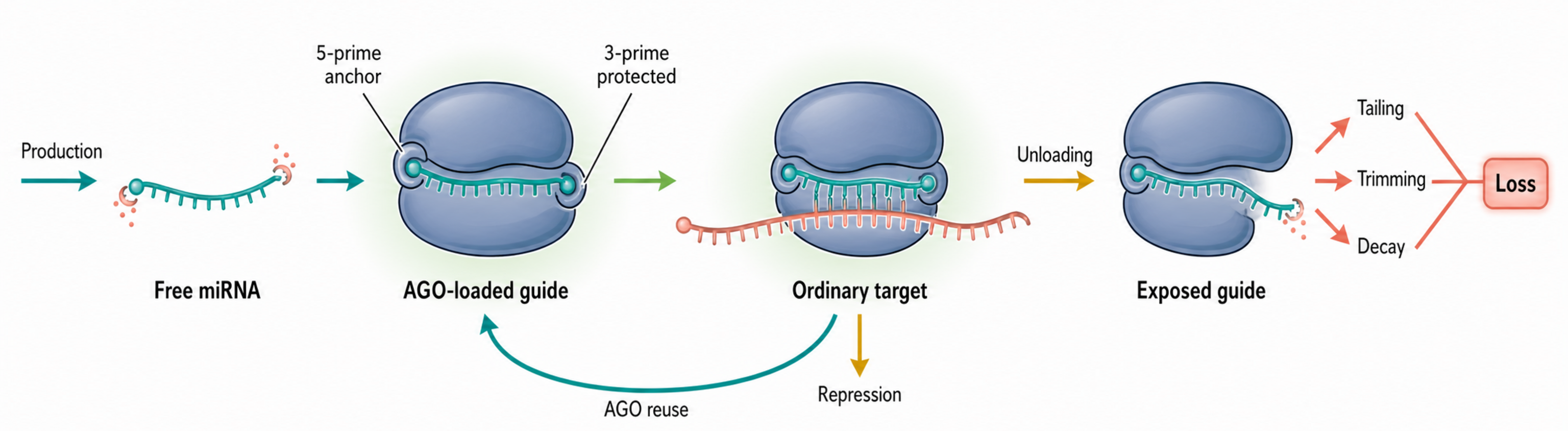
Figure 85.1. Basal miRNA Stability as Argonaute-Protected States. A free mature miRNA is vulnerable to decay, whereas an Argonaute-loaded guide is protected by contacts that anchor the 5′ phosphate, present the seed, and shelter the 3′ end. Ordinary target engagement permits repression and Argonaute reuse. Unloading, abnormal target pairing, or Argonaute turnover exposes the guide to tailing, trimming, and nucleolytic decay.
Argonaute Dynamics: Loading, Recycling, Unloading, and Protein Fate
Argonaute is often drawn as a static carrier, but the protein moves through multiple states. It is synthesized, loaded with a guide, binds and releases targets, recruits effector proteins, may enter different subcellular compartments, and eventually turns over. Guide loading is covered in Chapter 84; here the important question is what happens after loading. A guide that leaves Argonaute becomes vulnerable. An Argonaute protein that becomes damaged, modified, or trapped in an abnormal target-bound state may be degraded or remodeled. miRNA turnover therefore cannot be fully separated from Argonaute turnover.
Target binding usually supports repeated use of the miRNA. In ordinary repression, the Argonaute-miRNA complex binds a target site, recruits repression machinery, releases the target or remains transiently associated, and can engage additional targets. This catalytic-like reuse is one reason a miRNA can regulate many transcripts. However, the analogy to an enzyme is limited because target binding can also alter the regulator. A high-affinity or unusually paired target may convert Argonaute from a reusable regulator into a substrate for unloading and decay pathways.
Unloading has several possible meanings and should be specified. It can mean passive dissociation of a guide from Argonaute, active removal assisted by proteins, target-induced opening of the guide-binding channel, or destruction of Argonaute that indirectly releases the guide. In TDMD, unloading and Argonaute degradation are difficult to separate experimentally because the trigger can produce guide tailing, guide trimming, guide loss, Argonaute ubiquitylation, and Argonaute protein reduction in overlapping time windows. Han et al. 2020 is the key listed primary paper showing that a ubiquitin ligase pathway can mediate target-directed miRNA decay independently of tailing and trimming as the initiating requirement.
Argonaute dynamics also explain why genetic or pharmacological perturbations may have broad effects. Reducing a decay factor can increase a subset of TDMD-sensitive miRNAs, but it may also change Argonaute availability, shift competition among guides, or alter target repression networks. Increasing a trigger RNA can deplete a miRNA, but it may also titrate Argonaute, compete with endogenous targets, or produce stress. A mechanistic experiment therefore needs controls that distinguish guide abundance, guide integrity, Argonaute protein abundance, target repression, and global pathway saturation.
85.2. Target-directed miRNA degradation and trigger RNA features
Target-Directed miRNA Degradation and Trigger RNA Features
Target-directed miRNA degradation is the process in which a target RNA causes decay of the miRNA that binds it. The word “target” can be misleading because ordinary miRNA targets are usually the regulated substrates, whereas TDMD trigger RNAs regulate the miRNA itself. A trigger RNA may be an endogenous transcript, a viral noncoding RNA, an engineered target site, or a disease-associated long RNA. What makes it a trigger is not simply the presence of a seed match. It is a combination of pairing geometry, accessibility, abundance, localization, and resistance to being destroyed before it can remodel Argonaute.
An ordinary animal miRNA site often pairs to the seed and may include modest 3′ supplementary pairing. The miRNA remains protected, and the target RNA is repressed. A TDMD trigger usually has stronger and more extended complementarity, especially to the miRNA 3′ region. At the same time, many effective triggers avoid the geometry that would allow AGO2 to slice the target efficiently. Slicing requires extensive pairing around the scissile region opposite miRNA positions 10 and 11. A central bulge, mismatch, or other distortion can prevent target cleavage while still allowing enough binding energy to hold the Argonaute-miRNA complex in an abnormal conformation. This geometry lets the target persist long enough to destabilize the guide.
The target’s expression context also matters. A perfect trigger sequence expressed at a very low level may have no measurable effect. A high-copy engineered trigger may cause strong miRNA loss but may not represent physiological biology. Translation can interfere with trigger function if ribosomes displace the Argonaute complex or alter target RNA structure. Li et al. 2025 is an important listed study because it reports that translation suppresses exogenous target RNA-mediated miRNA decay, underscoring that target RNA fate, ribosome movement, and trigger availability can determine whether a target behaves as a TDMD trigger.
Trigger-site architecture is best taught as a set of competing outcomes. If the target pairs weakly, it may be a conventional repressed target. If it pairs extensively and supports AGO2 catalysis, the target may be sliced rather than acting as a long-lived trigger. If it pairs strongly to the seed and 3′ region while preventing slicing, it may expose the miRNA 3′ end and promote TDMD. If it has many sites, it may also behave as a sponge, reducing miRNA availability without necessarily degrading the miRNA. These outcomes are not labels attached to RNA classes; they are mechanistic states determined by pairing, concentration, and cellular context.
Box 85.1. Four Outcomes of miRNA-Target Pairing
The same phrase “miRNA target” can refer to an RNA that is repressed, sliced, sequesters a guide, or triggers guide decay. The outcome depends on pairing geometry, target abundance, translation, localization, and Argonaute context.
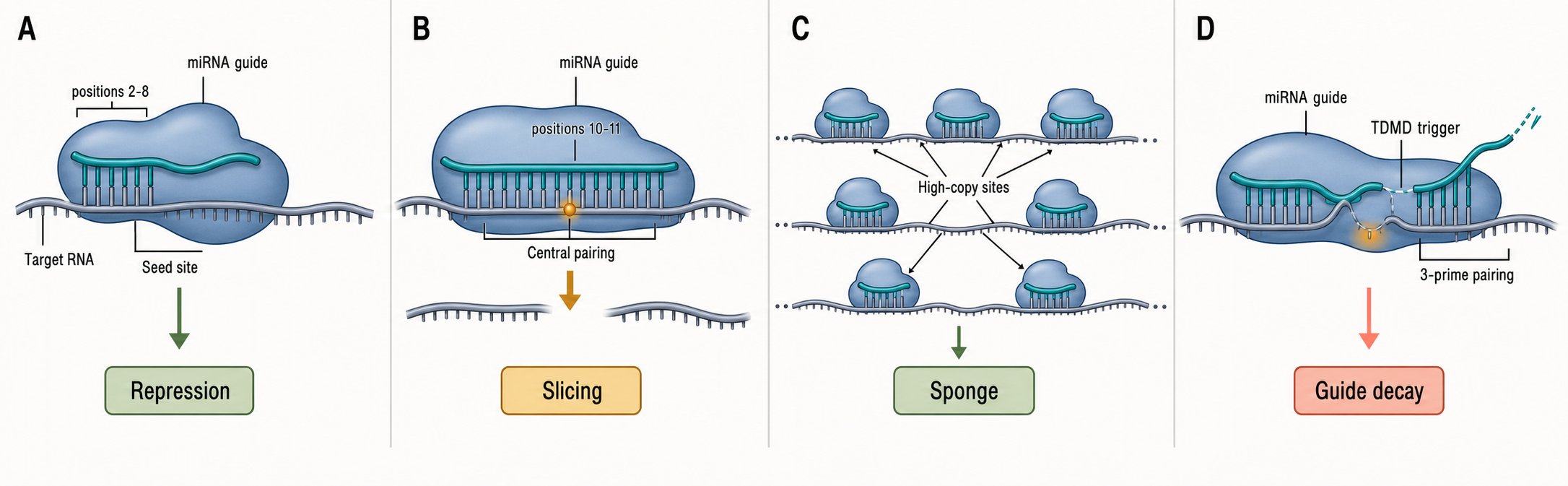
Figure 85.2. Pairing Geometry Determines Target Outcome. Target RNAs with different pairing geometries produce different outcomes. A canonical seed site usually represses the target while preserving the miRNA guide. Extensive central pairing can create an AGO2 slicing substrate. Many high-copy sites can sequester miRNA-loaded Argonaute as a sponge. A slicing-resistant trigger with seed and 3′ supplementary pairing can expose the guide 3′ end and induce TDMD.
Structural Mechanism and the ZSWIM8/Cullin-RING Ligase Pathway
Structural studies explain why TDMD is not simply “more target pairing.” In a normal Argonaute-miRNA complex, the guide’s 3′ end is protected in the protein. TDMD trigger pairing can pull the miRNA 3′ region into an extended duplex with the target. Sheu-Gruttadauria et al. 2019 showed that target-directed degradation involves a structural state in which the miRNA 3′ end is exposed, making it accessible to enzymes that can add nucleotides or remove them. The trigger therefore converts the guide from a protected molecule into one with a vulnerable end.
The structural model accounts for the characteristic tailing and trimming signatures seen in many TDMD experiments. Once the 3′ end is exposed, terminal nucleotidyltransferases can add non-templated bases and exonucleases can trim the guide. Sequencing then detects uridylated, adenylated, shortened, or otherwise altered isomiRs. These signatures are biologically informative because they report that the guide end became accessible. However, they do not by themselves identify the first causal step in miRNA decay. A modified 3′ end may be an intermediate, a byproduct, a stabilizing change, or a downstream footprint of Argonaute remodeling.
ZSWIM8 introduced a second layer of mechanism. ZSWIM8 is a substrate receptor associated with a cullin-RING ubiquitin ligase pathway. Cullin-RING ligases use modular substrate receptors to recognize specific protein states and promote ubiquitin transfer. In TDMD, the relevant substrate is not a naked miRNA but an abnormal Argonaute-miRNA-target complex. Han et al. 2020 showed that ZSWIM8-dependent ubiquitin ligase activity is required for many target-directed miRNA decay events and that this requirement can be separated from the visible tailing and trimming of the guide. This result shifted the model from “tailing and trimming cause all TDMD” to “trigger-bound Argonaute can be recognized by ubiquitin machinery, and tailing/trimming are part of or consequences of the decay process.”
The mechanistic sequence can be described in five steps. First, a trigger RNA forms a high-affinity, slicing-resistant interaction with a loaded miRNA. Second, the trigger-bound complex adopts a conformation in which the miRNA 3′ end is exposed or Argonaute is otherwise marked as abnormal. Third, a ZSWIM8-linked cullin-RING ligase pathway recognizes the abnormal complex. Fourth, ubiquitin-dependent remodeling, Argonaute degradation, or associated factors promote guide unloading and loss. Fifth, tailing, trimming, and nucleolytic decay remove or alter the guide. The order and relative importance of steps four and five can differ by system, and the field still distinguishes model components that are established from those inferred.
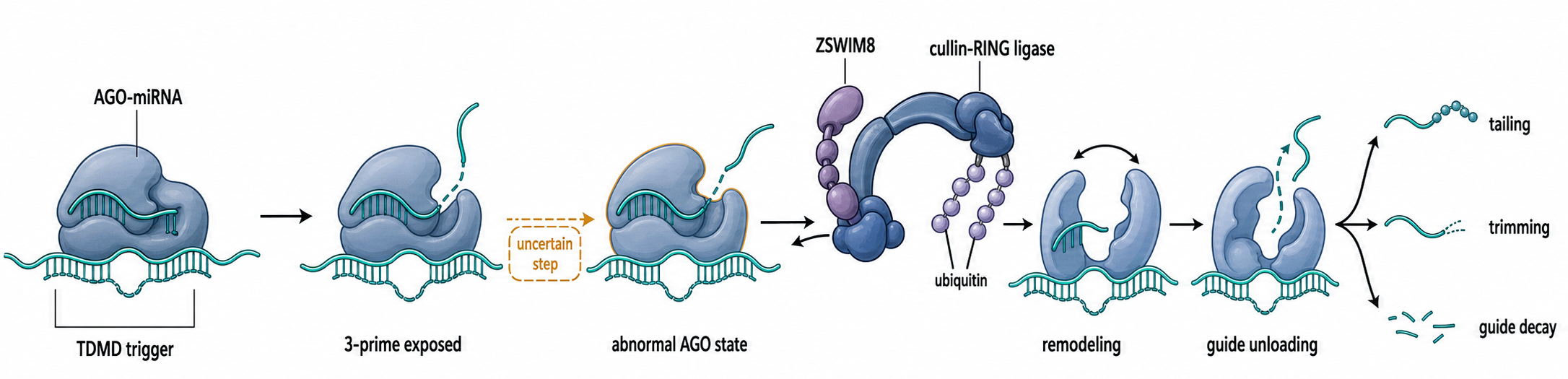
Figure 85.3. ZSWIM8/Cullin-RING Logic in Target-Directed miRNA Degradation. A TDMD trigger forms a high-affinity, slicing-resistant complex with Argonaute-loaded miRNA. Trigger pairing exposes the miRNA 3′ end and creates an abnormal Argonaute state. A ZSWIM8-linked cullin-RING ubiquitin ligase pathway recognizes the complex, promotes ubiquitin-dependent remodeling or turnover, and enables guide unloading, tailing, trimming, and decay.
This pathway has a quality-control flavor. Argonaute is useful when it carries a guide and releases or represses ordinary targets. It becomes potentially harmful when trapped in an unusual target-bound state that exposes the guide, blocks recycling, or creates nonproductive complexes. ZSWIM8-linked recognition provides a way to remove such complexes and reset the small-RNA system. That logic also explains why TDMD can have developmental functions: removing selected miRNAs at the right time can change regulatory programs without waiting for transcriptional repression of the miRNA gene.
85.3. Tailing, trimming, uridylation, adenylation, and nuclease pathways
Tailing and trimming are the main visible molecular marks of many miRNA turnover events. Tailing adds non-templated nucleotides to the 3′ end. Trimming removes nucleotides from the 3′ end. Together they generate 3′ isomiRs, a term for miRNA variants that share the same 5′ end but differ at the 3′ end by length or added bases. A 3′ isomiR can be a stable regulatory species, a processing product, a decay intermediate, or a sequencing artifact. The first task in interpretation is therefore to ask what process produced the end change and whether that end change alters function or abundance.
Uridylation is the addition of uridine residues. In RNA biology, uridylation is often associated with decay, but it is not universally destructive. It can mark RNAs for exonucleolytic degradation, remodel precursor processing, or produce defined end states. The listed uridylation reviews emphasize that uridylation shapes both coding and noncoding transcriptomes and that nucleotide-resolution methods are required to assign exact 3′ end states (De Almeida et al. 2018; de Almeida et al. 2018; Menezes et al. 2018; Pirouz et al. 2019). For miRNAs, uridylation can occur during precursor maturation, as a mature guide modification, or after TDMD-triggered exposure of the guide 3′ end.
Adenylation is the addition of adenosine residues. It can stabilize some small RNAs in particular contexts and destabilize others. The effect depends on the enzyme, the number of added nucleotides, the substrate, and the downstream decay machinery. It is therefore misleading to say that uridylation always degrades miRNAs and adenylation always stabilizes them. A single added nucleotide may change cloning efficiency or target affinity only subtly, whereas an oligo(U) tail may recruit a decay pathway. A mixed or short tail may represent a transient state that is hard to classify from endpoint sequencing alone.
Terminal nucleotidyltransferases are the enzymes that add tails. In animal systems, TUTase/TENT family enzymes are often discussed in miRNA uridylation and adenylation. Some act on pre-miRNAs during biogenesis; others can modify mature miRNAs whose 3′ ends become accessible. Exonucleases remove nucleotides during trimming or complete decay. The exact nuclease can vary among organisms and substrates. Examples from the broader small-RNA field include 3′ to 5′ nucleases that trim mature miRNAs, decay enzymes that prefer uridylated substrates, and plant SMALL RNA DEGRADING NUCLEASE (SDN)-like activities that define comparative small-RNA turnover logic. The provided references are strongest for broad uridylation and TDMD reviews, so enzyme assignments in this draft should be treated as pathway-level synthesis pending chapter-specific curation.
Table 85.1 should separate enzyme action from biological interpretation. The same observed read, such as a miRNA with two added uridines, may mean different things in different experiments.
Table 85.1. Interpreting miRNA Tailing and Trimming. Tailing and trimming are molecular observations whose interpretation depends on enzyme, substrate, tail length, nucleotide identity, and assay design. A uridylated or shortened miRNA may be a decay intermediate, a stable isomiR, a processing product, or a technical artifact.
| Observed end state | Possible enzyme class | Possible biological meaning | Common assay caveat | Best validation step |
|---|---|---|---|---|
| Single U addition | TENT/TUT uridylyltransferase | Exposed 3′ end, stable 3′ isomiR, or early decay mark | Single-base tails can reflect ligation or mapping bias | Tail-aware small-RNA-seq plus enzyme or pathway perturbation |
| Oligo(U) addition | TENT/TUT activity linked to decay-prone substrates | Possible decay mark after guide exposure or processing remodel | Long tails may be soft-clipped, truncated, or undercounted | Nucleotide-resolution 3′ end assay with decay-rate measurement |
| Single A addition | Adenylyltransferase or TENT-family enzyme | Substrate-specific stabilization, destabilization, or neutral isomiR | A single A is not equivalent to oligo(A)-linked decay | Enzyme-specific perturbation and mature miRNA half-life test |
| Mixed tail | Sequential or competing terminal transferases | Transient exposed-guide state or heterogeneous decay intermediates | Rare tail classes can be collapsed by preprocessing filters | Tail-aware alignment with spike-ins and targeted end validation |
| 1-2 nucleotide trimming | 3′ to 5′ exonuclease | Stable shorter isomiR or early trimming after guide-end exposure | Trimmed reads can misassign among related miRNA family members | Confirm constant 5′ end and size shift by targeted assay |
| Extensive trimming | Exonuclease plus downstream decay machinery | Committed guide decay or degradation after unloading | Very short fragments may be lost during library selection | Size-resolved northern or targeted assay with nuclease perturbation |
| Unchanged mature sequence with reduced abundance | No end-modifying enzyme evident | Altered production, loading, dilution, or decay without captured intermediates | Endpoint abundance is not a decay-rate measurement | Measure pri/pre-miRNA, AGO loading, and pulse-chase kinetics |
| Precursor tailing | TENT/TUT enzyme acting before Dicer maturation | Processing regulation rather than mature guide turnover | Precursor and mature signals can be conflated in bulk assays | Separate pri-, pre-, and mature-miRNA assays with processing controls |
| 5′ end shift | Drosha or Dicer cleavage offset, not a 3′ tailing enzyme | Seed change and target retargeting rather than classic TDMD signature | 3′ end-focused pipelines can miss seed-altering isoforms | Map precise 5′ ends and test target-spectrum consequences |
Tailing and trimming also affect target biology. A 5′ change can alter the seed and redirect targets, but most TDMD-associated tailing and trimming is 3′ biased. A 3′ change may affect supplementary pairing, Argonaute residence time, decay susceptibility, or detection by assays. If a miRNA relies on 3′ supplementary pairing to regulate a specific target, trimming can weaken that interaction without changing the seed family. If a sequencing protocol ligates adapters less efficiently to certain tailed or structured ends, the apparent isomiR distribution may be partly technical. Mechanistic conclusions therefore require controls that distinguish actual RNA molecules from library recovery bias.
85.4. Viral, developmental, and tissue-specific miRNA turnover systems
Viral miRNA Turnover Systems and Host-Pathogen Logic
Viruses provide natural selection experiments in RNA regulation. Some viruses encode miRNAs or miRNA-like small RNAs to regulate viral and host genes. Some host miRNAs restrict viral replication, and some viruses use host miRNAs to stabilize or translate viral RNAs. TDMD adds another possibility: a viral RNA can act as a trigger that depletes a host miRNA, or an engineered trigger can be used to redirect depletion toward a viral or cellular miRNA. The reference list for this chapter includes Hiers et al. 2024 as the most relevant review anchor for TDMD mechanism and implications; broad antiviral references in the file are useful context but do not by themselves support detailed miRNA-turnover claims.
The viral logic is straightforward. If a host miRNA restricts a viral lifecycle or shapes an antiviral cell state, a viral trigger that depletes that miRNA could benefit the virus. If a virus depends on a particular host miRNA, trigger-mediated depletion of that miRNA could restrict viral replication. If a viral miRNA is abundant and contributes to latency or immune evasion, an engineered TDMD site might be used experimentally to reduce that miRNA. Ortega et al. 2024 is directly relevant to this engineering concept because it reports retargeting TDMD sites to highly expressed viral or cellular miRNAs.
Viral systems also illustrate causality pitfalls. Viral infection changes transcription, translation, RNA decay, innate immune signaling, cell viability, and cell composition. A host miRNA may decline during infection because of TDMD, but it may also decline because infected cells shut down transcription, because precursor processing is inhibited, because cells die, or because the sampled population changes. Conversely, a viral noncoding RNA that binds a miRNA may act as a sponge without accelerating decay. A TDMD claim in infection therefore needs trigger-site mutation, mature and precursor miRNA measurements, direct Argonaute association, time resolution, and controls for infection-associated stress.
Developmental, Tissue-Specific, and Disease-Associated Turnover
Development often requires rapid changes in regulatory state. A cell can reduce a miRNA’s future production by shutting off transcription of the miRNA gene, but that does not immediately remove loaded miRNAs already present in Argonaute. Target-directed decay provides a faster post-loading route. A developmentally expressed trigger RNA can deplete a mature miRNA at a specific time and place, allowing previously repressed targets to become active. Jones et al. 2023 provides strong listed evidence that TDMD regulates developmental miRNA expression and embryonic growth in mammals.
The developmental example is important because it prevents two overgeneralizations. TDMD is not merely a viral trick, and it is not merely an artifact of overexpressed artificial target sites. It can be part of normal regulatory programs. At the same time, not every developmental change in miRNA abundance is TDMD. Many changes are transcriptional, processing-dependent, or due to cell-type composition. The evidence standard for endogenous TDMD is higher than for observing a miRNA decline during differentiation. One must show that a specific trigger site, expressed in the relevant cells, is needed for mature miRNA loss and that disrupting the site changes the miRNA and downstream biology.
Tissue specificity can arise through several routes. A trigger RNA may be expressed only in a tissue. A miRNA may be abundant only in a lineage. An Argonaute paralog, tailing enzyme, trimming nuclease, or ZSWIM8-linked pathway component may vary in abundance. Translation rate and RNA localization can determine whether a candidate trigger is accessible. The same RNA sequence might be an efficient trigger in one tissue and inert in another if it is not co-localized with the relevant Argonaute-miRNA complex.
Disease-associated TDMD claims are mechanistically plausible but require careful validation. Wei et al. 2024 reports a pseudogene-derived lncRNA that promotes ischemic acute kidney injury by TDMD of kidney-protective miR-668. This is a useful example because it connects TDMD to a disease-relevant lncRNA and a protective miRNA, but it also illustrates why lncRNA claims need site-specific controls. Long RNAs can affect chromatin, transcription, RNA-binding proteins, translation, and cellular stress. A credible disease TDMD model needs mutational separation of the trigger site from other lncRNA functions, endogenous expression measurements, ZSWIM8 or pathway dependence where appropriate, and rescue of the relevant miRNA or targets.
Figure 85.4 should place viral, developmental, and disease-associated examples on one framework, emphasizing that the same molecular logic can serve different biological purposes.
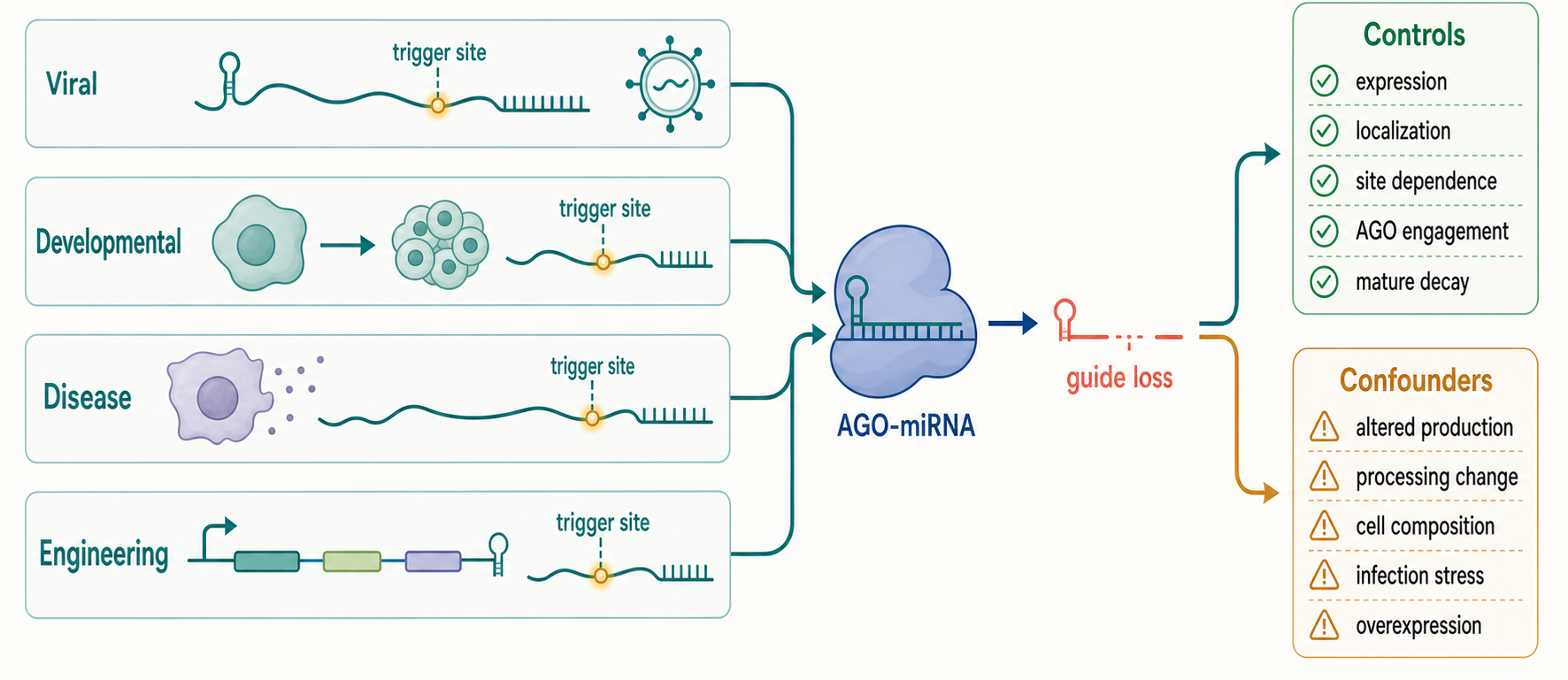
Figure 85.4. Biological Contexts for TDMD. TDMD logic can be used by different biological and experimental systems. Viral or engineered RNAs can provide abundant trigger sites, developmental transcripts can remove selected miRNAs during state transitions, and disease-associated long RNAs can be proposed triggers when site-specific evidence supports the mechanism. Each context requires controls for expression, localization, trigger-site dependence, Argonaute engagement, and mature miRNA decay.
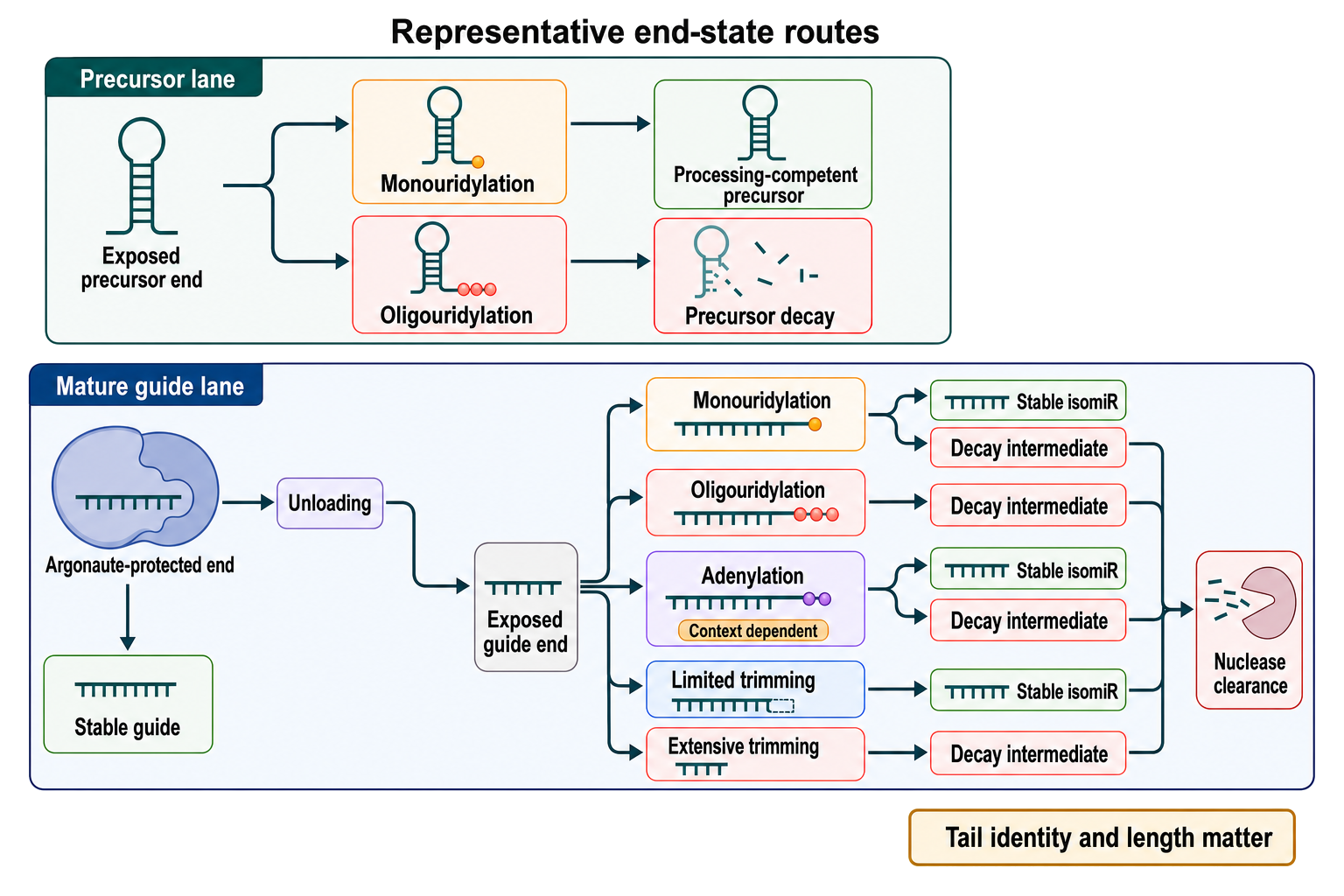
Figure 85.5. Tailing and trimming route precursor and mature miRNAs among processing, stable isomiRs, and decay. A precursor with an exposed 3′ end can undergo limited tailing that changes processing competence or longer uridylation that promotes precursor decay. A mature guide is protected while its 3′ end remains docked in Argonaute; unloading or end exposure permits monouridylation, oligouridylation, adenylation, or trimming. Limited changes can persist as stable isomiRs, whereas extensive trimming or decay-linked tailing can feed nuclease clearance. These are representative context-dependent routes, not universal identities between a particular tail and one fate.
85.5. Measurement, causality, and model conflicts in miRNA decay
Measuring miRNA decay is harder than measuring miRNA abundance. A standard small-RNA-seq experiment counts reads that map to mature miRNAs and isomiRs. This is useful for detecting abundance changes and 3′ end variants, but it is not automatically a decay-rate assay. To infer decay, one must measure time, production, and loss. If a mature miRNA declines after a trigger is expressed, the decline may reflect faster degradation, lower processing, reduced loading, dilution, library bias, or loss of the cell type that expressed the miRNA. A decay model should explain why precursor abundance, mature guide integrity, Argonaute association, and target-site dependence point to degradation rather than to one of these alternatives.
Box 85.2. Why Mature miRNA Abundance Is Not a Decay Rate
A mature miRNA count is the result of synthesis, processing, loading, decay, dilution, and sampling. To claim altered decay, experiments must measure time and control production.
Small-RNA-seq has specific technical issues. Adapter ligation efficiency varies with sequence, end structure, length, 2′ modifications, and terminal additions. Non-templated tails can cause mapping programs to soft-clip or discard reads unless the pipeline is designed to detect them. Multimapping reads can obscure family members with similar mature sequences. A 3′ trimmed isomiR may be hard to distinguish from a closely related annotated miRNA if the 5′ end is not unique. Quantitative conclusions therefore depend on library design, spike-ins, consistent trimming rules, tail-aware alignment, and independent validation.
3′ end methods improve resolution by asking exactly which nucleotides are present at the mature miRNA end. Tail-aware small-RNA-seq, splinted ligation approaches, 3′ rapid amplification methods, and nucleotide-resolution uridylation assays can distinguish templated sequence from non-templated additions. Pirouz et al. 2019 is particularly relevant as a methods-oriented review for analyzing 3′ RNA uridylation at nucleotide resolution. Even these methods require caution: capturing an end state does not prove whether the end state caused decay or was produced after decay commitment.
Pulse-chase designs address kinetics. A metabolic labeling experiment marks newly synthesized RNA or follows pre-existing RNA after blocking new production. For miRNAs, pulse-chase is complicated because mature guides are short, highly protein-bound, and produced through precursor processing. Blocking transcription can have broad stress effects, and global processing inhibition disrupts many RNAs. The most persuasive designs combine modest perturbations, time courses, mature and precursor measurements, and mathematical models that estimate synthesis and decay separately.
Perturbation design is equally important. Overexpressing a trigger RNA can demonstrate that a sequence is capable of inducing TDMD, but endogenous causality requires site mutation or deletion at the natural locus. Knocking out ZSWIM8 can reveal pathway dependence, but ZSWIM8 loss may stabilize many TDMD-sensitive miRNAs and indirectly alter target networks. Proteasome or cullin inhibition can implicate ubiquitin-linked pathways, but these interventions affect many proteins. The strongest experiments use convergent evidence: trigger-site mutation, rescue with a decay-resistant or site-mutated construct, ZSWIM8 dependence, Argonaute protein-state readouts, and downstream target-response measurements.
Table 85.2 should be an evidence ladder for miRNA decay claims. It should distinguish abundance association, end-modification evidence, trigger capability, endogenous trigger necessity, pathway dependence, and biological consequence.
Table 85.2. Evidence Ladder for miRNA Decay and TDMD Claims. Evidence for miRNA decay becomes stronger as studies move from abundance association to kinetic measurement, trigger-site necessity, pathway dependence, and biological rescue. No single assay proves all parts of a TDMD model.
| Evidence type | Supports | Does not prove | Common artifact | Stronger follow-up |
|---|---|---|---|---|
| Mature miRNA decrease | Mature guide pool is reduced | Decay, TDMD, or altered half-life | Cell-composition shifts, library bias, reduced processing, dilution | Add pri/pre-miRNA, AGO loading, spike-ins, and time course |
| pri/pre-miRNA unchanged | Loss is likely post-transcriptional or post-processing | Trigger-dependent degradation | Precursor assay timing or sensitivity can miss transient changes | Pair with mature pulse-chase and trigger-site perturbation |
| Tailed or trimmed isomiRs | Guide 3′ end became accessible or modified | That tailing or trimming initiated TDMD | Adapter bias, tail clipping, multimapping, end-recovery bias | Tail-aware sequencing plus end validation and pathway perturbation |
| Trigger overexpression | Candidate sequence can induce miRNA loss | Physiological necessity or endogenous stoichiometry | AGO saturation, stress, sponge behavior, translation disruption | Mutate or delete the endogenous trigger site |
| Endogenous trigger-site mutation | Native site is required for the miRNA effect | All phenotypes are direct TDMD consequences | Editing can alter RNA structure, abundance, or other functions | Rescue with site-mutant and decay-competent constructs |
| AGO immunoprecipitation | miRNA and candidate trigger occupy Argonaute complexes | Decay or abnormal Argonaute remodeling | Nonspecific recovery, crosslinking bias, indirect association | Test site dependence and time-resolved loss from AGO and input |
| ZSWIM8 loss | Candidate event depends on a TDMD-linked ubiquitin pathway | Direct ZSWIM8 recognition of the specific RNP | Global stabilization of many miRNAs and network effects | Acute rescue, domain mutants, and Argonaute ubiquitin/remodeling readouts |
| Pulse-chase decay rate | Mature guide half-life changes over time | Trigger identity or pathway mechanism | Metabolic labeling or transcription block stress | Combine kinetics with trigger-site and ZSWIM8 tests |
| Downstream target rescue | miRNA loss has regulatory consequences | Decay rather than direct target or lncRNA effects | Pleiotropic trigger perturbation and ceRNA-like effects | Rescue with miRNA mimic, decay-resistant guide, or target-site mutant |
| Phenotype rescue | TDMD model affects organismal or cellular outcome | Exact molecular order of decay events | Compensation, off-target edits, background effects | Rescue independently at miRNA, trigger-site, and pathway levels |
Model conflicts remain active. One conflict is whether tailing and trimming are drivers or footprints of TDMD. The current synthesis is that they can contribute to decay and are valuable signatures, but ZSWIM8-linked recognition of abnormal Argonaute states is often upstream or parallel. Another conflict is how broadly endogenous TDMD shapes miRNA expression compared with transcriptional and processing regulation. The answer is likely context-dependent. A third conflict is whether target RNAs generally destabilize miRNAs or whether only specialized trigger geometries do so. Current evidence favors the latter: ordinary targets generally repress target RNA without destroying the guide, while specialized trigger sites induce decay.
Experimental Foundations and Evidence
The evidence base for miRNA turnover combines structural biology, genetics, sequencing, biochemistry, and quantitative modeling. Structural biology establishes plausibility by showing how trigger pairing can alter Argonaute conformation and expose the miRNA 3′ end. Sheu-Gruttadauria et al. 2019 is the main listed structural anchor. Its importance is not merely that it provides an atomic picture; it explains why extensive supplementary pairing and central distortions can create a degradation-prone state rather than a normal repression event.
Genetic evidence identifies pathway components. ZSWIM8 loss-of-function experiments show that many TDMD events require the ZSWIM8-linked ubiquitin ligase pathway (Han et al. 2020). Developmental genetics can test whether endogenous trigger sites matter in organisms rather than only in transfected cells, as illustrated by Jones et al. 2023. Disease-model genetics can test whether a candidate lncRNA or pseudogene transcript affects a miRNA through a specific trigger site, as in the kidney injury study by Wei et al. 2024. The strength of these experiments depends on whether they isolate the trigger-site mechanism from other functions of the RNA or protein.
Sequencing evidence detects miRNA abundance and end states. Mature miRNA loss, increased tailing, increased trimming, and altered isomiR distributions can all support a turnover model. However, sequencing is strongest when paired with orthogonal assays: northern blotting or targeted small-RNA assays for size changes, Argonaute immunoprecipitation for loaded guide abundance, precursor assays for biogenesis, and trigger RNA measurements for exposure. A tail-aware computational pipeline is not optional when the question is tailing and trimming.
Biochemical and cellular trigger assays define sufficiency. A synthetic or cloned trigger site can be mutated to test seed pairing, 3′ supplementary pairing, central mismatches, site number, orientation, and translation. Such assays can identify sequence features needed for TDMD, but they are vulnerable to overexpression artifacts. The same sequence may behave differently when embedded in an endogenous transcript with normal RNA structure, translation, localization, and RNA-binding proteins.
Quantitative models are necessary because production and decay both determine abundance. A mature miRNA half-life cannot be inferred from a single endpoint. Time courses, pulse-chase data, and simultaneous precursor measurements allow one to estimate whether a trigger changes decay rate. Zhang et al. 2022, although focused on miRNA sponge modules, is useful as a reminder that target-mediated models require time and stoichiometry, not only correlation. In TDMD, the relevant quantitative variables include trigger concentration, miRNA-loaded Argonaute concentration, binding dwell time, slicing resistance, translation status, ZSWIM8 availability, and decay enzyme access.
Box 85.3. Citation and Coverage Caution for Viral and Tissue-Specific TDMD
Viral and tissue-specific TDMD mechanisms are plausible and important, but detailed claims require direct primary evidence for the specific virus, cell type, trigger site, and miRNA.
Biological Contexts Across Systems
In ordinary animal cells, most miRNA-target interactions do not cause rapid guide degradation. This statement matters because otherwise target abundance would constantly erase miRNA programs. Stable Argonaute-loaded guides allow a miRNA to regulate many transcripts over time. TDMD is therefore a regulated exception, not the default consequence of target recognition. The exception becomes biologically useful when a cell needs to remove selected miRNAs after they have already been produced.
In development, TDMD can help transition between regulatory states. A miRNA that represses early-stage targets may need to disappear quickly when those targets become necessary. Turning off the miRNA gene may be too slow if loaded miRNAs persist. A trigger RNA can accelerate removal of the mature guide. Jones et al. 2023 supports the idea that such mechanisms can influence mammalian embryonic growth, making TDMD part of developmental regulation rather than only an infection or artificial reporter phenomenon.
In viral systems, trigger-like RNAs can reshape host or viral miRNA pools. The details vary by virus and must be handled carefully because infection changes many pathways at once. A direct viral example comes from Herpesvirus saimiri: the viral noncoding RNA HSUR1 down-regulates host miR-27 through sequence-specific interaction rather than by a generic infection-stress effect. For this chapter, the main point is mechanistic: viral RNAs can provide abundant, structured, localized binding sites with unusual pairing geometries, which are the same ingredients needed for TDMD. Ortega et al. 2024 extends this logic by retargeting TDMD sites toward highly expressed viral or cellular miRNAs.
In disease and tissue injury, TDMD can be proposed when a disease-associated RNA reduces a protective miRNA. The kidney injury example from Wei et al. 2024 is relevant, but it should be read with the same evidence standards applied to ceRNA and lncRNA studies. A long RNA can have many mechanisms. To assign TDMD, one must show that the miRNA decline depends on the trigger site and not merely on the long RNA’s expression, transcriptional effects, or cellular stress.
Plant small-RNA turnover provides a useful comparison but is not interchangeable with animal TDMD. Plant small RNAs often have 3′ end methylation, extensive target pairing, and plant-specific small-RNA-degrading nucleases. The listed plant uridylation and decay review by de Almeida et al. 2018 supports the broader lesson that RNA tailing and decay are organism-specific. Animal miRNA TDMD should not be generalized from plant small-RNA decay without checking end chemistry, Argonaute type, and nuclease pathway.
Technology, Computational, Clinical, and Engineering Links
TDMD can be engineered. A designed trigger site can be placed in an RNA to deplete a chosen miRNA, provided the site pairs in the right geometry, is expressed at sufficient concentration, avoids rapid slicing or translation-mediated displacement, and reaches the same compartment as the miRNA-loaded Argonaute. Ortega et al. 2024 is the most direct listed example of retargeting TDMD sites. Such tools can test miRNA function and may eventually inform therapeutic strategies, but they face the same delivery, specificity, and stoichiometry challenges as other RNA-based interventions.
Computational prediction of TDMD triggers is harder than ordinary seed-site prediction. A trigger model must consider seed pairing, 3′ supplementary pairing, central mismatches, site accessibility, target abundance, translation status, cellular localization, Argonaute paralog, and ZSWIM8 pathway availability. A sequence pattern alone is insufficient. Candidate triggers inferred from transcriptome data should be treated as hypotheses until site mutation and time-resolved miRNA measurements confirm decay.
Clinical interpretation should be conservative. A disease sample with low miRNA abundance does not automatically imply TDMD. The loss could reflect altered cell composition, transcriptional repression, processing defects, inflammation, tissue injury, or assay bias. Conversely, a disease-associated RNA with a predicted TDMD site is not a trigger until the relevant pairing geometry, expression level, Argonaute engagement, mature miRNA loss, and functional rescue are demonstrated. These standards are especially important for cancer and tissue injury studies where large expression changes and secondary effects are common.
Therapeutic anti-miR strategies in Chapter 152 intentionally inhibit miRNAs, but TDMD-inspired strategies would differ by using a target-like trigger rather than an antisense blocker. A trigger may reduce mature guide abundance, whereas an anti-miR can occupy and inhibit the guide without necessarily destroying it. The distinction matters for duration, reversibility, off-target effects, and interpretation of downstream target derepression.
Recent Consensus
The current consensus is that Argonaute loading strongly protects mature miRNAs, but protection is conditional rather than absolute. Loaded miRNAs are stable because Argonaute shields their ends and organizes target recognition. They become vulnerable when a trigger RNA changes the guide’s 3′ end exposure, Argonaute conformation, or protein fate.
TDMD is now recognized as a biologically relevant miRNA turnover mechanism. Reviews by Han and Mendell 2023 and Hiers et al. 2024 synthesize the field around tailing, trimming, target pairing, Argonaute remodeling, and functional implications. The strongest mechanistic anchors are the structural explanation of guide-end exposure (Sheu-Gruttadauria et al. 2019) and the genetic identification of the ZSWIM8-linked ubiquitin ligase pathway (Han et al. 2020).
Tailing and trimming remain central readouts but not complete explanations. 3′ uridylation, adenylation, and trimming can mark miRNAs for decay, change isomiR populations, or report a degradation-prone state. The field has moved away from treating every tailed or trimmed miRNA as proof of one universal decay pathway. Instead, end modifications must be interpreted with pathway genetics, time courses, and substrate context.
Endogenous TDMD appears important in selected biological programs, especially development, but its transcriptome-wide prevalence remains an empirical question. Developmental mammalian evidence supports physiologic function (Jones et al. 2023), while engineered retargeting demonstrates tool potential (Ortega et al. 2024). Disease and viral examples are plausible but require rigorous site-level validation.
Open Questions, Controversies, Deprecated Models, and Common Misconceptions
Open questions:
- How does ZSWIM8 recognize TDMD-prone Argonaute complexes? The pathway suggests that trigger-bound Argonaute presents a distinct protein or RNP surface, but the exact recognition determinants, ubiquitylation sites, and downstream remodeling steps remain incompletely resolved in the listed reference set.
- How often do tailing and trimming cause decay rather than record decay commitment? Han et al. 2020 supports the idea that ZSWIM8-mediated TDMD can be independent of tailing and trimming as a causal requirement, but tailing and trimming may still accelerate or complete decay in particular contexts. The correct answer is likely pathway- and substrate-specific.
- How do translation, RNA localization, and RNA-binding proteins regulate trigger activity? Li et al. 2025 indicates that translation can suppress exogenous target RNA-mediated miRNA decay. This finding argues against treating every highly complementary site as a trigger independent of the mRNP environment.
Common misconceptions:
- “A target that pairs strongly with a miRNA is always a stronger repressed target.” Extensive pairing can instead lead to target slicing, TDMD, or altered Argonaute dynamics. Pairing geometry determines outcome.
- “Tailing equals degradation.” Tailing can mark decay, reflect exposed guide ends, stabilize or remodel a substrate, or create a stable isomiR. The biological meaning depends on the enzyme, tail length, nucleotide identity, and context.
- “A decline in mature miRNA abundance proves TDMD.” Mature miRNA abundance can fall because of transcriptional repression, processing changes, altered loading, cell-type shifts, dilution, or technical recovery bias. TDMD requires evidence that a trigger site accelerates mature guide loss.
- “ZSWIM8 is a general miRNA biogenesis factor.” ZSWIM8 is best understood in this chapter as a factor in target-directed degradation of selected miRNAs, not as a universal requirement for producing all miRNAs.