Chapter 116. RNA-Virus Replication Complexes, Recombination, and Population Dynamics
Scope Note
This chapter examines how RNA-dependent RNA polymerases operate inside viral replication-transcription complexes and how copying outcomes scale into viral population dynamics. It owns polymerase operation in complexes, replication organelles and factories, context-specific template switching, recombination, reassortment, defective genomes, quasispecies, mutation spectra, bottlenecks, selection, transmission, and antiviral population evolution. Comparative enzyme folds, isolated kinetics, fidelity biochemistry, inhibitor binding, and resistance biochemistry belong to Chapter 23. Retroviral and retrotransposon replication belongs to Chapter 120.
Executive Summary
RNA-dependent RNA polymerases are the catalytic centers of RNA-virus replication, but their cellular behavior is defined by complexes. Viral cofactors recruit templates, stabilize initiation and elongation states, connect polymerase to helicases or proofreading functions, and position synthesis at membranes or inside factories. The replication complex determines which RNA becomes a template, whether synthesis produces a genome or transcript, how nascent RNA exits, and when the polymerase switches templates or releases an incomplete product.
Copying fidelity becomes biologically meaningful through the complete replication complex and the number of rounds completed. Polymerase discrimination, proofreading where present, nucleotide-pool balance, RNA structure, and accessory proteins shape the raw mutation spectrum. Selection, drift, complementation, recombination, and bottlenecks then transform copying errors into observed variant frequencies. Mutation rate, mutation spectrum, and substitution rate are therefore different quantities rather than interchangeable measures of a polymerase.
Replication does not occur in free solution. Viral RdRPs assemble with viral and host proteins into replication-transcription complexes on host membranes. Positive-strand RNA viruses remodel endoplasmic reticulum, Golgi, endosomal, lysosomal, mitochondrial, or peroxisomal membranes into spherules, double-membrane vesicles, or membranous webs. Negative-strand RNA viruses form inclusion bodies or replication factories with liquid-liquid phase separation characteristics. The membrane scaffold concentrates components, protects replication intermediates from innate immune sensors, and coordinates replication with translation, assembly, and export. Defective viral genomes, especially copy-back and deletion variants, are generated during replication and can interfere with standard virus replication or stimulate innate immunity.
Recombination and reassortment are two mechanisms of large-scale genetic exchange in RNA viruses. Recombination occurs by template switching during RNA synthesis and is common in positive-strand RNA viruses, including coronaviruses and picornaviruses. Reassortment occurs when segmented viruses exchange whole genome segments during co-infection and is especially important in influenza A virus, where it can generate pandemic strains. Both mechanisms produce novel genotypes that sampling and phylogenetic methods can miss if only consensus sequences are analyzed.
Quasispecies theory, originally developed by Eigen and Schuster to describe error-prone self-replication in prebiotic systems, was adapted to RNA viruses by Domingo and others in the late 1970s. A viral quasispecies is a mutant distribution centered on one or more master sequences. The population, not any single sequence, is the unit of selection. This has practical consequences: a mutation that appears deleterious when measured on a single genotype can persist as a minority variant and become beneficial after an environmental shift; antiviral resistance can develop from pre-existing minority variants rather than de novo during treatment; and the fitness of a viral population can be modulated by altering the mutation rate, a concept known as lethal mutagenesis.
Evolution under antivirals, immune pressure, and transmission bottlenecks is the applied face of quasispecies biology. Polymerase inhibitors select resistance mutations, often with associated fitness costs that can be partially restored by compensatory mutations. Immune escape variants arise from the mutant spectrum and expand under neutralizing antibody or T cell pressure. Transmission bottlenecks, which can reduce the infecting population to a single or very few genomes, impose a founder effect that resets the within-host mutant spectrum. Understanding these dynamics is essential for antiviral drug design, combination therapy, vaccine strain selection, and predicting emergence.
Concept Inventory
- RNA-dependent RNA polymerase (RdRP): the enzyme that catalyzes nucleotidyl transfer from a ribonucleoside triphosphate to the 3′-hydroxyl of a growing RNA chain using an RNA template. RdRPs are the only polymerases universally encoded by RNA viruses. Some DNA viruses and cellular organisms also encode RdRPs for RNA silencing amplification, but viral RdRPs are the paradigmatic examples.
- Replication-transcription complex (RTC): the macromolecular assembly of viral RdRP, viral cofactors, host proteins, and RNA templates organized on a membrane surface or within a viral factory. The RTC carries out genome replication and, in negative-strand and some positive-strand RNA viruses, transcription of subgenomic mRNAs.
- Fidelity in the polymerase context: the accuracy of nucleotide incorporation, usually expressed as an error rate per nucleotide per round of copying. Fidelity is determined by the polymerase active site geometry, the induced-fit conformational change upon nucleotide binding, the presence or absence of proofreading, and the nucleotide pool balance in the host cell.
- Proofreading in viral RdRPs: 3′-to-5′ exoribonuclease activity that removes misincorporated nucleotides. This activity was long thought absent from RNA viruses until the discovery of the coronavirus ExoN domain in nonstructural protein 14. The ExoN domain acts in concert with the nsp12 RdRP and the nsp10 cofactor.
- Lethal mutagenesis: population decline or extinction caused by increased mutational load during continued copying. It is a population outcome rather than a synonym for direct synthesis inhibition, and its probability depends on proofreading, mutation spectrum, population size, complementation, and replication rounds.
- Viral factory or replication organelle: the host-membrane-derived compartment that concentrates viral replication components. Positive-strand RNA virus factories are typically membrane invaginations (spherules) or double-membrane vesicles. Negative-strand RNA virus factories are cytoplasmic inclusion bodies that can show properties of liquid-liquid phase-separated condensates. Large cytoplasmic DNA viruses also form factories, but those are not covered here.
- Recombination in RNA viruses: occurs primarily by copy-choice (template-switching) during RNA synthesis, in which the RdRP and nascent RNA dissociate from one template and anneal to another. This is distinct from the breakage-and-rejoining recombination of DNA. Reassortment is a separate process: when two related segmented viruses infect the same cell, progeny virions can package segments from both parents.
- Defective interfering (DI) RNA: a truncated viral genome that retains replication signals but has lost essential coding capacity. DI RNAs replicate only in the presence of a helper standard virus, whose replication they can interfere with by competing for polymerase and structural proteins. Defective viral genomes more broadly include copy-back, deletion, and snapback forms that may interfere, stimulate immunity, or persist without strong interference.
- Quasispecies: a population of genetically related sequences centered on one or more consensus sequences, generated by high mutation rates and shaped by mutation-selection balance. The term comes from physical chemistry (Eigen 1971) and was applied to RNA viruses in the late 1970s. A quasispecies is not equivalent to a “population with many mutations”; the mathematical definition involves a mutant distribution in sequence space that is stable under mutation and selection.
- Mutation rate: the probability of error per nucleotide per round of copying. Mutation frequency is the observed frequency of variants in a population sample. These differ because selection, drift, bottlenecks, and replication rounds intervene between error generation and sampling. The two are often conflated in the literature, and careful chapters distinguish them.
- Transmission bottleneck: the reduction in population size and genetic diversity when a virus moves from one host to another, or from one tissue compartment to another. Transmission bottlenecks for many RNA viruses are narrow, on the order of one to ten infectious units, meaning that some within-host variants are stochastically lost and the recipient starts with a genetically simpler population.
What to Know Before Reading This Chapter
The reader needs polymerase enzymology background: the concept of a template, a primer or initiation nucleotide, incoming nucleoside triphosphates, the two-metal-ion mechanism, and the difference between processive and distributive synthesis. The chapters on bacterial RNA polymerase (Chapter 20) and RNA-dependent RNA polymerases and reverse transcriptases (Chapter 23) provide this foundation. This chapter assumes the reader knows what an RNA virus genome looks like (Chapter 115 covers genome strategies and replication cycles) and what a viral replication cycle is.
The reader should distinguish between the replication complex as a biochemical entity (a purified or reconstituted RdRP with template and products) and the replication organelle as a cellular structure (a membrane-bound compartment within the infected cell). Both are called “replication complexes” in parts of the literature, which causes confusion. This chapter uses “replication-transcription complex” for the macromolecular assembly and “replication organelle,” “viral factory,” or “replication compartment” for the cellular structure.
The chapter assumes familiarity with the concept that mutation and selection operate together. A high mutation rate alone does not determine evolutionary rate; selection, population size, bottleneck severity, and recombination all modulate which mutations survive. The reader should also be comfortable with the idea that a viral population inside a host is not a single sequence but a distribution, and that measuring a consensus sequence hides minority variants that may become important after an environmental change.
Several topics are intentionally separated. Comparative polymerase folds, two-metal catalysis, isolated kinetics, fidelity determinants, inhibitor binding, and resistance biochemistry belong to Chapter 23. Individual drug pharmacology and clinical trial data belong to Chapter 160. Retroviral and retrotransposon life cycles belong to Chapter 120. Viral RNA structures that regulate replication are covered in Chapter 117, and epidemiological emergence at larger scales belongs to Chapter 115.
116.1. Polymerase operation within RNA-virus replication complexes
The isolated RNA-dependent RNA polymerase provides the catalytic active site, but a replication-transcription complex determines its operational state. Comparative folds, two-metal catalysis, isolated kinetics, and inhibitor binding are treated in Chapter 23. Here the polymerase is considered as part of an assembly that must recognize a viral template, choose an initiation site, establish a processive elongation state, coordinate helicase or nucleoprotein remodeling, manage double-stranded intermediates, and deliver product RNA to translation, encapsidation, or another round of synthesis.
Initiation is a complex-level decision. De novo initiation requires the template terminus, initiating nucleotides, and accessory proteins to be aligned within an initiation-competent assembly. Protein-primed initiation requires delivery and modification of a protein primer such as VPg. Primer-dependent systems must generate or acquire an oligonucleotide and transfer it to the polymerase-template complex. Negative-strand viral polymerases also encounter nucleoprotein-coated templates rather than naked RNA, so initiation and elongation require coordinated displacement and reassembly of nucleoprotein.
The complex must switch between initiation and processive elongation. Initiation often uses a compact conformation that stabilizes the first short product; continued synthesis requires opening or rearrangement to accommodate the growing duplex. Viral cofactors can form sliding supports, bridge polymerase to helicase activity, tether the template, or maintain the complex at a membrane pore. Premature dissociation produces abortive or defective products, whereas pausing can permit regulated template switching or transcription of subgenomic RNAs.
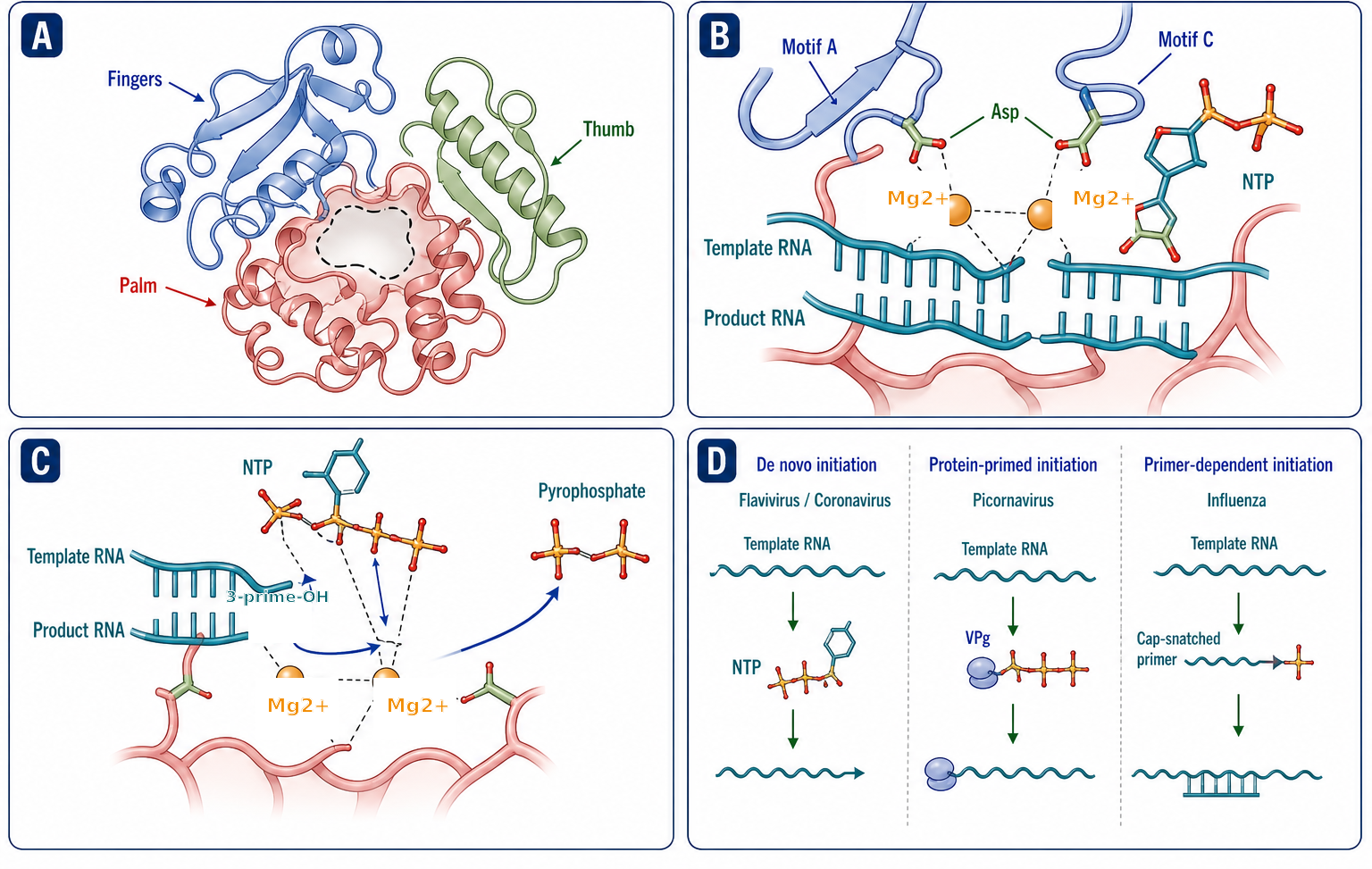
Figure 116.1. Polymerase operation within a replication-transcription complex. Polymerase chemistry is embedded in a complex that controls substrate choice, processivity, error survival, and product fate.
Fidelity in cells is an output of the complete complex. Polymerase discrimination is one component, but proofreading, accessory-factor geometry, nucleotide pools, template structure, elongation speed, and the opportunity for extension after a mismatch also matter. Biochemical misincorporation measurements therefore should not be equated directly with the mutation frequency recovered after multiple replication rounds. Error-corrected sequencing, fluctuation analysis, and reconstructed reporter systems estimate different points along the path from chemical error to surviving variant.
Coronavirus proofreading illustrates distributed polymerase operation. The nsp12 polymerase functions with cofactors, while nsp14 ExoN with nsp10 can remove some mismatches from a nascent 3′ end. Proofreading therefore requires handoff or coordination between synthesis and excision rather than a proofreading domain embedded in the polymerase core. Loss of ExoN increases the recovered mutation frequency and changes sensitivity to some nucleotide analogs, linking replication-complex architecture to genome size and population-level mutational load.
Antiviral perturbations are retained here only as experiments on complex output and population evolution. A synthesis-blocking compound should reduce defined nascent products or cause a predictable stalled intermediate; a mutagenic compound should alter the mutation spectrum before population decline; and a resistance substitution should be evaluated inside the full complex and viral background. Comparative inhibitor binding, isolated enzyme mechanisms, and resistance biochemistry belong to Chapter 23, while clinical pharmacology belongs to Chapter 160.
The error rate is not uniform across the genome. Sequence context, RNA secondary structure, nucleotide pools, and the replication rate all modulate local fidelity. Homopolymeric runs and repeat sequences are hotspots for insertion and deletion errors through polymerase stuttering and slippage. The practical importance is that mutation rate estimates averaged across a genome or a reporter gene may not apply to every site, and that some drug resistance mutations occur at higher rates than the genome average because of local sequence features that promote polymerase errors.
Host nucleotide pools shape viral mutagenesis indirectly. Some cellular antiviral effectors, including interferon-induced proteins and the Viperin radical SAM enzyme, can deplete nucleotide pools or produce modified nucleotides that serve as poor polymerase substrates. Conversely, the balance among the four nucleoside triphosphates inside an infected cell can bias the spectrum of incorporation errors because an imbalanced pool increases the probability that a mismatched nucleotide outcompetes the correct one at the active site. This principle underlies some antiviral strategies that target host nucleotide metabolism rather than the viral polymerase itself.
116.2. Replication Complexes, Membranes, Factories, and Organelles
Viral RNA replication occurs in organized macromolecular assemblies rather than in free solution. RNA virus genomes delivered to the cytoplasm must be translated to produce the RdRP and accessory proteins, after which replication begins on host membranes. The reasons for membrane association are multiple: concentration of replication components increases the effective reaction rate; membranes provide a scaffold for complex assembly; double-stranded RNA replication intermediates are shielded from cytoplasmic innate immune sensors, particularly MDA5, PKR, and OAS; and the spatial coupling of replication, translation, and assembly coordinates the viral life cycle.
Every positive-strand RNA virus family studied to date remodels host membranes into replication organelles. The major architectural themes are spherules (invaginations of a membrane into a vesicle or organelle lumen with a neck connecting the interior to the cytoplasm), double-membrane vesicles (concentric membrane pairs that enclose replication complexes), and membranous webs (clusters of convoluted membranes and vesicles). Despite the different morphologies, all positive-strand RNA virus replication organelles appear to serve the same core function: sequestering replication while allowing nucleotide import and product RNA export through the neck or pore.
Poliovirus (Picornaviridae) remodels endoplasmic reticulum and Golgi membranes into clusters of double-membrane vesicles approximately 100 to 300 nanometers in diameter. Viral proteins 2BC and 3A are the primary membrane remodelers, and 3AB anchors the 3D polymerase and the 3B (VPg) primer to the membrane. The membrane association of 3AB is essential for replication. Flock house virus (Nodaviridae) forms spherules on the outer mitochondrial membrane, providing a simpler model system in which the viral protein A and the RNA template are sufficient for spherule formation in the presence of cellular factors. The spherule neck is lined by the viral polymerase and the template-product RNA duplex, and product single-stranded RNA is extruded through the neck into the cytoplasm for translation and packaging.
Coronaviruses (Coronaviridae) induce a more elaborate membrane rearrangement. The replicase polyprotein, translated from the genomic RNA, is cleaved into sixteen nonstructural proteins (nsp1-nsp16). Transmembrane domains in nsp3, nsp4, and nsp6 anchor the replication complex to the endoplasmic reticulum and drive the formation of double-membrane vesicles and convoluted membranes. Double-membrane vesicles contain the viral RdRP (nsp12), the processivity factor nsp7-nsp8, the helicase nsp13, the proofreading exonuclease nsp14, and the endoribonuclease nsp15, together with the template-product RNA. Pores in the double-membrane vesicle are thought to allow nucleotide import and product RNA release, but the structure and regulation of these pores remain under investigation. The double-membrane vesicle provides one of the most complete examples of a replication organelle that physically separates the steps of RNA synthesis from cytoplasmic surveillance.
Flaviviruses (Flaviviridae), including dengue virus, Zika virus, and hepatitis C virus, form spherule-like invaginations of the endoplasmic reticulum membrane. The flavivirus RdRP domain resides in the C-terminal portion of the NS5 protein, while the N-terminal portion carries a methyltransferase domain that caps the product RNA. NS5 is recruited to the membrane by interaction with NS3 (a protease-helicase) and transmembrane NS4A and NS4B proteins. The replication complex forms in close apposition to sites of translation and, in some flaviviruses, to lipid droplets that store the capsid protein before assembly. The topology is such that double-stranded RNA replication intermediates remain inside the spherule while single-stranded product RNA is released to the cytoplasmic face. Dengue virus spherules are approximately 80 to 100 nanometers in diameter, and each spherule appears to contain a small number of polymerase complexes, perhaps only one to a few.
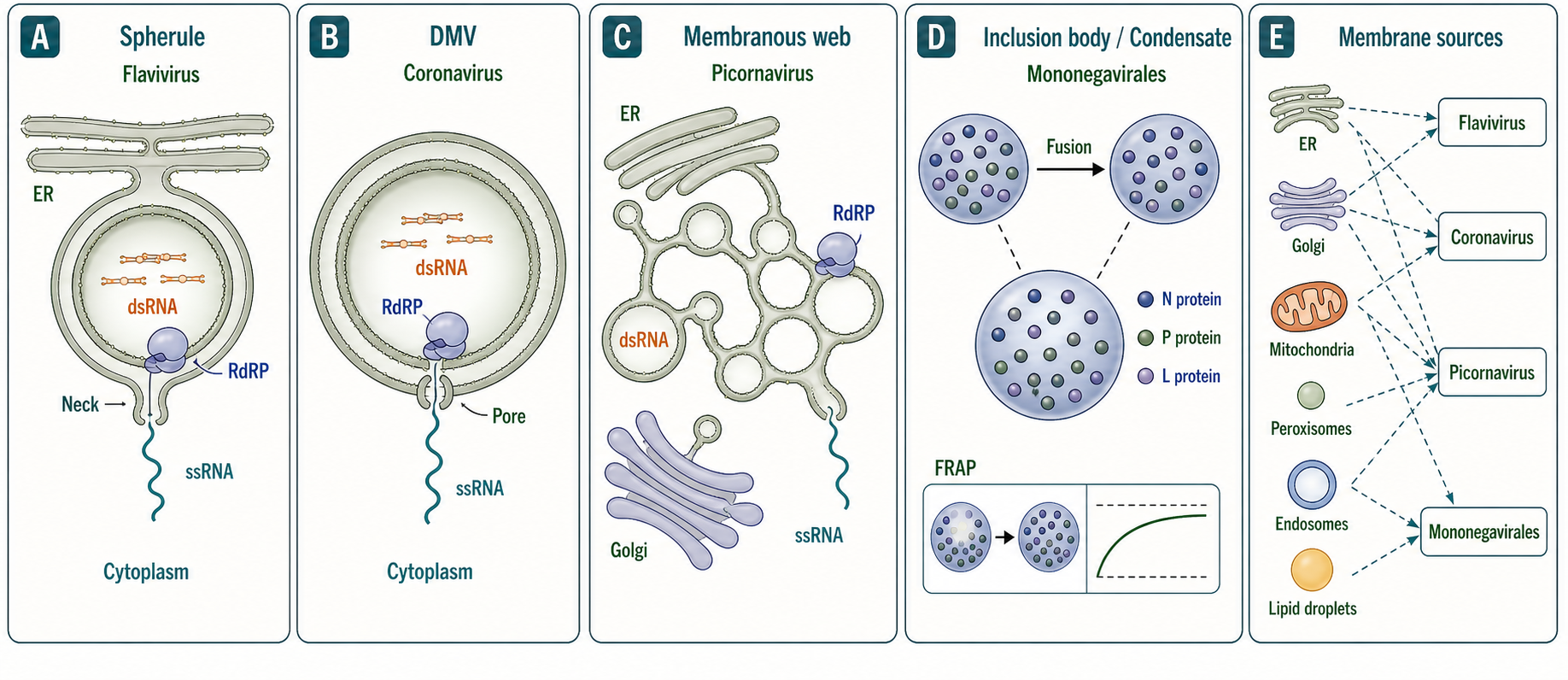
Figure 116.3. RNA-virus replication organelles and factories. Replication organelles and factories solve common problems—template concentration, intermediate protection, cofactor organization, and product routing—with different cellular architectures.
Negative-strand RNA viruses organize replication differently. Rhabdoviruses, paramyxoviruses, filoviruses, and bornaviruses form cytoplasmic inclusion bodies that serve as replication factories. These inclusion bodies contain the viral polymerase, the nucleoprotein that encapsidates the genomic and antigenomic RNA, the phosphoprotein cofactor, and host proteins. The inclusion bodies of some negative-strand RNA viruses, including rabies virus (Rhabdoviridae) and respiratory syncytial virus (Pneumoviridae), exhibit properties of liquid-liquid phase-separated condensates: they are roughly spherical, fuse with one another, dissolve under conditions that disrupt weak multivalent interactions such as 1,6-hexanediol treatment, and concentrate viral proteins while excluding some cytoplasmic proteins. The condensate nature of these factories has been proposed to concentrate replication components, exclude antiviral factors, and couple replication to subsequent steps such as assembly.
Influenza virus (Orthomyxoviridae) is unusual among RNA viruses because its RNA-dependent RNA polymerase (the heterotrimer PA-PB1-PB2) replicates and transcribes the genome in the host cell nucleus rather than the cytoplasm. The polymerase synthesizes viral mRNA using capped primers cleaved from host pre-mRNA by the PA endonuclease subunit, a process called cap-snatching. Genome replication produces full-length complementary RNA (cRNA) that serves as a template for new negative-sense genomic RNA (vRNA). The polymerase operates in association with the viral nucleoprotein, which coats both cRNA and vRNA, and with host RNA-processing factors. The nuclear environment means that influenza virus replication must navigate host mRNA processing, splicing, and export pathways, which is exploited by some anti-influenza strategies.
Bacteriophage RNA-dependent RNA polymerases offer comparative insight. The Qβ replicase is a heterotetramer composed of the phage-encoded catalytic subunit and three host proteins: ribosomal protein S1, elongation factors EF-Tu and EF-Ts. The host factors increase template specificity by discriminating against non-viral RNAs, essentially coupling translation machinery to replication specificity. This is a striking example of a simple virus co-opting host translational proteins to construct a replication complex, and it may reflect ancient strategies used by early RNA replicators before the evolution of dedicated viral polymerases.
Host factors participate in replication-complex assembly and function across all RNA viruses. Cyclophilins, particularly cyclophilin A, are peptidyl-prolyl isomerases that modulate the conformation of viral nonstructural proteins including the hepatitis C virus NS5A and NS5B. Cyclophilin inhibitors such as alisporivir have shown anti-HCV activity in clinical trials. The host membrane-shaping reticulon proteins are required for the formation of some viral replication organelles. Lipid kinases, especially phosphatidylinositol 4-kinase type III, are recruited by many positive-strand RNA viruses to generate phosphatidylinositol 4-phosphate-enriched membranes that serve as platforms for replication complexes. These host-factor dependencies are potential antiviral targets, but they must be weighed against host toxicity.
Defective viral genomes, particularly defective interfering RNAs, arise during replication. Copy-back defective interfering RNAs form when the RdRP dissociates from the template, the nascent RNA folds back on itself through intra-molecular base pairing, and the polymerase uses the nascent strand as a new template, creating a hairpin RNA with complementary ends. These copy-back RNAs retain the replication signals at their termini, allowing them to be replicated preferentially because of their shorter length, but they lack coding capacity. Deletion defective interfering RNAs arise when the polymerase skips a region of template, producing an internally deleted genome. When defective interfering RNAs are packaged and transmitted along with standard virus, they can reduce infectious yield, modulate virulence, and stimulate innate immunity by providing abundant double-stranded RNA. The balance between standard virus and defective interfering RNAs is an evolving area of replication-complex biology because it may determine infection severity.
116.3. Recombination, Reassortment, Defective Genomes, and Template Switching
Genetic exchange in RNA viruses occurs through recombination and reassortment. These two mechanisms are mechanistically distinct but share the biological consequence of creating new combinations of genetic material that can alter fitness, host range, antigenicity, and drug sensitivity.
RNA virus recombination is primarily copy-choice recombination, also called template switching, in which the viral RdRP and its associated nascent RNA dissociate from one template RNA molecule and anneal to a homologous or non-homologous region of another template, then resume synthesis. This process is distinct from the homologous recombination of DNA, which requires sequence homology and is catalyzed by dedicated recombination enzymes. RNA recombination can occur between different positions of the same template (producing deletion or duplication variants), between two co-infecting viral genomes (producing inter-molecular recombinants), or between viral and host RNA (a rare event that can contribute to virus evolution). Copy-choice recombination is an inherent property of the RdRP rather than an enzymatic pathway devoted to recombination.
The mechanistic basis of template switching is polymerase pausing. When the RdRP encounters a template structure, a modified nucleotide, a nucleotide shortage, or a bound protein, it can pause or stall. During the pause, the 3′ end of the nascent RNA can dissociate from the template. If a different RNA template is nearby — especially likely inside a replication organelle where template and product RNAs are concentrated — the nascent RNA and associated polymerase can anneal to the new template through base pairing and resume elongation. The frequency of recombination depends on the pause frequency, the stability of the polymerase-template interaction, local sequence similarity between templates, and the physical proximity of template molecules inside the replication organelle.
Recombination is most extensively documented in positive-strand RNA viruses. In poliovirus, recombination is frequent enough that phylogenetic trees of complete genomes often show different evolutionary histories for different genome regions; the capsid region and the polymerase region can have distinct ancestries in natural isolates. Coronavirus recombination is of special medical interest because it generated the SARS-CoV, MERS-CoV, and SARS-CoV-2 genomes from bat coronavirus ancestors, likely with intermediate hosts. The SARS-CoV-2 spike protein contains a furin cleavage site insertion whose origin is debated, with template-switching recombination among viral genomes or between viral and host RNA as candidate mechanisms. Recombination breakpoints in coronaviruses are nonrandom, occurring preferentially at specific genome positions and at transcriptional regulatory sequences that direct subgenomic mRNA synthesis.
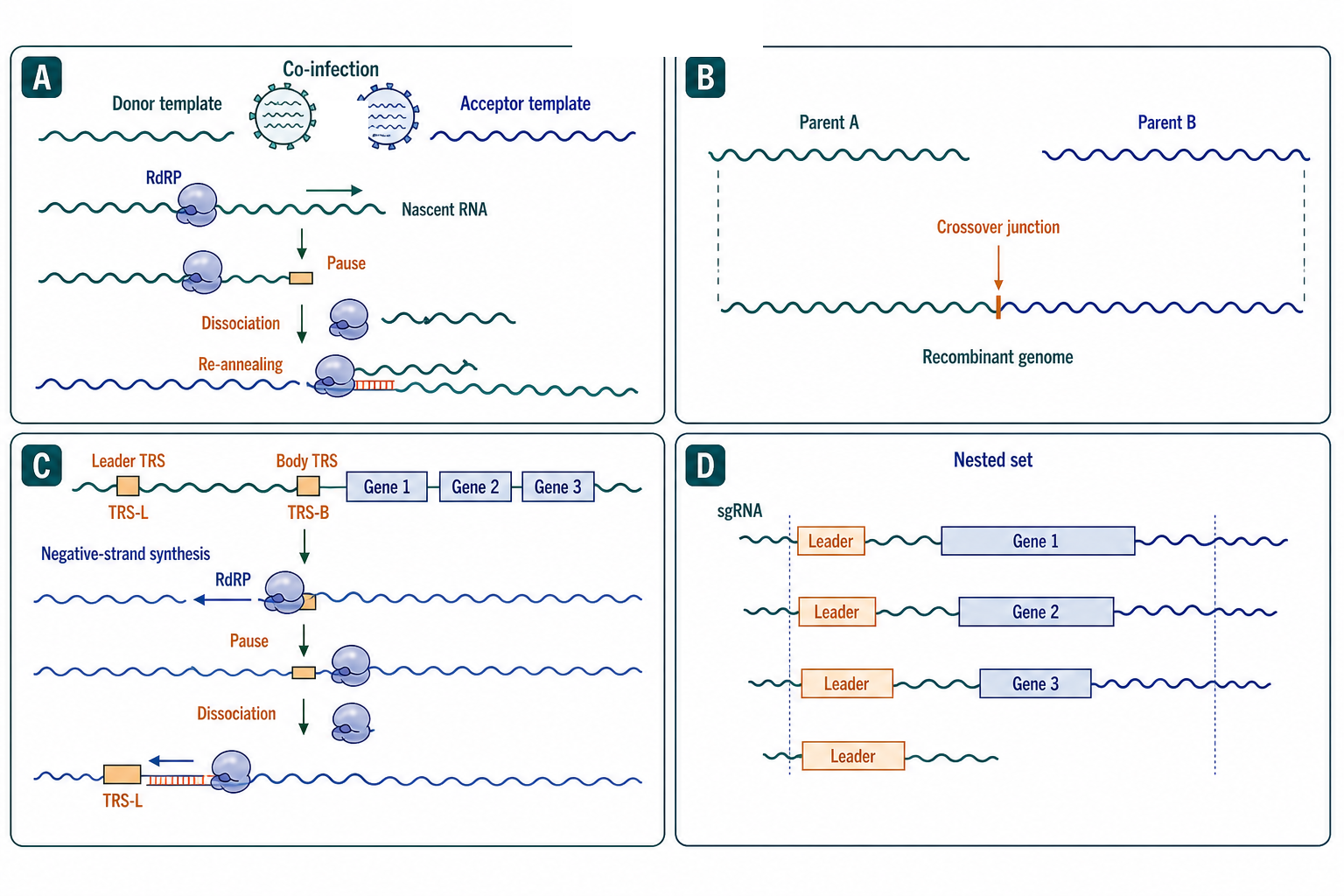
Figure 116.4. Template switching, programmed transcription, and defective-genome formation. Pausing and template proximity create several products whose biological meanings differ even though polymerase switching is a shared step.
The coronavirus transcription mechanism itself relies on a form of discontinuous RNA synthesis that resembles template switching. During negative-strand RNA synthesis from the genomic positive-sense template, the polymerase pauses at transcription regulatory sequences located upstream of each gene. The nascent negative-strand RNA can then dissociate and re-anneal to the leader transcription regulatory sequence at the 5′ end of the genome. This discontinuous step fuses a common leader sequence (derived from the 5′ end of the genome) to the body of each subgenomic mRNA, producing a nested set of 3′-coterminal mRNAs. This mechanism is a specialized, programmed version of template switching and illustrates how recombination-like processes can be co-opted for regulated gene expression.
Reassortment is the recombination of segmented RNA virus genomes by exchange of whole segments during co-infection. If two influenza A virus strains infect the same cell, the eight genome segments from both parents are synthesized and packaged. Because packaging is somewhat flexible, progeny virions can contain segments from both parents. Reassortment is the mechanism behind influenza A virus antigenic shift, in which a virus acquires a hemagglutinin or neuraminidase segment from an animal influenza virus and generates a novel subtype to which the human population has little pre-existing immunity. The pandemics of 1957 (H2N2), 1968 (H3N2), and 2009 (H1N1pdm09) all arose from reassortment between human, avian, and/or swine influenza viruses. Reassortment also occurs in other segmented RNA virus families, including Bunyavirales and Reoviridae (which have double-stranded RNA genomes), and contributes to the genetic diversity of these families.
Selection operates on recombination and reassortment products. Most recombinants and reassortants are less fit than either parent because random combinations of genome regions that have co-evolved often break favorable epistatic interactions. But the rare recombinants and reassortants that are more fit can sweep rapidly through a population, especially when the environment has changed, such as during a host switch or after drug treatment. This creates an evolutionary pattern in which viral populations appear clonal for long periods, interspersed with recombination events that create new, fit genotypes that expand.
Defective viral genomes are products of aberrant replication that have biological consequences beyond simply being dead-end byproducts. Copy-back defective viral genomes from paramyxoviruses and filoviruses are potent inducers of the innate immune response because they contain long stretches of double-stranded RNA, the ligand for MDA5 and PKR. In Sendai virus and respiratory syncytial virus, copy-back defective viral genomes can determine whether an infection is cleared or becomes persistent, and the ratio of standard to defective genomes may influence disease severity. In hepatitis C virus patients, defective viral genomes with large in-frame deletions in the envelope glycoprotein genes have been detected, and these genomes may contribute to immune evasion by diverting antibody responses toward nonfunctional envelope proteins that are secreted rather than incorporated into virions. Defective viral genomes can also contribute to the establishment of persistent infections in culture and in hosts by reducing cytopathicity while maintaining a reservoir of replication-competent genomes.
Defective interfering RNAs deserve special mention because the interference effect was discovered experimentally in influenza virus by von Magnus in the 1950s, before the molecular nature of defective genomes was understood. Von Magnus observed that serial undiluted passage of influenza virus in eggs led to a cyclical decrease and recovery of infectious titer, with incomplete virus particles predominating at low-titer passages. We now know that copy-back and deletion defective interfering RNAs accumulate during high-multiplicity passage because their shorter length gives them a replication advantage, and they interfere with standard virus replication by competing for limiting polymerase and nucleoprotein. The von Magnus effect is a direct demonstration that defective genomes are not merely dead-end products but can shape the population dynamics of RNA viruses in experimental systems and, by extension, in hosts.
116.4. Quasispecies, Mutation Spectra, Selection, and Bottlenecks
Quasispecies theory began with Manfred Eigen’s 1971 work on self-replicating macromolecules and error thresholds. Eigen formulated the relationship among replication fidelity, genome length, and the maximum error rate compatible with maintaining genetic information. The error threshold is the mutation rate above which the population cannot maintain a master sequence because errors accumulate faster than selection can eliminate them. For an RNA virus with a genome of roughly 10⁴ nucleotides, the maximum tolerable mutation rate is approximately 1 to 10 mutations per genome per replication round, which is close to the measured error rates of many RNA viruses. This proximity means that small increases in the mutation rate, as caused by mutagenic nucleoside analogs, can push the population across the error threshold into error catastrophe.
Esteban Domingo and colleagues applied quasispecies theory to RNA viruses beginning in 1978, working with the bacteriophage Qβ. They demonstrated that a Qβ population is not a single sequence but a distribution of mutants centered on a master or consensus sequence, that minority variants in the distribution can be selected when the environment changes, and that the population rather than the individual genome is the target of selection. These findings were later extended to animal and human RNA viruses, including foot-and-mouth disease virus, lymphocytic choriomeningitis virus, human immunodeficiency virus (which is a retrovirus; the concept applies because reverse transcriptase error rates are similar), and hepatitis C virus.
A quasispecies is not merely a “population with many mutants.” The mathematical definition involves a mutant distribution that is in mutation-selection balance, where the population occupies a limited region of sequence space and the frequency of each variant is determined by its replication rate, its mutational coupling to other variants, and the mutation rate. The practical features relevant to virology are: the quasispecies can contain variants that are individually less fit than the consensus but are maintained by mutational input and may become fit after an environmental shift; the quasispecies can traverse fitness valleys that individual genotypes cannot cross; and the quasispecies can store genetic information in the mutant spectrum rather than in a single master sequence.
Mutation spectra describe the kinds and contexts of mutations, not only their number. Polymerase-complex composition, proofreading, nucleotide pools, template structure, host editing, and chemical perturbation can each bias transitions, transversions, insertions, or deletions. The spectrum interacts with the genetic code and RNA structure, so two populations with the same mean mutation rate can explore different viable neighborhoods. A changed spectrum under an antiviral is evidence for altered copying only after sequencing error, host editing, and selection during subsequent rounds are separated.
Selection acts continuously on the mutant spectrum. Deleterious mutations are removed by purifying selection at the protein, RNA structure, and regulatory element levels. Beneficial mutations, including those that confer drug resistance or immune escape, increase in frequency. Neutral and nearly neutral mutations can drift upward or downward in frequency depending on population size and linkage to selected sites. The interplay of mutation, selection, and drift determines the allele frequency spectrum of the within-host population at any time. Next-generation sequencing of viral populations, particularly with error-correction methods such as CirSeq (circular sequencing) and primer-ID-based approaches, can resolve variants down to frequencies of approximately 1 in 1,000 to 1 in 10,000, revealing a rich mutant spectrum that was invisible to Sanger sequencing.
Population bottlenecks are reductions in population size that stochastically change the composition of the mutant spectrum. The transmission bottleneck when a virus moves from one host to another for many RNA viruses is narrow, on the order of 1 to 10 infectious genomes. This means that most within-host variants are lost during transmission, and the recipient host starts with a genetically simpler population that must regenerate diversity through new mutations. Within a host, anatomical bottlenecks occur when a virus moves from one tissue compartment to another, such as from the respiratory tract to the central nervous system or from the blood to a solid organ. Bottlenecks are important because they enable Muller’s ratchet — the irreversible accumulation of deleterious mutations in small asexual populations — to operate during transmission and within-host dissemination. A viral population that undergoes repeated bottlenecks can drift to lower fitness even without an environmental change, and this effect has been proposed as a contributor to the attenuation of some live-attenuated vaccines that are passaged under conditions that create serial bottlenecks.
Table 116.1. Distinguishing mutation and population-evolution measurements. Biochemical misincorporation, mutation rate, mutation spectrum, variant frequency, substitution rate, and bottleneck size are not interchangeable.
| Quantity | What it measures | Typical evidence | Intervening processes | Common overinterpretation |
|---|---|---|---|---|
| Biochemical misincorporation | Error probability in a defined complex and template | Reconstituted incorporation assay | Proofreading, extension, cellular context | Genome-wide in-cell mutation rate |
| Mutation rate | New heritable errors per copying event | Fluctuation, barcode, or controlled single-cycle assay | Recovery selection and reporter context | Observed allele frequency |
| Mutation spectrum | Relative error classes and sequence contexts | Error-corrected sequencing with controls | Editing, selection, nucleotide pools, artifacts | Pure active-site preference |
| Variant frequency | Fraction of sampled genomes carrying a variant | Deep sequencing or haplotypes | Replication, selection, drift, linkage | Time or probability of origin |
| Substitution rate | Fixed or transmitted changes per site and time | Longitudinal or phylogenetic analysis | Purifying selection, transmission, saturation | Biochemical mutation rate |
| Bottleneck size | Diversity founding a new population | Donor-recipient variants, barcodes, likelihood models | Establishment selection and sampling | Fitness of every lost variant |
Table 116.1. Distinguishing viral mutation and population-evolution measurements
| Quantity | What it measures | Typical evidence | Processes between measurement and observed population | Common overinterpretation |
|---|---|---|---|---|
| Biochemical misincorporation | Error probability for a defined polymerase complex and template | Purified or reconstituted incorporation assay | Proofreading, extension, complex context, and cell state | Treating one template assay as the in-cell genome-wide mutation rate |
| Mutation rate | New heritable errors per copying event | Fluctuation test, barcoded lineage, or controlled single-cycle assay | Selection during recovery and reporter-specific context | Equating rate with variant frequency |
| Mutation spectrum | Relative classes and sequence contexts of new errors | Error-corrected sequencing with matched controls | Host editing, nucleotide pools, selection, and sequencing artifacts | Assigning every spectral bias to polymerase active-site chemistry |
| Variant frequency | Fraction of sampled genomes carrying a variant | Deep sequencing or haplotype reconstruction | Replication rounds, selection, drift, linkage, and sampling | Inferring when or how often the mutation arose |
| Substitution rate | Changes fixed or transmitted per site per unit time | Longitudinal or phylogenetic analysis | Purifying selection, transmission, recombination, and saturation | Treating substitution rate as the biochemical mutation rate |
| Bottleneck size | Number or diversity of genomes founding a new population | Donor-recipient variants, barcodes, or likelihood models | Selection during establishment and incomplete sampling | Interpreting every lost variant as deleterious |
Fitness is the replicative capacity of a virus relative to a reference strain under defined conditions. Fitness is measured by growth competition assays in which two distinguishable viruses are co-infected at a known ratio and the ratio is measured over multiple rounds of replication. Fitness is context-dependent: a virus that is fit in one cell type, temperature, drug concentration, or immune environment may be less fit in another. Fitness landscapes are conceptual maps of fitness as a function of genotype. A rugged fitness landscape has many local peaks separated by valleys of low fitness, making it difficult for a population to move from one peak to another without crossing a valley. Recombination can facilitate such moves by combining beneficial mutations from different peaks while avoiding the intermediate low-fitness states that sequential mutation would require.
The quasispecies framework has practical implications under antiviral selection. Pre-existing minority variants can expand when treatment changes the fitness landscape. A mutagenic pressure can instead increase deleterious load and reduce population fitness, but the outcome depends on the achieved spectrum, proofreading, population size, complementation, and the number of replication rounds. Molecular incorporation and resistance biochemistry belong to Chapter 23; this chapter asks how those perturbations alter the distribution and survival of viral lineages.
116.5. Evolution Under Antivirals, Immunity, and Transmission
Antiviral treatment changes the viral fitness landscape. The speed of resistance emergence depends on the pre-treatment frequency of relevant variants, the number of nucleotide and amino-acid changes required, the fitness of intermediate genotypes, effective population size, linkage, recombination, drug exposure, and the degree of replication suppression. “Genetic barrier” is therefore a population property of a drug-virus-background combination, not merely a count of mutations in an isolated enzyme.
Resistance can impose a context-dependent fitness cost, and compensatory substitutions elsewhere in the complex or genome can restore growth without reversing resistance. Competition experiments should therefore compare isogenic viruses across drug concentrations and relevant cell states. A resistance substitution with poor isolated polymerase kinetics can still persist if complementation, linkage, altered complex assembly, or compensation restores whole-virus fitness. Detailed biochemical mechanisms belong to Chapter 23.
Immune-driven evolution operates on a larger set of targets than drug-driven evolution because neutralizing antibodies and cytotoxic T cells can recognize multiple epitopes across the viral proteome. Antibodies select mutations in surface glycoproteins that reduce binding without abolishing receptor engagement and entry. T cells select mutations in epitope sequences that reduce major histocompatibility complex binding or T cell receptor recognition. The virus population inside a chronically infected host, such as HCV or HIV, continuously evolves to escape the current antibody and T cell response, which in turn drives the host to produce new responses against the new variants. This co-evolutionary arms race is a major reason that chronic RNA virus infections are difficult for the host immune system to clear without antiviral drugs and why broadly neutralizing antibodies are rare and usually target conserved epitopes where escape is constrained.
The interaction between immune and drug selection changes the treatment response. Antiviral therapy that rapidly reduces viral load can reduce the diversity of the quasispecies and limit the number of variants available for immune escape. Conversely, incomplete viral suppression can create a population bottleneck followed by expansion of resistant variants, some of which may carry new immune escape mutations. Combination antiviral therapy that includes polymerase inhibitors, protease inhibitors, and entry inhibitors simultaneously suppresses multiple replication steps and limits the chance that a variant resistant to all components exists in the pre-treatment population.
Transmission imposes a genetic bottleneck that reduces diversity and resets evolution. For many acute RNA virus infections, including influenza, dengue, SARS-CoV-2, and norovirus, the transmitted population is estimated at fewer than ten infectious genomes and in some cases a single genome. This narrow bottleneck means that the recipient starts with a small sample of the donor’s mutant spectrum, and minority variants that were selectively neutral or mildly deleterious in the donor may be absent from the recipient. The bottleneck also limits the transmission of drug resistance unless the resistance variant is already dominant in the donor. For viruses such as HIV that are transmitted as a single founder virus in most heterosexual transmissions, the acute infection begins with a genetically homogeneous population that diversifies over weeks to months. This pattern has implications for vaccine design, because the transmitted-founder virus may have properties distinct from the diverse chronic-phase population.
Compartmentalization adds another layer. Within an infected host, different anatomical compartments — blood, lymphoid tissue, central nervous system, genital tract, respiratory mucosa — can harbor genetically distinct subpopulations because of differences in immune pressure, drug penetration, replication rate, and cell-type-specific factors. This compartmentalization can serve as a reservoir for variants that re-seed other compartments, and it can complicate treatment if drugs achieve different concentrations in different tissues.
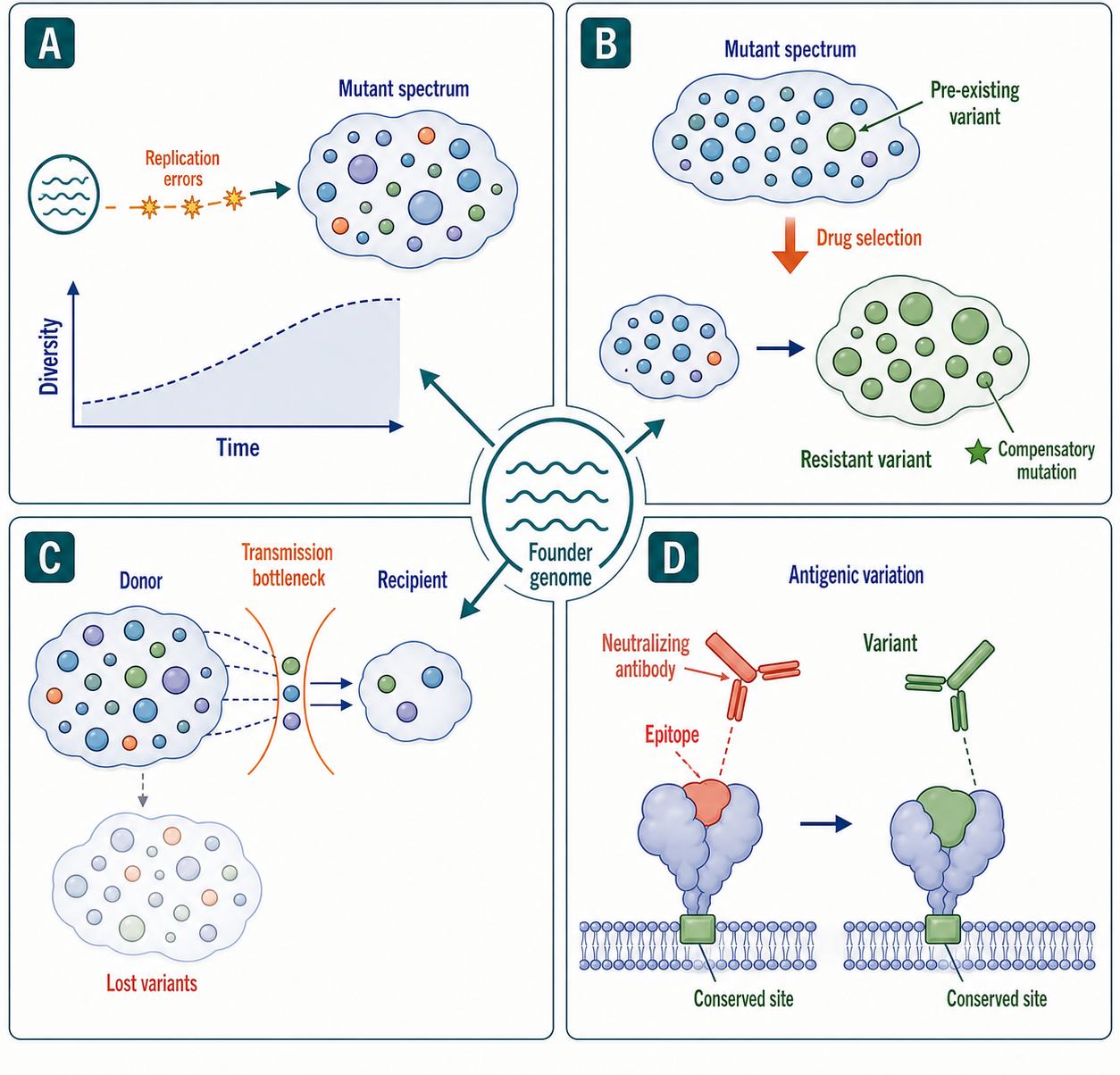
Figure 116.5. Population dynamics across within-host selection and transmission. Variant frequency reflects selection, drift, linkage, and sampling as well as mutation supply.
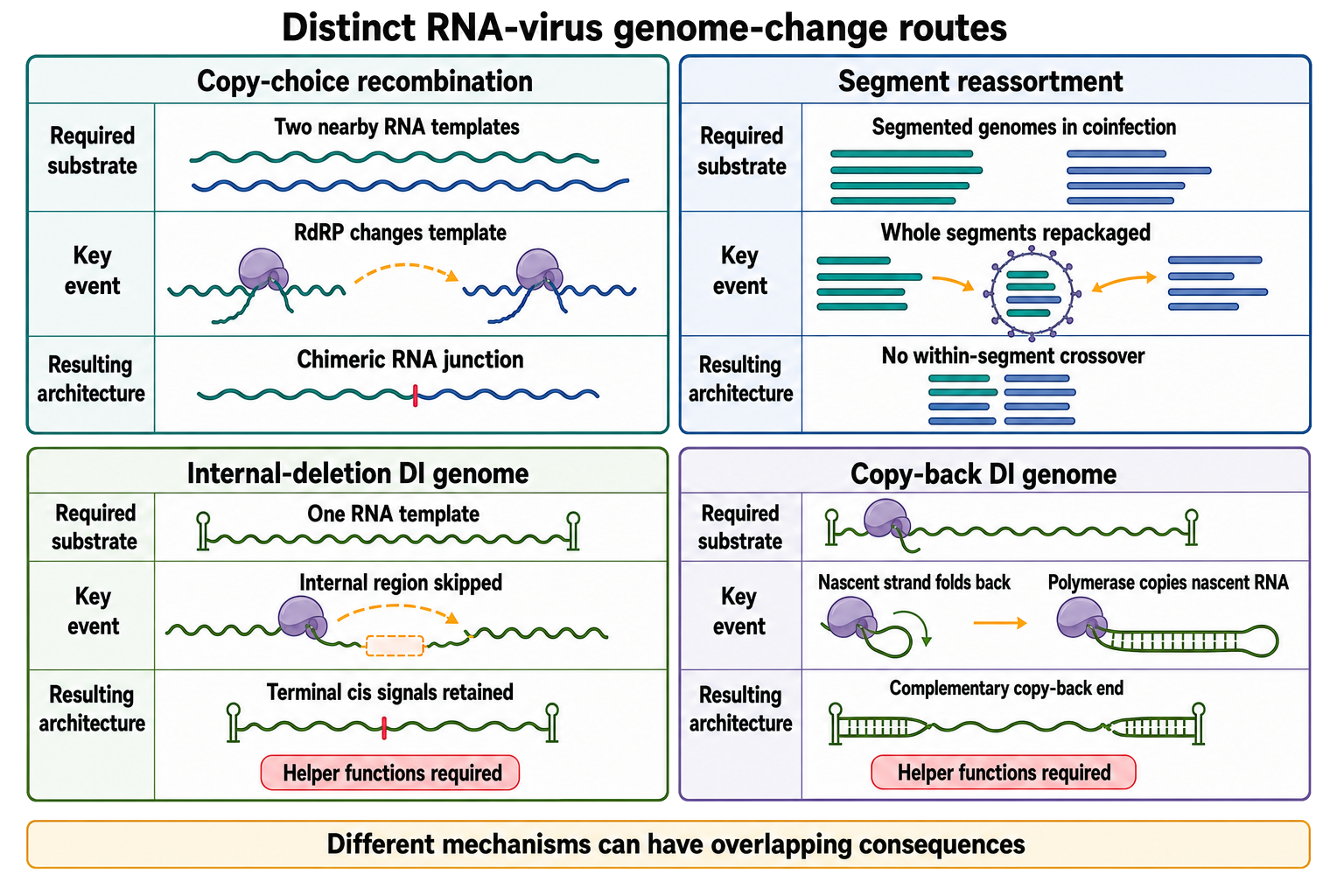
Figure 116.6. Recombination, reassortment, and defective-genome formation are distinct routes. Recombination creates a junction within an RNA, reassortment exchanges intact genome segments, and defective genomes arise by deletion or copy-back replication errors; similar evolutionary consequences do not make these mechanisms interchangeable.
Phylogenetic methods can reconstruct viral evolutionary history from sequence data. Within-host phylogenies can identify the timing and direction of drug resistance mutations, distinguish de novo from transmitted resistance, and estimate the date of the most recent common ancestor of a sampled population. Between-host phylogenies, combined with epidemiological data, can trace transmission chains, identify superspreading events, date the introduction of a virus into a new geographic region or host species, and detect recombination and reassortment events. The molecular clock — the approximately constant rate of nucleotide substitution over time — is a key assumption, and it is reasonably well supported for many RNA viruses over short time scales because of the high mutation rate. Over longer time scales, saturation of mutation at variable sites can distort the clock, and different genes evolve at different rates because of differences in selection pressure.
Combination pressure can raise the population-level barrier when no accessible genotype retains adequate fitness under all components. The simple product of single-resistance frequencies is only an approximation because linkage, recombination, epistasis, compartmental drug exposure, and sequential selection can change joint probabilities. The evolutionary design goal is durable suppression across plausible mutational paths, while drug choice and clinical outcomes belong to Chapter 160.
Immune selection follows the same population logic but acts across many epitopes and cell types. Escape depends on variant availability, epitope constraint, linkage to other selected sites, and the cost of preserving entry or replication. Conserved targets can limit accessible escape paths, whereas heterogeneous or incomplete pressure can permit stepwise adaptation. Vaccine design is treated elsewhere; the ownership here is the population response to immune selection.
Box 116.1. Mutation rate is not mutation frequency
Render-ready content:
Mutation rate asks how often a new heritable error occurs during copying. Mutation frequency asks how common a variant is in a sampled population. Between those quantities lie extension or proofreading, multiple replication rounds, selection, drift, complementation, linkage, recombination, compartmentalization, bottlenecks, and sequencing error. Report which quantity was measured, the time and population sampled, the error-correction method, and the model used to infer any unobserved rate.
The broader implication for pandemic preparedness is that the high mutation rate and large population sizes of RNA viruses constitute an intrinsic source of genetic novelty. Most novel variants are neutral or deleterious, but when billions of replication events occur in millions of infected hosts, even improbable beneficial mutations occur, and one such variant can spark an outbreak, a vaccine-escape lineage, or a drug-resistant epidemic. Surveillance programs that track viral genomic diversity — not only consensus sequences but also minority variant frequencies, recombination events, and reassortment patterns — are essential for early detection of variants that may alter transmission, virulence, or intervention efficacy.
Experimental Foundations and Evidence Standards
Evidence for polymerase operation in complexes combines purified reconstitution, cryo-electron microscopy of multi-protein assemblies, minigenomes, replicons, and infected-cell nascent-RNA measurements. A catalytic subunit can demonstrate nucleotide incorporation, but template choice, initiation, processivity, proofreading handoff, subgenomic transcription, and product export require the relevant cofactors and RNA context. The comparison of isolated enzyme folds and kinetics is treated in Chapter 23.
Evidence for replication organelle architecture comes from electron microscopy, electron tomography, and correlative light and electron microscopy of infected cells. The three-dimensional reconstructions of coronavirus double-membrane vesicles and flavivirus spherules have been essential for understanding how replication is compartmentalized. Correlative light and electron microscopy has been particularly important for connecting fluorescently tagged viral proteins to ultrastructure, allowing the identification of replication organelles among the many membrane structures in an infected cell.
Evidence for recombination and reassortment comes from phylogenetic incongruence, experimental co-infections, and deep sequencing of natural populations. The detection of recombination requires demonstrating that different regions of the same genome have different evolutionary histories, which can be confounded if homologous regions have different phylogenetic signals for other reasons. Experimental co-infections with distinguishable parental viruses provide the most direct evidence: recombinant progeny are recovered, sequenced, and tested for the predicted breakpoint junctions. For influenza reassortment, the gold standard is the recovery of viruses with segment combinations from both parents, verified by segment-specific PCR or sequencing, and with altered phenotypes such as new antigenic subtypes.
Evidence for quasispecies dynamics comes from high-depth sequencing of viral populations, experimental evolution, and theoretical modeling. Early evidence came from biological cloning and RNA fingerprinting (RNase T1 oligonucleotide mapping) of Qβ populations, which showed that a plaque-purified virus rapidly regenerated a diverse mutant spectrum after a few passages. Modern approaches use error-corrected deep sequencing to track variants at frequencies below the sequencer error rate. Experimental evolution studies passage virus under defined conditions and track fitness, mutation spectrum, and population bottleneck effects. These studies have confirmed that population bottlenecks reduce fitness (Muller’s ratchet), that mutagenic nucleoside analogs cause population extinction (lethal mutagenesis), and that recombination can rescue fit genotypes from declining populations.
The main interpretive hazards include: confusing mutation rate with mutation frequency, treating a consensus sequence as the viral genotype, ignoring low-frequency variants that are below the detection threshold, overinterpreting phylogenetic trees built from a small number of sequences, and misattributing a fitness difference to a specific mutation without reconstructing the mutation in an isogenic background. The formal standard for attributing a phenotype to a mutation is reverse genetics: introduce the candidate mutation into a cloned viral genome, recover the mutant virus, and demonstrate that the phenotype is recapitulated in the absence of other changes.
Biological Contexts and Cross-Chapter Boundaries
This chapter sits at the interface of viral cell biology and population genetics. Comparative polymerase structure, isolated fidelity, inhibitor binding, and resistance biochemistry belong to Chapter 23. Replication organelles connect to genome strategies in Chapter 115 and regulatory RNA structures in Chapter 117. Recombination and reassortment connect to emergence in Chapter 115, while quasispecies and antiviral evolution connect to pharmacology in Chapter 160 and immune selection in Chapter 110.
The most important boundary is complex operation versus isolated chemistry. This chapter explains how copying, proofreading, pausing, and template switching occur in a cellular assembly and how their products reshape populations. It does not compare catalytic folds, derive inhibitor binding, or catalog resistance substitutions. Retroviral and retrotransposon replication is treated in Chapter 120; population principles can apply there, but their life cycles are not retaught here.
Recent Consensus
RNA-virus polymerases operate with viral cofactors, RNA templates, nucleoproteins, and often remodeled membranes rather than as free enzymes. Coronavirus proofreading by nsp14 ExoN is an established example of fidelity distributed across a complex. Positive-strand RNA viruses organize replication on remodeled membranes, while many negative-strand viruses form protein-RNA factories or inclusion bodies. Product RNA export and the exact coupling among synthesis, proofreading, encapsidation, and factory organization remain incompletely resolved.
Copy-choice recombination, programmed discontinuous transcription, reassortment, and defective-genome production are established copying outcomes whose frequency depends on cellular and complex context. Quasispecies theory provides a useful population framework, although idealized Eigen-model assumptions differ from finite, structured, recombining viral populations. Mutant spectra, minority variants, Muller’s ratchet, lethal mutagenesis, fitness costs, compensation, and transmission bottlenecks are experimentally supported independently of any one mathematical formalism.
Open Questions, Controversies, Deprecated Models, and Common Misconceptions
Open questions:
- Whether all positive-strand RNA virus replication organelles share a common mechanism for product RNA export? The spherule neck is narrow — roughly 2 to 4 nanometers — which is enough to pass a single-stranded RNA but not a double-stranded RNA duplex. The hypothesis that the partially unwound product RNA is threaded through the neck during synthesis is attractive but incompletely established for most virus families.
- Are the replication factories of negative-strand RNA viruses functionally equivalent to the membrane-bound replication organelles of positive-strand RNA viruses? The condensate model accounts for liquid-like properties but does not explain how replication specificity, template recruitment, and product RNA export and encapsidation are coordinated inside the condensate.
Controversies:
- The extent to which recombination drives RNA virus macroevolution is debated. Recombination is clearly important within virus families, and it has generated the pandemic coronaviruses, but whether it routinely generates new virus species, orders, or families is less clear. The alternative view is that most virus family-level diversity reflects ancient divergence and that recombination operates primarily within family boundaries.
Common misconceptions:
- “Quasispecies means that RNA viruses mutate so fast they can adapt to anything.” Most mutations are deleterious, many are neutral, and only a small fraction are beneficial. The quasispecies provides variation on which selection can act, but it does not guarantee adaptation. Constraints such as protein folding, receptor binding, RNA structure, and codon usage limit the range of viable variation, and many environmental challenges (such as combination therapy targeting conserved catalytic residues) have not been overcome by RNA virus evolution.
- “Coronaviruses have proofreading, so they don’t mutate.” Coronavirus proofreading reduces the mutation rate roughly 10- to 20-fold compared with other RNA viruses, but it does not eliminate mutations. SARS-CoV-2 variants of concern, including Alpha, Delta, and Omicron, accumulated multiple mutations in the spike protein and elsewhere, demonstrating that the proofreading-reduced mutation rate combined with enormous population sizes still generates substantial genetic diversity.
- “Defective interfering RNAs are always protective or always laboratory artifacts.” Defective interfering RNAs can reduce viral yield and contribute to clearance or persistence depending on the ratio of defective to standard genomes, the timing of defective interfering RNA production, the innate immune response they stimulate, and whether they are transmitted. Their role in natural infections remains incompletely characterized.
- “Resistance mutations that carry a fitness cost will disappear when the drug is withdrawn.” Compensatory mutations can reduce or eliminate the fitness cost, allowing resistant variants to persist. Even without compensation, the resistant variant may persist at low frequency if the fitness cost is small relative to the effective population size, and it can re-emerge rapidly if treatment resumes or if a related drug is used.