Chapter 22. Specialized Nuclear, Organellar, and Viral-Like RNA Polymerases
Scope Note
This chapter covers RNA polymerases that sit outside the main bacterial RNA polymerase, archaeal RNA polymerase, and eukaryotic nuclear RNA polymerases I, II, and III treated in Chapters 20 and 21. The central examples are plant RNA polymerases IV and V, mitochondrial RNA polymerases, chloroplast and plastid RNA polymerases, bacteriophage-derived single-subunit polymerases, viral-like transcription modules, and polymerases used for in vitro RNA synthesis. The chapter emphasizes DNA-dependent RNA synthesis. RNA-dependent RNA polymerases, reverse transcriptases, telomerase, and other RNA-templated synthesis enzymes are treated in Chapter 23.
The chapter’s organizing principle is that a polymerase is specialized not only by its catalytic fold, but also by its template, promoter-recognition system, compartment, accessory factors, product fate, and evolutionary history. A plant Pol V transcript, a mitochondrial polycistronic RNA, a chloroplast precursor transcript, a T7 in vitro transcript, and a viral-like capped RNA may all be made by enzymes called RNA polymerases, yet the biological meaning of each product depends on the pathway that receives the nascent RNA.
Executive Summary
Specialized RNA polymerases demonstrate that transcription systems evolve through duplication, divergence, endosymbiotic remodeling, viral acquisition, nuclear retargeting, and technological domestication. The same chemical reaction, addition of ribonucleotides to a growing RNA chain using a nucleic-acid template, can be embedded in very different biological programs.
Plant RNA polymerases IV and V are nuclear, multisubunit, Pol II-related enzymes that participate in RNA-directed DNA methylation, a small-RNA-guided chromatin-silencing pathway in land plants. Pol IV helps generate RNA substrates that are converted into small interfering RNAs. Pol V produces low-abundance chromatin-associated scaffold transcripts at target loci. These transcripts are not ordinary mRNAs, and their biological importance is often detected through small-RNA profiles, DNA methylation changes, chromatin assays, and genetic phenotypes rather than through abundant polyadenylated RNA.
Organellar transcription reflects the mixed ancestry of mitochondria and plastids. Mitochondria in many eukaryotes use a nuclear-encoded phage-like single-subunit RNA polymerase together with accessory transcription factors. Human POLRMT is a well-studied example, but human mitochondrial transcription is not a universal model for all eukaryotic mitochondria. Plant plastids can use both a nuclear-encoded phage-type polymerase and a plastid-encoded bacterial-like multisubunit polymerase. In chloroplasts, promoter class, developmental state, tissue, and light-responsive maturation influence whether nuclear-encoded polymerase or plastid-encoded polymerase activity dominates.
Organellar transcription cannot be understood as transcription alone. Many organellar RNAs are synthesized as precursor RNAs that require cleavage, editing, splicing, stabilization by RNA-binding proteins, and translation-linked regulation before they become functional mRNAs, rRNAs, or tRNAs. The primary transcript is therefore an early intermediate in an RNA-maturation pathway, not necessarily the final molecule measured by steady-state RNA sequencing.
Bacteriophage-derived single-subunit polymerases, especially T7 RNA polymerase, show that promoter recognition, initiation, promoter escape, catalysis, and elongation can be performed by one polypeptide. This compact architecture made T7, T3, and SP6 polymerases central tools in molecular biology, while structural studies of T7 RNAP show that the enzyme undergoes large conformational transitions as it moves from initiation to processive elongation. Their products support biochemical assays, RNA structure studies, guide RNA production, cell-free expression, synthetic biology, and mRNA manufacturing. However, in vitro transcription does not automatically produce one homogeneous RNA. Abortive transcripts, premature termination products, terminal heterogeneity, residual template DNA, residual enzyme, and double-stranded RNA byproducts must be measured and controlled when product identity matters.
Viral-like transcription modules and mobile-element-associated polymerases must be classified carefully. Similar enzyme folds can appear in organelles, viruses, plasmids, and mobile elements, but fold similarity alone does not define biological role. The relevant questions are whether the template is DNA or RNA, whether the product is RNA or DNA, which compartment contains the reaction, which cofactors are required, how the RNA is modified or capped, and how the transcript contributes to the life cycle. This distinction is especially important at the boundary between this chapter and Chapter 23, where RNA-templated enzymes are treated separately.
Concept Inventory
- RNA polymerase IV: a plant-specific Pol II-related nuclear RNA polymerase. Its best-established role is to produce RNA substrates that enter small interfering RNA biogenesis during RNA-directed DNA methylation. Pol IV should not be treated as a plant version of Pol II for ordinary mRNA synthesis.
- RNA polymerase V: a plant-specific Pol II-related nuclear RNA polymerase that produces chromatin-associated scaffold transcripts used in RNA-directed DNA methylation. Pol V transcripts are often low-abundance, non-polyadenylated or poorly captured by standard mRNA-focused workflows, and tightly linked to chromatin context.
- RNA-directed DNA methylation: a plant chromatin-silencing pathway in which small RNAs guide DNA methylation and associated repressive chromatin states to homologous genomic regions. RdDM is important for repeat and transposon control, but it is not the only pathway that maintains plant DNA methylation.
- Nuclear-encoded organellar polymerase: a phage-type RNA polymerase encoded by a nuclear gene, synthesized in the cytosol, imported into an organelle, and used to transcribe organellar DNA. Different organisms target different polymerase repertoires to mitochondria, plastids, or both.
- Plastid-encoded polymerase: a bacterial-like multisubunit RNA polymerase whose core subunits are encoded by the plastid genome. PEP resembles bacterial RNA polymerase in broad ancestry, but its activity in chloroplasts depends strongly on nuclear-encoded accessory proteins and plastid developmental state.
- Mitochondrial RNA polymerase: a single-subunit phage-like DNA-dependent RNA polymerase responsible for transcription of mitochondrial DNA in many eukaryotes. In humans the enzyme is POLRMT, which functions with accessory factors including TFAM and TFB2M during transcription initiation. Other eukaryotic lineages can differ substantially.
- Single-subunit RNA polymerase: a DNA-dependent RNA polymerase in which one polypeptide contains the major functions needed for promoter recognition, DNA opening, initiation, nucleotide addition, promoter escape, and elongation. T7 RNA polymerase is the canonical research example, but single-subunit polymerases are mechanistically and biologically diverse.
- In vitro transcription: RNA synthesis outside living cells using a DNA template, purified or partially purified polymerase, ribonucleoside triphosphates, buffer, divalent cations, and optional capping or nucleotide-modification chemistry. Analytical IVT and therapeutic-scale IVT have different quality thresholds.
- Double-stranded RNA byproduct: an unintended duplex RNA species produced during or after RNA synthesis. In mammalian systems, long or structured double-stranded RNA can stimulate innate immune sensors, so direct measurement and removal of double-stranded RNA are important for immune-sensitive experiments and RNA therapeutics.
What to Know Before Reading This Chapter
Readers should know four ideas from earlier chapters. First, DNA-dependent RNA polymerases synthesize RNA by reading a DNA template and adding ribonucleotides to the 3′ end of a growing RNA chain. Second, polymerases are not interchangeable motors: promoter recognition, initiation factors, elongation behavior, and termination mechanisms differ among bacterial RNA polymerase, archaeal RNA polymerase, Pol I, Pol II, and Pol III. Third, mitochondria and plastids originated from bacterial endosymbionts, but modern organelles are integrated with the nuclear genome. Fourth, noncoding RNAs can act through pairing, binding, scaffolding, and chromatin recruitment rather than through translation.
This chapter uses several running examples. Plant Pol IV and Pol V illustrate specialization by chromatin-silencing pathway. Human mitochondrial POLRMT illustrates nuclear-encoded retargeting of a phage-like polymerase to an organelle. Tobacco RpoTp illustrates a nuclear-encoded plastid polymerase that recognizes promoter classes distinct from the plastid-encoded polymerase. T7 RNA polymerase illustrates how a simple phage enzyme became an industrial and laboratory workhorse.
Several terms require caution. “Phage-like” means that a polymerase shares ancestry or architecture with bacteriophage single-subunit polymerases; it does not mean that the enzyme currently belongs to a phage. “Viral-like” means that a protein or module resembles a viral enzyme or strategy; it does not by itself prove active infection. “Organellar transcript” can refer to a primary transcript, a processed mRNA, a mature rRNA, a tRNA precursor, or a stabilized RNA fragment, so the experimental assay must be specified.
22.1. Plant nuclear-encoded RNA polymerases and silencing pathways
Table 22.1. Specialized Polymerases by Template, Product, and Compartment. Overview of major specialized RNA polymerases discussed in this chapter, organized by template, product type, and biological compartment.
| Polymerase | Template | Product | Compartment | Key Cofactors | Main Biological Role | Chapter Cross-Reference |
|---|---|---|---|---|---|---|
| Pol IV | DNA | Short siRNA-precursor RNAs | Plant nucleus | CLSY chromatin remodelers, SHH1 | siRNA production for RNA-directed DNA methylation | Ch. 15, 82, 107 |
| Pol V | DNA | Chromatin-associated scaffold transcripts | Plant nucleus | DRD1, MORC6 | Scaffold for RdDM silencing machinery at target loci | Ch. 15, 82, 107 |
| POLRMT (mitochondrial) | Mitochondrial DNA | Pre-mRNA, rRNA, tRNA precursors | Mitochondria | TFAM, TFB2M, TEFM | Mitochondrial gene expression | Ch. 22, 23 |
| NEP (plastid) | Plastid DNA | Housekeeping and early plastid RNAs | Plastid / chloroplast | None required (single-subunit) | Early plastid development and housekeeping transcription | Ch. 20, 23 |
| PEP (plastid) | Plastid DNA | Photosynthesis-associated mRNAs | Chloroplast | Sigma factors, PAP proteins | Photosynthetic gene expression in mature chloroplasts | Ch. 20, 23 |
| T7 / T3 / SP6 | Linear or plasmid DNA | RNA of desired sequence | In vitro | None required | Research and therapeutic RNA synthesis | Ch. 137, 142 |
| Viral-like capping module | Viral DNA | Capped viral RNA | Viral compartment | Virus-encoded capping subunits | Viral mRNA production and RNA-end formation | Ch. 39 |
From Pol II Relatives to Plant-Specific Silencing Enzymes
Land plants contain the canonical nuclear polymerases Pol I, Pol II, and Pol III, but they also contain Pol IV and Pol V. These two additional polymerases are related to Pol II by subunit ancestry, yet their main functions are not to make protein-coding mRNAs. Pol IV and Pol V are specialized for RNA-directed DNA methylation and related chromatin-silencing processes.
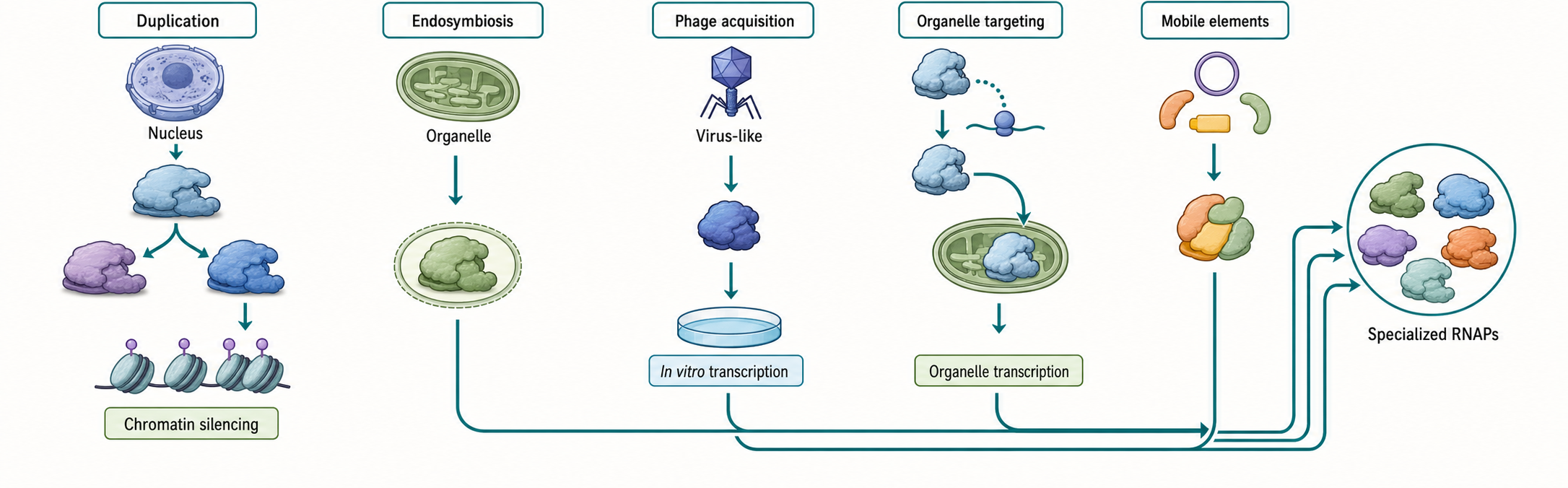
Figure 22.1. Routes to Specialized RNA Polymerases. Specialized RNA polymerases arise through multiple evolutionary routes: duplication and divergence of nuclear polymerases, endosymbiotic retention or replacement of bacterial RNA polymerases, acquisition of phage-derived single-subunit enzymes, nuclear retargeting of organellar polymerases, and capture of polymerase modules from mobile elements or viruses. Each route produces a distinct enzyme architecture adapted to a particular biological context, so specialized polymerases as a group represent convergent evolutionary solutions rather than isolated exceptions to a single ancestral plan.
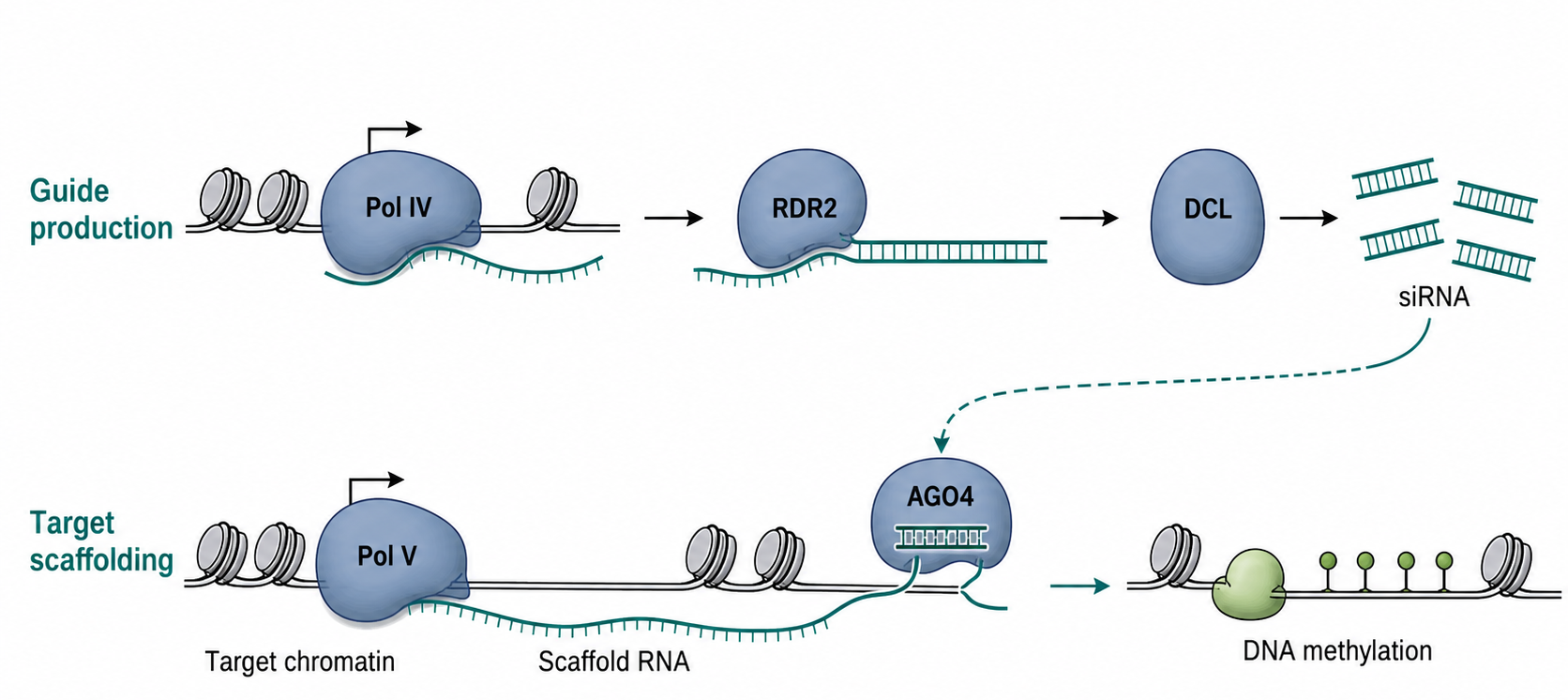
Figure 22.2. Pol IV and Pol V in RNA-Directed DNA Methylation. In the canonical RNA-directed DNA methylation pathway, Pol IV acts upstream to generate RNA substrates that are converted into double-stranded RNA by an RNA-dependent RNA polymerase and processed by Dicer-like enzymes into small interfering RNAs. Pol V acts downstream at target chromatin, producing low-abundance scaffold transcripts that help recruit and stabilize small-RNA-guided silencing complexes at their genomic destinations. This division of labor—guide RNA production by Pol IV versus target-site scaffolding by Pol V—distinguishes the two plant-specific polymerases from each other and from conventional Pol II mRNA synthesis.
The phrase “RNA-directed DNA methylation” describes a causal logic rather than a single molecule. Small RNAs with sequence complementarity to a genomic region guide silencing complexes to DNA or chromatin. DNA methylation and associated repressive chromatin features then reduce transcription or stabilize heterochromatin at repeats, transposons, and other vulnerable loci. The pathway is especially important in plant genomes because plant genomes contain abundant transposable elements, repeats, and epigenetically regulated regions that must be controlled without silencing nearby genes indiscriminately.
Pol IV and Pol V divide labor in this pathway. Pol IV acts upstream in small-RNA production. At many RdDM targets, Pol IV generates RNA that is copied into double-stranded RNA by an RNA-dependent RNA polymerase and processed by Dicer-like enzymes into small interfering RNAs. Those siRNAs are loaded into Argonaute proteins. Pol V acts at target chromatin by producing scaffold transcripts that help recruit or stabilize siRNA-guided silencing machinery. In simplified form, Pol IV helps make the guide, whereas Pol V helps mark the destination.
That simplified statement is useful pedagogically, but it should not be overextended. RdDM has multiple branches, locus classes, and developmental contexts. Some loci depend strongly on canonical Pol IV and Pol V activities, whereas others have partial redundancy, noncanonical inputs, or maintenance methylation mechanisms that persist even when a single pathway component is compromised. The practical consequence is that loss of Pol IV, loss of Pol V, loss of a Dicer-like enzyme, loss of an Argonaute protein, and loss of a DNA methyltransferase can produce overlapping but non-identical molecular phenotypes.
Products That Are Hard to See by Ordinary RNA-Seq
Pol IV and Pol V teach an important lesson about transcript detection. A transcript can be biologically important even if it is rare, unstable, non-polyadenylated, chromatin-associated, or rapidly processed. Standard RNA-seq protocols often enrich for polyadenylated mRNA or for abundant steady-state RNA. Such protocols are poorly matched to Pol IV and Pol V products. Pol IV products may be transient substrates for siRNA production. Pol V products may remain close to chromatin and may not accumulate as conventional soluble transcripts.
Evidence for Pol IV and Pol V function therefore comes from several complementary assays. Genetics can test whether polymerase subunits are required for DNA methylation at target loci. Small-RNA sequencing can test whether siRNA populations disappear or change when Pol IV is disrupted. Chromatin assays can test whether Pol V-dependent target regions lose silencing machinery, DNA methylation, or repressive chromatin features. Nascent RNA or chromatin-associated RNA methods can detect transcripts missed by steady-state mRNA sequencing, although these methods also have biases. No single assay by itself fully defines the pathway.
The molecular identity of Pol IV and Pol V also matters. Their largest subunits are related to the largest subunits of Pol II, but plant-specific substitutions and accessory factors change recruitment, chromatin association, and pathway coupling. Polymerase specialization is therefore a physical property of the enzyme complex and a network property of the pathway. A Pol IV or Pol V subunit sequence alone is not enough to predict the full set of target loci or context-dependent phenotypes.
Table 22.2. Plant Pol IV and Pol V Comparison. Comparison of the two plant-specific Pol II-related polymerases that participate in RNA-directed DNA methylation.
| Enzyme | Product Type | Pathway Role | Associated Factors | Detection Challenge | Biological Consequence |
|---|---|---|---|---|---|
| Pol IV | Short single-stranded RNAs (siRNA precursors) | Upstream: generates RNA substrates for siRNA biogenesis | CLSY1/CLSY2 chromatin remodelers, SHH1, RDR2 | Transient, non-polyadenylated; missed by standard mRNA-seq | Required for siRNA accumulation and DNA methylation at RdDM loci |
| Pol V | Chromatin-associated scaffold transcripts | Downstream: recruits siRNA-guided silencing complexes to target loci | DRD1, MORC6, AGO4-pathway components | Very low abundance, chromatin-tethered; not recovered in soluble RNA fractions | Required for siRNA-directed DNA methylation and repressive chromatin at target sites |
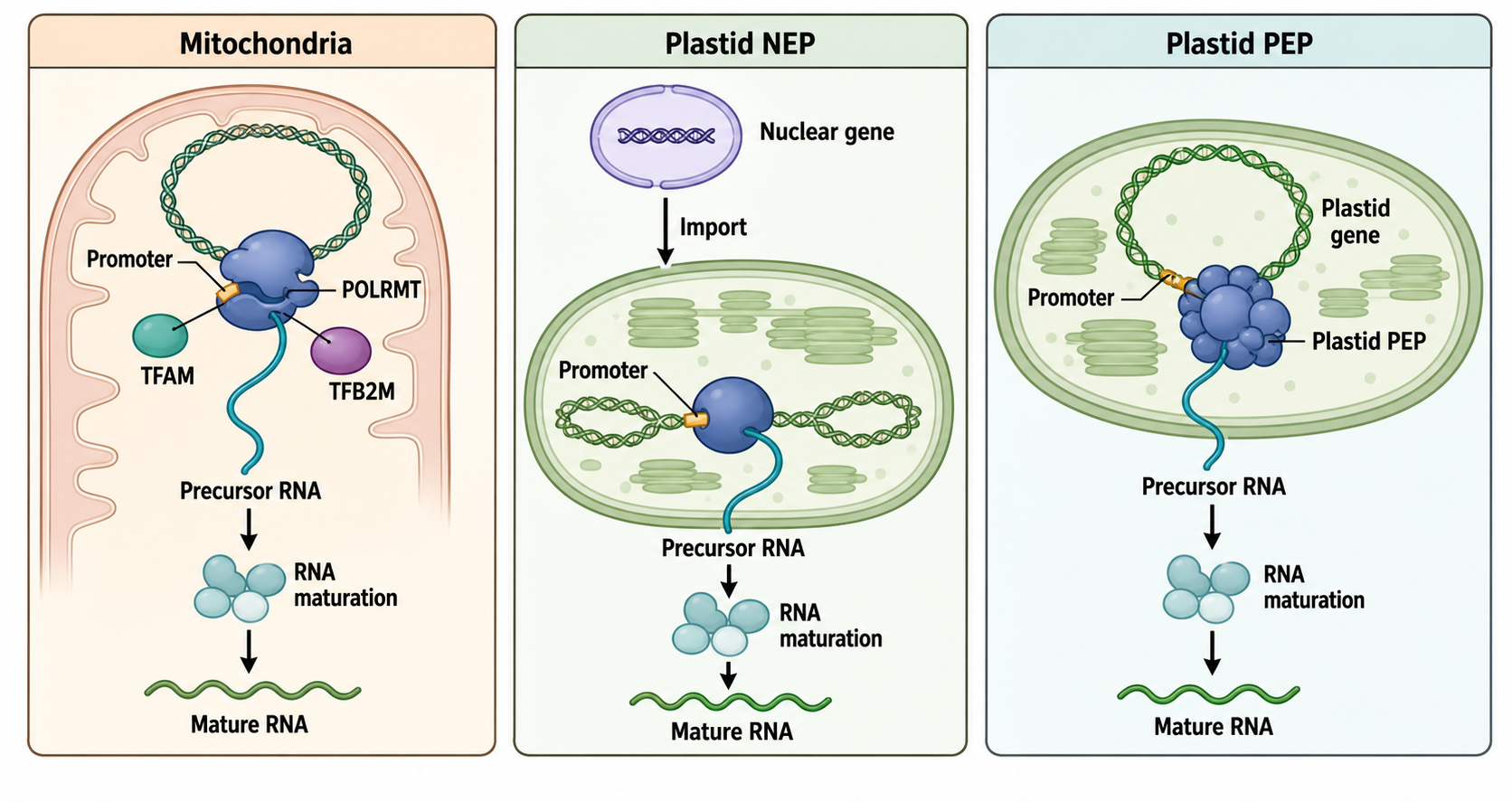
Figure 22.3. Organellar Polymerase Systems. Organellar transcription reflects the mixed evolutionary ancestry of mitochondria and plastids: in many eukaryotes, mitochondria use a nuclear-encoded phage-like single-subunit polymerase (such as human POLRMT) together with organelle-specific accessory factors, while plastids in land plants can use both a nuclear-encoded phage-type polymerase (NEP) and a plastid-encoded bacterial-like multisubunit polymerase (PEP), with usage varying by promoter class and developmental stage. In both organelles, the primary RNA product is a precursor that must undergo cleavage, splicing, editing, or stabilization before function, so transcription initiation is only the first step in a processing-heavy RNA-maturation pathway.
Chromatin Silencing Rather Than Ordinary Gene Expression
A common misconception is that Pol IV and Pol V are alternative plant polymerases for ordinary nuclear gene expression. Their best-established roles are instead in chromatin regulation and genome defense. Pol IV and Pol V products are not translated into proteins; they guide or scaffold silencing. The appropriate comparison is not Pol II mRNA output, but the broader class of noncoding transcription events that create regulatory RNA molecules.
Another misconception is that RdDM is simply RNA interference moved into the nucleus. The pathway shares small-RNA logic with RNA interference, but RdDM acts on chromatin and DNA methylation. The endpoint is not only degradation or translational repression of an RNA target. The endpoint can be a heritable or semi-stable chromatin state at a genomic locus. This distinction connects Pol IV and Pol V to Chapters 16, 87, 96, and 113, where transposon control, small-RNA pathways, RNA-chromatin interactions, and plant antiviral defense are treated more broadly.
The evolutionary question remains active. Current synthesis supports a loss-and-gain model in which duplicated Pol II-related complexes lost some ancestral features and gained plant-specific specialization for silencing. Exactly how Pol IV and Pol V acquired their distinct recruitment patterns, transcript properties, and factor interactions remains a field of ongoing genetic, biochemical, and structural work.
22.2. Mitochondrial and chloroplast RNA polymerase systems
Endosymbiosis Changed Both the Genome and the Transcription Apparatus
Mitochondria and plastids descend from bacterial endosymbionts, but modern organelles are not simply bacteria living inside eukaryotic cells. Most proteins that act in organelles are encoded by nuclear genes, translated in the cytosol, and imported into the organelle. Organellar transcription systems therefore preserve traces of bacterial ancestry while also showing extensive nuclear control.
Mitochondrial transcription in many eukaryotes is performed by a nuclear-encoded single-subunit polymerase related to bacteriophage RNA polymerases. In human mitochondria, the polymerase POLRMT transcribes mitochondrial DNA in cooperation with accessory factors. TFAM binds and bends mitochondrial promoter DNA and helps organize mitochondrial nucleoids. TFB2M participates in promoter opening and initiation. TEFM supports processive elongation and reduces premature termination in some contexts. The reaction is not just “T7 polymerase in mitochondria”; it is a specialized organellar transcription system with mitochondrial promoters, mitochondrial DNA packaging, and downstream RNA-processing needs.
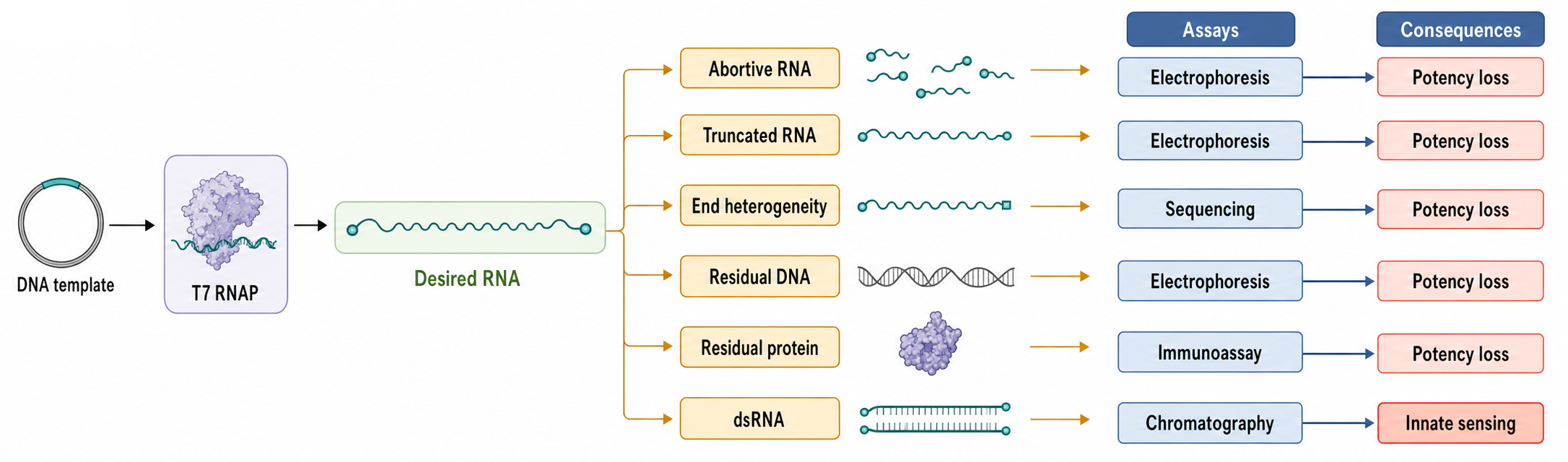
Figure 22.4. In Vitro Transcription Quality-Control Map. In vitro transcription with T7-like polymerases reliably produces RNA from a defined DNA template, but the reaction mixture typically contains impurities alongside the intended product: abortive short transcripts from failed initiation, prematurely terminated species, incomplete runoff products, terminal heterogeneity at the 3′ end, residual template DNA, residual enzyme, and double-stranded RNA formed by antisense transcription or copy-back priming. Each impurity class has distinct biological consequences—double-stranded RNA in particular can activate innate immune sensors—and requires dedicated assays for detection and removal when product quality matters for sensitive research or therapeutic applications.
Human mitochondrial transcription also illustrates how transcript architecture can differ from nuclear mRNA architecture. Human mitochondrial DNA is compact and encodes mRNAs, rRNAs, and tRNAs in long transcription units. Many mature RNA ends are generated by processing around tRNA sequences, a logic sometimes called the tRNA punctuation model. The primary transcript is therefore a precursor that must be cleaved and matured before its products function in mitochondrial translation. Later chapters treat mitochondrial RNA processing, editing in nonhuman systems, and organellar RNA quality control in more detail.
The boundary case is lineage diversity. Human POLRMT is experimentally important and medically relevant, but it should not be treated as the universal mitochondrial transcription program. Protists, fungi, plants, and animals differ in mitochondrial genome architecture, promoter organization, RNA editing, intron content, transcript processing, and polymerase-associated factors. The conserved principle is organellar integration with nuclear-encoded factors, not uniformity of mechanism.
Plastids Use Both Bacterial-Like and Phage-Type Polymerases
Plastids, including chloroplasts, have an additional layer of complexity because many plants use two broad polymerase systems. The plastid-encoded polymerase, or PEP, is a bacterial-like multisubunit RNA polymerase whose core subunits are encoded in the plastid genome. Nuclear-encoded polymerases, or NEPs, are phage-type single-subunit enzymes encoded in the nucleus and imported into plastids. This dual system means that chloroplast transcription cannot be classified simply as bacterial-like or phage-like.
PEP is especially important for photosynthesis-associated genes in mature chloroplasts, but PEP is not autonomous. It depends on nuclear-encoded sigma-like factors, polymerase-associated proteins, and chloroplast developmental state. Recent structures of plant PEP show why the enzyme should be treated as a plastid transcription machine assembled with many accessory factors, not as an unchanged bacterial polymerase. NEP can transcribe housekeeping and early plastid genes, including genes needed to build the plastid gene-expression apparatus. The relationship between NEP and PEP changes during plastid development. A developing plastid must first express genes needed for its own transcription and translation machinery; a mature chloroplast must sustain high expression of photosynthetic complexes. Polymerase usage is therefore tied to developmental timing and organelle identity.
Promoter architecture helps explain the division of labor. Some plastid promoters resemble bacterial sigma-factor-dependent promoters and are recognized by PEP with appropriate sigma factors. Other promoter classes are recognized by NEP. The tobacco RpoTp overexpression study provides a concrete example: a nuclear-encoded phage-type polymerase can recognize a distinct promoter type in chloroplast transcription. This observation shows that nuclear-encoded enzymes can enter an organelle and create promoter specificity that is not simply inherited from the endosymbiotic bacterial ancestor.
Chloroplast transcription is also regulated by physiological state. Light, development, nutrient status, stress, and retrograde signaling can alter organellar gene expression. In a unicellular red alga, TOR signaling was linked to expression of a nuclear-encoded chloroplast RelA-SpoT homolog and to modulation of chloroplast ribosomal RNA synthesis, illustrating that organellar transcription and ribosome biogenesis can be embedded in broader cellular nutrient and growth-control networks. The details differ across lineages, but the conceptual lesson is general: organellar transcription is coordinated with cell state.
Table 22.3. Organellar Polymerase Types. Characteristics of the main polymerase classes operating in plant and animal organelles.
| Polymerase Class | Encoded By | Organelle | Promoter Type | Accessory Factors | RNA Maturation Links |
|---|---|---|---|---|---|
| Mitochondrial POLRMT-like | Nuclear genome | Mitochondria | Mitochondrial-specific LSP and HSP promoters | TFAM, TFB2M, TEFM | tRNA punctuation cleavage; RNA editing in some lineages; end trimming |
| Plastid NEP (RpoTp) | Nuclear genome | Plastid / chloroplast | NEP-specific promoter classes (type Ib / II) | None required for elongation | Cleavage; stabilization by PPR proteins; translation-linked regulation |
| Plastid PEP | Plastid genome (core subunits) | Chloroplast | Bacterial-like sigma-dependent promoters | Sigma factors (SIG1–SIG6), PAP proteins | Cleavage, intron splicing, C-to-U RNA editing, stabilization, translation coupling |
| Lineage-specific variants | Nuclear or organellar genome | Mitochondria or plastid | Organism-specific | Organism-specific | Extensive RNA maturation in most plant, fungal, and protist lineages |
Organellar RNA Maturation Is Part of the Transcription Problem
The main output of organellar transcription is often a precursor RNA. Plant organellar RNAs can undergo cleavage, intron splicing, RNA editing, end trimming, stabilization by sequence-specific RNA-binding proteins, and translation-linked regulation. Mitochondrial and chloroplast transcripts may be organized in operon-like units or long transcription units whose mature products are generated post-transcriptionally. Some mature transcript ends are defined less by where polymerase stops and more by where processing enzymes cleave and where RNA-binding proteins protect the RNA from exonucleases.
Box 22.1. Polymerase Name Does Not Define Transcript Fate
- An RNA polymerase catalyzes nucleotide addition, but the biological meaning of its product is determined by what happens to the transcript after synthesis.
- A Pol V scaffold transcript, a mitochondrial rRNA precursor, a T7 in vitro transcript, and a viral capped mRNA may all be made by enzymes called RNA polymerases, yet their fates differ completely.
- Transcript fate is determined by compartment (nucleus, organelle, cytoplasm, or test tube), the RNA-processing factors present, RNA-binding proteins that stabilize or localize the RNA, small-RNA or chromatin pathways that intercept the product, and RNA-end chemistry (5′ cap, 5′ triphosphate, poly(A) tail, or absence of all modifications).
- Assigning transcript fate requires multiple assays: steady-state RNA-seq, small-RNA-seq, chromatin association, RNA half-life measurement, translation efficiency, and pathway-specific genetic or phenotypic readouts.
This processing-heavy biology affects interpretation of experiments. A decrease in a mature chloroplast mRNA could mean reduced transcription, defective processing, reduced stabilization, increased decay, impaired editing, altered translation, or a developmental shift in plastid state. A run-on assay, nascent RNA measurement, promoter reporter, steady-state RNA-seq profile, and ribosome association assay may give different views of the same locus. The chapter’s practical rule is that organellar RNA abundance is rarely a direct proxy for transcription rate without additional evidence.
Box 22.2. Why Organellar RNA Biology Is Processing-Heavy
- Organellar genomes evolved from bacterial chromosomes, but many plant and animal organellar genes are organized in polycistronic or long transcription units rather than as individually promoter-driven transcription units.
- Mature products—individual mRNAs, rRNAs, and tRNAs—are released from long primary transcripts by cleavage enzymes and protected from exonucleases by sequence-specific RNA-binding proteins, especially pentatricopeptide repeat (PPR) proteins.
- Many organellar RNAs also require intron splicing and, in plant organelles, extensive C-to-U RNA editing before the encoded protein sequence is complete.
- Steady-state organellar RNA abundance therefore reflects transcription rate, processing efficiency, RNA-binding protein availability, and RNA decay rates simultaneously; distinguishing transcription from maturation requires additional experimental controls such as run-on assays or nascent RNA profiling.
Organellar RNA biology also creates cross-talk between polymerase systems and protein biogenesis. Chloroplast and mitochondrial ribosomes translate organelle-encoded proteins, many of which are subunits of respiratory or photosynthetic complexes. Those complexes also contain nuclear-encoded proteins imported into the organelle. Transcription, RNA maturation, translation, protein import, and assembly must therefore be coordinated. This coupling is why organellar transcription chapters connect naturally to chapters on organellar RNA genes, ribosome biogenesis, translation, RNA editing, and RNA quality control.
22.3. Single-subunit polymerases and bacteriophage-derived enzymes
One Polypeptide Can Carry an Entire Transcription Cycle
Bacteriophage T7, T3, and SP6 RNA polymerases are single-subunit DNA-dependent RNA polymerases. Unlike bacterial RNA polymerase, which uses a multisubunit core and sigma factors, a T7-like polymerase can recognize a promoter, open DNA, initiate RNA synthesis, escape the promoter, and elongate the RNA using one polypeptide. This architecture makes the enzymes conceptually elegant and experimentally convenient.
The transcription cycle still contains the same basic stages as other DNA-dependent transcription systems. First, the polymerase recognizes a promoter sequence. Second, it forms an initiation complex in which the template strand is positioned and the first ribonucleotides are joined. Third, it undergoes promoter escape, a transition in which promoter contacts are reduced and the enzyme becomes a processive elongation complex. Fourth, it continues nucleotide addition while maintaining a transcription bubble and RNA-DNA hybrid. The difference is that many functions distributed across subunits and initiation factors in other systems are built into one protein.
This compactness helps explain why phage-like polymerases were repeatedly useful in evolution. A single gene can encode an RNA-synthesis machine that recognizes its own promoter class. In a phage, such a polymerase can rapidly redirect host resources to phage transcription. In an organelle, a nuclear-encoded phage-like polymerase can be imported and retargeted to organellar promoters. In the laboratory, the same architecture allows researchers to express a purified polymerase and use a short promoter sequence to drive RNA synthesis from engineered templates.
The compactness also has limits. Single-subunit polymerases are not miniature versions of every other polymerase. They have their own promoter requirements, initiation-site preferences, abortive-initiation behavior, sequence-dependent pausing tendencies, and product-end features. T7 RNAP structural work provides a detailed model for initiation-to-elongation remodeling, RNA binding, and promoter escape, but related phage polymerases such as T3 and SP6 differ in promoter recognition and termination behavior. Similar single-subunit architecture therefore does not guarantee identical promoter specificity or identical product quality.
T7 RNA Polymerase as a Molecular Biology Workhorse
T7 RNA polymerase is the most widely used single-subunit polymerase for in vitro transcription. A DNA template containing a T7 promoter upstream of a desired sequence can produce RNA in a defined reaction containing polymerase, ribonucleoside triphosphates, magnesium, buffer, and appropriate salts. The method is simple enough for routine laboratory use but powerful enough for large-scale RNA manufacturing.
The range of products is broad. Researchers use T7 transcription to make ribozymes, aptamers, riboswitch RNAs, guide RNAs, long noncoding RNA fragments, structured RNA domains for biophysics, mRNA standards, reporter RNAs, RNA probes, and coding mRNAs. Cell-free expression systems often use T7 polymerase to transcribe mRNAs that are translated in the same reaction. Therapeutic RNA platforms use related in vitro transcription logic to produce mRNA or self-amplifying RNA, although therapeutic manufacturing adds strict controls on template quality, capping, modified nucleotides, product length, impurities, and formulation.
Table 22.4. Polymerases Used for In Vitro Transcription. Properties of bacteriophage-derived and related polymerases used for in vitro RNA synthesis.
| Polymerase | Promoter | Strengths | Common Artifacts | Preferred Applications | Mitigation Strategies |
|---|---|---|---|---|---|
| T7 | 23-bp T7 consensus (φ10) | Highest yield; robust; widely validated | Abortive products; 3′ end heterogeneity; dsRNA byproducts; +1/+2 initiation variation | Long RNA, mRNA, guide RNA, therapeutic mRNA | Optimize Mg²⁺; add inorganic pyrophosphatase; chromatographic dsRNA removal |
| T3 | 23-bp T3 consensus | High yield; distinct promoter specificity from T7 | Similar to T7: abortive products, dsRNA | Probe synthesis; legacy T3 vector systems | Similar to T7 |
| SP6 | SP6 promoter | High yield; well-characterized | Similar to T7: abortive products, dsRNA | Riboprobe generation; capped RNA synthesis | Similar to T7 |
| Mitochondrial (POLRMT) | Mitochondrial promoter sequences | Accepts some modified nucleotides; specialized promoter selectivity | Lower yield than T7; truncated products | Research on mitochondrial promoter and initiation mechanism | Optimize accessory factors TFAM and TFB2M |
| Engineered T7 variants | Modified T7 or alternative promoters | Reduced dsRNA; improved modified-nucleotide incorporation; improved end homogeneity | Application-specific impurities | Therapeutic mRNA; guide RNA requiring precise ends | Application-specific QC and purification |
The enzyme’s utility depends on promoter specificity. A T7 promoter placed in front of a sequence recruits T7 polymerase efficiently, often producing high transcript yield. That specificity is also the reason T7 systems can be orthogonal in synthetic biology: the polymerase can read its cognate promoter without requiring the host’s usual transcription factors. However, orthogonality is contextual. In cells, high T7 polymerase activity can burden metabolism, expose RNA to innate sensors, create toxic products, or uncouple transcription from normal RNA processing.
Product Heterogeneity Is a Mechanistic Consequence, Not a Minor Detail
In vitro transcription is often drawn as a clean arrow from DNA template to RNA product. Real reactions produce a distribution of molecules. During early initiation, polymerases can release short abortive RNAs before forming a stable elongation complex. During elongation, sequence context, template structure, nucleotide concentration, magnesium, temperature, and product RNA structure can affect pausing and premature termination. At transcript ends, non-templated additions, incomplete runoff, self-priming, and template-dependent end heterogeneity can occur.
Double-stranded RNA byproducts are especially important. They can arise through antisense transcription, self-priming, copy-back products, annealing of complementary species, or other reaction-dependent routes. In immune-sensitive mammalian systems, double-stranded RNA can activate sensors such as Toll-like receptor 3, RIG-I-like receptors, protein kinase R, and oligoadenylate synthetase pathways. Even small fractions of double-stranded RNA can dominate biological response if the intended product is supposed to be a non-inflammatory mRNA.
The correct response is not to assume that a band of the expected size on a gel proves product identity. Product identity may require cap analysis, length analysis, end mapping, residual DNA testing, residual protein testing, double-stranded RNA assays, chromatographic profiling, sequencing, mass spectrometry, or functional assays depending on the application. For a structural RNA experiment, a minor truncated species may confound folding. For an mRNA vaccine or therapeutic, a minor innate immune contaminant may alter potency and reactogenicity. For a guide RNA, end heterogeneity may affect target recognition or nuclease loading.
Box 22.3. IVT Product Identity Requires Direct Measurement
- A correct DNA template sequence and a band of expected size on a gel do not guarantee that an in vitro transcription reaction has produced a homogeneous, functional RNA.
- Common impurities include abortive initiation products (approximately 2–12 nt), prematurely terminated species, incomplete runoff products, 3′-end heterogeneity from non-templated additions, antisense or copy-back double-stranded RNA, residual template DNA, and residual polymerase.
- Each impurity has application-specific consequences: double-stranded RNA can activate innate immune sensors (TLR3, RIG-I, PKR, OAS) in mammalian cells; truncated species can fail to translate or fold; end heterogeneity can impair guide RNA loading into nuclease complexes.
- Product identity verification requires assays matched to application: capillary or gel electrophoresis for length distribution, sequencing for sequence integrity, dsRNA-specific immunoassay, residual DNA quantification, potency assay, and chromatographic profiling when strict purity standards apply.
Cell-free transcription-translation reviews and RNA manufacturing literature support the general principle that polymerase choice and reaction design strongly affect product quality and expression behavior. Dedicated IVT studies show that immunostimulatory byproducts can be reduced by enzyme engineering and that process analytics such as anion-exchange HPLC can monitor mRNA reaction quality during manufacturing development.
22.4. Polymerase specialization in organelles, parasites, and mobile elements
Similar Enzyme Modules Can Be Used in Different Life Cycles
Polymerase-like and viral-like transcription modules occur in many biological contexts. Large DNA viruses can encode transcription or RNA-end-modification enzymes. Mobile elements can encode polymerase-related proteins or recruit host polymerases. Organelles can use polymerases with phage-like ancestry. Parasite-associated virus-like RNAs can alter host or parasite biology. These examples are connected by enzyme evolution, but they should not be collapsed into one category.
The distinction begins with template and product. A DNA-dependent RNA polymerase reads DNA and makes RNA. An RNA-dependent RNA polymerase reads RNA and makes RNA. A reverse transcriptase reads RNA and makes DNA. A DNA polymerase reads DNA and makes DNA. Many mobile-element and viral systems combine more than one activity, and some enzymes have accessory domains that modify RNA ends, cap transcripts, or process products. Classification should therefore begin with demonstrated biochemical reaction, not with the word “viral” in a protein annotation.
Large DNA viruses provide useful examples because they may encode enzymes that help produce or modify mRNA-like transcripts. A Faustovirus mRNA capping enzyme, for example, illustrates how viral systems can package RNA-end modification with viral gene-expression programs. Capping is not polymerization, but it is mechanistically coupled to transcript identity because a 5′ cap affects RNA stability, translation, and immune recognition. Viral-like transcription modules often make sense only when polymerase activity, RNA processing, and RNA-end chemistry are considered together.
Parasites and Virus-Like RNAs Complicate Simple Categories
Parasites can carry viruses, virus-like RNAs, endosymbionts, and mobile elements. Some parasite systems contain non-parasite-genome-encoded virus-like RNAs that influence pathogenic traits, as reported for human blood flukes. Such findings are biologically important, but they require careful interpretation. The presence of a virus-like RNA or polymerase-related sequence does not by itself define whether the polymerase is encoded by the parasite genome, an associated virus, a mobile element, an endosymbiont, or contamination. Evidence must connect sequence, expression, physical particle or RNP state, inheritance, enzymatic activity, and phenotype.
This caution matters because high-throughput sequencing can detect fragments from many sources. A transcriptome assembly might contain host RNA, parasite RNA, symbiont RNA, viral RNA, environmental RNA, and laboratory contaminants. Polymerase annotation can also be misleading when conserved domains are short or divergent. Strong classification often requires genome-resolved evidence, strand-specific expression data, small-RNA or long-read support, biochemical assays, and phylogenetic analysis.
Mobile Elements and the Boundary with RNA-Templated Synthesis
Mobile elements blur textbook boundaries. Some elements use DNA-dependent transcription to make RNA intermediates. Some use reverse transcriptases to copy RNA back into DNA. Some encode or recruit endonucleases, integrases, polymerases, or capping activities. Some defense and mobile systems now being discovered have RNA-guided or RNA-linked steps. The correct classification depends on the reaction being discussed at that moment.
This chapter treats DNA-dependent RNA synthesis by specialized polymerases and phage-like polymerases. Chapter 23 treats RNA-dependent RNA polymerases and reverse transcriptases. Chapter 16 treats repeats, retroelements, and repeat-derived RNAs. Chapter 101 treats RNA-guided mobile elements and programmable insertion systems. The cross-chapter handoff is important because a mobile element may use a DNA-dependent polymerase to make its RNA, then a reverse transcriptase to convert that RNA into DNA, and then host or element-encoded factors to integrate or regulate the result.
From an evolutionary perspective, polymerase modules are reusable biochemical solutions. From an experimental perspective, each module must be assigned to a specific template, product, compartment, and life-cycle role. Similarity to a phage polymerase or viral enzyme is a starting hypothesis, not a completed mechanism.
22.5. Biotechnological polymerases for in vitro transcription and RNA production
Research-Scale In Vitro Transcription
In vitro transcription, or IVT, is the synthesis of RNA in a defined reaction outside living cells. The minimum components are a DNA template with a suitable promoter, an RNA polymerase, ribonucleoside triphosphates, magnesium or another required divalent metal condition, buffer, and time. Researchers can make linear templates by PCR, restriction digestion, synthetic DNA assembly, or plasmid linearization. The downstream RNA can be purified by precipitation, chromatography, gel extraction, magnetic capture, nuclease treatment, or other methods depending on length and use.
T7 RNA polymerase dominates research-scale IVT because it is robust and produces high yields. T3 and SP6 polymerases are also used, especially when template design or legacy vector systems contain their promoters. Engineered variants and alternative polymerases may be chosen to alter promoter recognition, reduce sequence bias, accept modified nucleotides, operate under different temperatures, or improve product features. The best polymerase is therefore application-specific rather than universally T7.
For a short RNA used in a binding assay, the key quality concern might be length homogeneity and folding. For a guide RNA, the key concern might be precise 5′ and 3′ ends. For a long mRNA, the concerns include cap status, poly(A) tail length, internal modifications, double-stranded RNA byproducts, and translational competence. For a ribozyme, an extra 5′ guanosine introduced for promoter efficiency can change folding or activity. Template design and polymerase choice are therefore part of experimental design, not routine setup.
Therapeutic and Vaccine-Scale RNA Production
Therapeutic-scale IVT uses the same core chemistry as research-scale IVT, but the quality standard is much higher. An RNA drug or vaccine product must have a defined identity, acceptable purity, controlled potency, and controlled safety profile. For mRNA products, manufacturing must manage template DNA, polymerase, nucleotides, capping reagents or cap analogs, modified nucleotides, magnesium, pyrophosphate, reaction byproducts, residual proteins, residual DNA, truncated RNAs, long aberrant RNAs, double-stranded RNA, endotoxin, and formulation compatibility.
Capping strategy is a central design choice. Some workflows use co-transcriptional capping with cap analogs. Others use enzymatic capping after transcription. Co-transcriptional capping can simplify production but must control cap incorporation efficiency and cap orientation. Enzymatic capping can be more controllable in some settings but adds processing steps. Modified nucleotides such as pseudouridine or N1-methylpseudouridine can alter innate immune recognition and translation behavior, but incorporation efficiency, sequence context, purification, and formulation all influence the final product. Detailed therapeutic RNA chemistry and manufacturing are treated in Chapters 153 and 159.
Double-stranded RNA removal is particularly important for mRNA therapeutics because double-stranded RNA contaminants can trigger innate immune pathways and reduce translation. Purification strategies such as chromatography can reduce these contaminants, but the appropriate method depends on product length, chemistry, scale, and analytical requirements. A product that is acceptable for a cell-free translation assay may be unacceptable for animal dosing or clinical manufacturing.
The chapter reference set supports the broad point that cell-free transcription and cell-free transcription-translation systems must be engineered as coupled biochemical platforms. For therapeutic-scale RNA production, the same local evidence base now anchors impurity classes, enzyme-engineering approaches to immunostimulatory byproducts, reaction-condition effects on product quality, and chromatographic process analytics. Detailed regulatory release-testing requirements are treated in the RNA therapeutics chapters.
Cell-Free Transcription-Translation and Synthetic Biology
Cell-free transcription-translation systems combine transcription and translation in vitro. They can be made from bacterial lysates, reconstituted translation systems, wheat germ extract, rabbit reticulocyte lysate, insect cell extract, or other platforms. Polymerase choice affects the timing and amount of RNA production, which in turn affects translation, RNA degradation, resource consumption, and circuit behavior.
In a T7-driven bacterial extract system, transcription can be much faster than translation or RNA folding. High transcription rates may deplete nucleotides, alter magnesium balance, create RNA structures that sequester ribosomes, or overload degradation pathways. Synthetic circuits may fail not because the DNA design is wrong, but because polymerase expression, promoter strength, RNA stability, and translation capacity are mismatched. This is an example of polymerase specialization in an engineered rather than natural context.
Cell-free systems also show why compartment matters. In cells, transcription may be coupled to chromatin, RNA processing, export, localization, translation, or decay. In a cell-free reaction, many of those couplings are absent or replaced by extract-specific processes. T7 polymerase can make an RNA efficiently, but whether that RNA behaves like a cellular transcript depends on capping, modification, protein binding, localization, decay, and translation environment.
Experimental Foundations and Evidence
Specialized polymerases are studied with a mixture of genetics, biochemistry, structural biology, genomics, and analytical chemistry. Each approach answers a different question.
Genetics can show necessity. Knockout, knockdown, mutant, or complementation experiments can reveal whether a polymerase subunit is required for a phenotype, a small-RNA population, a methylation pattern, an organellar transcript, or a developmental state. In Pol IV and Pol V studies, genetics is powerful because loss of polymerase-specific subunits can be linked to changes in siRNAs and DNA methylation. The limitation is that downstream effects can be indirect; a polymerase mutation can alter chromatin, small RNAs, and transcript abundance in a cascade.
Biochemistry can show mechanism. Purified or partially purified polymerases can be tested for promoter binding, initiation, elongation, nucleotide incorporation, cofactor requirements, and product formation. Mitochondrial transcription initiation studies are especially informative because accessory factors can be added or omitted in defined reactions. The limitation is that organellar DNA packaging, RNA-processing coupling, and cellular state may be simplified in vitro.
Structural biology can show physical organization. Polymerase structures reveal active sites, nucleic-acid paths, promoter interactions, initiation conformations, and factor-binding surfaces. For single-subunit polymerases, structures help explain how promoter recognition and catalysis occur in one polypeptide. For nuclear and organellar polymerases, structures can reveal how specialization arises from altered surfaces and accessory factors. The limitation is that structures capture selected states, while transcription is a dynamic cycle.
Genomics and transcriptomics can show pathway output. Small-RNA sequencing, bisulfite sequencing, chromatin immunoprecipitation, nascent RNA profiling, organellar RNA-seq, long-read sequencing, and ribosome profiling can connect polymerase activity to products and biological consequences. The limitation is that steady-state abundance often mixes transcription, processing, stabilization, and decay. Organellar systems are particularly vulnerable to this ambiguity.
Analytical chemistry and manufacturing assays can show product identity. For IVT products, gel electrophoresis, capillary electrophoresis, liquid chromatography, mass spectrometry, nuclease sensitivity assays, immunoassays for double-stranded RNA, sequencing, residual DNA assays, and potency assays may all be needed. The limitation is that each assay has its own detection threshold and bias. A negative result in one assay does not prove absence of all problematic species.
Biological Contexts Across Systems
In plant nuclei, polymerase specialization supports genome defense and epigenetic regulation. Pol IV and Pol V act at the boundary between transcription and chromatin control. Their products help the plant cell use RNA sequence information to identify genomic regions that require methylation or silencing. The main biological consequence is not RNA abundance but genome regulation.
In mitochondria, polymerase specialization supports organellar energy metabolism. Mitochondrial transcripts encode components of oxidative phosphorylation and mitochondrial translation machinery. Defects in mitochondrial transcription or RNA processing can impair respiratory-chain biogenesis, stress responses, and tissue function. The details vary by organism, but the high-level requirement is coordination between the nuclear genome and mitochondrial gene expression.
In chloroplasts, polymerase specialization supports photosynthetic development. NEP and PEP activities change as plastids mature and as photosynthetic gene expression becomes dominant. Chloroplast transcription must be coordinated with light exposure, chloroplast ribosome biogenesis, photosystem assembly, redox state, and retrograde communication to the nucleus. A chloroplast transcript is part of a developmental and environmental program rather than an isolated output.
In phage and phage-derived systems, polymerase specialization supports rapid transcription from a compact genetic module. A phage can encode its own polymerase to control temporal gene expression and redirect host resources. In the laboratory, that same specificity becomes a tool. The biological and technological meanings differ even when the enzyme is the same.
In viral-like and mobile-element systems, polymerase specialization supports replication, gene expression, RNA-end formation, or mobility. These systems are diverse, and many examples remain hypotheses until sequence, expression, biochemical activity, inheritance, and phenotype are connected. The safest generalization is that mobile genetic systems reuse polymerase and RNA-processing modules in ways that must be interpreted with life-cycle context.
Technology, Computational, and Clinical Links
Specialized polymerases are central to RNA technology. T7 RNA polymerase underlies many IVT workflows used for RNA probes, guide RNAs, mRNA production, RNA standards, aptamer selection, ribozyme studies, and cell-free expression. Polymerase choice affects RNA yield, end precision, modified nucleotide acceptance, byproduct profile, and downstream biological activity.
Computational analysis appears in several places. Promoter prediction can help distinguish NEP-like and PEP-like plastid promoters, but promoter models must be trained and validated in the relevant lineage and developmental state. Small-RNA and methylome analysis can identify RdDM targets, but causal assignment to Pol IV or Pol V requires genetic or biochemical support. IVT product analysis can use sequencing and chromatographic data, but computational classification of impurities must be grounded in validated standards.
Clinical relevance is most direct for mitochondrial transcription defects and RNA therapeutics manufacturing. Human mitochondrial transcription defects can contribute to mitochondrial disease mechanisms, though clinical interpretation requires gene-specific and variant-specific evidence. IVT manufacturing is clinically relevant because mRNA vaccines and RNA therapeutics must control immune-stimulatory impurities, product identity, capping, and potency. Antiviral polymerase drugs are mostly treated in Chapters 23 and 160, but the manufacturing and quality-control logic of RNA products belongs here as well.
Recent Consensus
The current consensus is that specialized polymerases should be classified by template, product, promoter recognition, compartment, cofactors, evolutionary origin, and downstream RNA pathway. Plant Pol IV and Pol V are Pol II-related nuclear enzymes specialized for small-RNA-guided chromatin silencing rather than conventional mRNA production.
Organellar transcription systems are mosaics produced by endosymbiotic inheritance and nuclear control. Many mitochondria use nuclear-encoded phage-like polymerases with accessory factors, while plant plastids can use both nuclear-encoded phage-type polymerases and plastid-encoded bacterial-like polymerases.
Organellar RNA abundance must be interpreted together with RNA maturation. Cleavage, splicing, editing, stabilization, and translation-linked regulation can dominate steady-state RNA patterns.
T7-like polymerases are powerful tools because one protein can perform much of the transcription cycle, but IVT product identity must be measured directly. Template correctness does not guarantee transcript homogeneity, especially when immune activity, therapeutic potency, or precise RNA ends matter.
Open Questions, Controversies, Deprecated Models, and Common Misconceptions
Open questions:
- How exactly did Pol IV and Pol V evolve distinct recruitment, initiation, and transcript-fate properties from Pol II-related ancestors? Comparative plant genomics and structural biology support specialization, but many intermediate steps remain unresolved.
- How do organellar polymerases coordinate with RNA editing, splicing, stabilization, and translation in different tissues and developmental states? Plant organellar RNA maturation is now recognized as central, but quantitative coupling between transcription and downstream processing remains difficult to measure.
- How many phage-like or viral-like polymerase modules remain undiscovered in organelles, mobile elements, large viruses, and parasite-associated systems? Sequencing continues to reveal candidates, but biochemical validation lags behind annotation.
- Can engineered polymerases reduce IVT byproducts without sacrificing yield, modified nucleotide incorporation, or scalability? This is a major practical question for therapeutic RNA manufacturing and synthetic biology.
Common misconceptions:
- “Organellar transcription is simply bacterial transcription inside an organelle.” Modern mitochondria and chloroplasts use nuclear-encoded factors, imported polymerases, organelle-specific promoters, and extensive RNA maturation. Chloroplasts may retain bacterial-like PEP activity, but PEP itself depends strongly on nuclear-encoded accessory proteins.
- “Pol IV and Pol V are plant versions of Pol II for making ordinary mRNAs.” Their best-supported roles are in RdDM and chromatin silencing, where the RNA products serve as siRNA precursors or chromatin-associated scaffolds.
- “T7 RNA polymerase makes one perfect RNA whenever the DNA template is correct.” IVT reactions can produce abortive products, truncated RNAs, end heterogeneity, residual template DNA, residual proteins, and double-stranded RNA byproducts.
- “A viral-like polymerase annotation proves active viral replication.” Annotation is a hypothesis. Strong evidence requires template, product, expression, phylogeny, biochemical activity, and life-cycle context.