Chapter 8. RNA World Hypotheses, Ribozymes, and Early Metabolic Logic
Scope Note
This chapter explains why RNA world hypotheses remain central to origin-of-life research and why those hypotheses must be handled as constrained scientific models rather than as a single story. Chapter 7 treated the chemical problem of making informational polymers: feedstocks, nucleotide synthesis, activation, polymerization, copying chemistry, and plausible early-Earth settings. Chapter 8 begins after that chemical threshold. It asks what RNA or RNA-like polymers could have done once polymers existed, folded, reacted, copied imperfectly, and participated in selection.
The phrase “RNA world” names a family of hypotheses in which RNA or RNA-like polymers performed information-bearing and catalytic or regulatory roles before the modern division of labor among DNA genomes, RNA transcripts, and protein enzymes. The strongest versions imagine a period dominated by RNA itself. More moderate versions allow proto-RNA polymers, short peptides, ribonucleotide cofactors, mineral surfaces, lipid compartments, condensates, or metabolism-like networks to have helped RNA-centered heredity and catalysis. The distinction matters because an RNA world model is only as strong as the chemistry, catalysis, copying, compartmentalization, and evolutionary logic that connect its parts.
This chapter emphasizes three linked questions. First, what do natural and laboratory-selected ribozymes show about RNA catalysis? Second, how should ribonucleotide-containing cofactors and RNA-small-molecule interactions be interpreted as possible molecular relics? Third, what constraints must any RNA-based evolutionary system satisfy to preserve heritable information while exploring new functions? Its ownership is evolutionary inference and catalytic possibility, not a complete comparative ribozyme mechanism catalog; Chapter 9 owns catalytic strategies, kinetics, structures, natural families, selected ribozymes, and engineering. Chapter 10 continues the deep-time sequence through genetic-code evolution, and Chapter 11 treats ancient RNP inference.
Executive Summary
RNA world hypotheses are attractive because RNA combines two properties that modern cells usually distribute among different molecular classes. RNA has a sequence that can, in principle, store heritable information through base order. RNA also folds into three-dimensional structures that can recognize substrates, organize metal ions and functional groups, and catalyze chemical reactions. A molecule with both sequence-based heredity and catalytic potential provides a plausible bridge between chemistry and Darwinian evolution before DNA genomes and coded protein enzymes became dominant.
The RNA world should not be taught as one rigid scenario. A strict RNA-first model proposes that canonical RNA served as both genetic material and catalyst before coded proteins. A proto-RNA model proposes that related polymers with noncanonical sugars, bases, or linkages preceded modern RNA. RNA-peptide models propose early cooperation between RNA and amino acids or short peptides. Compartment-first, mineral-surface, metabolism-assisted, viroid-like, quadruplex, and condensate models emphasize localization, concentration, physical organization, or network chemistry. These variants differ in their burden of proof. Each model must explain not only how useful molecules could form, but also how useful functions became linked to heritable persistence.
Natural ribozymes establish that RNA catalysis is a real biological phenomenon. Modern ribozymes include compact self-cleaving RNAs, group I and group II introns, RNase P RNA in many lineages, the glmS riboswitch-ribozyme, and the ribosomal RNA core that catalyzes peptide-bond formation. Ribozyme databases such as Ribocentre organize these classes and their evidence base. HDV-like self-cleaving ribozymes illustrate how a compact RNA fold can catalyze backbone scission through positioned nucleobases, metal ions, and local geometry. These systems show what RNA can do in modern biology, but they do not by themselves prove that any specific modern ribozyme was present before cells.
Laboratory-selected ribozymes provide a second line of evidence. In vitro selection begins with a large pool of RNA sequences and repeatedly enriches molecules that bind or catalyze a target reaction. Selected ribozymes have shown that RNA sequence space contains catalytic solutions beyond the natural ribozyme repertoire. RNA-catalyzed nucleotide synthesis is a landmark example because it links RNA catalysis to chemistry relevant to RNA building blocks. Comparisons of natural and artificial RNAs indicate that selected ribozymes can occupy functional regions of sequence space not obviously represented by known natural RNAs. The correct inference is possibility and selectability, not historical identity.
Ribonucleotide-containing cofactors strengthen, but do not settle, the argument for ancient RNA-centered chemistry. ATP, NAD, FAD, coenzyme A, and S-adenosylmethionine contain nucleotide-like or adenosine-derived modules. Modern riboswitches show that RNA can bind small metabolites with high specificity. Together, these observations are compatible with the idea that ancient RNA catalysts used nucleotide-like cofactors and that later protein enzymes inherited those chemical partners. The same observations also have alternative explanations: ribonucleotide scaffolds may have persisted because they are chemically versatile, because they were abundant for other reasons, or because evolution reused available molecular modules.
Replication remains the central bottleneck. For RNA-based evolution, polymers must be copied with enough fidelity to maintain useful sequence information, but with enough variation to explore new functions. Template copying must also overcome product inhibition, strand separation, resource renewal, side reactions, and parasite molecules that exploit cooperative catalysts without contributing function. Error-threshold reasoning explains why high copying error rates restrict the length and complexity of early genomes. Theory also shows that the onset of natural selection depends on population structure, catalytic benefit, mutation, and spatial organization.
Modern RNA viruses, viroids, and condensates are useful analogies but poor fossils. RNA viruses demonstrate principles of error-prone RNA genome evolution, bottlenecks, and selection, yet modern RNA viruses depend on protein polymerases and host cells. Viroid-like RNAs show that small structured RNAs can participate in infectious cycles, but viroids also depend on host enzymes and cellular environments. Condensate models provide plausible localization and concentration mechanisms, but their relevance depends on chemical compatibility with replication, resource flow, and selection.
Current consensus is therefore neither dismissal nor proof. RNA world models are supported by RNA catalysis, selected ribozymes, RNA-small-molecule recognition, the RNA-based ribosomal catalytic center, and ribonucleotide-rich metabolism. They remain incomplete because no model has yet connected prebiotic synthesis, activated polymerization, accurate copying, strand release, compartmentalized selection, metabolic support, and transition to translation in one fully demonstrated pathway. The strongest scientific stance is to preserve constrained variants, identify what each variant explains, and mark clearly which claims are established observations, strong inferences, context-dependent analogies, or speculative historical reconstructions.
Concept Inventory
- RNA world: a family of hypotheses in which RNA or RNA-like polymers carried genetic information and performed catalytic or regulatory functions before DNA, RNA, and proteins assumed their modern division of labor. The term should be used broadly enough to include strict RNA-first models, proto-RNA models, RNA-peptide cooperation, compartmental models, mineral-assisted models, and metabolism-assisted models. It should not be used as though all these variants make the same claims.
- Strict RNA-first model: proposes that canonical RNA, or something very close to it, served as both the genetic and catalytic molecule before coded proteins. The main burden for this model is chemical: canonical ribonucleotides must be synthesized, activated, polymerized, copied, and selected without protein enzymes. A proto-RNA world is a related model in which earlier polymers chemically distinct from modern RNA preceded canonical RNA. Proto-RNA models may ease some prebiotic synthesis problems, but they must explain how information and function transferred into modern RNA chemistry.
- Ribozyme: an RNA molecule whose folded structure catalyzes a chemical reaction. Catalysis means increasing reaction rate through a mechanism such as substrate positioning, acid-base chemistry, metal-ion coordination, electrostatic stabilization, or strain of the reacting bonds. RNA binding alone is not ribozyme activity. An RNA aptamer binds a ligand. An RNA scaffold organizes molecules. A regulatory RNA changes expression or localization. A ribozyme must catalyze a reaction.
- Natural ribozyme: found in biological systems. Its evidence may include conserved sequence and structure, mapped reaction products, biochemical reconstitution, mutational analysis, comparative distribution, and biological context. Natural ribozymes may be ancient retentions, later innovations, mobile-element features, or recently evolved regulatory modules; the presence of a ribozyme today does not determine its age.
- Selected ribozyme: isolated by laboratory selection or experimental evolution from a pool of candidate RNA sequences. Selected ribozymes show that RNA sequence space contains molecules capable of catalysis under defined conditions. They are powerful evidence for catalytic possibility and selectability, but they are not direct samples from early Earth.
- Catalytic possibility space: the range of reactions that RNA structures can support. Natural ribozymes, selected ribozymes, structural biology, kinetic assays, and comparative analysis each sample this space differently. Possibility space is broader than prebiotic plausibility: a reaction may be catalyzed by RNA in a laboratory assay yet require conditions, substrates, or selection pressures not available in an origin-of-life setting.
- Ribonucleotide cofactor: a small molecule helper that contains a ribonucleotide-like component. ATP, NAD, FAD, coenzyme A, and S-adenosylmethionine are important examples. A molecular relic is a modern molecule or feature interpreted as retaining information about an earlier evolutionary stage. Relic arguments require caution because biochemical utility and evolutionary reuse can mimic ancient retention.
- RNA replication: the copying of sequence information across reaction cycles or generations. Polymer formation is not enough. Replication requires template recognition, bond formation, product release, resource renewal, manageable error, and a connection between the copied sequence and differential persistence. An error threshold is a fidelity limit beyond which functional sequence information cannot be maintained because errors accumulate faster than selection can preserve useful variants.
- Evolvability: the capacity of a molecular population to generate heritable variation that selection can act on. In RNA world reasoning, evolvability requires sequence variation, copying, phenotype-like function from folding or catalysis, and some form of individuality or localization. Viroid-like models, condensate models, and compartment models are attempts to explain how small RNAs or RNA-rich assemblies might preserve enough individuality for selection.
What to Know Before Reading This Chapter
The reader should be comfortable with the chemical vocabulary introduced in Chapters 2, 3, 4, and 7. RNA is a polymer of ribonucleotides joined by phosphodiester bonds. Each ribonucleotide contains a ribose sugar, a phosphate, and a nucleobase. Base pairing allows one RNA strand to recognize another strand with complementary sequence. Folding allows a single RNA strand to form stems, loops, bulges, junctions, pseudoknots, and tertiary contacts. A folded RNA can present a binding pocket, position reactive groups, and coordinate metal ions.
The reader should also distinguish a thermodynamic statement from an evolutionary statement. RNA folding can be described by free-energy landscapes, alternative structures, and ensembles. A folded structure may have a catalytic or binding activity. Evolution begins only when activity affects the persistence or copying of sequence information. A self-cleaving RNA is catalytic, but self-cleavage alone is not replication. A template-directed polymerization reaction makes a product, but it becomes evolutionary replication only if sequence information is inherited across cycles and selection can act on variants.
Three running examples anchor the chapter. Self-cleaving ribozymes show how a compact folded RNA can catalyze a phosphodiester reaction. Ribonucleotide cofactors show how RNA-like chemical modules are embedded in modern metabolism. Error-threshold models show why early RNA genomes could not simply grow longer without better copying fidelity or compensating population structure.
The reader should treat evidence levels explicitly. Direct observations include modern ribozyme activity in biochemical assays and selected ribozyme activity in laboratory conditions. Strong inferences include the principle that RNA can support both information storage and catalysis. Weaker inferences include claims that specific modern molecules are direct relics of an RNA world. Speculative reconstructions include exact prebiotic routes, exact environmental settings, and detailed timelines before cellular life.
8.1. Definitions and variants of RNA world models
Table 8.1. Natural Ribozyme Classes and Evidence Types. Six major natural ribozyme classes illustrate the range of reactions RNA catalyzes in living systems and the caution required when interpreting each class as evidence for ancient RNA-centered life.
| Ribozyme class | Reaction catalyzed | Biological context | Main evidence | Evolutionary caution |
|---|---|---|---|---|
| Self-cleaving ribozymes | Site-specific RNA backbone cleavage | Viral, viroid-like, mobile-element, bacterial, and eukaryotic contexts | Product mapping, mutagenesis, structure, comparative motifs | Distribution may reflect mobility, recruitment, or repeated evolution |
| Group I introns | Self-splicing by transesterification | rRNA, tRNA, mRNA, organellar, microbial, and mobile contexts | Biochemistry, conserved structure, mobility studies | Ancient relevance varies by lineage and element history |
| Group II introns | Self-splicing and mobility-related reactions | Bacterial and organellar genomes; retroelement-like contexts | Biochemistry, structure, comparative evolution | Important for spliceosome evolution but not a direct pre-cellular fossil |
| RNase P RNA | tRNA 5′ leader processing | Bacteria, archaea, eukaryotic organelles, and mixed systems | Reconstitution, substrate processing, comparative biology | Protein assistance and protein-only replacements complicate ancestry inference |
| glmS riboswitch-ribozyme | Ligand-dependent self-cleavage | Bacterial gene regulation | Ligand binding, cleavage assays, regulatory genetics | Modern regulatory context is evolved |
| Ribosomal RNA | Peptide-bond formation | Translation in all cellular life | Structural biology, biochemical mechanism, universal conservation | Full ribosome is a complex RNP, not an RNA-only machine |
An RNA world model begins from a simple asymmetry in modern biology. DNA is chemically stable and usually stores genomes. Proteins, with twenty standard amino acids and many side-chain chemistries, catalyze most reactions. RNA sits between these roles: messenger RNAs carry information, transfer RNAs interpret codons, ribosomal RNAs form the catalytic and structural core of the ribosome, small RNAs regulate gene expression, riboswitches bind metabolites, and ribozymes catalyze reactions. The RNA world idea asks whether this intermediate role is a late specialization or a remnant of an earlier stage when RNA-like molecules were more central.
The strict RNA-first model is the cleanest conceptual version. In this model, RNA appears before coded proteins and before DNA genomes. RNA sequences serve as genetic information, and folded RNA structures catalyze reactions that promote copying, ligation, metabolism-like transformations, or compartment survival. The model is appealing because it avoids a circular problem: modern proteins require nucleic-acid templates for synthesis, and modern nucleic-acid replication requires proteins. A molecule that can both encode and act could start a simpler evolutionary cycle.
The same simplicity creates the strict model’s hardest burden. Canonical RNA is chemically demanding. Ribose, nucleobases, phosphates, nucleotide activation, linkage specificity, strand copying, and product release all require explanation without modern enzymes. Even if short RNAs form, longer folded ribozymes must emerge and persist despite hydrolysis, incorrect linkages, side reactions, and dilution. Chapter 7 covers these chemical constraints in more detail; the point here is that a strict RNA-first model is not established merely by showing that RNA can catalyze reactions.
Proto-RNA models loosen the chemistry while preserving the evolutionary logic. A proto-RNA polymer might contain alternative sugars, different bases, noncanonical backbone linkages, or mixtures of monomers. Such polymers could be easier to form under prebiotic conditions or more stable in particular environments. The advantage is chemical plausibility. The cost is a continuity problem. A proto-RNA world must explain how the system moved from proto-RNA heredity to canonical RNA heredity. If the early polymer and RNA could not exchange information or cooperate chemically, the model simply moves the origin problem to another molecule.
Table 8.2. Model Variants and Testable Constraints. Seven major RNA world model variants each address a different set of constraints, and each introduces an unsolved problem that the next round of evidence must address.
| Model variant | What it explains well | Main unsolved constraint | Evidence type needed next | Related chapter |
|---|---|---|---|---|
| Strict RNA-first | Unified heredity and catalysis | Canonical RNA synthesis and self-replication | Demonstrated copying cycles under plausible chemistry | Chapter 7, Chapter 8 |
| Proto-RNA | Easier prebiotic polymer options | Transition to canonical RNA | Chemical continuity and information transfer | Chapter 7 |
| RNA-peptide | Expanded catalysis and fold stabilization | Heritable specificity before full code | Experiments linking peptide assistance to RNA inheritance | Chapter 10, Chapter 11 |
| Metabolism-assisted | Energy flow and substrate regeneration | Link between network benefit and heredity | Coupled reaction networks with selectable RNA catalysts | Chapter 8 |
| Compartment-assisted | Local benefit and parasite control | Growth, division, resource exchange | Protocell systems linking RNA activity to compartment persistence | Chapter 8 |
| Mineral-surface | Concentration and surface catalysis | Product release and cycle continuity | Adsorption-reaction-release systems compatible with copying | Chapter 7, Chapter 8 |
| Condensate-supported | Concentration and spatial organization | Chemical specificity and reproducible inheritance | Prebiotic-compatible condensates supporting replication cycles | Chapter 8 |
RNA-peptide models address another likely weakness of strict RNA autonomy. Amino acids and short peptides could have existed before the full genetic code. Short cationic, hydrophobic, or metal-binding peptides may stabilize RNA folds, help localize RNA, promote strand separation, or contribute catalytic groups that RNA lacks. In these models, RNA does not need to do everything alone. RNA supplies sequence, templating, and structured binding; peptides supply chemical diversity and physical stabilization. The resulting model is still RNA-centered if RNA remains the primary heritable molecule, but it is not RNA-only.
Metabolism-assisted models emphasize reaction networks and energy flow. A single ribozyme can catalyze a reaction in a tube, but a living system needs sustained production and regeneration of substrates, energy carriers, and compartments. In a metabolism-assisted RNA world, RNA catalysts interact with preexisting geochemical or autocatalytic networks. The key question is whether those networks can become heritable. A metabolism-like cycle that helps all molecules equally does not automatically create Darwinian selection. Selection requires some linkage between the catalysts that improve the cycle and the persistence or copying of those catalysts.
Compartment-first and lipid-assisted models emphasize individuality. If every useful product diffuses away, a catalytic RNA may benefit unrelated molecules as much as its own lineage. Compartments, pores, mineral surfaces, droplets, films, or gels can create local neighborhoods where catalytic benefit remains associated with particular sequences. The compartment does not have to be a modern membrane-bound cell. It only has to provide enough spatial structure for selection to distinguish productive assemblies from less productive ones.
Mineral-surface models propose that geological materials concentrated monomers, oriented polymers, catalyzed bond formation, or protected molecules from degradation. Such models are attractive because surfaces can solve dilution and localization problems. They also create boundary cases. A surface may promote polymerization but trap products too strongly. A surface may concentrate useful monomers but also concentrate inhibitors. A mineral-assisted RNA world therefore needs compatibility among adsorption, reaction, release, copying, and selection.
Quadruplex and guanine-rich models emphasize particular RNA structural motifs. Guanine-rich sequences can form G-quadruplexes, stacked structures stabilized by monovalent cations. A “quadruplex world” model proposes that such stable structures may have contributed to early organization or catalysis. This model highlights an important general point: early RNA need not have resembled the average modern messenger RNA. Particular sequence compositions or structural motifs may have had unusual stability or function. The unresolved question is whether those motifs can support open-ended heredity rather than only stable assemblies.
Viroid-like models use small circular or compact RNAs as analogies for minimal RNA agents. Modern viroids are small infectious RNAs in plants, and some contain ribozyme motifs or depend on highly structured RNA conformations. They demonstrate that small RNAs can participate in biological cycles, but modern viroids require host polymerases, host processing, and host cellular environments. The correct use of viroid-like models is analogy: they show how much biological effect a small RNA can have in a modern cell, not what existed before cells.
Condensate models emphasize phase separation or localized assemblies. A condensate is a molecularly crowded phase that concentrates certain molecules relative to the surrounding solution. Condensates could, in principle, enrich RNA, substrates, cofactors, and catalysts while excluding inhibitors or creating reaction microenvironments. The caveat is that modern biomolecular condensates often depend on evolved proteins, sequence-specific interactions, and regulated cellular conditions. Prebiotic condensate models must therefore specify plausible chemistry rather than borrowing modern cell biology wholesale.
These variants are best viewed as a model family. Strong versions can conflict. For example, a strict RNA-only model and a peptide-assisted model assign different levels of autonomy to RNA. Weaker versions can be complementary. RNA may have required mineral concentration, compartmental localization, small-molecule cofactors, and peptide stabilization at different stages. The disciplined question is not “Which label wins?” but “Which model explains which constraint, and what new constraint does it introduce?”
Caution
Do not overgeneralize: “RNA world” does not mean that modern RNA appeared all at once, acted alone, or replaced all other chemistry. The term describes RNA-centered heredity and catalysis within a wider set of possible chemical and physical supports.
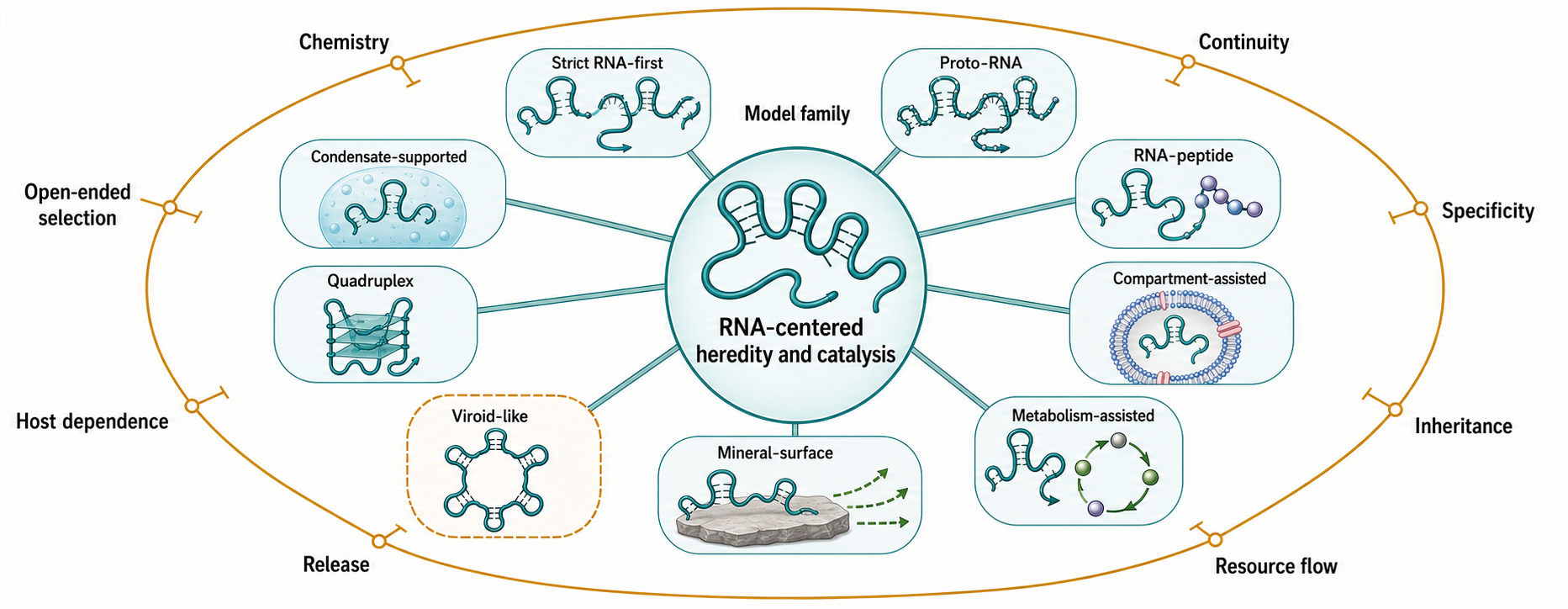
Figure 8.1. Family of RNA World Models. The phrase “RNA world” names a family of related hypotheses rather than a single rigid historical claim. A central concept of RNA-centered heredity and catalysis branches into major model variants—strict RNA-first, proto-RNA, RNA-peptide cooperation, compartment-assisted, metabolism-assisted, mineral-surface, viroid-like, and condensate-supported—each with its own burden of proof and its own set of unsolved constraints. Understanding the RNA world as a model family prevents the misconception that confirming any one variant settles the question of how life originated.
8.2. Natural ribozymes, selected ribozymes, and catalytic possibility space
Ribozymes are the strongest modern reason to take RNA world hypotheses seriously. Before ribozymes were known, it was easy to imagine RNA only as a passive carrier of information. A ribozyme overturns that picture. Its sequence folds into a structure that positions substrates, organizes metal ions, and stabilizes a chemical transition state. The molecule is both a genetic polymer and a catalyst-bearing structure.
Most natural ribozymes catalyze reactions involving RNA phosphodiester bonds. A phosphodiester bond is the covalent linkage connecting adjacent nucleotides in an RNA backbone. Self-cleaving ribozymes catalyze site-specific cleavage of this backbone, often through an internal transesterification reaction in which a 2′ hydroxyl attacks the adjacent phosphate. The reaction produces characteristic termini, such as a 2′,3′ cyclic phosphate and a 5′ hydroxyl. This chemistry is useful pedagogically because it shows that RNA’s own ribose hydroxyl groups can participate in catalysis.
Compact self-cleaving ribozymes include hammerhead, hairpin, hepatitis delta virus-like, twister, pistol, hatchet, and related classes. They differ in sequence, fold, and catalytic strategy, but they share a theme: a relatively small RNA architecture creates an active site around a scissile phosphate. HDV-like ribozymes are particularly well studied and occur in diverse genomic contexts. Their distribution illustrates both the power and the danger of evolutionary interpretation. A ribozyme family can be widespread because it is ancient, mobile, easy to evolve, repeatedly recruited, or some combination of these.
Large self-splicing ribozymes extend the argument. Group I introns remove themselves from precursor RNAs through transesterification reactions that use an external guanosine nucleophile. Group II introns also self-splice and are especially important for evolutionary discussions because they are mechanistically and structurally connected to spliceosomal introns and retroelement biology. These ribozymes are not merely small catalytic motifs; they are large structured RNAs whose folding, metal-ion interactions, and mobile-element contexts reveal how RNA catalysis can be embedded in genome evolution. Detailed intron mobility and spliceosomal ancestry are treated again in Chapters 13 and 39.
RNase P RNA provides a different example. RNase P processes precursor transfer RNAs by removing 5′ leader sequences. In many bacteria and some organellar or archaeal contexts, the RNA component is catalytic, although proteins can assist folding, substrate recognition, or activity. RNase P is therefore a ribonucleoprotein boundary case. The catalytic RNA demonstrates RNA enzymology, while the protein partners show how modern evolution often retained RNA catalysis but surrounded it with protein support.
The glmS riboswitch-ribozyme connects metabolite sensing to catalysis. It binds glucosamine-6-phosphate and uses ligand binding to promote self-cleavage of its own RNA, thereby regulating gene expression. This system is important because it bridges riboswitch logic and ribozyme chemistry. The ligand is not merely an on-off signal; it participates in the catalytic mechanism. The glmS example supports the plausibility of RNA-small-molecule cooperation, while reminding the reader that modern regulatory contexts are evolved cellular systems.
Box 8.1. Ribozyme Versus RNA-Binding Element
- A ribozyme accelerates a chemical reaction through substrate positioning, acid-base chemistry, metal-ion coordination, or electrostatic stabilization of the transition state.
- An aptamer binds a ligand with high specificity but does not necessarily catalyze a reaction.
- An RNA scaffold organizes other molecules or protein binding partners without catalyzing a bond change.
- A regulatory RNA changes gene expression by altering transcription, translation, splicing, or RNA stability.
- These roles can overlap: the glmS riboswitch-ribozyme both binds glucosamine-6-phosphate and catalyzes self-cleavage.
- Catalytic claims always require direct reaction evidence—a rate enhancement relative to the uncatalyzed reaction, mapped products, and mechanistic characterization.
The ribosome supplies the most consequential natural ribozyme. Peptide-bond formation occurs in the peptidyl transferase center, an RNA-rich active site of the large ribosomal subunit. Ribosomal proteins stabilize and organize the ribosome, but the catalytic center itself is built from ribosomal RNA. This observation strongly supports the idea that RNA catalysis lies near the root of translation. Chapter 10 treats this topic in depth because it connects RNA catalysis to the origin of coded peptide synthesis.
Ribozyme catalogs and databases are valuable because they separate evidence from anecdote. Ribocentre collects ribozyme classes, sequences, structures, reactions, and literature links. A database entry is not a substitute for mechanistic understanding, but curated catalogs help define which RNAs have demonstrated catalytic activity, which reactions they perform, and which contexts require caution. They also reduce the chance that “ribozyme” becomes a loose label for any structured RNA.
Natural ribozymes answer one question clearly: RNA can catalyze biologically relevant reactions. They answer historical questions less directly. A modern ribozyme can be ancient, but it can also be a later adaptation. Mobile elements can spread ribozymes horizontally. Short self-cleaving motifs may evolve repeatedly because a limited set of folds can solve similar cleavage problems. RNA catalysis is therefore established; the age and origin of each ribozyme class must be evaluated separately.
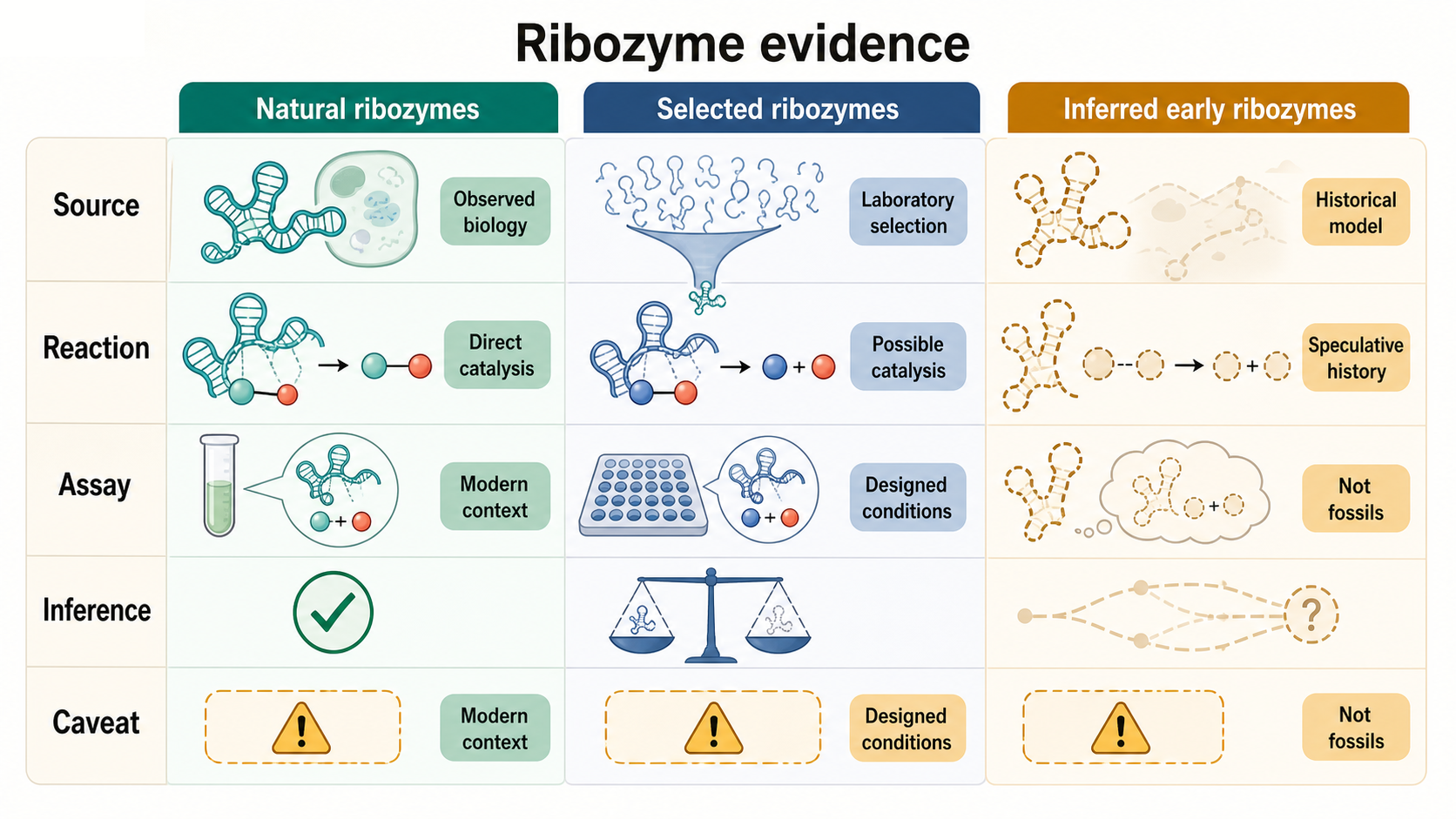
Figure 8.2. Ribozyme Evidence Ladder. Ribozyme evidence comes in three types with different evolutionary meanings. Three parallel columns compare natural ribozymes (found in living organisms), laboratory-selected ribozymes (enriched by in vitro selection), and inferred ancient ribozymes (reconstructed by inference), with each column characterized by source, reaction demonstrated, assay type, the evolutionary inference it supports, and its main caveat. Natural ribozymes establish that RNA catalysis is real in modern biology; selected ribozymes demonstrate that sequence space contains additional catalytic solutions; neither class directly identifies the ribozymes that existed before cellular life.
Selected ribozymes complement natural examples. In vitro selection, sometimes called SELEX when used for ligand-binding aptamers, starts with a large pool of sequences. The experiment imposes a function: bind a ligand, ligate a substrate, cleave a bond, extend a primer, or catalyze a reaction. Molecules that perform the function are retained, amplified, mutated if desired, and subjected to additional rounds. Over cycles, rare functional molecules become enriched. The method is a laboratory analog of selection, not a reconstruction of prebiotic evolution.
Selected ribozymes have expanded the known catalytic repertoire of RNA. They have catalyzed ligation, cleavage, acyl transfer, aminoacylation-like reactions, carbon-carbon bond formation in some selections, polymerase-like extension, and nucleotide-related chemistry. RNA-catalyzed nucleotide synthesis is especially relevant because it shows that RNA can participate in formation of molecules related to its own building blocks. This is not equivalent to a complete self-replicating RNA metabolism, but it directly addresses a core question: can RNA catalysis reach beyond cutting and joining RNA backbones?
The phrase catalytic possibility space is useful because it prevents two opposite mistakes. The first mistake is to infer from the limited set of natural ribozymes that RNA is catalytically narrow. Natural biology samples only functions that survived in particular lineages and contexts. The second mistake is to infer from selected ribozymes that any laboratory activity was prebiotically relevant. Selection experiments sample what RNA can do under designed conditions. Their substrates, salts, temperatures, pH, cofactors, amplification steps, and selection pressures may differ greatly from early-Earth settings.
Comparisons between natural and artificial RNAs suggest that RNA functions occupy constrained but real regions of sequence space. Many random sequences do not fold into useful catalysts. Functional RNAs often require specific motifs, tertiary contacts, and structural stability. Yet large populations and repeated selection can find activities that would be invisible from modern natural catalogs alone. This supports a modest but important claim: early RNA populations did not need to sample all possible sequences uniformly; selection, recombination, ligation, duplication, and compartmentalization could enrich functional neighborhoods.
Assay limits matter. A ribozyme may show activity only at high magnesium concentration, with chemically activated substrates, under carefully controlled pH, or with a selection handle that makes product recovery easy. A rate enhancement measured in vitro may be impressive relative to an uncatalyzed reaction but still too slow for a plausible prebiotic cycle. Conversely, a weak activity can become evolutionarily meaningful if it improves persistence or copying in a localized population. The biological relevance of catalysis depends on both chemistry and population context.
Caution
Do not overgeneralize: a selected ribozyme proves that RNA can perform a reaction under specified selection and assay conditions. It does not prove that the same sequence, substrate, or environment existed on early Earth.
8.3. Cofactors, ribonucleotide relics, and early metabolic networks
Metabolism is the organized chemistry that sustains a living system. In modern cells, metabolism depends heavily on protein enzymes, but those enzymes often use small helper molecules called cofactors. A cofactor can carry electrons, transfer chemical groups, stabilize charge, activate substrates, or link energetically favorable and unfavorable reactions. Many central cofactors contain ribonucleotide-like components, especially adenosine-containing modules.
ATP is the most familiar example. It is a ribonucleotide triphosphate used in RNA synthesis, but it is also the cell’s major phosphoryl-transfer and energy-coupling molecule. NAD and NADP carry electrons through nicotinamide chemistry but include adenosine-containing nucleotide architecture. FAD and FMN participate in redox chemistry and derive from riboflavin linked to nucleotide-like structures. Coenzyme A carries acyl groups and contains an adenosine phosphate portion. S-adenosylmethionine, often abbreviated SAM, is made from methionine and ATP and serves as a major methyl-group donor.
The cofactor-relic argument interprets this pattern as evidence that ribonucleotide chemistry was important before protein-dominated metabolism. If ancient RNA catalysts bound nucleotide-like molecules, modern protein enzymes may have inherited those cofactors as useful chemical modules. In this view, nucleotide handles helped early catalysts recognize, position, or exchange reactive groups. Later proteins took over most catalysis but retained many of the same small-molecule partners.
This argument is plausible because RNA is good at molecular recognition. Riboswitches show that folded RNAs can bind metabolites with high specificity and regulate gene expression in response. Some riboswitch aptamer domains bind SAM, thiamine pyrophosphate, flavin mononucleotide, guanine, adenine, lysine, glycine, and other metabolites. These examples show that RNA can form pockets for chemically diverse ligands. They do not show that riboswitches themselves are prebiotic, but they make RNA-cofactor interaction chemically credible.
The cofactor-relic argument is strongest when several observations converge: a cofactor contains a ribonucleotide-like recognition module; the reactive part of the molecule performs chemistry that would be useful in an RNA-centered system; RNA can bind similar molecules; and the cofactor is broadly distributed in modern life. Even then, the inference remains suggestive rather than decisive. Modern distribution can reflect ancient origin, but it can also reflect later fixation after the last universal common ancestor.
Alternative explanations must be kept nearby. Adenosine may be common in cofactors because ATP became abundant and evolution reused ATP-derived scaffolds. Protein enzymes may recognize nucleotide-like handles because those handles are convenient, soluble, charged, and modular. A cofactor may preserve ancient chemistry while its nucleotide appendage functions mainly as a binding handle for modern enzymes. These explanations are not mutually exclusive. A molecule can be ancient, chemically useful, and repeatedly repurposed.
Early metabolic networks introduce another difficulty: catalysis must be organized into cycles or flows. A ribozyme that produces a useful metabolite helps an RNA world only if the product contributes to the persistence, copying, or reproduction of that ribozyme or its compartment. If products diffuse away and benefit all molecules equally, catalytic advantage becomes public goods chemistry. Selection can still act, but only if spatial structure, compartments, surfaces, or reaction cycles keep benefit partly associated with the producing sequence or assembly.
Energy coupling is especially important. RNA backbone formation, nucleotide activation, ligation, and many metabolic transformations require activated substrates or favorable reaction pathways. Modern metabolism uses ATP, thioesters, redox cofactors, ion gradients, and enzyme-controlled coupling. An early RNA-centered system would need simpler equivalents: activated monomers, environmental cycles, mineral-catalyzed activation, photochemistry, wet-dry cycling, thioester-like chemistry, or cofactors that made otherwise unfavorable reactions possible. Chapter 7 treats prebiotic activation chemistry; here the key point is that ribozymes require a supply chain.
The phrase “early metabolic logic” does not imply that early systems had modern pathways such as glycolysis, the tricarboxylic acid cycle, or nucleotide biosynthesis. It means that any evolving molecular system must solve recurring tasks: obtain building blocks, activate them, maintain favorable concentrations, remove or dilute inhibitors, repair or replace damaged molecules, and link useful chemical work to inheritance. RNA world models become stronger when they show how ribozymes, cofactors, and compartments could satisfy those tasks together.
One productive way to read cofactor evidence is as a map of possible chemical partnerships. ATP-like molecules suggest phosphoryl transfer and activation. NAD- or FAD-like molecules suggest redox chemistry. SAM-like molecules suggest methyl transfer. Coenzyme A-like molecules suggest acyl transfer and thioester chemistry. RNA alone has limited side-chain chemistry compared with proteins, but RNA bound to cofactors can access a wider chemical repertoire. This is a major reason RNA-cofactor models are attractive.
The boundary case is that modern cofactors are embedded in protein enzyme systems. A modern NAD-dependent dehydrogenase does not prove that RNA once catalyzed the same reaction. It proves that nucleotide-containing cofactors can be central to metabolism. A modern SAM riboswitch does not prove that SAM existed before proteins. It proves that RNA can specifically recognize SAM. The stronger historical argument must integrate chemistry, distribution, structure, and plausible evolutionary continuity.
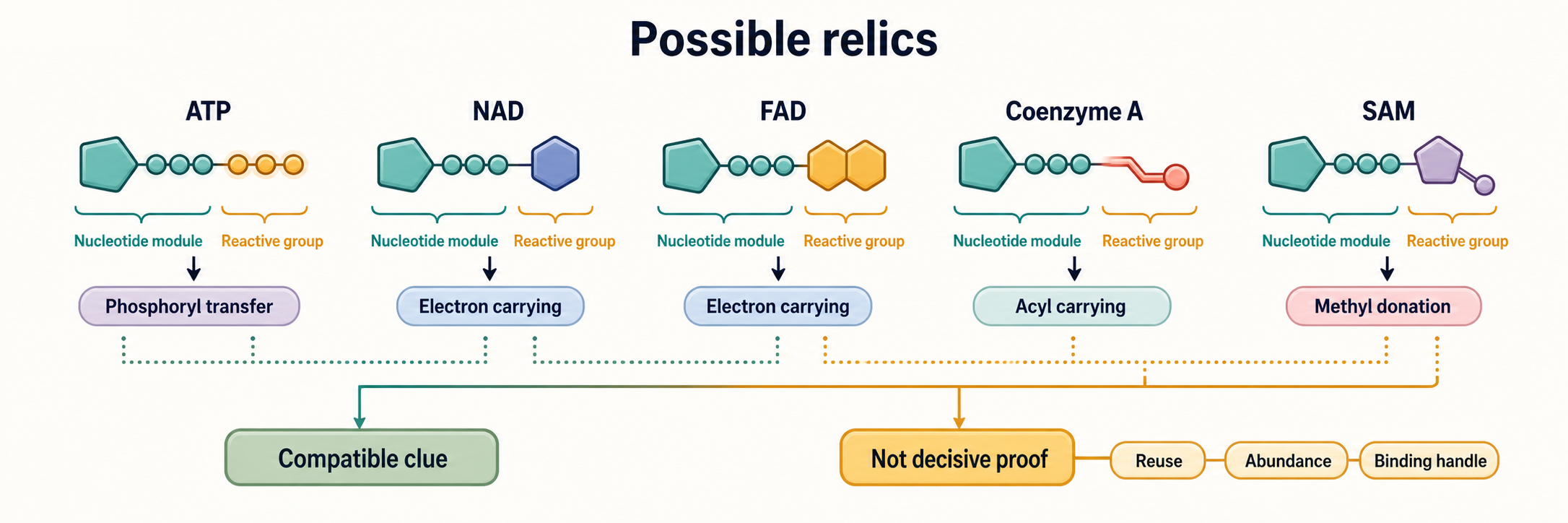
Figure 8.3. Ribonucleotide Cofactors as Possible Relics. Several of the cell’s most central metabolic cofactors—ATP, NAD, FAD, coenzyme A, and S-adenosylmethionine—contain ribonucleotide-like structural modules attached to chemically reactive groups. This figure maps each cofactor to its nucleotide-like component, its principal chemical function (phosphoryl transfer, electron carrying, methyl donation, or acyl carrying), and the alternative explanations for its nucleotide appendage. These cofactors are compatible with ancient RNA-centered metabolism but are not unambiguous molecular fossils, because biochemical convenience, the abundance of ATP, and evolutionary reuse of modular scaffolds are all plausible alternative explanations.
Caution
Do not overgeneralize: ribonucleotide-containing cofactors are compatible with ancient RNA-centered metabolism, but they are not unambiguous fossils. The careful claim is that modern metabolism contains many RNA-like chemical modules that an RNA-centered early system could have used or helped establish.
8.4. RNA replication, error thresholds, and evolvability
Replication is the central unsolved problem for RNA world hypotheses. A folded RNA can catalyze a reaction, but evolution requires heritable information. Heritable information means that sequence features influencing function are copied into descendants often enough for selection to preserve beneficial variants. A ribozyme that acts once and disappears is chemistry. A ribozyme whose sequence contributes to its own copying or to the reproduction of its compartment can become part of evolution.
Template-directed copying is the simplest conceptual route. One RNA strand aligns complementary monomers or oligomers by base pairing. Activated building blocks then form phosphodiester bonds to make a complementary strand. A second round of copying can regenerate the original sequence. This logic is straightforward on paper, but difficult in chemistry. Monomers must be activated. Incorrect bases must be rejected often enough. The growing strand must not stall. The product strand must separate from the template. Copying must work across sequences, not only for specially designed templates.
Product inhibition illustrates why a plausible reaction is not automatically a plausible cycle. Complementary RNA strands can bind each other strongly. If the copied product remains bound to the template, the template cannot begin another copying cycle. Modern cells solve strand separation with helicases, polymerases, topoisomerases, thermal regulation, and elaborate replication machinery. Prebiotic systems would need simpler solutions: short templates, temperature cycling, pH cycling, strand-displacing chemistry, compartment dynamics, surface release, or sequence compositions that reduce irreversible duplex trapping.
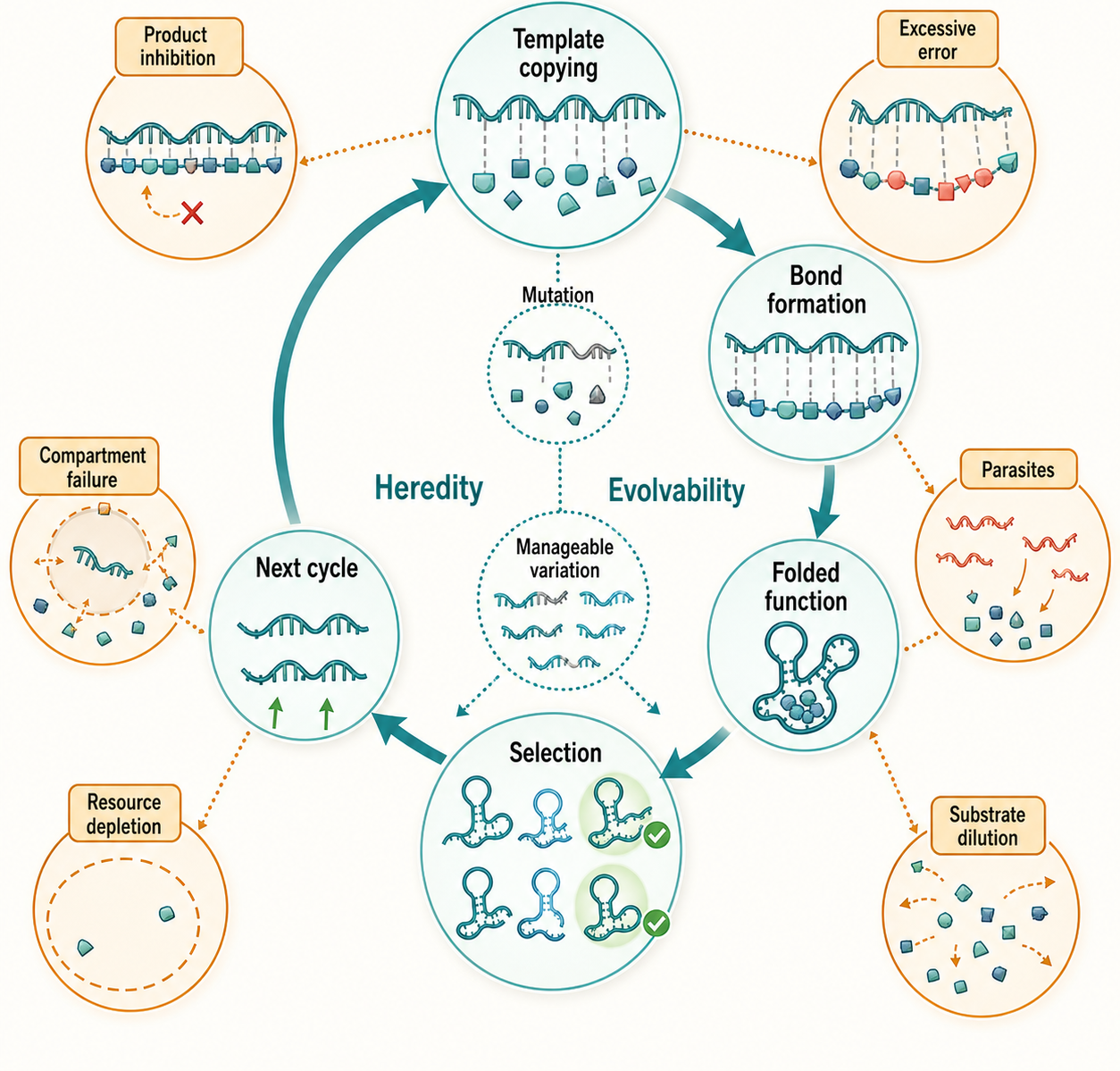
Figure 8.4. Replication, Error, and Evolvability. RNA-based heredity requires more than polymer formation; it requires a self-sustaining copying cycle coupled to selection. This figure depicts the key steps: a template RNA aligns complementary building blocks, bonds form to produce a new strand, the product folds or acts on its environment, differential persistence selects functional sequences, and surviving templates enter the next copying round. Arrayed around the cycle are six failure modes: product inhibition from strong duplex binding, error-threshold violation when mutation rate exceeds the fidelity needed to preserve sequence information, parasite molecules that consume copying resources without contributing function, substrate dilution when activated monomers are lost to the surroundings, resource depletion, and compartment failure that breaks the link between catalytic benefit and sequence inheritance.
An error threshold is a quantitative expression of a qualitative constraint. If each copied nucleotide has a chance of being wrong, the probability of copying an entire sequence correctly declines as sequence length increases. A short sequence can tolerate a higher per-site error rate than a long sequence. When errors are too frequent, selection cannot maintain the sequence pattern required for function. The population becomes a cloud of related but mostly defective variants. Error-threshold theory therefore limits the amount of information early RNA replicators could carry at a given fidelity.
Box 8.2. Why Error Thresholds Matter
- When each nucleotide position has a chance of being copied incorrectly, the probability of copying an entire sequence without any error falls steeply as sequence length increases.
- A short RNA can tolerate a higher per-site error rate than a long RNA and still maintain its functional sequence in a population.
- When errors accumulate faster than selection can remove defective variants, the population disperses into a cloud of related but mostly nonfunctional sequences, and useful information is lost.
- Consequently, early RNA genomes were under pressure to remain short, to improve copying fidelity, to distribute functions across several cooperating short molecules, or to rely on compartment-level selection that retains functional assemblies even when individual copying is imperfect.
- Error-threshold models make these trade-offs quantitative and identify which combinations of genome length, mutation rate, and selection strength are compatible with maintaining heritable information.
The error threshold should not be treated as a single universal number. It depends on genome length, mutation rate, population size, selection strength, neutrality, recombination, compartmentalization, and whether multiple sequences can perform the same function. Some ribozymes tolerate many mutations; others require precise active-site geometry. Some functions can be distributed among several shorter molecules; others require one long molecule. Some compartments may preserve cooperative sets even when individual sequence fidelity is modest. Theory is valuable because it makes these assumptions visible.
Evolvability requires a balance between fidelity and variation. Perfect copying would preserve existing function but provide no new variants. Extremely inaccurate copying would destroy function. Productive evolution occurs between these extremes, where sequence information is stable enough to persist but variable enough to explore neighboring possibilities. RNA is well suited to this logic because sequence changes can alter both base pairing and three-dimensional folding. A single mutation can weaken a stem, create a new loop, disrupt an active site, or change ligand binding.
Parasites are a second major constraint. In an RNA replication system, a parasitic RNA is a molecule that is copied efficiently but does not contribute to the function that sustains copying. For example, a short RNA might use a replicase ribozyme but not help produce it. Because shorter molecules often replicate faster, parasites can overtake cooperative molecules. This problem appears in many theoretical models and experimental evolution systems. It is not a moral category; it is a population-dynamic consequence of shared replication resources.
Compartments and spatial structure can reduce parasite collapse. If a compartment contains both a functional catalyst and the sequences that benefit from it, the compartment may grow or divide more successfully than compartments dominated by parasites. Mineral pores, lipid vesicles, droplets, gels, wet-dry films, and surface microenvironments can all create local neighborhoods. The key is not that a compartment resembles a modern cell. The key is that spatial organization links function to inheritance. Without that linkage, selection has little grip on cooperative chemistry.
Autocatalytic network models formalize the onset of selection. An autocatalytic system contains molecules whose reactions help produce more of themselves or more of the network. For heteropolymers such as RNA, sequence variation creates many possible interactions. Theoretical work on autocatalytic heteropolymers asks when such systems move from chemistry to selection: when some sequences increase their own persistence, when networks become self-maintaining, when parasites are controlled, and when heredity becomes stable enough for adaptation. These models are useful when they remain tied to chemical feasibility.
RNA polymerase ribozymes are an important experimental bridge, although detailed coverage belongs with Chapter 7’s template-copying chemistry and later enzymology chapters. Laboratory evolution has produced ribozymes that extend primers and copy portions of RNA templates under defined conditions. These results show that RNA can catalyze polymerase-like reactions. The remaining gaps are large: sequence generality, speed, fidelity, strand separation, substrate availability, and integration into a self-sustaining cycle. A polymerase-like ribozyme is therefore a milestone, not a complete RNA replicator.
Modern RNA viruses provide useful but limited analogies. RNA viruses maintain RNA genomes under high mutation rates, bottlenecks, and selection. Experiments with RNA viruses show that bottlenecks can sometimes expose variation, purge competitors, or produce context-dependent effects under elevated error rates. These observations help teach error-prone evolution. They do not reconstruct prebiotic replication because modern RNA viruses rely on protein polymerases, host metabolism, cellular membranes, and evolved genome structures.
The difference between replication and reproduction is also important. A molecule can copy itself, but a protocell-like compartment must reproduce as an organized unit. If an RNA sequence improves metabolism inside a vesicle, the vesicle must grow, divide, or otherwise transmit that RNA-enriched state. If a droplet concentrates useful RNAs, droplet formation and dissolution must preserve enough continuity for selection. RNA world models often focus on molecular copying, but open-ended evolution likely required coupling between molecular replication and compartment-level persistence.
Caution
Do not overgeneralize: polymerization is not replication, and replication is not automatically evolution. RNA-based evolution requires copied sequence information, functional consequences of sequence variation, manageable errors, resource renewal, product release, and enough spatial organization to link useful function to inheritance.
8.5. Limits of reconstruction and competing origin-of-life models
Origin-of-life reconstruction is unlike reconstruction of a recent evolutionary event. Recent evolution can use fossils, genomes, biogeography, and dated lineages. The RNA world predates cellular fossils and lies beyond ordinary phylogenetic reach. No preserved prebiotic RNA ecosystem can be sampled. The field therefore builds constrained inferences from modern biology, experimental chemistry, geochemistry, theoretical models, and comparative structure.
This indirect evidence is powerful but uneven. Modern ribozymes directly show that RNA can catalyze reactions. The ribosome strongly suggests that RNA catalysis was central to the emergence of translation. Ribonucleotide-containing cofactors suggest continuity between nucleotide chemistry and metabolism. Laboratory selection shows that RNA sequence space contains many functions not represented in current biology. Prebiotic chemistry shows plausible routes to some building blocks and activated intermediates. No single evidence class supplies a complete history.
The most common overclaim is to treat a modern example as a fossil. A natural ribozyme is not automatically ancient. A selected ribozyme is not a recovered ancestor. A riboswitch is not a preserved metabolic regulator from pre-cellular life. A viroid is not an RNA world organism. A condensate in a modern cell is not a prebiotic droplet. Each can illuminate a principle, but historical claims require additional reasoning.
Viroids are a useful case study. A viroid is a small circular RNA pathogen, especially known from plants. Viroids can have compact structures, can move through host tissues, and can be copied in host-dependent cycles. Some small infectious RNAs use ribozyme-mediated processing. These features make viroids tempting analogies for early RNA agents. The caveat is decisive: viroids depend on modern host enzymes, host trafficking, and host cellular environments. They demonstrate what small RNAs can do inside cells, not what RNAs did before cells.
Condensate models are another useful case. Phase-separated or localized assemblies can concentrate reactants, reduce dilution, create microenvironments, and preserve molecular neighborhoods. These properties address real origin-of-life problems. Yet a condensate model must still answer chemical questions. What molecules form the condensate? Are activated monomers enriched or excluded? Do templates and products separate? Are catalysts retained but waste products released? Can compartments grow and divide or at least cycle reproducibly? Modern condensate biology provides mechanisms to consider, but prebiotic relevance must be shown independently.
Table 8.3. Analogies That Should Not Be Overread. Six modern RNA systems are frequently invoked in origin-of-life arguments, but each has a clearly bounded scope of inference that students should learn to apply.
| Modern analogy | What it demonstrates | What it does not demonstrate | Correct use |
|---|---|---|---|
| Selected ribozymes | RNA can evolve catalytic activity under selection | The same sequences existed prebiotically | Map catalytic possibility and constraints |
| Natural ribozymes | RNA catalysis exists in biology | Every modern ribozyme is ancient | Study mechanisms and comparative distribution |
| Riboswitches | RNA can bind metabolites specifically | Modern riboswitches are pre-cellular regulators | Support RNA-small-molecule plausibility |
| Viroids | Small structured RNAs can participate in infectious cycles | Viroids are pre-cellular fossils | Use as modern minimal RNA-agent analogies |
| RNA viruses | RNA genomes can evolve under high mutation rates | Protein-free RNA replication is easy | Teach mutation, bottlenecks, and selection limits |
| Condensates | Molecules can be localized and concentrated | Modern condensates existed before cells | Test physical mechanisms for compartmentalization |
Metabolism-first models emphasize energy flow and reaction networks before genetic polymers. Their strength is that life requires sustained chemistry, not only informational molecules. Their challenge is heredity. A reaction network can persist if conditions remain favorable, but Darwinian evolution requires variations in the network to be inherited and selected. A metabolism-first model becomes more compatible with RNA world reasoning when RNA-like polymers enter as heritable catalysts within a preexisting chemical network.
Lipid-first or compartment-first models emphasize boundaries. Their strength is individuality: compartments can retain products, create local concentrations, and support competition among protocell-like units. Their challenge is informational control. A vesicle can grow and divide physically without encoding adaptive chemical functions. A compartment-first model becomes more complete when heritable polymers influence compartment growth, division, permeability, or resource use.
Peptide-first and RNA-peptide coevolution models emphasize chemical diversity. Amino-acid side chains can perform acid-base chemistry, hydrophobic packing, metal binding, and redox-related functions that RNA handles less easily. The strongest version of a peptide-first model must explain how peptide sequences became heritable before nucleic-acid templating. RNA-peptide coevolution models are often more plausible than strict peptide-first models because RNA supplies sequence information while peptides help chemistry.
Mineral-surface models emphasize environmental structure. Minerals can concentrate molecules, promote reactions, protect polymers, select particular chemistries, or provide redox and catalytic surfaces. The challenge is release and continuity. If useful products remain stuck to a surface, replication cycles may stall. If products release too easily, spatial association may be lost. Mineral models are therefore most useful when they specify cycles of adsorption, reaction, release, and selection.
The strongest origin models connect constraints across stages. They explain where monomers come from, how polymers form, how folded molecules perform functions, how copying occurs, how errors remain tolerable, how parasites are limited, how resources are renewed, how compartments or spatial structure preserve individuality, and how the system can transition toward coded peptides and modern cellular metabolism. A model that solves one step while making a later step impossible is not a full origin scenario.
The field also needs negative knowledge. Some older or simplified arguments implied that discovery of ribozymes would nearly solve the origin problem. That view is obsolete. Ribozyme discovery solved the conceptual problem of RNA catalysis, not the chemical and evolutionary problems of self-sustaining RNA replication. Other arguments implied that ribonucleotide cofactors or the ribosomal RNA core are direct proof of a detailed RNA world. Those arguments overstate relic evidence. The modern consensus is more precise: RNA-centered stages are plausible and strongly motivated, but exact histories remain unresolved.
The correct conclusion is not agnosticism without structure. It is constrained pluralism. Several models can be kept alive if they solve different parts of the problem and remain chemically compatible. Strict RNA-first models set a useful benchmark for RNA autonomy. Proto-RNA models test alternative hereditary chemistries. RNA-peptide models test cooperative catalysis. Compartment and condensate models test spatial organization. Metabolism-assisted models test energy flow and network continuity. The task is to connect these models without erasing their distinct claims.
Caution
Do not overgeneralize: uncertainty about the exact origin route does not weaken the established observation that RNA can store information and catalyze reactions. It means that historical reconstruction must label what is observed, what is inferred, what is analogous, and what remains speculative.
Box 8.3. Common Overclaims in RNA World Arguments
- Ribozyme existence is evidence for RNA catalysis, not complete proof of a historical RNA world; a full RNA world also requires plausible synthesis, replication, resource flow, and a transition to coded peptide synthesis.
- Selected ribozymes are products of laboratory selection under defined conditions; they are not fossils and do not show that those sequences or substrates existed on early Earth.
- Ribonucleotide-containing cofactors are suggestive of ancient RNA-centered chemistry but are not unambiguous molecular relics; biochemical convenience and evolutionary reuse are alternative explanations.
- Modern RNA viruses and viroids are useful analogies for RNA genome evolution but depend on protein enzymes, host cells, and evolved cellular infrastructure.
- Compartment and condensate models address the localization problem but solve it only if the compartment remains coupled to RNA replication and selection.
Biological Contexts Across Modern Systems
Modern biology preserves many RNA-centered systems, but each must be interpreted in context. The ribosome is the central example because its catalytic core is ribosomal RNA. This does not mean the modern ribosome is a fossilized RNA world organism. It means that translation contains an RNA-based catalytic center surrounded by layers of protein, RNA expansion segments, assembly factors, modification enzymes, and quality-control systems. The ribosome is best treated as an evolutionary palimpsest: ancient RNA chemistry embedded within later ribonucleoprotein complexity.
Self-cleaving ribozymes occur in viruses, viroid-like agents, retrotransposons, bacterial genomes, eukaryotic repetitive elements, and other mobile contexts. Their biological roles include processing multimeric transcripts, regulating RNA stability, participating in mobile element cycles, and sometimes functions that remain uncertain. Their wide distribution supports the evolutionary versatility of RNA catalysis, but it also warns against simple ancestry claims. Mobile genetic elements can move ribozymes across lineages, and compact catalytic motifs can arise or be recruited repeatedly.
Group I and group II introns link RNA catalysis to genome dynamics. They can splice themselves from precursor RNAs, and many are associated with mobility functions. Group II introns are especially important because they are connected to the evolutionary history of spliceosomal introns and retroelements. These systems illustrate a general principle for RNA world reasoning: RNA catalysis did not disappear when proteins evolved. Instead, RNA catalysis became embedded in mixed RNA-protein systems, mobile elements, and regulatory circuits.
RNase P illustrates partial retention and replacement. In many bacteria, RNase P RNA is catalytic with protein assistance. In some lineages, protein-only RNase P enzymes exist or predominate. This distribution shows that an RNA-catalyzed function can be retained, supplemented, or replaced by proteins in different evolutionary contexts. The example cautions against assuming that all ancient RNA functions remain RNA-catalyzed today. Protein enzymes can take over functions while leaving only indirect traces of earlier RNA involvement.
Riboswitches and ribozyme-riboswitch hybrids show RNA-small-molecule recognition in living cells. Riboswitches are common in bacteria and regulate gene expression by binding metabolites. Some control transcription termination, translation initiation, splicing, or RNA stability. The glmS riboswitch-ribozyme is a particularly clear bridge between binding and catalysis. It reminds readers that RNA can sense metabolic state and execute chemical change, but also that modern riboswitches operate in cells with evolved transcription, translation, and metabolite homeostasis.
Viroids and RNA viruses teach different lessons. Viroids show that small structured RNAs can have biological agency in modern hosts. RNA viruses show that RNA genomes can evolve rapidly under mutation, selection, and bottlenecks. Neither should be mistaken for a pre-cellular RNA replicator. Both depend on modern biological infrastructure. Their value lies in principles: small RNA structure can matter, error-prone RNA evolution can be productive, and population dynamics can shape RNA lineages.
Technology, Computational, and Engineering Links
Ribozyme research has practical consequences beyond origin-of-life theory. In vitro selection has produced ribozymes and aptamers for molecular recognition, catalysis, biosensing, gene-regulatory control, and synthetic biology. The same selection logic used to ask what RNA could do in early evolution can be used to engineer RNAs with defined modern functions. Chapter 154 treats therapeutic ribozymes and programmable RNA biologics in a clinical and engineering context.
Ribozyme databases and comparative resources support systematic analysis. A curated resource such as Ribocentre helps researchers compare ribozyme classes, reaction types, structures, sequence motifs, and biological contexts. Such resources are important for avoiding two errors: rediscovering known motifs under new names and overlooking mechanistic differences among superficially similar RNAs.
Computational RNA folding and structure prediction contribute to RNA world research by estimating whether candidate sequences can form stable motifs, alternative folds, or ligand-binding pockets. The same caveats described in Chapters 3 and 4 apply. Predicted structure is not observed structure, and a stable predicted fold is not proof of activity. Experimental validation remains essential for catalytic claims. Computational models are most useful when they guide hypotheses that can be tested by mutagenesis, structural probing, kinetics, or selection.
Population-genetic and dynamical models help clarify replication and error-threshold arguments. These models can ask how mutation rate, sequence length, selection strength, compartment size, resource limitation, and parasite burden affect persistence. Their strength is explicit assumptions. Their weakness is abstraction. A model that permits efficient copying, perfect mixing control, or unlimited activated monomers may be mathematically clean but chemically unrealistic. The best modeling work keeps chemical constraints visible.
Synthetic protocell and compartment experiments provide another bridge. Researchers can encapsulate RNAs, enzymes, or reaction networks in vesicles, droplets, coacervates, gels, or microfluidic compartments. These systems test localization, resource exchange, growth, division, and competition. They do not recreate early Earth by default, but they make abstract problems experimentally tangible. For RNA world reasoning, the most informative systems are those that link RNA sequence or RNA activity to compartment persistence.
Recent Consensus
The RNA world is best understood as a family of RNA-centered hypotheses rather than a single complete origin story. This formulation preserves the central insight that RNA can connect information and catalysis while avoiding the false claim that canonical RNA alone must explain every early step.
Natural ribozymes and selected ribozymes establish RNA catalytic capacity. Natural examples demonstrate biological reality. Selected examples demonstrate that sequence space contains additional catalytic solutions. Both evidence classes are necessary, and each has different limitations.
Ribonucleotide-rich cofactors, riboswitches, and the RNA-based ribosomal catalytic center are compatible with ancient RNA-centered chemistry. They are strongest when interpreted as converging clues rather than as standalone proof. Relic arguments should remain probabilistic and comparative.
Replication fidelity, strand separation, resource renewal, spatial organization, and parasite control remain central bottlenecks. A plausible RNA world model must explain heredity, not only polymer formation or isolated catalysis.
Competing origin-of-life models may be complementary when they solve different constraints. Proto-RNA chemistry, peptides, lipids, minerals, metabolism-like networks, viroid-like RNAs, and condensates should be evaluated by their chemical compatibility and evolutionary consequences, not by labels alone.
Open Questions, Controversies, Deprecated Models, and Common Misconceptions
Open questions:
- Did canonical RNA arise directly, or did chemically distinct proto-RNA polymers precede it?
- Which ribozyme activities are plausible under prebiotic substrate, salt, pH, temperature, and concentration conditions?
- How could early RNA systems achieve enough copying fidelity without protein polymerases?
- How were template copying and product strand release coupled in repeatable cycles?
- What forms of compartmentalization or spatial organization linked catalytic function to inheritance?
- Did short peptides assist RNA before the genetic code, and if so, how specific were those interactions?
- Which modern RNA features are ancient retentions, and which are later innovations or convergent solutions?
- How did RNA-centered chemistry transition into coded peptide synthesis and then into DNA-RNA-protein cells?
Common misconceptions:
- “Ribozymes prove the RNA world.” Ribozymes prove RNA catalysis. A historical RNA world also requires plausible synthesis, replication, selection, and transition pathways.
- “The RNA world means RNA acted alone.” Many serious RNA world variants include proto-RNA, peptides, minerals, lipids, cofactors, compartments, or metabolic networks.
- “Selected ribozymes are fossils.” Selected ribozymes are products of laboratory selection. They show possibility and constraints, not direct ancestry.
- “Ribonucleotide cofactors are decisive relics.” Cofactor structures are suggestive but can reflect ancient chemistry, later reuse, or biochemical convenience.
- “Modern RNA viruses model prebiotic replication.” RNA viruses teach principles of RNA genome evolution but depend on evolved proteins and host cells.
- “A molecule that polymerizes has replicated.” Replication requires sequence information to be copied and inherited across cycles.
- “Competing origin models must be mutually exclusive.” Strong versions may conflict, but weaker versions can describe different stages or supports in one coupled origin process.
Deprecated or weakened claims:
- The discovery of ribozymes alone solves the origin-of-life problem. This claim is too strong because replication, resource flow, compartments, and transitions remain unresolved.
- Modern ribozymes can be read as a direct inventory of pre-cellular ribozymes. This claim is too strong because modern ribozymes have their own evolutionary histories.
- The abundance of adenosine-containing cofactors is proof of a specific RNA world pathway. This claim is too strong because multiple evolutionary explanations remain plausible.