Chapter 10. Evolution of the Genetic Code, tRNA Adaptors, and the Ribosome
Scope Note
Translation is the cellular process that converts nucleotide sequence into amino-acid sequence. In modern cells, translation requires messenger RNA (mRNA), transfer RNA (tRNA), aminoacyl-tRNA synthetases, ribosomal RNA (rRNA), ribosomal proteins, elongation and release factors, nucleotide modifications, and quality-control pathways. The origin of translation is therefore not a single problem. It is a linked set of problems: how codons acquired amino-acid meanings, how adaptor RNAs connected codons to amino acids, how peptide-bond formation became coupled to templated decoding, and how the resulting system became accurate enough to support long proteins.
This chapter follows the Chapter 8 discussion of RNA-world hypotheses into the emergence of coded peptide synthesis. It focuses on three molecular innovations. The first innovation is the genetic code, the mapping between nucleotide triplets and amino acids or translation termination. The second innovation is the tRNA adaptor system, in which an RNA molecule carries an amino acid at one end and pairs with an mRNA codon through an anticodon at another site. The third innovation is the ribosome, especially the RNA-rich peptidyl transferase center that catalyzes peptide-bond formation. Together, these innovations created the bridge from an RNA-centered chemical world to the RNA-protein biology that characterizes all known cellular life.
The origin of the genetic code is not solved. Modern data strongly constrain plausible histories, but no current model reconstructs every step from prebiotic chemistry to the near-universal code, modern tRNAs, aminoacyl-tRNA synthetases, and ribosomes. The chapter therefore treats stereochemical, coevolutionary, error-minimization, and frozen-accident models as partially compatible explanations for different aspects of the problem rather than as mutually exclusive stories. Later chapters treat mature tRNA biology (Chapter 39, Chapter 41), ribosome biogenesis and specialization (Chapter 42-Chapter 44), translation mechanisms (Chapter 66-Chapter 71), and codon-dependent mRNA stability (Chapter 36) in greater depth.
Executive Summary
The genetic code is the rule system by which nucleotide triplets specify amino acids or translation termination. A codon is a three-nucleotide word read in mRNA during translation. An anticodon is a three-nucleotide region of a tRNA that pairs with a codon in the ribosome. The code is often drawn as a table, but the table is only a compressed representation of a molecular system. Codon meaning depends on tRNAs, aminoacyl-tRNA synthetases, ribosomes, release factors, nucleotide modifications, and cellular quality control.
The adaptor problem is the central conceptual bridge. Nucleic acids and amino acids do not share a general chemical complementarity that would allow every codon to bind its amino acid directly. Modern translation solves this problem with tRNAs. A tRNA has an acceptor end that carries an amino acid and an anticodon loop that pairs with mRNA. The charged tRNA, called an aminoacyl-tRNA, brings a particular amino acid into the ribosome when its anticodon matches the codon being decoded.
Aminoacyl-tRNA synthetases maintain the link between the code table and chemistry. These enzymes attach amino acids to the correct tRNAs by recognizing tRNA identity elements. Identity elements include acceptor-stem bases, the discriminator base near the 3′ end, anticodon bases, modified nucleotides, and three-dimensional shape. The anticodon can be important, but it is not a universal identity rule. This distributed recognition is why changing codon meaning usually requires coordinated changes in tRNA, synthetase, release-factor, and proteome context.
The ribosome is a ribonucleoprotein machine, but the chemistry of peptide-bond formation occurs in an RNA-based active site. The peptidyl transferase center of the large ribosomal subunit is built from rRNA. Ribosomal proteins stabilize, organize, and regulate the machine, but the catalytic core is not a typical protein enzyme. This feature makes the ribosome one of the most important modern traces of ancient RNA catalysis.
The genetic code is near-universal rather than absolutely universal. Most cellular life uses the same core code, but mitochondria, some microbial lineages, and specialized translation systems show natural codon reassignments. Selenocysteine and pyrrolysine add amino-acid meanings through specialized signals, tRNAs, and factors. Engineered systems can introduce suppressor tRNAs, orthogonal synthetases, quadruplet codons, recoded genomes, and programmable RNA-editing-based expansion. These cases show that codon meaning can change, but only under molecular constraints.
Modern translation also shows why origin models must explain operation, not only assignment. Wobble pairing allows one tRNA to read multiple synonymous codons, but wobble is tuned by tRNA modifications and ribosomal monitoring. Codon use affects translation speed, ribosome collisions, mRNA decay, and cellular stress responses. These modern regulatory layers should not be projected directly onto the earliest stages of translation, but they make clear that the code is embedded in a dynamic biochemical system.
Concept Inventory
- Genetic code: the mapping between codons and amino acids or termination. The standard code has 64 codons: 61 sense codons that usually specify amino acids and three stop codons that usually signal termination. The code is degenerate, meaning that multiple codons can specify the same amino acid. Degeneracy is not random redundancy; synonymous codons can differ in decoding speed, tRNA demand, modification dependence, and effects on mRNA stability.
- Codon: a three-nucleotide unit in an mRNA reading frame. The same nucleotide triplet can have different consequences outside a translated reading frame, after RNA editing, in a recoded organism, or in a specialized translation context. An anticodon is the tRNA sequence that pairs with a codon. Anticodon-codon pairing is central to decoding, but codon meaning is fixed upstream by aminoacylation: the ribosome normally checks the anticodon rather than chemically verifying the attached amino acid.
- tRNA adaptor: an RNA that links codon recognition to amino-acid delivery. A mature tRNA is usually about 70 to 90 nucleotides long, folds into a cloverleaf secondary structure and an L-shaped tertiary structure, carries a conserved 3′ CCA end, and contains multiple modified nucleotides. Aminoacylation is the attachment of an amino acid to the 3′ end of a tRNA. The product, an aminoacyl-tRNA, is the direct substrate used by the ribosome during elongation.
- Aminoacyl-tRNA synthetase: an enzyme that charges one amino acid onto its cognate tRNA set. Modern synthetases are divided into two broad structural classes, but the evolutionary relationship between synthetase classes and early code formation remains debated. Many synthetases include editing functions that hydrolyze incorrectly activated amino acids or mischarged tRNAs, reducing mistranslation. A tRNA identity element is any feature that helps a synthetase distinguish a cognate tRNA from noncognate tRNAs.
- Peptidyl transferase center: the catalytic region of the large ribosomal subunit where the growing peptide is transferred from the P-site tRNA to the amino acid attached to the A-site tRNA. The A site holds the incoming aminoacyl-tRNA, the P site holds the peptidyl-tRNA carrying the growing chain, and the E site binds the deacylated tRNA before exit. The peptidyl transferase center is built primarily from rRNA.
- Wobble: flexible pairing between the first anticodon position and the third codon position. Wobble allows fewer tRNAs to decode more codons, but it also requires control by nucleotide modifications and ribosomal geometry. Codon capture is a model for reassignment in which a codon disappears or becomes rare, its old decoding function is lost, and the codon later reappears with a new meaning. An ambiguous intermediate is a reassignment model in which a codon is temporarily decoded in more than one way before one meaning becomes fixed.
- Code expansion: the addition of new coding capacity. Natural examples include selenocysteine and pyrrolysine. Engineered examples include reassigned stop codons, orthogonal tRNA-synthetase pairs, quadruplet codons, and programmable RNA-editing strategies. These examples are useful experimentally, but they should not be treated as direct reenactments of ancient code evolution.
What to Know Before Reading This Chapter
The reader should already understand three basic facts about biological polymers. First, RNA and DNA are sequence polymers made from nucleotides. Second, proteins are sequence polymers made from amino acids. Third, biological function depends not only on sequence but also on folding, chemical modification, molecular recognition, and cellular context. Translation is the process that connects these polymer worlds.
The reader should also distinguish a mapping from a mechanism. The written genetic code table is a mapping: UUU specifies phenylalanine, AUG usually specifies methionine and initiation, UAA usually specifies stop, and so on. The mechanism that enforces this mapping is not the table. The mechanism includes tRNAs with anticodons, synthetases that attach amino acids to tRNAs, ribosomes that select codon-matched tRNAs, and factors that terminate translation at stop codons. This distinction is essential for understanding why origin models must account for chemistry, recognition, selection, and historical constraint.
Three running examples will recur. The first example is phenylalanine tRNA, a standard tRNA charged with phenylalanine by phenylalanyl-tRNA synthetase and used to decode phenylalanine codons. It illustrates the adaptor problem and the separation between aminoacylation and decoding. The second example is the ribosomal peptidyl transferase center, which illustrates RNA catalysis inside a modern RNA-protein machine. The third example is reassignment of stop codons, including pyrrolysine decoding of TAG in some archaea, which illustrates how code changes can occur without implying that the code is freely mutable.
10.1. Genetic-code origin models and stereochemical hypotheses
The genetic-code origin problem asks how codons became associated with amino acids and termination. A simple code table hides several different questions. Why are codons triplets rather than doublets or longer words? Why are there 20 common encoded amino acids rather than a smaller or larger set? Why are similar amino acids often assigned to related codons? Why are stop signals integrated into the same triplet system? Why is the code almost the same across cellular life but not perfectly universal? No single model answers all of these questions.
Stereochemical hypotheses propose that at least some codon assignments arose from direct chemical affinity between amino acids and RNA sequences. The core idea is intuitive: if an amino acid binds preferentially to an RNA sequence containing its codon or anticodon, the assignment could begin as a chemical association before the existence of modern synthetases. This model is attractive because it gives the code a possible physical foothold. It connects assignment to molecular recognition rather than to a purely arbitrary convention.
The evidence for stereochemical models is suggestive but incomplete. RNA aptamer selection experiments and comparative arguments have been used to ask whether amino-acid-binding RNAs are enriched for codon-like or anticodon-like sequences. Such evidence can support the possibility that some assignments had chemical biases. It cannot, by itself, show that all assignments were created in this way, that the selected RNAs resemble ancient RNAs, or that binding affinity was strong enough to build a full translation system. A careful statement is therefore: stereochemical effects may have contributed to some early assignments, but stereochemistry is not a complete explanation for the modern code.
Coevolution hypotheses link genetic-code expansion to amino-acid biosynthesis. In these models, early translation may have used a smaller amino-acid alphabet, and new amino acids were incorporated as metabolism generated new compounds. Codon assignments might then reflect precursor-product relationships among amino acids or stages in biosynthetic pathway evolution. For example, if one amino acid was metabolically derived from another, related codons might have been assigned as the biochemical repertoire expanded. This model connects code evolution to early metabolism and amino-acid availability.
Table 10.1. Genetic-Code Origin Models. This table summarizes four genetic-code origin model families, comparing their central claims, main evidence types, chief weaknesses, and mutual compatibility.
| Model | Main claim | Supporting evidence type | Main weakness | Compatibility with other models |
|---|---|---|---|---|
| Stereochemical | Some codon assignments reflect direct chemical affinity between amino acids and cognate RNA sequences | RNA aptamer enrichment for codon-like or anticodon-like sequences | Evidence uneven across amino acids; aptamer conditions differ from early Earth | May explain initial biases; compatible with coevolution for early assignments |
| Coevolutionary | Codon assignments expanded alongside amino-acid biosynthetic pathways; related amino acids occupy neighboring codons | Amino-acid chemical relatedness in codon blocks; biosynthetic pathway topology | Modern metabolic pathways may not reflect ancient chemistry | Compatible with stereochemistry for early assignments; reinforces error-minimization pattern |
| Error-minimization | The standard code layout minimizes the phenotypic cost of single-nucleotide mutations and mistranslation | Statistical comparison with random code alternatives; chemical clustering of synonymous codon neighborhoods | Cannot distinguish selection from inheritance of earlier biases; may be a byproduct | Explains a property that any model must account for; compatible with coevolution and stereochemistry |
| Frozen accident | Near-universality reflects historical lock-in; changing any assignment disrupts many proteins simultaneously | Conservation across all domains; proteome-wide cost of any reassignment | Does not explain why specific assignments were made initially | A late-stage constraint compatible with all origin models |
The limitation of coevolution models is historical inference. Modern biosynthetic pathways are themselves evolved systems. A pathway observed in bacteria or archaea today may not preserve the exact chemistry of early metabolism. Some amino acids may have been prebiotically available, some may have been generated by primitive metabolic networks, and some may have entered the code only after enzymes improved biosynthesis. Coevolution models are strongest when they are used to explain patterns of code expansion and amino-acid relatedness, not when they are treated as a complete reconstruction of early metabolism.
Error-minimization hypotheses emphasize code robustness. In the standard code, many single-nucleotide changes produce either the same amino acid or an amino acid with related chemical properties. Hydrophobic amino acids cluster in parts of the code; acidic and amide amino acids show related neighborhoods; many third-position changes are synonymous. This organization can reduce the damage caused by point mutations, misreading, or mistranslation. A code that maps related codons to chemically similar amino acids will, on average, produce less disruptive errors than a random mapping.
The key question for error minimization is whether robustness was selected directly, inherited from earlier assignment mechanisms, or both. Selection for error tolerance would require a translation system accurate enough that proteins mattered but error-prone enough that mistranslation imposed strong costs. That condition is plausible during code evolution, but it is not a direct observation. Some error-minimizing structure could also emerge from stereochemical affinities, biosynthetic expansion, or codon-capture histories. Robustness is therefore a property that any model must explain, but it need not be the single cause of code organization.
Frozen-accident models emphasize historical lock-in. Once a genetic code is used by many genes, changing a codon assignment changes many proteins at once. Most reassignment events would be harmful because they alter amino-acid sequences across the proteome. The code can therefore become frozen because the cost of changing it grows with the number of encoded genes and the dependence of cellular systems on translated proteins. This model explains why the code is highly conserved across life.
The phrase frozen accident can be misleading if read too strongly. The code is not absolutely frozen, and its assignments are not necessarily arbitrary accidents. Natural variants show that assignments can change in organelles and some microbial lineages. Specialized amino acids such as selenocysteine and pyrrolysine show that codons can acquire context-dependent meanings. Engineered systems show additional routes for reassignment. A better interpretation is that historical lock-in is a major constraint after translation becomes globally integrated, while earlier stages may have been more fluid.
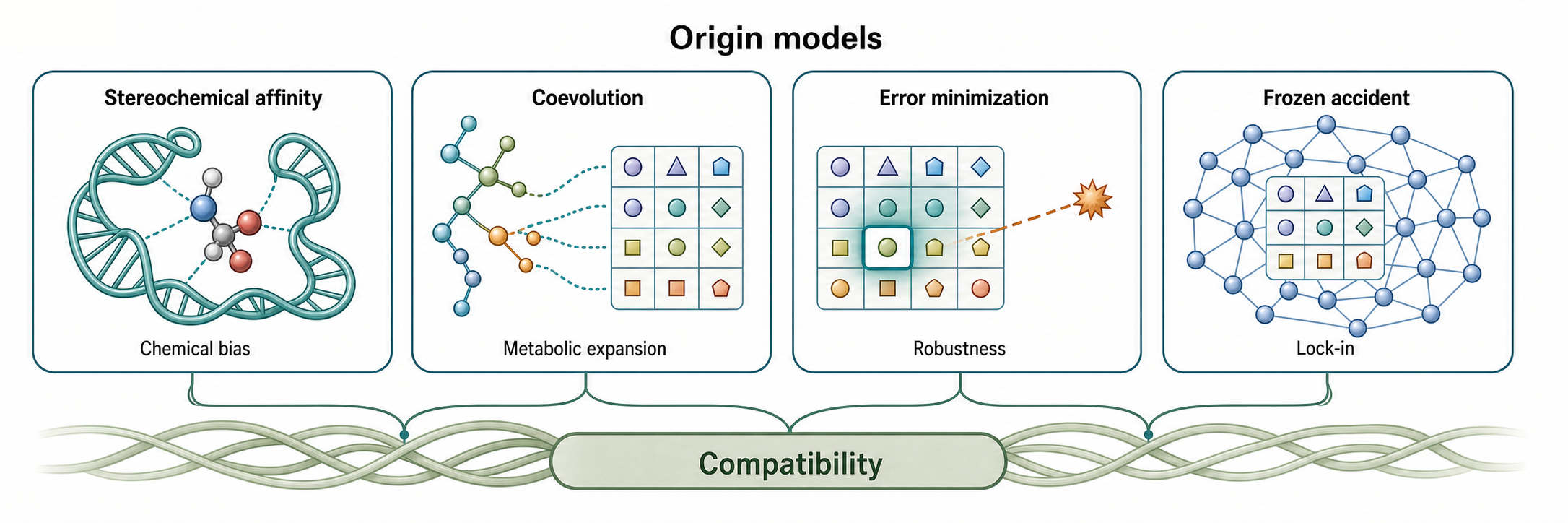
Figure 10.1. Genetic-Code Origin Model Families. The four major hypotheses for how codon–amino-acid assignments arose—stereochemical affinity, coevolution with amino-acid biosynthesis, error minimization, and frozen accident—each explain a different constraint on the genetic code. Stereochemical models propose that some assignments reflect direct chemical affinity between amino acids and RNA sequences; coevolutionary models link code expansion to metabolic evolution; error-minimization models attribute code organization to selection for robustness against mutation and mistranslation; and frozen-accident models explain near-universal conservation as the outcome of proteome-wide lock-in. These families are best understood as complementary explanations for different stages and properties of code evolution rather than mutually exclusive alternatives.
These model families are best treated as complementary constraints. Stereochemistry can provide local chemical biases. Coevolution can explain expansion with amino-acid availability and metabolism. Error minimization can explain selection for robustness. Frozen accident can explain conservation after widespread use. The unresolved task is to determine which mechanisms dominated at which stages and for which assignments.
Box 10.1. Why the Genetic Code Is Not Just a Table
The code table lists codon meanings, but codon meaning is implemented by a molecular system. A codon is read by an anticodon in a tRNA. The tRNA has already been charged with an amino acid by a synthetase. The ribosome checks codon-anticodon geometry and positions the attached amino acid in the peptidyl transferase center. Release factors compete for stop codons. tRNA modifications tune wobble pairing. Quality-control pathways respond when decoding fails. A code-origin model must therefore explain how a table-like mapping became embedded in this interacting system of molecules.
The code table lists codon meanings, but codon meaning is implemented by a molecular system. A codon is read by an anticodon in a tRNA. The tRNA has already been charged with an amino acid by a synthetase. The ribosome checks codon-anticodon geometry and places the attached amino acid into the peptidyl transferase center. Release factors compete for stop codons. tRNA modifications tune wobble. Quality-control pathways respond when decoding fails. A code-origin model must therefore explain how a table-like mapping became embedded in interacting molecules.
10.2. tRNA ancestry, aminoacylation, identity elements, and adaptor logic
tRNA is the adaptor molecule that makes the genetic code physically possible. The adaptor problem was recognized before the molecular identity of tRNA was fully clear: nucleic acids provide sequence information, but amino acids are chemically different monomers. A direct codon-amino acid interaction cannot generally explain the accurate incorporation of all amino acids into proteins. An adaptor solves the problem by having two functional surfaces. One surface is connected to the amino acid, and another surface reads the codon.
Modern tRNAs are small structured RNAs with a conserved architectural logic. In two-dimensional drawings, a tRNA has an acceptor stem, D arm, anticodon arm, variable region, and T arm. In three dimensions, the molecule folds into an L shape. One end of the L contains the acceptor stem and the 3′ CCA tail where the amino acid is attached. The other functional region contains the anticodon loop, which pairs with the mRNA codon in the ribosome. The physical separation of these regions is crucial: aminoacylation specificity is established before ribosomal decoding, while codon recognition occurs during translation.
Aminoacylation is the reaction that attaches an amino acid to a tRNA. In modern cells, aminoacyl-tRNA synthetases usually perform this reaction in two stages. First, the synthetase activates an amino acid with adenosine triphosphate (ATP), forming an aminoacyl-adenylate intermediate. Second, the enzyme transfers the amino acid to the 2′ or 3′ hydroxyl group of the terminal adenosine in the tRNA CCA end. The resulting aminoacyl-tRNA is an ester-linked molecule: the amino acid is attached to the tRNA in a high-energy form suitable for peptide-bond formation.
This chemistry explains a deep feature of translation. The ribosome does not normally inspect whether the amino acid attached to a tRNA is chemically correct. If a tRNA with a phenylalanine anticodon is mischarged with another amino acid, the ribosome will generally insert the attached amino acid at phenylalanine codons because the decoding center reads the anticodon. This is why aminoacylation is where the code chemical meaning is enforced. The synthetase system is not a peripheral accessory; it is one of the main molecular guardians of the code.
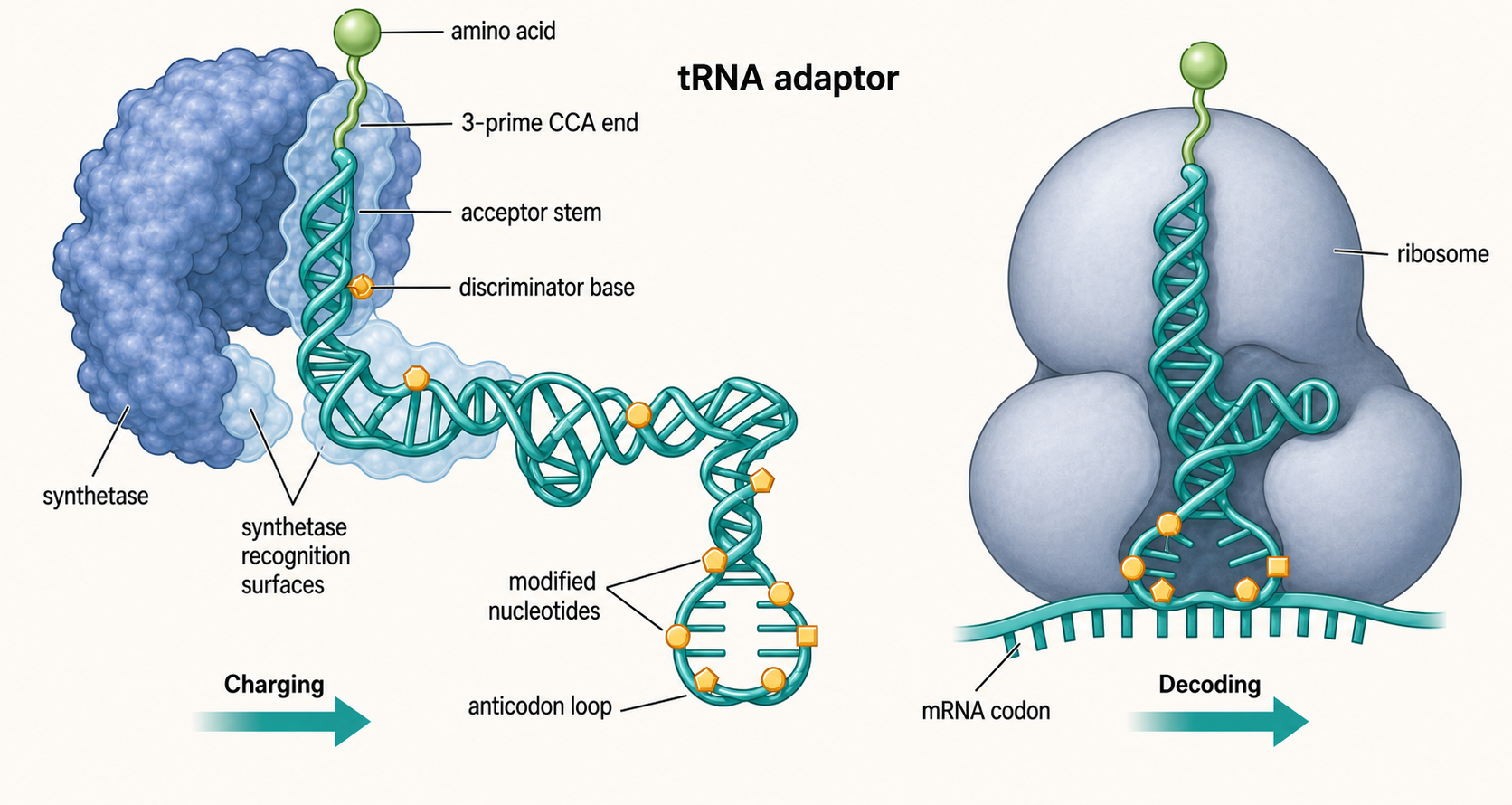
Figure 10.2. tRNA as an Adaptor. A tRNA adaptor bridges the nucleotide and amino-acid worlds through two physically separated functional surfaces: the 3′ CCA acceptor end, where an amino acid is esterified by an aminoacyl-tRNA synthetase, and the anticodon loop, which pairs with an mRNA codon in the ribosome. The acceptor stem, discriminator base, anticodon bases, and modified nucleotides collectively constitute the identity elements that allow each synthetase to recognize its cognate tRNA. Because the ribosome reads the anticodon rather than chemically verifying the attached amino acid, aminoacylation by the synthetase is the step at which the genetic code’s chemical meaning is enforced.
Table 10.2. tRNA Identity Elements. This table lists representative tRNA identity elements, their structural location, the molecular partner that recognizes them, their functional consequence for aminoacylation or decoding, and a brief example.
| Identity element | Location in tRNA | Recognized by | Effect on aminoacylation or decoding | Example or note |
|---|---|---|---|---|
| Acceptor-stem base pairs | Positions 1–7 of acceptor stem | Aminoacyl-tRNA synthetase | Dominant specificity determinant for many synthetases | G3:U70 pair in alanine tRNA; required for AlaRS charging |
| Discriminator base | Position 73, immediately 5′ of CCA | Aminoacyl-tRNA synthetase | Required for correct amino-acid attachment in many systems | A73 in alanine tRNA; G73 in histidine tRNA |
| Anticodon bases | Anticodon loop (positions 34–36) | Synthetase (some tRNAs) and ribosome decoding center | Determines codon recognition; major identity element for several synthetase families | Dominant for glutamine and cysteine tRNA charging |
| Modified nucleotides | Anticodon loop (especially position 34) and elsewhere | Ribosome decoding center; some synthetases | Tune wobble pairing; affect decoding accuracy and frame maintenance | mnm5s2U at position 34 expands wobble decoding in bacteria |
| Three-dimensional shape | Overall folded L-form | Class II synthetases and some class I synthetases | Contributes to discrimination against noncognate tRNAs | Shape-based recognition important for some multisubunit synthetases |
tRNA identity elements are the features that allow a synthetase to recognize its cognate tRNAs. Some identity elements are sequence positions, such as bases in the acceptor stem or the discriminator base immediately before the CCA tail. Some are anticodon bases. Some are modified nucleotides or shape features created by the folded tRNA. The set of identity elements differs among tRNA families and organisms. For some tRNAs, the anticodon is a major determinant of synthetase recognition. For others, acceptor-stem or tertiary-structure features dominate. This distributed recognition means that the anticodon determines the amino acid is an oversimplification.
Synthetase editing reinforces translation fidelity. Several amino acids are chemically similar enough that a synthetase can sometimes activate the wrong substrate. Editing domains or separate trans-editing factors hydrolyze incorrect aminoacyl-adenylates or mischarged tRNAs. This proofreading is not equally important for all synthetases, but its existence shows that the modern code is maintained by kinetic discrimination and quality control, not by perfect initial recognition. Drug studies that target aminoacylation also illustrate that charging chemistry is a vulnerable and specific point in translation.
tRNA ancestry models ask how such an adaptor could have evolved before modern tRNAs and synthetases existed. One family of models emphasizes an acceptor-stem minihelix. A minihelix is a shortened RNA corresponding roughly to the acceptor arm and T-arm-like region of tRNA. In this view, early aminoacylation may have involved small RNA helices that carried amino acids before anticodon-based decoding was fully developed. This is plausible because the acceptor stem contains many synthetase identity elements and because aminoacylation can be conceptually separated from anticodon reading. However, a minihelix model does not by itself explain how codon-directed translation emerged.
Another family of models proposes that modern tRNAs arose from ligation, duplication, or fusion of shorter hairpin RNAs. The internal symmetry of tRNA-like folds has encouraged the idea that a modern tRNA could descend from two related RNA hairpins, while minihelix and acceptor-stem studies show that smaller tRNA-like RNAs can carry aminoacylation-relevant identity information. Such models address structural ancestry: how a stable L-shaped adaptor might evolve from smaller RNAs. They do not automatically solve assignment specificity. A plausible origin scenario still needs a path from aminoacylated RNA fragments to a system in which anticodon-like elements control ordered peptide synthesis.
Modern tRNA modifications add another layer of caution. tRNAs are among the most heavily modified RNAs in cells. Modifications can stabilize tertiary structure, protect tRNAs from degradation, tune anticodon pairing, and prevent frameshifting or misreading. Suzuki review of tRNA modifications and disease relevance emphasizes how modifications affect decoding and cellular physiology. These modifications are not necessarily ancient in their modern forms, but they reveal that adaptor function is chemically tuned.
Modern aminoacylation can also be measured globally. For example, tRNA charging landscapes in plants show that aminoacylation is a regulated cellular state rather than a fixed property of the code table. Disease-associated RNA repeats can interfere with aminoacylation, as in studies of phenylalanine-tRNA aminoacylation compromised by C9orf72 repeat RNA. These are modern physiological examples, not origin evidence. Their pedagogical value is that they show how many layers must work correctly for adaptor logic to produce accurate proteins.
Box 10.2. tRNA Minihelix Models
A tRNA minihelix model proposes that the acceptor-stem region of tRNA is evolutionarily older than the full modern tRNA. The model is attractive because aminoacylation occurs at the acceptor end and several synthetases rely heavily on acceptor-stem identity elements. It remains incomplete unless connected to anticodon evolution, ribosome binding, and templated peptide synthesis. A minihelix could carry an amino acid, but ordered incorporation according to an RNA template requires additional molecular innovations beyond the minihelix itself.
A tRNA minihelix model proposes that the acceptor-stem region of tRNA is evolutionarily older than the full modern tRNA. The model is attractive because aminoacylation occurs at the acceptor end and because several synthetases recognize acceptor-stem features. The model is incomplete unless it is connected to anticodon evolution, ribosome binding, and peptide synthesis. A minihelix could carry an amino acid, but translation requires ordered incorporation according to an RNA template.
10.3. Ribosomal RNA, peptidyl transferase center, and ribosome ancestry
The ribosome is the molecular machine that makes coded peptide synthesis possible. Modern ribosomes have two subunits. The small subunit binds mRNA and monitors codon-anticodon pairing. The large subunit contains the peptidyl transferase center and the peptide exit tunnel. Both subunits are ribonucleoprotein assemblies, meaning that they contain RNA and protein. The evolutionary importance of the ribosome lies in the distribution of labor: proteins are abundant and important, but the core chemistry of peptide-bond formation is centered in rRNA.
Peptide-bond formation during elongation can be described in causal steps. An aminoacyl-tRNA enters the A site when its anticodon matches the mRNA codon. The growing peptide is attached to the tRNA in the P site. The peptidyl transferase center positions the amino group of the A-site amino acid near the ester linkage connecting the growing peptide to the P-site tRNA. The amino group attacks the carbonyl carbon of the peptidyl-tRNA ester, transferring the peptide to the A-site tRNA and extending the chain by one amino acid. After translocation, the newly formed peptidyl-tRNA moves to the P site and the deacylated tRNA exits.
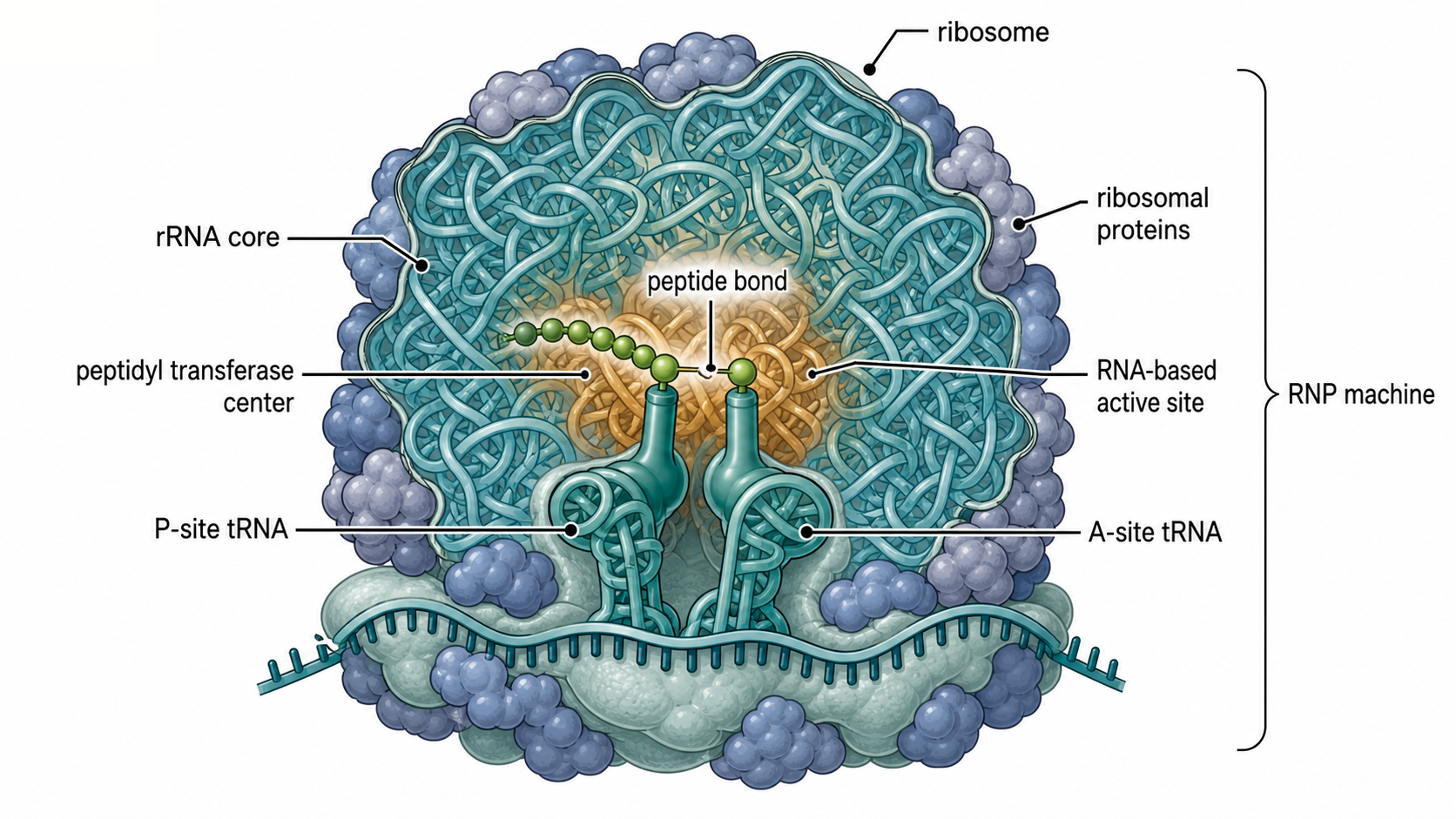
Figure 10.3. RNA Core of the Ribosome. The large ribosomal subunit contains an rRNA-based peptidyl transferase center where the growing polypeptide is transferred from the P-site tRNA to the aminoacyl-tRNA in the A site. The rRNA core surrounds the catalytic region, while ribosomal proteins are concentrated more peripherally, stabilizing and regulating the machine without directly catalyzing peptide-bond formation. The rRNA-based active site is the principal structural evidence that ancient RNA catalysis underlies modern translation.
The peptidyl transferase center is built from large-subunit rRNA. This fact is a cornerstone of RNA-world thinking because it shows that an RNA-based active site catalyzes the central reaction of protein synthesis. The ribosome is not a simple ribozyme in the same sense as a small self-splicing RNA. It is a large RNP machine whose activity depends on substrate positioning, metal ions, rRNA architecture, ribosomal proteins, translation factors, and dynamic motions. Still, the location of the catalytic center strongly supports ancient RNA involvement in translation.
The ribosome also has a decoding center, but decoding and peptide-bond formation occur in different subunits. The small subunit checks the geometry of codon-anticodon pairing, while the large subunit catalyzes peptide transfer. This division matters for origin models. An early peptide-forming RNA catalyst could, in principle, precede the modern coupling of mRNA decoding to peptide-bond formation. Conversely, an early templating system without efficient peptide-bond catalysis would not produce useful proteins. The origin of translation requires coupling these modules into a coordinated cycle.
Ribosome ancestry studies often focus on structural conservation. The most conserved parts of rRNA are candidates for ancient ribosomal cores, while expansion segments and lineage-specific proteins are usually interpreted as later additions. Accretion models propose that the ribosome grew by adding RNA and protein layers around an older core. These models are attractive because modern ribosome structures preserve nested patterns of conservation, but they remain models. Inferring order of assembly from modern structure requires assumptions about how molecules grow and how selection preserves or remodels old contacts.
Segmented and permuted rRNAs provide another line of evidence. Some organisms have rRNAs split into multiple segments, yet the segments assemble into functional ribosomes. Analysis of RNA-RNA interaction regions in segmented ribosomes can identify contacts that are robust to segmentation and may reflect ancient interaction modules. Such evidence does not directly show how the first ribosome arose, but it tests which rRNA interactions are structurally fundamental.
The relationship between tRNA maturation and ribosome evolution is also important. RNase P processes the 5′ leaders of precursor tRNAs, and tRNA maturation is required for modern translation. Recent work on coevolution of RNase P and the ribosome places tRNA processing and ribosome history in the same broader evolutionary frame. The key point is not that RNase P caused ribosome origin, but that ancient RNP systems involved in tRNA maturation and translation may have evolved under shared constraints.
Modern ribosome assembly should not be mistaken for ribosome origin. Eukaryotic ribosome assembly requires many assembly factors, nucleolar steps, rRNA processing events, modifications, export pathways, and quality-control checkpoints. Bacterial assembly is less compartmentalized but still carefully ordered and protein-assisted. These pathways are products of cellular evolution. They do, however, reveal constraints on rRNA folding, subunit construction, modification placement, and error avoidance.
Termination chemistry illustrates the versatility of the ribosomal catalytic center. At a stop codon, release factors promote hydrolysis of the peptidyl-tRNA bond rather than transfer of the peptide to another amino acid. Recent mechanistic work on release factor-mediated peptidyl-tRNA hydrolysis shows how protein factors use the ribosomal active site to switch from elongation chemistry to termination chemistry. This modern mechanism is not an origin model, but it demonstrates how the RNA catalytic center of the ribosome is controlled by protein factors and decoding states.
10.4. Wobble, codon capture, ambiguity, and code expansion
The standard code has more codons than amino acids. This degeneracy creates the need for decoding strategies that are accurate but not wasteful. Wobble pairing is one such strategy. In wobble, the first position of the anticodon can pair flexibly with the third position of the codon. This allows one tRNA to decode more than one synonymous codon. For example, a tRNA with a suitable wobble-position nucleotide may read two or more codons that differ at the third position.
Wobble is not loose or uncontrolled pairing. The ribosome constrains codon-anticodon geometry, and modified nucleotides in the anticodon loop tune which pairings are allowed. Some modifications expand decoding capacity; others restrict mispairing and preserve accuracy. Defects in wobble modifications can alter translation speed, increase ribosome pausing or collisions, and activate quality-control responses. Thus, wobble is best understood as regulated flexibility.
Codon reassignment is a change in the meaning of a codon. Two major models are codon capture and ambiguous intermediates. In codon capture, a codon becomes rare or disappears from a genome. Because the codon is no longer used, the original tRNA or release-factor function can be lost without strong cost. Later, if the codon reappears, it can be captured by a different tRNA or decoding factor. This model is especially plausible in small genomes with biased nucleotide composition, such as many mitochondria.
In an ambiguous-intermediate model, a codon is decoded in two ways for a period of evolutionary time. A new tRNA, altered release factor, or changed modification state allows a codon to specify either its old meaning or a new meaning. If the ambiguous state is tolerable, selection can then favor genomic changes that reduce harmful ambiguity, eventually fixing the new assignment. This model explains how reassignment can occur without requiring complete codon disappearance first. Its weakness is that ambiguity can be costly, especially in large proteomes.
Natural code expansion shows that the code can incorporate additional amino acids under special conditions. Selenocysteine is inserted at certain UGA codons using specialized RNA signals and factors. Pyrrolysine can be inserted at UAG or TAG codons in some organisms using a dedicated tRNA and synthetase. A recent archaeal example in which TAG codons are assigned to pyrrolysine demonstrates that stop-codon reassignment can become a lineage-wide coding feature rather than a rare exception. Such cases show code flexibility while also highlighting the required molecular infrastructure.
Engineered expansion systems make the same lesson experimentally visible. Orthogonal tRNA-synthetase pairs can be introduced so that a reassigned stop codon incorporates a nonstandard amino acid. Quadruplet codons can increase coding capacity by using four-nucleotide decoding units. Recoded genomes can remove a codon from normal use and then reassign it. Programmable pseudouridine editing has recently been used to alter RNA codon decoding and expand coding capacity. These systems are powerful tools for synthetic biology, but they are not direct evidence for how the original code evolved.
Modern codon use also affects mRNA fate and cellular regulation. tRNA wobble modification can cooperate with growth-signaling pathways such as mTORC1 to support protein synthesis capacity. Suboptimal codon pairs can trigger ribosome collisions and quality-control pathways in tRNA modification mutants. Specific tRNAs can promote mRNA decay by recruiting the CCR4-NOT complex to translating ribosomes. These findings belong mainly to modern regulatory biology, but they warn against treating codons as abstract symbols independent of cellular physiology.
Box 10.3. Near-Universal Does Not Mean Universal
The standard genetic code is shared across cellular life so broadly that it must predate the diversification of modern lineages, yet it is not used without exception. Mitochondrial codes, some microbial codes, selenocysteine at UGA, pyrrolysine at UAG in some archaea, suppressor tRNAs, and engineered recoding all depart from the standard table. These departures do not make the code arbitrary. Each requires compatible tRNAs, synthetases, and release factors, together with appropriate codon distributions and a proteome tolerant of the changed amino-acid assignments.
The standard code is shared so widely that it must reflect deep common ancestry, but it is not used without exception. Mitochondrial codes, some microbial codes, selenocysteine insertion, pyrrolysine insertion, suppressor tRNAs, and engineered recoding all show departures from the simple table. These departures do not make the code arbitrary. They show that reassignment requires compatible tRNAs, synthetases, release factors, codon distributions, and proteome tolerance.
10.5. Comparative evidence from modern translation systems
Comparative evidence is the main way modern biology constrains ancient translation. The deepest fact is that bacteria, archaea, and eukaryotes all use ribosomes, tRNAs, aminoacyl-tRNA synthetases, mRNA templates, elongation factors, and related decoding logic. This shared architecture strongly suggests that a sophisticated translation system existed before the last universal common ancestor. The shared system was not identical to any modern system, but it was already far beyond a simple RNA-world ribozyme.
The similarities among translation systems identify ancient constraints. All cellular ribosomes use rRNA-rich cores. All cellular translation uses aminoacyl-tRNAs as substrates. All cellular systems must solve initiation, elongation, termination, recycling, and quality control. All cellular systems must maintain tRNA pools and synthetase specificity. These shared requirements support the view that adaptor-based translation and ribosomal peptide synthesis were already integrated early in cellular evolution.
The differences among translation systems are equally informative. Bacteria often couple transcription and translation because both occur in the same compartment; a ribosome can begin translating an mRNA while RNA polymerase is still transcribing it. Eukaryotes separate transcription and translation with the nuclear envelope and use capping, splicing, polyadenylation, export, scanning, and surveillance before most mRNAs are translated. Archaea combine bacterial-like and eukaryote-like features in ways that illuminate ancient translation factors and information-processing systems. Mitochondria and chloroplasts show how ribosomes and codes can change in reduced or specialized genomes.
Table 10.3. Translation Features Used in Comparative Evolution. This table compares key translation system features across bacteria, archaea, eukaryotes, and organelles, with the evolutionary interpretation that each comparison supports.
| Feature | Bacteria | Archaea | Eukaryotes | Organelles | Evolutionary interpretation |
|---|---|---|---|---|---|
| Ribosome size and composition | 70S; rRNA-rich core | 70S-like; rRNA-rich core | 80S; rRNA-rich, more proteins | 70S (mitochondria and chloroplasts) | Shared rRNA-based core predates LUCA; protein accretion is lineage-specific |
| Transcription–translation coupling | Coupled in cytoplasm | Partial coupling | Decoupled by nuclear envelope | Decoupled from nuclear transcription | Nuclear compartmentalization drove decoupling in eukaryotes |
| Translation initiation mechanism | Shine–Dalgarno / fMet-tRNA | Leaderless or Shine-Dalgarno-like; some eukaryotic-type factors | Cap-dependent scanning; eIF2–GTP complex | Bacterial-type (organellar genomes) | Eukaryote scanning mechanism is derived; archaea share some initiation factors with eukaryotes |
| Genetic code deviations | Rare; selenocysteine at UGA | Pyrrolysine at UAG; archaeal codon variants | Rare in cytoplasm; selenocysteine | Variant mitochondrial codes common | Genome reduction and small proteomes relax the constraint against code change |
| tRNA supply | Genomically encoded | Genomically encoded | Genomically encoded; organellar import | Import from cytoplasm (mitochondria); genomically encoded (chloroplasts) | Import evolved after genome reduction removed organellar tRNA genes |
| Peptidyl transferase center chemistry | rRNA-based | rRNA-based | rRNA-based | rRNA-based | Universal rRNA active site is the strongest evidence for ancestral RNA-based peptide-bond catalysis |
Organellar translation is a particularly useful boundary case. Mitochondria and chloroplasts descend from bacteria, but their translation systems have changed under genome reduction, altered tRNA import, organelle-specific ribosomal proteins, and changed codon usage. Some mitochondria use variant genetic codes. These systems show that translation can evolve substantially after endosymbiosis, while still preserving the basic adaptor and ribosome logic. They also caution against assuming that a simplified modern system is primitive. Simplification can be derived.
Viruses provide another boundary case. Most viruses do not encode complete translation systems and instead rely on host ribosomes. Viral RNAs can manipulate initiation, recoding, frameshifting, readthrough, RNA structure, and host codon use, but viruses generally do not preserve independent ancient translation systems. Viral examples are therefore useful for studying decoding flexibility and host dependence, not for reconstructing a separate origin of the ribosome.
Table 10.4. Modern Code Flexibility. This table distinguishes natural and engineered mechanisms of codon-meaning change or expansion, summarizing molecular requirements, biological consequences, and cautions for origin-model inference.
| Mechanism | Natural or engineered | Molecular requirement | Biological consequence | Origin-model caution |
|---|---|---|---|---|
| Codon capture | Natural | Codon disappearance from genome; new tRNA or altered release factor | Codon reused with new amino-acid or stop meaning | Requires special conditions such as biased genome composition and small proteome; not freely generalizable |
| Ambiguous intermediate | Natural | Transient dual decoding by competing tRNA and release factor | Temporary proteome heterogeneity; resolved by further mutation | Costly ambiguity phase limits applicability in large proteomes |
| Pyrrolysine at UAG | Natural | pylT tRNA, PylRS synthetase, pyrrolysine-insertion signals | UAG encodes pyrrolysine genome-wide in some methanogens and archaea | Shows stop-codon reassignment is possible but requires full compatible infrastructure |
| Selenocysteine at UGA | Natural | SECIS RNA element, SelB elongation factor, dedicated tRNA | UGA encodes selenocysteine in a context-dependent manner | Context-dependent; not a wholesale codon reassignment |
| Orthogonal tRNA–synthetase pair | Engineered | Orthogonal tRNA and cognate synthetase; host codon removal from essential genes | Nonstandard amino acid incorporated at reassigned stop codon | Maps constraint landscape of translation; does not recapitulate ancient code origin |
| Programmable pseudouridine editing | Engineered | Site-directed mRNA pseudouridylation; compatible decoding tRNA | Altered codon decoding and expanded amino-acid incorporation | RNA-level flexibility demonstrated; no natural evolutionary parallel currently known |
Modern experimental methods can test translation mechanisms but have limits for origin inference. Ribosome profiling sequences ribosome-protected mRNA fragments and can reveal translated regions, codon-level pausing, ribosome collisions, and responses to perturbation. Structural biology can visualize ribosome states, tRNA positions, and release-factor mechanisms. Comparative genomics can identify conserved proteins, RNAs, motifs, and code variants. Biochemistry can reconstitute charging, decoding, peptide-bond formation, and editing. None of these methods directly observes ancient translation. Their strength is greatest when independent evidence classes converge.
Comparative inference is vulnerable to several artifacts. Conservation can reflect functional constraint without preserving the original state. Loss can mimic primitiveness. Horizontal gene transfer can obscure phylogenetic patterns. Modern organisms have lineage-specific adaptations that can be mistaken for ancient features. In vitro reconstitution can show that a reaction is possible, but possibility is not the same as historical occurrence. A rigorous origin argument should separate observation, mechanism, inference, and speculation.
Box 10.4. Comparative Evidence Is Not a Time Machine
Modern translation systems preserve clues about ancient biology, but they are not frozen snapshots of the earliest cells. Strong evolutionary inference usually requires convergence among several independent evidence classes: conserved sequence, conserved structure, conserved catalytic mechanism, broad phylogenetic distribution, and functional necessity. A single conserved feature may be ancient, but it may also be maintained by modern functional constraint, acquired by horizontal transfer, derived by simplification, or convergently stabilized by selection.
Modern translation systems preserve clues about ancient biology, but they are not frozen snapshots. Strong evolutionary inference usually requires agreement among several evidence classes: conserved sequence, conserved structure, conserved mechanism, broad phylogenetic distribution, and functional necessity. A single conserved feature may be ancient, but it may also be constrained, transferred, simplified, or convergently stabilized.
Biological Contexts Across Translation Systems
In bacteria, translation is closely integrated with transcription, RNA folding, and mRNA decay. Ribosomes can load onto nascent transcripts, and translation can influence whether an mRNA is protected or degraded. This context matters because bacterial translation shows how decoding, RNA structure, and transcript fate are physically coupled in one compartment. It also illustrates why early translation may have evolved in a setting where RNA synthesis, RNA folding, and peptide synthesis were not cleanly separated.
In archaea, translation shares the basic bacterial-like organization of cytoplasmic ribosomes but includes information-processing features related to eukaryotic systems. Archaeal biology is important for deep evolutionary comparison because archaea are not simply intermediates between bacteria and eukaryotes. They are a separate domain with their own derived features and conserved molecular machinery. Archaeal pyrrolysine systems and code variants are especially useful for thinking about codon reassignment and expansion.
In eukaryotes, translation operates after extensive mRNA processing. Nuclear transcription, splicing, export, cytoplasmic initiation, elongation, termination, decay, and quality control are connected but compartmentalized. This does not make eukaryotic translation less relevant to code evolution; rather, it shows how the ancient core has been embedded in a larger regulatory system. Eukaryotic ribosome assembly, for example, demonstrates the cellular cost of building and checking a highly complex RNP machine.
In organelles, translation shows both conservation and plasticity. Mitochondrial ribosomes can have unusual RNA-protein compositions, mitochondrial genomes can use variant codes, and tRNA availability can be shaped by import or reduced gene sets. Chloroplast translation retains stronger bacterial resemblance in many respects but is integrated with photosynthetic gene regulation and nucleus-encoded factors. These examples show that the translation system can be remodeled in specialized cellular compartments while preserving adaptor-based decoding.
In engineered cells and cell-free systems, researchers can perturb translation more deliberately than natural evolution usually allows. Orthogonal synthetases, synthetic tRNAs, stop-codon suppression, genome recoding, and RNA-editing-based codon expansion reveal which molecular changes are tolerated and which create bottlenecks. The evolutionary lesson is indirect: engineered systems map the constraint landscape of translation, but historical origin still requires independent evidence.
Technology, Computational, and Engineering Links
The evolution of the genetic code is not only a historical topic. It directly informs modern biotechnology. Genetic-code expansion uses the same modular logic that origin models analyze: a codon or codon-like signal, a tRNA adaptor, a charging enzyme, ribosomal acceptance, and cellular tolerance. If any module fails, the new assignment fails. This is why nonstandard amino-acid incorporation is often engineered as an orthogonal pair: the introduced tRNA and synthetase should interact with each other but minimally cross-react with host tRNAs and synthetases.
Synthetic recoding also depends on codon usage. A codon can be reassigned more easily if it is rare or removed from essential genes. This resembles codon-capture logic, but engineered recoding is planned and experimentally controlled rather than historical. Recoded organisms can be used for biocontainment, resistance to viral infection, or production of proteins with nonstandard amino acids. The same experiments expose the burden of reassignment: release factors, suppressor efficiency, tRNA abundance, mRNA sequence context, and protein function all matter.
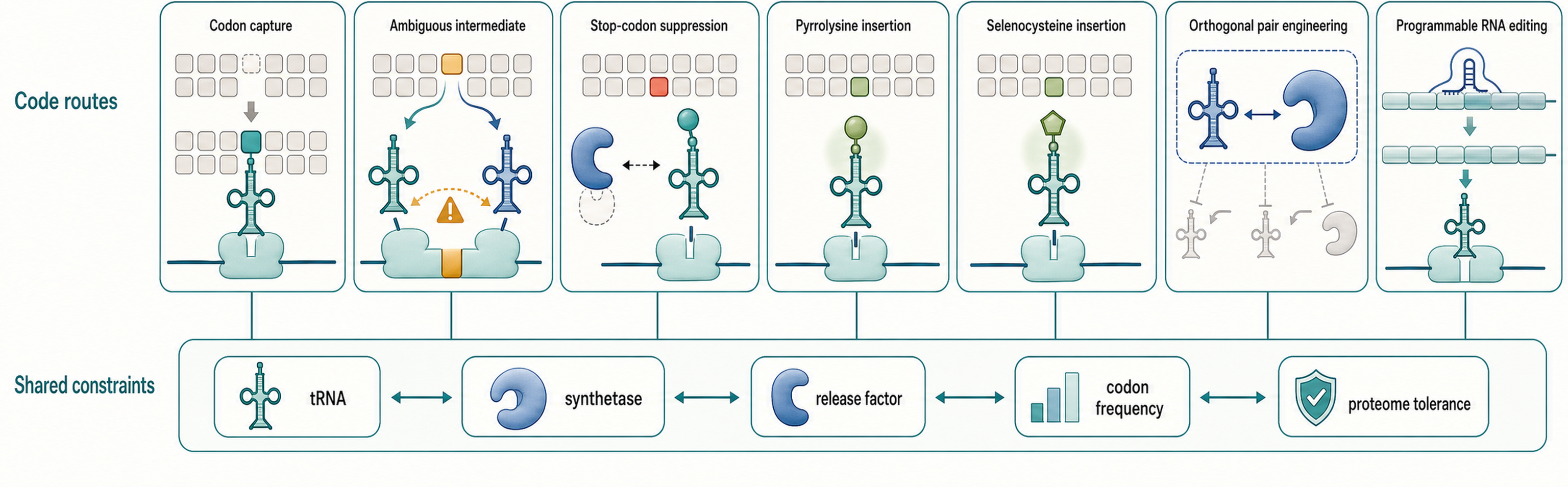
Figure 10.4. Code Reassignment and Expansion Routes. Codon meaning can change through several mechanistically distinct routes: in codon capture, a codon disappears from use and is later reassigned by a new tRNA or altered decoding factor; in the ambiguous-intermediate model, a codon is transiently decoded two ways before one assignment is fixed by further selection. Natural expansions include pyrrolysine insertion at UAG codons in archaeal methanogens, selenocysteine at context-dependent UGA codons, and pseudouridine-editing-based codon reprogramming demonstrated in engineered cells. All routes are constrained by the need for a compatible tRNA, synthetase, and release factor, together with suitable codon frequency and proteome tolerance of any changed amino-acid assignments.
Computational studies of code evolution evaluate questions that experiments cannot fully reproduce. Models can compare the standard code with random alternative codes, quantify error minimization, simulate codon reassignment routes, or infer phylogenetic distributions of variant codes. These approaches are useful when their assumptions are explicit. A simulation that shows the standard code is unusually error-minimizing does not prove how the code evolved; it establishes a property that evolutionary explanations should address.
Ribosome profiling and related translation measurements connect codon use to modern physiology. These methods can identify codon-associated pausing, elongation defects, ribosome collisions, and responses to tRNA modification loss. They are especially useful for testing how changes in tRNA pools or wobble modifications affect decoding. Their limitation is that ribosome-protected fragments are indirect readouts that require careful control for nuclease bias, mapping ambiguity, translation inhibitors, and mRNA abundance.
Recent Consensus
The current consensus is not a single origin narrative. It is a set of constrained conclusions. First, the standard genetic code is highly conserved because it was already deeply embedded before the diversification of modern cellular lineages. Second, the code has properties, including degeneracy and partial error minimization, that require explanation but do not uniquely identify one origin mechanism. Third, stereochemical, coevolutionary, error-minimizing, and frozen-accident explanations can be partly compatible.
There is strong agreement that tRNAs are the central adaptors of modern translation. Their two-ended logic, with aminoacylation at the acceptor end and decoding through the anticodon, explains how nucleotide sequence specifies amino-acid sequence. There is also strong agreement that synthetases maintain code assignments by reading distributed tRNA identity elements and, in many cases, editing mistakes.
There is strong agreement that the ribosomal peptidyl transferase center is RNA-based and that this supports ancient RNA involvement in peptide-bond formation. There is less agreement about the exact sequence of ribosome origin: whether peptide synthesis began with small aminoacylated RNAs, with a proto-peptidyl-transferase RNA, with RNA-peptide coevolution, or with other intermediate systems.
There is broad agreement that the code is near-universal rather than absolutely universal. Natural reassignments, organellar variants, pyrrolysine, selenocysteine, and engineered expansions show that codon meaning can change. There is also agreement that such change is constrained by the surrounding translation system.
Finally, there is growing consensus that modern codon effects cannot be reduced to amino-acid identity. Wobble modifications, tRNA pools, codon-pair effects, ribosome collisions, and mRNA decay pathways show that codons also affect translation dynamics and RNA fate. These modern regulatory findings are not direct origin evidence, but they clarify the molecular complexity that code evolution eventually produced.
Open Questions, Controversies, Deprecated Models, and Common Misconceptions
Open questions:
- How many amino acids were used in the earliest coded peptides?
- Did the first assignments involve direct RNA-amino-acid affinity, metabolic availability, primitive adaptors, or some combination?
- Did acceptor-stem minihelices precede full tRNAs?
- How did aminoacylation specificity work before modern protein synthetases?
- How did codon-directed decoding become physically coupled to RNA-catalyzed peptide-bond formation?
- How much of standard code error minimization reflects selection, chemical bias, biosynthetic expansion, or contingency?
Controversies:
- One controversy concerns the strength of stereochemical evidence. Supporters argue that codon-like or anticodon-like sequences in amino-acid-binding RNAs suggest a chemical basis for assignments. Critics note that the evidence is uneven across amino acids and that aptamer selection experiments do not recreate early Earth conditions. The productive middle position is to treat stereochemistry as plausible for some assignments but insufficient as a full explanation until stronger evidence is available.
- A second controversy concerns the reconstruction of ribosome ancestry. Accretion models can order ribosomal features from older cores to newer additions, but different assumptions can produce different histories. Conserved rRNA cores are powerful evidence for deep ancestry, yet they do not reveal every intermediate. Models that describe the ribosome as a direct fossil of the RNA world should be qualified: the modern ribosome is ancient in core architecture but heavily evolved.
- A third controversy concerns the meaning of code variants. Code variants prove that codon assignments can change, but they do not prove that early code evolution was easy or unconstrained. Most known variants occur under special genomic or cellular conditions, such as organellar genome reduction, altered release factors, codon disappearance, or specialized tRNA-synthetase systems. The existence of variants should be used to study mechanisms of reassignment, not to dismiss the evolutionary stability of the code.
Common misconceptions:
- “The genetic code is universal without exceptions.” The code is near-universal, but natural variants and specialized expansions exist.
- “The anticodon alone determines which amino acid a tRNA carries.” Aminoacylation depends on distributed tRNA identity elements and synthetase recognition.
- “The ribosome is a protein enzyme.” The modern ribosome is an RNP machine, and its peptidyl transferase center is rRNA-based.
- “Wobble means inaccurate decoding.” Wobble is regulated flexibility, often controlled by modified nucleotides and ribosomal geometry.
- “Engineered code expansion recapitulates ancient code evolution.” Engineered systems reveal constraints and possibilities, but they are designed interventions in modern cells.
- “Conservation alone proves evolutionary order.” Conservation supports deep importance, but order of origin requires additional structural, biochemical, and phylogenetic evidence.