Chapter 65. RNA Inverse Folding, Sequence Design, and Programmable RNA Architecture
Scope Note
This chapter explains how RNA sequences are designed to adopt desired structures, regulate molecular processes, encode therapeutic or experimental functions, and assemble programmable architectures. The chapter treats inverse folding as one part of a broader design problem that also includes function, kinetics, manufacturing, immune sensing, delivery, and experimental validation.
Executive Summary
RNA inverse folding is the problem of finding one or more RNA sequences that are predicted to fold into a specified structure. The phrase is useful but narrow. Practical RNA design rarely asks only whether a sequence has a chosen minimum-free-energy secondary structure. A useful design must satisfy a collection of constraints: the target fold should be thermodynamically favored or kinetically reachable; undesired folds should be disfavored; conserved sequence motifs, protein-binding sites, ligand-binding pockets, coding potential, chemical modifications, and manufacturing requirements may need to remain intact; and the RNA must function in the physical and biological context where it will be used. In this broader sense, RNA design is a multi-objective engineering problem.
Design objectives differ by RNA class. A riboswitch or synthetic aptamer device must link ligand binding to a conformational or expression change. A CRISPR single-guide RNA must position a spacer sequence for target recognition while retaining scaffold structures that recruit the nuclease. A small interfering RNA must load into Argonaute, pair productively with a target, avoid dangerous off-target seed effects, and remain compatible with chemical stabilization and delivery. A synthetic messenger RNA must encode a protein while optimizing untranslated regions, codon usage, secondary structure, cap and tail features, stability, translation, immunogenicity, and manufacturability. RNA origami and programmable RNA architectures place an additional burden on long-range assembly: a design must create a defined nanoscale object, not merely a local hairpin.
Several design strategies recur across these applications. First, the designer specifies constraints at multiple levels: sequence, secondary structure, tertiary motifs, interaction sites, ensemble properties, kinetics, and biological readouts. Second, the design algorithm searches a very large sequence space using dynamic programming, local stochastic moves, constraint programming, genetic algorithms, Pareto optimization, or learned generative models. Third, promising designs are filtered for failure modes that prediction tools often miss, including pseudoknots, metal-ion-dependent tertiary contacts, co-transcriptional traps, cellular RNA-binding proteins, innate immune sensing, nuclease susceptibility, synthesis artifacts, and assay-specific biases. Fourth, experimental validation is treated as part of the design loop. Chemical probing, binding measurements, enzymatic assays, reporter systems, sequencing screens, protein expression assays, and cellular phenotyping identify both successful designs and informative failures.
Recent consensus is that RNA design has become reliable for many local secondary-structure tasks and some modular architectures, but remains difficult for context-dependent biological function. Machine learning and active learning can improve design when high-quality experimental data connect sequence to function, but they do not remove the need for mechanistic constraints, negative controls, and validation outside the training distribution. The most robust RNA design workflows combine physical modeling, empirical design rules, high-throughput testing, and explicit failure analysis.
Concept Inventory
- Inverse folding: the computational task of finding a sequence that is predicted to adopt a target fold, usually a secondary structure. Boundary case: a sequence that has the desired minimum-free-energy fold may still fail if the correct functional ensemble, kinetics, tertiary contacts, or cellular interactions are absent.
- Design objective: the property to optimize, such as structural match, folding free energy gap, ligand response, protein expression, knockdown potency, nuclease recruitment, assembly yield, or low immunogenicity.
- Design constraint: a required property that narrows the sequence space, such as fixed nucleotides, forbidden motifs, codon choices, GC-content range, chemical modification compatibility, scaffold conservation, or avoidance of off-target complementarity.
- Ensemble design: design against a distribution of structures rather than a single structure. This matters when function depends on populations, switching, or avoidance of off-pathway folds.
- Multi-state design: design of one sequence whose fold or interactions change between two or more states, such as ligand-free and ligand-bound riboswitch conformations.
- Kinetic design: design that accounts for folding pathways and rates, including co-transcriptional folding as the RNA emerges from RNA polymerase.
- Programmable RNA architecture: an RNA molecule or complex whose sequence is intentionally specified to build a structure, recognize a target, regulate a process, or assemble a material.
- Manufacturability: the practical compatibility of a designed RNA with synthesis, purification, storage, delivery, and quality control.
- Active learning: an iterative design strategy in which a model proposes experiments, the resulting data update the model, and the next experimental round is chosen to improve performance or uncertainty.
What to Know Before Reading This Chapter
This chapter assumes familiarity with RNA base pairing, secondary-structure notation, free energy, partition functions, and folding ensembles from Chapter 3 and CH1004. A secondary structure is the set of intramolecular base pairs usually represented as stems, loops, bulges, and junctions; it is an abstraction that does not fully specify three-dimensional shape. A minimum-free-energy structure is the structure predicted by a thermodynamic model to have the lowest free energy under specified assumptions. A folding ensemble is the population of structures that can be occupied, weighted by their free energies and by kinetic accessibility.
The main running examples are a synthetic riboswitch, a CRISPR single-guide RNA, a small interfering RNA, a synthetic mRNA vaccine sequence, and an RNA origami scaffold. These examples differ in size and purpose, but each illustrates the same core design logic: specify a desired behavior, translate that behavior into molecular constraints, search sequence space, predict failure modes, test experimentally, and revise the design.
Readers should also keep one caution in mind. The word “designed” does not mean “fully understood” or “guaranteed to work.” RNA design tools often optimize simplified objectives. A design may be successful by one computational metric and unsuccessful in a biological assay because the assay measures a different property.
65.1. Inverse folding objectives and design constraints
RNA inverse folding begins with a reversal of the usual folding question. In forward folding, the input is an RNA sequence and the output is a predicted structure or ensemble. In inverse folding, the input is a desired structure and the output is a sequence predicted to form that structure. A common target is a dot-bracket secondary structure, where paired positions are marked by matching parentheses and unpaired positions by dots. The simplest success criterion asks whether a candidate sequence has the target as its predicted minimum-free-energy structure.
Table 65.1. RNA Design Classes and Constraints. RNA design classes differ in what can be freely programmed and what must be preserved. The table compares programmable elements, outputs, and structural, biological, and validation requirements across common design problems.
| RNA class | Main programmable element | Core output | Structural constraints | Biological constraints | Major failure modes | Useful validation assays |
|---|---|---|---|---|---|---|
| Riboswitch | Aptamer domain linked to expression platform | Ligand-responsive gene regulation | Aptamer fold, expression-platform helix, energy gap between states | Endogenous ligand concentration, transcription timing, ribosome access | Insufficient switching range, constitutively locked state, cotranscriptional misfolding | Transcription termination assay, translation reporter, ligand titration, chemical probing |
| Aptamer biosensor | Binding-pocket sequence and signal transduction module | Target detection or regulated binding | Binding-pocket geometry, junction to reporter element | Nuclease stability, target specificity, matrix effects | Weak affinity, poor selectivity, signal not transduced to output | Binding kinetics assay, competition assay, specificity panel |
| CRISPR guide RNA | Spacer sequence (~20 nt) | On-target genome editing | Scaffold integrity, spacer–scaffold junction | Off-target sites, chromatin accessibility, PAM compatibility | Low on-target efficiency, high off-target editing, scaffold disruption | Indel frequency assay, off-target deep sequencing, cell viability |
| siRNA | Guide strand complementary to target | Target mRNA knockdown | Duplex asymmetry for guide-strand loading, seed region context | Argonaute loading, nuclease stability, innate immune avoidance | Poor strand selection, seed-mediated off-target effects, immune activation | Target knockdown by qRT-PCR, transcriptome off-target profiling, cytokine assay |
| Synthetic mRNA | Coding sequence, UTRs, cap, poly(A) tail | Protein expression | Avoid structure at start codon, stable UTR architecture | Codon optimality, innate immune sensing, delivery compatibility, manufacturability | Low translation, innate immune activation, instability, poor delivery | Protein expression assay, RNA integrity analysis, immune activation panel |
| RNA origami or nanostructure | Modular kissing loops, helical junctions, tile sequences | Defined nanoscale assembly | Long-range helix geometry, junction angles, assembly stoichiometry | Metal-ion dependence, nuclease susceptibility, cellular delivery | Incomplete assembly, misfolded module nucleates aggregates | Native gel electrophoresis, atomic force microscopy, cryo-EM |
That simple criterion is rarely enough. A target structure may be the lowest-energy predicted structure but only slightly more stable than many alternatives. In that case, a substantial fraction of molecules may occupy competing folds. A designer therefore often evaluates the energy gap between the target and near alternatives, the base-pairing probability of each desired helix, the probability that forbidden pairs occur, and the sensitivity of the fold to salt, temperature, sequence variants, and chemical modifications. Partition-function methods, discussed in Chapter 3, are important because they turn the design problem from “does the best predicted structure match?” into “how strongly does the ensemble support the intended structure?”
Box 65.1. Predicted Fold Is Not Function
A designed RNA can satisfy a target-fold score but still fail because the target ensemble is weak, the folding pathway is wrong, a required tertiary contact is missing, a protein remodels the RNA in the cellular environment, a manufacturing impurity changes the assay outcome, or the biological endpoint depends on delivery rather than folding alone.
Constraints enter at several scales. Sequence constraints fix or restrict particular positions. A ribozyme may require catalytic nucleotides; a telomerase RNA may require an alignment region, template boundary elements, and protein-binding motifs; a CRISPR guide RNA must preserve the guide spacer and the nuclease-binding scaffold; an mRNA must encode a specified amino-acid sequence. Structure constraints require or forbid base pairs. Composition constraints set ranges for GC content, homopolymer runs, dinucleotide frequencies, or repeats that complicate synthesis. Biological constraints include avoidance of immunostimulatory motifs, unwanted microRNA seed matches, cryptic splice sites, premature polyadenylation signals, ribosome stalling motifs, and off-target hybridization.
The search space explains why inverse folding is computationally nontrivial. A 100-nucleotide RNA has four to the power of 100 possible sequences before constraints are applied. Algorithms therefore use heuristics or exact formulations that exploit structure. Constraint-programming approaches such as RNAiFOLD frame the problem as satisfying a set of sequence and folding constraints, which can be powerful when the designer can state hard requirements (Garcia-Martin et al., 2013). Genetic algorithms and stochastic search methods mutate and recombine candidate sequences while scoring the candidates by structure and auxiliary objectives (Ganjtabesh et al., 2013). Multi-objective methods treat design as a Pareto problem, where no single sequence may be best for all criteria at once (Gu et al., 2024; Ward et al., 2023).
The practical design objective should be written in the language of the experiment. A design objective for an aptamer is not “make this hairpin”; it is “bind this ligand with a useful affinity and selectivity under the assay or cellular conditions.” A design objective for an mRNA vaccine is not “maximize predicted stability”; it is “produce sufficient antigen for the desired immune response while remaining manufacturable, deliverable, tolerable, and safe.” This distinction matters because secondary structure can be a proxy for function, a competing influence on function, or a nuisance variable depending on the application.
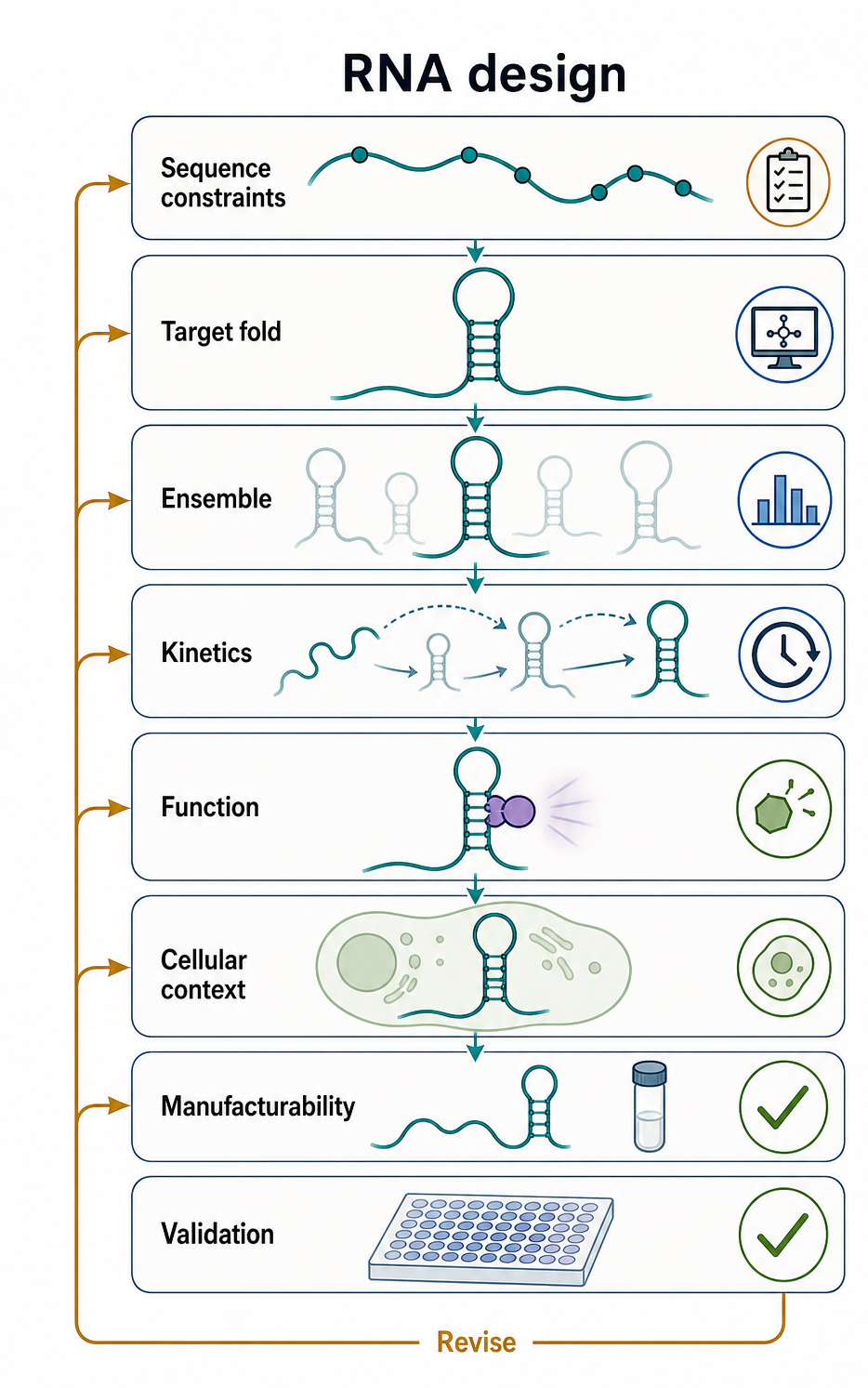
Figure 65.1. Objective Stack for RNA Design. RNA inverse folding is one layer in a larger design stack. A target sequence must satisfy fixed sequence constraints, desired base pairs, ensemble properties, kinetic accessibility, biochemical function, cellular context, manufacturability, and validation criteria. The figure shows these layers as a vertical stack feeding into an experimental design loop, making clear that satisfying a secondary-structure objective is necessary but not sufficient for functional RNA engineering.
Evidence for inverse-folding methods comes from benchmark prediction studies, designed RNAs tested in vitro, and applied examples. The yeast telomerase RNA design study by Lebo and Zappulla used inverse-folding logic to alter a natural functional RNA and then measured increased activity in vitro, showing that design can improve a biologically meaningful RNP component when the structural model and constraints are appropriate (Lebo and Zappulla, 2023). Pseudoknot-containing ribozymes highlight a boundary case: many standard secondary-structure tools handle nested base pairs better than pseudoknots, so design workflows for pseudoknotted catalytic RNAs require specialized modeling and testing (Kayedkhordeh et al., 2021).
Table 65.2. Validation Ladder for Designed RNAs. Designed RNA validation should move from molecular quality through structure, biochemical function, cellular behavior, and context-specific safety; each level supports a different strength of conclusion.
| Validation level | What it tests | Example assays | Common artifacts | Appropriate conclusion |
|---|---|---|---|---|
| Molecular quality | RNA integrity, purity, and correct length | Gel electrophoresis, capillary electrophoresis, mass spectrometry | Truncated products, dsRNA contaminants, batch variation | RNA is suitable for further testing |
| Structure | Predicted base pairs and fold | Chemical probing (SHAPE, DMS), enzymatic probing, NMR | Probe- or buffer-specific reactivity, protein effects on structure | Target fold is populated under tested conditions |
| Binding or catalysis | Ligand, protein, or target-RNA interaction; ribozyme activity | Isothermal titration calorimetry, EMSA, cleavage assay, FRET | Incorrect RNA concentration, aggregation, nonspecific binding | RNA interacts with intended partner with measured affinity or rate |
| Cellular output | Expression, knockdown, editing, or switching in cells | Reporter assay, qRT-PCR, flow cytometry, Western blot | Transfection efficiency variation, nonspecific toxicity, assay saturation | Designed RNA modulates intended cellular readout under assay conditions |
| Off-target and safety | Unintended transcriptomic or cellular effects | RNA-seq, indel profiling, cytokine panel, cell viability assay | Batch impurities, sequence-independent delivery effects, inflammatory noise | Design is selective and tolerable in the tested context |
| In vivo or delivery context | Biodistribution, expression, immune response, and efficacy | Bioluminescence imaging, ELISA, immunogenicity assay, pharmacokinetics | Animal-to-animal variability, formulation batch differences, route-of-administration effects | RNA performs as intended in the physiologically relevant context |
Do not overgeneralize from a successful target fold. A sequence can match a secondary-structure model while failing to adopt the needed tertiary geometry, failing to bind a required protein, or folding too slowly. Conversely, a sequence can fail a simplified secondary-structure metric but still work in a cell because proteins, transcription, ligands, or chaperones steer the molecule into the functional state. Inverse folding is therefore the entry point to RNA design, not the whole discipline.
65.2. Riboswitch, aptamer, guide RNA, siRNA, and mRNA design
Different RNA design problems use different definitions of success. A riboswitch is an RNA regulatory element, usually in a bacterial messenger RNA, that binds a small molecule and changes gene expression. Many natural riboswitches have an aptamer domain that recognizes the ligand and an expression platform that changes transcription termination, translation initiation, splicing, or RNA stability. A designed riboswitch must couple these two parts. Ligand binding must stabilize one structural state over another, and the structural change must alter a biological output. The thiamine pyrophosphate riboswitch illustrates the point: magnesium ions and ligand interactions help stabilize a folded aptamer, but the regulatory consequence depends on how that aptamer is connected to downstream expression features (Li et al., 2022).
An aptamer is an RNA or DNA sequence that binds a target molecule. Aptamer design may begin from selection experiments rather than from pure computation, because a binding pocket often depends on tertiary contacts that are difficult to predict from sequence alone. Viral aptamer and biosensor work illustrates how selected binding sequences can be incorporated into detection devices, but it also shows the need to test specificity, matrix effects, nuclease stability, and signal transduction rather than binding alone (Hu et al., 2024). When an aptamer becomes part of a switch, the designer must preserve the ligand-binding fold while allowing an alternative state that exists before ligand binding.
Guide RNA design is different because the target-recognition element is usually a programmable sequence paired to a protein scaffold. In CRISPR-Cas9 editing, a single-guide RNA contains a spacer that base-pairs with genomic DNA and a scaffold that binds Cas9. The design problem includes on-target activity, off-target risk, chromatin accessibility, protospacer-adjacent motif compatibility, scaffold integrity, guide expression, and cellular toxicity. Reviews of sgRNA design tools emphasize that sequence features, mismatch position, target context, and data source all influence predictive performance (Cui et al., 2018). Newer RNA-guided systems, including bridge recombinases, broaden the idea of programmable RNA beyond nuclease targeting and increase the need to understand how guide architecture is interpreted by protein machinery (Pelea et al., 2026).
Small interfering RNAs are short double-stranded RNAs, typically about 21 to 23 nucleotides, that guide Argonaute-containing RNA-induced silencing complexes to complementary RNA targets. A useful siRNA must be loaded with the correct guide strand, pair with the intended transcript, trigger cleavage or repression, avoid excessive seed-mediated off-target repression, resist nucleases long enough to act, and avoid innate immune activation. Chemical modifications and delivery carriers can improve therapeutic performance, but modifications may also change Argonaute loading, target pairing, toxicity, or tissue distribution. Reviews of siRNA therapeutics stress that potency, specificity, and delivery are inseparable design requirements rather than late-stage add-ons (Zhang et al., 2023).
Synthetic mRNA design is a larger constrained optimization problem because many nucleotide sequences encode the same protein. Codon choice can alter translation speed, RNA structure, GC content, dinucleotide composition, codon optimality, and innate immune stimulation. Untranslated regions can recruit or avoid RNA-binding proteins, influence translation initiation, and affect decay. Cap structure, poly(A) tail design, modified nucleotides, purification, and delivery formulation all influence biological outcome. Recent reviews of mRNA vaccines emphasize that sequence design, chemical modification, delivery, and immune context jointly determine efficacy (Lu et al., 2025; Leong et al., 2025; Teo, 2022). Algorithmic mRNA optimization has shown that sequence design can improve stability and immunogenicity metrics, but the correct objective depends on the use case and experimental system (Zhang H et al., 2023; Jin et al., 2025).
These RNA classes also differ in what can be modular. A guide RNA spacer is often highly programmable, but the scaffold may tolerate only limited changes. A siRNA guide sequence is programmable, but seed effects impose constraints that are not obvious from perfect target complementarity. An aptamer can be modular in a sensor design, but the junction between aptamer and expression platform often determines whether ligand binding is transmitted. An mRNA coding region can be recoded extensively, but synonymous changes are not neutral when they alter structure, translation kinetics, immune recognition, or manufacturing yield.
Box 65.2. Synonymous Does Not Mean Neutral
Synonymous substitutions preserve the encoded protein sequence but can change mRNA structure, codon optimality, translation kinetics, decay rates, innate immune sensing, synthesis yield, and purification behavior. Synonymous recoding should therefore be treated as a design decision with measurable consequences, not a neutral operation.
The evidence basis for these design problems spans biochemical binding assays, cellular reporter assays, sequencing-based off-target detection, animal studies, clinical trials, and regulatory experience. A computational guide score is not the same evidence type as measured editing efficiency. A reporter assay for a riboswitch is not the same as endogenous gene regulation. A cell-culture mRNA expression assay is not the same as protective vaccine efficacy. A rigorous design workflow keeps the assay endpoint visible, because each endpoint can select for a different kind of sequence.
65.3. Multi-state and condition-responsive designs
Many useful RNA devices are not designed to have one structure. They are designed to change state. Multi-state design asks one sequence to support two or more alternative conformations or interaction patterns, with each state favored under a different condition. The condition may be ligand binding, temperature, pH, ion concentration, protein binding, transcriptional progress, cellular compartment, target RNA abundance, or light-activated chemistry.
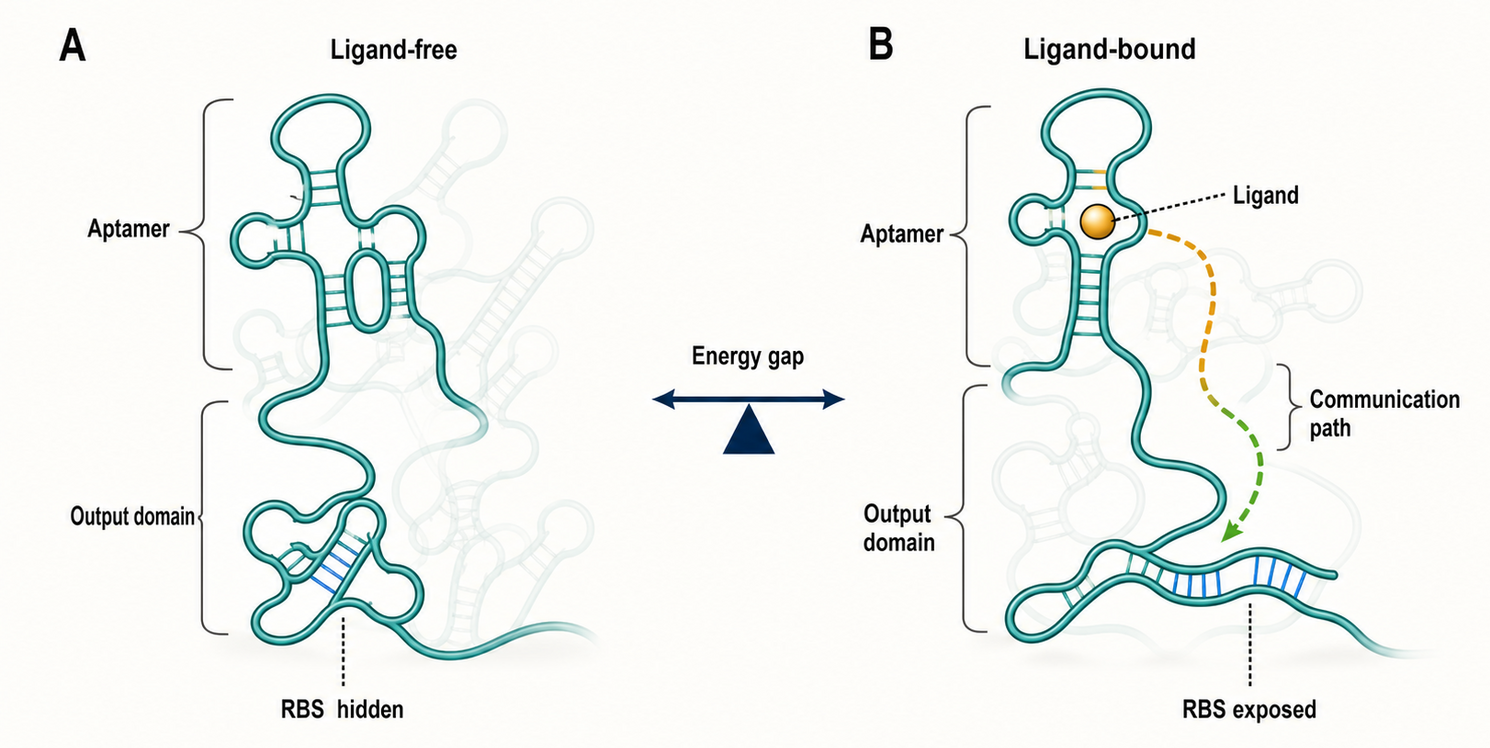
Figure 65.2. Multi-State Riboswitch Design. A multi-state riboswitch design tunes a ligand-free ensemble and a ligand-bound ensemble. Ligand binding stabilizes the aptamer state, which changes the availability of an expression platform such as a ribosome-binding site or terminator hairpin. Useful switching requires an appropriate free-energy difference between states and a physical communication path between the binding site and the output domain.
The simplest way to understand multi-state design is to compare an always-on hairpin with a riboswitch. An always-on hairpin should make the same stem in all relevant conditions. A riboswitch should occupy an unbound ensemble that permits one regulatory output and a ligand-bound ensemble that favors another. The designer must tune the free-energy difference between the states. If the ligand-free state is too stable, ligand binding cannot switch the RNA. If the ligand-bound state is too stable even without ligand, the device becomes constitutively locked. A functional switch therefore often sits near a thermodynamic boundary.
Fitness functions translate such behavior into scores. Ward and colleagues emphasize that RNA structure design depends strongly on the chosen fitness function: one score may reward target base pairs, another may reward ensemble defect, another may penalize off-target structures, and another may encode multi-state behavior (Ward et al., 2023). DERNA and related Pareto approaches make this explicit by seeking designs that balance competing objectives rather than collapsing them into one arbitrary score (Gu et al., 2024). This framework is useful because RNA design often involves tradeoffs, not a single optimum.
Condition-responsive designs include toehold switches, ligand-responsive ribozymes, RNA thermometers, aptamer-controlled splicing elements, synthetic guide switches, and mRNA regulatory elements responsive to microRNAs or RNA-binding proteins. A toehold switch sequesters a ribosome-binding site or start codon until a trigger RNA binds and opens the structure. A microRNA-responsive therapeutic mRNA can include target sites that reduce expression in cells where a particular microRNA is abundant. These examples illustrate two design modes. Some devices directly change RNA structure; others change which protein or RNA partners can bind.
Multi-state design is difficult because the designer must avoid unintended third states. For example, a trigger-responsive RNA may bind the correct trigger but also form a stable intramolecular fold that blocks the trigger site. An aptamer-fused device may bind ligand but fail to communicate the binding event to the output domain. A temperature-responsive RNA may work in vitro but fail in cells because proteins stabilize one state. A multi-state mRNA design may improve stability while also hiding a translation initiation region or exposing an immunostimulatory motif.
Experimental validation should measure state occupancy and output. Chemical probing can ask whether a region becomes more or less reactive upon ligand addition. Binding assays can measure affinity. Reporter assays can measure expression. Mutational analysis can test whether the predicted paired regions and junctions are necessary. High-throughput libraries can reveal design rules by measuring many variants. However, a reporter readout alone can be ambiguous: increased expression may reflect folding, RNA abundance, transcription, translation, or degradation. Failure analysis should therefore combine structure-sensitive and output-sensitive assays when the mechanism matters.
The boundary between multi-state design and ordinary sequence optimization is not sharp. mRNA coding-region design can be viewed as multi-state because the same molecule must survive manufacturing, remain stable during storage, avoid excessive innate immune activation, recruit ribosomes after delivery, and be degraded at an acceptable rate. These states are not always conformational states, but they are condition-dependent molecular performances.
65.4. Cotranscriptional and kinetic design
Thermodynamic design asks which structures are stable at equilibrium. Kinetic design asks which structures form, in what order, and how quickly. RNA folding often begins before transcription has finished. As RNA polymerase synthesizes an RNA from the 5′ end toward the 3′ end, the nascent chain can form local helices that later persist, rearrange, or block formation of the thermodynamic ground state. Co-transcriptional folding is therefore a design constraint whenever the pathway affects function.
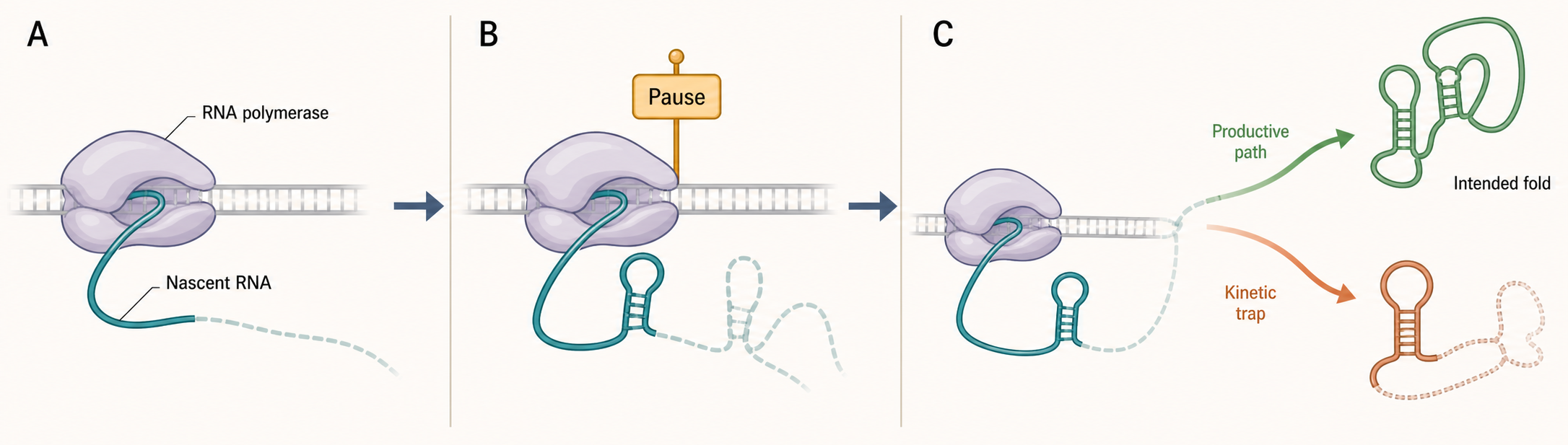
Figure 65.3. Cotranscriptional Folding and Kinetic Traps. As RNA polymerase synthesizes an RNA from 5′ to 3′, early transcript segments can form local helices before downstream partners are available. Some intermediates guide the RNA toward the intended structure, whereas others create kinetic traps that persist even if a different final structure is thermodynamically favored. The panel illustrates how transcription speed, pausing, and helix stability together determine whether a designed RNA reaches its intended fold.
A hairpin illustrates the basic kinetic issue. If complementary segments emerge close together in time, a stem may form quickly. If one segment is temporarily trapped in an alternative helix before its intended partner is transcribed, the RNA may become kinetically trapped. Hairpin-folding kinetic models show that rates depend on loop closure, base-pair formation, and rearrangement barriers, not only final free energy (Zhang and Chen, 2002). For longer RNAs, the number of possible intermediates increases dramatically.
Natural RNAs exploit co-transcriptional folding. Bacterial attenuation systems use nascent structures to decide whether transcription terminates. Riboswitches must often bind ligand before an expression platform folds irreversibly into a terminator or anti-terminator state. Eukaryotic pre-mRNA processing couples transcription to splicing, cleavage, modification, and RNP assembly; reviews of co-transcriptional splicing and plant RNA processing emphasize that nascent RNA timing affects molecular decisions (Shenasa and Bentley, 2023; Marquardt et al., 2023). Although these chapters treat natural biology more fully in Chapter 25, the same principles matter when synthetic RNAs are transcribed in vitro or expressed in cells.
The HIV-1 trans-activation response element, or TAR RNA, provides a concrete kinetic example. TAR is a structured element near the 5′ end of HIV-1 transcripts. Studies of TAR co-transcriptional folding examine how the RNA forms intermediate structures as it emerges from polymerase and how those structures relate to the functional hairpin (Jin L et al., 2024). For a designer, the lesson is general: a sequence that can form the correct final hairpin may still behave differently depending on transcription speed, pausing, ionic conditions, and interacting proteins.
Kinetic design can use several strategies. One strategy is to remove strong off-pathway complementarity that appears early during transcription. Another is to place functional modules in an order that encourages the desired pathway. A third is to tune helix stability so that early structures can rearrange when later sequence becomes available. For ribozymes and riboswitches, designers may also include stabilizing peripheral elements or avoid them depending on whether rapid rearrangement is needed. For mRNA, kinetic effects can influence in vitro transcription products, co-transcriptional formation of double-stranded regions, and downstream purification or immune recognition.
Kinetic prediction remains less mature than equilibrium secondary-structure design. Models must approximate transcription rates, pausing, folding rates, strand displacement, magnesium effects, tertiary contacts, and protein interactions. In cells, helicases and RNA-binding proteins can remodel structures. DEAD-box helicases and other RNP factors can prevent designed folding behavior from matching in vitro predictions; broad RNA stability and helicase biology are treated elsewhere, but the design implication is direct (Cargill et al., 2021; Li W et al., 2022). A robust kinetic design therefore avoids assuming that the final minimum-free-energy structure is the only biologically relevant state.
Validation should include time or pathway information when pathway matters. Single-round transcription assays, time-resolved chemical probing, transcriptional reporter systems, and mutational traps can reveal whether an RNA reaches the intended state by the intended route. A design that works only after heat denaturation and slow cooling may be unsuitable for expression in a living cell, even if it looks excellent in a refolding assay.
65.5. Manufacturability, immunogenicity, and stability constraints
A designed RNA must be producible. Manufacturability refers to whether a sequence can be synthesized, transcribed, purified, formulated, stored, and characterized with acceptable quality. For short oligonucleotides, synthesis constraints include coupling efficiency, chemical modification compatibility, purification of closely related products, and avoidance of problematic motifs. For long mRNAs, in vitro transcription must produce full-length RNA with controlled cap status, poly(A) tail features, nucleotide composition, and low levels of contaminants such as double-stranded RNA. These manufacturing details can dominate biological outcome.
RNA stability has several meanings. Chemical stability refers to resistance to hydrolysis and oxidative or chemical damage. Enzymatic stability refers to resistance to ribonucleases. Structural stability refers to maintenance of a desired fold or architecture. Biological stability refers to transcript half-life in a cell or organism. These meanings can conflict. A highly structured region may resist some nucleases but impede translation. A chemically modified siRNA may last longer in serum but bind proteins differently. An mRNA optimized for high stability may create long-lived antigen expression that is helpful in one vaccine setting and undesirable in another.
Immunogenicity is especially important for therapeutic and vaccine RNAs. In vitro-transcribed RNA can activate innate immune sensors, including endosomal Toll-like receptors and cytosolic RNA sensors, depending on sequence, structure, modifications, contaminants, delivery route, and cell type. Mu and Hur review how in vitro-transcribed RNA immunogenicity depends not only on the intended RNA molecule but also on byproducts and formulation context (Mu and Hur, 2021). Modified nucleotides and purification can reduce innate immune activation, but immune activation is not always a defect. Vaccines may benefit from a controlled inflammatory signal, whereas protein-replacement mRNA may require minimal innate activation.
Sequence design influences immunogenicity and stability through several routes. Uridine content, CpG motifs, double-stranded regions, uncapped or improperly capped ends, triphosphate ends, and contaminating duplexes can affect sensing. Codon optimization changes GC content and dinucleotide composition. Structural changes can expose or hide sensor ligands. Circular RNAs raise an additional boundary case: circularization removes free ends and can alter stability and immune sensing, but circular RNAs must be manufactured and purified carefully. Work on RNA circles with minimized immunogenicity as PKR inhibitors illustrates how architecture, immunogenicity, and function intersect (Liu et al., 2022).
For mRNA vaccines, design also includes protein expression and antigen quality. A sequence must encode the intended antigen, maintain reading frame, avoid problematic sequence elements, and be compatible with the delivery system. Reviews of mRNA vaccine technology emphasize that sequence optimization cannot be separated from lipid nanoparticle formulation, biodistribution, immune sensing, and clinical performance (Lu et al., 2025; Leong et al., 2025; Fu et al., 2023). Delivery can change which cells encounter the RNA and which innate pathways are activated. A design that performs well in cultured cells after transfection may not perform similarly after systemic delivery.
Manufacturing creates assay artifacts that can be mistaken for sequence effects. Double-stranded RNA contaminants from in vitro transcription can increase immune activation independent of the designed coding sequence. Truncated products can alter apparent translation. Batch-to-batch differences in cap incorporation or purification can obscure true design differences. For siRNAs and chemically modified oligonucleotides, incomplete deprotection, impurities, or incorrect stereochemistry can alter potency and toxicity. A fair comparison between RNA designs requires matched production and quality-control conditions.
Designers should specify what stability is being optimized and in what context. “More stable RNA” is not a sufficient objective. More stable during freezer storage, more stable in serum, more stable after endosomal escape, more stable in the cytosol, more stable as a folded aptamer, and more stable as a coding transcript are different goals. A useful design document states the intended stability endpoint, the assay used to measure it, and the likely tradeoffs.
65.6. ML-guided generation and active learning
Machine learning enters RNA design in three main ways. Predictive models estimate a property of a candidate sequence, generative models propose new sequences, and active-learning systems choose which sequences to test next. These approaches can be useful when the relationship between sequence and function is too complex for simple rules but enough data exist to learn patterns.
A predictive model might estimate guide RNA editing efficiency, siRNA potency, mRNA stability, riboswitch activity, aptamer binding, or RNA three-dimensional structure. The inputs can include sequence, predicted structure, thermodynamic features, chemical modifications, target context, expression system, or experimental metadata. The output may be a scalar score, a probability, a structure, or an uncertainty estimate. Geometric deep learning of RNA structure illustrates the attempt to learn structural features beyond simple secondary-structure rules (Townshend et al., 2021). Machine-learning perspectives on RNA-targeted small molecules and RNA-binding chemical space show that learned models can connect RNA sequence or structure to ligand recognition, but also depend heavily on the quality and representativeness of training data (Xiao et al., 2023; Yazdani et al., 2023).
Generative design can propose sequences that satisfy learned patterns. For example, a model trained on high-performing guide RNAs may propose guides with favorable sequence features. A model trained on mRNA stability measurements may propose synonymous coding sequences predicted to last longer. A structure-aware generator may propose RNA motifs or architectures. The major caution is that generated sequences can exploit blind spots in the scoring model. A model may assign high scores to sequences that are outside the experimental domain, difficult to synthesize, immunostimulatory, or prone to unmodeled off-target interactions.
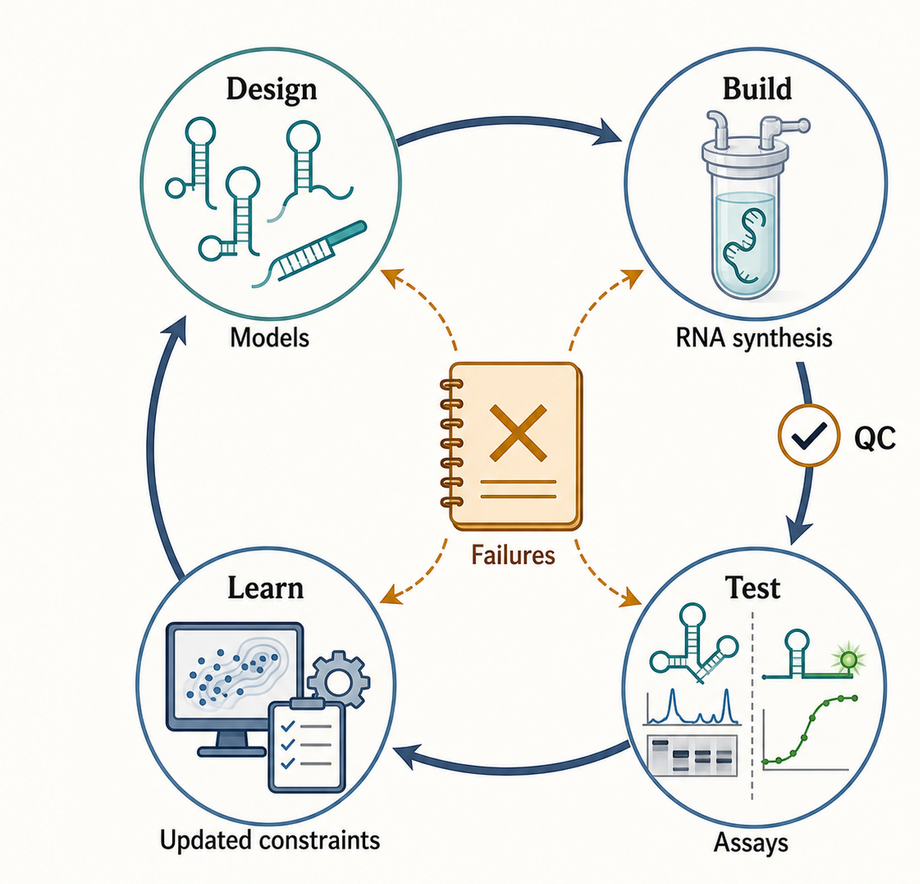
Figure 65.4. Experimental Design–Build–Test–Learn Loop. Designed RNA sequences are generated by physical models, empirical rules, and machine-learning predictors, then synthesized or transcribed, quality controlled, and tested by structural and functional assays. Results, including failures, are used to update constraints and scoring in the next design round. Recording failure modes as design information rather than discarding them is what distinguishes an iterative workflow from a one-shot prediction exercise.
Active learning is a way to make the design loop more efficient. Instead of testing random sequences or only the current predicted best sequences, an active-learning workflow chooses experiments that are expected to improve the model or find better designs. Some selected sequences may be uncertain rather than predicted to be excellent, because measuring them can clarify the sequence-function landscape. Active learning has been used in RNA-related data analysis contexts, and the same principle applies to design libraries when high-throughput testing is possible (Lin et al., 2022). In RNA design, active learning is most persuasive when experiments are cheap enough to run iteratively and the design space is large enough that exhaustive testing is impossible.
Machine learning does not remove the need for mechanistic features. In many RNA applications, the best models combine sequence features, thermodynamic predictions, structural constraints, and empirical data. A guide RNA model that ignores target context can fail. An mRNA model that ignores purification and delivery can fail. An aptamer model trained on one assay buffer may not generalize to serum or cytosol. A model trained on short local motifs may miss long-range structure. A model trained on published successful designs may lack negative examples.
Benchmarking must match intended use. Cross-validation within one dataset can overestimate performance when related sequences appear in both training and test sets. Random train-test splits can be misleading if the deployment task requires generalization to new targets, new scaffolds, new cell types, or new chemical modifications. A rigorous benchmark separates families, targets, or experimental batches when those sources of correlation matter. This issue is familiar from RNA-seq and broader RNA machine-learning reviews, where technical structure in the data can be mistaken for biological signal (Pandey and Onkara Perumal, 2023).
The most useful role for machine learning is often triage rather than replacement of validation. A model can prioritize a smaller library, identify suspicious designs, suggest sequence features to vary, or estimate uncertainty. Experimental testing then determines whether the proposed sequence works in the intended context. When failures are fed back into the model with accurate metadata, the next round can become more informative.
65.7. Experimental validation and failure analysis
Validation asks whether a designed RNA has the intended molecular and biological behavior. Failure analysis asks why it does not. Both are part of RNA design, because the first experimental round is often more informative than definitive.
Structural validation can use chemical probing, enzymatic probing, nuclear magnetic resonance spectroscopy, cryo-electron microscopy, X-ray crystallography, Förster resonance energy transfer, and computational modeling constrained by experimental data. Chemical probing methods report nucleotide reactivity, not structure directly, so they require careful interpretation. A nucleotide can become less reactive because it is base-paired, protein-bound, ligand-protected, stacked, or inaccessible. Reviews of RNA structure determination and modeling emphasize that experimental constraints and computational models are complementary but imperfect (Zhang J et al., 2022). For designed RNAs, probing should include negative controls, destabilizing mutations, compensatory mutations, and relevant ligand or protein conditions when possible.
Functional validation depends on the RNA class. A riboswitch design can be tested with transcription termination assays, translation reporters, ligand titrations, and mutations that disrupt or restore predicted helices. An aptamer can be tested with binding kinetics, competition assays, and specificity panels. A guide RNA can be tested for on-target editing, off-target editing, indels or rearrangements, transcriptomic effects, and cell viability. A siRNA can be tested for target knockdown, seed-mediated off-target effects, immune activation, and durability. An mRNA can be tested for integrity, cap and tail quality, translation, protein localization, immune activation, and in vivo expression. RNA origami can be tested by native gels, atomic force microscopy, cryo-electron microscopy, and functional cargo display.
A useful validation ladder starts close to the design objective and then moves outward. If the objective is ligand-responsive switching, first test folding and ligand binding in vitro, then test reporter output in cells, then test endogenous or therapeutic context if relevant. If the objective is mRNA protein expression, first check RNA quality and translation in a controlled system, then test cell-type dependence, innate immune response, and delivery context. If the objective is genome editing, first verify guide expression and on-target activity, then profile off-target and structural genome changes.
Common failure modes are predictable. The target structure may not form. The target structure may form but not create the required tertiary contact. The RNA may fold correctly in vitro but be remodeled in cells. A designed switch may have high background or low dynamic range. A guide may fail because the target is inaccessible or because the scaffold is disrupted. An siRNA may knock down unintended transcripts through seed pairing. An mRNA may express poorly because structure blocks initiation, because codon choices alter elongation or decay, because innate sensing suppresses translation, or because delivery misses the relevant cells. A nanostructure may assemble incompletely because one module misfolds and nucleates aggregates.
Failure analysis should distinguish design error from assay error. Low activity can reflect RNA degradation, incorrect concentration, poor transfection, poor delivery, wrong buffer, failed ligand addition, batch contamination, cell stress, or readout saturation. RNA localization and trafficking reviews illustrate that subcellular context can strongly affect RNA behavior and measurement (Wang et al., 2023). Clinical or disease-associated RNA studies that include experimental validation also show the danger of overinterpreting computational predictions without biochemical or cellular confirmation (Gargiulo et al., 2023; Cai et al., 2024; Lu T et al., 2025).
Compensatory mutation is one of the strongest validation tools for a designed helix. If disrupting one side of a predicted stem breaks function and restoring base pairing with complementary mutations restores function, the evidence for the helix is stronger than with a single mutation. For protein- or ligand-binding motifs, rescue may require restoring a shape or sequence motif rather than simple Watson-Crick pairing. For guide RNAs and siRNAs, mismatch and seed-position scans can map which base-pairing interactions matter.
A failed design is useful if the failure is recorded precisely. The record should include sequence, modifications, synthesis method, purification, predicted structures, assay conditions, measured molecular quality, biological readout, and suspected failure mode. The next design round can then decide whether to change sequence constraints, scoring weights, production conditions, or the assay itself.
Recent Consensus
RNA design is most mature for local secondary-structure objectives, guide sequence scoring, and several experimentally constrained engineering tasks. It is less mature for fully predictive design of tertiary folds, large multi-state devices, context-independent mRNA performance, and cellular behavior dominated by delivery or RNP remodeling. Current consensus favors hybrid workflows: physical folding models provide mechanistic constraints; empirical rules capture class-specific biology; machine learning ranks or generates candidates when data support it; and experiments close the loop.
The field also agrees that “optimal” is application-specific. A sequence optimized for maximum translation is not automatically optimal for vaccination, protein replacement, or transient genome editing. A guide optimized for potency may have unacceptable off-target risk. A riboswitch optimized for low background may have weak induced expression. Multi-objective and Pareto framing is therefore more realistic than a single universal RNA design score (Ward et al., 2023; Gu et al., 2024).
Open Questions, Controversies, Deprecated Models, and Common Misconceptions
Open questions:
- How far can learned RNA design models generalize beyond the assay systems used to train them? Models trained on dense, high-quality libraries can be powerful within a domain, but generalization to new chemical modifications, organisms, delivery vehicles, or RNA architectures remains uncertain.
- How can researchers integrate co-transcriptional kinetics with large-scale design? Equilibrium folding predictions are fast enough for broad search; kinetic and co-transcriptional simulations are often slower and require parameters that are hard to know in cells.
- How to can design tertiary structure and RNP assembly with the same reliability that simple helices be designed? RNA origami and modular motifs have made real progress, but metal ions, long-range contacts, and protein cofactors remain challenging (Poppleton et al., 2023; Pyle and Schlick, 2016).
Common misconceptions:
- “Inverse folding solves RNA function.” Inverse folding solves a structural proxy. Function may require binding, catalysis, localization, translation, immune avoidance, or assembly that is not captured by the proxy.
- “Synonymous recoding is biologically neutral.” Synonymous substitutions can alter RNA structure, codon optimality, translation kinetics, immune sensing, and manufacturability.
- “A high-throughput reporter assay proves the mechanism.” A reporter assay proves the measured output under assay conditions. Mechanistic claims require controls that connect the output to folding, binding, processing, or another proposed causal step.