Chapter 140. RNA Homology Search, Family Classification, and Annotation Pipelines
Scope Note
This chapter explains how RNA sequences are prepared, searched, aligned, classified, curated, and assigned to annotation records when family conservation depends on primary sequence, conserved motifs, or structured RNA models. The focus is operational: choosing sequence, profile, or covariance-model searches; constructing and quality-controlling alignments; running and interpreting Infernal-style searches; curating Rfam-style families; setting thresholds; resolving competing models; assigning records; and benchmarking uncertainty. RNA-family evolutionary interpretation belongs to Chapter 12, while comparative secondary-structure inference and covariation statistics belong to Chapter 62.
Executive Summary
RNA homology search begins with an operational question: which search representation is appropriate for the query and target database? RNA adds a complication because many families conserve base-paired architecture more strongly than exact nucleotide identities. A bacterial riboswitch aptamer, RNase P RNA domain, small nucleolar RNA guide, or microRNA precursor can preserve stems, loops, and pairing relationships even when many nucleotides change. A search method that ignores structure may miss remote homologs; a method that overweights an uncertain alignment or structure may produce confident-looking false positives.
Simple sequence search is fast and useful for close homologs, but profile methods become more sensitive when a family has enough examples to estimate position-specific conservation. Profile hidden Markov models represent insertions, deletions, and residue preferences across a linear alignment. Covariance models extend this idea for structured RNAs by representing paired positions jointly, so a G-C pair, A-U pair, or G-U wobble can be scored as a conserved pairing state rather than as two independent columns. Infernal implements covariance-model search and alignment workflows, and Rfam uses curated seed alignments, consensus structures, covariance models, thresholds, clans, and release procedures to annotate many noncoding RNA families.
Multiple alignment is the hinge between sequence data and structure-aware inference. A poor alignment can create artificial covariation, hide real compensatory substitutions, or merge unrelated RNAs. For structured RNAs, the alignment must place homologous nucleotides in the same columns while also respecting conserved base pairs. This is difficult when RNA families have variable-length loops, lineage-specific inserts, fragmented assemblies, repeated motifs, pseudoknots, or modular domain combinations. Structure-aware alignment therefore relies on a mixture of sequence similarity, predicted or known secondary structure, curated anchors, thermodynamic plausibility, and iterative inspection.
Structure-aware search consumes a consensus structure or paired-column model, but this chapter does not derive that structure. Chapter 62 explains comparative structure inference, covariation statistics, and compensatory substitutions as structural evidence. Here the operational concern is whether the model input is appropriate, whether paired columns are stable enough for search, and how uncertainty in that input propagates into scores, thresholds, classification, and record assignment.
Benchmarking RNA homology methods is difficult because RNA databases are curated from the same genomes, search tools, family definitions, and literature that benchmarks often reuse. Positive sets may be biased toward easy, abundant families; negative sets may contain unrecognized RNAs; assemblies may include fragments or contamination; and thresholds tuned on one release may not transfer to another. An annotation record should therefore carry model and database versions, score, threshold, alignment coverage, classification decision, and uncertainty label rather than reducing every hit to an experimentally validated gene.
Concept Inventory
- RNA homology candidate: a sequence or domain returned by a search as potentially homologous to a query or modeled family; evolutionary interpretation is developed in Chapter 12.
- Query preparation: checking boundaries, orientation, ambiguous bases, low complexity, artifacts, and entity level before search.
- Sequence similarity search: comparison of a query sequence against a database using local or global sequence similarity, often without explicit structural modeling.
- Profile method: a method that represents a family alignment as position-specific constraints rather than as a single query sequence.
- Profile hidden Markov model: a probabilistic model for a linear sequence family, including match, insertion, and deletion states.
- Covariance model: a probabilistic model for an RNA family that scores both conserved single-stranded positions and conserved base-paired positions.
- Stochastic context-free grammar: a grammar formalism used to model nested RNA secondary structures, excluding most pseudoknotted interactions in standard covariance models.
- Seed alignment: a curated, trusted multiple alignment used to build a family model.
- Full alignment: a broader alignment of database hits to a family model, usually less manually curated than the seed.
- Rfam family: a curated RNA family represented by a seed alignment, consensus secondary structure, covariance model, annotation, thresholds, and database cross-references.
- Infernal: a software suite for building, calibrating, searching, and aligning RNA covariance models.
- Alignment quality control: review of anchors, paired-column consistency, variable regions, fragments, taxonomic redundancy, and ambiguous columns before model construction or classification.
- Consensus secondary structure: a representation of base pairs conserved across a family alignment rather than a guaranteed structure for every individual sequence.
- Gathering threshold: a curated score threshold used to decide which hits belong to a family for a given model and release.
- Family classification: assignment to a family, subfamily, clan, modular combination, or unresolved competing models.
- Record assignment: creation of a confidence-aware annotation record from a classified hit.
- Database bias: distortion caused by uneven taxonomic sampling, study intensity, assembly quality, annotation practices, or benchmark construction.
What to Know Before Reading This Chapter
RNA family analysis assumes a reader is comfortable with three kinds of evidence. First, RNA is a linear polymer with 5′ to 3′ polarity and four common bases, so ordinary sequence similarity can reveal close homologs. Second, many RNAs fold into secondary structures in which positions far apart in the sequence base-pair with each other. Third, homologous RNAs can preserve a structural role while changing the actual nucleotides. A conserved stem may tolerate many substitutions as long as base pairing remains possible.
The running examples in this chapter are tRNAs, bacterial riboswitches, RNase P RNA, small nucleolar RNAs, microRNA precursors, and viral structured elements. These examples cover compact, strongly structured RNAs; structured domains embedded in longer transcripts; guide RNAs whose target-complementary regions evolve under different constraints from their scaffold; and viral motifs whose sequence may be constrained simultaneously by coding, replication, packaging, and immune evasion.
The chapter treats computational predictions as evidence, not as final biological proof. A covariance-model hit can be a strong annotation when the sequence aligns well, exceeds a curated threshold, preserves diagnostic structure, appears in plausible genomic context, and is supported by expression or comparative evidence. A marginal hit in a low-quality contig, repetitive region, or taxonomically distant genome is a hypothesis requiring additional evidence.
140.1. Sequence, profile, and structure-aware homology search
RNA sequence search asks a simple question with many hidden conditions: does a query sequence resemble known RNA sequences strongly enough to support a biological inference? The query might be a newly assembled environmental contig, an intergenic region near a metabolic gene, a transcript expressed in a stress condition, or a short sequence excised from a viral genome. The database might contain genomes, transcript assemblies, noncoding RNA families, or all nucleotide sequences available in a public archive. The output is usually not “the answer”; it is a ranked set of candidate homologs, each shaped by the query length, database composition, scoring system, thresholds, and the evolutionary distance between query and known family.
The simplest search strategy treats RNA as ordinary nucleotide sequence. Local sequence search can rapidly find close homologs when enough nucleotide identity remains. This is useful for rRNA fragments in metagenomes, closely related bacterial small RNAs, recently duplicated small nucleolar RNA copies, microRNA hairpins within a clade, or viral regulatory elements in related strains. The strength of simple sequence search is speed and interpretability: a high-identity alignment over a meaningful length is easy to inspect, and the method can scale to large databases. Its weakness is that RNA families often diverge at the sequence level while conserving base-pairing architecture or short motifs. A riboswitch aptamer may preserve ligand-binding geometry through scattered conserved residues and stems; a tRNA preserves cloverleaf architecture and identity elements; a small nucleolar RNA preserves guide complementarity and box motifs but not all intervening sequence.
Pairwise sequence identity also has a misleading vocabulary problem. “Percent identity” is not a universal measure of relatedness because it depends on alignment length, gap placement, base composition, and evolutionary rate. Two 25-nucleotide motifs with 80 percent identity can occur by chance in a large database, while two 200-nucleotide structured RNAs with 45 percent identity and conserved paired architecture may represent convincing homologs. Low-complexity regions, repeats, poly(U) tracts, poly(A)-rich transcript ends, and simple sequence motifs can inflate apparent similarity. Sequence search therefore requires masking or careful interpretation for repetitive sequence, and RNA-specific interpretation for short motifs.
Profile methods improve on single-query search by representing a family rather than one sequence. A profile is built from a multiple alignment of known family members. Instead of asking whether a target resembles one example, the profile asks whether the target fits the position-specific conservation pattern of the family. A profile hidden Markov model, or profile HMM, uses match states for aligned columns, insertion states for extra residues, and deletion states for missing residues. Each match state can have its own nucleotide emission probabilities, and transitions between states model where insertions and deletions are likely. Profile HMMs are powerful for RNA domains whose conservation is mostly linear: conserved sequence boxes, mature miRNA seed regions, guide boxes, or conserved protein-coding-like motifs in viral RNAs.
Profile HMMs still treat aligned columns as independent unless additional information is encoded outside the model. That independence is a poor approximation for paired RNA positions. In a conserved stem, a G on one side is not independent of a C on the other side. If the left side changes from G to A, the right side may change from C to U to preserve pairing. A linear profile sees two columns with weak single-column conservation; a structure-aware model sees a conserved relationship between columns. This distinction is the reason covariance models matter for structured RNA homology.
Search workflows often use a hierarchy rather than one method. A fast sequence search can find close homologs and provide seed candidates. A profile HMM can expand the candidate set when enough aligned examples exist. A covariance model can search more deeply when conserved secondary structure is central. Some pipelines use filters: a fast first-pass method removes most of the database, then a slower structure-aware method evaluates remaining candidates. Infernal workflows use acceleration heuristics because full covariance-model search is computationally expensive compared with ordinary sequence search. Barquist and colleagues describe practical Infernal use from single-sequence starts to family models, and Nawrocki and Eddy emphasize the special value and cost of functional RNA homology search in metagenomic data.
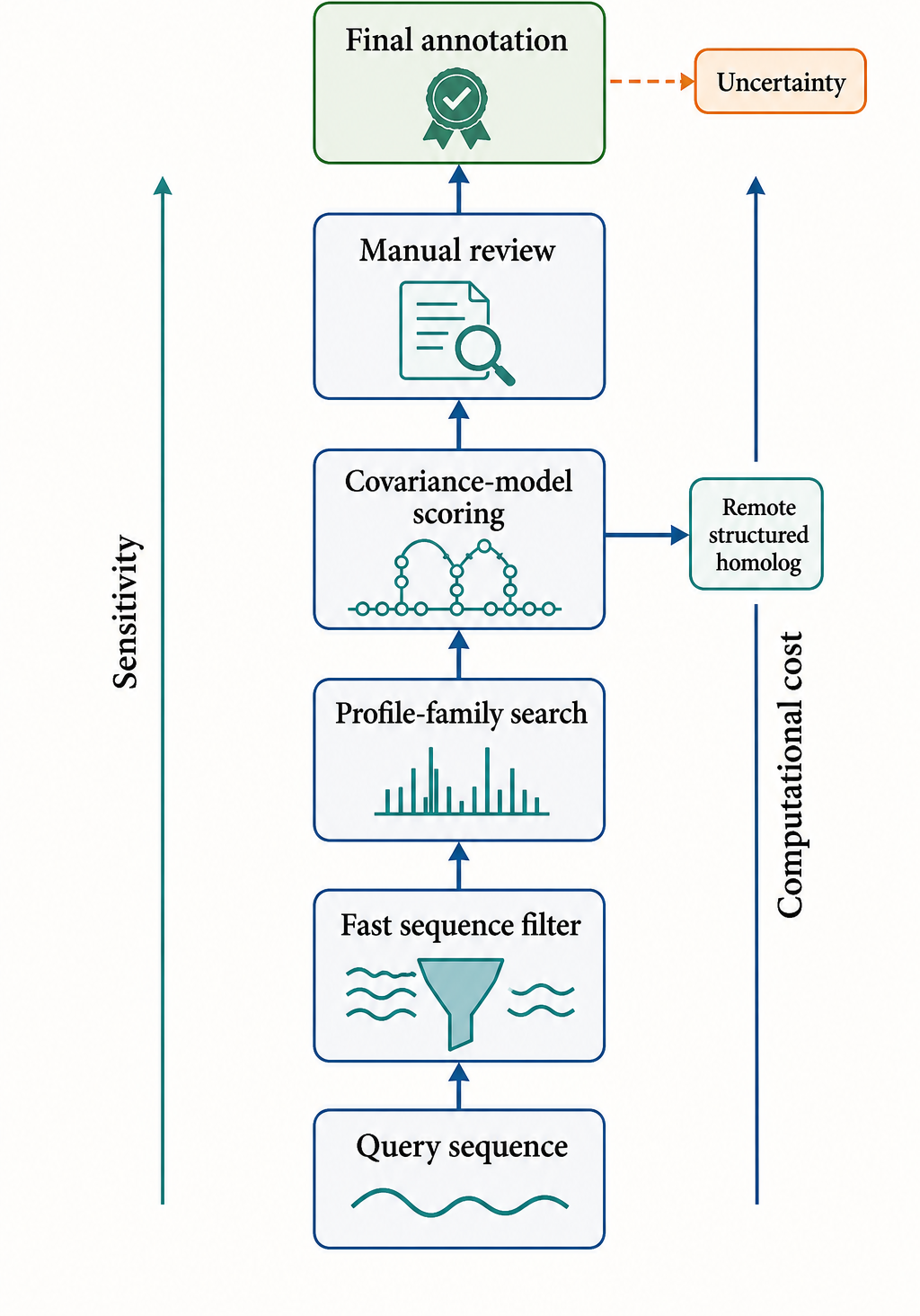
Figure 140.1. Search Workflow Ladder. RNA-family search should escalate from fast sequence comparison to profile hidden Markov models and covariance models as homology becomes more remote or structure-constrained, trading computation for sensitivity and requiring explicit uncertainty review.
The input sequence context influences which search is appropriate. For a complete bacterial genome, an intergenic hit near a plausible operon may be easier to interpret than an isolated short hit in an unplaced contig. For a metagenomic assembly, a candidate RNA may be partial, chimeric, taxonomically ambiguous, or located near unannotated genes. For a transcriptome, expression evidence confirms transcription but not necessarily conserved function; fragmented transcripts can split structured domains, and assembly errors can alter predicted stems. For viral genomes, overlapping coding sequence can create sequence conservation unrelated to RNA structure, while RNA structure can also constrain synonymous sites.
A concrete example is a bacterial riboswitch search. A close homolog of a known riboswitch may be found by ordinary sequence similarity because the aptamer sequence and local genomic context remain conserved. A more distant homolog may preserve a set of paired stems and ligand-contacting nucleotides while the intervening loops and peripheral stems have diverged. A covariance model can score both the conserved sequence positions and the paired positions. The resulting hit is more credible if it occurs upstream of genes in the relevant metabolic pathway, aligns across the diagnostic aptamer core, preserves the expected pairing pattern, and exceeds a threshold calibrated for that family. The same score without genomic context or with broken core pairs should be treated more cautiously.
Another example is a small nucleolar RNA. Box C/D and box H/ACA small nucleolar RNAs have short conserved sequence motifs and guide regions that pair with target RNAs. A profile method can detect conserved boxes, but guide regions may differ according to target site, and many snoRNAs are embedded in introns or repeated in lineage-specific clusters. Search must distinguish a true family member from a short motif match in an intron. Evidence improves when the candidate has the expected motif spacing, secondary-structure features, expression, processing ends, target complementarity, and conservation pattern.
Do not overgeneralize from “sequence hit” to “functional RNA gene.” A sequence hit may represent a pseudogene, fragment, paralog, contaminant, low-complexity artifact, transposon-derived sequence, or conserved DNA element that is not transcribed. Conversely, a biologically real RNA can fail sequence search because the family is too diverged, too short, too lineage-specific, or too poorly represented in the database. Search sensitivity and specificity are always properties of a method, database, family, and threshold together.
Box 140.1. What a Search Hit Can Claim
A search hit should be translated into claims in stages. The narrow claim is that a target sequence resembles a query, profile, or covariance model under the chosen scoring system, database, and threshold. A stronger homology claim asks whether the aligned region plausibly descends from the same ancestral RNA domain. A stronger annotation claim asks whether the hit covers diagnostic positions, preserves important motifs or pairs, and avoids low-complexity or repeat artifacts. A biological function claim needs still more evidence: transcription, processing or mature-end support, plausible genomic context, conserved target or ligand logic, perturbation data, biochemical activity, or structural evidence. Negative results also need care. Failure to find a hit may mean that the RNA is absent, but it may also mean that the family is too diverged, poorly represented, too short, fragmented in the assembly, or outside the model’s scope.
Table 140.1. RNA Search Method Comparison. Pairwise, motif, profile hidden Markov, covariance-model, and hybrid searches differ in input assumptions, sensitivity, cost, and failure modes; method choice should match expected sequence and structure conservation.
| Method class | Input | Strengths | Failure modes | Best-use cases |
|---|---|---|---|---|
| Pairwise sequence search | Single query or genomic interval searched against nucleotide databases. | Fast, scalable, and easy to inspect for close homologs. | Misses remote structured RNAs; repeats and low-complexity tracts inflate hits. | Close rRNA fragments, clade-specific small RNAs, recent snoRNA copies, related viral elements. |
| Motif search | Short sequence or sequence-structure pattern such as a box, seed, or catalytic motif. | Detects diagnostic residues even when flanking sequence diverges. | Short motifs recur by chance and can be reused by unrelated RNAs. | snoRNA boxes, riboswitch ligand-contact motifs, ribozyme catalytic cores, miRNA seed checks. |
| Profile HMM | Curated linear multiple alignment with position-specific residue and indel patterns. | More sensitive than one-query search for conserved linear family features. | Treats paired columns independently; weak for stems conserved mainly by covariation. | Guide boxes, mature miRNA regions, conserved viral motifs, first-pass family expansion. |
| Covariance model | Seed alignment with annotated nested consensus secondary structure. | Scores conserved single positions and paired positions jointly. | Slower; inherits alignment errors and represents most pseudoknots incompletely. | tRNAs, riboswitch aptamers, RNase P domains, Rfam and Infernal-style structured RNA annotation. |
| Hybrid/iterative retrieval | Fast filters, profile or covariance searches, threshold review, and seed refinement. | Balances database scale with structure-aware sensitivity. | False positives can propagate; thresholds and benchmarks can leak curation bias. | Metagenomes, pangenomes, remote homolog discovery, RNAlien or GERONIMO-like workflows. |
The evidence basis for profile search comes from computational method development, curated database practice, and RNA-family case studies. The verified sources used here cover Infernal protocols, functional RNA homology search, RNAlien model construction, LocARNAscan, and GERONIMO. Exact commands and release-specific behavior should always be checked against the documentation for the installed software and selected database release.
140.2. Operational alignment construction and quality control
Multiple alignment is the operation that decides which nucleotides from different sequences are treated as homologous positions. For protein-coding genes, codon-aware alignment and translated amino acid conservation often provide strong anchors. For structured RNAs, alignment must respect both primary sequence and secondary structure. A nucleotide in one RNA loop should align with homologous loop nucleotides in other family members; one side of a stem should align with the homologous side of the same stem; and lineage-specific insertions should not force unrelated positions into shared columns. The alignment is therefore not a neutral pre-processing step. It is a scientific model of ancestry and structural correspondence.
The main challenge is that RNA sequence and structure can disagree locally. Suppose a stem has four base pairs in one bacterium and six in another. A sequence-only aligner may align by nucleotide similarity and shift one side of the stem, breaking the pairing pattern. A structure-aware aligner may preserve the stem but introduce gaps that look odd from a pure sequence perspective. Both choices make assumptions. The correct alignment depends on whether the compared molecules are true homologs, whether the stem is homologous, whether the insertions are real, and whether compensatory changes support the pairing. For families with known structures, biochemical or crystallographic information can guide the alignment. For newly discovered families, the alignment and structure are inferred together, which increases uncertainty.
Seed alignments are curated because automatic multiple alignment is rarely sufficient for diverse structured RNAs. A seed alignment should include trusted representatives that span diversity without being dominated by many nearly identical sequences. Overrepresentation of one clade can bias conservation estimates and model thresholds. Too few sequences can make the family look artificially conserved. Too many divergent or misclassified sequences can destroy the structural signal. Curators often start with clear homologs, align conserved motifs, inspect predicted or known stems, trim ambiguous regions, add representatives iteratively, and remove sequences that cannot be aligned consistently.
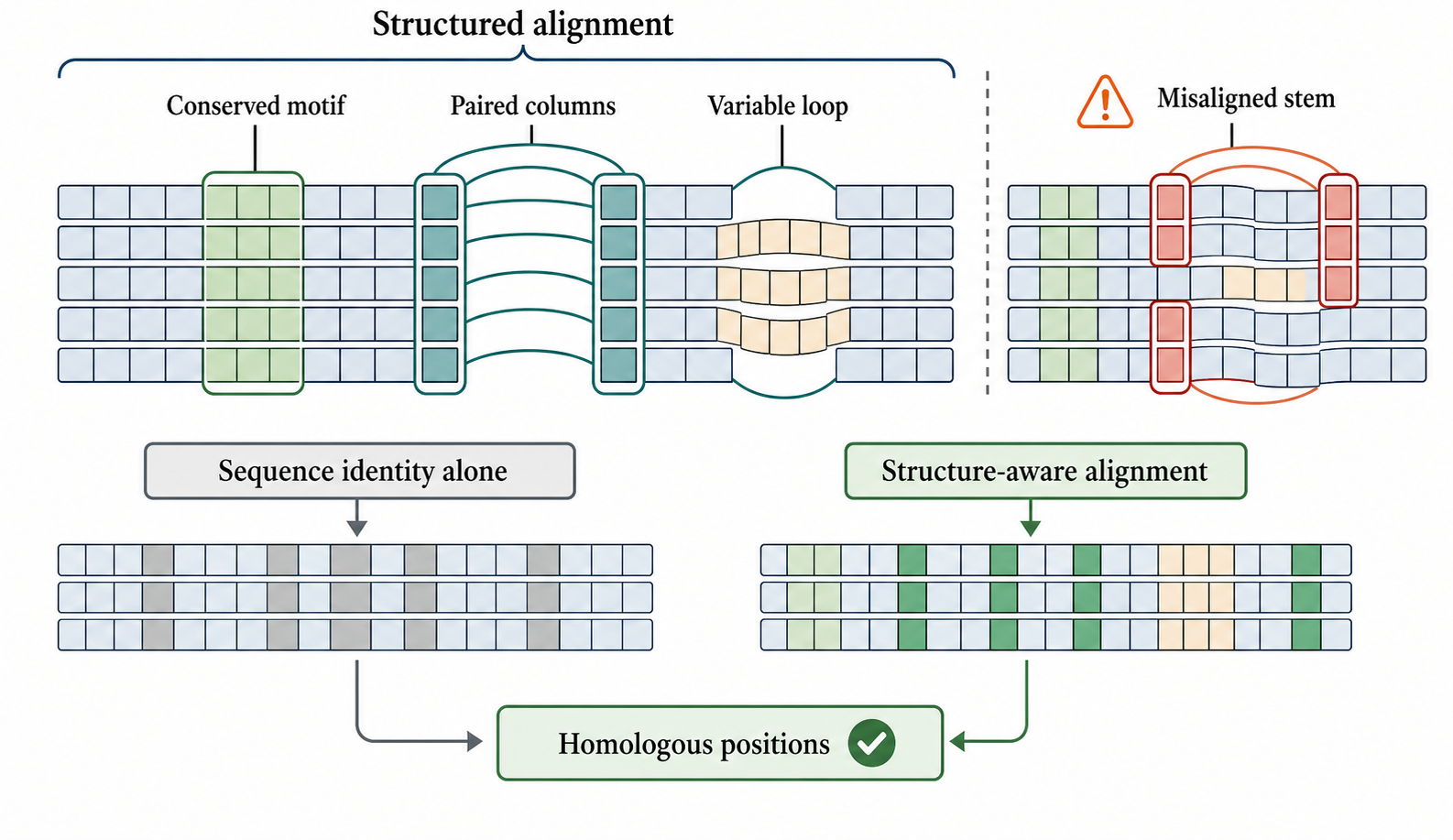
Figure 140.2. Structured RNA Alignment Anatomy. A structured RNA alignment preserves homologous motifs and paired columns while allowing loop insertions or deletions; maximizing sequence identity alone can misregister stems and corrupt covariance evidence.
Structured RNA alignment uses several kinds of anchors. Conserved sequence motifs can anchor ligand-binding residues in riboswitches, box motifs in small nucleolar RNAs, anticodon loops in tRNAs, catalytic residues in ribozymes, or conserved snRNA protein-binding motifs. Conserved secondary structure anchors paired regions. Genomic context can anchor orthologous bacterial small RNAs near conserved flanking genes. Biogenesis features can anchor mature microRNA arms, processing sites, or snoRNA boxes. Experimental structures can anchor ribosomal RNA or ribozyme domains. No single anchor is always decisive; robust alignments combine multiple forms of evidence.
Variable regions need special treatment. Loops, peripheral stems, lineage-specific insertions, and flexible linkers may be real parts of the RNA but poor contributors to homology detection. If variable regions are forced into too many shared columns, the model may learn noise. If variable regions are trimmed too aggressively, the model may miss biologically important lineage-specific features. For Rfam-style curation, the seed alignment usually emphasizes the conserved core that defines the family. Full alignments then place additional hits against the model and can contain many sequences that have not received the same manual inspection.
Pseudoknots illustrate a boundary case. Standard covariance models are based on formalisms that efficiently represent nested base pairs. Many RNA pseudoknots contain crossing interactions that are not represented in ordinary nested secondary-structure annotation. A family with an essential pseudoknot may still be modeled by including nested stems and conserved sequence motifs while leaving the crossing interaction outside the model or representing only part of the structure. This does not mean the pseudoknot is biologically unimportant; it means the model formalism has limits. Viral frameshift pseudoknots and some ribozymes require particular caution because sequence conservation, coding constraints, and crossing interactions can overlap.
Alignment uncertainty should be recorded rather than hidden. A final alignment may have high-confidence core columns and low-confidence peripheral regions. Conserved motifs may be unambiguous while flanking stems are uncertain. A short metagenomic fragment may align well to one stem but lack the rest of the domain. In downstream claims, “this sequence belongs to the family” is stronger when the diagnostic core aligns and weaker when only a partial motif aligns. “This family has a conserved structure” is stronger when covariation is supported across many independent lineages and weaker when structure depends on one alignment choice.
RNA alignment also interacts with taxonomy. Closely related sequences improve local alignment confidence but contribute limited independent evolutionary information. Distant sequences provide more covariation opportunities but are harder to align. A useful alignment often samples intermediate distances so that substitutions accumulate without erasing homology. Environmental data can add diversity, but metagenomic sequences can be partial, error-prone, and hard to place phylogenetically. GERONIMO and RNAlien exemplify efforts to retrieve structural RNA homologs or build family models across broad evolutionary contexts, but their outputs still require inspection and threshold decisions.
Table 140.2. Alignment Evidence and Failure Modes. Conserved motifs, paired stems, variable loops, genomic context, processing signals, and fragment boundaries contribute different alignment evidence; each also has characteristic artifacts that can mimic homology.
| Alignment feature | Evidence contribution | Common artifact | Mitigation |
|---|---|---|---|
| Conserved motif | Anchors ligand-contact residues, catalytic positions, snoRNA boxes, or protein-binding sites. | Chance short match or unrelated motif reuse. | Require flanking structure, taxonomic pattern, and genomic or biogenesis support. |
| Paired stem | Supports homologous paired columns and possible compensatory substitutions. | Shifted columns can create artificial covariation or break a true stem. | Inspect paired columns, alternative alignments, and independent lineage changes. |
| Variable loop | Separates flexible insertions from the conserved family core. | Forcing unrelated insertions into shared columns teaches the model noise. | Trim or mark low-confidence regions while preserving diagnostic loop features. |
| Genomic context | Supports orthology or regulatory placement near plausible flanking genes. | Conserved DNA context can outlive transcription or RNA function. | Check orientation, neighboring genes, synteny depth, and expression when available. |
| Processing signal | Links an alignment to mature ends, miRNA arms, or snoRNA biogenesis motifs. | Read-end bias or cleavage noise can mimic processing boundaries. | Require precise ends, expected motif spacing, and independent small-RNA or RNP evidence. |
| Metagenomic fragment | Adds diversity and can reveal partial family members in unsampled lineages. | Chimeric, truncated, or taxonomically ambiguous contigs distort the alignment. | Label as partial, require diagnostic core coverage, and record contig quality. |
Multiple alignment is therefore an evidence object. It should be versioned, cited, and inspected like an experimental dataset. A covariance model built from an alignment inherits the alignment’s strengths and errors. A benchmark using a database family inherits the database alignment and curation assumptions. A phylogenetic claim based on compensatory substitutions inherits the alignment’s column homology. For structured RNAs, the alignment is often the place where biological expertise enters the computational workflow most strongly.
140.3. Covariance-model search, Rfam curation, and family classification
A covariance model is a probabilistic model of an RNA family that represents both sequence conservation and conserved secondary structure. It can be understood as a profile model with paired states. Single-stranded positions emit one nucleotide at a time. Paired positions emit nucleotide pairs, allowing the model to score compatible base pairs such as G-C, C-G, A-U, U-A, and often G-U or U-G differently from mismatches. Insertions and deletions are modeled around this consensus architecture. The model therefore asks whether a target sequence can be aligned to the family in a way that preserves both primary-sequence features and paired architecture.
The formal basis of many covariance models is a stochastic context-free grammar, a probabilistic grammar suited to nested dependencies. In ordinary language, the model can open a base pair, emit the left and right nucleotides in related states, then model what occurs inside the pair. This is why covariance models can represent helices whose two sides are far apart in linear sequence. The same formalism also explains computational cost: searching a large database with a model that permits many possible alignments and base-pairing configurations is slower than linear sequence search. Practical software therefore uses filters, calibration, and carefully chosen thresholds.
Infernal is the central software suite for covariance-model workflows in modern RNA family annotation. A typical workflow begins with a seed alignment annotated with consensus secondary structure. cmbuild builds a covariance model from the alignment. Calibration estimates score distributions needed for statistical significance. cmsearch searches sequence databases for matches to a model, while cmalign aligns new sequences to an existing model. Practical protocols emphasize model construction, thresholding, output interpretation, and iterative refinement rather than treating the software as a one-command oracle. Barquist and colleagues provide a practical Infernal protocol, while Nawrocki and Eddy discuss functional RNA homolog identification in complex data.
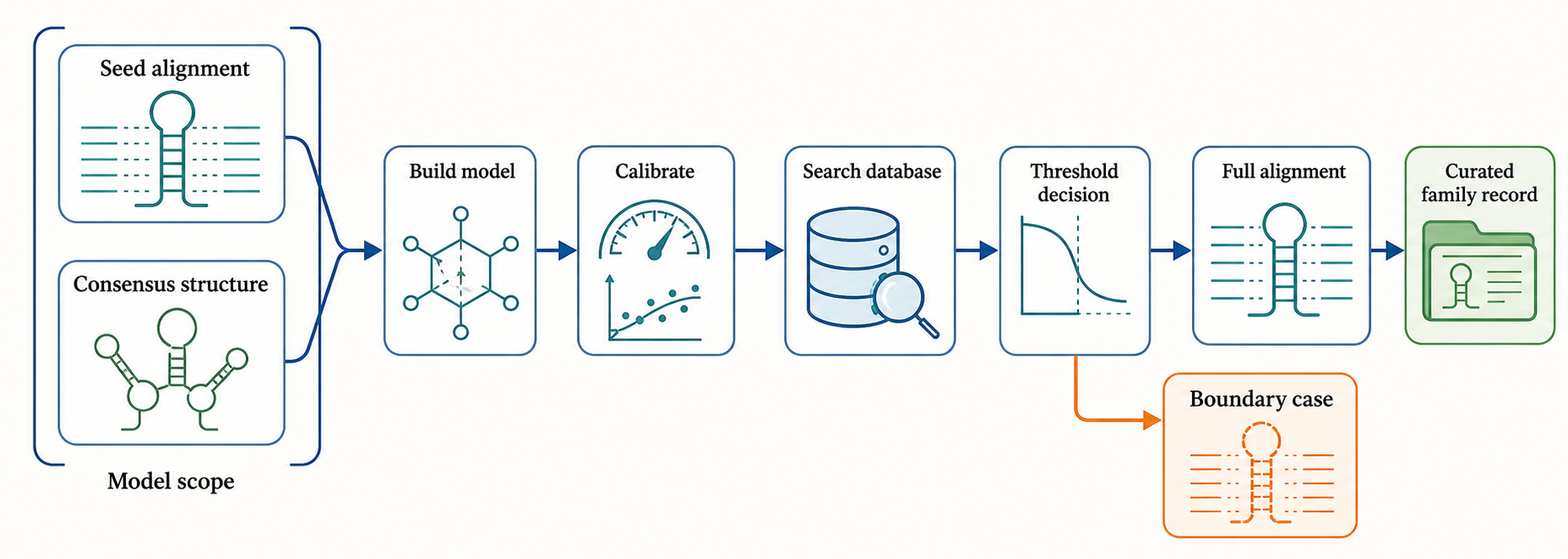
Figure 140.3. Covariance Model Construction and Search. Covariance-model annotation begins with a curated seed alignment and consensus structure, then proceeds through model building, calibration, search, thresholding, and full alignment; thresholds and human curation determine final family membership.
Rfam is a curated database of RNA families built around this model logic. A typical family record includes a curated seed alignment, a consensus secondary structure, a covariance model, family annotation, literature references, database cross-links, thresholds, and a broader set of hits generated by searching sequence databases. Rfam curation is not simply automatic clustering. Curators define family scope, choose representatives, resolve overlaps, set score cutoffs, annotate context, and update models as evidence changes. Exact record fields, thresholds, and conflict rules are release-specific and must be read from the release used in the analysis.
Family definition is a biological decision as much as a computational one. A family may be defined by common ancestry, shared structure, shared biogenesis, shared molecular function, or a practical combination. tRNAs form an ancient and easily recognized class, but tRNA genes also include organellar variants, suppressor tRNAs, pseudogenes, and fragmented or permuted forms in some lineages. Riboswitch aptamer classes are often defined by ligand specificity and structural architecture, but some aptamers diverge deeply and some metabolite-binding RNAs are known from few examples. MicroRNA families can be defined by mature sequence similarity, hairpin ancestry, seed sequence, or genomic cluster, and these definitions do not always agree. Rfam families therefore need explicit scope notes and sometimes clans or higher-level groupings to represent related but distinct families.
Family discovery often begins outside Rfam. Researchers may notice conserved intergenic elements, conserved transcript ends, repeated hairpins, expression-supported small RNAs, or motif-structure combinations near genes in a pathway. Computational discovery can search for conserved sequence motifs, predicted stable structures, unusual covariation, syntenic conservation, or expression patterns. RNAlien addresses unsupervised RNA family model construction, while LocARNAscan incorporates thermodynamic stability into sequence- and structure-based homology search. GERONIMO supports systematic retrieval of structural RNAs across broad evolutionary contexts. These tools help generate candidate families or expand known ones, but candidate families still need curation: removal of false positives, alignment inspection, taxonomic evaluation, structural support, and literature linkage.
Thresholds are where model scores become annotations. A model can assign a score or significance estimate to many database segments, but a database must decide which hits to report as family members. A gathering threshold is a curated cutoff intended to separate trusted family members from nonmembers for a particular model. The same numerical score is not comparable across all families because model length, conservation, structure, and database composition differ. Lowering thresholds increases sensitivity but can admit false positives; raising thresholds increases specificity but can miss distant homologs. Trusted cutoffs often depend on known family diversity, overlap with other models, and manual inspection around the score boundary.
Overlapping hits are common. A sequence segment may match two related RNA models, a general family and a more specific subfamily, or a true RNA family and a repetitive element model. Rfam uses concepts such as clans and competition among overlapping models to avoid presenting redundant or contradictory annotations, but exact rules are release-specific and should be checked against curated Rfam documentation before finalizing. The biological issue is broader than a database rule: closely related families may be hard to separate, while modular RNAs can contain domains that legitimately match multiple models.
Table 140.3. Rfam/Infernal Record Fields and Interpretation. Seed alignments, consensus structures, model scores, gathering thresholds, full alignments, clans, and release versions describe different parts of an Rfam or Infernal record; none alone proves biological function.
| Field or output | What it means | What it does not prove | Downstream use |
|---|---|---|---|
| Seed alignment | Curated representative core used to build the family model. | It is not a complete census or proof of function for every member. | Defines model scope, conserved columns, and starting threshold decisions. |
| Consensus structure | Family-level annotation of conserved paired and unpaired positions. | It is not a measured fold for every sequence or condition. | Guides paired states in the model and flags structure-breaking hits. |
| Covariance model score | Degree to which a target fits the sequence and paired-position model. | It does not prove transcription, processing, localization, or activity. | Ranks candidate homologs and supports threshold-based annotation. |
| Gathering threshold | Curated cutoff for trusted membership in a specific model release. | It is not universal across families, databases, or fragment types. | Separates routine annotations from boundary cases needing review. |
| Full alignment | Broader set of database hits aligned to the family model. | It is usually less manually curated than the seed alignment. | Surveys taxonomic spread, candidate expansions, and partial hits. |
| Clan or overlap decision | Resolution of related or competing models at the same locus. | It does not always mean the biology is mutually exclusive. | Prevents duplicate calls and highlights subfamily or modular conflicts. |
| Release version | Snapshot of model, threshold, source database, and curation state. | It is not permanent truth as genomes and family definitions change. | Enables reproducibility, benchmark audits, and score-threshold comparison. |
Covariance models are powerful but not omniscient. They work best for RNAs with a conserved nested secondary-structure core and enough representative sequences to estimate the model. They are less effective for very short RNAs, highly lineage-specific RNAs with few examples, RNAs whose function depends on tertiary contacts without strong secondary-structure conservation, RNAs dominated by protein-binding motifs, RNAs with extensive pseudoknots, and long lncRNAs whose function may reside in small domains or transcriptional processes rather than a conserved full-length fold. A long transcript can contain one Rfam-annotated domain without the entire transcript belonging to that family.
Curation must also distinguish genomic DNA matches, expressed RNAs, mature products, and functional molecules. A covariance-model hit in a genome indicates that the DNA contains a sequence compatible with the RNA family model. It does not prove transcription, processing, modification, localization, RNP assembly, or biological function in that organism. Expression data, processing endpoints, knockouts, biochemical assays, and comparative genomic context can strengthen the annotation. For many families, especially bacterial structured RNAs, genomic context is a major line of evidence because the RNA occurs upstream of genes in a pathway it plausibly regulates. For other families, such as snRNAs or snoRNAs, biogenesis signals and RNP protein partners matter.
Box 140.2. Covariance-Model Annotation Checklist
Before promoting a covariance-model hit to a trusted annotation, check five features. First, the hit should cover the diagnostic family core rather than only a short motif or one peripheral stem. Second, conserved paired columns should remain compatible, especially in positions that define the model’s consensus structure. Third, essential sequence features such as catalytic residues, ligand-contacting nucleotides, snoRNA boxes, anticodon loops, or processing motifs should be intact when the family has such features. Fourth, the genomic or transcript context should make biological sense for the family: orientation, neighboring genes, host transcript, processing pattern, or expected compartment can all matter. Fifth, record provenance: model accession, model release, sequence database version, score, threshold, E-value or significance estimate, coverage, and any overlap or clan decision. A strong score with broken core structure, poor coverage, or implausible context should remain a candidate, not a finished annotation.
The practical output of Rfam and Infernal should be read as curated computational evidence. Strong hits to well-curated models are among the best available annotations for many noncoding RNA families. Marginal hits, partial hits, overlapping hits, and hits from poorly sampled families should be treated as hypotheses. Model version, database version, score, threshold, alignment coverage, taxonomic context, and curation notes should travel with any downstream claim.
140.4. Search pipelines, annotation thresholds, and record assignment
An annotation pipeline turns candidate hits into records through explicit stages. A typical sequence is: prepare and validate the query or family model; choose the target database and release; apply fast filters or close-homolog searches; run a profile or covariance-model search; collect scores, significance estimates, and alignments; evaluate coverage and diagnostic features; resolve overlapping models; apply family-specific thresholds; assign confidence and record type; and preserve rejected or deferred candidates for audit. Skipping a stage may be reasonable, but the omission should be visible.
Query preparation is the first control. A single-sequence query should be checked for orientation, ambiguous bases, low complexity, adapters, assembly artifacts, and whether it represents a full RNA, a domain, a precursor, or a mature product. A family query requires a reviewed alignment, consensus annotation appropriate for the search model, and a declared taxonomic and structural scope. A long transcript containing one conserved domain should not be searched or classified as though the entire transcript were a compact RNA family.
Database choice changes both sensitivity and false-positive burden. Complete genomes support locus context but can contain assembly gaps. Transcriptomes provide expression-linked sequences but may fragment domains or omit unexpressed conditions. Metagenomes expand taxonomic diversity but contain short, chimeric, or taxonomically uncertain contigs. A general nucleotide archive maximizes breadth but mixes sequence quality and provenance. The pipeline should record the database identity and release because an E-value, candidate count, and threshold decision depend on the searched space.
Search stages often combine speed and sensitivity. A fast sequence or profile filter can remove most database segments. A covariance model can then evaluate the reduced candidate set when conserved nested structure is central. Iterative family expansion may add high-confidence hits, rebuild an alignment, and search again. Iteration can improve sensitivity, but it can also cause model drift: one false positive enters the seed, changes the model, retrieves additional false positives, and gradually shifts the apparent family boundary. Each iteration should therefore retain the prior seed, new candidates, acceptance rule, and rejected boundary cases [Barquist_2016, Eggenhofer_2016].
Thresholds convert scores into operational decisions. A gathering threshold is family- and release-specific, not a universal measure across all covariance models. A trusted full-length hit generally needs both a score above the accepted boundary and adequate coverage of the diagnostic core. A short fragment can score strongly over a conserved motif while lacking the rest of the RNA. Conversely, a remote homolog may fall below a routine threshold but preserve key motifs, structure, and context. Pipelines should distinguish routine acceptance, boundary review, and rejection rather than treating one cutoff as a biological law.
Family classification can be hierarchical. A candidate may fit a broad clan, a family, and a more specific subfamily model. Competing hits can also arise because two models overlap the same locus, because a modular RNA legitimately contains two domains, or because a repeat resembles part of an RNA family. The classifier should compare scores, coverage, diagnostic positions, model scope, and overlap rules. When evidence does not resolve the alternatives, the output should preserve the conflict rather than select one label silently.
Record assignment follows classification. A useful annotation record distinguishes a trusted full-length member, trusted partial member, candidate remote homolog, possible pseudogene, overlapping-model conflict, low-complexity suspect, and manual-review case. The record should include model accession and version, target sequence and database version, coordinates and strand, raw and normalized scores when available, significance estimate, threshold, alignment coverage, classification decision, and uncertainty reason. Expression, processing, genomic context, or biochemical evidence can be linked without being collapsed into the search score.
A riboswitch example shows why these distinctions matter. A complete aptamer hit above threshold with intact ligand-contacting positions, conserved paired core, and plausible placement upstream of pathway genes can receive a trusted family annotation. A fragment matching one conserved stem on a short metagenomic contig should be labeled partial. A subthreshold hit with plausible context but a damaged diagnostic junction should remain a candidate or possible pseudogene. None of these record types alone proves ligand binding or regulatory function.
MicroRNA annotation requires different record logic. A hairpin-like genomic hit is not enough; a pipeline may incorporate precursor coverage, mature and star-arm placement, processing compatibility, repeat overlap, and small-RNA evidence. Family assignment can refer to precursor ancestry or mature-sequence grouping, so the record must state which classification was applied. The biological evolution of those units belongs to Chapter 12; the operational pipeline must prevent a precursor-model hit from being silently reported as a validated mature functional product.
Comparative structure evidence enters as a model input and a quality-control field. A consensus structure or covariation summary can support paired columns, but deriving and benchmarking those structures belongs to Chapter 62. The annotation pipeline should record which structure annotation was used, which paired regions were covered, and whether the candidate disrupts diagnostic pairs. It should not rederive a complete physical folding model or convert covariation into a function claim.
The final pipeline output should be reproducible and reviewable. Reproducibility here means that another analyst can identify the query, model, database, commands or method class, thresholds, filters, candidate set, and assignment rule. Broader workflow-manager, software-environment, deposition, licensing, and maintenance practices are treated in Chapter 144. The scientific responsibility of this chapter is the search and annotation decision chain itself.
140.5. Benchmarking search sensitivity, database bias, and annotation uncertainty
Benchmarking asks how well a method performs on a defined task. For RNA homology search, common tasks include detecting known family members, avoiding false positives, aligning new sequences to a family, reconstructing consensus structures, classifying metagenomic fragments, expanding a curated family, or discovering new families. A benchmark needs positives, negatives, metrics, and a separation between model construction and evaluation. Each of these pieces is difficult for structured RNAs.
Positive sets are biased toward what the field already knows. Rfam and similar databases contain many well-studied RNA classes, abundant bacterial and archaeal RNAs, model-organism RNAs, and families discovered because they have strong conservation signals. Families with weak sequence conservation, narrow taxonomic distribution, poor expression evidence, long unstructured regions, or context-dependent function are underrepresented. If a benchmark uses database families as truth, it may reward methods that resemble the curation pipeline used to build the database. That is not necessarily wrong, but it narrows the interpretation: the benchmark measures performance on currently curated, detectable families, not on all functional RNAs.
Negative sets are even harder. A random genomic segment may contain an unannotated RNA. A shuffled sequence may destroy nucleotide composition, dinucleotide frequencies, or local genomic features in unrealistic ways. A matched intergenic control may include promoters, terminators, untranslated regions, repetitive elements, or undiscovered structured motifs. A sequence that lacks a database annotation is not necessarily a true negative. This is especially important in metagenomes and under-sampled lineages, where many RNAs remain unknown.
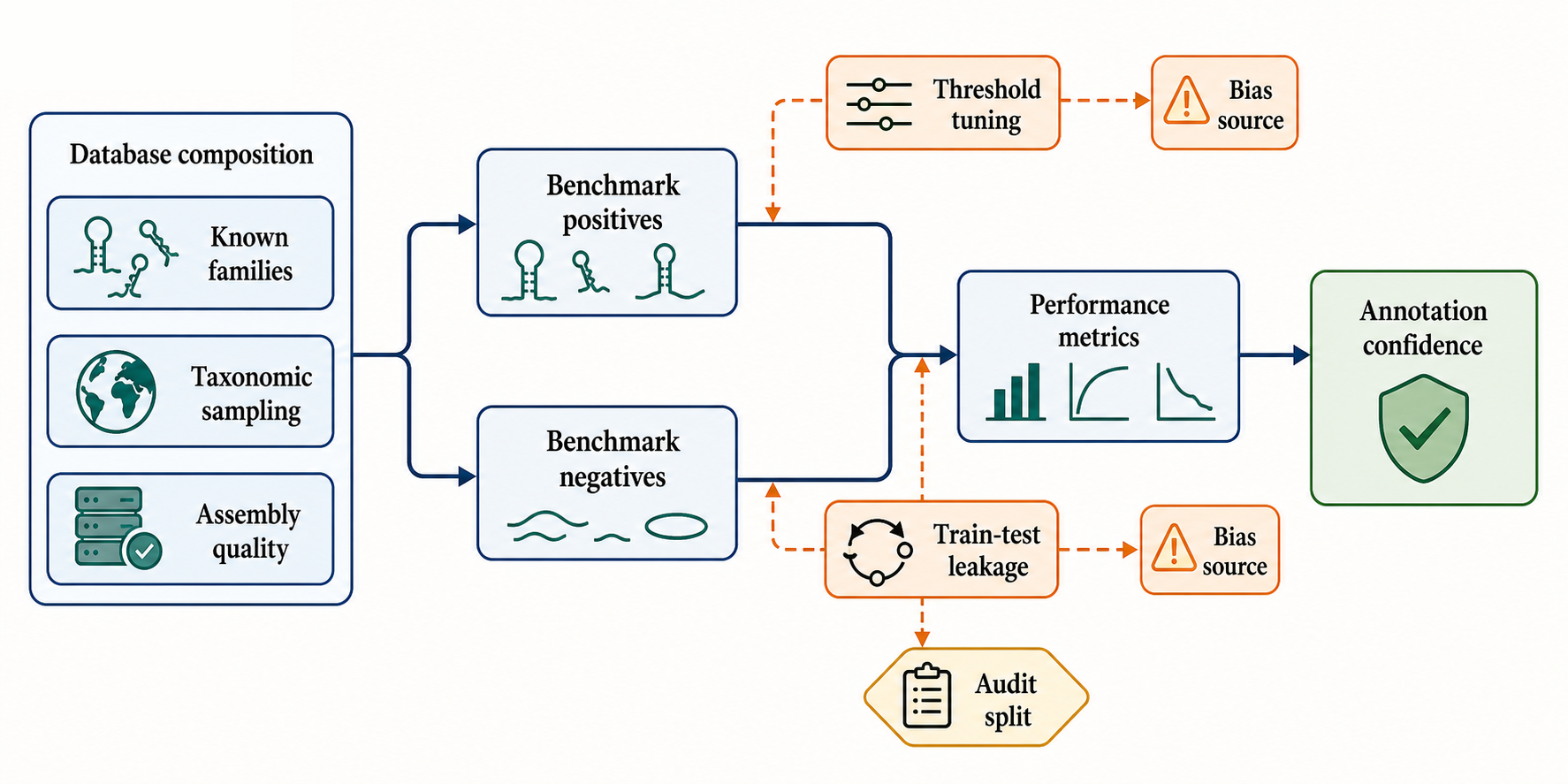
Figure 140.6. Benchmark Bias Map. Benchmark performance depends on database composition, taxonomic and assembly coverage, negative-set construction, threshold tuning, and train-test leakage; biased benchmarks can inflate annotation confidence outside the tested domain.
Metrics must match the biological question. Sensitivity asks what fraction of true family members are found. Specificity asks what fraction of nonmembers are rejected. Precision asks what fraction of called hits are correct. Recall is another name for sensitivity in many settings. Alignment accuracy measures whether homologous columns are placed correctly. Structure accuracy measures whether base pairs are predicted correctly. Family-level classification accuracy asks whether a hit is assigned to the right family rather than a related model. Runtime and memory matter because metagenomic and pangenomic databases are large. A method can be excellent for close homolog detection and poor for remote homolog discovery, or sensitive for full-length sequences and unreliable for fragments.
Database bias operates at several levels. Taxonomic bias arises because some clades have thousands of genomes and others have few. Study bias arises because rRNAs, tRNAs, riboswitches, miRNAs, and CRISPR repeats have been searched more thoroughly than rare lineage-specific RNAs. Assembly bias arises because short-read assemblies fragment repeats and structured regions, while metagenomic contigs may be incomplete or chimeric. Annotation bias arises because older database releases, gene callers, and family definitions influence later training and evaluation. Publication bias arises because striking discoveries are more likely to be curated than negative searches.
Threshold transfer is a common failure mode. A score cutoff tuned on one database release may behave differently when the database becomes larger, more diverse, or more contaminated. A threshold tuned on complete genomes may not work on short reads or fragmented contigs. A threshold tuned for one family may not apply to another family with different length and conservation. A threshold that controls false positives in bacteria may behave differently in AT-rich eukaryotic introns or viral genomes with overlapping coding constraints. Annotation pipelines should record model version, sequence database version, score, E-value or significance estimate, gathering threshold, alignment coverage, and filtering rules.
Partial hits require special labels. A metagenomic read may match one conserved stem of a ribozyme but not the catalytic core. A genome assembly gap may truncate an RNA. A pseudogene may preserve one motif while losing essential structure. A long transcript may contain a small structured domain that matches an Rfam family, but the full transcript should not inherit the domain’s function. A partial hit is often useful for discovery and taxonomic profiling, but it should not be promoted to a full functional annotation without additional evidence.
Annotation uncertainty should be part of the output. Useful labels include trusted full-length family member, trusted partial family member, candidate remote homolog, fragment, possible pseudogene, overlapping model conflict, low-complexity suspect, context-supported candidate, expression-supported candidate, and manual review required. These labels are more informative than a binary present/absent call. They also prevent downstream analyses from treating all hits as equivalent evidence.
Table 140.4. Annotation Confidence Labels. Full-length, partial, remote, pseudogene-like, overlapping, low-complexity, and review-required annotations need different minimum evidence and downstream handling; confidence labels should expose rather than hide uncertainty.
| Label | Minimum evidence | Examples | Recommended downstream handling |
|---|---|---|---|
| Trusted full-length member | Above family threshold, full diagnostic coverage, intact motifs and paired core. | Complete riboswitch aptamer upstream of pathway genes; intact tRNA-like model hit. | Include in family counts and functional hypotheses with model and database provenance. |
| Trusted partial member | Strong score and diagnostic subset, but truncated by read, contig, or assembly gap. | Metagenomic fragment covering one conserved ribozyme stem and core motif. | Use for discovery or taxonomic profiling; exclude from full-length function claims. |
| Candidate remote homolog | Marginal or subthreshold score plus preserved core structure or plausible context. | Distant riboswitch-like aptamer near relevant transport genes. | Retain as hypothesis; inspect alignment and seek expression or comparative support. |
| Possible pseudogene | Family-like sequence with disrupted essential motif, broken stem, or no biogenesis evidence. | tRNA-like copy with damaged acceptor stem; miRNA hairpin lacking processing signature. | Track separately from functional genes until rescue or expression evidence appears. |
| Overlapping model conflict | Same locus matches related family, subfamily, repeat, or modular domain model. | General riboswitch clan hit competing with a more specific aptamer model. | Resolve by score, coverage, clan rules, and context; preserve the conflict note. |
| Low-complexity suspect | Hit dominated by simple repeats, poly(A/U), biased composition, or short motif reuse. | Poly(U)-rich intronic tract or repetitive hairpin with weak model coverage. | Mask or rerun with composition controls; require independent evidence before use. |
| Manual review required | Inconsistent evidence, boundary score, unusual taxonomy, or poor sequence quality. | High score with a broken core pair; plausible metagenomic hit on a chimeric contig. | Queue curator inspection, record the reason, and block automated promotion. |
Uncertainty labels are especially important when annotations are aggregated. A genome browser track, pathway enrichment table, pangenome matrix, or machine-learning training set may hide the original score distribution and present all family calls as equivalent rows. That flattening can make a weak fragment influence downstream conclusions as strongly as a complete curated RNA. A better practice is to propagate confidence classes, exclude weak calls from analyses that require complete family members, and retain marginal calls in discovery-oriented supplements where manual review is expected.
Benchmark leakage is a specific risk for modern computational RNA methods. If a model is trained, tuned, or prompted using families that also appear in the evaluation set, performance can be inflated. Leakage can occur through identical sequences, closely related homologs, shared seed alignments, database-derived features, or family labels reused across releases. For RNA foundation models and machine-learning classifiers, leakage can also occur when train and test splits separate sequences randomly rather than by family, genome, or taxonomic clade. A realistic benchmark should split at the level appropriate to the claim: sequence-level generalization, family-level generalization, taxonomic transfer, fragment robustness, or discovery of genuinely new families.
Box 140.3. Benchmark Split Discipline
Choose benchmark splits to match the scientific claim. A random sequence split mainly tests whether a method recognizes close variants of families it has already seen. A genome-level split asks whether the method transfers to new assemblies from related organisms. A taxonomic split asks whether the method survives clade-specific composition, annotation, and evolutionary distance. A family-level split asks whether the method can recognize or rank RNA classes outside its training families. A release-time split, where training uses an older database release and testing uses later curated additions, can expose database-update leakage but still inherits curation bias. For fragment benchmarks, split complete and partial sequences deliberately rather than mixing them silently. Always remove identical or near-identical sequences across train and test sets, record database release versions, and state whether the benchmark measures annotation of known family space or discovery beyond current curation.
The final uncertainty is biological. Homology does not always mean identical function. Paralogous RNAs can diverge, riboswitch aptamers can change ligand specificity, guide RNAs can change targets, small RNAs can evolve new regulatory networks, and mobile elements can carry RNA domains into new contexts. Conversely, unrelated RNAs can converge on similar structures or motifs. Annotation should therefore distinguish family membership, structural class, molecular function, biological process, genomic context, expression evidence, and experimental validation.
Recent Consensus
Recent consensus is clear on the broad logic of RNA homology analysis. Sequence methods remain essential first-pass tools because they are fast, interpretable, and effective for close homologs. Profile methods improve sensitivity when a family has enough representative sequences to estimate position-specific conservation. Covariance models are the standard approach for many structured RNA families because they score conserved base-paired positions as coupled features rather than as independent columns. Rfam and Infernal provide foundational infrastructure for comparative RNA annotation by connecting curated seed alignments, consensus secondary structures, covariance models, thresholds, full alignments, family descriptions, and release-specific provenance.
Current best practice treats a Rfam/Infernal-style result as a sequence of reviewable operational decisions. A hit is strongest when the diagnostic core is covered, the score exceeds a family-appropriate threshold, expected motifs and paired regions are intact, competing models are resolved, context is plausible, and the model and database versions are recorded. Formal inference of conserved structure from covariation belongs to Chapter 62. The annotation output should retain confidence and record class rather than presenting an undifferentiated list of validated RNA genes.
Open Questions, Controversies, Deprecated Models, and Common Misconceptions
Open questions:
- How should annotation pipelines classify modular RNAs, rapidly evolving bacterial small RNAs, viral structured elements, long noncoding RNA domains, fragmented metagenomic hits, and guide RNAs with target-changing regions?
- How should family thresholds transfer across complete genomes, transcriptomes, metagenomic fragments, and expanding database releases without silently changing false-positive rates?
- How should competing family, subfamily, clan, repeat, and domain models be represented when one locus receives several plausible assignments?
Common misconceptions:
- “A sequence hit is not automatically a functional RNA gene.” A covariance-model match is not automatically evidence of transcription, processing, localization, RNP assembly, or biological activity. A consensus secondary structure is not a measured structure for every individual family member in every condition. A high number of genomes in a benchmark is not equivalent to high independent evolutionary depth if most genomes are closely related. A negative database result is not proof that a genome lacks a functional RNA, especially in poorly sampled lineages or low-quality assemblies.
- “Rfam family membership, homologous ancestry, structural class, ligand specificity, regulatory target, molecular function, and experimentally validated biological role are the same claim.” Weak fragments, pseudogenes, overlapping model conflicts, low-complexity matches, and lineage-specific expansions should retain uncertainty labels rather than being promoted to full family members. Benchmark results should be read with leakage, database bias, threshold transfer, and incomplete truth sets in mind. Reliable RNA annotation comes from stating exactly which claim each evidence type supports and which claims remain untested.