Chapter 39. tRNA Transcription, Processing, Identity Elements, and Quality Control
Scope Note
This chapter follows transfer RNAs from gene organization through transcription, end processing, intron removal, CCA addition, cellular logistics, identity acquisition, maturation checkpoints, and decay. Transfer RNAs are often introduced as passive adaptors between codons and amino acids, but a mature tRNA is the product of a spatially organized biogenesis pathway. Each molecule must be transcribed in the correct compartment, folded, processed at both ends, modified, assigned the identity features needed for downstream recognition, delivered to the translation apparatus, and removed or restored when misprocessed or damaged. The chapter provides the tRNA-side handoff to Chapter 40, which owns aminoacyl-tRNA synthetase catalysis, proofreading, disease, inhibitors, and engineering.
Executive Summary
Transfer RNAs are small structured RNAs that connect nucleotide sequence to amino acid sequence. A mature tRNA carries an anticodon that base-pairs with a codon in messenger RNA and a covalently attached amino acid at its 3′ CCA terminus. That simple adaptor definition is accurate but incomplete. The cell must first make the tRNA, sculpt it from a precursor, verify that it has the right ends and structure, add or preserve the CCA terminus, modify many nucleotides, attach the correct amino acid, and prevent defective or mischarged molecules from corrupting translation.
Most eukaryotic nuclear tRNA genes are transcribed by RNA polymerase III, a polymerase specialized for many short noncoding RNAs. Eukaryotic tRNA promoters are unusual because the major promoter elements often lie inside the transcribed tRNA coding region. Bacterial tRNAs are transcribed by the single bacterial RNA polymerase, frequently as parts of operons or polycistronic transcripts. Organellar tRNAs are embedded in mitochondrial or plastid transcription programs and may be processed from larger precursor RNAs. A reader should therefore avoid the phrase “tRNA transcription” as if it named one universal pathway. The promoter logic, transcription unit, termination signal, chromatin context, and processing order differ by domain and compartment (Jarrous et al. 2022; Chery and Drouard 2023; Barshad et al. 2018).
Newly transcribed tRNAs are usually not immediately functional. A precursor tRNA may contain a 5′ leader, a 3′ trailer, an intron, missing CCA, extra flanking sequences from a polycistronic transcript, or abnormal folding features. The 5′ leader is removed by RNase P, a ribonucleoprotein enzyme in many systems and a protein-only enzyme in some organelles. The 3′ trailer is removed by pathways that include RNase Z or other exonucleolytic and endonucleolytic activities depending on organism. Some tRNAs, especially many eukaryotic and archaeal tRNAs, contain introns that are removed by tRNA splicing endonucleases and ligation pathways. These events are processing steps, not optional refinements. Incorrect ends can prevent aminoacylation, block export, trigger decay, or generate disease phenotypes.
The CCA sequence at the mature 3′ end is the universal amino acid attachment platform for tRNAs used in ribosomal translation. Some tRNA genes encode CCA; others do not. CCA-adding enzymes, also called tRNA nucleotidyltransferases, can add C, C, and A without a nucleic acid template by recognizing the tRNA acceptor end and using protein active-site geometry. CCA addition is a maturation step, a repair step when the end is damaged, and a quality-control checkpoint because only a correctly shaped acceptor end should be efficiently completed. In eukaryotes, tRNAs also move between nucleus and cytoplasm, and some tRNAs can undergo retrograde nuclear import under stress or quality-control conditions. The logistics of tRNA movement are therefore part of maturation rather than a separate transport afterthought (Jarrous et al. 2022).
Maturation must produce a tRNA that the charging machinery can recognize. Identity elements—including acceptor-stem pairs, the discriminator base, anticodon features, variable-arm geometry, and modifications—form a distributed recognition surface rather than one universal barcode. This chapter explains how transcription, processing, folding, and modification create that surface. Chapter 40 then follows the handoff through the two-step aminoacylation reaction, class I and class II synthetase architectures, editing, indirect pathways, kinetics, inhibitors, disease, and engineered orthogonal pairs.
tRNA quality control operates at several layers. Misprocessed tRNAs can be degraded before export or translation. Mature tRNAs with missing modifications, unstable acceptor stems, damaged ends, or structural defects can enter decay pathways. Aminoacyl-tRNA synthetases proofread substrates during charging. Translation factors and the ribosome impose additional selection, but they cannot fully correct a tRNA that carries the wrong amino acid. Decay pathways that remove defective tRNAs protect translation fidelity, but the same cleavage products can be confused with regulated tRNA fragments unless the experimental evidence distinguishes precursor processing, decay, stress cleavage, and functional small RNA accumulation. Chapter 41 treats tRNA fragments and modifications in more depth.
Disease and biotechnology show why tRNA biogenesis is not a housekeeping footnote. Human disease can arise from mutations in tRNA genes, tRNA processing enzymes, CCA-addition factors, aminoacyl-tRNA synthetases, and proteins that organize tRNA maturation. Mitochondrial tRNAs are especially disease-prone because many mitochondrial tRNAs have noncanonical structures and because mitochondrial translation is essential for oxidative phosphorylation. Repeat-expansion disorders can also intersect with tRNA processing or aminoacylation, as recent studies report disruption of tRNA processing by FAM98B aggregation in GGC repeat disorders and impaired phenylalanine-tRNA aminoacylation by C9orf72 repeat RNA (Yang et al. 2025; Malnar Črnigoj et al. 2023). Biotechnology uses the same principles in reverse: engineered tRNAs, orthogonal synthetases, suppressor tRNAs, and recoded genomes exploit identity elements and charging specificity to alter translation.
Concept Inventory
- Transfer RNA: a small structured RNA, usually about 70-90 nucleotides in bacteria and eukaryotic cytosol, that carries an amino acid and reads messenger RNA codons through an anticodon. The cloverleaf secondary structure describes the acceptor stem, D arm, anticodon arm, variable region, and T arm. The L-shaped tertiary structure places the anticodon and amino acid attachment end at opposite ends of the molecule.
- Precursor tRNA: a transcript that has not yet acquired the structure and ends required for normal function. It may contain a 5′ leader, a 3′ trailer, an intron, missing CCA, or additional neighboring RNA segments. Precursor status is not a sign of error by itself; precursor tRNAs are normal intermediates.
- RNase P: the enzyme that removes the 5′ leader from precursor tRNAs in most systems. In bacteria and many eukaryotic nuclei, RNase P is a ribonucleoprotein whose RNA component contributes directly to catalysis. In some organelles and lineages, protein-only RNase P enzymes perform the same general reaction. Chapter 11 covers ancient ribonucleoproteins and RNase P ancestry.
- RNase Z: a tRNA 3′ endonuclease that removes 3′ trailer sequences from many precursor tRNAs. The human ELAC2 protein is a long-form RNase Z family enzyme important for mitochondrial and nuclear tRNA 3′ processing.
- CCA terminus: the cytidine-cytidine-adenosine sequence at the 3′ end of mature tRNAs. The amino acid is esterified to the ribose of the terminal adenosine. CCA can be genome-encoded or added after transcription by a CCA-adding enzyme.
- Aminoacylation handoff: the transition from a mature, identity-competent tRNA to the charged aminoacyl-tRNA used in translation. This chapter owns how biogenesis creates a recognizable tRNA; Chapter 40 owns the two-step enzyme reaction and synthetase-family mechanisms.
- tRNA identity elements: molecular features that allow a synthetase to recognize the correct tRNA. Antideterminants are features that prevent recognition by the wrong synthetase. Identity is distributed: a single base may be decisive for one tRNA family, while another family uses a pattern across the acceptor stem, anticodon, and tertiary structure.
- Charging-dependent quality-control handoff: the checkpoint at which a mature tRNA is accepted, rejected, mischarged, edited, or diverted by aminoacylation machinery. The consequence for tRNA maturation is introduced here; comparative editing mechanisms belong to Chapter 40.
- tRNA quality control: selective handling of defective tRNAs. It includes processing checkpoints, nuclear retention, export failure, end repair, CCA repair, deacylation, nuclease-mediated decay, and stress-induced cleavage. A quality-control substrate should be distinguished from a normal precursor or a functional regulated fragment.
What to Know Before Reading This Chapter
The reader should know that RNA molecules have polarity. The 5′ end and 3′ end carry different chemical groups, and enzymes often recognize one end specifically. For tRNAs, the 5′ end must be correctly trimmed, while the 3′ end must terminate in CCA for amino acid attachment. A tRNA with a nearly correct sequence but the wrong end chemistry may fail as a translation adaptor.
The reader should also know the basic translation cycle. During elongation, an aminoacyl-tRNA enters the ribosomal A site with elongation factor assistance, pairs its anticodon with an mRNA codon, and donates its amino acid to the growing polypeptide. The ribosome checks codon-anticodon geometry, but it largely does not check whether the amino acid attached to the tRNA is chemically correct. That is why aminoacyl-tRNA synthetases and their proofreading functions are central to translation fidelity.
Finally, tRNAs are heavily modified RNAs. This chapter mentions modifications when they affect processing, stability, or aminoacylation, but Chapter 41 treats modification chemistry and stress-regulated tRNA fragments in detail. A useful working rule is that modification, processing, folding, and charging are interdependent. A missing modification may destabilize a tRNA, alter synthetase recognition, slow decoding, or expose the molecule to decay.
39.1. tRNA transcription and gene organization
tRNA transcription is the production of tRNA precursor RNA from tRNA genes. A tRNA gene is usually short, but its genomic context can be complicated. Some tRNA genes are isolated transcription units. Others are clustered, repeated many times, embedded in operons, interspersed with other stable RNA genes, or positioned inside organellar polycistronic transcripts. Gene organization matters because it determines which polymerase transcribes the gene, where the precursor begins and ends, whether neighboring RNAs must be separated, and which processing enzymes encounter the transcript first.
In bacteria, one RNA polymerase transcribes protein-coding genes, ribosomal RNA genes, tRNA genes, and many other RNAs. Bacterial tRNA genes can occur alone, in clusters of tRNAs, or in rRNA operons. A single bacterial transcript may therefore contain rRNA segments, one or more tRNAs, and flanking sequences that must be cleaved. The core logic is economical: transcription can produce a larger precursor, and processing enzymes convert that precursor into stable functional RNAs. This arrangement makes bacterial tRNA maturation naturally connected to ribosome biogenesis and growth rate.
Eukaryotic nuclear tRNA genes are mainly transcribed by RNA polymerase III. RNA polymerase III is the eukaryotic nuclear polymerase specialized for many abundant short noncoding RNAs, including tRNAs and 5S ribosomal RNA. A common tRNA gene uses internal promoter elements called the A box and B box. “Internal” means that the promoter elements lie within the DNA sequence that will be transcribed into the tRNA body. General transcription factors assemble on these elements and recruit RNA polymerase III. This is a major contrast with many protein-coding genes, where promoter elements usually lie upstream of the transcribed region. Chapter 21 treats RNA polymerase III architecture and initiation in detail.
Internal promoters create a useful but sometimes counterintuitive principle: a tRNA gene sequence can encode both a functional RNA product and the DNA signals for making that product. Mutations in the same region can therefore affect transcription factor binding, tRNA folding, synthetase recognition, decoding, or several of these at once. Interpretation of tRNA variants must ask whether the variant changes the gene as a transcription unit, the RNA as a folding molecule, or the mature tRNA as a translation adaptor.
Eukaryotic tRNA genes are also genomic landmarks. In several organisms, tRNA genes cluster near chromatin boundaries, replication features, or three-dimensional genome organization sites. Those architectural roles should not be overgeneralized. A tRNA gene can be a transcription unit, a chromatin-associated landmark, a repeated element, or a source of tRNA fragments depending on context. The direct topic here is the RNA biogenesis route. Broader genome organization belongs with Chapters 15 and 21.
Organellar tRNA gene organization follows the rules of the organelle rather than the nuclear rules. Mammalian mitochondrial DNA encodes a compact set of tRNAs interspersed among rRNA and mRNA regions. In the classic tRNA punctuation model, mitochondrial tRNAs serve as processing landmarks: excising tRNAs from a long precursor releases neighboring mRNA and rRNA segments. This model is most useful for mammalian mitochondria and should not be treated as a universal organellar rule. Plant mitochondria, chloroplasts, and protist organelles have different genome architectures, intron patterns, editing requirements, and imported tRNA dependencies (Barshad et al. 2018; Chery and Drouard 2023).
Plant systems illustrate why tRNA genes should be interpreted across compartments. A plant cell contains nuclear, mitochondrial, and chloroplast genomes. Some tRNAs are encoded in organelles, some are nuclear encoded and function in the cytosol, and some lineages import tRNAs into organelles. Plant tRNA biology also includes functions beyond canonical translation, including regulatory or stress-linked roles discussed in the plant-focused review by Chery and Drouard. For this chapter, the important point is that compartment assignment changes every later step: the polymerase, processing enzymes, modifications, aminoacyl-tRNA synthetases, transport factors, and quality-control pathways are not identical across nucleus, mitochondrion, and chloroplast.
The evidence for tRNA transcription and gene organization comes from genome annotation, transcript-end mapping, chromatin immunoprecipitation of polymerase and transcription factors, nascent RNA assays, tRNA-specific sequencing, comparative genomics, and genetic perturbation of transcription machinery. Each method has limitations. Short reads often map ambiguously among repeated tRNA genes. Mature tRNAs are highly modified and structured, which can block reverse transcriptase and bias sequencing. A signal at a tRNA locus may represent a mature tRNA, precursor tRNA, tRNA fragment, or cross-mapping from another gene copy. Strong claims about a specific tRNA gene therefore require locus-aware mapping and, when possible, direct precursor evidence.
39.2. 5-prime leader, 3-prime trailer, and intron processing
Most precursor tRNAs need end processing. The 5′ leader is the sequence upstream of the mature tRNA 5′ end in a precursor transcript. The 3′ trailer is the sequence downstream of the mature tRNA body, before any mature CCA terminus. These flanking segments are useful during transcription and precursor formation, but they must be removed because the mature tRNA structure begins and ends at precise positions. If the 5′ or 3′ end is wrong, the acceptor stem may not form correctly, the CCA-adding enzyme may fail, the synthetase may not recognize the tRNA, or the molecule may be retained and degraded.
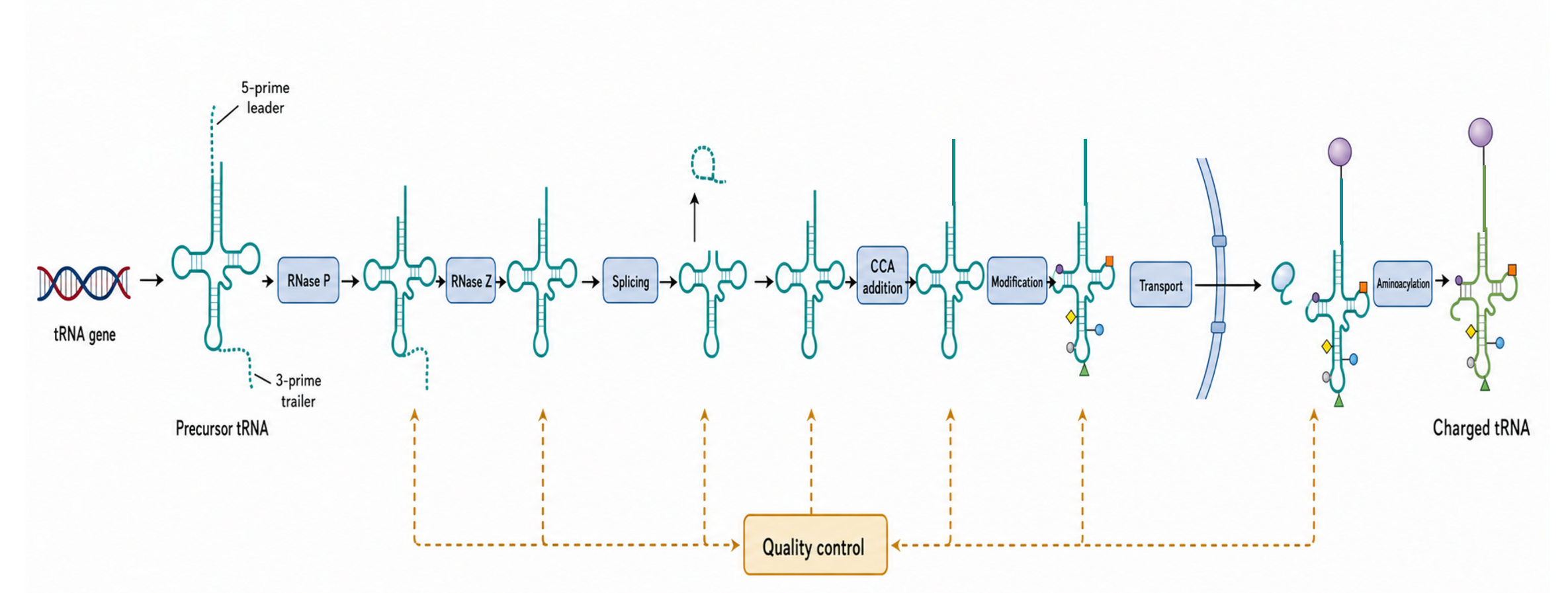
Figure 39.1. tRNA Biogenesis Pipeline. tRNA biogenesis is a coordinated maturation pathway rather than a single transcription event. A precursor tRNA is transcribed from an isolated gene, a cluster, an operon, or an organellar polycistronic transcript, then processed at its 5′ and 3′ ends, spliced if an intron is present, completed with a CCA terminus, modified, exported or imported to the correct compartment, and charged with its amino acid. Errors at any step can block charging, alter localization, or route the molecule into quality control.
RNase P performs 5′ leader removal in most known tRNA biogenesis pathways. In bacterial RNase P and many nuclear RNase P systems, the enzyme is a ribonucleoprotein: it contains both RNA and protein, and the RNA component is central to substrate recognition and catalysis. This is historically important because RNase P helped establish that RNA can be catalytic. In some organelles and eukaryotic lineages, protein-only RNase P enzymes perform tRNA 5′ processing. The shared task is the same: identify the mature tRNA boundary and cleave the precursor so the tRNA has the correct 5′ end.
The substrate-recognition problem for RNase P is subtle. RNase P does not read a long protein-like coding sequence. It recognizes the folded or foldable shape of precursor tRNA, including features of the acceptor stem and leader junction. This explains why tRNA folding and processing are coupled. A mutation that destabilizes the acceptor stem can reduce RNase P processing even if the cleavage-site sequence is not directly changed. Conversely, a leader sequence can influence folding and processing kinetics even though the leader will not remain in the mature tRNA.
The 3′ trailer can be removed by RNase Z family endonucleases or by other nucleases depending on organism and substrate. RNase Z cleaves downstream of the discriminator base to create a 3′ end that can be completed by CCA addition when CCA is not genome encoded. In human cells, ELAC2 is a clinically important RNase Z family enzyme with roles in tRNA 3′ processing, including mitochondrial tRNA maturation. The current bibliography supports tRNA processing at chapter level through Jarrous et al. but is not enough for all named enzyme mechanisms.
Some tRNAs contain introns. A tRNA intron is an intervening sequence within the tRNA precursor that must be removed to generate a functional mature tRNA. In many eukaryotic nuclear tRNAs, introns are near the anticodon loop. In archaea, intron positions can be more diverse. tRNA splicing differs from spliceosomal pre-mRNA splicing. It uses tRNA splicing endonucleases that recognize tRNA structure and cut at exon-intron boundaries, followed by ligation and end-healing steps that restore a continuous tRNA. The tRNA must then fold into a mature architecture that can be modified and aminoacylated.
It is important not to confuse tRNA introns with group I, group II, or spliceosomal introns. The word intron only means an intervening sequence removed from a precursor; it does not specify one chemistry. tRNA intron removal has its own enzyme families, substrate recognition logic, and quality-control consequences. Chapter 27 covers spliceosome chemistry and intron evolution. This section focuses on tRNA-specific splicing.
Processing order is not fixed across life. In one system, 5′ leader removal may precede 3′ processing; in another, 3′ trimming, intron removal, modification, or CCA addition may occur in a different order. Compartment also matters. In budding yeast, some tRNA processing and splicing events are spatially organized across nucleus, cytoplasm, and organellar surfaces. In mammalian mitochondria, tRNA cleavage can release neighboring mRNAs and rRNAs from long polycistronic transcripts. In plants, organellar tRNA maturation may intersect with RNA editing, intron splicing, and imported nuclear-encoded factors. Jarrous et al. emphasize coordination between transcription and tRNA processing rather than a simple assembly line.
The evidence basis for processing pathways includes primer extension, northern blotting, RNA-end mapping, high-throughput tRNA sequencing, in vitro processing assays, loss-of-function genetics, subcellular localization, and rescue by wild-type or catalytic-mutant enzymes. A key artifact is that mature tRNAs are difficult sequencing substrates because modifications and tight structure can block reverse transcription. Precursor tRNAs may therefore appear overrepresented or underrepresented depending on library chemistry. Another artifact is indirect accumulation: loss of a processing enzyme may destabilize a whole maturation compartment, so a precursor increase does not automatically identify the direct cleavage substrate.
Table 39.1. Major tRNA Maturation Enzymes and Substrates. Each maturation step is carried out by a specific enzyme class, and failure at any step has predictable consequences for downstream processing or translation.
| Step | Substrate | Main enzyme or factor | Product | Failure consequence |
|---|---|---|---|---|
| 5′ leader removal | Precursor tRNA with 5′ leader | RNase P (ribonucleoprotein or protein-only) | Mature 5′ end | Precursor accumulation; impaired aminoacylation |
| 3′ trailer removal | Precursor tRNA with 3′ trailer | RNase Z / ELAC2 or exonucleases | Mature discriminator base at 3′ end | Failed CCA addition; precursor accumulation |
| Intron removal | Intron-containing pre-tRNA | tRNA splicing endonuclease and RNA ligase | Continuous tRNA body | Unspliced precursor; blocked modification and aminoacylation |
| CCA addition | Processed tRNA 3′ end lacking CCA | CCA-adding enzyme (TRNT1 in humans) | Aminoacylation platform (CCA terminus) | Reduced charging; quality-control decay |
| Modification | Mature or maturing tRNA | Modification enzyme families | Stable, decoding-competent tRNA | Decay or decoding defects; synthetase misrecognition |
| Aminoacylation | Mature modified tRNA | Aminoacyl-tRNA synthetase | Charged tRNA (aminoacyl-tRNA) | Translation error or proteome-wide mistranslation |
39.3. CCA addition, maturation, and nuclear-cytoplasmic logistics
The CCA terminus is the three-nucleotide sequence at the 3′ end of every canonical tRNA used by the ribosome. The amino acid is attached to the ribose of the terminal adenosine. This makes CCA a chemical platform, not a decorative tail. Without a correct CCA end, a tRNA cannot be charged by an aminoacyl-tRNA synthetase and cannot function in translation.
Some tRNA genes encode the CCA sequence in the genome. Many do not. When CCA is absent from the primary transcript, a CCA-adding enzyme adds C, C, and A after 3′ end processing. These enzymes are template-independent polymerases: they do not copy a nucleic acid template. Instead, the protein active site and the tRNA acceptor end guide nucleotide choice and order. The enzyme must add two cytidines and then one adenosine, stop at the correct point, and avoid making long nonspecific tails. That specificity makes CCA addition a striking example of protein-guided RNA end synthesis.
CCA addition is also a repair pathway. The 3′ end of a tRNA can be damaged, shortened, or incompletely processed. Re-adding CCA can restore aminoacylation competence if the rest of the tRNA is intact. Conversely, failure to add or maintain CCA can convert an otherwise normal tRNA into a quality-control substrate. In human disease genetics, TRNT1, the gene encoding the nuclear CCA-adding enzyme that services cytosolic and mitochondrial tRNAs, is associated with disease phenotypes when mutated. support related tRNA maturation context but do not substitute for gene-specific provenance.
Maturation is broader than end trimming and CCA addition. A mature tRNA has the correct ends, folded tertiary structure, modification pattern, aminoacylation competence, and cellular location. Some modifications occur early and influence folding or processing. Others occur after end maturation. Chapter 41 treats modifications in detail, but this chapter must keep them in view because a missing modification can expose a tRNA to decay or alter synthetase recognition. Suzuki reviews the disease relevance of tRNA modifications and provides a bridge to the next chapter.
Nuclear-cytoplasmic logistics are part of eukaryotic tRNA maturation. A nuclear-encoded tRNA is transcribed in the nucleus but functions mainly in cytoplasmic translation unless it is imported into an organelle or retained for processing. Export receptors recognize features of mature or maturing tRNAs and move them through nuclear pores. Export is selective: a tRNA with unprocessed ends, defective structure, or missing maturation marks may be retained or re-imported rather than used in translation.
Retrograde tRNA import is the movement of tRNAs from cytoplasm back into the nucleus. This process is well characterized in yeast and has been linked to nutrient conditions and quality-control logic. The mechanistic interpretation should be cautious. Retrograde import is not simply “reverse export”; it can connect tRNA availability, stress state, modification, and nuclear surveillance. The present bibliography establishes the need to coordinate transcription and processing but is thin for transport-factor specifics.
Organellar logistics add another layer. Mitochondria and chloroplasts need tRNAs for organellar translation. Some organelles encode enough tRNAs for their translation system, while others import nuclear-encoded tRNAs. Import requires recognition, transport across organellar membranes, and compatibility with organellar aminoacylation and ribosomes. A cytosolic tRNA that is imported into a mitochondrion may encounter different modification enzymes, synthetases, and quality-control pressures than it would in the cytosol. Chapter 17 covers organellar RNA gene content; this chapter emphasizes that tRNA logistics influence maturation and function.
The evidence for CCA addition and logistics includes biochemical assays with purified CCA-adding enzymes, sequencing of tRNA 3′ ends, genetic depletion of nucleotidyltransferases, aminoacylation measurements, subcellular fractionation, fluorescence localization, nuclear export assays, and organellar import assays. Each method has interpretive limits. Oligonucleotide ligation-based end mapping may fail if the tRNA end is blocked or aminoacylated. Subcellular fractionation can mix nuclear, cytosolic, and organellar pools. Aminoacylation assays can be disrupted by deacylation during extraction. Strong studies preserve charging state, verify compartment purity, and connect end state to functional aminoacylation.
39.4. tRNA identity elements and the handoff from maturation to aminoacylation
A processed tRNA is not automatically identity competent. Its acceptor stem, discriminator base, anticodon loop, variable arm, tertiary fold, modifications, and terminal CCA together create a surface that downstream enzymes interpret. A tRNA identity element is a nucleotide or structural feature whose alteration changes recognition by a cognate aminoacyl-tRNA synthetase; an antideterminant reduces recognition by a noncognate enzyme. Identity is therefore relational: a feature matters with respect to a particular enzyme in a particular organism and compartment.
Biogenesis establishes that relational surface. Five-prime and 3′ processing expose the mature acceptor stem. CCA addition supplies the terminal adenosine that receives the amino acid. Intron removal restores anticodon-loop architecture. Modifications can stabilize tertiary structure or directly alter contacts. Nuclear export and organellar import place the mature tRNA in the same compartment as a compatible synthetase. Failure at any earlier step can appear experimentally as reduced charging even when the synthetase itself is normal.
Alanine tRNA provides the classic counterexample to anticodon-only identity. In many systems, the G3:U70 wobble pair in the acceptor stem is a major determinant for alanyl-tRNA synthetase. Transplanting or disrupting this pair can redirect or reduce recognition, showing that a feature far from the anticodon can dominate charging identity. The exact contribution must still be tested in the organism and tRNA background at issue; identity rules are conserved unevenly and can be modified by neighboring sequence or chemical modification.
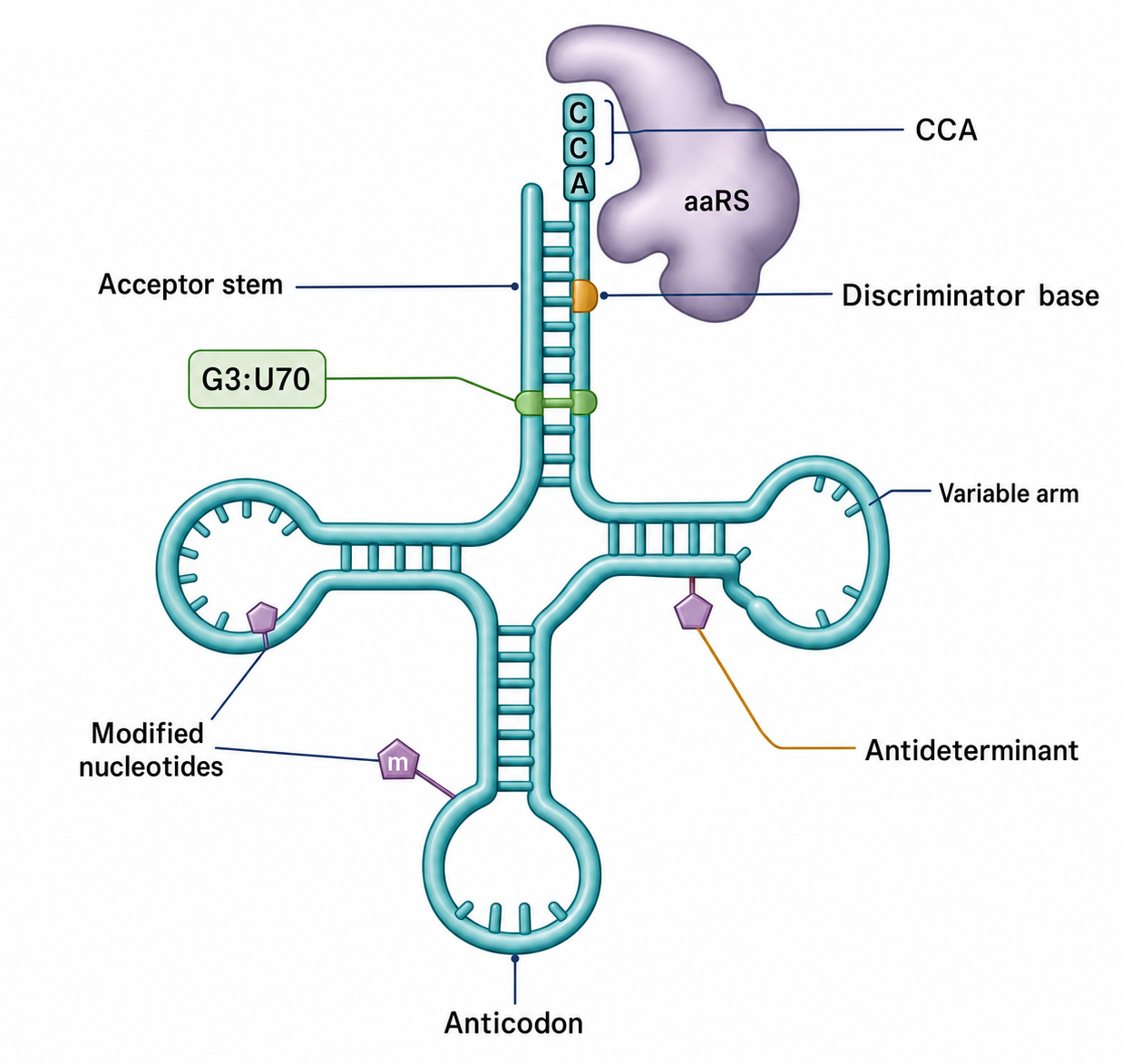
Figure 39.2. tRNA Identity-Element Map. Aminoacyl-tRNA synthetases read distributed identity information across the tRNA body, including the anticodon, acceptor stem base pairs, discriminator base at position 73, variable arm, and chemically modified nucleotides. The anticodon can be important, but acceptor-stem and discriminator-base features can dominate recognition in specific tRNA families; for example, a G3:U70 wobble pair in the acceptor stem is a major identity element for alanyl-tRNA synthetase. Antideterminants at other positions prevent recognition by the wrong synthetase.
Box 39.1. Why the Anticodon Is Not the Whole Identity Code
The anticodon defines which codon a tRNA reads, but it does not always define which amino acid is attached. Synthetases must solve both problems—selecting the correct tRNA and rejecting near-cognate tRNAs—by recognizing distributed features across the tRNA body. The best-known example is tRNA^Ala: the major identity element for alanyl-tRNA synthetase is a G3:U70 wobble base pair in the acceptor stem, far from the anticodon. Swapping this pair into another tRNA body can redirect aminoacylation toward alanine even without changing the anticodon. Antideterminants at other positions block cross-recognition by non-cognate synthetases. Codon reading and amino acid charging are related but distinct recognition problems, each solved by different structural features of the same molecule.
Antideterminants matter because all tRNAs share the same broad L-shaped architecture. A synthetase must reject near-cognate tRNAs as well as recognize its cognate set. This negative recognition becomes especially important across compartments: a nuclear-encoded tRNA imported into an organelle may encounter a different synthetase repertoire, while a duplicated tRNA family can evolve identity changes without altering its decoded codon. Comparative claims must specify whether they concern cytosolic, mitochondrial, plastid, bacterial, or archaeal identity.
Charging assays report the success of the whole handoff, not automatically the cause of failure. Acid-preserving extraction and acid-urea electrophoresis can separate charged and uncharged tRNA species; chemistry-aware sequencing and mass spectrometry can extend the analysis across tRNA pools. Ceriotti et al. map Arabidopsis aminoacylation states at scale, illustrating that abundance and charging are different measurements. A reduced charged fraction can arise from failed maturation, a missing modification, synthetase inhibition, amino-acid limitation, rapid deacylation during handling, or altered subcellular composition.
Identity-swap experiments provide stronger causal evidence. A candidate determinant is mutated in the tRNA, transferred to a different tRNA background, or paired with a synthetase mutation; charging and mischarging are then measured under defined conditions and in cells. Structural contact is supportive but not sufficient, because a visible contact may contribute little to discrimination. Likewise, binding does not equal productive aminoacylation. Chapter 40 develops the kinetic partitions among amino-acid activation, tRNA binding, transfer, editing, product release, and trans-editing.
The ownership handoff prevents duplication. This section ends when a mature tRNA presents its identity surface to the charging machinery. Chapter 40 owns synthetase classes, catalytic steps, amino-acid selection, proofreading, indirect pathways, complexes, evolution, disease alleles, inhibitors, and orthogonal synthetase–tRNA engineering, including the reaction-cycle visual formerly planned here. Chapter 68 then follows correctly charged tRNAs into elongation.
39.5. Quality control, proofreading, and decay
tRNA quality control is the set of mechanisms that prevent defective tRNAs from damaging translation. The substrate can be a precursor with unprocessed ends, a mature-looking tRNA with a folding defect, a tRNA missing critical modifications, a damaged tRNA end, a hypomodified tRNA prone to cleavage, a mischarged tRNA, or a tRNA fragment that must be cleared. These substrates are different, and the evidence needed to classify them is different.
Processing checkpoints act early. A tRNA with an abnormal 5′ leader, 3′ trailer, intron, or acceptor stem may fail to pass through normal maturation. It can be retained in the nucleus, fail export, fail CCA addition, fail aminoacylation, or become a nuclease substrate. In eukaryotic systems, nuclear surveillance helps prevent immature tRNAs from reaching the cytoplasmic ribosome. In organelles, failed tRNA processing can disrupt processing of neighboring RNAs, especially where tRNAs are embedded in polycistronic transcripts.
Decay pathways remove defective tRNAs. In yeast, the rapid tRNA decay pathway is a well-known model in which structurally unstable mature tRNAs, often destabilized by missing modifications or acceptor-stem defects, are degraded by exonucleases. Nuclear surveillance and mature tRNA decay pathways can overlap conceptually but should be separated experimentally: one acts mainly on precursor or incorrectly localized molecules, while another acts on mature or nearly mature tRNAs that fail stability requirements.
Charging machinery adds a downstream quality-control gate. A synthetase may reject an immature tRNA, fail to charge it, or edit a misactivated or misacylated product before translation. This matters because the ribosome primarily checks codon-anticodon geometry rather than the chemical identity of the attached amino acid. The tRNA-biogenesis consequence belongs here; pre-transfer, post-transfer, and trans-editing mechanisms are compared in Chapter 40.
The cell also has to handle deacylated tRNAs. A deacylated tRNA can signal amino acid limitation and alter translation programs. In bacteria, uncharged tRNAs entering the ribosomal A site activate stringent-response signaling through RelA-family systems. In eukaryotes, uncharged tRNAs can activate GCN2 kinase through mechanisms covered in stress and translation chapters. This signaling role does not mean deacylated tRNAs are always defective; deacylation can be a normal sensor state. Quality-control language should be reserved for molecules that are damaged, misprocessed, unstable, or incorrectly charged.
tRNA cleavage is another source of confusion. Stress nucleases can cleave mature tRNAs into halves or smaller fragments, and some tRNA-derived fragments have proposed regulatory functions. Other fragments are decay intermediates from defective tRNAs. Chapter 41 handles this area in detail. For Chapter 39, the key caution is that fragment detection alone does not prove a regulated small RNA function. The investigator must determine whether the fragment arises from a specific nuclease, whether its end chemistry matches the proposed pathway, whether it accumulates independently of general RNA decay, and whether perturbing the fragment changes a biological output.
Recent work also connects tRNA processing factors to disease-linked aggregation. Yang et al. report that polyglycine-mediated aggregation of FAM98B disrupts tRNA processing in GGC repeat disorders. This kind of mechanism is important because it links a protein-aggregation phenotype to a specific RNA maturation pathway. The evidence standard is higher than colocalization: the disease model should connect repeat translation or aggregation to loss of a processing factor, altered tRNA maturation, downstream translation or cellular defects, and rescue where feasible.
Some quality-control references in the current bibliography concern mRNA surveillance, exosome-ribosome complexes, nonsense-mediated decay, and translation-coupled mRNA quality control (Chang et al. 2007; Monaghan et al. 2023; Inada and Beckmann 2024; Kogel et al. 2024; Tan et al. 2025; Zhang et al. 2025). These sources are useful as conceptual boundary material, not as direct tRNA decay provenance. They remind the reader that RNA surveillance often couples to translation, ribosomes, and decay machines. However, a claim about tRNA decay should be supported by tRNA-specific evidence whenever possible.
The evidence ladder for tRNA quality control begins with substrate definition. Is the molecule a precursor, mature tRNA, aminoacyl-tRNA, misacylated tRNA, or fragment? Next comes pathway assignment: which nuclease, synthetase editing domain, export factor, or processing enzyme recognizes it? Then comes causality: does perturbing the factor change the substrate in the predicted direction, and does a rescue restore the normal tRNA pool? Finally comes biological consequence: does the quality-control failure alter decoding, proteome fidelity, stress survival, mitochondrial translation, growth, development, or disease phenotype?
Table 39.2. Evidence Ladder for tRNA Claims. Different types of claims about tRNA biology require different evidence, and each is vulnerable to specific artifacts that can mimic or mask the true result.
| Claim type | Weak evidence | Stronger evidence | Common artifact | Best follow-up |
|---|---|---|---|---|
| tRNA transcription rate | Mature tRNA abundance | Nascent RNA mapping; RNA Pol III occupancy by ChIP | Processing or decay change masquerades as transcription change | Combine promoter perturbation with precursor-specific assay |
| Precursor processing defect | Reduced mature tRNA | Northern blot with precursor-specific probe; in vitro cleavage rescue | Indirect loss of maturation compartment inflates precursor signal | Genetic rescue with wild-type processing enzyme |
| CCA-addition defect | Reduced aminoacylation | tRNA 3′-end sequencing; CCA-enzyme depletion | Deacylation during extraction mimics CCA loss | Preserve tRNA ends; confirm with 3′-end sequencing |
| Nuclear export or retrograde import defect | Altered cytoplasmic tRNA abundance | Subcellular fractionation; fluorescence tracking of tRNA | Cross-contamination between nuclear and cytoplasmic fractions | Verify purity of fractionation with compartment markers |
| Aminoacylation change | Total tRNA abundance | Acid-urea gel separating charged and uncharged forms | Deacylation during alkaline extraction | Acid-preserving extraction; charge-state electrophoresis |
| Misacylation or proofreading failure | Reduced translational fidelity inferred indirectly | Misincorporation reporter; charged-tRNA mass spectrometry | Aminoacyl-tRNA ester bonds hydrolyze during sample prep | Rapid acid extraction; peptide-based mistranslation reporter |
| tRNA decay pathway assignment | tRNA abundance decrease | Time-course after metabolic labeling; nuclease-mutant accumulation | Blocked processing can mimic increased decay | Distinguish substrate: precursor vs. mature tRNA |
| Functional tRNA fragment claim | Fragment detected by small RNA-seq | Fragment has specific end chemistry; perturbation changes biological output | Fragment may be decay intermediate or reverse-transcriptase artifact | Validate nuclease identity; show functional output change |
| Disease mechanism | Genetic correlation with disease | Biochemical defect in patient material; molecular rescue in model | Secondary mitochondrial dysfunction or cellular stress complicates interpretation | Connect genotype to RNA defect to translation phenotype |
39.6. Disease links and biotechnology
tRNA-related disease can arise from several molecular entry points. A mutation in a tRNA gene can alter transcription, processing, folding, modification, aminoacylation, decoding, or stability. A mutation in a tRNA processing enzyme can affect many tRNAs at once. A mutation in an aminoacyl-tRNA synthetase can reduce charging, impair proofreading, produce toxic gain of function, or disturb noncanonical functions of the synthetase. A mutation in a modification enzyme can destabilize specific tRNA families or alter decoding. These categories overlap, so disease interpretation must identify the immediate RNA defect rather than only naming the gene.
Mitochondrial tRNAs are prominent in human disease. Human mitochondrial tRNAs are encoded by mitochondrial DNA, often have noncanonical structural features compared with cytosolic tRNAs, and participate in translation of oxidative phosphorylation subunits. A mitochondrial tRNA variant can impair precursor cleavage, folding, modification, aminoacylation, stability, or decoding. Because each mitochondrial tRNA is needed for multiple mitochondrial mRNAs, a defect can reduce respiratory-chain protein synthesis broadly. Suzuki 2021 supports the disease relevance of tRNA modifications; direct disease treatment for individual mitochondrial tRNA variants should be added in Chapter 151 and in this chapter before final release.
Nuclear-encoded processing enzymes can also produce mitochondrial phenotypes. ELAC2, RNase P components, and TRNT1 are examples of factors whose defects can affect tRNA maturation or CCA addition. The clinical presentation may be tissue-specific even when the enzyme is broadly expressed, because brain, heart, muscle, hematopoietic tissue, and other high-demand tissues differ in mitochondrial translation requirements and stress tolerance.
Aminoacyl-tRNA synthetase disease is a neighboring mechanism rather than one category of tRNA-processing failure. A synthetase allele can reduce charging, alter editing, disturb localization or a multisynthetase complex, or affect a noncanonical protein function while the tRNA precursor remains normal. Chapter 40 owns those enzyme-centered distinctions; this chapter retains the diagnostic need to determine whether a mature identity-competent tRNA pool is present.
Table 39.3. Disease Mechanisms by Affected Layer. Mutations or disruptions at each layer of tRNA biogenesis produce characteristic RNA and biological consequences that guide mechanistic interpretation.
| Affected layer | Example molecular defect | Immediate RNA consequence | Downstream biological consequence |
|---|---|---|---|
| tRNA gene | Mitochondrial tRNA point mutation | Reduced precursor processing or altered tRNA folding | Impaired mitochondrial translation; oxidative phosphorylation defect |
| Processing enzyme | ELAC2 or RNase P component variant | Precursor tRNA accumulation; incomplete 3′ end | Mitochondrial or cytosolic translation phenotype; tissue-specific disease |
| CCA addition | TRNT1 variant | Missing or unstable CCA terminus | Reduced aminoacylation; multisystem metabolic disease |
| Modification enzyme | Loss of stabilizing modification | Hypomodified tRNA prone to decay | Decoding defects; reduced specific tRNA abundance |
| Aminoacyl-tRNA synthetase | Reduced charging or impaired proofreading | Uncharged or mischarged tRNA accumulation | Proteome stress; neuropathy or mitochondrial translation disorder |
| Toxic repeat RNA or peptide | C9orf72 repeat RNA or polyglycine-FAM98B aggregation | Impaired aminoacylation or disrupted tRNA processing | ALS/FTD-linked tRNA pathway dysfunction; translation stress |
Repeat-expansion disorders show that tRNA biology can be disrupted indirectly. Malnar Črnigoj et al. report compromised phenylalanine-tRNA aminoacylation by ALS/FTD-associated C9orf72 C4G2 repeat RNA. Yang et al. report that polyglycine-mediated aggregation of FAM98B disrupts tRNA processing in GGC repeat disorders. These studies should not be generalized to all repeat expansions or all tRNAs. Their value is mechanistic: toxic repeat RNA or repeat-associated peptides can intersect with tRNA maturation and charging pathways in specific disease contexts.
Biotechnology uses the maturation rules in this chapter as an upstream constraint. A suppressor or orthogonal tRNA still needs a compatible promoter, processing pathway, CCA end, modification state, localization route, and stable fold. Identity elements and antideterminants are the design interface with its engineered synthetase, whose directed evolution, substrate chemistry, orthogonality metrics, and failure modes are treated in Chapter 40.
Table 39.4. tRNA-Side Identity Engineering and Handoffs. Engineered tRNAs exploit natural identity rules to modify decoding, but each application carries specificity and off-target risks. This table identifies the tRNA-side design variable and the required synthetase handoff; Chapter 40 owns active-site engineering, orthogonal-pair selection, kinetic performance, and biosafety depth.
| Engineering goal | tRNA feature manipulated | Synthetase feature manipulated | Desired output | Major risk |
|---|---|---|---|---|
| Stop-codon suppression | Anticodon changed to complement stop codon | Cognate synthetase retained or adapted | Read-through of premature termination codon | Off-target read-through of natural stop codons |
| Noncanonical amino acid incorporation | Anticodon and antideterminants redesigned | Active site engineered for noncanonical amino acid | Site-specific incorporation of synthetic amino acid | Cross-reactivity with endogenous tRNAs or synthetases |
| Sense-codon reassignment | Anticodon changed to target sense codon | Synthetase specificity redirected | Altered codon meaning in recoded cell | Competition with endogenous tRNA reading the same codon |
| Orthogonal translation in cells | Identity elements and antideterminants redesigned | Orthogonal synthetase avoids charging endogenous tRNAs | Independent parallel translation system | Partial orthogonality causes endogenous tRNA mischarging |
| Cell-free translation with custom tRNA pools | Defined tRNA pool; identity elements controlled | Synthetases chosen for desired amino acid set | Direct control over codon-amino acid assignments | Incomplete reconstitution of translation factors |
Suppressor-tRNA and recoded-organism strategies must therefore be evaluated at two separable layers. This chapter asks whether the engineered tRNA is expressed, matured, localized, and stable. Chapter 40 asks whether the partner enzyme charges only the intended tRNA and amino acid, whether editing or host competition defeats the design, and whether inhibitor or biocontainment claims remain selective in vivo.
Experimental Foundations and Evidence
tRNA biology requires specialized methods because tRNAs are short, structured, repeated in genomes, chemically modified, and sometimes aminoacylated. Standard RNA-seq is often a poor default. Reverse transcriptase can stop at modified nucleotides. Reads can map to multiple tRNA gene copies. Mature tRNAs may be too short or too structured for ordinary library preparation. Aminoacylated tRNAs can lose their amino acid during extraction. A method must be chosen for the claim.
Transcription and precursor claims use nascent RNA mapping, promoter occupancy, transcription-factor perturbation, and precursor-specific assays. Mature tRNA abundance alone does not prove transcription rate because processing and decay also change abundance. Processing claims use end mapping, northern blots that distinguish precursor lengths, intron-specific probes, in vitro cleavage assays, and enzyme perturbations. Charging claims require acid-preserving extraction, acid-urea gels, chemical or enzymatic discrimination of charged states, mass spectrometry, or sequencing methods explicitly validated for aminoacylation. Quality-control claims require time, pathway, and substrate information rather than only steady-state changes.
Structural biology and identity-swap experiments explain how a mature tRNA surface is read. A visible synthetase contact becomes causal when altering the tRNA feature changes charging and transferring that feature redirects recognition in an appropriate background. In vitro sufficiency does not always equal in vivo dominance because modification state, competing tRNAs, localization, and synthetase abundance change outcomes. Detailed kinetic partitioning is treated in Chapter 40.
Genetics and disease studies provide organismal consequence. A processing-enzyme mutation that accumulates precursor tRNAs, reduces aminoacylation, impairs translation, and causes a rescueable phenotype provides a strong chain of evidence. A variant that merely correlates with reduced tRNA abundance is weaker. Disease tissues add complications: cell composition, stress response, secondary mitochondrial dysfunction, and treatment state can alter RNA profiles. Strong clinical mechanisms connect genotype, biochemical defect, RNA state, translation output, and tissue phenotype.
Box 39.2. Preserving Aminoacylation During Extraction
Aminoacyl-tRNA ester bonds are chemically labile and break rapidly under alkaline or physiological pH conditions encountered during standard RNA extraction. To measure the charged fraction of a tRNA population, RNA must be extracted under acidic conditions (typically pH 4–5) to preserve the ester bond between the amino acid and the terminal ribose. Samples should not be heated or exposed to alkaline agents before the charging assay. Acid-urea polyacrylamide gel electrophoresis separates charged and uncharged forms because the appended amino acid shifts the migration of these small RNAs. Total tRNA abundance measured by standard RNA-seq or northern blotting without charge-state preservation is not a substitute for a charging assay, and a study that reports unchanged or reduced aminoacylation should verify that the extraction and detection method preserved and distinguished charged from uncharged tRNA.
Biological Contexts Across Organisms
Bacteria often couple tRNA production to growth and ribosome biogenesis. tRNAs may be transcribed from operons, processed from larger RNAs, and regulated through amino-acid availability. The mature pool is handed to bacterial synthetases; their antimicrobial selectivity is treated in Chapter 40.
Archaea share the same adaptor logic but can have distinctive tRNA intron patterns, processing enzymes, and aminoacylation routes. Archaeal tRNA biology is especially useful for understanding evolution because it preserves ancient-looking RNA-processing and translation features while also showing lineage-specific innovation.
Eukaryotic nuclear-cytoplasmic tRNA biology is compartmentalized. Transcription and early processing begin in the nucleus. Export, retrograde import, cytoplasmic charging, modification, ribosome delivery, and decay are spatially organized. This compartmentalization makes quality control possible but also creates logistics problems: a tRNA must be sufficiently mature to export, yet some maturation events may continue after export.
Mitochondrial tRNAs are constrained by organellar genome architecture and translation demands. Mammalian mitochondrial tRNAs often deviate from canonical cloverleaf expectations, and their processing is linked to maturation of neighboring mitochondrial RNAs. Plant and protist organelles can use different mixtures of encoded and imported tRNAs. Chloroplast tRNAs operate in a bacterial-like translation system embedded in plant development and photosynthesis.
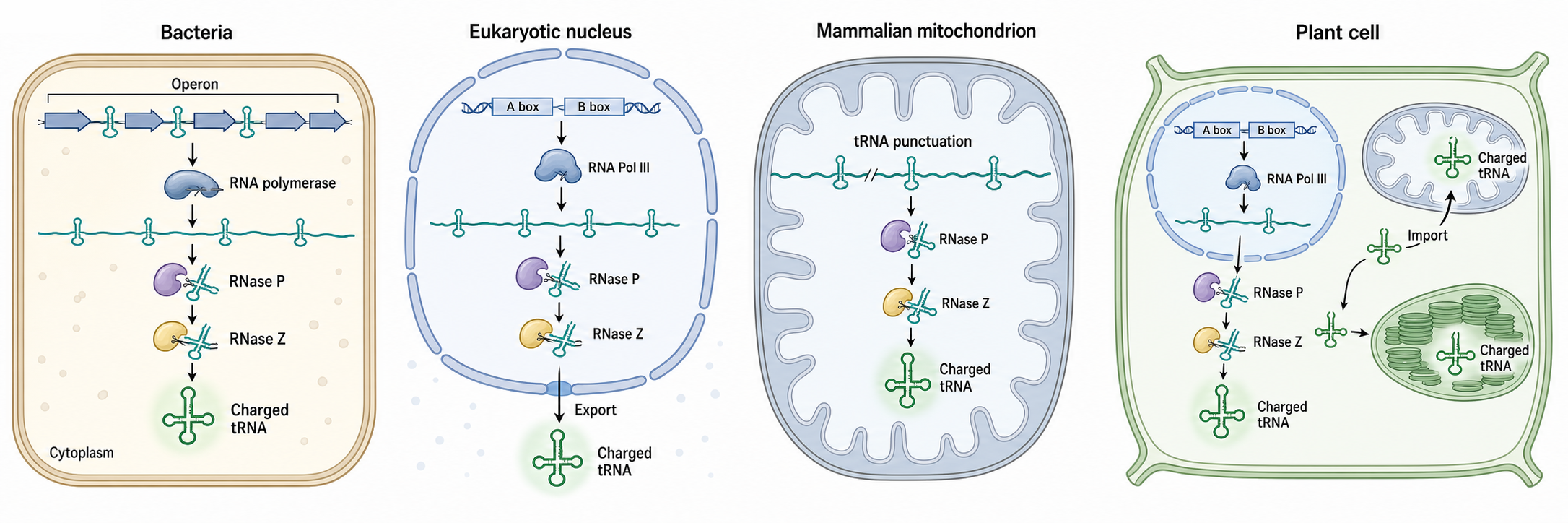
Figure 39.4. Compartment Comparison of tRNA Biogenesis. The adaptor role of tRNA is universal, but the route to a mature charged tRNA depends on domain, organelle, and gene organization. In bacteria, a single RNA polymerase transcribes tRNA genes from operons or clusters and RNase P and RNase Z process the ends in the cytoplasm. In eukaryotic nuclei, RNA polymerase III is recruited by internal A-box and B-box promoter elements, and nuclear processing, modification, and export precede cytoplasmic charging. In mammalian mitochondria, a polycistronic precursor is punctuated by tRNAs that are excised to release neighboring mRNAs and rRNAs, with charging performed by mitochondrion-specific synthetases. In plant cells, nuclear, mitochondrial, and chloroplast tRNA pools each have distinct gene complements, and some tRNAs are imported into organelles from the cytosol.
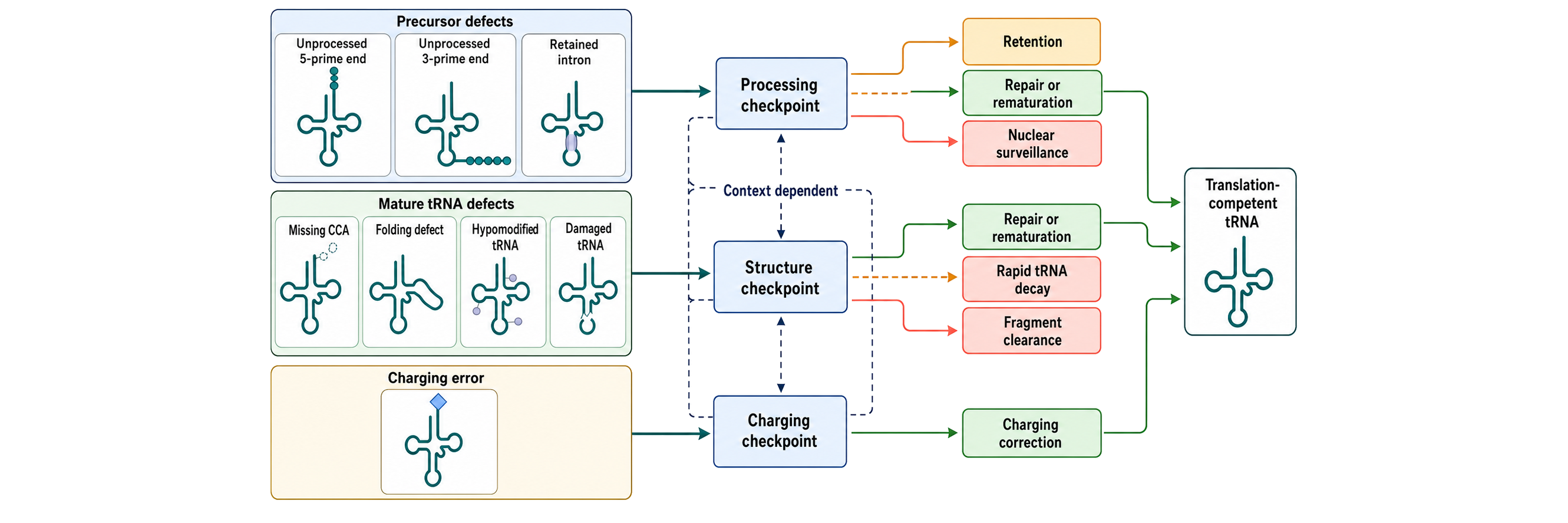
Figure 39.5. tRNA Quality-Control Decisions from Precursor Defect to Mature-tRNA Decay. The figure should classify unprocessed 5′ and 3′ ends, a retained intron, missing CCA, folding defects, hypomodification, molecular damage, and a charging error before routing them through context-dependent checkpoints. Repairable molecules can be retained and rematured, charging errors can be corrected and retried, and restored tRNAs can rejoin the translation-competent pool. Persistent precursor defects can enter nuclear surveillance, whereas unstable mature tRNAs can enter rapid tRNA decay and damaged or cleaved products can undergo fragment clearance. Uncharged sensor states should not be labeled defective by default.
Engineered systems deliberately move across these boundaries. A bacterial-derived orthogonal tRNA may be expressed in a eukaryotic system, or a suppressor tRNA may be designed for mammalian cells. These transfers work only when promoter, processing, modification, export, charging, and decoding requirements are compatible enough. This chapter owns failure before charging; Chapter 40 owns cross-reactivity and catalytic failure at charging.
Box 39.3. tRNA Fragment Interpretation Checklist
Detected tRNA-derived fragments can arise from multiple distinct processes, and detection alone does not establish function. Before interpreting a fragment as a regulatory small RNA, consider the following questions:
- Is the parent molecule a precursor tRNA or a mature tRNA? Processing intermediates should not be classified as regulatory small RNAs.
- Which nuclease generated the fragment ends, and is the end chemistry consistent with that nuclease?
- Does the fragment accumulate when general RNA decay changes, or does it persist independently of bulk decay?
- Is the fragment produced by stress-induced cleavage, which is reversible and condition-specific, or by a constitutive pathway?
- Does perturbing the fragment level by deleting the responsible nuclease or modifying the parent tRNA change a measurable biological output?
Chapter 41 provides detailed treatment of tRNA-derived fragments and stress-regulated small RNAs.
Technology, Clinical, and Engineering Links
Clinically, tRNA pathways are diagnostic and mechanistic targets. Sequencing can identify variants in tRNA genes or processing factors, but the variant’s effect must be tested at the RNA level. Does the precursor accumulate? Is the CCA end missing? Is aminoacylation reduced? Is mitochondrial translation impaired? Does the variant affect one tRNA or many? These questions matter for interpreting uncertain variants.
Therapeutically, tRNAs are being explored as information-level medicines. Suppressor tRNAs could read through premature termination codons, and engineered tRNAs could compensate for defective decoding. Delivery, processing, expression level, immune sensing, off-target suppression, and tissue distribution are tRNA-side constraints. Synthetase inhibitors and orthogonal-pair specificity are treated in Chapter 40.
For biotechnology, a tRNA is an editable interface only if it survives the host’s biogenesis pathway. Genetic-code expansion, recoded genomes, and cell-free translation each test whether the designed tRNA is produced with correct ends and identity features. Chapter 40 continues from that mature substrate to enzyme engineering and noncanonical amino-acid assignment.
Recent Consensus
Current consensus treats tRNA maturation as a coordinated pathway rather than as independent trimming reactions. Transcription, leader removal, trailer removal, intron splicing, CCA addition, modification, export, aminoacylation, and decay influence one another. The strongest version of this view is not that every step occurs in one fixed order, but that cells organize tRNA biogenesis so defective intermediates are usually prevented from entering translation (Jarrous et al. 2022).
Current consensus treats tRNA identity as a product of both sequence and maturation context. Identity elements can be redesigned, but successful transfer between organisms depends on processing, modification, localization, and compatibility with the host charging system. Comparative synthetase fidelity, enzyme engineering, and drug selectivity are synthesized in Chapter 40.
The least settled areas are pathway integration and disease specificity. Many individual enzymes are known, but the order, location, and conditional regulation of tRNA maturation steps vary across organisms and compartments. Disease mechanisms often require allele-specific analysis because the same gene class can affect processing, charging, editing, localization, or noncanonical protein functions.
Open Questions, Controversies, Deprecated Models, and Common Misconceptions
Open questions:
- What determines how cells quantitatively decide between repair and decay for damaged tRNAs? CCA repair can restore some 3′ ends, but unstable or hypomodified tRNAs may be degraded. The molecular thresholds that separate repairable from terminally defective substrates are not fully mapped for many organisms.
- How much regulated variation in aminoacylation occurs in normal physiology? Bulk tRNA abundance is easier to measure than charging state, but charging state is closer to translational capacity. Newer aminoacylation profiling studies, including plant work by Ceriotti et al., support more direct measurement, but causal links to translation outputs remain context dependent.
- How often disease-linked tRNA pathway proteins act through canonical tRNA biogenesis versus additional functions? Aminoacyl-tRNA synthetases and RNA-binding proteins can have noncanonical roles. Disease interpretation should not assume that every phenotype from a synthetase gene is simply reduced aminoacylation.
Common misconceptions:
- “The anticodon alone determines tRNA identity.” Synthetase identity can depend on the acceptor stem, discriminator base, tertiary structure, modifications, and antideterminants as much as or more than the anticodon.
- “Any detected tRNA fragment is a functional regulatory RNA.” A fragment can be a processing by-product, decay intermediate, stress cleavage product, sequencing artifact, or functional molecule. Function requires pathway and perturbation evidence.
- “A tRNA gene mutation affects only decoding.” The same variant can affect transcription factor binding, precursor processing, modification, folding, aminoacylation, stability, export, and decoding.
- “Organellar tRNA rules are bacterial rules preserved unchanged.” Organelles retain bacterial ancestry but have specialized genomes, imported factors, unusual tRNAs, and lineage-specific processing systems.