Chapter 7. Prebiotic Chemistry, Nucleotide Synthesis, and Routes to Informational Polymers
Scope Note
This chapter explains the chemical problem that must be solved before an RNA world can be discussed responsibly. Modern RNA is a polymer made from ribonucleotide building blocks. Each ribonucleotide contains a ribose sugar, a nucleobase, and phosphate, and neighboring residues are joined by phosphodiester bonds. Modern cells build and copy RNA with enzymes, energy metabolism, membranes, quality-control pathways, and regulated concentrations of substrates. Prebiotic chemistry asks a harder question: how could environments before cellular life have generated, concentrated, activated, linked, copied, and selected RNA-like molecules without the machinery that modern cells use?
The chapter follows the path from simple feedstocks to informational polymers. A feedstock is a starting material available to a proposed reaction pathway. Activation chemistry is chemistry that makes bond formation more favorable, often by creating a reactive intermediate or a good leaving group. A concentration mechanism is a physical or chemical process that raises local reactant concentration enough for productive reactions. Template-directed copying is the formation of a complementary sequence guided by a preexisting strand. Compartmentalization is localization of molecules in vesicles, pores, droplets, gels, ice channels, surface films, or other microenvironments that can preserve useful combinations. Selection is differential persistence, copying, or propagation because a molecule or compartment has a property that affects its own continuation.
The boundary with later chapters is important. Chapter 7 treats prebiotic chemistry and the transition toward copyable polymers. Chapter 8 discusses RNA world hypotheses, ribozymes, and early metabolic logic once RNA-like polymers can fold and catalyze. Chapter 10 discusses genetic-code origins, aminoacylation, tRNA adaptor logic, and the ribosome. Chapter 2 covers the chemistry of modern nucleotides and phosphodiester bonds; this chapter asks how related chemistry might have begun under prebiological conditions.
Executive Summary
RNA is attractive in origin-of-life research because a single chemical class can, in principle, combine sequence information with folding and catalysis. A strand of RNA can store information in base order, recognize another strand through base pairing, form secondary and tertiary structures, and in some cases catalyze chemical reactions. Those properties make RNA a plausible participant in early heredity. The same properties also make RNA chemically demanding. A prebiotic RNA scenario must explain how simple starting materials became ribose, nucleobases, nucleosides, nucleotides, activated building blocks, oligomers, copyable templates, compartments, and selectable systems.
The central lesson of this chapter is that prebiotic chemistry should be evaluated as a connected pathway, not as isolated reactions. A route that makes ribose but cannot protect ribose from degradation is incomplete. A route that makes a nucleobase but cannot connect that base to a sugar and phosphate is incomplete. A route that makes activated monomers but requires conditions that destroy the template is incomplete. A route that forms oligomers but cannot copy them is incomplete. A route that copies sequences but has no way to separate strands, replenish substrates, or link molecular function to propagation is incomplete.
Geochemical settings matter because the same environment can solve and create problems at the same time. Drying can concentrate solutes and drive condensation reactions, but drying can also promote unhelpful side reactions. Freezing can concentrate solutes in eutectic brine channels and reduce hydrolysis, but freezing must be connected to thawing, transport, and product release. Mineral surfaces can adsorb, orient, and sometimes catalyze molecules, but surfaces can also bind products too tightly or bias chemistry away from useful polymers. Compartments can retain molecules, but useful compartments must balance retention with exchange. The chapter therefore treats wet-dry cycles, freeze-thaw cycles, mineral surfaces, pores, films, and protocell-like compartments as condition packages, not as magic solutions.
The ribose problem illustrates why a single word can hide several requirements. Ribose is the five-carbon sugar in canonical RNA. The problem is not only whether ribose can form. The problem includes sugar selectivity, ribose stability, stereochemistry, connection to nucleobases, phosphorylation, activation, and compatibility with oligomer formation. Some proposed pathways try to stabilize or select ribose. Others bypass free ribose by building nucleotides through routes that avoid isolating ribose as a vulnerable intermediate. Still others propose that proto-RNA polymers with different sugars, bases, or backbones preceded modern RNA.
Noncanonical nucleosides and nucleotides expand the search space. A noncanonical nucleotide is a nucleotide-like building block outside the modern canonical RNA set. Early informational chemistry may have used different bases, alternative pairing systems, mixed backbones, or transitional polymers before the modern A, C, G, and U alphabet became fixed. This possibility does not weaken RNA-world thinking. It often makes the RNA-world problem more chemically realistic, because it allows modern RNA to be a later optimized outcome rather than the first polymer that ever carried information.
The transition from chemistry to heredity requires copying. Template-directed nonenzymatic ligation demonstrates that base-pairing information can guide the joining of RNA fragments without protein enzymes. Alternative base chemistry such as diaminopurine can change nonenzymatic copying behavior, supporting the idea that early copying might not have used only the modern base alphabet. Such experiments are powerful because they show mechanisms by which sequence information can influence product formation. They remain partial because open-ended evolution also requires substrate supply, strand separation, manageable errors, resource renewal, and selection.
Strict RNA-first scenarios and complementary scenarios should not be caricatured. A strict RNA-first scenario proposes that RNA-like molecules handled both information and catalysis before DNA genomes and coded proteins. Complementary scenarios propose that proto-RNA, peptides, lipids, minerals, small-molecule networks, or compartments assisted early RNA chemistry. These views can overlap because early Earth may have contained multiple interacting chemical systems.
The practical evidence standard is to grade claims by scope. A reaction can demonstrate chemical possibility. A multi-step pathway can support prebiotic plausibility if feedstocks, conditions, selectivity, and product stability are defensible. An integrated origin scenario must additionally connect chemistry to copying, variation, selection, and continuity toward biology. Polymerase ribozyme replication experiments, including recent work using trinucleotide substrates under pH-freeze-thaw cycles, are important boundary evidence because they test what selected RNA catalysts can do after catalytic RNAs exist; they do not by themselves explain how the first ribozymes arose.
Concept Inventory
- Prebiotic chemistry: chemistry proposed to have occurred before biology or before modern enzymatic metabolism. In this chapter the term is restricted to chemistry relevant to informational polymers and primitive selection. A reaction is not prebiotic merely because it is done without enzymes. The feedstocks, environment, energy source, yields, selectivity, and product survival must be argued in an early-Earth context.
- Feedstock: a starting material available to a proposed prebiotic pathway. In origin-of-life chemistry, plausible feedstocks may include small carbon compounds, nitrogen-containing molecules, phosphate minerals, sulfur species, metal ions, formaldehyde-like carbonyl compounds, cyanide-derived species, simple sugars, amphiphiles, and mineral-bound reactants. A laboratory reagent is not automatically a feedstock. For example, a modern purified activated nucleotide is a convenient experimental substrate, but a prebiotic pathway must explain how a comparable activated substrate would have formed and persisted.
- Activation chemistry: makes bond formation more favorable. Modern polymerases use nucleoside triphosphates whose high-energy phosphoanhydride bonds help drive phosphodiester formation. Prebiotic systems did not begin with regulated nucleotide triphosphate metabolism, so origin-of-life models invoke other activated intermediates, drying chemistry, cyclic phosphates, mineral effects, chemical fuels, or environmental cycles. Activation must be compatible with product stability; a reactive substrate that destroys templates or hydrolyzes too quickly may not help heredity.
- Concentration mechanism increases local reactant concentration. This: necessary because dilute molecules in open water rarely collide productively. Evaporation, freezing, adsorption on minerals, retention in pores, phase separation, vesicle encapsulation, gels, and surface films can all concentrate molecules. Concentration is not automatically beneficial. It can enrich inhibitors, salts, hydrolytic catalysts, destructive oxidants, or side-reaction partners.
- Ribose problem: the difficulty of generating, stabilizing, selecting, and incorporating ribose into ribonucleotide pathways. Ribose is chemically important because canonical RNA uses beta-D-ribofuranose. The ribose problem includes several layers: making a five-carbon sugar, favoring ribose among many sugars, preserving ribose long enough to react, selecting the right stereochemistry, connecting ribose to a nucleobase, adding phosphate, and using the product in oligomerization.
- Noncanonical nucleotide: a nucleotide-like building block outside the modern RNA set. Noncanonical candidates may contain alternative bases, sugars, linkages, or phosphate arrangements. Some noncanonical compounds are modern synthetic tools; others are candidate prebiotic intermediates. The context must be stated because the same chemical class can be used in origin-of-life models, biotechnology, or chemical biology.
- Template-directed copying: formation of a complementary polymer sequence guided by a template. A template can align monomers or oligomers through base pairing, stacking, or other recognition interactions. Nonenzymatic ligation is joining of activated fragments without protein enzymes or ribozymes. Template-directed ligation is a copying route because fragment order is constrained by the template sequence.
- Compartmentalization: physical localization in a bounded or semi-bounded space. Compartments include fatty-acid vesicles, droplets, mineral pores, cracks, gels, ice channels, surface films, and other microenvironments. A compartment is useful for origins research only if it helps maintain chemical continuity while allowing matter and energy exchange. Selection requires that useful molecular properties remain linked to the molecules or compartments that are propagated.
- Proto-RNA: a hypothesized RNA-like informational polymer that may have preceded canonical RNA. Proto-RNA proposals differ in backbone, sugar, base set, stereochemistry, and transition route. A proto-RNA model can ease some synthesis problems, but it must explain how information passed from proto-RNA chemistry into modern RNA chemistry without losing heritable function.
- Plausibility constraint: a requirement that a prebiotic scenario must satisfy to be credible. Constraints include feedstock availability, energy input, concentration, selectivity, product stability, environmental compatibility, sequence copying, strand separation, variation, and selection. Constraints can sometimes be relaxed by choosing a different environment, but they should not be ignored.
What to Know Before Reading This Chapter
The reader should know the nucleotide vocabulary from Chapter 2. A nucleobase is the base component of a nucleic acid residue, such as adenine, guanine, cytosine, or uracil in modern RNA. Ribose is the sugar in RNA. A nucleoside is a base attached to a sugar. A nucleotide is a nucleoside with phosphate. A phosphodiester bond links one nucleotide residue to the next in a polymer. In modern RNA, the standard backbone linkage joins the 3′ oxygen of one ribose to the 5′ phosphate of the next residue.
The reader should also distinguish polymerization from replication. Polymerization means joining monomers into a polymer. Replication means producing a related or complementary sequence that preserves information across copying cycles. A polymer can form without being heritable. A heritable polymer must be copied with enough fidelity, must release products or otherwise continue cycling, and must be linked to selection.
The chapter uses three running examples. First, ribose shows why origin-of-life chemistry is a pathway problem rather than a single synthesis problem. Second, template-directed ligation shows how base pairing can transfer sequence information without enzymes. Third, freeze-thaw polymerase ribozyme experiments show what selected RNA catalysts can do after ribozymes exist, while also marking a boundary between Chapter 7 chemistry and Chapter 8 RNA-world biology.
One more caution is necessary. Modern biology is not a direct replay of prebiotic chemistry. Present-day RNA polymerases, ribosomes, ATP metabolism, membranes, and repair pathways are products of long evolution. Origin-of-life research uses modern chemistry to test what is possible under defined conditions, then asks whether those conditions are compatible with early-Earth settings. The distinction between possibility and historical plausibility runs through the entire chapter.
7.1. Geochemical settings, feedstocks, activation chemistry, and concentration mechanisms
A geochemical setting is the physical and chemical environment in which a prebiotic pathway is proposed to operate. The setting is not a background decoration. It defines water activity, temperature, pH, salinity, UV exposure, redox state, mineral availability, freeze-thaw behavior, drying rate, and chemical gradients. These variables determine whether feedstocks form, whether products survive, whether reactants concentrate, and whether sequential steps can be connected.
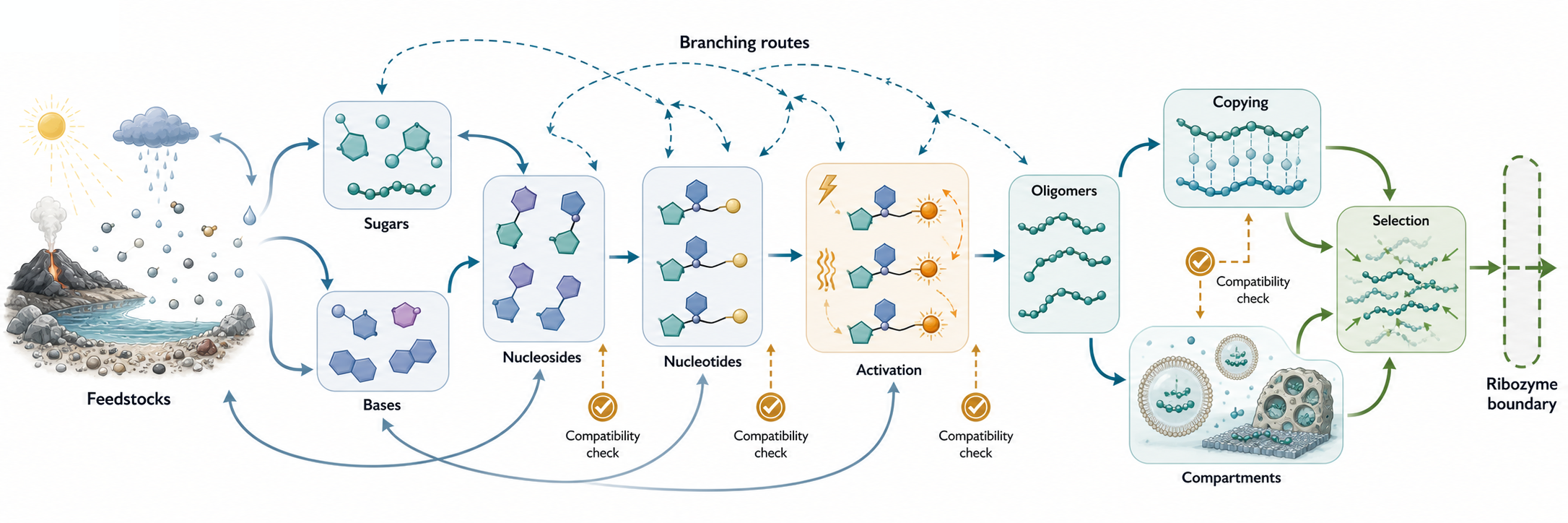
Figure 7.1. From Feedstocks to Informational Polymers. The pathway from geochemical feedstocks to RNA-like heredity requires multiple connected chemical transitions rather than a single reaction. This figure traces sugar, base, nucleoside, and nucleotide formation; activation chemistry; oligomerization; template-directed copying; compartmentalization; and selection, ending at the boundary with ribozyme-assisted replication. Branching routes and feedback loops reflect the current understanding that no single linear pathway has been experimentally established, and that each transition must be compatible with conditions that support adjacent steps.
Table 7.1. Prebiotic Chemistry Problems and Candidate Solutions. Summary of the major chemical problems on the route from simple feedstocks to selectable informational polymers, with candidate solution strategies and the main constraint remaining in each case.
| Problem | Why it matters | Candidate solution class | Main evidence type | Main unresolved issue | Related chapters |
|---|---|---|---|---|---|
| Feedstock supply | Building blocks must form, arrive, and persist in usable form | HCN-derived chemistry; carbonyl chemistry; extraterrestrial delivery | Model synthesis; meteorite analysis | Realistic mixed concentrations and compatibility | Chapter 1, Chapter 2 |
| Ribose formation | Canonical RNA requires β-D-ribofuranose; sugar-forming chemistry yields complex mixtures | Formose reaction; borate-mediated sugar selection; convergent nucleotide assembly | Organic chemistry; product characterization | Selectivity for ribose from competing sugars | Chapter 2 |
| Ribose stabilization | Ribose degrades rapidly in water and at elevated temperatures | Borate complexation; dry-state protection; metal-ion chelation | Chemical stability assays | Stabilizing conditions must be compatible with downstream steps | Chapter 2 |
| Nucleobase synthesis | RNA requires four bases with different formation routes and stabilities | HCN oligomerization for purines; cyanoacetylene chemistry for pyrimidines | Synthesis yields; product characterization | Simultaneous synthesis of full modern alphabet; cytosine deamination | Chapter 2 |
| Nucleoside formation | Glycosidic bond must link base to sugar with correct anomeric and regiochemistry | Direct glycosylation; base-on-sugar assembly; convergent intermediates | NMR and MS product characterization | Low selectivity for correct isomer in uncontrolled reactions | Chapter 2 |
| Phosphorylation | Backbone requires phosphate at defined positions; minerals often insoluble | Mineral-phosphate reactions; dry-state phosphorylation; cyclic phosphate | Regioselectivity assays | Position specificity; environmental phosphate availability | Chapter 2 |
| Activation | Phosphodiester formation in water is thermodynamically disfavored | Activated monomers; drying chemistry; cyclic phosphate intermediates; chemical fuels | Polymerization and copying assays | Activated-species stability versus template and product survival | Chapter 2, Chapter 8 |
| Phosphodiester formation | Backbone bonds must form with 3′–5′ preference for copying-compatible polymers | Wet-dry condensation; mineral-surface catalysis; activated monomer extension | Oligomerization assays; gel electrophoresis | Mixed 2′–5′ and 3′–5′ linkages; short product chains | Chapter 2, Chapter 8 |
| Copying fidelity | Errors must be low enough for sequence to persist across cycles | Base-pairing constraints; alternative base sets; chemical selection for accurate copies | Nonenzymatic extension assays; sequence analysis | Mismatch rates; sequence-context dependence | Chapter 8 |
| Strand separation | Product-template duplexes must dissociate for continued copying | Thermal cycles; pH shifts; freeze-thaw dynamics; short fragments | Ribozyme replication experiments; physical chemistry | Separation conditions that do not destroy RNA or substrates | Chapter 8 |
| Compartmentalization | Useful molecules must remain linked to local chemical history for selection | Fatty-acid vesicles; mineral pores; surface films; gels; ice channels | Model protocell experiments | Permeability balance; compositional inheritance through division | Chapter 8, Chapter 11 |
| Selection | Molecular properties must link to differential propagation | Compartment-linked selection; spatial structure; template-directed enrichment | In vitro selection analogy; dynamic combinatorial experiments | Parasite suppression; linking function to propagation without modern machinery | Chapter 8, Chapter 11 |
Table 7.2. Strict RNA-First and Complementary Scenarios. Comparison of RNA-centered origin-of-life scenarios by their main claim, chemical advantage, chemical bottleneck, evolutionary bottleneck, and current evidence status.
| Scenario | Main claim | Chemical strength | Chemical bottleneck | Evolutionary bottleneck | Evidence status |
|---|---|---|---|---|---|
| Strict RNA-first | Canonical RNA handled both information and catalysis before DNA and protein | RNA catalysis is demonstrated; base pairing enables recognition and copying | Full canonical nucleotide synthesis from prebiotic feedstocks; strand separation | Origin of first ribozyme before selection-based amplification exists | Plausible; no complete demonstrated pathway |
| Proto-RNA-first | A simpler RNA-like polymer with alternative backbone or bases preceded canonical RNA | Bypasses some ribose formation and glycosylation barriers | No copyable proto-RNA system has been fully demonstrated | Information transfer from proto-RNA to canonical RNA must be explained | Chemically motivated; transition largely unresolved |
| Mixed-polymer | Early informational polymers combined canonical and noncanonical bases, linkages, or backbones | Wider chemical accessibility; lowers barrier for any single component | Copying and selection in heterogeneous polymer mixtures | Convergence toward modern RNA sequence and linkage regularity | Supported by noncanonical nucleotide synthesis reviews |
| Peptide-assisted | Short peptides stabilize RNA, catalyze reactions, or modify compartment properties | Amino acids form under many prebiotic conditions; peptides bind RNA | RNA–peptide co-evolution without an existing genetic code | Integration of RNA and peptide functions before coded translation | Indirect; aminoacylation experiments suggest early coupling |
| Lipid-compartment-assisted | Fatty-acid vesicles or similar compartments provide selection units before modern cells | Fatty-acid vesicles grow, divide, and encapsulate RNA-like polymers | Maintaining compositional inheritance through membrane division | Coupling RNA function to compartment fitness | Model protocell experiments support mechanism in principle |
| Mineral-surface | Mineral surfaces adsorb, orient, and assist oligomerization of RNA precursors | Demonstrated for some clay minerals and nucleotide adsorption | Product release from surface; linkage specificity on surface | Transfer of surface-organized chemistry to solution-phase heredity | Laboratory evidence; geochemical plausibility varies by mineral |
| Metabolism-linked | Chemical reaction networks supply substrates and energy before or alongside genetic polymers | Plausible prebiotic chemical cycles identified in model systems | Linking non-genetic networks to sequence-specific heritable molecules | First sequence-encoding molecule emerging from a network without prior selection | Theoretical basis; limited experimental integration with RNA |
Examples of settings include evaporating ponds, wet-dry shorelines, geothermal fields, volcanic landscapes, hydrothermal systems, alkaline vents, ice-covered environments, mineral pores, clay-rich surfaces, impact-generated environments, and atmospheric or extraterrestrial delivery followed by surface chemistry. Each setting has strengths and weaknesses. Evaporating ponds can concentrate solutes and drive condensation as water activity falls. Ice can produce concentrated brine channels and slow some hydrolytic damage. Minerals can adsorb and orient molecules. Hydrothermal gradients can supply energy and redox chemistry. Pores can localize reactants. None of these settings automatically solves the origin problem.
Feedstock evaluation asks four questions. First, can the starting materials plausibly form or arrive in the setting? Second, can they persist long enough to react? Third, can they reach useful concentrations? Fourth, can they enter downstream steps without incompatible purification? For example, formaldehyde-like carbonyl chemistry may support sugar formation, but sugar mixtures can become complex and unstable. Cyanide-derived chemistry can be productive for nucleobase or nucleotide-related pathways, but concentration, pH, metal ions, UV exposure, and side products matter. Phosphate can be essential for nucleotides, but phosphate availability, solubility, and activation are difficult in many environments; cyanosulfidic and phosphorylation studies provide model routes while also showing how tightly phosphate chemistry depends on local conditions.
Activation chemistry is required because many bond-forming reactions in water are thermodynamically or kinetically disfavored. Phosphodiester formation is a good example. Joining nucleotides releases water or requires a leaving group; in bulk water the reverse reaction, hydrolysis, is often favored. Modern cells solve this by using activated triphosphates and enzymes. Prebiotic scenarios instead must invoke activated monomers, activated oligomers, drying, cyclic phosphate intermediates, mineral effects, chemical fuels, or environmental cycling.
Activation creates a compatibility problem. A strong activator may produce useful bonds but also degrade products. A dry phase may drive condensation, but the same dry phase may form heterogeneous cross-linked mixtures. A metal ion may accelerate polymerization but also catalyze cleavage. A high temperature may speed reactions but reduce product lifetime. A pH shift may help strand separation but damage activated intermediates. A credible pathway therefore must specify not only activation occurs but also when, where, and how products move into the next step.
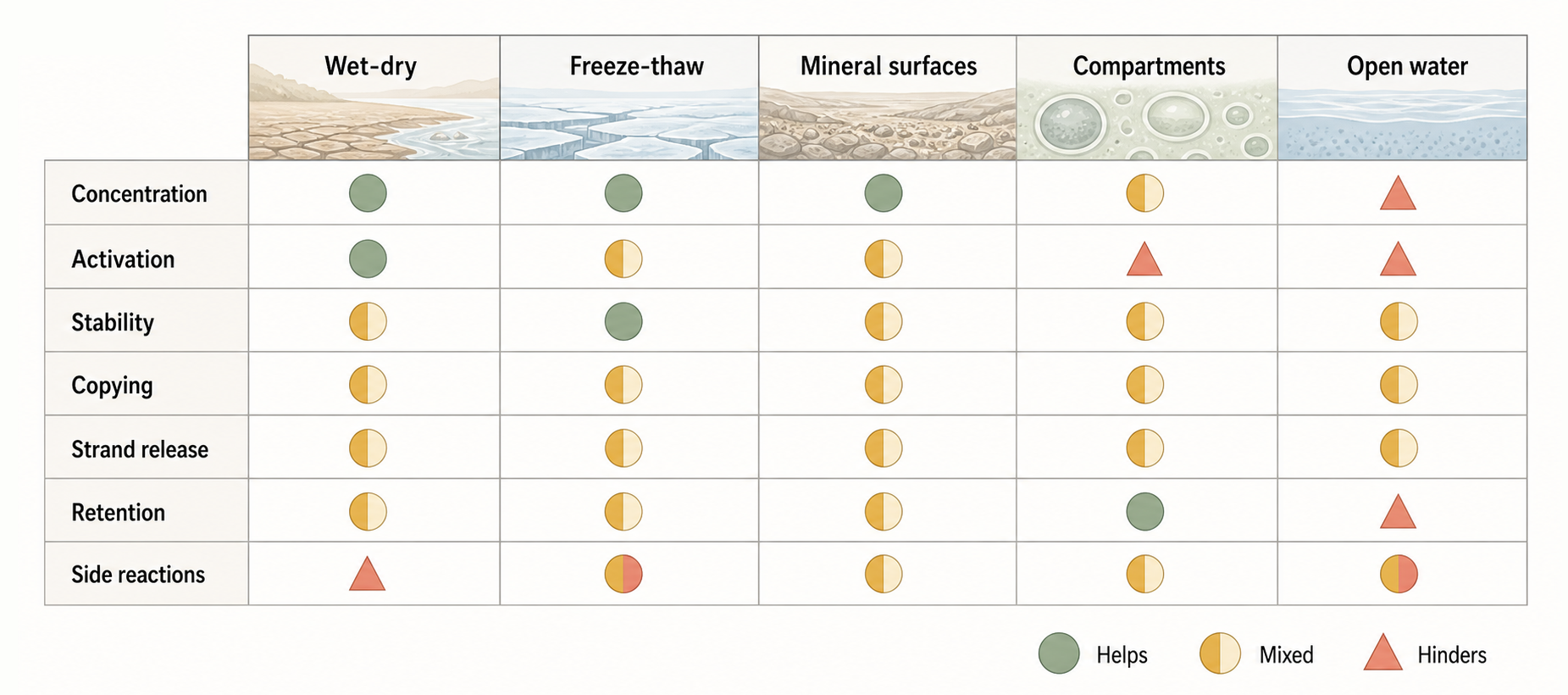
Figure 7.2. Condition Compatibility Map. Different prebiotic environments offer different advantages and disadvantages for the sequential chemistry required before RNA-like heredity can arise. This matrix compares wet-dry cycling, freeze-thaw cycling, mineral surfaces, compartments, and open aqueous settings across properties including concentration capacity, activation support, product stability, copying compatibility, strand-separation potential, compartment retention, and characteristic destructive side reactions, illustrating why a condition that helps one step can hinder the next.
Concentration mechanisms are equally important. In a dilute ocean-like setting, even useful monomers may rarely meet in productive orientations. Dry-down events concentrate solutes by removing water. Freeze-thaw cycles concentrate solutes in brine channels between ice crystals. Mineral surfaces concentrate molecules by adsorption. Pores and cracks can trap molecules while allowing fluid exchange. Compartments can retain molecules and create local histories. Repeated cycles can perform a crude sorting function because products that survive one cycle can enter the next.
The evidence basis for settings is mixed. Some claims come from laboratory simulations of drying, freezing, mineral adsorption, or model geochemistry. Some come from chemical reasoning about thermodynamics and kinetics. Some come from modern analog environments. These evidence types are useful but limited. Laboratory simulations simplify early Earth; modern environments are not ancient Earth; and model chemistry often uses purified reactants to isolate a mechanism. The strongest setting claims connect the chemistry to a plausible supply of feedstocks and a plausible next step.
One concrete example is a wet-dry cycle at a shoreline or geothermal field. During the wet phase, soluble feedstocks can mix and diffuse. During evaporation, concentrations rise and condensation reactions may become more favorable. During rehydration, products can redistribute, some side products can be removed, and a new cycle begins. This setting is attractive for polymer formation, but it must also address degradation during heat, salt accumulation, product heterogeneity, and whether copied strands or compartments survive repeated cycles.
A freezing setting illustrates a different tradeoff. When water freezes, solutes can become concentrated in microscopic liquid channels. Lower temperature can slow hydrolysis, and freeze-thaw cycles can combine concentration with periodic release. Recent polymerase ribozyme work uses pH-freeze-thaw cycles as part of an experimental replication system. That result does not prove that early Earth used the same system, but it shows how environmental cycling can reshape the copying problem.
Caution
Do not overgeneralize: a favorable setting for one reaction may be unfavorable for the next. Prebiotic pathways should be evaluated for condition compatibility across multiple steps, not for isolated success under hand-picked conditions.
7.2. Ribose, nucleobase, nucleotide, and phosphodiester formation routes
The route from simple chemistry to RNA building blocks can be divided into four related problems: making sugars, making bases, connecting bases to sugars, and adding phosphate in a form that can support polymerization. These steps are often presented as if they occur in a neat sequence. In reality, many proposed routes are convergent or bypass free intermediates. That distinction matters because some isolated intermediates, including ribose, are unstable or hard to select from mixtures.
Ribose is a five-carbon aldose sugar. In canonical RNA, ribose appears mainly as beta-D-ribofuranose in the nucleotide residue. The word ribose in prebiotic chemistry should not be treated as a solved object. Sugar-forming chemistry can produce complex mixtures. Ribose can degrade or react further. The desired stereochemistry is only one part of a larger chemical space. Reviews of ribose-to-RNA pathways emphasize that ribose formation, ribose stabilization, sugar selection, nucleoside formation, phosphorylation, and polymerization are connected problems.
The formose reaction is often discussed because it can generate sugars from formaldehyde-derived chemistry. Its appeal is that it starts from simple carbonyl chemistry. Its problem is that it can produce a complex mixture rather than clean ribose. Stabilizing agents, mineral interactions, borate chemistry, selective crystallization, and environmental cycling have been proposed to bias or protect ribose. Such proposals are useful, but they must also connect to nucleobase and phosphate chemistry. A stabilized ribose pool becomes an RNA precursor pool only when the adjacent base, phosphate, activation, and oligomerization steps are chemically compatible.
Nucleobase formation poses a different selectivity problem. Modern RNA uses purines, adenine and guanine, and pyrimidines, cytosine and uracil. These bases do not have identical formation routes or stability profiles. A scenario that makes adenine does not automatically make cytosine. Cytosine can deaminate to uracil. Purines and pyrimidines may require different precursor sets or conditions. The early alphabet may therefore have differed from the modern one, or different base classes may have entered the system through different routes before later chemical or biological standardization.
Nucleoside formation means attaching a nucleobase to a sugar through a glycosidic bond. Modern enzymes control the base, sugar form, anomeric configuration, and regioselectivity. In uncontrolled mixtures, several wrong connections can compete with the desired product. A prebiotic pathway must therefore explain how the correct or at least copyable nucleoside-like products become enriched. Some routes try to attach preformed bases to sugars. Others build the base on a sugar-containing scaffold or assemble nucleotide-like products through convergent intermediates. The second strategy can bypass the need for high-yield free ribose plus free base coupling.
Nucleotide formation adds phosphate. Phosphate gives nucleotides their backbone chemistry, charge, and activation possibilities. But phosphate chemistry is not trivial. Phosphate minerals can be insoluble, and phosphorylation must compete with hydrolysis and side reactions. A nucleotide useful for RNA formation must not only contain phosphate; the phosphate must be in a position and activation state that permits phosphodiester formation or later activation.
Phosphodiester formation links nucleotide residues into an oligomer. Modern RNA has mostly 3′ to 5′ linkages, but prebiotic products may include 2′ to 5′ linkages, cyclic intermediates, short oligomers, branch points, or mixed polymers. Mixed linkage chemistry is often viewed as a problem because modern RNA structure and enzyme recognition depend on backbone regularity. However, a mixture may also be a starting pool for chemical selection. If certain linkages copy, fold, or persist better, later cycles could enrich them. Prebiotic phosphorylation, aqueous self-assembly, and template-directed ligation studies therefore support the possibility of local bond formation while keeping linkage regularity and downstream copying as explicit constraints.
Noncanonical nucleosides and nucleotides are important because they challenge the assumption that the modern alphabet had to appear first. A noncanonical base might be easier to synthesize, pair more strongly, avoid a particular side reaction, or support copying under conditions where canonical bases fail. A noncanonical sugar or backbone might be more accessible or stable. A major review of prebiotic noncanonical nucleosides and nucleotides treats these compounds as plausible alternatives or complements to canonical RNA chemistry.
The key boundary case is transition. A proto-RNA system can be chemically attractive, but it must provide a route to canonical RNA or explain why canonical RNA later replaced it. If an alternative polymer carries information but cannot template RNA, cannot coexist with RNA, or cannot transfer function into RNA sequence space, it solves one problem by creating another. If an alternative polymer can template or be templated by RNA, or if mixed polymers bridge the two chemistries, the transition becomes more plausible.
The evidence basis in this subsection is largely chemical. Product identity can be tested by chromatography, mass spectrometry, nuclear magnetic resonance spectroscopy, isotopic labeling, and comparison to standards. Yield and selectivity can be measured. Stability can be tested under defined conditions. These methods can establish that a pathway works in the flask. They cannot by themselves establish that the same pathway dominated on early Earth. The historical claim requires environmental and compatibility arguments.
Caution
Do not overgeneralize: nucleotide synthesis is not one problem. It includes carbon source, nitrogen source, sugar chemistry, base chemistry, glycosidic connectivity, phosphate chemistry, activation, stereochemistry, purification or selection, and compatibility with oligomerization.
7.3. Template copying, ligation, compartmentalization, and selection
Informational polymers become biologically interesting when sequence affects copying or persistence. A random polymer that forms once and disappears is chemistry. A polymer that can bias formation of related polymers has the beginning of heredity. Template-directed copying is therefore the conceptual bridge from prebiotic synthesis to evolution.
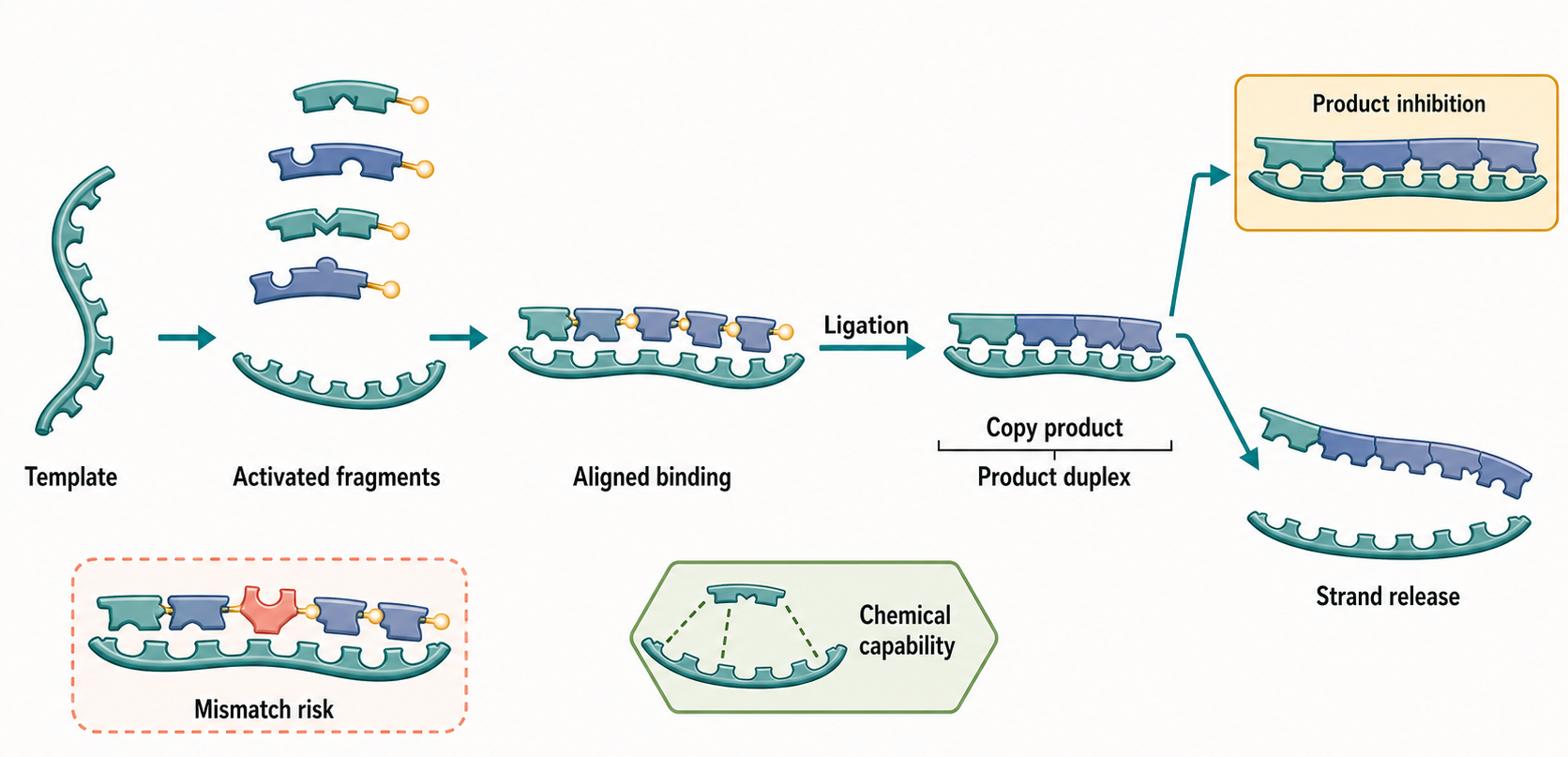
Figure 7.3. Template-Directed Copying by Fragment Ligation. Template-directed ligation is a route by which base-pairing transfers sequence information without protein enzymes. A template strand aligns short activated RNA fragments in complementary register; chemical joining of adjacent fragments generates a product whose sequence reflects the template. The figure marks two key bottlenecks: product inhibition when the template-product duplex is too stable to release the copied strand, and mismatch risk when incorrectly bound fragments are ligated, illustrating that template-directed ligation demonstrates a chemical capability rather than a complete replication cycle.
In template-directed copying, a strand presents an ordered sequence of recognition sites. Complementary monomers or short oligomers bind along the template. If the bound building blocks become joined, the product sequence reflects the template sequence. Modern nucleic acid copying uses polymerases, but base pairing itself provides a primitive alignment mechanism. A template does not have to be long to matter. Even short sequences can enrich complementary products compared with untargeted chemistry.
Nonenzymatic monomer-by-monomer extension is one possible copying route, but it faces obstacles. Activated monomers must bind the template, react at the growing end, avoid mismatches, and continue through multiple positions. The growing product can remain bound to the template, causing product inhibition. Secondary structures in the template can block access. Divalent metal ions can help some reactions but damage RNA. The reaction must be fast enough to compete with hydrolysis and side reactions.
Nonenzymatic ligation offers a complementary route. Instead of adding one monomer at a time, short activated fragments bind next to one another on a template and are chemically joined. Template-directed copying by nonenzymatic ligation demonstrates that base-pairing information can guide RNA copying chemistry without protein enzymes. The template increases effective local concentration and correct alignment of fragments. Ligation can therefore use sequence information even when monomer extension is inefficient.
This ligation result should be interpreted carefully. It is strong evidence for a chemical capability: a template can direct joining of RNA fragments. It is not a complete replication cycle. A complete cycle would require generation of fragments, activation, binding, ligation, product release, repeated copying, variation, and selection. It would also require management of mismatches and parasitic fragments. The experiment defines a route around one bottleneck; it does not remove all bottlenecks.
Base chemistry can change copying. Diaminopurine, a noncanonical purine-like base, can form a different hydrogen-bonding pattern than adenine in some contexts. Work on diaminopurine in nonenzymatic RNA template copying shows that alternative bases can alter copying behavior. This supports the broader possibility that early informational polymers used a different alphabet because copying efficiency, fidelity, or stability may have favored bases other than the modern set. The transition problem remains: any alternative base set must connect to later canonical RNA.
Dynamic combinatorial chemistry provides another lens. In a chemically fueled dynamic library, components can exchange and be selected by templates or environmental conditions. Template-based copying in such systems illustrates how a template can bias the composition of a reactive mixture. This work is not the same as RNA replication, but it helps clarify a general principle: when molecules can form and break reversibly or under fuel control, templates and selection pressures can reshape the population.
Strand separation is a major bottleneck. Base pairing that helps copying also holds template and product together. Modern cells solve this with helicases, polymerase dynamics, thermal control, topological management, and strand-displacement pathways. A prebiotic system might use heat cycles, pH shifts, short fragments, weak base pairs, compartment dynamics, mineral surfaces, or freeze-thaw cycles. Every proposed solution affects fidelity and stability. Weak interactions help separation but can reduce accurate copying. Strong interactions improve templating but increase product inhibition.
Compartmentalization makes copying evolvable by linking benefit to propagation. Suppose a rare RNA sequence helps make activated substrates. If the products diffuse away and help unrelated sequences equally, the helpful sequence has no selective advantage. If the sequence and products remain in the same vesicle, pore, gel, droplet, or surface region, the benefit can remain local. Selection can then act on the compartment or localized molecular population.
Compartments must satisfy a balance. If a compartment is too leaky, useful molecules and products diffuse away. If a compartment is too closed, feedstocks cannot enter and waste cannot leave. If a compartment grows and divides without preserving composition, useful sequences may be diluted. If compartments fuse too readily, selection can be blurred. Early compartments need not resemble modern cell membranes, but they must create enough individuality for differential persistence.
Selection requires variation. Variation can arise from copying errors, mixed oligomer pools, different lengths, different linkages, noncanonical bases, environmental exposure, or compartment composition. Differential persistence can arise because one molecule copies better, folds more stably, catalyzes a useful reaction, binds a protective mineral surface, resists hydrolysis, or improves compartment growth. Differential propagation can operate on molecules, networks, or compartments. The key is linkage between property and continuation.
Modern in vitro selection and SELEX provide a useful analogy, not a direct prebiotic model. SELEX, or systematic evolution of ligands by exponential enrichment, enriches nucleic acid sequences that bind a target or perform a function through cycles of selection and amplification. Experimental RNA evolution similarly shows that selection can discover functional RNA sequences from large populations. But modern selection experiments use designed libraries, purified reagents, controlled targets, and enzymatic amplification. The analogy teaches the logic of selection; it should not be cited as evidence that the same process happened prebiotically.
Caution
Do not overgeneralize: templating, ligation, and selection are separable ideas. A template can guide chemistry without producing an evolving system. A compartment can concentrate molecules without supporting inheritance. Selection requires that useful properties remain linked to the molecules or compartments that propagate.
7.4. Alternatives and complements to strict RNA-first scenarios
A strict RNA-first scenario proposes that RNA or a very close RNA-like polymer handled both genetic information and catalysis before DNA genomes and coded proteins. The idea is powerful because modern biology contains catalytic RNA, RNA-guided recognition, RNA-containing cofactors, ribosomal RNA at the catalytic center of translation, and many RNA-based regulatory systems. Yet strict RNA-first scenarios face demanding chemistry. They must explain formation of canonical nucleotides, activation, polymerization, replication, strand separation, compartmental selection, and eventual transition to protein-assisted biology.
Complementary scenarios relax one or more assumptions. A proto-RNA-first scenario proposes that an RNA-like polymer preceded canonical ribose-phosphate RNA. A mixed-polymer scenario allows noncanonical bases, mixed linkages, or mixed backbones. A peptide-assisted scenario allows amino acids or short peptides to stabilize RNA, catalyze reactions, or alter compartments. A lipid-assisted scenario treats compartments as early selection units. A mineral-surface scenario emphasizes adsorption, orientation, and catalysis on geological materials. A metabolism-linked scenario emphasizes reaction networks and energy flow before or alongside genetic polymers.
These scenarios are not automatically mutually exclusive. Early Earth may have contained many local chemical environments. A shoreline system could concentrate nucleotides by drying, a mineral surface could organize oligomers, a compartment could preserve a useful mixture, and short peptides could stabilize a fold. The relevant question is not which label wins. The relevant question is whether the proposed components are chemically compatible and whether they create a path toward heritable, selectable polymers.
Proto-RNA models are attractive because canonical RNA is difficult to make directly. A proto-RNA backbone might be easier to assemble, more stable, or better suited to early copying. Some alternative bases might pair more strongly or with different fidelity. Some alternative sugars might avoid parts of the ribose problem. The cost is the transition requirement. A proto-RNA world must explain how canonical RNA inherited sequence information, catalytic functions, or selective advantages from the earlier system. Without a bridge, proto-RNA becomes a separate chemistry rather than an ancestor of RNA.
Peptide-assisted models address another weakness of strict RNA-first thinking. Amino acids and short peptides can be chemically simpler in some settings than long, precise RNA polymers. Peptides can bind phosphate, metal ions, nucleobases, and RNA surfaces. They can influence folding, aggregation, and compartment properties. RNA can also interact with amino acids and aminoacylated intermediates. Triplet-encoded prebiotic RNA aminoacylation is a boundary example because it connects RNA sequence patterns to amino-acid attachment chemistry, a theme that Chapter 10 will develop in the context of tRNA adaptor logic.
Lipid and compartment models emphasize individuality before modern cells. Fatty-acid vesicles, surface films, droplets, pores, gels, or ice channels could preserve local molecular histories. A compartment that grows faster because it contains a useful polymer could be selected even before modern genomes. However, compartment models must avoid a common shortcut. A vesicle or droplet is not enough. It must allow feedstock entry, retain useful molecules, permit copying or propagation, divide or recur, and limit parasites.
Mineral-surface models emphasize concentration and catalysis. Minerals can adsorb organic molecules, protect them from dilution, orient them for reaction, and provide metal ions or reactive surfaces. They can also trap products, catalyze degradation, or favor unhelpful reactions. Mineral scenarios therefore require direct evidence for both productive chemistry and product release or transfer into later steps; mineral-surface origin models are strongest when adsorption, reaction, release, and transfer into a copying or compartment context are all specified.
Metabolism-linked models emphasize energy flow and network chemistry. A purely genetic polymer cannot evolve if there is no supply of activated substrates or no way to regenerate useful intermediates. Network chemistry can provide precursors, redox chemistry, or activation. But network-first scenarios must explain how chemical cycles become linked to heritable information. If a network has no memory and no selective linkage, it may produce molecules without Darwinian evolution.
Noncanonical nucleotide chemistry can bridge these views. Alternative bases or backbones may make synthesis easier, copying more robust, or compartments more selective. They can be treated as proto-RNA candidates, mixed-polymer components, or transition intermediates. The review literature on prebiotic noncanonical nucleosides and nucleotides supports the seriousness of this possibility. The strongest version of the idea does not say anything could have worked. It asks which noncanonical systems are chemically accessible, copyable, selectable, and able to transition toward modern RNA.
Caution
Do not overgeneralize: RNA-first does not mean fully modern RNA appeared alone in a pure solution. Many RNA-centered models allow precursor polymers, noncanonical bases, peptides, lipids, minerals, and environmental cycles.
Box 7.1. Common Overclaims in Prebiotic RNA Chemistry
- A single successful synthesis demonstrates chemical possibility under defined conditions, not a complete origin scenario; a credible pathway requires connected steps with compatible feedstocks, environments, and product stability.
- Modern laboratory reagents are not automatically prebiotic; feedstocks, concentrations, purification steps, and energy sources must be argued in an early-Earth context.
- RNA-first does not require that fully modern canonical RNA appeared at the first step; proto-RNA, noncanonical bases, and mixed polymers are compatible with RNA-centered origin models.
- Noncanonical nucleotides can support RNA-world thinking by providing more chemically accessible precursors or bridging chemistries rather than undermining it.
- A compartment must support inheritance or selection, not only concentration; retaining products without linking them to propagation does not by itself create Darwinian evolution.
7.5. Experimental support, plausibility constraints, and open problems
Origin-of-life experiments are often misunderstood because they answer different questions at different levels. The first level is chemical possibility: can a reaction occur under defined conditions? The second level is pathway plausibility: can a sequence of reactions occur with defensible feedstocks, environments, selectivity, and product stability? The third level is system plausibility: can the pathway connect to copying, variation, selection, compartmentalization, and continuity toward biological chemistry? A result at the first level can be valuable even if it does not reach the third level.
Product characterization is essential. A claimed prebiotic reaction should state substrates, conditions, time, temperature, pH, salts, minerals, light exposure, yield, product identity, side products, and analytical method. Chromatography can separate products; mass spectrometry can identify masses and fragmentation patterns; nuclear magnetic resonance spectroscopy can establish structures; isotopic labeling can trace atoms; gel electrophoresis can show oligomer length distributions; sequencing-like methods can report copying products in modern assays. Each method has limits. A mass peak is not always a unique structure. A gel band is not always a defined sequence. A yield measured from purified substrates may not apply to a messy feedstock mixture.
Prebiotic relevance also depends on reagent discipline. If a reaction requires a purified reagent that itself has no plausible formation route, the reaction may still be mechanistically informative but should not be overstated. If a reaction requires sequential purification after each step, the pathway must explain what natural process performs the purification. If a reaction works only at a concentration far above plausible environmental levels, the model must supply a concentration mechanism. If a reaction works only in one pH but the next step requires an incompatible pH, cycling or spatial separation must be justified.
Ribozyme replication experiments illustrate both the power and the boundary of laboratory evolution. Polymerase ribozymes are RNA catalysts selected to extend or copy RNA. Recent work using trinucleotide substrates under pH-freeze-thaw cycles enabled open-ended exponential RNA replication by a polymerase ribozyme. This is important because it shows how selected RNA catalysts can exploit environmental cycling and oligomer substrates. It also shows that copying constraints can change when substrate format and physical cycles change. But this experiment starts after a sophisticated ribozyme exists. It does not explain how the first ribozyme arose from prebiotic chemistry.
RNA-catalyzed nucleotide synthesis is another boundary result. Selected RNA molecules can catalyze chemistry related to nucleotide formation. Such results matter for RNA-world plausibility because they show that RNA sequence space contains catalytic solutions relevant to its own chemistry. They do not prove that such catalysts arose before life. They belong at the interface between Chapter 7 and Chapter 8: Chapter 7 asks how building blocks and copyable polymers arose; Chapter 8 asks what ribozymes could do once selectable RNA populations existed.
The major unresolved constraints remain severe. Phosphate availability and activation are not solved in every environment. Homochirality is difficult because RNA copying generally works best when building blocks share the same handedness; mixtures of enantiomers can interfere with polymerization and folding. Ribose stability and sugar selectivity remain difficult. Linkage regioselectivity remains difficult. Activated monomer supply must be continuous or recurrent. Template copying must manage mismatches, product inhibition, secondary structure, and strand separation. Compartmental systems must allow both retention and exchange. Selection must avoid collapse by parasites or diffusion of benefits.
Open problems should not be treated as simple gaps waiting for one missing reaction. They are coupled. For example, a solution to strand separation that uses high heat may worsen ribose degradation. A solution to ribose stabilization that requires borate-rich chemistry may not coexist with another step. A solution to product retention in compartments may block feedstock entry. A solution to fast copying may increase mismatch rates. The field advances when experiments expose these couplings rather than hiding them.
One helpful way to read the literature is to assign evidence labels. Established observation: a reaction or copying behavior occurred under stated laboratory conditions. Plausible pathway support: the reaction uses defensible feedstocks and connects to adjacent steps with manageable compatibility problems. Integrated scenario support: the pathway connects building-block formation, activation, oligomerization, copying, compartmentalization, and selection. Speculative extrapolation: the result suggests a possibility while environmental fit or downstream connection remains untested. This evidence discipline prevents both premature dismissal and premature certainty.
Caution
Do not overgeneralize: uncertainty about a complete origin route is not evidence against RNA chemistry, and a successful model reaction is not evidence for a complete origin route. The scientific task is to map which constraints have been experimentally reduced, which remain open, and which proposed connections are incompatible.
Box 7.2. Plausibility Checklist for a Prebiotic Pathway
- Feedstocks: are the starting materials plausibly available and persistent in the proposed geochemical environment?
- Energy or activation: is there a credible source of activation energy or activated intermediates compatible with the setting?
- Concentration: can reactants reach productive concentrations without also enriching toxic, hydrolytic, or inhibitory species?
- Selectivity: does the chemistry favor the relevant products over a large competing mixture?
- Product stability: do products survive long enough under the same conditions to enter the next reaction step?
- Compatibility with adjacent steps: are the conditions required for each step mutually compatible across the full reaction sequence?
- Copying or propagation: can the polymer be replicated or otherwise propagated with sufficient fidelity to preserve sequence information?
- Variation and selection: can the system generate heritable variation that is subject to differential propagation linked to molecular or compartment properties?
Biological Contexts Across Deep Time
Chapter 7 is not a chapter about modern organisms, but modern biology motivates the chemical questions. Modern cells use ribonucleotides in RNA, energy metabolism, cofactors, signaling, and enzyme reactions. The ribosome uses RNA at the peptidyl transferase center. Many ribozymes catalyze phosphodiester chemistry. RNA molecules guide recognition in systems as different as translation, splicing, RNA interference, CRISPR immunity, and telomerase. These facts do not prove a specific prebiotic route, but they explain why RNA remains central to origin-of-life models.
The most important deep-time biological context is the transition from chemistry to evolvability. Chemical systems can produce complex mixtures without heredity. Biological evolution requires entities whose properties influence their own propagation. RNA-like polymers are attractive because sequence can influence folding and copying. A sequence that folds into a structure that improves its own copying or retention can, in principle, become enriched. That linkage between sequence, function, and propagation is the conceptual bridge from Chapter 7 to Chapter 8.
Modern examples should be used as analogies with care. RNA viruses show that RNA genomes can evolve rapidly, but RNA viruses depend on protein polymerases and host cells. Ribozymes show that RNA can catalyze reactions, but modern ribozymes evolved in biological contexts. SELEX shows that selection can enrich functional nucleic acids, but SELEX uses designed laboratory cycles. Modern protocell experiments show that compartments can grow, divide, and exchange materials, but model protocells are not fossils. These systems teach principles; they do not directly reconstruct early Earth.
Comparative biology becomes more relevant in Chapters 8 to 12. Ribozymes, ribosomal RNA, tRNA, cofactors, RNA-binding proteins, and conserved RNA families can provide clues about ancient molecular biology. Chapter 7 supplies the chemical foundation needed to interpret those clues without assuming that modern RNA appeared fully formed.
Technology, Computational, and Engineering Links
Prebiotic RNA chemistry has practical links to modern technology because origin-of-life experiments force chemists to understand RNA synthesis, activation, copying, and degradation under nonstandard conditions. Chemical synthesis of RNA, enzymatic RNA production, nucleotide analog design, and nonenzymatic copying studies all benefit from precise knowledge of leaving groups, metal ions, pH, protecting effects, and side reactions. Some modern RNA therapeutics and probes use modified nucleosides or nucleotides, although therapeutic optimization is a different goal from prebiotic plausibility.
Computational modeling helps because prebiotic pathways are multi-constraint problems. Reaction-network models can track possible intermediates and side products. Geochemical models can estimate concentration, pH, temperature, mineral availability, or wet-dry cycling. Kinetic models can compare formation and degradation rates. Population models can test whether copying fidelity, compartment size, mutation, resource flow, and selection could sustain heredity. These models are useful only when their assumptions are explicit and connected to real chemistry.
Machine learning and automated reaction exploration may help identify candidate pathways, but prediction is not evidence by itself. A proposed reaction network still needs experimental product characterization and environmental justification. Computational work is strongest when it narrows hypotheses, identifies incompatibilities, or predicts measurable outcomes for laboratory tests.
Engineering also benefits from prebiotic logic. Nonenzymatic ligation and template-directed assembly can inspire programmable materials and molecular computation. Dynamic combinatorial libraries can model selection-like enrichment. Ribozyme replication studies can inform synthetic minimal replicator design. These applications should not be confused with historical claims; they are modern uses of origin-inspired chemistry.
Recent Consensus
- RNA remains a leading candidate for early informational chemistry because sequence storage, base-pair recognition, folding, and catalysis can occur in one molecular class.
- No complete experimentally established pathway connects simple geochemistry to RNA-based life.
- Prebiotic plausibility requires connected evaluation of feedstocks, concentration, activation, selectivity, product stability, copying, strand separation, compartments, and selection.
- The ribose problem includes synthesis, stability, selectivity, stereochemistry, nucleoside formation, phosphorylation, and oligomer compatibility.
- Noncanonical nucleosides, noncanonical nucleotides, and proto-RNA polymers are serious complements to strict canonical RNA-first scenarios.
- Template-directed nonenzymatic ligation and alternative-base copying studies demonstrate important chemical capabilities, but they remain partial models rather than complete replication cycles.
- Environmental cycles such as wet-dry or freeze-thaw cycles can help by coupling concentration, activation, strand dynamics, and selection, but each cycle must be tested for compatibility with adjacent chemistry.
- Ribozyme replication experiments test what selected RNA catalysts can do after ribozymes exist; they do not replace prebiotic synthesis and first-ribozyme origin questions.
Open Questions, Controversies, Deprecated Models, and Common Misconceptions
Open questions:
- Which early-Earth settings could connect feedstock generation, nucleotide formation, oligomerization, copying, compartmentalization, and selection without incompatible conditions?
- Did canonical RNA arise directly, or did proto-RNA, noncanonical bases, mixed backbones, or other informational polymers precede it?
- How were ribose, phosphate, and nucleobase chemistry coupled without modern enzymes or purification?
- How did early systems achieve enough homochirality and linkage regularity for copying and folding?
- What mechanisms separated copied strands without destroying templates or activated substrates?
- How did compartments retain useful molecules while allowing feedstock exchange and growth?
- How did early systems suppress parasites, dead-end products, and side reactions?
- Which modern RNA features are ancient retentions, and which are later biological innovations?
- Should be handled cautiously. Older narratives sometimes treated prebiotic chemistry as a linear march from simple molecules to modern RNA. Current work favors conditional, branching pathways with environmental cycling, alternative intermediates, and explicit compatibility constraints. The older linear narrative is pedagogically simple but chemically misleading.
Common misconceptions:
- “RNA-first means modern RNA appeared fully formed.” RNA-centered models can include precursor polymers, noncanonical bases, mixed chemistries, and gradual transitions.
- “One successful synthesis proves an origin scenario.” A reaction demonstrates possibility under defined conditions; an origin scenario requires compatible feedstocks, environments, downstream steps, and selection.
- “Noncanonical nucleotides argue against RNA-world thinking.” Noncanonical chemistry may explain how RNA-like heredity began before modern RNA chemistry became fixed.
- “Concentration solves prebiotic chemistry by itself.” Concentration can also enrich inhibitors, salts, and destructive side reactions.
- “Compartments must be modern lipid membranes.” Early compartments may have included vesicles, pores, gels, droplets, ice channels, mineral surfaces, or recurring microenvironments.
- “Ribozyme replication experiments explain the first RNA.” They test capabilities of selected RNA catalysts after catalytic RNAs exist.